INTRODUCTION
More than 50% of the radiotherapy in the UK is offered for patients treated with palliative intent.Reference Hoskin and Makin1 This patient group presents radiotherapy departments with specific considerations beyond those being treated, with the presence and prevalence of multi-symptomology and severe morbidity potentially impacting on the patient pathway and treatment episodes.Reference Potter, Hami, Bryan and Quigley2 Such symptomology extends beyond the purely physical, such as immobility or dyspnoea, and may also encompass psychological and social aspects, including anxiety, low mood and social isolation. These may present as a need to speak with staff on matters not necessarily pertaining to treatment, but which need to addressed as part of a holistic approach to provide a complete package of treatment, beyond the pure delivery of radiation therapy.
The difficulties in measuring and quantifying radiotherapeutic productivity and throughput have resulted in a number of studies aimed at considering patient-related, treatment and equipment factors,Reference Delaney, Shafiq, Jalaludin and Barton3–Reference Burnet, Routsis and Murrell6 and at refining the common scheduling unit of treatment time of 10 minutes.Reference Barbera, Jackson and Schulze4,Reference Burnet, Routsis and Murrell6 Such studies have resulted in formula models with dominance necessarily given to those factors that are most predictable and easily quantified, that is, number of fields, use of multi-leaf collimation, equipment, films/images taken, first fraction and site/technique.Reference Delaney, Shafiq, Jalaludin and Barton3,Reference Burnet, Routsis and Murrell6 Patient-related factors and symptoms have ultimately not been included, although were initially assessed for significance in terms of anaesthesia or mobility.Reference Delaney, Shafiq, Jalaludin and Barton3 While recognising the inherent difficulties in quantifying the impact of patient symptomology as a variable, this study seeks to consider whether these factors adversely impact on treatment times and scheduling.
Orthovoltage treatments have been included in one Basic Treatment Equivalent (BTE) modelling exercise,Reference Delaney, Gebski and Lunn7 but their usage is otherwise excluded, with no study considering orthovoltage alone. However they offer a unique and appropriate treatment option for a number of palliative scenarios including bone metastases from primary disease of the breast or prostate, cranial irradiation for brain metastases, drain sites, and locally advanced and fungating breast disease. The appropriateness of orthovoltage is limited by the superficiality of depth of treatment, the preferential uptake in denser structures of bone and cartilage, and higher surface radiation dose.Reference Hoskin and Makin1,Reference Cooke, Cherry and Duxbury8 Conversely, orthovoltage has the advantage of simplicity in operation and technique, a limited number of fractionated treatments and minimal trauma to patients in terms of equipment and immobilisation, and is therefore highly appropriate for the needs of multi-symptomatic palliative patients.
Delaney et al.Reference Delaney, Gebski and Lunn7 noted that orthovoltage treatments required specific BTE values and took ∼1.5 times longer than the basic model; however, this was within the context of the main data set provided by megavoltage linear accelerators. Similarly treatment with palliative intent and/or performance status has been a factor in BTE models,Reference Griffiths, Delaney and Jalaludin5–,Reference Delaney, Gebski and Lunn7,Reference Delaney, Gebski and Lunn9 but not considered as the main criteria, or not given a status representative of the proportion of radiotherapy offered with palliative intent in the United Kingdom.
Consequently the current study was designed to consider a therapeutic scenario of those elements that have been either excluded from, or relegated within, previous considerations of radiotherapeutic productivity: orthovoltage treatments, palliative patients and the potential influence of patient-related factors and symptomology on treatment times.
MATERIALS AND METHODS
Two departmental sites were chosen for the pilot study; Addenbrookes Oncology Centre, where an orthovoltage treatment unit forms part of the radiotherapy department, including 7 megavoltage linear accelerators. The availability of electron modality provides alternative treatment routes for some tumour sites, which could also be treated on an orthovoltage unit, and it was acknowledged that this may influence the number and range of tumour sites that could be sampled by the study. The radiotherapy department at Peterborough District Hospital was also selected, which is unique in being comprised of a sole orthovoltage unit.
The sampling criterion was for the inclusion of all adult patients being treated with palliative intent. The sample size was determined by the 4-week period of the pilot study.
BTE methodology was employed for the studyReference Delaney, Shafiq, Jalaludin and Barton3,Reference Delaney, Gebski and Lunn7,Reference Delaney, Gebski and Lunn9 with the duration of treatment episodes being timed with a stopwatch. Treatment time was measured from the point of entry of the patient to the treatment room to the point of exit. Such timing can encompass not only the actual delivery of radiation therapy, but also factors that have been previously excluded from BTE, including socialisation between staff and patient, offering appropriate care and support for factors such as pain or anxiety, for the change of dressings and for the standard observational assessment and spoken enquiry as to the patient's performance status and well-being. Machine, equipment and treatment factors were also included in order to provide a level of consistency and to allow consideration of the effect and possible skew of these additional factors on the duration of treatment.
A number of tools were designed in order to facilitate the collection of data. A tabulated data collection sheet was employed to include demographics for validation purposes, timings, tumour site, number of fields, first or subsequent fraction, number of staff and whether equipment was employed. Performance status, using the Karnofsky Performance Scale (KPS), was also includedReference Karnofsky, Burchenal and Macleod10 along with patient symptoms or factors. These elements of data were chosen as having direct relevance either to the BTE methodology, symptomology, or the use of orthovoltage and palliative treatments. The scope and usage of these tools were limited to the 4-week duration of the pilot study. The tools were designed to be as unobtrusive as possible in terms of their impact on staff workloads and effect on the behaviour of the patient. Stopwatches were employed discreetly, and the completion of the sheet could be undertaken outside the treatment area, during the time taken for treatments to take place.
Guidance notes on the data collection sheet, and a KPS information sheet was provided to ensure validity, consistency and to assist in inter-rater reliability. A literature review of symptomology in patients with cancer identified 76 factors, with considerable use of inter-changeable descriptors. Physical symptoms dominated the list with only seven factors being of a psychological nature; however anxiety and depression were represented within the top 10 overall symptoms noted. Due to the range and diversity of symptoms and terms used, recommendations from previous studies were utilised in the methodology,Reference Potter, Hami, Bryan and Quigley2 resulting in a symptom checklist being devised of the 15 most common symptoms, utilising multiple terms, that is, anxiety/worry, dyspnoea/breathlessness, in order to assist staff and to provide some level of consistency when attempting to quantify this somewhat subjective issue.
Both in-study and post-study validation were undertaken to assess implementation of data collection tools, and the consistency and validity of recorded data, particularly in relation to performance status and symptomology. Analysis of data considered the prevalence of symptoms recorded and the central tendency and dispersion of treatment times for symptoms, first fractions/plan and treat episodes, use of equipment, number of fields, age and KPS. Variations in timings, both in mean and linear terms were also analysed for the factors of field numbers, age and symptoms. The t-test and Pearson’s correlation coefficient were employed to give statistical references. A p-value of ≤0.05 was taken to denote significance.
Ethical approval was obtained prior to the commencement of the study due to the involvement of direct patient observation, and the utilisation of patient records for validation purposes.
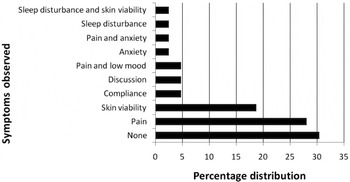
Percentage distribution of symptoms (N = 43).

RESULTS
Data were collected from two orthovoltage units at two departments, over a 4-week period. Forty-three fractions of treatment were recorded on 24 patients and 18 different tumour sites, the three most common sites being whole cranium (13.95%), breast (13.95%) and drain sites (20.93%). Twelve different descriptors of symptoms were recorded and these were rationalised into 7 generic symptom types. Figure 1 illustrates the percentage distribution of all symptoms recorded.
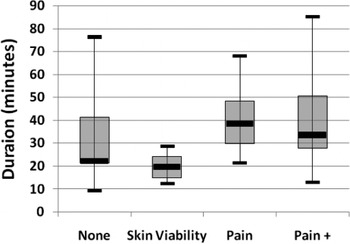
Comparison of central tendency and dispersion: major symptoms (N = 36).

Four major symptom groups were observed, which provided sufficient data for meaningful analysis; Skin Viability (inclusive of fungating wounds, ulceration, scabbing, crusting and erythema), Pain, Pain+ (grouped to include multiple concurrent symptoms of pain with anxiety, pain with low mood etc.), and finally the absence of reported symptoms, that is, ‘None’. Figure 2 compared central tendency and dispersion of these symptoms.
Pain/Pain+ had the longest duration of treatment. Ten of 15 episodes involved plan and treat, and 7 of 15 had more than one field. If plan and treat and multiple fields were excluded, episodes of treatment with Skin Viability symptoms had the longest duration in treatment time. The relatively high timings were also recorded when no symptoms were observed (mean = 30.98 minutes).
Linear trends were applied to attempt to clarify the relative effect on timings of the major symptoms identified; mean treatment times of symptom influence, when ordered, reflected those of central tendency and dispersion, that is, Pain/Pain+, None, and finally Skin Viability if plan and treat and multiple fields were included in the analysis. If first fractions and multiple fields are removed, then Skin Viability had the longest treatment time, with a clear linear trend time in excess of ‘None’ and Pain/Pain+.
In terms of the other patient-related factors of age and performance status, there was found to be little impact on treatment times. The age of patients ranged from 48 to 86; the lowest age of 48 had a KPS of 90, but this patient also had the third highest treatment duration of 68 minutes. The symptom of pain was recorded and this episode involved a first fraction/plan and treat and two fields of treatment. The lowest mean treatment times were found in the 60–69 age group, which was also the second largest of the age groupings (n = 13). Of these, 5 of 13 episodes were plan and treat, and KPS ranged from 20 to 95, with 9 of 13 being KPS of 60+; 8 had 1 field of treatment, 4 had 2 fields and 1 patient was treated with 4 fields.
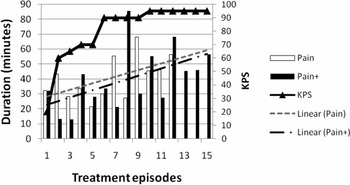
KPS and treatment times in patients with Pain/Pain+ symptoms (N = 15).

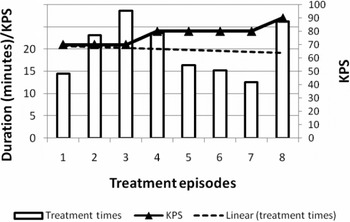
KPS and treatment times in patients with Skin Viability symptoms (N = 8).

Pearson's product-moment correlation coefficient was used to compare KPS and treatment times. There was found to be a weak positive correlation with r = 0.35. The highest treatment times were recorded for KPS scores of 80, 90 and 95. The 7 highest treatment times, in excess of 50 minutes, were also found to have symptoms of Pain/Pain+ in 5 of 7 episodes; 4 of 7 episodes were plan and treat; and 5 of 7 episodes involved the treatment of ≥3 fields. A patient with a KPS score of 30 was found to have the lowest mean treatment time, involving a single field treatment, subsequent fractions and with symptoms of Pain+ observed. The application of linear trends to the consideration of KPS, symptoms and treatment duration demonstrated this inverse relationship for the prevalent symptom of Pain/Pain+ (Figure 3); however, a slight reduction in treatment times as KPS increased was found when Skin Viability was analysed in isolation from other symptoms (Figure 4). Further consideration of the skin viability group revealed that they were all single field treatments, and 7 out of 8 were subsequent fractions.
Analysis of differences in timings was undertaken for the factors of plan and treat/first fraction versus subsequent fractions, the use or otherwise of equipment, and the number of fields delivered within a treatment episode. Use of the t-test demonstrated that the difference between the duration of treatment times for plan and treat to subsequent fractions was highly significant (p < 0.01).
First fractions were considered separately, due to two episodes of treatment involving plan and treat but not being first fractions, with the addition of new fields to an existing prescription of treatment. The differences in timings between first fractions to subsequent fractions were found to be significant (p < 0.05). The use of equipment was also considered. Equipment included the use of bolus and lead strips or cut-outs. A t-test result of 0.314 revealed no significant difference between whether equipment was used or not.
The number of fields treated across all treatment episodes ranged from one to five. Treatment time was found to increase with the number of fields treated. Pearson's product-moment correlation coefficient produced a relatively strong positive correlation with r = 0.77.
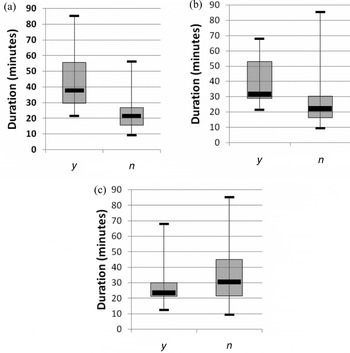
Comparison of central tendency and dispersion: box plot comparison. (a) plan and treat, yes/no (N = 16); (b) first fraction, yes/no (N = 14); (c) use of equipment, yes/no (N = 21).

These findings were mirrored when consideration was given to measures of central tendency and dispersion for the factors of plan and treat, first fractions and equipment (Figure 5a–c).
Lower dispersion and central tendency was demonstrated for episodes of treatment when equipment was utilised, compared to when it was not used. Mean duration for episodes with equipment was 28.89 minutes. This is compared with episodes without equipment at 34.47 minutes. Examination of data revealed the presence of multiple fields in episodes where equipment was not utilised.
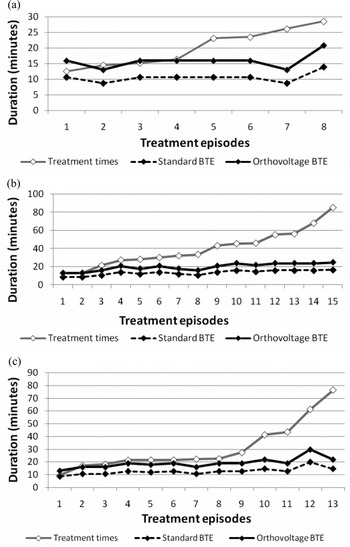
Comparison of treatment times and BTE. (a) Treatment times for the symptom of skin viability (N = 8); (b) for pain/pain+ (N = 15); (c) for episodes with no recorded symptoms (N = 13). These are compared with actual treatment times for each symptom group.

BTE calculations were undertaken on the three most prevalent symptom groups: Skin Viability, Pain/Pain+, and ‘None’. Calculations were made for both standard BTE and for BTE timings for orthovoltage unitsReference Delaney, Gebski and Lunn7 (Figure 6a–c).
Treatment times for Skin Viability ranged from 12.51 to 28.53 minutes. The mean duration was 19.96 minutes ± SD 6.05. Fifty percent of timings were within 1.5 minutes of calculated orthovoltage BTE and 87.5% were within 7.7 minutes.
Treatment times for Pain/Pain+ ranged from 13.07 to 85.23 minutes. The mean duration was 39.87 minutes ± SD 20.18; 33.3% of actual timings were within 9.25 minutes of the calculated orthovoltage BTE. Two treatment episodes were within 0.2 minutes.
Treatment times for episodes where no symptoms were recorded ranged from 9.38 to 76.36 minutes. The mean duration was 30.98 minutes ± SD 19.36; 53.8% of actual timings were within 3.65 minutes of the calculated orthovoltage BTE and 69.2% were within 8.5 minutes.
DISCUSSION
The data collected were relatively shallow in nature, comprising only 43 episodes over a 4-week period. Due to this it was felt appropriate to rationalise symptom descriptors into generic categories, resulting in a greater depth of raw data for analysis. The two largest symptom groups were found to be Pain/Pain+ and Skin viability. ‘None’ was also recorded to reflect those episodes when no symptoms were reported or observed. This was among the largest of the categories and its inclusion provides comparative data when considering the effect of the identified symptoms on duration of treatment. It is of note that the review of literature indicated that the most prevalent symptoms found in cancer patients treated with palliative intent are pain, nausea/vomiting and breathlessness. Discussion with palliative experts in practice confirmed that pain, dyspnoea and fatigue/debility were the most prevalent factors in their experience. Within the current study, dyspnoea was not observed nor recorded, and debility formed a minor symptom group.
Both Pain/Pain+ and ‘None’ displayed a wide dispersion of treatment times. The highest times for both these factors occur concurrently with multiple treatment fields and episodes of plan and treat/first fractions. This was an initial indication of the potential superior influence of these two treatment factors on the duration of treatment times and corresponds with two of the main elements of the standard BTE model. This trend was perpetuated when skin viability was considered; minimal dispersion and low central tendency were demonstrated, with analysis confirming only one plan and treat episode and single fields for all fractions of treatment within the skin viability category. Linear trends were applied to symptoms both with and without plan and treat/multiple fields, and appeared to confirm the impact of these treatment factors on timings. When these were excluded, skin viability was found to be the most influential symptom on treatment duration. Potentially this may result from the need to remove and re-apply dressings, and also the requirement to protect equipment for infection control purposes.
An analysis of variance test would have been the statistical tool of choice to compare multiple variables, as represented by the range of symptoms presented; lacking sufficient data, this remained outside the scope of the current pilot study. It may also be considered that difficulties in analysis are inherent with regards to symptomology; the presence, experience and effect of symptoms lack control in statistical terms, and in a multi-symptomatic patient it would be problematic to identify which variable was (most) influential on the treatment time.
Age and performance status were also given consideration. Age was found to be wholly unrelated to treatment duration, and provided no indication of potential KPS. This was illustrated with the extremes of age found during analysis, when the youngest patient recorded had a high KPS but whose treatment was the second longest in duration. The inverse was found for patients in the 60–69 category, and consideration of the elements of plan and treat and multiple fields were again found to be present in those treatments which took the longest time. KPS was compared for all treatment timings, inclusive of all symptoms recorded, and was found to have a weakly positive correlation (r = 0.35). This raises the question of whether KPS provides a suitable indicator of the need for longer appointments due to increased morbidity in patients, or whether there is an issue of appropriate usage, understanding and recording of performance status amongst clinical staff groups. All those study participants with a KPS of ≤40 had recorded symptoms, encompassing pain, low mood, sleep disturbance, skin viability or the need to discuss treatment or psycho-social issues. Those patients with scores of 90+ had a 30% rate of no symptomology being observed or reported. It was only when skin viability was considered in isolation, as the most influential of the symptoms when plan and treat and multiple fields were excluded, that a subtle positive trend was seen between decreased treatment times and improving KPS.
Having noted the persistent presence and influence of multiple fields, and plan and treat/first fraction treatments within the analysis of treatment duration, t-tests and Pearson's product-moment correlation coefficient tests were undertaken. The difference between plan and treat and subsequent fractions were found to be highly significant at p = 0.008; first fractions and subsequent fractions emerged as p = 0.02. This difference between plan and treat and first fractions emerged due to two cases where further fields were added to pre-existing treatment prescriptions–thus rendering them as ‘plan and treat’, but not as the first fractions for that course of treatment. Greater dispersion was found within subsequent fractions due to the addition of fields during the course of treatment. An increase in the number of fields across all treatments resulted in a moderately strong positive correlation of r = 0.77.
Throughout previous studies of radiotherapeutic productivity, the number of fields was given consideration at an early stageReference Delaney, Gebski, Rus, Manderson and Langlands11 and was a continuing feature as further complexity was introduced to developing models, including the issue of first fractions. The emergence of field numbers treated as a factor during this pilot study is confirmation that within the scope of purely orthovoltage treatments, these specific treatment factors continue to be a primary element in treatment duration, and must be included in any consequent model.
The use of equipment within orthovoltage treatment techniques involves the utilisation of lead cut-outs or strips, in order to better conform a treatment area from the square or round fields produced by standard applicators. The expectation that this would involve greater time than those treatments where no equipment was required was not borne out when central tendency and dispersion were considered (Figure 5c). The longer treatment times for episodes when no equipment was utilised corresponded with the presence of multiple fields, and provides further confirmation of the influence of fields as a factor in timings.
BTE calculations of both the standard formula, and the suggested orthovoltage formula (1.5 times the standard BTE time)Reference Delaney, Gebski and Lunn7 were undertaken for the highest symptom groups of Pain/Pain+ and Skin Viability, and compared with the category of ‘None’. As may be seen from Figure 6a–c, the orthovoltage formula provided a better match; however matching was closest for episodes with no recorded symptoms. For Skin Viability, four fractions of treatment were reasonably matched, with 50% of orthovoltage BTE calculations being within 1.5 minutes of actual timings. Divergence resulted not from multiple fields in this instance, and had only one episode of plan and treat. Instead the timings were influenced by patient mobility issues, the need to change a field size, and a final fraction of treatment, which would encompass giving advice on follow-up and care. BTE calculations in relation to Pain/Pain+ demonstrated a similar initial match and then divergence (two orthovoltage BTE episodes were within 0.2 minutes of actual timings). In this instance, plan and treat, first fractions and multiple fields were present on those episodes that diverged from that calculated. The closer matching of timings in the absence of symptoms, and divergence when symptomology is introduced may be suggestive that patient-related factors are in play when considering modelling for orthovoltage productivity. It is the case that only first fraction, the number of fields and the use of equipment is common to both BTE and to the delivery of orthovoltage treatments, and as such specific modelling and a different basis for formulating productivity would prove of benefit.
Validation of this study demonstrated an overall consistency in terms of the accurate recording of data, and in the matching of those observed symptoms and morbidities when later reference was made to medical records. A dip-sampling exercise of 10% of treatment episodes was undertaken. Two occasions were identified when equipment was not fully recorded, and there was a single variance of the recording of a KPS of 90, when notes indicated a World Health Organisation (WHO) score of 2. A further episode recorded no observable symptoms, when notes identified severe pain and dyspnoea during recent clinical contact. Discussion with staff members confirmed the ease of use of the provided tools and guidance notes. There was some disparity in the utilisation of guidance, with one site referring to guidance for each treatment episode, and the second making initial use of guidance, but relying increasingly on radiographer experience as their familiarity and confidence in the study and its tools increased. Consideration should also be given to the possibility that the presence of the tools, regardless of the unobtrusive intent in their design and usage, may cause staff to become less objective and more conscious of the assessment of patient-related and other factors. This potential halo effect amongst staff is perhaps unavoidable when engaged in disclosed observational studies, and may arise not only from the very presence of a tool, but also from the knowledge that the patient is fully aware of the study and the fact that specific recorded assessments are being undertaken.
CONCLUSION
In methodological terms, the utilisation of BTE affords a valid, reproducible and practical approach for undertaking radiotherapeutic productivity analysis. The orthovoltage modality may successfully utilise certain aspects of BTE: first fractions, number of fields and use of equipment, and this study confirms the over-arching influence that two of these three elements have on the duration of treatment times. The inherent analytical, practical and clinical difficulties in measuring patient-related factors have been acknowledged, encompassing the issues of controlling and assessing the influence of each variable and the assessment of qualitative, subjective symptom experiences, and the equally subjective observation of these presentations. Further refinement and the introduction of quantitative assessments such as pain scores and quality of life indices could increase the objectivity and measurability of symptoms that would otherwise remain beyond proper statistical interpretation; however, these run the risk of becoming too unwieldy to have practical application for data collection within a clinical setting. It must be recognised that from the current study data, it is not possible to ascertain and quantify what influence, if any, symptomology has on the duration of treatment times.
Such difficulties however should not deter rigorous consideration being given to patient-related factors and symptomology, and the indivisibility of these factors from the more technical aspects of radiotherapy delivery, when affecting productivity. This study has provided some bench-marking that may usefully be implemented within a full scale study; this with a view to further and better data being utilised in modelling a tabulated reference tool, to comprise baseline timings for orthovoltage treatments, as a basis for appropriately estimating treatment times. Additional factors such as physical and psycho-social symptoms, number of fields and plan and treat requirements could then be represented by blocks of time which would effectively ‘bolt-on’ to the basic unit of treatment time for an individual patient. As a lateral progression from BTE, a new orthovoltage and patient-factor based model is therefore indicated as the next logical step arising from this study.
Acknowledgements
The researcher thank the radiotherapists who took part in this study in the departments of Addenbrookes Oncology Centre and Peterborough District Hospital; also thanks go to Mrs Katharine Walker for her support, Mrs Donna Routsis for her invaluable input and encouragement, and Mr Mark Hulse for his advice and insight.