Stakeholder engagement in larger polar research projects
The changes in the polar regions are too complex and their consequences too far reaching to be dealt with by single scientific disciplines and in isolation from those affected by and affecting polar change. It has thus become crucial for academics working in polar research to engage with researchers from other disciplines as well as with non-academic stake- and rights-holders (hereafter inclusively referred to as non-academic stakeholders), including indigenous peoples, local communities, policy makers, business representatives, NGOs and many more (Tengö, Brondizio, Elmqvist, Malmer, & Spierenburg, Reference Tengö, Brondizio, Elmqvist, Malmer and Spierenburg2014). Evengård, Nymand Larsen, and Paasche (Reference Evengård, Nymand Larsen and Paasche2015) indicate that the scientific community today recognises the importance of complex interrelationships among major drivers of change but still finds it hard to practically move forward, especially in truly cross-disciplinary ways. Stakeholder engagement and participatory approaches are not new phenomena. The former developed in the business realm in the 1980s and the latter has roots within emancipatory theory and practice related to adult education dating back to the 1970s (Brown & Tandon, Reference Brown and Tandon1983; Macaulay, Reference Macaulay2017). As early as 1969, Arnstein used the image of a ladder – “the ladder of participation” – to differentiate between different qualities of engagement: the higher the level of engagement with stakeholders was, for example, through co-production activities, the more likely a research project would come up with desirable outcomes (Arnstein, Reference Arnstein1969). Yet, within Arctic research the shift from traditional, discipline-based science (the so-called “Mode 1”) towards the more participation and application-based form of research that crosses disciplinary boundaries (“Mode 2”) is a more recent trend (Brunet, Hickey, & Humphries, Reference Brunet, Hickey and Humphries2014, Reference Brunet, Hickey and Humphries2016). It is out of the scope of this research note to dwell on the origins and variations of research theories dealing with the engagement of non-academic stakeholders. However, in order to demonstrate that – at least European – polar research is rather new to stakeholder engagement, we will briefly touch upon two turning points that are likely to have triggered this paradigm shift: the International Polar Year (IPY) and the European Commission’s Horizon 2020-funding programme.
The fourth IPY 2007–2008 was not just the largest coordinated research effort in the polar regions, but it also marked a shift in research collaboration. For the first time, researchers from the social sciences and humanities, as well as members of local and indigenous communities took an active role in multidisciplinary polar science projects (Krupnik et al., Reference Krupnik2011). This, stated Krupnik et al. (Reference Krupnik2011, p.iii), “sent a powerful message about the societal value of advanced research on rapid environmental change across the Polar Regions”. It also demonstrated that the polar research community had become aware of how important it was to integrate different knowledge systems and to share data beyond scientific disciplines, in order to understand polar change and its global implications (Summerhayes, Rachold, & Krupnik, Reference Summerhayes, Rachold, Krupnik and Krupnik2011). In evaluating its legacy, the IPY was regarded to have solidified the transition towards more societally relevant polar science, which included the needs and interests of non-academic stakeholders (Summerhayes et al., Reference Summerhayes, Rachold, Krupnik and Krupnik2011).
While the seeds for more engagement-oriented research processes were planted during the IPY, many larger funded polar research projects in Europe have not yet reached a participatory practice compared to, for example, local-scale studies conducted in Canada (Brunet et al., Reference Brunet, Hickey and Humphries2014). However, European research-funding agencies have a growing demand for results that are societally relevant and originate from collaborative research efforts. The European Commission is one of the largest investors in polar research, spending around 200 million euro in Arctic-related science projects under the Horizon 2020 programme, which stretches from 2014 to 2020. Horizon 2020 is one example for a research-funding programme that attaches significant importance to science’s contribution to solving societal challenges. The novelty of Horizon 2020 is its call for “science with and for society” (EC, 2013), whereas the preceding funding instrument, Framework Programme 7, only stated a need for “science in society” (EC, 2006). Horizon 2020 puts a stronger emphasis on integrating societal relevance in science and innovation. The multimillion euro-funded European polar research projects thus are challenged not only to reach out to and inform non-academic stakeholders but also to actively include them in the research process.
One of these Horizon 2020-funded projects is a coordination and support action project, called EU-PolarNet. The consortium of this project does not conduct any research itself; rather, it has been tasked to co-develop an integrated European polar research programme with international scientific partners and non-academic stakeholders. In this process, the consortium members have reached out to policy makers, indigenous peoples and local communities, business and NGO representatives as well as to researchers of different disciplines in order to learn what they regarded as the most pressing issues in the polar regions that should be addressed by future polar research. The above-listed main groups of stakeholders were identified in the project’s stakeholder map (EU-PolarNet, 2016). Due to the strategic relevance of EU-PolarNet for the future funding of polar research projects, we also regarded researchers as stakeholders and refer them as academic stakeholders. In order to gain a better understanding of how to engage with both academic and non-academic stakeholders, the project launched a survey, inquiring about stakeholders’ motivation and preferences in the engagement process. The same procedure was used for both academic and non-academic stakeholders. Since this stakeholder engagement process in a large EU project is a relatively new topic, we are not only presenting the results of this survey but also evaluating the effectiveness of a survey like this in engaging with different polar stakeholder groups.
Asking stakeholders about their engagement preferences
Whom we asked
The stakeholder engagement survey was available both as an online and as a printed version. The printed survey was handed out at three events: the EU-PolarNet Town Hall Event 2016 in Brussels, the Arctic Circle 2016 in Reykjavik and the WOC Sustainable Ocean Summit 2016 in Rotterdam. It was given to all participants who represented organisations with either interest and/or focus on polar research and activities, including scientists, policy makers, business and NGO representatives as well as indigenous peoples’ representatives. Furthermore, the survey was published on the EU-PolarNet website in April 2017, where it still is available today. The stakeholder engagement survey was promoted alongside a second survey conducted by EU-PolarNet, which asked academic and non-academic stakeholders about their priorities for future polar research. Invitations were distributed via personalised emails, mailing lists of partner institutions and social media. Survey participants stating an interest to engage further with polar research were also asked to fill the engagement survey. In this research note, we present the results based on the 302 replies to the stakeholder engagement survey received by November 2017. Most of these replies (263 out of 302) were received through the online version.
The majority of the respondents (52%) came from the eight Arctic countries. European non-Arctic countries accounted for 41% of the respondents and the remaining respondents (7%) were from other countries (Asia, South America and Australasia).
The survey began with multiple-choice profile questions (such as the affiliation), followed by the open question on polar topic(s) of interest to the respondent. Subsequently, participants were asked about their motivation for engaging in research projects, at what stage of a research project they would like to get involved in and how they would like to be involved in a research project. The type of research project, which stakeholders could engage in, was not specified, except for its relation to the polar regions. These three questions offered multi-choice options, which aimed at covering key areas of motivation (such as staying informed, receiving information for policy making and defining research questions), stages of engagement (from project planning to dissemination) and modes of engagement (such as meetings, workshops and personal dialogues), respectively. The survey was designed to be easy to answer during an event and thus with relatively short multiple-choice answers, we hoped to get a high response rate. The choices of answer options were based on our past experience as well as assumptions on what motivates stakeholders to be engaged and at what stage they would like to get engaged and how. The answers were analysed through a quantitative analysis of the multiple-choice answers.
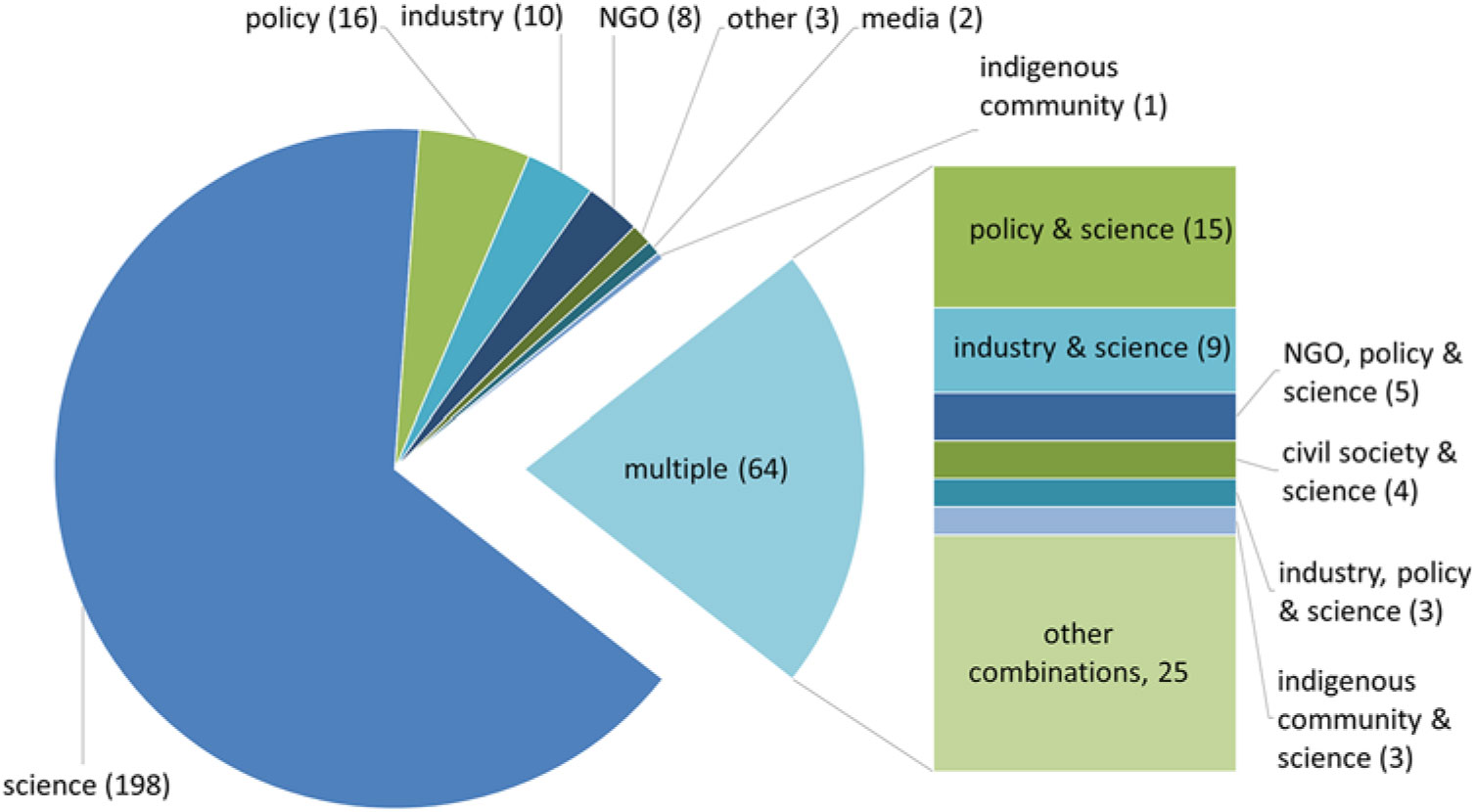
As respondents had the option to choose multiple affiliations (for example science and business) stakeholder categories are overlapping (Fig. 1). Of all 302 respondents, 64 stakeholders stated that they are affiliated with more than one group, the most frequent affiliation combinations are shown in Figure 1. In total, 83% (n = 251) of respondents stated that they are affiliated to science (including multiple affiliations) and 17% (n = 51) were solely non-academic. The respondents with multiple affiliations including science were merged with scientists into the academic group, as an analysis did not show any difference in the answers between scientists with multiple affiliations (mainly paired with policy making and NGO) and scientists without any other affiliation. The number of answers from indigenous peoples and local community representatives was so low that no conclusion could be made, and thus, we have omitted those from this paper. However, we acknowledge and understand the importance of including indigenous and local people in research projects and collaborating with them in developing research agendas, and we will put a stronger emphasis on this in future engagement processes.
Affiliations of the respondents with breakdown of those respondents who chose multiple affiliations. In the analysis of the results, multiple affiliations were merged with science into the group “academics”.

How they answered the survey
What would your motivation be to get engaged in research projects in the polar regions?
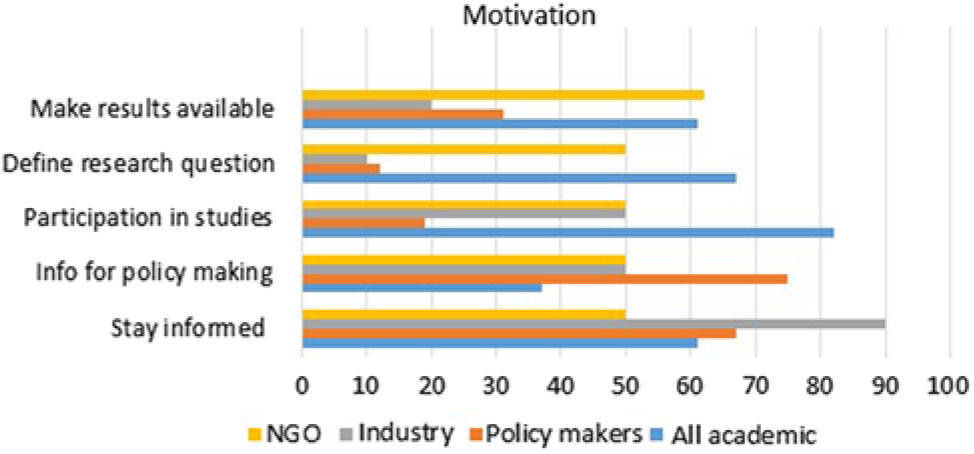
The responses to the first engagement question varied between academic and non-academic survey participants (Fig. 2). Academic participants stated a high interest to get engaged in future studies (82%) and to influence the research agenda (defining research question, 67%), whereas participants affiliated to industry (10%) and policy making (12%) were least interested in defining research questions. Industry (50%) and NGO (50%) representatives were keen on participating in the research, whereas policy makers were interested in obtaining up-to-date information for concrete decision-making (75%) and to be informed about current activities in the polar regions (67%). Industry representatives equally demonstrated a very high (90%) motivation in staying informed about polar issues. Participants affiliated to NGOs in turn showed an interest in all options and half were interested in being involved in each engagement option.
Illustration of what motivated stakeholders to engage in a research project.

At what stage of a research project would you be most interested to get involved?
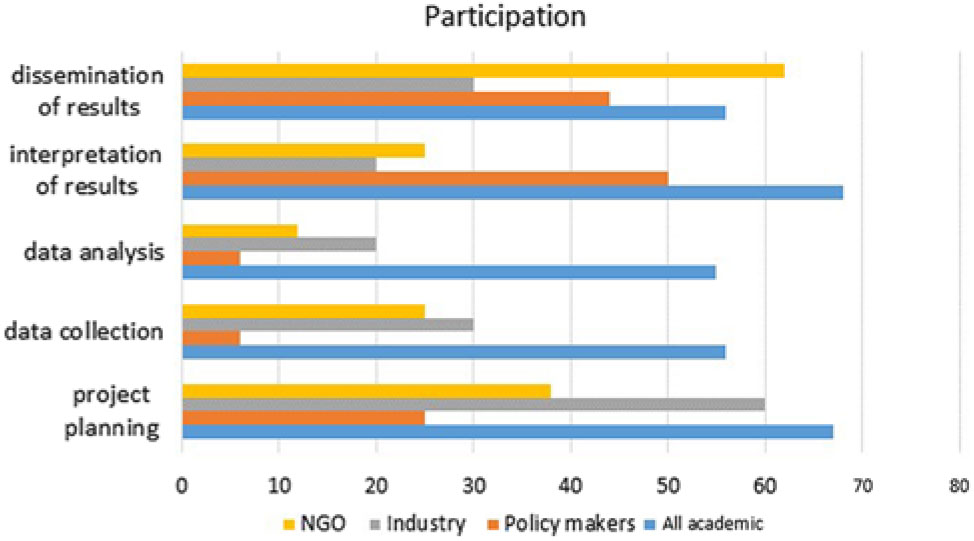
Generally speaking, academic survey participants showed an interest in participating in more stages compared to non-academic participants, with the only exception being the dissemination of the results (Fig. 3). The majority of academics were interested in participating in all stages during the research process: from project planning (67%) to data analysis (55%) and dissemination of the results (56%). Industry representatives were keen on participating in the project planning (60%), which was least interesting to policy makers (25%) and NGOs (38%). Data collection and data analysis emerged as those stages in a research process in which non-academic stakeholders showed little interest, while the final steps involving the interpretation of the results and their dissemination were of higher interest to NGO representatives (62%) and policy makers (44%).
Stage of research project stakeholders was interested in getting involved.

How would you best be involved in a research project?
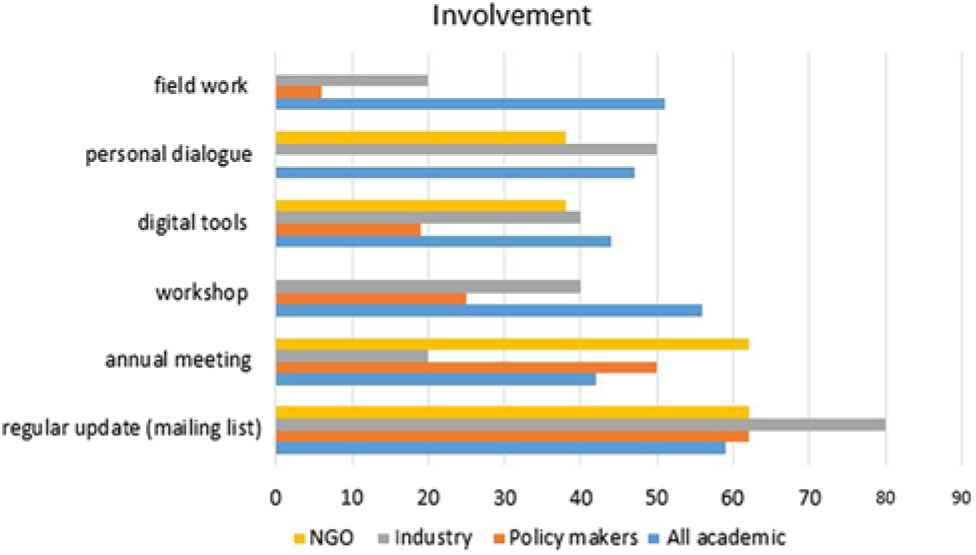
The answers showed a general preference towards receiving regular updates via a mailing list (Fig. 4). Academic survey participants were not just interested in engaging in different stages of the process, but they were also more interested in various ways of involvement, including more interactive engagement formats such as workshops, personal dialogues and fieldwork. NGO representatives were keen on participating in annual meetings (62%) and receiving regular updates (62%), whereas industry participants were mostly interested in being updated via regular emails and newsletters (80%) and by personal dialogue (50%).
Preferred format on how stakeholders wanted to get involved.

What we can learn from their answers
The answers from non-academic survey participants with their diverse backgrounds were too low in numbers for more detailed statistical tests and major conclusions. Despite this deficit, the results show interesting trends like the observations concluded by Harris and Lyon (Reference Harris and Lyon2013) stating that enterprises are keen on doing joint research, which would aim for the profit and NGOs are looking for knowledge that can be used for highlighting their agenda and putting pressure on public and private sectors. When comparing the answers of the survey respondents based on the stakeholder group they represent, we can see variations in their motivation, the stages of a research project that are of interest to them and the preferred mode of engagement.
On the contrary to well-documented literature, stating that stakeholders should be engaged early on and throughout a research process in order to enable equal partnerships and mutual benefits (Bieluch et al., Reference Bieluch, Bell, Teisl, Lindenfeld, Leahy and Silka2017; Brunet et al., Reference Brunet, Hickey and Humphries2016; Groß & Stauffacher, Reference Groß and Stauffacher2014; Klenk & Meehan, Reference Klenk and Meehan2015; Mauser et al., Reference Mauser, Klepper, Rice, Schmalzbauer, Hackmann, Leemans and Moore2013; Pain, Reference Pain2004), the majority of non-academic survey participants (representing industry and policy making) did not state an interest in being involved in the initial phases of a project, such as defining the research question. This result does not allow the general conclusion that non-academic stakeholders are generally not interested in engaging from the onset on. Rather, it demonstrates two limitations of the survey: first, the low participation of non-academic stakeholders. This likely is due to a combination of reasons, including the lack of non-academic stakeholder participants at the targeted events and the limited response rate to survey invitations sent via email. A second limitation is that participants were not able to state in the survey why they were not interested in specific stages or engagement modes. Rather than being a sign of not being interested, the limiting factor, for instance, could be a lack of time, personal or financial resources. One risk that collaborative research projects can face is “stakeholder fatigue” or “consultation fatigue” (Arctic Council, 2013; Ford et al., Reference Ford, Stephenson, Cunsolo Willox, Edge, Farahbakhsh, Furgal and Sherman2016; Gramberger, Zellmer, Kok, & Metzger, Reference Gramberger, Zellmer, Kok and Metzger2015; Jönsson & Swarling, Reference Jönsson and Swarling2014; Reed, Reference Reed2008). This risk does not only arise within one research project but is also often seen when the same stakeholders are asked to join several research projects, especially when they see no (direct) positive outcome as a result. Furthermore, an online survey could be the wrong tool to obtain feedback from some stakeholder groups, and the suggested engagement modes in the survey might not reflect their preferences.
The survey results also suggest that researchers show a larger motivation to engage in more stages of a project and are interested in more diverse engagement modes than non-academic survey participants. This does not come as a surprise. While for most non-academic stakeholders, engagement in a research project is an additional task to other existing activities and obligations, it belongs to a researcher’s job to engage in different stages of a project. Furthermore, researchers are likely to benefit more from the engagement processes and its outcomes than non-academic stakeholders (Brunet et al., Reference Brunet, Hickey and Humphries2016). One reason for this is that the engagement process in many cases falls back on academic perspectives, which are not necessarily shared by non-academic stakeholders (Bracken, Bulkeley, & Whitman, Reference Bracken, Bulkeley and Whitman2015; Thompson, Owen, Lindsay, Leonard, & Cronin, Reference Thompson, Owen, Lindsay, Leonard and Cronin2017). Academics’ lack of experience in co-conducting research (Bieluch et al., Reference Bieluch, Bell, Teisl, Lindenfeld, Leahy and Silka2017) and relying on “extended ivory towers, i.e., working with likeminded and similarly socialized actors outside academia” (Lang, Wiek, & van Wehrden, Reference Lang, Wiek and von Wehrden2017) constrains meaningful co-creation processes between researchers of multiple disciplines and non-academic stakeholders.
This “top-down” constellation of engagement often implies the empowerment of non-academic stakeholders by scientists, which has been criticised for creating paternalistic relationships (Pain, Reference Pain2004). Where these power dynamics are left un-managed and stakeholders are restricted in their contributions, meaningful outcomes of the participatory processes are unlikely (Reed et al., Reference Reed, Vella, Challies, de Vente, Frewer, Hohenwallner-Ries and van Delden2017). In search of a meaningful cooperation, it is therefore important not just to aim at all full inclusion of stakeholders in the research process but to define and shape their roles according to specific interests, needs and expertise (Jolibert & Wesselink, Reference Jolibert and Wesselink2012) – thus putting a focus on the “if and how” of the engagement process. A decentralisation of power, by, for example, engaging non-academic stakeholders from the proposal phase and funding allocation onwards, could improve the engagement (Brunet et al., Reference Brunet, Hickey and Humphries2016). Underlying power structures therefore need to be acknowledged before and during an engagement process, in order to create a space where researchers and stakeholders can interact and contribute on equal terms (O’Brien, Marzano, & White, Reference O’Brien, Marzano and White2013; Reed et al., Reference Reed, Vella, Challies, de Vente, Frewer, Hohenwallner-Ries and van Delden2017). In the Arctic, this power structure is especially evident in relation to indigenous peoples. The role of indigenous knowledge is acknowledged on an official level, for example, in the Joint Statements of the first and second Arctic Science Ministerial, which recognise the importance of both traditional and local knowledge and scientific and technological information for informed decision-making (ASM, 2016, 2018). However, there are major obstacles to the integration of traditional knowledge and scientific knowledge. These include skepticism and cultural biases of some scientists as to the value of traditional knowledge, as well as reluctance of policy makers to relinquish control (Evengård et al., Reference Evengård, Nymand Larsen and Paasche2015, p. 19). In this complex relationship between the indigenous peoples and the research community, one should look for alternative avenues that engage the first group in a familiar and comfortable setting with procedures accepted by all in question. We acknowledge that this power unbalance and bias towards scientific processes also applies to this survey, resulting in most responses coming from academics.
Based on these aspects and taking the limitations of the survey into account, the results suggest that the perceived ideal way of engagement needs to be tested against the actual preferences of stakeholders. Pohl (Reference Pohl2011), for example, states that stakeholders interested in real-world issues would be better approached on how to solve the issues, whereas business, governmental and civil society stakeholders are best involved within thought-style, structured case studies and critical thinking. Despite its stated limitations, survey results show that the participants had different preferences. It remains to be understood what these preferences are based on and if these can be extrapolated for a specific stakeholder group keeping in mind differences within each stakeholder group based on the culture, location and so on.
The way forward
Creating an overview of motivations and engagement preferences of various stakeholder groups does not offer a one-size fits guide on how to conduct stakeholder engagement. However, it could be a tool to facilitate planning processes and conducting the first contacts with stakeholders. The differences in preferences and variations among stakeholders are crucial building blocks towards meaningful and sustained stakeholder engagement needed in a true co-design of research projects. We regard our survey as a first attempt to identify how stakeholders would like to get engaged in larger scale polar projects. The answers suggest that studies on stakeholder engagement preferences could retrieve insightful results and improve future engagement processes. We therefore recommend that variations and differences in stakeholder preferences need to be studied more closely in future including perquisites needed for different stakeholders to get engaged (such as seed money and compensation of their time spent). These insights could improve our crucial understanding of how different non-academic stakeholders want to get involved and what is needed for the engagement. To tackle the issues that the polar areas are facing today, the scientific community needs to work together across disciplines and together with indigenous and local communities, and other stakeholders to increase our understanding of the complexity of change.
Financial support
This research note was supported by EU-PolarNet, a coordination and support action funded by the European Commission under the Horizon 2020 framework (grant number 652641).
Conflicts of interest
The authors declare no conflicts of interest.