


Introduction
Cognitive Behaviour Therapy (CBT) has been found to be effective in treating people with schizophrenia (Wykes, Steel, Everitt and Tarrier, Reference Wykes, Steel, Everitt and Tarrier2008). Although there is evidence to suggest that CBT might be effective in treating mental health problems in developing countries (Naeem, Waheed, Gobbi, Ayub and Kingdon, Reference Naeem, Waheed, Gobbi, Ayub and Kingdon2011; Wong, Reference Wong2008), it is rarely available in these countries. Cognitive behaviour therapy like other modern therapies was developed in the West. Therefore, it has been recommended that CBT needs cultural adaptation before its application in nonwestern cultures (Hays and Iwamasa, Reference Hays and Iwamasa2006; Iwamasa, Reference Iwamasa1993; Naeem, Phiri, Rathod and Kingdon, Reference Naeem, Phiri, Rathod and Kingdon2010).
The explanatory models of illness are often rooted in local cultural and religious beliefs and values, which need to be addressed in any psychosocial intervention as these play a very important role in help seeking and health-related behaviours (Lloyd et al., Reference Lloyd, Jacob, Patel, St Louis, Bhugra and Mann1998; Joel et al., Reference Joel, Sathyaseelan, Jayakaran, Vijayakumar, Muthurathnam and Jacob2003; Kleinman, Reference Kleinman1980; Littlewood, Reference Littlewood1990; Weiss, Reference Weiss1997). Even health workers hold indigenous beliefs about mental illness that differ markedly from the biomedical models, emphasized by mental health professionals (Joel et al., Reference Joel, Sathyaseelan, Jayakaran, Vijayakumar, Muthurathnam and Jacob2003). Zafar et al. (Reference Zafar, Syed, Tehseen, Gowani, Waqar and Zubair2008) reported that one-third (30%) of the participants of a survey in Karachi, Pakistan, attributed “mental illness” as the main cause of psychotic symptoms. Other causes included “God's will” (32.3%), “superstitious ideas” (33.1%), “loneliness” (24.8%) and “unemployment” (19.3%) (Zafar et al., Reference Zafar, Syed, Tehseen, Gowani, Waqar and Zubair2008). Another study that compared beliefs of British, British Pakistani and Native Pakistani medical students about the manifestation, causes and cures of schizophrenia, reported that although Pakistanis possessed negative beliefs and attitudes about people with schizophrenia, there was no evidence to indicate that Pakistanis believed more in superstitious causal explanations. Pakistanis were more likely to consider seeking help from faith healers, compared with British Pakistanis and the British (Furnham, Raja and Khan, Reference Furnham, Raja and Khan2008).
Our work in Pakistan using mixed methods research to culturally adapt CBT for depression has shown that numerous adjustments need to be made for CBT to be acceptable, accessible and effective (Naeem, Ayub, Gobbi and Kingdon, Reference Naeem, Ayub, Gobbi and Kingdon2009; Naeem, Ayub, Kingdon and Gobbi, Reference Naeem, Ayub, Kingdon and Gobbi2012; Naeem, Gobbi, Ayub and Kingdon, Reference Naeem, Gobbi, Ayub and Kingdon2009; Naeem, Ayub, et al., Reference Naeem, Ayub, Gobbi and Kingdon2010, Reference Naeem, Waheed, Gobbi, Ayub and Kingdon2011). However, the adaptation work required expertise and resources that might not be readily available in developing countries. There is a need to further refine adaptation methodology so that adaptation can be carried out easily and with fewer resources.
Aims and objectives
The aim of this study was to explore the views of patients, carers and health professionals to guide adaptation of CBT for psychosis in Pakistan. Our objectives were: to conduct interviews with (a) the patients with psychosis and their carers; to explore their views about psychosis, its causes and the treatment; and (b) to explore the experience of psychologists and psychiatrists working with psychotic patients.
Method
Study design
This was a qualitative study that consisted mainly of one-to-one semi-structured interviews with patients, their carers and the mental health professionals. Semi-structured interviews with open ended questions were considered to be the most suitable technique for this study, as these interviews give the researcher more control over the topics of interview compared with unstructured interviews. However, unlike the structured interviews or questionnaires that use closed questions, there is no fixed range of responses to each question in semi-structured interviews (Kvale, Reference Kvale1996).
Development of semi-structured interviews
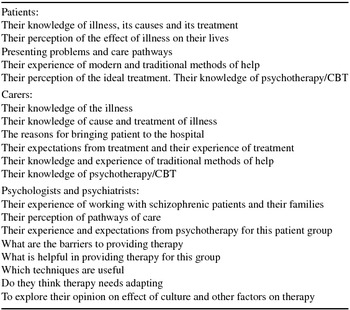
Semi-structured interviews were used for this study. In our previous work in Pakistan to culturally adapt CBT for depression, open ended interviews were conducted by a psychiatrist trained in CBT and qualitative methods. We therefore wanted to develop a semi-structured questionnaire that could be used by psychology graduates, thus reducing the cost and further standardizing the process of interviews. The semi-structured interviews for this study were adapted from our previous work (Naeem, Ayub, et al., Reference Naeem, Ayub, Gobbi and Kingdon2009; Naeem et al., Reference Naeem, Ayub, Kingdon and Gobbi2012; Naeem, Gobbi, Ayub and Kingdon, Reference Naeem, Gobbi, Ayub and Kingdon2009; Naeem, Ayub, et al., Reference Naeem, Ayub, Gobbi and Kingdon2010, Naeem, Waheed, et al., Reference Naeem, Waheed, Gobbi, Ayub and Kingdon2011). In order to do this, two of the authors (FN and MA) who had worked together on a previous project repeatedly read the interview transcripts from previous studies and their results. This exercise focused on the topics and the questions used in our past work and formed the basis of the semi-structured interview guide. These semi-structured interviews consisted of open ended questions, with prompts and guidance on exploratory questions. Once the initial list of questions had been developed, three co-authors reviewed the questions for both content and format, separately. We wanted to explore predetermined themes, but were also responsive to issues that were raised in discussion. This was to enable us to explore the difficult or contentious issues. Minor adjustments in the wording of the questions were made to further refine the interview questions. This process continued throughout the study based on feedback from interviewers and research team. Table 1 highlights the themes we wanted to explore in these interviews. These Semi-Structured Interviews are attached as supplementary material.
Summary of themes explored through interviews

Study participants and their selection
Purposive sampling method was used to employ participants in this study.
Group 1: Patients
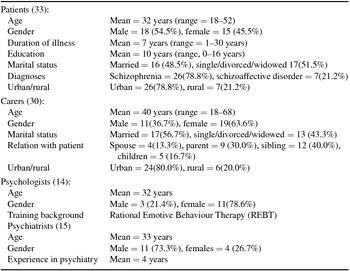
We interviewed patients (n = 33) with a diagnosis of schizophrenia/schizo-affective disorder or delusional disorder using ICD-10, RDC (International Classification of Diseases, 10th edn, Diagnostic Criteria for Research) who had at least one year duration of illness, and who were attending the outpatient clinic of a psychiatry department. Patients with severe illness, disruptive behaviour, learning disability or severe substance misuse problems were not included in this study.
Group 2: Carers
Carers attending the outpatient clinics of participating psychiatry departments were approached and those who consented were interviewed (n = 30). We selected this group because in our previous study we had learned that patients are mostly accompanied by their carers, and that carers make important decisions regarding choice of treatment, type of health care and follow-up.
Group 3: Psychologists and psychiatrists
Psychiatrists play a vital role in the referral process and we wanted to understand their views of therapy. We interviewed a total of 15 psychiatrists. We sought psychologists who preferably practised CBT or at least were aware of the basic concepts of CBT. We interviewed 14 psychologists. See Table 2 for all participant characteristics.
Characteristics of the participants

Collection of data and analyses
Interviewers were psychologists. Interviews with mental health professionals were conducted in English, whereas interviews with patients were conducted in Urdu. All the professionals were interviewed in their departments. The patients and carers were interviewed in rooms attached to the outpatient clinics. All the interviews were audio-recorded and lasted between 60 to 90 minutes using the interview questionnaires. We started transcribing interviews at the same time as the process of the interviews started. Contact telephone numbers were obtained from the participants so that they could be contacted if a point needed further clarification. Anonymity and confidentiality were assured. Access to data was limited to the research team. Field notes were taken by the researcher about non-verbal communication and behaviours. Each interviewer started analyzing the interviews as and when they were conducted. The interview scripts were returned to a random sample of the participants for comment, verification and for clarity with respect to queries that arose from the analysis stage. Interviewers were provided supervision and support through telephone and video-conferences using Skype throughout the study. The interviews were conducted between January and June 2010.
This work was informed by an ethnographic approach (Atkinson, Delamont, Coffey, Lofland and Lofland, Reference Atkinson, Delamont, Coffey, Lofland and Lofland2007). This approach to data collection allowed us to understand the focus of people participating in the study within their cultural context (Jorgensen, Reference Jorgensen1989). The principle of “emergent design” was followed when respondents raised issues that required further exploration or verification (Creswell, Reference Creswell2009). These issues were then tested appropriately with subsequent participants in interviews. We also contacted participants by telephone for clarification of areas of uncertainty when the data were analyzed. The data were analyzed by systematic content and question analysis (Morse and Field, Reference Morse and Field1996). Analysis involved the researcher immersing him/herself in data by reading the interview transcripts carefully several times, and identifying emerging themes and categories (Hammersley and Atkinson, Reference Hammersley and Atkinson1994). The interviewees were ascribed numbers that were used in the transcription and report. The data were largely descriptive, with most themes emerging in response to the interviews. The process stopped when saturation point was reached and we realized that no new themes were emerging. The themes were then converted into codes. Finally, the data were reorganized into wider themes (for example, barriers in therapy) and categories (for example, financial burden) and written for this article.
Themes emerging from the analysis of interviews by each interviewer were constantly compared and contrasted with other interviewers. Triangulation of themes and concepts was undertaken to further compare and contrast the data from different participating groups. This enhanced the reliability and validity of the analysis. Further validity checks were made by taking transcripts back to the participants and asking them if this is what they meant. The verbatim interviews were analyzed by two members of the research team in the UK, separately as and when they became available, identifying topics of interest (open codes) either because they already existed in literature (for example, spiritual causes of illness) or they were important because of the areas we wanted to explore (for example, patients’ beliefs about treatment).
Results
A total of 92 interviews were conducted by three psychology graduates. Findings from the interviews are described under different themes and subthemes. Themes from different groups of participants are presented where possible under headings for the sake of comparison.
Culture and religion
All the psychologists said therapy needs adapting according to local needs, taking into consideration cultural and religious factors. They also said religious and local beliefs have an effect on patients’ understanding of illness and their views on causes and treatment of the illness. Although one psychologist highlighted the positive impact religion can have on patients’ mental health, the rest considered it to be a barrier. Some psychologists also talked about keeping therapy separate from religion.
Our patients connect everything with religion. Even delusions and hallucinations are based on religion and culture (Psychologist 3). It is important to involve elements of religion and culture in therapy here. Then it becomes useful. If you don't understand religion and culture you can't give therapy (Psychologist 8). There are some techniques which we can't use; there are others which we can easily use (Psychologist 6). I keep therapy separate from religion. But culture can have an impact on therapy (Psychologist 2).
Therapy issues
Barriers in therapy
The psychologists described problems with engagement, high drop outs and home work assignments to be the main hurdle. Most commonly reported problems were lack of awareness of therapy, travelling distance, uncooperative family caregivers, and travelling expenses. They also said that patients were more focused on physical health and expected only medication when they visited the hospitals. They expected quick remedies and wanted their illness to be cured. Patients were reported to be surprised as to “how it is possible to treat a mental illness through only talking”. Psychiatrists also reported a high rate of drop outs from follow-up (40–70%). Personality profile of patients, nature of their illness and lack of therapeutic relationship were identified as barriers to follow-up by psychiatrists.
Nearly 50% of the patients come back for follow-up. I think they come back for free medicines. They only want medicines. They want quick cures. Some of them would say, how can you treat me with talking? Can talking cure my illness? (Psychologist 2).
All the mental health professionals agreed that the major barrier in therapy was translating therapy material as well as terminology into Urdu.
First we translate from English into Urdu and then make it even simpler. But to be honest with you, we have difficulties in conveying our message. There is no Urdu translation of CBT. It is also important that we talk to them according to the religion and culture and their environment. We have to do everything ourselves (Psychologist 8).
Both psychologists and psychiatrists reported that socioeconomic background plays a significant role in people's attitude to psychotherapy. The well-off, educated and urban population value psychotherapy. Therapists felt that being uneducated was a major barrier to therapy. The reasons varied from not being aware of therapy to difficulty in home work. Similarly, women are less likely to attend for follow-up.
These are usually educated and rational people who are from middle or upper socio-economic class. Nearly 40% of them prefer talking therapy over medicines (Psychologist 14). Even with less educated patients, when we educate them, 60% agree to therapy, especially young men (Psychologist 11).
Organization and resources of health system offer further barriers. Distance from treatment facility was described as the major barrier to therapy. Psychologists described the patients’ involvement with the traditional healers (e.g. hakims, homeopaths, herbalists) and religious/faith and spiritual healers as a major barrier in accessing and engaging with therapy. They also said that the patients’ belief in non medical causes of illness (magic, alternative medicine, taweed and dam) causes hindrances in therapy.
I would say 60–70% of therapy is affected by the patients’ knowledge about illness and the health system. How can they come back for therapy if they are coming from Dera Ghazi Khan (2–3 days travel distance)? (Psychologist 9). They have more resources in the west. We don't have any resources (Psychologist 14).
Involvement of family in Pakistan offers both strengths and difficulties to therapy. Family members often want to know everything about therapy and even want to participate in therapy. Psychologists described lack of family support or over involvement and uncooperative care givers as barriers in therapy.
Usually we find a family member who can act as a co-therapist. But if we can't do this then prognosis is poor (Psychologist 8). Sometimes patients say, you talk to me and ask me to change. Why don't you ask my family to change? (Psychologist 9).
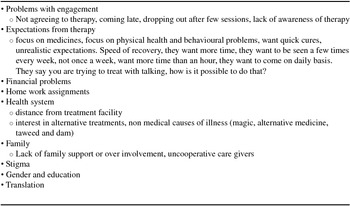
Mental health professionals talked about the high stigma attached to mental illness. This not only means patients are less likely to be brought to the health services, but might also be the reason why their relatives might not bring them again for therapy or for follow-up because they don't want people to know that the patient is being seen by a mental health professional (see Table 3).
Problems identified in providing therapy

They say this is a mad people's doctor and this is the treatment for madness (Psychologist 4). I am not getting better soon. Yes, there is improvement but it is very slow. My family says are you mad if you are seeing a psychologist (Patient 23).
What helps?
Interviews with therapists not only highlighted the barriers, but also brought the techniques that they find helpful in dealing with patients to our attention. Education of patients about illness was universally identified as the most useful part of therapy. Commonly used techniques that they felt were useful with patients with psychosis included helping with coping, behavioural techniques, social skills, family counselling, dealing with family conflicts, role play and role rehearsal. One of the psychologists talked about patients not being comfortable with downward arrow technique and Socratic dialogue. Most of them said patients expect a directive style rather than collaborative style. Only one psychologist talked about the use of Sufism (Muslim mindfulness) based techniques in therapy. This psychologist had been mentored by a faith healer (peer) in the use of such techniques.
We use an active approach because patients like us to give advice. They don't feel comfortable with the collaborative style (Psychologist 14). I have learned zikr e qalbi. I teach them this knowledge. It is very useful for some patients. Quran says, listen carefully that zikr of Allah gives peace to hearts. (Psychologist 6).
Views about schizophrenia, its causes and its management
Presenting problems and the effect of illness
All the patients were accompanied by a family member. Most patients described psychotic symptoms as their main concern, but four patients were more concerned about physical symptoms. The carers on the other hand described behavioural problems as the main reason for bringing patients to the hospital. This was confirmed by psychologists and doctors in their interviews. All the patients felt that the illness had affected their lives. As these patients said:
This illness is like a cancer or can be like depression. It does not leave me alone. I can't go to work and it has affected my whole life (Patient 22). This illness is eating me like termite eats wood (Patient 11).
Causes of illness
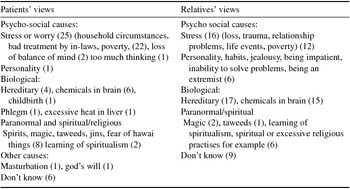
Most patients and carer related the symptoms with psycho-social problems and stress. Nearly one-third of patients and carers believed in spiritual or religious causes. One-third of patients believed in biological causes, although half of the carers held such beliefs. Most of them described more than one cause of the illness (see Table 4). As typified by these participants:
Causes of illness

My cousins took me to graveyard. I think something in air attacked me there. But I think I have also a problem with chemicals in my brain. Financial problems are another reason why I remain ill (Patient 16). Yes, he (the patient) has a mental illness, and although there are psychological reasons I think he is also affected by Saya (Jins or Ghosts and so forth) (Carer 27). They think their illness is because of magic, Saya or Jins (Psychologist 9).
Awareness of illness and pathways to care
Most of the patients (19) said that they suffer with a mental or psychological illness. Nearly half of them (12) said it is both a physical and mental illness, whereas 6 believed that they had a brain disease and nearly half (13) did not know the name of the illness they suffered from. Only 6 patients knew the name of their illness as schizophrenia. Nearly all the patients were referred by family or friends, 2 were referred by doctors, 2 by faith healers and one by an Imam. Psychologists said they also receive referrals from psychiatrists.
Patients follow a complex pathway and usually begin by seeking help from nonmedical healers when the illness starts. Almost all the patients had seen traditional healers or faith/spiritual healers before coming to the psychiatric health facility. Nearly half (14) of the patients admitted to having gone to a faith/spiritual healer, whereas one-third (8) reported consulting an alternative healer (Hakim or Homeopath) before coming to see a mental health professional. Some of these patients consulted more than one type of healer before presenting to the medical system.
We took him to so many Peer, Faqeer and Aamil (faith healers), but there was no change, so finally we were fed up and then my uncle asked me to bring her here to Dr Z. (Carer 15). The Movlie in Madrissa (religious scholar) asked me to come here (Patient 27). In fact my in-laws did not believe in spiritual healers or Taweed Ganday (techniques used by faith healers), so my mother took me to the Peer secretly. He put Dum (technique used by faith healers) on me and that relieved half of my illness (Patient 30). They usually come to hospital in the end. Once they have wasted all their money and resources on Peer Faqeer and Hakims they come here (Psychologist 13).
Management of illness
Patients and their families in Pakistan use a bio-psycho-social model of management of psychosis with additional emphasis on spiritual and religious causes. This can possibly be termed as bio-psycho-spirituo-social model of psychosis.
Medicines are helping me to some extent, but I am not fully satisfied. I get Dum from peer and also read Aayat. I also went to homeopath for treatment. You see, only medicines cannot treat illness. But in the end illness is from God and only God will cure it (Patient 25).
Nearly one-third of the patients and their carers reported ongoing treatment by traditional healers or faith healers. One-third carers (9) said their patient should also receive psychological help. Three carers said both psychological and spiritual treatments are needed by their patient in addition to current medical treatment. Nearly half of the patients (16) were aware of psychological treatments and expressed a wish to receive it, but only 4 of them had some experience of it.
I don't know much about talking therapy. But I think talking therapy can help me if someone can understand my thinking (Patient 19). It was helpful. It helped me with thinking clearly. I started going to work. It helped me to express my emotions. It helped me with catharsis. Now I don't argue or fight with my family members (Patient 16).
Discussion
Findings from this project confirm the need for adapting CBT in non Western cultures, which is consistent with previous literature (Hays and Iwamasa, Reference Hays and Iwamasa2006; Iwamasa, Reference Iwamasa1993; Naeem, Phiri, et al., Reference Naeem, Phiri, Rathod and Kingdon2010). All the psychologists interviewed in our study emphasized the need to be aware of cultural, religious and other related factors while providing therapy. Although most patients and carers related illness to stress, their model of illness was what can be called “bio-psycho-spiritual-social”. It is therefore not surprising that they consult healers from more than one system. One of the patients in our study said that his illness was because of excess of phlegm (Greek concept) and another described it to be due to excessive heat in the liver (Chinese concept). The information obtained from this study was used to deliver culturally adapted CBT for psychosis in a preliminary study in Pakistan and was found to be effective (Habib, Dawood, Kingdon and Naeem, Reference Habib, Dawood, Kingdon and Naeem2014).
We further refined the methodology we used previously in Pakistan in which CBT was adapted for depression, to see whether adaptation can be achieved with fewer resources. The semi-structured interviews used in this study were derived from our previous work and were conducted by psychology gradates. The results of this study are similar to those we obtained from our previous work, which involved interviews by an expert in research and therapy. We also interviewed carers in this study, which was not done in our first study, as carers make important decisions and being aware of their beliefs and knowledge might provide insights that could help with the process of therapy. These findings are consistent with our previous studies in which we adapted CBT for depression in Pakistan (Naeem et al., Reference Naeem, Waheed, Gobbi, Ayub and Kingdon2011). We found that our model, whereby we inform therapists regarding the following issues, is helpful: awareness of culture and religion, capacity of the health system and resources, and cognitions and beliefs related to illness, its causes and its treatment.
Implications for therapy and research
Our work suggests that CBT can be adapted in any given culture using a series of small scale qualitative studies. The process of adaptation consists of: (1) literature search; (2) data gathering from different stake holders, using qualitative methods; (3) assimilating information thus gathered into guidelines that can direct therapy; and (4) treatment trial to test the effectiveness of the guidelines.
This work shows that CBT might need minor adjustments for use in Pakistan. Issues raised in this article can be easily used to inform “culturally sensitive assessment and formulation”. Being aware of the cultural factors might also help to improve engagement. The overall findings from this study are consistent with the guidelines we have previously described for delivering culturally adapted CBT (Naeem, Ayub et al., Reference Naeem, Ayub, McGuire and Kingdon2010; Naeem, Phiri, et al., Reference Naeem, Ayub, Gobbi and Kingdon2010).
Limitations
The limitations of this study include the fact that the mental health professionals involved came from a big city and most of the patients and carers belonged to urban areas, which might make it less generalizable. Interviews have been criticized over their validity. However, the results were very similar both to our previous work and to work carried out in the UK.
Conclusions and future directions
This study was conducted as part of a bigger body of work, in which we are developing culturally adapted CBT for local use in Pakistan. In this study we further refined the methodology we had already developed for adapting CBT for depression in Pakistan. The information obtained from this study was used to deliver culturally sensitive CBT for psychosis in a small RCT. Future work needs to focus on broadening the scope of this work by involving patients and carers with other mental health problems and from a variety of socio-economic backgrounds. The guidelines for adaptation need to be tested in larger randomized controlled trials. Finally, there is a need to develop strategies for engaging patients and carers with limited formal education and living at greater geographic distance from the health facilities.
Acknowledgements
Authors acknowledge the contribution of patients and their carers and the mental health professionals who participated in this study.




Comments
No Comments have been published for this article.