Experimental
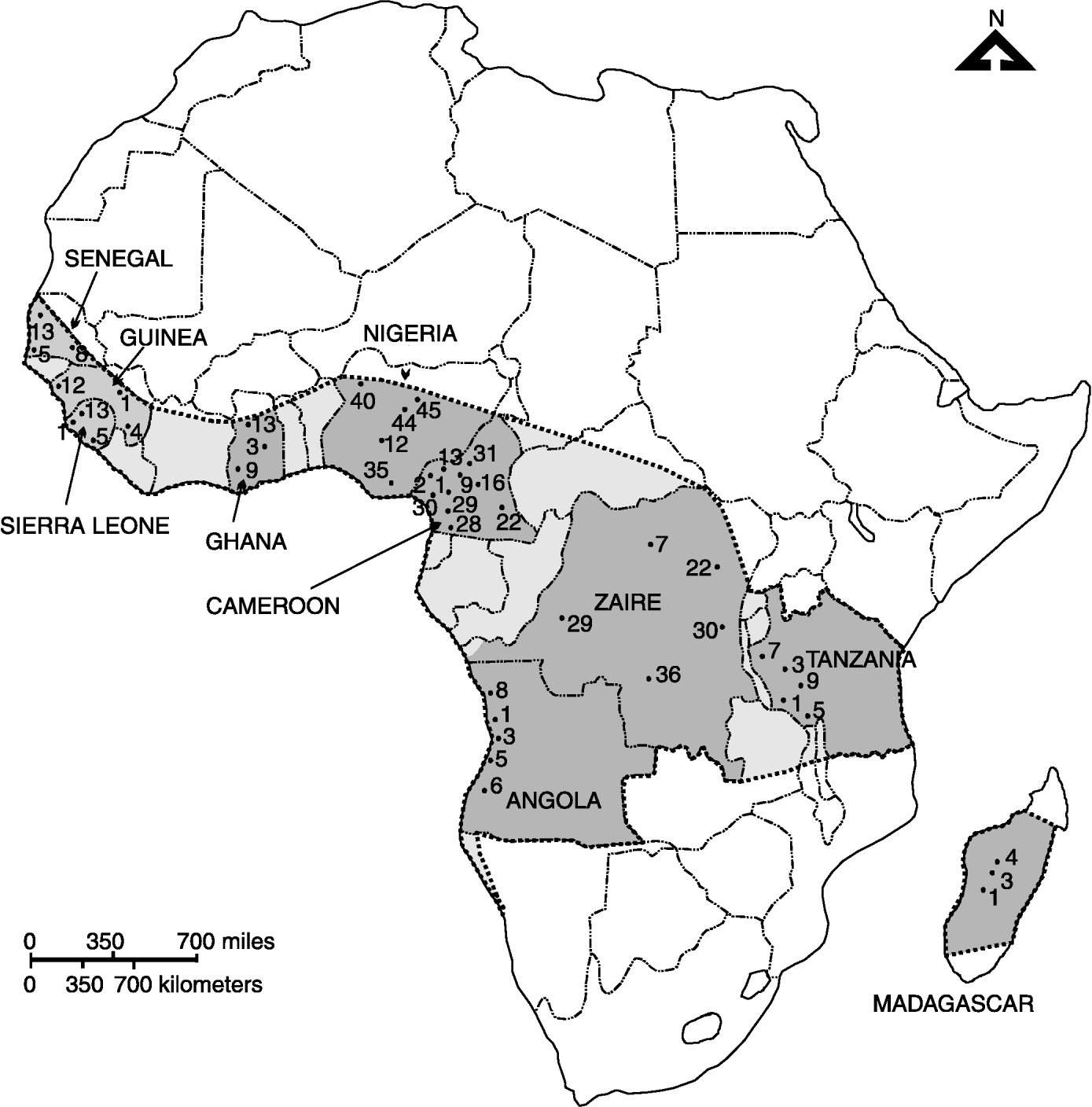
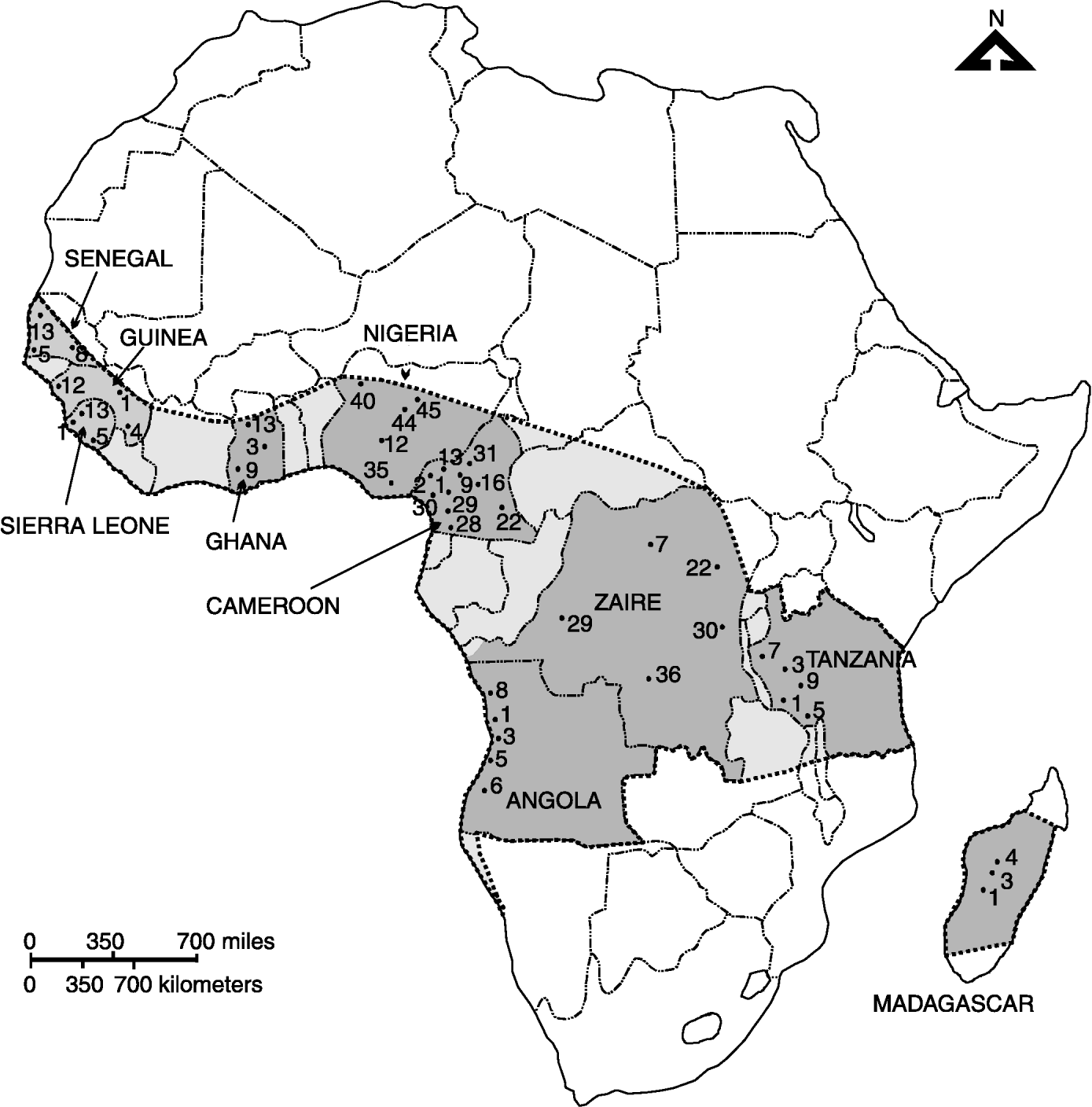
From a sample of 494 oil palms, derived from 45 native African populations (Fig. 1), two Deli and one La Mé (Côte d'Ivoire) breeding populations, and one semi-wild population Bahia (Brazil), 16 microsatellite markers (Billotte et al., Reference Billotte, Marseillac, Risterucci, Adon, Brottier, Baurens, Singh, Herran, Asmadi, Billot, Amblard, Durand-Gasselin, Courtois, Asmono, Cheah, Rohde, Ritter and Charrier2005) were used to derive genotypic descriptions. DNA was extracted from leaf material using a CTAB procedure (Doyle and Doyle, Reference Doyle and Doyle1990). PCR amplifications were performed according to Billotte et al. (Reference Billotte, Risterucci, Barcelos, Noyer, Amblard and Baurens2001), and the amplicons were separated on 7% denaturing polyacrylamide gels. Profiles were visualized by silver staining. POPGENE version 1.32 software (Yeh and Boyle, Reference Yeh and Boyle1999) was used to estimate allele frequencies and the effective number (A e) of alleles per locus. The generalized linear model procedure in SAS software was used to perform one-way ANOVA for A e and also the Duncan's multiple range test of comparison of all the populations based on their mean values of A e.
Distribution of oil palm in Africa and location of populations studied. (●) Population sampled in this study; (·····) limit of the distribution area.
Discussion
A combination of rapid population growth, urbanization and the development of agriculture is predicted to generate a loss in the genetic diversity of African native oil palms. The conservation of oil palm genetic resources provides a reservoir of genes for the development of novel traits, a prerequisite for the improvement of profitability of the crop. The major limitations for the in situ conservation of oil palm are the large area needed and the high maintenance cost. These drive the need to conserve only those collections which are allelically diverse.
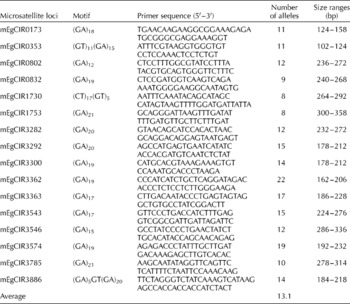
In all, 209 alleles were detected with a mean number of alleles per locus ranging from eight to 22 (Table 1). This high value reflects both the large number of individuals sampled and the high number (12–25) of microsatellite repeats in the loci analysed. Fourteen of the loci were monomorphic among the populations from Madagascar, suggesting a founder effect. The species was introduced to the island in the ninth century, and has suffered a high rate of inbreeding over many generations. Allele frequencies varied from one population to another. Some rare alleles (P < 0.05) and alleles A, B, C and D at locus mEgCIR3543 were present across populations from countries sharing a dry climate. The unequal distribution of allele frequencies among the populations was probably due to genetic drift, natural selection and human intervention which varied from one area to another. The selection of particular fruit types may have influenced the frequency of certain alleles through linkage. Alleles at high frequencies (P ≥ 0.75) found in Deli materials probably resulted from a founder effect in these materials that were derived from four palms introduced to the Bogor Botanic Garden in 1848 (Hartley, Reference Hartley1988) and also from several generations of selection favouring these alleles.
Synopsis of 16 Elaeis guineensis microsatellite loci, number of alleles and size ranges

The mean effective number of alleles per locus (A e) was 3.3 ± 1.3, which is higher than that found by Hayati et al. (Reference Hayati, Wickneswari, Maizura and Rajanaidu2004; A e = 1.35) using isozyme markers. The ANOVA for A e detected differences among populations over all loci (Table 2); whereas, the Duncan's multiple range test for A e clearly separated populations from Madagascar (A e = 1.1) and showed overlapping groups of populations for the rest (A e = 2.4–4.7) where A e values were comparable from one population to another. This was most probably due to human intervention as humans are an important factor in seed dispersal. For example, Tanzanian oil palms are reported to originate from the Congo and it is likely that Arab slave traders, who were active up and down the coast, may have distributed oil palm seeds. These features led to an exchange of materials among African natural oil palm collections resulting in a lack of significant differentiation.
Analysis of variance for expected heterozygosity (H e) in the natural oil palm populations and breeding materials

SS, sum of squares; MS, mean square; F, calculated parameter of Fisher.
Since conservation aims at securing maximum genetic diversity, be they alleles or genotypes, Hayati et al. (Reference Hayati, Wickneswari, Maizura and Rajanaidu2004) proposed the conservation of populations with A e representing 105–115% of the mean A e. Kulturatne (Reference Kulturatne2000) selected populations totalling 109–148% of the mean Shannon's index. In this study, populations with A e representing 109–142% of mean A e, possessing rare and unique alleles, were given priority as rare alleles are involved in plant adaptation to biotic and abiotic stresses (Rajora et al., Reference Rajora, Rahman, Bchert and Dancik2000). Our conclusion is that 22 natural oil palm populations together with at least one Madagascan population, as they grouped separately and are renowned for their high linoleic acid (C18:2) content, should be conserved.
Acknowledgements
Our sincere thanks to the Forest Genetics Laboratory of Universiti Kebangsaan Malaysia MPOB CIRAD-France and IRAD-Cameroon for their joint support.