Introduction
Increased concerns about global warming have resulted in special attention being paid to forests, soils and their ability to sustain carbon sequestration (Johnsen et al. Reference Johnsen, Wear, Oren, Teskey, Sanchez and Will2001, Pahlavan Yali et al. Reference Pahlavan Yali, Zarrinkafsh and Moeini2016). Forest ecosystems are the most important carbon pools among terrestrial ecosystems and can mitigate climate change (Labrecque et al. Reference Labrecque, Fournier, Luther and Piercey2006, Pan et al. Reference Pan, Birdsey, Fang, Houghton, Kauppi and Kurz2011, Lin & Ge, Reference Lin and Ge2019, Santini et al. Reference Santini, Adame, Nolan, Miquelajauregui, Piñero and Mastretta-Yanes2019, Zhang et al. Reference Zhang, Du, Zhou, Li, Mao and Dong2019). The high capacity of these ecosystems to reduce greenhouse gas emissions makes carbon management a key component of future natural climate solutions (Griscom et al. Reference Griscom, Adams, Ellis, Houghton, Lomax and Miteva2017, Fargione et al. Reference Fargione, Bassett, Boucher, Bridgham, Conant and Cook-Patton2018, Ontl et al. Reference Ontl, Janowiak, Swanston, Daley, Handler and Cornett2020). The Zagros forests span more than 5 million ha and are considered to represent the natural forest ecosystems of Iran, and their economic value in terms of carbon sequestration is substantial (Jazirehi & Ebrahimi Rostaghi Reference Jazirehi and Ebrahimi Rostaghi2013). Despite severe and continuous exploitation of these forests, some parts have been less disturbed, notably sacred groves, which are sacred religious areas and cemeteries (Pungetti et al. Reference Pungetti, Oviedo and Hooke2012, Plieninger et al. Reference Plieninger, Quintas-Soriano, Torralba, Mohammadi Samani and Shakeri2020). In these, a more natural state of the Zagros forests can be found (Shakeri Reference Shakeri2007, Jazirehi & Ebrahimi Rostaghi Reference Jazirehi and Ebrahimi Rostaghi2013).
In the northern Zagros forests, livelihoods include animal husbandry and traditional agriculture. Animal husbandry has a long tradition, and the leaves of local oak trees are used to provide livestock fodder. Overgrazing is one of the most significant human disturbances (Zhou et al. Reference Zhou, Li, Chen, Zhang and Li2011, Hu et al. Reference Hu, Li, Guo, Niu, He, Li and Yu2016, Schulz et al. Reference Schulz, Voigt, Beusch, Alemida-Cortez, Kowarik, Walz and Cierjacks2016, Gebregergs et al. Reference Gebregergs, Tessema, Solomon and Birhane2019), and grazing exclusion can help with the recovery of degraded ecosystems and enhance carbon sequestration (Qiu et al. Reference Qiu, Wei, Zhang and Cheng2013, Hu et al. Reference Hu, Li, Guo, Niu, He, Li and Yu2016, Ma et al. Reference Ma, Ding and Li2016, Atsbha et al. Reference Atsbha, Belayneh Desta and Zewdu2019, Gebregergs et al. Reference Gebregergs, Tessema, Solomon and Birhane2019, Liu et al. Reference Liu, Sheng, Wang, Ma, Huang and Li2020). Grazing, cutting down trees, collecting fodder and firewood and harvesting other crops from sacred groves are all forbidden by local community laws (Plieninger et al. Reference Plieninger, Quintas-Soriano, Torralba, Mohammadi Samani and Shakeri2020). The Zagros sacred groves represent an opportunity to see what the Zagros forests might look like in a less disturbed state. Here, we compare the carbon content of the sacred groves and silvopastoral lands to improve understanding of the capacity of Zagros oak forests to sequester carbon.
Methods
Study site description
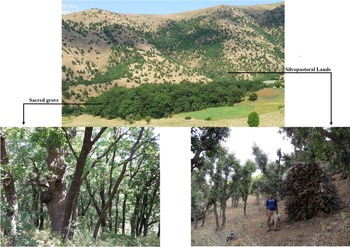
The study area includes sacred groves and silvopastoral lands in Baneh County (Zagros Mountains, Iran; 35º48′02″–36°11′40″N and 45°32′45″–46°10′25″E; Fig. 1). The climate is semi-humid and cold. The total annual precipitation is 600–800 mm. Dominant tree species are the oaks Quercus brantii Lindel, Quercus libani Olive and Quercus infectoria Olive. This study focused on the villages of Hange Jal, Booien Olya, Nejo, Yaghoub Abad and Gashkese, in each of which cemeteries more than 1 ha in area were selected as sacred groves. Silvopastoral areas were chosen from the forests surrounding these stands that had the same physiographical characteristics as the sacred groves. The land use of the forest is subject to Galazani, which involves gathering the branches and leaves of oak trees to feed livestock in the cold season, livestock grazing and other usages, such as harvesting the wood, by forest residents (Fig. 1).
Examples of a sacred grove and silvopastoral land in Hange Jal village.

Sampling design
We used nested concentric plots (ICIMOD et al. 2010, Karki et al. Reference Karki, Joshi, Udas, Adhikari, Sherpa and Kotru2016), each including a large circular plot (250 m2 with an 8.20m radius) for tree measurements, a larger sub-plot (100 m2 with a 5.65-m radius) for saplings, a smaller sub-plot (3.14 m2 with a 1.00-m radius) to count regeneration (seedlings) and the smallest sub-plot (0.56-m radius) for leaf litter, herbs, grasses and soil samples (Fig. 2). Sampling centres were determined using a systematic random method, and 20 plots were surveyed in each site (10 plots in sacred groves, 10 plots in the silvopastoral lands, study total of 100 plots).
Concentric nested circular plots. DBH = diameter at breast height.

Measurement of forest carbon stock
In both land-use areas, the diameter at breast height (DBH) and height of individual trees (DBH ≥5 cm) were measured. All trees that were measured were documented and identified to the species level. In the laboratory, the wood-specific densities (ρ) of the different tree species in each land use were measured. Above ground tree biomass (AGTB), aboveground sapling biomass (AGSB), mass of leaf litter, herbs and grass (LHG) and mass of dead wood and fallen stumps (DWS) were calculated using the allometric equations of Chave et al. (Reference Chave, Andalo, Brown, Cairns, Chambers and Eamus2005) and ICIMOD et al. (2010). Belowground biomass (BGB) was calculated using the equation of Cairns et al. (Reference Cairns, Brown, Helmer and Baumgardner1997). Soil organic carbon (SOC) was measured in 100 soil samples taken from depths of 0–15 and 15–30 cm. The percentage of SOC was determined using the Walkley and Black (Reference Walkley and Black1934) method (Nosetto et al. Reference Nosetto, Jobbagy and Paruelo2006, Amanuel et al. Reference Amanuel, Yimer and Karltun2018). The SOC stock was then calculated using the formulae of ICIMOD et al. (2010) and Karki et al. (Reference Karki, Joshi, Udas, Adhikari, Sherpa and Kotru2016). The total carbon content (tC ha–1) within each land use was then estimated from the sum of the above variables (ICIMOD et al. 2010, Karki et al. Reference Karki, Joshi, Udas, Adhikari, Sherpa and Kotru2016, Sumarga et al. Reference Sumarga, Nurudin and Suwandhi2020). The total forest carbon stock was converted into a carbon dioxide (CO2) equivalent by multiplying by 3.67 (Pearson et al. Reference Pearson, Brown and Birdsey2007).
SPSS version 23 was used for all analyses. The data and residuals were tested for normality. After assessing the homogeneity of variance, t-tests were used to compare the mean values of the variables between the two land uses.
Results
The studied variables were significantly different between the sacred groves and silvopastoral lands (Table 1). Aboveground and belowground tree biomass values in the sacred groves were c. five times greater than in the silvopastoral areas. In the silvopastoral areas, the values of herbs and grass, leaf litter and dead and fallen wood were much lower than in the sacred groves (Table 1). Total forest biomass and total carbon in the sacred groves were five- and three-fold greater, respectively, than in the silvopastoral lands (Table 2).
Mean biomass values under the two land uses. The same superscript letters beside the means of any variable indicate no difference at the 1% level between attributes.

The same Roman letters beside means of any parameter indicate no difference at the 5% level between two land uses.
AGSB = aboveground sapling biomass; AGTB = aboveground tree biomass; BGB = belowground biomass; DWS = dead wood and fallen stumps; LHG = leaf litter, herbs and grass; TFBI = total forest biomass.
Mean total carbon content and composition percentages by type under the two land uses.

AGSB = aboveground sapling biomass; AGTB = aboveground tree biomass; BGB = belowground biomass; DWS = dead wood and fallen stumps; LHG = leaf litter, herbs and grass; SOC = soil organic carbon; TBC = total biomass carbon; TC = total carbon.
Biomass
The mean total biomass values of the sacred groves and silvopastoral lands were 453.8 and 89.4 t ha–1, respectively (Table 1). However, the proportions of the biomass in each of the pools were similar between the land uses; most of the biomass was in AGTB and the least was in AGSB (Table 1). The DWS biomass was substantially greater in the sacred groves (Table 1). Although the LHG biomass was also much greater in sacred groves than in the silvopastoral areas, the percentage of LHG in the total biomass was greater in the latter.
Carbon content
The mean total carbon contents were 338.79 and 113.46 tC ha–1, respectively, in the sacred groves and silvopastoral lands, and the carbon distributions among the carbon pools also differed (Table 2). AGTB and soil contributed most to the total forest carbon stock, while ABSB contributed the least in both land uses. The mean SOC was significantly lower (71.44 tC ha–1) in the silvopastoral lands than in the sacred groves (125.49 tC ha–1). Importantly, in silvopastoral lands the soil carbon (62.96% of total carbon) was greater than the total biomass carbon (37.04% of total carbon). The mean total sequestered carbon dioxide (CO2) was 1243.36 tCO2 ha–1 in sacred groves and 416.40 tCO2 ha–1 in silvopastoral lands.
Discussion
We compared for the first time the biomass and carbon storage capacity of sacred groves in the Zagros forests with those of adjacent heavily used silvopastoral lands. Aboveground biomass and the total quantity of carbon in all carbon pools were substantially greater in sacred groves than in silvopastoral fields. In the sacred groves there were multi-storey tree cover, trees of greater height and diameter, denser canopy, more abundant leaf litter, greater deadwood, richer grass cover under the canopy and greater species diversity. These findings agree with earlier studies (Dibaba et al. Reference Dibaba, Soromessa and Workineh2019, Baul et al. Reference Baul, Chakraborty, Nandi, Mohiuddin, Kilpeläinen and Sultana2021), suggesting that forest stands with high species diversity and trees with large diameters and heights may in themselves store more carbon. For example, in homestead forests in Bangladesh, Baul et al. (Reference Baul, Chakraborty, Nandi, Mohiuddin, Kilpeläinen and Sultana2021) inferred that when tree height and DBH increased by one unit each, the biomass carbon stock increased by 11 and 3 Mg C ha−1, respectively. Dibaba et al. (Reference Dibaba, Soromessa and Workineh2019) observed that larger trees with greater diameters have the greatest carbon stores in terms of biomass. Wegiel and Polowy (Reference Wegiel and Polowy2020) demonstrated that the amount of carbon stored in plants is strongly related to their biomass. The greater the potential of aboveground and belowground biomass to produce carbon in diverse species and ecosystems, the more carbon is stored in tree trunks, leaf litter and soil.
Grazing exclusion work has shown that overgrazing is among the most significant of human disturbances impacting the performance of ecosystems and SOC stocks (Liu et al. Reference Liu, Sheng, Wang, Ma, Huang and Li2020), reducing plant cover, biomass and ecosystem productivity (Atsbha et al. Reference Atsbha, Belayneh Desta and Zewdu2019). Grazing exclusion can help recover degraded ecosystems (Hu et al. Reference Hu, Li, Guo, Niu, He, Li and Yu2016) and promote carbon deposition (Hu et al. Reference Hu, Li, Guo, Niu, He, Li and Yu2016, Gebregergs et al. Reference Gebregergs, Tessema, Solomon and Birhane2019). In the Zagros silvopastoral lands, animal husbandry is carried out using traditional methods; exacerbating the loss of grass cover on the forest floor, the branches and leaves of the trees in these forests are also used as fodder for the grazing of livestock through the pollarding system. Pollarding lowers tree production and growth capabilities within this land use (Soltani et al. Reference Soltani, Sadeghi Kaji and Kahyani2020). Low foliage production, little leaf litter on forest floors, sparse grass cover, high soil erosion and compaction of the soil surface result in low biomass and carbon inputs and storage levels that are much lower than predicted in the silvopastoral areas. Under local community rules, grazing is prohibited in sacred groves, and this is evidently one of the main contributors to the increased carbon observed in the sacred groves. Tsegay and Meng (Reference Tsegay and Meng2021) also found that exclosure of forests plays a fundamental role in sustaining sinks of carbon, and Speed et al. (Reference Speed, Martinsen, Mysterud, Mulder, Holand and Austrheim2014) concluded that grazing exclusion can increase aboveground carbon stocks, albeit at a low rate. Dong et al. (Reference Dong, Martinsen, Wu, Zheng, Liang, Liu and Mulder2021) suggested that grazing exclusion increased aboveground and belowground biomass in semi-arid grasslands and that this contributed to increased SOC concentration. In the Zagros forests, the mean carbon pools in sacred groves were significantly greater than in the silvopastoral lands. These sacred groves give an idea of what the biomass and carbon storage levels and distributions might be in restored Zagros forests. Tsegay and Meng (Reference Tsegay and Meng2021) and Gebregergs et al. (Reference Gebregergs, Tessema, Solomon and Birhane2019) demonstrated that aboveground and belowground carbon stocks were significantly greater under grazing exclusion. Sacred groves also have much greater aboveground and belowground carbon stocks. Grazing and tree cutting are prohibited in the Zagros sacred forests, resulting in much greater biomass and carbon storage in trees and soil than within silvopastoral fields.
The present results indicate that Zagros forests are currently far from their natural state; grazing and overexploitation are prominent drivers of this devastation. In the northern Loess Plateau of China, overgrazing has had a detrimental impact on plant development and soil carbon supply, plant cover, height, lead litter, aboveground and belowground productivity and soil carbon stock, all of which declined with increased grazing intensity (Zhu et al. Reference Zhu, Tang, Chen, Shangguan and Deng2018). Other studies, such as that of Limpert et al. (Reference Limpert, Carnell and Macreadie2021), have indicated that grazing exclusion increases the concentration of carbon in the soil and lowers carbon emissions.
Renhui et al. (Reference Renhui, Yinzhan, Liqi, Dong, Yanchun and Yuan2022) demonstrated that plant density, SOC and total nitrogen significantly increase with grazing exclusion; this grazing exclusion also strengthen the relationships between plant variables and SOC. The present results and those from other grazing exclusion studies (Nosetto et al. Reference Nosetto, Jobbagy and Paruelo2006, Qiu et al. Reference Qiu, Wei, Zhang and Cheng2013, Speed et al. Reference Speed, Martinsen, Mysterud, Mulder, Holand and Austrheim2014, Conant et al. Reference Conant, Cerri, Osborne and Paustian2017, Liu et al. Reference Liu, Sheng, Wang, Ma, Huang and Li2020) point to the necessity of restoring silvopastoral lands, balancing grazing and preventing the degradation and overexploitation of these forests. However, grazing has variable effects on SOC depending on the soil type, geography and climate (Wade et al. Reference Wade, Sonnier and Boughton2022), and in different areas livestock grazing may require different management strategies to ensure optimal carbon sequestration.
Negative anthropogenic impacts on carbon storage have been reported. For example, Zhu et al. (Reference Zhu, Ciais, Bastos, Ballantyne, Chevallier and Gasser2021) showed that emissions from the land could increase with deforestation. Shaw et al. (Reference Shaw, Rodrigue, Voicu, Latifovic, Pouliot and Hayne2021) demonstrated that anthropogenic and natural disturbances changed a study area from a net carbon sink into a net carbon source, and Hoover et al. (Reference Hoover and Smith2021) suggested that mean aboveground live tree carbon accumulation rates could increase considerably when anthropogenic disturbances are excluded. Our findings are consistent with those from these previous investigations, suggesting that the major differences between biomass and carbon in the two analysed applications were attributable to anthropogenic disturbances.
The proportions of each carbon pool in the overall amount of carbon stored were also substantial. In the sacred groves, two-thirds of the carbon were in aboveground and belowground pools, while one-third was in the soil. In contrast, in silvopastoral lands, the soil accounted for c. two-thirds of the total carbon, the remainder being in belowground and aboveground pools. This indicates a decrease in tree density and seedlings and a reduction in regeneration in the silvopastoral lands. The amount of soil carbon in sacred groves was c. 1.8 times that of silvopastoral lands. The change in the amount of soil carbon sequestration depends on the amount of carbon entering the soil through plant debris and the amount of carbon lost through decomposition (Rice Reference Rice2004). Singh et al. (Reference Singh, Bala, Chaudhuri and Meena2003), Rice (Reference Rice2004), Varamesh (Reference Varamesh2009), Salehi and Noormohammadi (Reference Salehi and Noormohammadi2012) and Pahlavan Yali et al. (Reference Pahlavan Yali, Zarrinkafsh and Moeini2016), amongst others, have pointed to the relationship between SOC sequestration and vegetation percentage, leaf litter, crop residues, land use and management. The significant difference of soil carbon in the present two land-use areas was also attributable to the difference in the return of organic matter to the soil; this was reduced in the silvopastoral lands because, in such lands, in addition to livestock grazing, the production capacity of the main element – trees – is removed due to pruning, reducing the production of foliage and leaving the forest floor bare of leaf litter and grass (Moradi & Shabanian Reference Moradi and Shabanian2022).
Sacred groves with high carbon reserves are part of the Zagros forests. In fact, if the Zagros forests were less degraded, they would be in a similar situation to the sacred groves today, and these forests could have a greater impact on carbon sequestration. Although preventing deforestation is necessary for the mitigation of climate change, it is not sufficient to achieve such mitigation (Erb et al. Reference Erb, Kastner, Plutzar, Bais, Carvalhais and Fetzel2018). Sacred groves can protect forest ecosystems and might help reduce climate change through carbon sequestration (Shrestha et al. Reference Shrestha, Devkota and Sharma2016). The Zagros sacred groves currently store 827 000 kg CO2 ha–1 more than the silvopastoral lands, and this is a sign of the high level of degradation in the forests of the study area.
Conclusions
The Zagros forests offer a useful model of what happens when forests are seriously damaged. The significant differences in biomass and carbon stocks between the sacred groves and silvopastoral lands indicate the potentially great value of restoring these forests. Here, the sacred groves are the most significant sites for biodiversity conservation and for carbon storage, as more formal types of protected areas have frequently failed in these areas (e.g., forest genetic resources under the management of the Department of Natural Resources and Watershed Management of Kurdistan Province in the study area or protected areas under the management of the Department of Environment Protection in the Zagros forests). The number of sacred groves in the forests of the northern Zagros forests is significant; these forests contain essential carbon reserves and high levels of biodiversity that are of great environmental importance. The Zagros forests of western Iran occupy a vast and important area, and the potential role of this natural and valuable ecosystem in storing carbon and perhaps helping to reduce climate change is becoming more apparent.
Acknowledgements
We express our sincere gratitude to the Vice Chancellorship of Research and Technology, University of Kurdistan, for supporting this research.
Financial support
None.
Competing interests
The authors declare none.
Ethical standards
None.