


Introduction
Although there have been major advances in the treatment of obsessive-compulsive disorder (OCD), it remains a challenging problem to treat successfully, with a significant proportion of patients not resolving their difficulties (Abramowitz, Reference Abramowitz1998). Many reasons have been put forward to account for therapeutic failure in OCD, including the presence of “over-valued ideation” where the patient perceives their obsessional fear as likely to be true (ego-syntonic) (Foa, Reference Foa1979; Rachman, Reference Rachman, Foa and Emmelkamp1983). Given the possible importance of such ego-syntonic beliefs in treatment refractoriness, it seems likely that comorbidity with obsessive compulsive personality disorder (OCPD) would have the same effect because OCPD is by definition characterized by ego-syntonic beliefs, i.e. excessively conscientiousness, scrupulous and inflexible about matters of morality, ethics or values. There is now evidence that some of these factors in the context of OCPD are associated with the severity of OCD itself (Gordon, Salkovskis, Oldfield and Carter, Reference Gordon, Salkovskis, Oldfield and Carter2013).
It is often suggested that, in general, co-morbid personality disorders are likely to interfere with CBT based treatment of Axis I disorders, given that personality disorders are regarded as dispositional and are therefore considered less amenable to change than axis I psychiatric disorders. In pharmacological treatment of anxiety disorders, clients with personality disorders show worse treatment outcomes for axis I disorders than those without (Reich, Reference Reich2003). In a study conducted by Baer et al. (Reference Baer, Jenike, Ricciardi, Holland, Seymour and Minichiello1992) with participants with OCD, the effect of concomitant personality disorder on the results of 10 weeks of pharmacotherapy was evaluated. Schizotypal, avoidant and borderline personality disorders were associated with poorer treatment outcome. Reich (Reference Reich2003) attributes poorer outcome to the greater likelihood that patients with personality disorders drop out of treatment and have poorer treatment compliance and interpersonal difficulties with mental health professionals. By contrast, however, in CBT research on the impact of personality disorders on CBT for anxiety disorders has found no, or limited, influence of comorbid personality disorders (Dreessen, Arntz, Luttels and Sallaerts, Reference Dreessen, Arntz, Luttels and Sallaerts1994; Dreessen, Hoekstra and Arntz, Reference Dreessen, Hoekstra and Arntz1997; Steketee, Chambless and Tran, Reference Steketee, Chambless and Tran2001). Dreessen et al. (Reference Dreessen, Arntz, Luttels and Sallaerts1994) reported on the effect of SCID-II personality pathology on treatment outcome to standardized individual CBT, in a group of 31 patients with panic disorder. It was found that patients with one or more personality disorders improved parallel to patients without a personality disorder. In a further investigation, Dreessen et al. (Reference Dreessen, Hoekstra and Arntz1997) studied 43 patients who completed standardized CBT for their obsessive-compulsive axis I complaints. They reported that the presence of one or more personality disorders had no impact upon change from pre-test to later tests, and that the presence of an avoidant, dependent, obsessive-compulsive, paranoid or schizotypal personality disorder was unrelated to immediate or long-term treatment outcome. Furthermore, the effect of personality pathology was studied by evaluating dimensional personality variables (the total number of personality disorder diagnoses, total number of personality traits, and the avoidant, obsessive-compulsive, paranoid, schizotypal, passive-aggressive, and self-defeating trait scores), and it was reported that none of these variables significantly predicted treatment outcome. In this study, personality disorder variables did not affect treatment outcome of patients with OCD even after including data of the drop-outs. The authors concluded therefore that the presence of any personality disorder, irrespective of type, is unrelated to treatment outcome.
Dreessen and Arntz (Reference Dreessen and Arntz1998) argue that apparent differences found in some studies in end of treatment outcome, i.e. higher posttreatment scores in individuals with co-morbid axis II disorders compared to those without axis II disorders may be accounted for by the fact that patients with personality disorders display higher symptom severity on axis I disorders prior to treatment. There is certainly ample other evidence that co-morbid axis II disorders are commonly associated with more severe symptomatology in terms of Axis I disorders (Gordon et al., Reference Gordon, Salkovskis, Oldfield and Carter2013; van den Hout, Brouwers and Oomen, Reference van den Hout, Brouwers and Oomen2006). It may be that these observations account for the clinical impression that patients respond less well to treatment. van den Hout et al. (Reference van den Hout, Brouwers and Oomen2006) investigated the short-term outcome of CBT for individuals with co-morbid personality disorders and axis I disorders such as OCD, panic disorder with agoraphobia and major depression. Results indicated that patients with axis II problems had higher axis I problems both before and after treatment, but the decrease was parallel.
The very elevated rates of OCPD in OCD samples, ranging from 23% (Albert, Maina, Forner and Bogetto, Reference Albert, Maina, Forner and Bogetto2004) to 45% (Gordon et al., Reference Gordon, Salkovskis, Oldfield and Carter2013) suggest that some of the same mechanisms are involved in these two otherwise distinct problems. Gordon et al. (Reference Gordon, Salkovskis, Oldfield and Carter2013) point out that the shared phenomenology of OCD and OCPD may explain the significant and specific association between them. They found that, across the entire OCD group, those who met the OCPD criteria for attention to detail, perfectionism, hoarding, and stubbornness had significantly higher self-reported obsession symptoms (OCI total scores), with no differences for excessive work, high standards, reluctance to delegate, and reluctance to spend money. It may be that responsibility as a cognitive factor could explain these associations (Salkovskis and Forrester, Reference Salkovskis, Forrester, Frost and Steketee2002).
Given that this is clearly such a common comorbidity, it is vitally important to explore whether the presence of OCPD specifically has a significant impact on cognitive behavioural treatment for OCD. It has been suggested that the occurrence of OCPD in the context of ego-syntonic but counter-productive traits, such as perfectionism, scrupulosity, or preoccupation with detail, can pose difficulties in the treatment of OCD (Salkovskis, Forrester, Richard and Morrison, Reference Salkovskis, Forrester, Richard, Morrison, Tarrier, Wells and Haddock1998). This may be due to the fact that the patient may wish to be rid of troublesome thoughts but also continue to behave in a way that may be regarded as obsessional. Salkovskis et al. (Reference Salkovskis, Forrester, Richard, Morrison, Tarrier, Wells and Haddock1998) suggest that the therapist and client may therefore need to experiment with more flexible ways of thinking and responding to their life as a whole; this process is usually incorporated into CBT for OCD which emphasizes both cognitive interventions and ERP in the form of behavioural experiments.
At present, there is little research evidence regarding the impact of OCPD on treatment outcome specifically in OCD. One study found a negative impact on pharmacological treatment (Cavedini, Erzegovesi, Ronchi and Bellodi, Reference Cavedini, Erzegovesi, Ronchi and Bellodi1997), while another did not find a significant difference in outcome in response to serotonin reuptake inhibitor between those with and without co-morbid OCPD (Baer et al., Reference Baer, Jenike, Ricciardi, Holland, Seymour and Minichiello1992). In terms of psychological therapy, Dreessen et al. (Reference Dreessen, Hoekstra and Arntz1997) reported that the presence of a range of personality disorders, including OCPD, did not negatively impact on CBT for OCD. Recently, Pinto, Liebowitz, Foa and Simpson (Reference Pinto, Liebowitz, Foa and Simpson2011) analysed a subset of medication refractory patients taken from a randomized trial. These patients were selected because they failed to respond adequately following at least 12 weeks on a stable, therapeutic dose of an SRI, and therefore received ERP as an addition to an SRI or SSRI. Results in this highly selected group indicated that OCPD severity predicted worse outcome when patients were given exposure and ritual prevention (ERP); however, the effect size is unclear, as is the extent to which the failure to respond to medication may have influenced the results.
The aims of the current study therefore were to explore in larger samples seen in routine clinical practice whether or not the presence of OCPD impacted on cognitive-behavioural treatment for OCD by studying treatment outcome for patients with OCD with co-morbid OCPD relative to those without OCPD.
Method
Participants
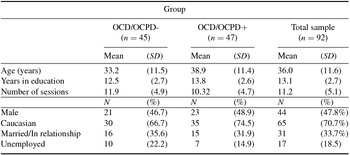
The sample consisted of 92 individuals, all of whom had completed treatment in a specialist anxiety disorders treatment and research centre for anxiety disorders, the Centre for Anxiety Disorders and Trauma (CADAT) run jointly by the Specialist Directorate of the South London and Maudsley Trust and the Institute of Psychiatry, King's College London. Of this total, 45 participants met diagnostic criteria for OCD, but not for OCPD, while 47 individuals had a diagnosis of OCD with co-morbid OCPD. Of all of the participants, 48 (52.2%) were female and 44 (47.8%) were male. Participants were aged 17 years or over, and the mean age of the sample was 36.03 years (SD = 11.57; range = 17–64 years). Table 1 sets out sociodemographic information of the total sample and that of participants with OCD according to whether or not they met diagnostic criteria for OCPD.
Sociodemographic characteristics of the each group with OCD according to whether criteria for OCPD was not met (OCD/OCPD-) and whether diagnostic criteria for OCPD was met (OCD/OCPD+) and the total sample

Treatment setting and content of therapy
CADAT is both a specialist CBT service (accepting national referrals) and part of local services. Clinicians at CADAT have a high level of training in CBT; most are either clinical psychologists or nurse therapists with diplomas in CBT or equivalent. The emphasis of the clinic on research-practice links, innovation in clinical methods and rigorous supervision promotes high quality CBT with a focus on idiosyncratic formulation and intricately designed behavioural experiments. Treatment starts with an emphasis on normalizing intrusive thoughts, and quickly progresses to an idiosyncratic formulation based on the vicious flower (Salkovskis et al., Reference Salkovskis, Forrester, Richard, Morrison, Tarrier, Wells and Haddock1998) and a “theory a, theory b” (Challacombe, Oldfield and Salkovskis, Reference Challacombe, Oldfield and Salkovskis2011). Goals and costs/benefits are discussed at an early stage. Several sessions can be devoted to exploration of the role of safety-seeking behaviours (Salkovskis, Reference Salkovskis1991) progressing to collaboratively derived behavioural experiments (see Challacombe et al., Reference Challacombe, Oldfield and Salkovskis2011 for examples). Whilst this stage of treatment involves encountering previously avoided situations and tolerating anxiety, this tends not to be classic “exposure” (that is, not a hierarchical progression through increasingly anxiety-provoking situations whilst allowing the habituation of anxiety); instead, the aim is belief change - finding evidence to support a less-threatening belief about “how the world really works” and to counter obsessional beliefs. As treatment continues, the emphasis shifts to greater use of homework tasks and being “OCD-free”. The final sessions and follow-up period focus on relapse prevention and how to overcome setbacks. A strong message in treatment is that nothing should be avoided, and that OCD is to be overcome, rather than “managed” or minimized.
Procedure
The data for this study were extracted from existing case-notes and databases previously set up for audit purposes within the specialist centre for anxiety disorders. Data were entered into an existing database for individuals with OCD. NHS referrals for OCD are accepted nationally and locally. As part of routine assessment procedure in the service, participants were assessed through a structured clinical diagnostic interview (the Structured Clinical Interview for DSM IV, SCID IV) by an appropriately trained clinical psychologist or a cognitive-behavioural therapist to determine relevant diagnoses and clinical characteristics. Furthermore, participants completed self-rated questionnaires for demographic information and further clinical characteristics. When participants completed treatment, which typically consisted of 12 sessions of individual CBT, therapist-completed measures and participant-completed measures were re-administered.
Measures
Participants completed the Beck Depression Inventory (BDI; Beck, Steer and Brown, Reference Beck, Steer and Brown2005) and the Beck Anxiety Inventory (BAI; Beck and Steer, Reference Beck and Steer1993) and took part in the Structured Clinical Interview for DSM–IV Axis I disorders (First, Spitzer, Gibbon and Williams, Reference First, Spitzer, Gibbon and Williams1996) and Structured Clinical Interview of DSM-IV Axis II disorders (First, Spitzer, Gibbon, Williams and Benjamin, Reference First, Spitzer, Gibbon, Williams and Benjamin1997). Participants also completed the Obsessive Compulsive Inventory (OCI; Foa, Kozak, Salkovskis, Coles and Amir, Reference Foa, Kozak, Salkovskis, Coles and Amir1998), the Responsibility Attitudes Scale (RAS; Salkovskis et al., Reference Salkovskis, Wroe, Gledhill, Morrison, Forrester and Richards2000) and the Client Ratings Scale (based on Watson and Marks, Reference Watson and Marks1971).
Beck Depression Inventory (BDI; Beck et al., Reference Beck, Steer and Brown2005) is a widely used 21-item self-report scale used to measure symptoms and severity of depression over the previous week, including cognitive, affective, motivational, and physiological symptoms. Each item has four alternative answers scored 0 to 3 and total scores range from 0 to 63.
Beck Anxiety Inventory (BAI; Beck and Steer, Reference Beck and Steer1993) is a 21-item self-report questionnaire designed to assess distress associated with symptoms of anxiety over the previous week. Each item enquires about how much the respondent has been bothered by each symptom on a 0–3 scale of severity from “not at all” to “severely”. Scores are added to give a single score ranging from 0–63.
Structured Clinical Interview for DSM-IV Axis I Disorders (SCID; First et al., Reference First, Spitzer, Gibbon and Williams1996) is a semi-structured interview used to screen for DSM-IV axis I disorders. All participants were administered the screening module of the SCID to identify possible co-morbid axis I disorders. Where particular axis I disorders were indicated on the screener, a full SCID was conducted for the relevant disorder(s) to ascertain whether or not the participant reached full diagnostic criteria for the disorder(s). The SCID for Axis I disorders Version 2.0 for OCD (First et al., Reference First, Spitzer, Gibbon and Williams1996) was administered to all participants referred for OCD to confirm they met DSM-IV diagnostic criteria for OCD (APA, 1994).
Structured Clinical Interview for DSM-IV Axis II Personality Disorders (SCID-II; First et al., Reference First, Spitzer, Gibbon, Williams and Benjamin1997) was administered to participants with a self-report screener to determine further axis II diagnoses. If a participant indicated a personality disorder on the self-report screener, he or she was interviewed by the assessor with the relevant personality disorder module to ascertain whether he or she met full SCID-II criteria for the relevant diagnosis. However, all participants referred for OCD were interviewed using the OCPD module of the Axis II SCID.
Obsessive Compulsive Inventory (OCI; Foa et al., Reference Foa, Kozak, Salkovskis, Coles and Amir1998) is a 42-item self-report measure of the frequency and distress associated with a range of obsessions and compulsions. Each item is scored for frequency on a scale of 0–4 (0 = never, and 4 = almost always), and distress on a scale of 0–4 (0 = not at all, and 4 = extremely). A total score for frequency and distress can be calculated as well as sub-scale scores for seven subscales relevant to various manifestations of obsessional behaviour: washing, checking, doubting, ordering, obsessions, hoarding and mental neutralizing. The maximum total score across the subscales is 168.
Responsibility Attitudes Scale (RAS; Salkovskis et al., Reference Salkovskis, Wroe, Gledhill, Morrison, Forrester and Richards2000) is a 26-item self-report questionnaire designed to assess general beliefs about responsibility. Each item is measured on a 7-point Likert scale, with responses ranging from 1 = totally agree to 7 = totally disagree. The scale has high test-retest reliability and internal consistency (r = 0.94; α = 0.92; Salkovskis et al., Reference Salkovskis, Wroe, Gledhill, Morrison, Forrester and Richards2000). The RAS correlates significantly with measures of obsessionality, therefore demonstrating concurrent validity (Salkovskis et al., Reference Salkovskis, Wroe, Gledhill, Morrison, Forrester and Richards2000).
Client Ratings Scale (internal clinic scale, based on Watson and Marks, Reference Watson and Marks1971). This scale furnishes information about the most troublesome thought and ritual of the client, along with specific ratings of the discomfort and interference associated with the thought and ritual over the previous week. These items are measured on a scale of 0 to 8, where zero indicates “not at all” or “absent” and 8 indicates extreme discomfort or interference. The amount of time that the patient is troubled by the obsessional problems as a whole is also requested. Furthermore, clients rate their general anxiety on how distressing their anxiety difficulties are as a whole at present, as well as how much the anxiety problems as a whole interfere with life at present. These ratings are on a similar 9-point scale. Finally, clients are requested to rate how OCD has impaired areas of their lives, such as work, home-management, social and leisure activities, private leisure activities, general relationship with partner, and sexual relationship. These impairment ratings are on a 9-point scale, where 0 indicates “not at all impaired” and 8 indicates “very severely impaired”.
Demographic information
Data were collected from clinical records of participants’ age, gender, ethnicity, number of years spent in education, employment status and relationship status. Information regarding age at which OCD began to significantly interfere with the service user's life, as well as alcohol consumption, was collected.
Data analysis
Means, standard deviations, percentages and frequencies were calculated for demographic information and co-morbidity rates. Between-group differences for the OCD with OCPD versus the OCD without OCPD cases were calculated using Chi-square analyses for categorical variables and ANOVAs and t-tests for continuous variables. Treatment responses were assessed using mixed model repeated measures ANOVAs (pre–posttreatment as the within subjects variable, with diagnostic grouping as fixed factor between subject variables; i.e. OCPD/No OCPD). The analytic strategy was determined by the authors prior to detailed inspection of the data. Where multiple variables could be examined (e.g. OCD outcomes), the within-subjects variable was pre–posttreatment, with OCPD/No OCPD as fixed factor between subjects variable.
Results
Effects of treatment for OCD-specific measures
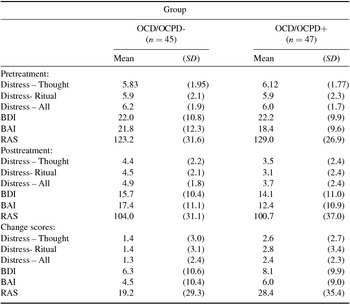
There were a number of outcome variables that could be analysed, and therefore a restricted range of variables were chosen a priori to reduce the impact of multiple testing. See Table 2 for pre–posttreatment scores on variables for the sample.
Pre to posttreatment scores for distress associated with obsessions and rituals, depression, anxiety, responsibility beliefs for groups with OCD with co-occurring OCPD and OCD without OCPD

Distress related to obsessional thoughts (0–8 Client-Ratings Scale)
There was a significant effect of treatment phase for distress associated with thoughts; F [1,80]=39.55, p < .0001. An OCPD x treatment interaction effect, however, was not significant, although the effect did suggest a trend, F [1, 80] =3.06, p = .083.
Distress related to rituals (0–8 Client-Ratings Scale)
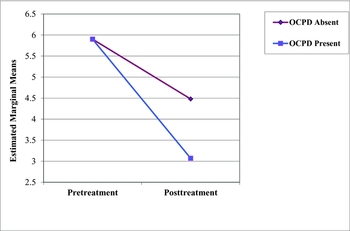
In terms of distress associated with rituals, there was a significant main effect of treatment, F [1, 80] = 34.9, p < .0001. The interaction between OCPD and treatment phase reached significance, F [1, 80] = 3.82, p = .05. For this variable, participants with OCPD displayed significantly greater improvement relative to patients without OCPD. An independent t-test indicates that at the end of treatment the groups were significantly different; t (85.9) = 2.03, p <.05. See Figure 1.
Mean scores of distress associated with rituals at pretreatment and posttreatment in participants with OCD and OCPD, compared with those with OCD without OCPD.

Distress rating for all obsessional problems (Client-Ratings Scale)
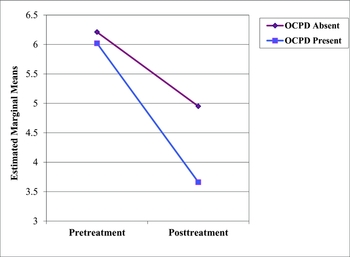
In terms of overall distress associated with obsessional difficulties, there was a significant main effect of treatment, F [1, 77] = 46.9, p < .0001. There was also a significant interaction between treatment phase and OCPD, F [1, 77] = 4.33, p < .05. A planned comparison indicated a significant difference between groups at posttreatment (t (82.9) = 2.03, p < .05). See Figure 2.
Mean scores of distress associated with all obsessional problems at pretreatment and posttreatment for participants with OCD and OCPD and those with OCD without OCPD

RAS
On this measure, there was a significant main effect of treatment, F [1, 90] = 49.67, p < .0001. However, the interaction between treatment phase and OCPD was not significant, F [1, 90] = 1.83, p = .18.
Obsessive compulsive inventory (OCI)
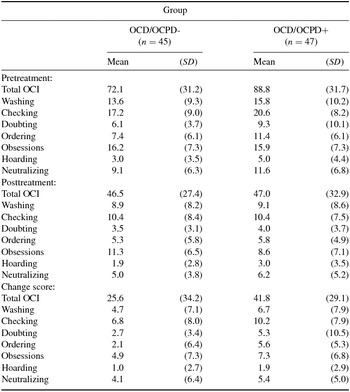
See Table 3 for pre to posttreatment scores on the OCI.
Pre to posttreatment scores on the Obsessive Compulsive Inventory for groups of participants with OCD with and without co-occurring OCPD

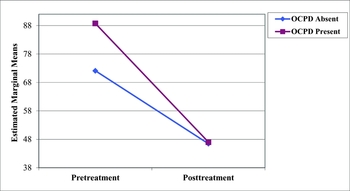
OCI total
For the total OCI scores, there was a significant main effect of treatment, F [1, 90] =103.12, p < .0001. There was also a significant interaction between treatment phase and OCPD, F [1, 90] = 5.9, p < .05. As can be seen from Figure 3, the pattern here is different; the pretreatment scores differ (p < .05) but converge at posttreatment.
Mean total OCI scores for participants with OCD with and without OCPD, before and after treatment

OCI washing
On the “washing” subscale of the OCI, there was a significant main effect of treatment, F [1, 90] = 53.55, p < .0001. There was no significant interaction between treatment phase and OCPD, F [1, 90] = 1.66, p = .20.
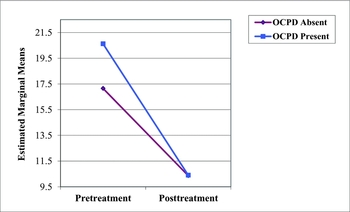
OCI checking
There was a significant main effect of treatment on the “checking” subscale of the OCI, F [1, 90] = 150.06, p < .0001. There was also a significant interaction between treatment phase and personality disorder, F [1, 90] = 4.28, p < .01. This interaction is illustrated in Figure 4.
Mean scores on OCI “Checking” subscale at pretreatment and posttreatment for OCD patients, with and without OCPD

OCI doubting
There was a significant main effect for treatment phase, F [1, 90] = 24.29, p < .0001. The interaction between treatment phase and OCPD was not significant, F [1, 90] =2.69, p = .11.
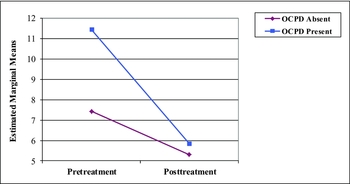
OCI ordering
For the OCI “ordering” subscale, there was a significant main effect of treatment, F [1, 90] = 39.73, p < .0001. As depicted in Figure 5, there was also a significant interaction between treatment and OCPD, F [1, 90] = 8.02, p <.05.
Mean scores on the “Ordering” subscale of the OCI for participants with OCD and OCPD, and those with OCD without OCPD

OCI obsessions
There was a significant effect of treatment phase F [1, 90] = 68.39, p < .0001. However, the interaction between treatment and personality disorder was not significant, F [1, 90] = 2.64, p = .107.
OCI hoarding
For the “hoarding” subscale of the OCI, a significant effect of treatment phase was found, F [1, 90] = 25.35, p < .0001. The interaction of treatment phase with OCPD, however, was not significant, F [1, 90] = 2.27, p = .135.
OCI neutralizing
There was a significant effect of treatment phase, F [1, 90] = 63.96, p<.0001. There was no significant interaction between treatment and OCPD, F [1, 90] = 1.17, p = .28.
Effects of treatment on mood
Depression (BDI). A significant main effect of treatment was found, F [1, 90] = 44.91, p < .0001. However, there was no significant interaction between treatment phase and personality disorder, F < 1.
Anxiety (BAI). There was a significant effect of treatment phase for anxiety, F [1, 92] = 26.88, p<.0001. There was no significant interaction between treatment phase and OCPD, F < 1.
Discussion
The aim of the present study was to evaluate the impact of OCPD on CBT for OCD by comparing patients with OCD who met diagnostic criteria for OCPD with those with OCD who did not meet criteria for OCPD. The presence of OCPD did not impact on outcomes in terms of depression and anxiety measures. However, there were significant differences between the OCD with OCPD and OCD without OCPD groups in terms of treatment outcome on other measures. For level of self-rated disability there was evidence of similar initial levels but with the OCPD group making greater gains. For OCD symptoms rated on the OCI, Checking, Ordering and Total OCI scores, initial levels were higher for OCPD patients but converged at posttreatment. In no instance was there evidence of the presence of OCPD impairing treatment response.
These findings unexpectedly suggest that individuals with OCD and OCPD appear to benefit more from CBT treatment for OCD than those without OCPD. Previously, Dreessen et al. (Reference Dreessen, Hoekstra and Arntz1997) studied the treatment outcome for 43 patients with OCD who completed standardized CBT for their obsessive compulsive axis I difficulties. They found that the presence of one or more personality disorders, including OCPD, had no impact on treatment, such that all participants benefited equally from treatment. Furthermore, previous studies have found that treatment of anxiety disorders for individuals with one or more concomitant personality disorder, is somewhat less successful than for patients without one or more personality disorders (Mennin and Heimberg, Reference Mennin and Heimberg2000). However, findings from the present study indicate that individuals specifically with OCPD had greater treatment gains in terms of OCD symptoms than those without OCPD.
Reasons for this finding are of great interest. Guidano and Liotti (Reference Guidano and Liotti1983) propose that underlying both OCPD and ritualistic elements of OCD are maladaptive components such as perfectionism, a need for certainty and a belief in an absolutely correct solution to problems. Furthermore, Beck, Freeman, Davis and Associates (Reference Beck, Freeman and Davis2004) suggest that individuals with OCPD have a view of themselves as responsible for themselves and others, and are accountable to their own (unrealistically high) perfectionistic standards. Furthermore, it has been suggested that dichotomous thinking is an important characteristic distortion of individuals with OCPD (Beck et al., Reference Beck, Freeman and Davis2004). It may be that CBT for OCD as conducted here with a cognitive emphasis might be particularly helpful for those with OCPD. Although treatment includes a major component of ERP, it is embedded within a cognitive rationale that seeks to change aspects of perfectionism as well as specific appraisals of responsibility and the way these motivate compulsive behaviour. Having loosened these beliefs, it then becomes easier for patients to engage in behavioural experiments including high levels of exposure with full response prevention. Cognitive elements in the treatment thus focus on increasing cognitive flexibility by offering the formulation as an “alternative explanation” (Salkovskis, Reference Salkovskis and Rapee1996), with an emphasis on “theory A vs theory B” (Challacombe et al., Reference Challacombe, Oldfield and Salkovskis2011). Other components, again formulation driven, target “just right” phenomena, dichotomous thinking, intolerance of uncertainty, and responsibility beliefs. These strategies may work by targeting the elevated levels of overall OCD symptoms in individuals with OCD and OCPD. It is also possible that individuals with OCD accompanied by OCPD respond especially well to certain aspects of the cognitive emphasis in terms of thought processes (Beck et al., Reference Beck, Freeman and Davis2004). Anecdotally, it also seems that, once a cognitive shift to an alternative, less threatening explanation of their obsessional fears is achieved, a level of effort towards perfectionism in therapy itself may come into play. Thus, patients with perfectionistic tendencies listen to their recordings of therapy and carry out other homework assignments more assiduously than those without such tendencies. In therapy with patients who have both OCD and OCPD it may be that what starts as a problem (perfectionism) can become an asset in treatment itself.
Since completing the present study, Pinto et al. (Reference Pinto, Liebowitz, Foa and Simpson2011) reported an interesting study that found that the presence of OCPD predicted worse outcome in therapy for OCD in a medication refractory sample. The presence of perfectionism in that study was associated with poorer treatment outcome. Indeed, Pinto et al. point out that the presence of this single OCPD trait was as predictive of outcome as the total number of OCPD criteria endorsed. Perfectionism has been found to be one of the most prevalent and stable OCPD features (McGlashan et al., Reference McGlashan, Grilo, Sanislow, Ralevski, Morey and Gunderson2005). Although at first sight this finding would appear to be at odds with those reported here, there are a number of key differences, notably the sample (medication refractory patients) and the behavioural framework used to present ERP rather than the cognitively based CBT in the present study. It may be that the outcomes are indeed different CBT relative to ERP for OCD. Clearly it would be helpful to conduct a study comparing these different approaches to therapy in patients suffering from OCD and OCPD.
Clinical implications
Clinically, the contrast between the present study and that of Pinto et al. (Reference Pinto, Liebowitz, Foa and Simpson2011) leaves a number of important questions unanswered. The fact that, in a routine clinical setting, participants with OCD and co-morbid OCPD displayed either similar or greater treatment gains than those without OCPD (with no evidence of poorer outcomes) is encouraging. We suggest that it would be inappropriate to anticipate poorer outcome (as often is the case) in order to avoid self-fulfilling expectancy effects. Furthermore, it seems that attributing therapeutic failure to concomitant OCPD would be erroneous; it may be simply that such patients require a treatment that increases their cognitive flexibility, as in the CBT delivered in the present study. Given the high rate of OCPD in samples with OCD, incorporating cognitive techniques aimed at addressing OCPD traits, such as clinical perfectionism as part of routine treatment may be useful.
Acknowledgements
Financial support: This study represents independent research part funded by the National Institute for Health Research (NIHR) Biomedical Research Centre at South London and Maudsley NHS Foundation Trust and King's College London. The views expressed are those of the authors and not necessarily those of the NHS, the NIHR or the Department of Health.
Conflict of interest: The authors have no conflicts of interest with respect to this publication.



Comments
No Comments have been published for this article.