




No CrossRef data available.
Article contents
The influence of attention and age on the occurrence of mirror movements
Published online by Cambridge University Press: 16 December 2005
Abstract
This study utilised a finger force task to investigate the influence of attention and age on the occurrence of motor overflow in the form of mirror movements in neurologically intact adults. Forty right-handed participants were recruited from three age groups: 20–30 years, 40–50 years, and 60–70 years. Participants were required to maintain a target force using both their index and middle fingers, representing 50% of their maximum strength capacity for that hand. Attention was directed to a hand by activating a bone conduction vibrator attached to the small finger of that hand. Based on Cabeza's (2002) model of hemispheric asymmetry reduction in older adults, it was hypothesised that mirror movements would increase with age. Furthermore, it was expected that when the attentional demands of the task were increased, motor overflow occurrence would be exacerbated for the older adult group. The results obtained provide support for the model, and qualified support for the hypothesis that increasing the attentional demands of a task results in greater motor overflow. It is proposed that the association between mirror movements and age observed in this study may result from an age-related increase in bihemispheric activation that occurs in older adults, who, unlike younger adults, benefit from bihemispheric processing for task performance. (JINS, 2005, 11, 855–862.)
Information
- Type
- Research Article
- Information
- Journal of the International Neuropsychological Society , Volume 11 , Issue 7 , November 2005 , pp. 855 - 862
- Copyright
- © 2005 The International Neuropsychological Society
INTRODUCTION
Motor overflow refers to the unintended movements that sometimes accompany voluntary movements (Aranyi & Rosler, 2002; Georgiou-Karistianis et al., 2004; Hoy et al., 2004a; Liederman & Foley, 1987). Mirror movements are a subtype of motor overflow that occurs in homologous muscles on the opposite side of the body (Abercombie et al., 1964; Mayston et al., 1999). These involuntary movements are normal in childhood, but decrease between the ages of seven and ten years (Connolly & Stratton, 1968; Nakada et al., 1998; Nass, 1985). Persistence of mirror movements into adulthood is considered to be abnormal and may be familial (Bauman, 1932; Heck, 1964; Regli et al., 1967; Somers et al., 1976; van den Berg et al., 2000). However, neurologically intact individuals do exhibit mirror movements when performing tasks involving muscle fatigue and extremes of effort (Armatas et al., 1994, 1996a, 1996b; Cernacek, 1961; Liederman & Foley, 1987; Stern et al., 1976; Todor & Lazarus, 1986; Yensen, 1965).
Two theories have been developed to explain motor overflow occurrence in both clinical and non-clinical populations (see Hoy et al., 2004b for a review). The mechanism underlying motor overflow appears to be dependent on the presence or absence of a disease state, and, where present, on the nature of the disease (Cincotta et al., 2003; Maegaki et al., 2002; Mayston et al., 1999; Reitz & Muller, 1998). The first theory, proposed by Cernacek (1961), suggests that the mechanism underlying motor overflow is transcallosal facilitation (TCF), whereby activation in one hemisphere during voluntary movement facilitates activation of the same neural area in the opposite hemisphere, via the connections of the corpus callosum (CC). Sufficient facilitation can lead to involuntary movements on the opposite side of the body (i.e., motor overflow). In the light of subsequent research, this explanation has been modified such that motor overflow is thought to occur via TCF unless inhibited by a callosally mediated, interhemispheric inhibitory mechanism arising from the contralateral hemisphere (Aranyi & Rosler, 2002; Mayston et al., 1999; Sohn et al., 2003). According to Hoy et al. (2004b), the research evidence indicates that during motor cortex activation there is a very early facilitation of the contralateral motor cortex, which most likely occurs transcallosally. This is followed by transcallosal inhibition (TCI) as the spread of cortical activation increases, which serves to assist unilateral movement. The corpus callosum is therefore involved in the production of motor overflow to the extent that callosal fibres can have a direct excitatory effect on cortical cells as well as exerting excitatory influences on inhibitory interneurones, which has a net inhibitory effect. A number of studies have found simultaneous bicortical activation, with studies using various neuroimaging techniques strongly suggesting that during unilateral finger movements both primary motor cortices are activated (e.g., Cheyne et al., 1995; Ikeda et al., 1992).
In contrast, the second theory—ipsilateral corticospinal activation—was proposed by Nass (1985) to explain motor overflow observed in young children, and suggests that motor overflow occurs due to the absence of inhibition of the ipsilateral section of the corticospinal tract, which consists of a small number of fibres that do not cross over. This theory proposes that sufficient removal or absence of intrahemispheric inhibition causes the ipsilateral pathway to become active, with the resulting activation causing motor overflow. The motor cortical region responsible for activation of this tract is believed to be spatially distinct from that responsible for the contralateral tract (Cramer et al., 1999; Ziemann et al., 1999). Normally, the ipsilateral tract is inhibited during unilateral movements by the contralateral hemisphere via the CC. That voluntary hand movement exerts an inhibitory influence over the ipsilateral motor cortex via callosally mediated inhibition of the ipsilateral corticospinal tract has been confirmed (Sohn et al., 2003).
These two theories are not necessarily mutually exclusive (Hoy et al., 2004b) and both propose an important role for the CC in motor overflow mechanisms. Age-related decreases in the size of the CC which may affect motor overflow occurrence via a transcallosal mechanism have been documented (Allen et al., 1991; Connolly & Stratton, 1968; Cowell et al., 1992; Nakada et al., 1998; Nass, 1985; Witelson, 1985). Allen et al. (1991) demonstrated significant relationships between age and the size of CC regions, with regional CC areas increasing during childhood and decreasing during adulthood. Furthermore, increased callosal area is associated with a larger number of fibres crossing through the CC, enhancing capacity for interhemispheric transfer (e.g., Aboitiz et al., 1992; de Lacoste-Utamsing & Holloway, 1982; La Mantia & Rakic, 1990; Tomasch, 1954; Witelson, 1985). The TCF explanation of motor overflow occurrence (Cernacek, 1961) would predict that diminished transcallosal connectivity should result in decreased potential for activation of homologous regions in the contralateral hemisphere. Therefore, motor overflow should decrease with age-related changes to the CC. However, if the occurrence of motor overflow is dependent on the balance between TCF and TCI, then impaired CC functioning could lead to increased potential for motor overflow. Since TCI is usually greater than TCF, physiological changes to the CC as a result of ageing may result in the loss of inhibitory projections. This in turn should result in an increase in motor overflow with age. In support of this, Bodwell et al. (2003) found greater motor overflow in elderly subjects. However, they concluded that increased motor overflow did not necessarily reflect age-related dysfunction. Rather, they proposed that overflow may be a compensatory event of normal ageing.
Bilateral hemispheric activation has been proposed as an age-related compensatory mechanism. Cabeza's (2002) hemispheric asymmetry reduction in older adults (HAROLD) model states that during cognitive tasks, older adults exhibit less lateralized prefrontal activity compared with younger adults. Cabeza cites 13 studies using either positron emission tomography (PET) or functional magnetic resonance imaging (fMRI) that show greater bilateral activation in older participants on tasks such as word and face recognition, face matching, inhibitory control and cued recall. In addition, Cabeza cites behavioural evidence from a study requiring participants to match two letters projected to either the same or opposite visual fields which supports the HAROLD model. In the letter matching study, younger adults performed within-hemisphere matching faster when the task complexity was low (i.e., only one distractor present), but across-hemisphere matching was faster when complexity was high (name matching with three distractors), while performance within and across hemispheres was equivalent when complexity was medium (three distractors). In contrast, the older adults showed an advantage for across-hemisphere matching in both medium and high complexity conditions, from which it was concluded that older adults may benefit from bihemispheric processing at task complexity levels for which younger adults find unilateral processing sufficient.
Although the evidence for the HAROLD model comes mainly from research on prefrontal cortex functioning using cognitive tasks, Cabeza (2002) maintains that the model could be applied to other brain areas. Cabeza cites a PET study by Calautti et al. (2001), which he suggests provides evidence that the HAROLD model may generalize to simple motor processes. Calautti et al. investigated the effects of ageing on brain activity during auditory-cued thumb-to-index finger tapping. Both older and younger age groups showed sensory motor activity in the contralateral hemisphere when performing this task. However, older adults showed more activity than younger adults in the right dorsal prefrontal cortex during right-hand tapping, suggesting increased ipsilateral activation in the older group. Furthermore, since contralateral motor cortical activity must be under the control of a balance of inhibitory and excitatory innervation, a loss of inhibitory projections could in fact explain the development of increased bilateral activation and at the same time explain an age-related increase in overflow.
Mattay et al. (2002) report that in their study of the neurophysiological correlates of age-related changes in human motor function, elderly participants were found to recruit additional cortical and subcortical areas when performing a simple motor task. During performance of a visually paced, sequential button-pressing task, older participants, aged 50 to 74 years, demonstrated greater activation of the contralateral primary motor cortex as well as other regions involved in motor processing. Furthermore, for those elderly participants with greater activity in motor regions, reaction times were faster, while those who did not show increased bilateral activation performed worse on the task, as indicated by their reaction time scores. These researchers argue that the heightened cortical activation observed in these older participants may reflect either compensatory mechanisms or functional reorganization in response to changes in neurotransmitter balance. They cite imaging and electrophysiological studies of motor behaviour that support the interpretation of increased cortical activation as a compensatory response to increased functional demands. They also acknowledge, however, that the observed cortical hyperactivity may reflect a breakdown of local inhibitory processes or be the result of an interplay between all of these mechanisms. Mattay et al. (2002) concluded that the findings from their study were consistent with the HAROLD model and show that these compensatory changes occur in older individuals even for simple motor tasks.
The HAROLD model suggests that an age-related increase in overflow should occur due to increased bilateral activation associated with task performance. In older adults, greater bilateral activation serves the need to provide additional resources, increased processing speed or greater inhibitory control (Cabeza, 2002), and so on most tasks increased motor overflow could be expected. Furthermore, the HAROLD model states that greater bilateral activation occurs to meet the need for greater resources. Increasing the attentional demands of a task requires greater resources and so should result in increased bilateral activation. Therefore, if the HAROLD model applies to motor overflow, increasing the attentional demands of a task should exacerbate motor overflow occurrence in older participants.
This study therefore investigated the effects of attentional processes and age on motor overflow, measured by the mirror movements exerted during a finger force task (i.e., involuntary movement observed in one hand while the opposite hand is exerting force), adopting our previously developed experimental technique (Armatas et al. 1996a, 1996b; Georgiou-Karistianis et al., 2004; Hoy et al., 2004a). The intensity of overflow occurring under conditions where attention was directed to the active, passive or neither hand was compared across three age groups. We predicted that, if bilateral activation increased with age, the older age group would exhibit increased motor overflow. Furthermore, increasing attentional demands during the task would result in greater motor overflow for the older participants due to the predicted bilateral activation increase (to meet the increased demand for resources to successfully perform the task).
METHOD
Participants
Participants comprised 40 right-handed, normal, healthy individuals from the general community. Data from four participants were subsequently excluded: three because of equipment failure, and one because of possible cognitive impairment. The final sample (N = 36) was divided into three equal age groups, 20–30 years (N = 12; Mage = 23.67 years, SD = 4.16), 40–50 years (N = 12; Mage = 45.42 years, SD = 2.31) and 60–70 years (N = 12; Mage = 66.67 years, SD = 3.94), each with six males and six females.
Materials
The experimental apparatus comprised two linear variable differential transformer (LVDT) units (Lucas Schaevitz model FTD-G-5K), which gave a measure of absolute force (measured in grams weight [g wt]) exerted on the surface of the unit. Each LVDT unit consisted of a circular force plate, which accommodated two fingers. The LVDT units were secured in a wooden enclosure for stability. The force transducers were connected to a laptop computer that allowed the experimenter to calibrate the apparatus, set task parameters, run the experiment, and analyse the data. The computer displayed the forces produced by each participant, allowing them to monitor each force created during a single trial. The load limit for these LVDT units was 5 kilograms (kg). Previous testing of forces of up to 9 kg with known weights revealed that these units accurately measured force beyond the 5 kg value set by the manufacturer (Armatas et al., 1996a). This meant that maximum finger strength could be determined accurately for all participants using this apparatus. In addition to the LVDT units, an Oticon A (47-ohm impedance) bone conduction vibrator was used as a transducer. It had a vibrating surface (1.7 cm in diameter) that was controlled by a microprocessor that allowed the setting of task parameters such as adjustments to intensity (1.25 V peak-to-peak, which produced a clearly perceptible vibration) and duration (1000 ms).
Test materials comprised four questionnaires: the Edinburgh Handedness Inventory (EdHI; Oldfield, 1971), Beck Depression Inventory (BDI; Beck et al., 1961), Mini-Mental State Exam (MMSE; Folstein et al., 1975) and a general health questionnaire. The EdHI assessed hand preference, and individuals with positive handedness quotients were considered right-handed. The BDI was used to screen for depressive symptoms, with scores above 9 considered indicative of depression. The MMSE screened for cognitive impairment, with scores below 23 considered to show signs of impairment. The health questionnaire was designed to obtain information regarding medical history involving multiple sclerosis, Parkinson's disease, Huntington's disease, schizophrenia, and depression, as these disorders have been found to generate anomalous patterns of motor overflow. The health questionnaire also collected information regarding any previous history of injury, surgery, or trauma to the head. We considered participants who were currently experiencing symptoms, taking medication for symptom relief or had recently experienced trauma to the head to be at risk for exhibiting irregular motor and/or mirror movements and we therefore excluded them from the study.
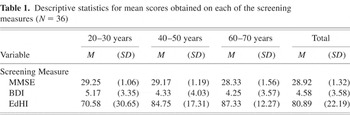
Mean scores obtained on each of the screening measures (MMSE, BDI, EdHI) for each age group for the final sample are shown in Table 1. The results revealed that MMSE, BDI, and EdHI values were in the normal range. One participant had a history of possible cognitive impairment and was excluded despite obtaining a normal MMSE score. No participants reported a history of Huntington's disease, Parkinson's disease, multiple sclerosis, or schizophrenia. Three participants reported a history of depression but were not currently experiencing a depressive episode or taking antidepressant medication and so were not excluded, leaving a final sample size of 36 for analysis.
Descriptive statistics for mean scores obtained on each of the screening measures (N = 36)

Procedure
Ethics approval for this research was gained from relevant ethics committees and participants provided written informed consent. Participants were told that the task involved pressing down with a nominated hand using only their index and middle fingers, while the fingers of the other hand do “nothing.” The participants were told that on each trial they would feel a small vibration randomly on either hand or not at all.
Before the commencement of the finger force task, the bone conduction vibrators were attached to the little fingers of both hands via Velcro strips. Participants were instructed to ignore any vibration detected throughout the task. Measurements were first taken of the force exerted by the index and middle fingers of each hand when resting on the LVDT units. Baseline measures compensating for the weight of the fingers resting on the apparatus were subsequently used on experimental trials. The maximum strength for each hand (index and middle fingers together) was then determined by having participants press down as hard as possible with a designated hand onto the LVDT force plate. They were asked to try and avoid the involvement of wrist or forearm action when pressing down on the transducer to ensure that the force produced was primarily due to finger strength. The experimenter carefully monitored the participants to ensure they met this requirement. The maximum force exerted by both the left and right hands individually for two trials each was taken to be the maximum force produced by that hand. This maximum strength value was then used to determine the target force for the remaining trials.
Following the maximum force trials, the participants were instructed that they would be required to sustain a force with their designated hand that represented 50% of their maximum force. It was demonstrated how the computer would display the participant's force production during each trial and how they would be able to monitor the force they were producing. For each trial, participants were informed with which hand to produce force. They were instructed to concentrate only on force production, to try and reach the target force quickly and accurately, and to maintain the target force until the signal to end the trial was given. They were also informed that regardless of which hand was active during a trial, the inactive hand should remain resting on the other LVDT force plate at all times.
Participants completed a total of 72 randomly ordered experimental trials. There were 12 trials per condition, with the responding hand and the direction of attention randomized across trials. On each trial the participant placed both hands (index and middle finger of each hand) on the LVDT force plates. A computer generated signal indicated to the participant to begin pressing the LVDT plate with the designated hand until the target force on the computer screen was reached. The participant then maintained the target force for approximately 5 seconds. At the 3-second mark of the trial (when the participant had achieved the target force), the vibratory stimulus was administered to either the active or the passive hand, or not at all. At the 5-second mark, a computer-generated signal indicated the end of the trial and the participant ceased pressing.
Data Inclusion Criteria
Each experimental trial was divided into three phases: initial, unstable, and maintenance. The initial phase was defined as the period of time during which the force exerted rose to 90% of the target force. The unstable phase represented the time during which the exerted force oscillated around the target force by more than 10%. The maintenance phase was defined as the time where the exerted force was maintained within 10% of the target force. Force exerted by the passive hand during this phase was used to measure mirror movements. If on a given trial, the participant was unable to maintain a level of force that was within 10% of the target force for at least 1 second, the trial was excluded from the data analyses. In addition to this, if the level of force exerted by the passive hand of the participant was below baseline (indicating that the passive hand was lifted off the LVDT), the trial was excluded. Approximately 8% of all trials were excluded using these criteria. For a participant's data to be included in the analyses, a minimum of eight trials was required for each experimental condition.
Design
A 3 × 3 repeated measures design was used with Age (20–30, 40–50, 60–70 years) as the between-subjects factor, and Attention (vibration directed to either the active hand, passive hand or not at all) as the within-subjects factor. Mirror movements were the unintended force exerted by the passive hand, which was measured in g wt.
RESULTS
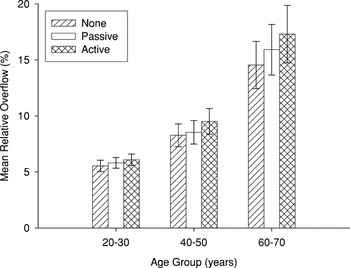
Measures of mirror movement taken during the maintenance phase were used to examine factors influencing the intensity of mirror movement. Although the strength requirements of the task were held constant across participants, the actual forces exerted by individuals varied. To control for the effect of larger forces producing greater amounts of motor overflow, mean mirror movement occurring during the maintenance phase was expressed as a percentage of the target force. To determine if there were any differences for the mean mirror movement relative to target force, an analysis of variance, using Helmert contrasts and Tukey's Post Hoc tests, with factors of Attention (vibration directed to either the active hand, passive hand, or not at all) and Age (20–30 years, 40–50 years, 60–70 years) was performed. A log transformation was applied to the data to reduce skew after which all assumptions underlying the analysis were met. Mauchly's Test of Sphericity was significant for Attention, χ2 (2, N = 36) = 6.54, p < 0.05 and therefore a Huynh-Feldt correction was used. Assumptions of sphericity were met for the factor of Age. Mean relative mirror movements for the untransformed data for all variables and groups are shown in Figure 1.

Mean mirror movement relative to target force for the three age groups and the three conditions of attention. None = no attention diversion; Passive = attention directed to the passive hand; Active = attention directed to the active hand. Standard error bars included.
There was a significant main effect of Attention, F(1.88,61.94) = 35.65, p < 0.001 (Observed Power = 1.00). Examination of the parameter coefficients for Helmert contrasts showed that mean relative mirror movement was significantly greater when attention was diverted to the active hand compared with the passive hand or neither hand, F(1,33) = 53.67, p < 0.001 (Observed Power = 1.00). Furthermore, mean relative mirror movement was significantly greater when attention was diverted to the passive hand compared with neither hand, F(1,33) = 15.14, p < 0.001 (Observed Power = 0.97). There was also a significant main effect of Age, F(2,33) = 12.32, p < 0.001 (Observed Power = 0.99) and a Tukey's HSD post hoc test showed that mean relative mirror movement was significantly less in the 20–30 year age group compared with the 60–70 year age group, mean difference = −0.9, p < 0.001. Furthermore, mean relative mirror movement was significantly less in the 30–40 year age group compared with the 60–70 year age group, mean difference = −0.52, p < 0.05. The Age by Attention interaction did not approach significance (Observed Power = 0.37). Although the interaction was not significant, Figure 1 demonstrates a trend for larger changes in overflow with attention manipulation in the oldest group. Therefore, the effect of attention was examined by performing a repeated measures analysis of variance within all three groups separately. There was a significant main effect of Attention in the 20–30 year age group, F(2,22) = 7.57, p < 0.005 (Observed Power = 0.91), the 40–50 year age group, F(2,22) = 12.60, p < 0.001 (Observed Power = 0.99), and the 60–70 year age group, F(2,22) = 17.85, p < 0.001 (Observed Power = 0.99). The overall main effect of Attention is therefore not driven by the oldest group alone, but is seen in all three age groups.
DISCUSSION
The present study investigated the effects of attentional processes and age on motor overflow occurrence in neurologically intact adults. Prior to this study, the relationship between attention and motor overflow had not been studied in this population. The results from this study suggest that attention and age play a role in motor overflow occurrence, which has implications for current theories of motor overflow and our understanding of the mechanisms underlying motor overflow across the lifespan.
Consistent with the proposition of Cabeza's (2002) HAROLD model that there is an age-related increase in bilateral hemispheric activation during task performance, motor overflow increased significantly with age. In older adults, the bilateral hemispheric activation predicted by the HAROLD model appears to have resulted in sufficient activation of the contralateral hemisphere to produce involuntary movement in the form of motor overflow in the passive hand. Both the 20–30 and 40–50 year age groups had significantly lower motor overflow than the 60–70 year age group, which suggests that bihemispheric activation was greatest for this older age group. These results are consistent with research by Bodwell et al. (2003) who also found greater overflow was exhibited by their elderly participants, and with the finding of Mattay et al. (2002) that older participants exhibit greater contralateral activation relative to younger participants when performing a simple motor task.
Although the finding that older adults exhibited greater motor overflow is consistent with the HAROLD model (Cabeza, 2002), the results relating to the manipulation of attentional demands provide only qualified support for the model as an explanation of increased motor overflow occurrence in older adults. In this study, contrary to our expectations, manipulating attentional demands during the task did not exacerbate motor overflow in older participants to a significantly greater extent than in younger participants. Rather, for all three age groups greater overflow occurred on conditions where attention was diverted to one hand compared to those where attention was not diverted. Furthermore, regardless of age, less motor overflow occurred when attention was directed to the passive hand, than when attention was directed to the active hand. The data do show a trend of older participants exhibiting a greater increase in motor overflow on the attention conditions, so it is possible that a larger sample size may have been required to detect an interaction between age and attention, although the observed power is low. There is also considerable variability in the overflow scores for the older age group, which suggests that not all older participants exhibited increased overflow to the same extent.
While the present results indicate that attention affects motor overflow, they do not indicate whether it was attention diverted to the active hand, or attention diverted from the passive hand, that caused greater motor overflow in the passive hand when the active hand was stimulated. A resources view, such as that proposed by Craik (1986) to explain the capacity to perform cognitive processes, can be used to provide an explanation for these results. When attention is directed to the active hand, this irrelevant stimulus needs to be managed to complete the task successfully by maintaining the required force. If this additional demand for resources is not met, task performance could be compromised, and so to supply additional cognitive resources, bihemispheric activation may occur. This in turn increases the potential for motor overflow if the bilateral activation of the contralateral hemispheric region is sufficient to produce involuntary movement in the passive hand. In contrast, when attention is directed to the passive hand, since this hand is inactive, the presence of a distractor has less of an impact on the task being performed. However, increased overflow occurs under these conditions compared to when attention is not diverted because there is still a need to suppress the irrelevant stimulus. Of course, further work is required to test this. One approach to addressing this issue would be to direct attention away from either hand using a concurrent task. If attentional processes then still affect motor overflow, mirror movements could be attributed to attention being directed away from the passive hand and not to the active hand.
Since we did not measure cortical activity during task performance, we can only speculate on the pattern of cortical activation that occurred. In younger adults whose CC is intact and functioning normally, bilateral hemispheric activation may occur due to facilitation of the contralateral hemisphere via callosal pathways (i.e., via TCF). However, this contralateral activation results in motor overflow only when the balance between TCF and TCI tips in favour of facilitation. With age, however, physiological changes to the CC may result in decreased TCF and TCI. Since TCI is generally greater than TCF, this loss of inhibition changes the balance between callosally mediated excitation and inhibition of the contralateral motor cortex, resulting in a preponderance of TCF, which is observed in greater motor overflow.
In summary, we report that increased motor overflow is associated both with altered attentional processes and with increasing age. Furthermore, we speculate that the age-related increase in motor overflow may result from a different mechanism to that underlying motor overflow in younger adults. We suggest that imaging studies investigating patterns of hemispheric activation as a function of differences in attentional requirements could be useful in adding to our understanding of the mechanisms underlying motor overflow across the lifespan. While the findings of this study lend support to the HAROLD model proposed by Cabeza (2002), they raise questions that require further investigation.
References
REFERENCES
Abercombie, M.,
Lindon, R., &
Tyson, M.
(1964).
Associated movements in normal and physically handicapped
children.
Developmental Medicine and Child Neurology,
6,
573–580.Google Scholar
Aboitiz, F.,
Scheibel, A.B.,
Fisher, R.S., &
Zaidel, E.
(1992).
Fibre composition of the human corpus callosum.
Brain Research,
598,
143–153.Google Scholar
Allen, L.S.,
Richey, M.F.,
Chai, Y.M., &
Gorski, R.A.
(1991).
Sex differences in the corpus callosum of the living human
being.
The Journal of Neuroscience,
11,
933–942.Google Scholar
Aranyi, Z. &
Rosler, K.M.
(2002).
Effort-induced mirror movements: A study of transcallosal inhibition
in humans.
Experimental Brain Research,
145,
76–82.Google Scholar
Armatas, C.A.,
Summers, J.J., &
Bradshaw, J.L.
(1994).
Mirror movements in normal adult subjects.
Journal of Clinical and Experimental Neuropsychology,
16,
405–413.Google Scholar
Armatas, C.A.,
Summers, J.J., &
Bradshaw, J.L.
(1996a).
Strength as a factor influencing mirror movements.
Human Movement Science,
15,
689–705.Google Scholar
Armatas, C.A.,
Summers, J.J., &
Bradshaw, J.L.
(1996b).
Handedness and performance variability as factors influencing mirror
movement occurrence.
Journal of Clinical and Experimental Neuropsychology,
18,
823–835.Google Scholar
Bauman, G.
(1932).
Absence of the cervical spine: Klippel-Feil Syndrome.
Journal of the American Medical Association,
98,
129–132.Google Scholar
Beck, A.T.,
Ward, C.H.,
Mendelson, M.,
Mock, J., &
Erbaugh, J.
(1961).
An inventory for measuring depression.
Archives of General Psychiatry,
4,
53–63.Google Scholar
Bodwell, J.A.,
Mahurin, R.K.,
Waddle, S.,
Price, R., &
Cramer, S.C.
(2003).
Age and features of movement influence motor overflow.
Journal of the American Geriatrics Society,
51,
1735–1739.Google Scholar
Cabeza, R.
(2002).
Hemispheric asymmetry reduction in older adults: The HAROLD
model.
Psychology and Aging,
17,
85–100.Google Scholar
Calautti, C.,
Serrati, C., &
Baron, J.C.
(2001).
Effects of age on brain activation during auditory-cued
thumb-to-index opposition: A positron emission tomography study.
Stroke,
32,
139–146.Google Scholar
Cernacek, J.
(1961).
Contralateral motor irradiation—cerebral dominance.
Archives of Neurology,
4,
61–68.Google Scholar
Cheyne, D.,
Weinberg, H.,
Gaetz, W., &
Jantzen, K.J.
(1995).
Motor cortex activity and predicting side of movement: Neuronal
network and dipole of premovement magnetic fields.
Neuroscience Letters,
188,
81–84.Google Scholar
Cincotta, M.,
Borgheresi, A.,
Ragazzoni, P.,
Vanni, P.,
Balestrieri, F.,
Benvenuti, F.,
Zaccara, G.,
Arnetoli, G., &
Ziemann, U.
(2003).
Separate ipsilateral and contralateral corticospinal projections in
congenital mirror movements: Neurophysiological evidence and significance
for motor rehabilitation.
Movement Disorders,
18,
1294–1300.Google Scholar
Connolly, K. &
Stratton, P.
(1968).
Developmental changes in associated movements.
Developmental Medicine and Child Neurology,
10,
49–56.Google Scholar
Cowell, P.E.,
Allen, L.S.,
Zalatimo, N.S., &
Denenberg, V.H.
(1992).
A developmental study of sex and age interactions in the human
corpus callosum.
Developmental Brain Research,
66,
187–192.Google Scholar
Craik, F.I.M.
(1986).
A functional account of age differences in memory. In
F. Lix &
H. Hagendord (Eds.),
Human memory and cognitive capabilities, mechanisms, and
performances (pp.
409–422).
Amsterdam:
Elsevier Science.
Cramer, S.C.,
Finklestein, S.P.,
Schaechter, J.D.,
Bush, G., &
Rosen, B.R.
(1999).
Activation of distinct motor cortex regions during ipsilateral and
contralateral finger movements.
Journal of Neurophysiology,
74,
383–387.Google Scholar
de Lacoste-Utamsing, C. &
Holloway, R.L.
(1982).
Sexual dimorphism in the human corpus callosum.
Science,
216,
1431–1432.Google Scholar
Folstein, M.F.,
Folstein, S.E., &
McHugh, P.R.
(1975).
Mini-mental state: A practical method for grading the cognitive
state of patients for the clinician.
Journal of Psychiatric Research,
12,
189–198.Google Scholar
Georgiou-Karistianis, N.,
Hoy, K.,
Bradshaw, J.,
Farrow, M.,
Chiu, E.,
Churchyard, A.,
Fitzgerald, P., &
Armatas, C.
(2004).
Motor overflow in Huntington's disease.
Journal of Neurology, Neurosurgery, and Psychiatry,
75,
904–906.Google Scholar
Heck, A.F.
(1964).
A study of neural and extraneural findings in a large family with
Friedreich's ataxia.
Journal of Neurological Sciences,
1,
226–255.CrossRefGoogle Scholar
Hoy, K.,
Fitzgerald, P.,
Bradshaw, J.,
Armatas, C.,
Farrow, M.,
Brown, T., &
Georgiou-Karistianis, N.
(2004a).
Motor overflow in schizophrenia.
Psychiatry Research,
125,
129–137.Google Scholar
Hoy, K.,
Fitzgerald, P.,
Bradshaw, J.,
Armatas, C., &
Georgiou-Karistianis, N.
(2004b).
Investigating the cortical origins of motor overflow.
Brain Research Reviews,
46,
315–327.Google Scholar
Ikeda, A.,
Luders, H.O.,
Burgess, R.C., &
Shibasaki, H.
(1992).
Movement related potentials recorded from supplementary motor area
and primary motor area.
Brain,
115,
1017–1043.Google Scholar
La Mantia, A.S. &
Rakic, P.
(1990).
Cytological and quantitative characteristics of four cerebral
commissures in the rhesus monkey.
Journal of Comparative Neurology,
291,
520–537.Google Scholar
Liederman, J. &
Foley, L.M.
(1987).
A modified finger lift test reveals an asymmetry of motor overflow
in adults.
Journal of Clinical and Experimental Neuropsychology,
9,
498–510.Google Scholar
Maegaki, Y.,
Seki, A.,
Suzaki, I.,
Sugihara, S.,
Ogawa, T.,
Amisaki, T.,
Fukuda, C., &
Koeda, T.
(2002).
Congenital mirror movement: A study of functional MRI and
transcranial magnetic stimulation.
Developmental Medicine and Child Neurology,
44,
838–843.Google Scholar
Mattay, V.S.,
Fera, F.,
Tessitore, A.,
Hariri, A.R.,
Das, S.,
Callicott, J.H., &
Weingerger, D.R.
(2002).
Neurophysiological correlates of age-related changes in human motor
function.
Neurology,
58,
630–635.Google Scholar
Mayston, M.J.,
Harrison, L.M., &
Stephens, J.A.
(1999).
A neurophysiological study of mirror movements in adults and
children.
Annals of Neurology,
45,
583–594.Google Scholar
Nakada, T.,
Fujii, Y.,
Suzuki, K., &
Kwee, I.L.
(1998).
High-field (3.0T) functional MRI sequential epoch analysis: An
example for motion control analysis.
Neuroscience Research,
32,
355–362.Google Scholar
Nass, R.
(1985).
Mirror movement asymmetries in congenital hemiparesis: The
inhibition hypothesis revisited.
Neurology,
35,
1059–1062.Google Scholar
Oldfield, R.C.
(1971).
The assessment and analysis of handedness: The Edinburgh
Inventory.
Neuropsychologia,
9,
97–113.Google Scholar
Regli, F.,
Filippa, G., &
Wiesendanger, M.
(1967).
Hereditary mirror movements.
Archives of Neurology,
16,
620–623.Google Scholar
Reitz, M. &
Muller, K.
(1998).
Differences between “congenital mirror movements” and
“associated movements” in normal children: A
neurophysiological case study.
Neuroscience Letters,
256,
69–72.Google Scholar
Sohn, Y.H.,
Jung, H.Y., &
Kaelin-Lang, A.
(2003).
Excitability of the ipsilateral motor cortex during phasic voluntary
hand movement.
Experimental Brain Research,
148,
176–185.Google Scholar
Somers, A.B.,
Levin, H.S., &
Hannay, H.J.
(1976).
A neuropsychological study of a family with hereditary mirror
movements.
Developmental Medicine and Child Neurology,
18,
791–798.Google Scholar
Stern, J.A.,
Gold, S.,
Hoine, H., &
Barocas, V.S.
(1976).
Towards a more refined analysis of the overflow or associated
movement phenomenon. In
D.V.S. Sankar (Ed.),
Mental Health in Children,
Vol. 11 (pp.
113–128).
New York:
PJD Publications Ltd.
Todor, J.I. &
Lazarus, J.C.
(1986).
Exertion level and the intensity of associated movements.
Developmental Medicine and Child Neurology,
28,
205–212.Google Scholar
Tomasch, J.
(1954).
Size, distribution and number of fibres in the human corpus
callosum.
The Anatomical Record,
119,
119–135.Google Scholar
van den Berg, C.,
Beek, P.J.,
Waganarr, R.C., &
van Wieringen, P.C.W.
(2000).
Coordination disorders in patients with Parkinson's disease: A
study of paced rhythmic forearm movements.
Experimental Brain Research,
134,
174–186.Google Scholar
Witelson, S.F.
(1985).
The brain connection: The corpus callosum is larger in
left-handers.
Science,
229,
665–668.Google Scholar
Yensen, R.
(1965).
A factor influencing motor overflow.
Perceptual and Motor Skills,
20,
967–968.Google Scholar
Ziemann, U.,
Ishii, K.,
Borgheresi, A.,
Yaseen, Z.,
Battaglia, F.,
Hallet, M.,
Cincotta, M.,
Wassermann, E.M.
(1999).
Dissociation of the pathways mediating ipsilateral and contralateral
motor evoked potentials in human hand and arm muscles.
Journal of Physiology (London),
518,
895–906.Google Scholar
Descriptive statistics for mean scores obtained on each of the screening measures (N = 36)
Mean mirror movement relative to target force for the three age groups and the three conditions of attention. None = no attention diversion; Passive = attention directed to the passive hand; Active = attention directed to the active hand. Standard error bars included.
 You have
Access
- 46
- Cited by