Introduction
China has encountered an increased demand for palliative care, largely due to the rising incidence of cancer and the demographic profile of the population (Lu et al., Reference Lu, Gu and Yu2018). According to the estimates of the Economist Intelligence Unit in 2015, 13% of China's population will be aged 65 or above by 2020, in comparison to 11% globally (Chen et al., Reference Chen, Sun and Zheng2018). At the time of publication, China ranked 71 of 80 countries in the Quality of Death Index “facing difficulties from slow adoption of palliative care and a rapidly aging population” (The Economist Intelligence Unit, 2015). Besides persisting financial barriers and staff shortages, studies have reported that certain Chinese cultural beliefs hamper the implementation and provision of palliative care (Zou et al., Reference Zou, O'Connor and Peters2013; Hu and Feng, Reference Hu and Feng2016; Lio et al., Reference Lio, Ning and Wu2018; Lu et al., Reference Lu, Gu and Yu2018). In particular, it is considered inappropriate to talk openly toward terminally ill patients regarding their diagnosis and prognosis as talking about death is believed to be bad luck and to disturb inner harmony (Wang et al., Reference Wang, Di and Reyes-Gibby2004; Zheng et al., Reference Zheng, Guo and Dong2015).
Various studies have examined the problem from the health professionals’ perspective. Health professionals in China generally recognize the importance of palliative care for terminally ill patients but often refrain from providing this care themselves expressing difficulties in dealing with death and citing feelings of helplessness, anxiety, and frustration (Qu et al., Reference Qu, Jiang and Ge2018). Often, sustaining life at all cost is perceived as the main objective of medicine while palliative care and accepting death are considered to be a sign of failure. Moreover, health professionals in China show strong moral and cultural beliefs toward death and avoid open and frank communication with terminally ill patients (Wang et al., Reference Wang, Di and Reyes-Gibby2004, Reference Wang, Molassiotis and Chung2018; Bai et al., Reference Bai, Zhang and Lu2010; Yang et al., Reference Yang, Ye and Tang2017). Those beliefs are in line with cultural norms of beneficence and protection of vulnerable groups (Bai et al., Reference Bai, Zhang and Lu2010). In addition, clinicians describe a fear of being blamed and enraging the patient and their family, when delivering bad news about the patient's prognosis (Wang et al., Reference Wang, Di and Reyes-Gibby2004). In general, the family's opinion is more highly rated than the patient's, and doctors rarely make decisions with their patients alone (Wang et al., Reference Wang, Di and Reyes-Gibby2004; Li et al., Reference Li, Xing and Chen2013; Zheng et al., Reference Zheng, Guo and Dong2015). There is no standardized requirement to obtain the patient's informed consent before initiating treatment. Pressure from family members not to disclose to the patient further complicates the difficulties in providing appropriate palliative care (Wang et al., Reference Wang, Di and Reyes-Gibby2004; Gong et al., Reference Gong, Zhou and Cheng2018). Wu et al. (Reference Wu, Li and Su2016) outlined that there are many misunderstandings surrounding palliative care in China between the general population and medical professionals. Receiving palliative care services is interpreted as simply waiting for the patient to die, or a masked euthanasia, which is against cultural values (Li et al., Reference Li, Xing and Chen2013; Hu and Feng, Reference Hu and Feng2016; Wu et al., Reference Wu, Li and Su2016). Accordingly, doctors are pressured to provide curative treatment to terminally ill patients by the patient's family (Wang et al., Reference Wang, Di and Reyes-Gibby2004). As a result, patients are exposed to untenable physical and emotional anguish which may even accelerate the patients’ death and exacerbate the financial burden for the patient's families (Wang et al., Reference Wang, Di and Reyes-Gibby2004; Wu et al., Reference Wu, Li and Su2016).
In contrast, terminally ill cancer patients in China might prefer to be enlightened regarding their diagnosis and prognosis in order to prepare for death. Ensuring a “good death” or “good death process” is the main purpose of palliative care and subject to individual interpretation (Ando et al., Reference Ando, Somchit and Miyashita2016). Identifying specific values and expectations of patients concerning a “good death” is crucial for effective palliative care delivery (Ning, Reference Ning2018). Likewise, it is important to consider the specific cultural context for cancer patients in China. Wang et al. (Reference Wang, Di and Reyes-Gibby2004) discovered that even though people in China would not enlighten their own family member if that person were terminally ill, they would mostly want to be enlightened if they themselves had a terminal disease.
Understanding cultural beliefs surrounding disclosure and death are crucial in order to deliver culturally sensitive palliative care. The predominant attitude of continuing burdensome treatment for terminally ill patients and the avoidance of disclosure and open dialogue hampers the development of palliative care. Therefore, this review aims to explore Chinese cultural beliefs concerning diagnosis and prognosis disclosure toward terminally ill patients and investigate terminally ill cancer patients' preferences regarding disclosure and a “good death” in Mainland China, Hong Kong, and Taiwan.
Methods
For this review, the databases MEDLINE, EMBASE, and WEB OF SCIENCE were searched in May 2020. The following search terms were used which had been determined through an expert focus group: (terminal care OR palliative OR end-of-life care) AND (Chinese OR China) AND culture in title and/or abstract. No filter was used. An additional hand search was conducted by scanning through the reference lists of the selected primary articles.
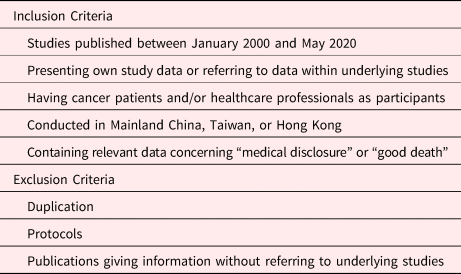
All identified papers were reviewed for relevance based on title and abstract. If sufficient information was not available to decide for inclusion or exclusion, as shown in Table 1, the full text was evaluated. The inclusion process adhered to the following criteria: all study types published between January 2010 and May 2020 with clear study design which presented its own study data or referred to data within underlying studies, having cancer patients and/or healthcare professionals as participants, conducted in Mainland China, Taiwan, or Hong Kong and containing relevant data concerning “medical disclosure” or “good death.” Moreover, publications needed to be published in the English language. Duplications, protocols, and publications giving information without referring to underlying studies were excluded as well as nonaccessible publications. All qualitative studies were assessed utilizing the CASP Checklist with 7 out of 10 points taken as the cutoff score (Critical Appraisal Skills Programme, 2018). All quantitative studies were analyzed using the NIH Study Quality Assessment Tool for observational cohort and cross-sectional studies with 10 out of 14 points taken as the cutoff score (National Heart, Lung and Blood Institute, 2019). The content analysis was conducted using an inductive approach to identify the most prominent themes within the literature (Bengtsson, Reference Bengtsson2016). After coding and categorization, the information within the publications could be thematically clustered into (a) Chinese cultural background, (b) benefit of disclosure for terminally ill cancer patients, (c) preferences of terminally ill cancer patients concerning disclosure, (d) health professionals’ attitudes regarding disclosure toward terminally ill cancer patients, and (e) cancer patients' preferences for a “good death.”
Inclusion and exclusion criteria of the literature review

Results
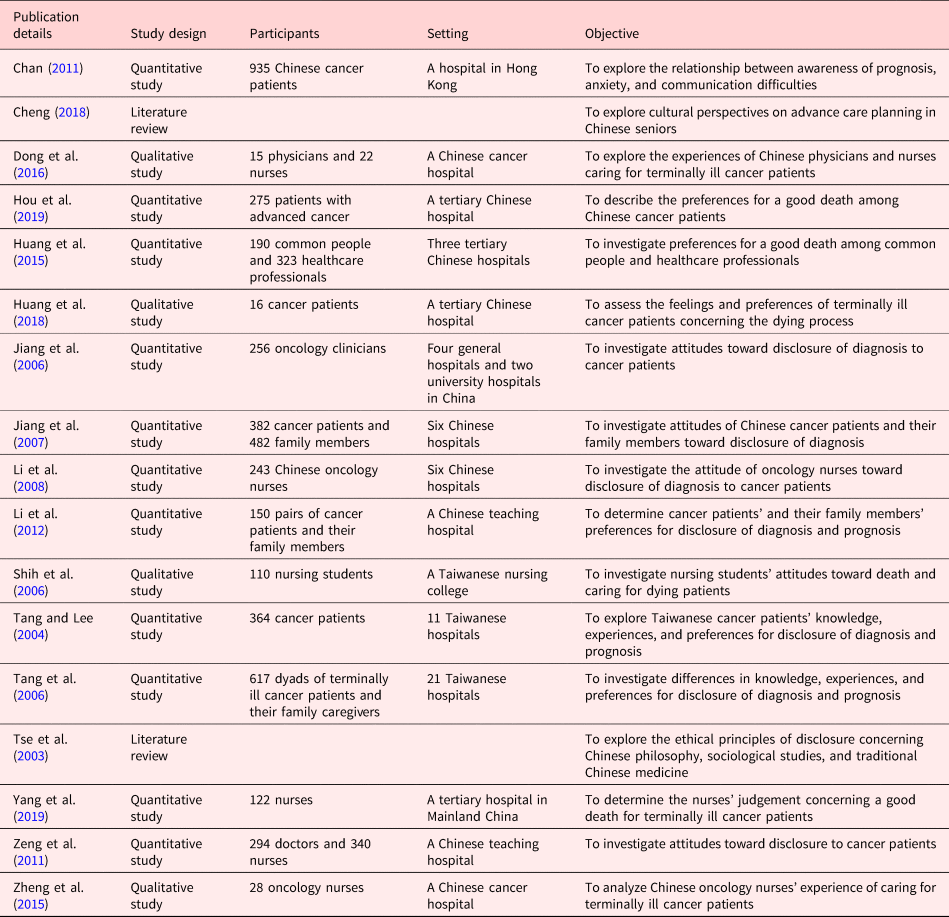
Primary database search revealed a total of 108 papers. Subsequently, 25 duplicates as well as 71 publications which did not meet the inclusion criteria were removed. From the 12 remaining publications, 3 did not reach the set NIH cutoff score and were excluded as well. The additional hand search led to inclusion of eight more papers. Ultimately, 17 publications including 11 quantitative studies, 4 qualitative studies and 2 literature reviews were included (Table 2).
Characteristics of included studies

Nonmaleficence does not justify nondisclosure
Tse et al. (Reference Tse, Chong and Fok2003) conducted a literature review investigating ethical principles for and against disclosure from the perspective of Chinese philosophy, sociological studies, and traditional Chinese medicine, and Cheng (Reference Cheng2018) analyzed cultural perspectives on advance care planning in Chinese seniors. Both reviews agreed that death is not to be feared, as Confucian, Taoist, as well as Buddhist philosophy describe death as a part of life (Tse et al., Reference Tse, Chong and Fok2003; Cheng, Reference Cheng2018). Sociological studies cited illustrate how people in rural communities in China openly prepare for their deaths and plan funeral celebrations. According to Tse et al. (Reference Tse, Chong and Fok2003), the fear of death and the “taboo” surrounding death and dying are not necessarily limited to certain cultures and might be a sociopsychological phenomenon of increasingly segregated societies and “institutionalized death.” The authors suggested that better education on treating and communicating with terminally ill patients could help doctors and family members to lose their fear of hurting the patient through such conversations (Tse et al., Reference Tse, Chong and Fok2003).
Likewise, both reviews argued that traditional Chinese culture did not necessarily favor nondisclosure (Tse et al., Reference Tse, Chong and Fok2003; Cheng, Reference Cheng2018). Tse et al. (Reference Tse, Chong and Fok2003) pointed out that nondisclosure by the principle of nonmaleficence can only be justified if the truth would form a strong psychosocial or spiritual burden to the patient. The principle of “Cheng” meaning “truthfulness” is a traditional concept in the Chinese Doctrine of the Mean (Zhongyong) of Confucian philosophy. Accordingly, patients should be told the truth if they ask for it unless there are serious objections against it (Tse et al., Reference Tse, Chong and Fok2003).
The literature on traditional Chinese medicine stresses the importance of truthfulness and prohibits the giving of false information to patients. It was argued that the psychological and spiritual burden of facing death might not have been particularly strong in traditional Chinese culture and may not override the requirement for truth disclosure (Tse et al., Reference Tse, Chong and Fok2003; Cheng, Reference Cheng2018).
Tse et al. (Reference Tse, Chong and Fok2003) suggested that a culturally sensitive approach to palliative care should take the concept of family determination and “death as taboo” into account by involving the family in the communication and decision-making process (provided the patient consents). In addition, a more tacit but clear communication approach might be applied utilizing euphemisms for words such as “death.” Also, the patient should decide whether he or she wants to be informed and make treatment decisions, and how far family members should be involved in the process (Tse et al., Reference Tse, Chong and Fok2003).
Disclosure benefits terminally ill cancer patients
Chan (Reference Chan2011) analyzed clinical data on 935 deceased palliative care patients in Hong Kong in order to explore the relationship between prognosis disclosure and anxiety around communication problems with family members. Patients who were unaware of their prognosis were more likely to show communication difficulties with family members and suffered from a higher level of anxiety than patients who had been comprehensively informed about their prognosis. It was suggested that patients who were aware of their prognosis were “more likely to engage in end-of-life planning and discussion” (Chan, Reference Chan2011). Tang and Lee (Reference Tang and Lee2004) argued that disclosure reduces the anxiety about the unknown and that patients who are aware of their prognosis do not carry the burden of forming conceivably wrong assumptions about their situation.
Jiang et al. (Reference Jiang, Liu and Li2007) described a study from Taiwan conducted by Lin (Reference Lin1999) investigating the relationship between disclosure and pain management. Cancer patients who were told the truth about their diagnosis and prognosis showed lower levels of pain intensity and pain interference than cancer patients who were unaware of their condition (Lin, Reference Lin1999; Jiang et al., Reference Jiang, Liu and Li2007).
Many terminally ill cancer patients want to know the truth
Li et al. (Reference Li, Yuan and Gao2012) questioned 150 hospitalized patients and their family members about their views on the disclosure of bad news to patients with cancer. One-third of the families were against disclosure toward the patient, whereas nearly all the patients wanted to be informed personally (98%). Nearly half of the patients wanted to be enlightened right after the diagnosis was found and the other half gradually. Further, 69.3% of the patients wanted to have all information on their disease, whereas only 18.7% of the families believed patients should be fully informed about their disease (Li et al., Reference Li, Yuan and Gao2012).
Huang et al. (Reference Huang, Liu and Zeng2015) conducted a cross-sectional questionnaire study with 190 ordinary people and 323 healthcare professionals in Mainland China. The authors found that people in China want to be told their prognosis in order to make preparations for their death (Huang et al., Reference Huang, Liu and Zeng2015).
Huang et al. (Reference Huang, Zeng and Mao2018) carried out open-ended interviews with 16 terminally ill cancer patients in Mainland China. Providing patients with information about the process of their disease helped the patients to accept their condition and communicate their wishes and end-of-life decisions to family members and healthcare professionals. The authors suggested that disclosure improved terminally ill patients' quality of life and facilitated the provision of palliative care (Huang et al., Reference Huang, Zeng and Mao2018).
Tang and Lee (Reference Tang and Lee2004) surveyed 364 cancer patients in Taiwan on disclosure of diagnosis and prognosis. Tang et al. (Reference Tang, Liu and Lai2006) conducted semi-structured interviews with 617 dyads of terminally ill cancer patients and their family caregivers in Taiwan. Both studies concluded that patients want to be personally informed of their diagnosis and prognosis by their doctor before family members are addressed (Tang and Lee, Reference Tang and Lee2004; Tang et al., Reference Tang, Liu and Lai2006). Tang et al. (Reference Tang, Liu and Lai2006) stated that the disclosure of prognosis enables patients and doctors to determine the right choice of therapy in order to avoid futile treatment. Moreover, open communication around prognosis was felt to support patient values (Tang et al., Reference Tang, Liu and Lai2006). It was also suggested that cancer patients in Taiwan share the same need for information as Western patients (Tang et al., Reference Tang, Liu and Lai2006). Tang and Lee (Reference Tang and Lee2004) demonstrated that nearly 94% of the patients could name their diagnosis, whereas only 58% knew about their prognosis. At the same time, many patients acquired the diagnosis personally instead of being informed by health professionals (Tang and Lee, Reference Tang and Lee2004). A smaller percentage of patients had received detailed information about their disease, such as the degree of malignancy (30%) and extent of metastases (20.6%). Only 3.8% of the patients had been disclosed information on their life expectancy (Tang and Lee, Reference Tang and Lee2004). Around 30% of the patients wanted to be informed about their diagnosis and prognosis in detail. The proportion of cancer patients who received detailed information on their prognosis was significantly lower than those who wished to be disclosed accordingly (Tang and Lee, Reference Tang and Lee2004). Li et al. (Reference Li, Yuan and Gao2012) showed that only 18% of the patients questioned in their study had been informed by doctors about their diagnosis, whereas 34.7% had been told by family members and 42% had found discovered their diagnosis through self-study. Patients with low educational level had a lower preference for complete disclosure. Most family members claimed that they were the most suitable person to enlighten the patient about the diagnosis (Li et al., Reference Li, Yuan and Gao2012).
Jiang et al. (Reference Jiang, Liu and Li2007) surveyed 382 cancer patients and 482 family members on how to disclose the diagnosis to patients with different stages of cancer. The patient group was more likely than the family group to want the patient to be informed of the diagnosis. Men showed a higher preference for disclosure than women. Both cancer patients and their families showed a strong preference for disclosure right after the diagnosis was made. However, in the case of terminal illness, the wish to be informed decreased significantly for both cancer patients and family members. Patients and families who were against disclosure in the cases of terminal illness claimed that disclosure is linked to feelings of hopelessness, helplessness, and the loss of the patient's quality of life (Jiang et al., Reference Jiang, Liu and Li2007).
Various studies revealed that patients preferred to be informed by their doctors whereas family members wished to enlighten the patient themselves (Tang and Lee, Reference Tang and Lee2004; Jiang et al., Reference Jiang, Liu and Li2007; Li et al., Reference Li, Yuan and Gao2012). Li et al. (Reference Li, Yuan and Gao2012) found that only 10.7% of all family members questioned wanted the doctor to inform the patient about the diagnosis. Patients with a lower educational status tend to be less willing to be informed by doctors (Li et al., Reference Li, Yuan and Gao2012). Patients and family members who were in favor of disclosure claimed that the provision of information improves cooperation between the patient and the doctor in medical treatment and enables the patient to better manage their remaining life and resolve “unfinished business” (Jiang et al., Reference Jiang, Liu and Li2007).
Healthcare professionals refrain from informing terminally ill patients
Zeng et al. (Reference Zeng, Huang and Zhao2011) surveyed 634 healthcare professionals in Mainland China (294 doctors and 340 nurses) to assess healthcare professionals’ attitude toward information disclosure to cancer patients. Overall, 70.8% of all 634 healthcare professionals included in the study agreed that disclosure leads to medical disputes. At the same time, 68.3% thought that the patient had priority to know the severeness of their condition, but only 49.5% said that the patient should be told the truth. Likewise, the majority of healthcare professionals were aware that their patients who hoped to learn their real condition were not fully informed about their disease. Accordingly, 38.1% of the healthcare professionals felt disturbed by lying to their patients. The authors revealed that even if cancer patients insisted on disclosure, nearly 20% of healthcare professionals would still refrain from telling them the truth. According to the participants, family consent was crucial for disclosure according to the principle of beneficence. Healthcare professionals described difficulties in cooperating with patients in “good faith” if the family demands nondisclosure (Zeng et al., Reference Zeng, Huang and Zhao2011).
Jiang et al. (Reference Jiang, Li and Liu2006) conducted a cross-sectional questionnaire study among 256 oncology clinicians in Mainland China and concluded that the attitude toward disclosure differed significantly depending on the stage of cancer. When doctors were asked if they would inform cancer patients about their disease, 87.5% were willing to enlighten the patient at the early stage of cancer, whereas only 40.5% would inform terminally ill cancer patients. Female doctors were more willing to inform patients with the terminal stage of cancer than men. Concerning the right time for disclosure, most of the participants agreed that patients should be informed right after the diagnosis is found, especially in the case of terminal illness (87.2%). Participants with relatives who had cancer had a higher preference for informing terminally ill patients right after the diagnosis. Oncology clinicians in favor of disclosure argued that terminally ill cancer patients have a right to know the truth about their disease (37.2%). Moreover, disclosure was said to enable the patients to resolve “unfinished business” (45.7%). Those opposed to disclosure feared that patients could lose quality of life (41.3%) and would experience hopelessness and helplessness (26.8%). Responders suggested that patients might give up therapy after disclosure. In 14.5% of the cases, families asked the doctor not to inform the patient. The majority of oncology clinicians agreed that the doctor-in-charge is the right person to inform the patient (Jiang et al., Reference Jiang, Li and Liu2006).
Dong et al. (Reference Dong, Zheng and Chen2016) conducted a qualitative interview study with 15 doctors and 22 nurses in Mainland China to explore their experiences of caring for terminally ill cancer patients. Health professionals often mentioned the taboo surrounding death within the Chinese culture. They reported intentions of helping patients and their families by giving hope concerning the patient's diagnosis and prognosis, although this hope was often unrealistic (Dong et al., Reference Dong, Zheng and Chen2016).
Li et al. (Reference Li, Liu and Zou2008) surveyed 243 oncology nurses in Mainland China and reported that three out of four were in favor of disclosure to cancer patients right after the diagnosis is found. Disclosure was believed to enhance cooperation between patient and doctors for treatment in the early stages of cancer. However, only 44.2% believed that cancer patients with terminal illness should be informed about their condition. Contrarily, 47.7% of the nurses believed that disclosure helped terminally ill cancer patients “resolve unfinished business” and 33.0% thought that terminally ill cancer patients had a right to know the truth about their disease. Accordingly, the nurses felt uncomfortable about deceiving their patients since they should be given the chance to prepare for death and fulfill their wishes. Furthermore, the authors reported that most nurses believed that patients should be informed by their doctors while more than half of the nurses argued that doctors hold a greater understanding of the illness. Therefore, the doctor could explain the situation to the patient fully and clearly. None of the nurses thought that they should enlighten the patient about the diagnosis themselves. The answers were consistent for both the early and terminal stages of cancer. High educational level and long work experience were negatively associated with disclosure toward terminal patients (Li et al., Reference Li, Liu and Zou2008).
Zheng et al. (Reference Zheng, Guo and Dong2015) conducted semi-structured interviews among 28 oncology nurses in Mainland China. The participants underlined the importance of nondisclosure to terminally ill cancer patients to maintain patients’ hope and confidence in fighting their disease. However, oncology nurses felt uncomfortable about lying toward patients and making them unable to prepare for death (Zheng et al., Reference Zheng, Guo and Dong2015).
Shih et al. (Reference Shih, Gau and Lin2006) asked 110 nursing students in Taiwan about the kind of help they would expect from healthcare professionals as a terminally ill patient. All students agreed on good quality physical care and most students (88%) wanted health professionals to show respect for their dignity. Four out of five nurse students wanted healthcare professionals to help maintain family and friends’ support and company. Simultaneously, the majority of nursing students (64%) felt that healthcare professionals are important facilitators for communication between the patients and their relatives since patients might lack the needed communication skills at the end of life and show difficulties in verbalizing their feelings, thoughts, and hopes. Approximately 23% of the nursing students believed that patients should be supported in finding peace of mind and fulfilling their life goals and wishes (Shih et al., Reference Shih, Gau and Lin2006).
Patients’ preferences for a good death are akin to those in Western societies
Several studies have investigated preferences of people in China at the end of life using the “Good Death Inventory” (GDI) originally developed by Miyashita et al. (Reference Miyashita, Morita and Sato2008) and translated into Mandarin by Tseng (Reference Tseng2013). The GDI encompasses 18 domains for a good death, including 10 core domains and 8 optional domains. Each domain consists of three items and answers can be given on a 7-point Likert scale (1: absolutely disagree, 2: disagree, 3: somewhat disagree, 4: unsure, 5: somewhat agree, 6: agree and 7: absolutely agree) (Miyashita et al., Reference Miyashita, Morita and Sato2008; Tseng, Reference Tseng2013).
Hou et al. (Reference Hou, Lu and Yang2019) conducted a cross-sectional questionnaire survey using the GDI among 275 patients with advanced cancer in Mainland China. Huang et al. (Reference Huang, Liu and Zeng2015) questioned 190 ordinary people and 323 healthcare providers (114 doctors and 209 nurses) in Mainland China. Yang et al. (Reference Yang, Lu and Hou2019) surveyed 258 terminally ill cancer patients in Mainland China, utilizing the GDI. Those studies revealed that a good relationship with family and medical staff as well as being respected as an individual are among the most important aspects at the end of life (Huang et al., Reference Huang, Liu and Zeng2015; Hou et al., Reference Hou, Lu and Yang2019; Yang et al., Reference Yang, Lu and Hou2019). In addition, people in China want to prepare for death, for example, by “being able to say what one wanted to say to dear people” (Huang et al., Reference Huang, Liu and Zeng2015). Religious and spiritual comfort, pride and beauty, control over the future, and dying in a favorite place have repeatedly been ranked as comparatively nonessential factors at the end of life. Many people in China, including terminally ill cancer patients, do not want to spend their final days unaware that one is dying (Huang et al., Reference Huang, Liu and Zeng2015; Hou et al., Reference Hou, Lu and Yang2019; Yang et al., Reference Yang, Lu and Hou2019). Patients with advanced cancer appeared to have a higher preference for independence than the general public and healthcare professionals. Such respondents gave higher importance to not being a burden to others. Contrarily, being respected as an individual and dying in a favorite place were of lower preference for patients with advanced cancer (Huang et al., Reference Huang, Liu and Zeng2015; Hou et al., Reference Hou, Lu and Yang2019). Huang et al. (Reference Huang, Liu and Zeng2015) found that healthcare professionals in China hold a higher preference for “physical and psychological comfort,” “natural death,” and “dying in a favorite place” compared with the general public. The researchers argued that healthcare professionals have had more contact with dying patients than the general public and had witnessed the negative consequences of futile treatment for terminally ill patients (Huang et al., Reference Huang, Liu and Zeng2015). Hou et al. (Reference Hou, Lu and Yang2019) found that older participants had a lower preference for dying in a favorite place, control over the future, preparation for death, and religious and spiritual comfort than younger participants (Hou et al., Reference Hou, Lu and Yang2019).
Despite cultural differences, many preferences of people in China concerning a good death were consistent with those of the Japanese and Western societies (Huang et al., Reference Huang, Liu and Zeng2015; Hou et al., Reference Hou, Lu and Yang2019; Yang et al., Reference Yang, Lu and Hou2019). Yang et al. (Reference Yang, Lu and Hou2019) found that cancer patients in China score significantly higher on the first three core domains of the GDI (“Being respected as an individual”, “Good relationship with medical staff,” and “Good relationship with family”) than participants of the primary Japanese study (Miyashita et al., Reference Miyashita, Morita and Sato2008; Yang et al., Reference Yang, Lu and Hou2019).
Discussion
Many terminally ill cancer patients in China want to be informed about their diagnosis and prognosis and prefer to be enlightened by their doctors. After disclosure, terminally ill cancer patients express lower levels of pain and anxiety. Moreover, terminally ill cancer patients value good relationships with family and medical staff. They want to feel respected as an individual and to be able to prepare for their death. Additionally, it can be argued that preferences of terminally ill cancer patients in China are widely consistent with those of Western societies.
Patients in the terminal stages of cancer in China value positive relationships with their family members, which is in line with the family-centered nature of Chinese culture. Therefore, the company of and care by family members should be integrated for comprehensive palliative care provision (Huang et al., Reference Huang, Liu and Zeng2015). At the same time, the patients wish to be respected as an individual and make their own decisions challenges the traditional Chinese concept of family determination.
Terminally ill cancer patients in China value positive relationships with medical staff and want to be informed by their doctors about their diagnosis and prognosis in order to prepare for death. However, healthcare professionals still show strong reluctance to talk openly to dying patients about their condition forcing patients to seek information from alternative sources. Healthcare professionals fear that disclosure could have negative consequences for the patient's mental state and impact negatively upon quality of life. Moreover, they believe that hope of recovery could support patients in fighting their disease. Also, healthcare professionals often fear that such discussions may result in medical disputes. Thus, there is a need for education for healthcare professionals which highlights the benefits of open communication for the doctor–patient relationship.
When healthcare professionals were asked to name reasons for disclosure at diagnosis or in the early stages of cancer, many cited improved cooperation in the following treatment. Interestingly, none of the healthcare professionals mentioned cooperation in therapy in the case of terminal illness (Jiang et al., Reference Jiang, Li and Liu2006; Li et al., Reference Li, Liu and Zou2008). The terminal stage of cancer was mainly associated with negative conceptions of death. However, comprehensive palliative care provision requires cooperation between doctors and their patients. The wide-ranging deficits in palliative care training of healthcare professionals need to be tackled in order to improve their competence and confidence in treating terminally ill patients (Hu and Feng, Reference Hu and Feng2016).
Many patients in China want to be informed about their condition before family members are addressed. Therefore, healthcare professionals should inquire and respect patients’ preferences instead of routinely asking family members without consent. At the same time, patients’ opinions tend to differ concerning their need for medical information. Although many patients want to know the truth, there is still a considerable number of patients who prefer not to be informed about their condition. Healthcare professionals need to differentiate between the patients who wish to be informed and those who would decline disclosure. An individualized approach to comprehensive palliative care is necessary. Educational programs need to focus on communication training in order to enable healthcare professionals to overcome barriers surrounding patient interaction.
There are several limitations to this review. Firstly, only a small number of publications exist on this topic, therefore, the availability of data was limited. All studies focused on patients, families, or healthcare professionals in urban setting, and thus did not deliver information on people living in rural areas. Moreover, studies from Taiwan and Hong Kong were included for analysis in order to gather more information while some findings may not be generalizable due to cultural differences. Nevertheless, the results of this review have shown that there is a clear discrepancy between the current treatment and the actual preferences of terminally ill cancer patients. Although the topic is highly sensitive, participants did not appear to give “socially desired” responses which challenges established beliefs in Chinese culture. Secondly, the scope of this review was limited since we focused on publications in the English language. Our search terms have been determined within an expert focus group but remain prone to potential cultural bias. Since the topic of this review was quite specific and there was little literature available, we were unable to determine specific, reoccurring keywords. Accordingly, we decided to conduct our literature search utilizing rather global search terms to sight a larger amount of potential literature. This has led, in return, to a large number of excluded publications. Thirdly, the quality assessment and analysis of publications has been conducted by one person only and re-conducted by the same person after a period of three weeks. Fourthly, the studies analyzed in this review solely focused on cancer patients. We have made that decision since no publications could be found focusing on nononcological terminally ill patients in our preliminary research. The underrepresentation of nononcological terminally ill patients in the literature should be addressed in order to gain a more holistic picture of implications for comprehensive palliative care implementation.
In conclusion, disclosure concerning diagnosis and prognosis is desired by many terminally ill cancer patients in China in order to prepare for death. They value open communication with health professionals and good relationships with health professionals and family members. The company of and care by family members forms a valuable part of culturally sensitive provision of palliative care for terminally ill cancer patients. The key challenge is to restructure health professionals’ palliative care training to ensure sensitively delivered care and to enable open communication with terminally ill patients. Ultimately, terminally ill cancer patients in China may fully participate in the medical decision-making process and receive comprehensive palliative care which consequently improves quality of life.
Acknowledgments
The authors thank Dr. Ruby Viney from the Academic Palliative and End of Life Care Centre of Liverpool University Hospitals Foundation Trust for her support.
Conflict of interest
The authors declared no potential conflict of interest with respect to the research, authorship, and/or publication of this article.