Introduction
A global feature of pottery production throughout history has been the vast amount of knowledge and skill required to produce a diverse range of high-quality products. The North Staffordshire Potteries during the eighteenth and nineteenth centuries were characterized by a growing body of just such useful and practical knowledge about the materials, processes, and skills required to produce local goods that sold in global markets.Footnote 1 The region flourished, exporting over sixty-two million pieces to the global market in 1836 produced under conditions of extreme social and geographical proximity, where tacit knowledge and competition loomed large.Footnote 2 The Potteries quickly became a “cauldron of creativity” that produced much of the earthenware, ceramics, and porcelain often held up as key commodities of the Consumer Revolution.Footnote 3 Messrs. Spode, Minton, Copeland, and the celebrated Wedgwood dynasty, led as pioneering figureheads for innovation and style, driving forward the development of new products and production methods.
Although it was not one of the more traditional lead sectors of the economy during the British Industrial Revolution, pottery production in North Staffordshire is an example of a “classic” industrial district. A strong sense of local identity emerged early in the region’s history and for almost 250 years the district dominated British earthenware production; generating and meeting ever increasing demand for “Staffordshireware.” With many producers producing similar-looking wares, and creamware and jasperware becoming popular in the late eighteenth century, the distinctive produce of the region (such as creamware and jasperware) quickly became known as Staffordshireware. A further notable example of regionally designated collective nouns to describe wares can be found in the Viennese furniture-making industry during the second half of the nineteenth century: chairs, regardless of which firm produced them, became known as Viennese chairs.Footnote 4 Unlike its more famous cousins, such as the cotton and metalworking districts of Lancashire and Sheffield, the Potteries did not experience the “terminal” phase of its life-cycle until the close of the twentieth century.Footnote 5 The English pottery industry had concentrated within the six- by three-mile region by the middle of the eighteenth century with pot shops and firing ovens crowded together, often just feet apart. It continued to grow into the nineteenth century in terms of the number of businesses operating, the size of the labor force, resources used, output, and the extent to which it dominated the local economy.Footnote 6
Storper and Venables argue that intense concentration and proximity creates “buzz” and face-to-face contact between individuals, which, alongside other benefits, is crucial for “creative activities” based on rapidly changing tacit knowledge that is difficult to codify.Footnote 7 This suggests that the Potteries region described above would stand to benefit from the properties of such buzz. However, in specific sites of intensive material production, such proximity also creates tensions between knowledge transfer and spillovers, and the need to retain competitive advantage. Pottery production continued to be dominated by knowledge-intensive, craft-based processes, and the skills of the master potter until well into the second half of the nineteenth century. Reliable automated machinery was in general use only by the 1870s.Footnote 8 Much of the innovation and technical progress in this important industry before and during the Industrial Revolution concerned the quality of the products.Footnote 9 Moreover, unlike other specialized artisanal trades such as weaving or brewing, and despite the importance of knowledge to the trade, the pottery industry did not have a legacy of a formal craft guild or institution with codified rules to govern behavior and access to vital knowledge and skills. As such, there is not much clear empirical evidence to suggest how potters in North Staffordshire during the eighteenth and nineteenth centuries sought to protect their knowledge in a fiercely competitive industry that had developed a strong sense of local identity.
This article considers the nature of knowledge in the North Staffordshire pottery industry between 1750 and 1851. It investigates formal and informal institutions of knowledge appropriation, and demonstrates how the types of knowledge being produced and used in the industry determined the actions and strategies of potters and nonpotters. The subject is addressed using new patent data and a detailed analysis of the specifications, alongside a range of contemporaneous qualitative evidence. The choices and behavior of individuals are determined and evaluated through the extent to which they revealed the knowledge underpinning key innovations. The type of knowledge being revealed or kept secret is also examined, and a new typology of knowledge in the pottery industry is proposed.
The article begins with a short review of the existing literature and a discussion of the discovery of a single, hitherto unknown and conceivably unique, newspaper advertisement from 1795 that purported to offer secrets for sale. The first section then begins the empirical investigation into knowledge appropriation that uses patent data and specifications to determine who was patenting what and where. All known pottery patents were collated and examined to identify trends in patenting activity and present the empirical landscape of formal protection of intellectual property in the pottery industry over time and space. The geographical and occupational characteristics of these data are analyzed. The article then turns to examine the knowledge held within pottery patents that were granted through a close reading of the specifications themselves. This allows for the proposal of a typology of the nature of knowledge in the industry that goes beyond the contested binary tacit/explicit interpretations that are applied across a variety of disciplines.Footnote 10
The second part of the article then presents evidence of innovation outside of the patent system to further refine the understanding of the nature of knowledge. It uses ephemeral trade literature and publications, exhibition reports, award citations, and sales catalogues to present further examples of different types of knowledge being shared, protected, and kept secret. The evidence presented helps explain the behavior and strategies of potters who kept their knowledge secret through informal channels. It also helps to address the extensively studied yet ongoing problem summarized by Moser: “It is well known that inventors do not patent all their innovations […] but why inventors do not patent is less well understood.” Footnote 11
The article concludes that patenting was not a widespread strategy used by North Staffordshire potters to protect their knowledge and appropriate returns from the majority of their innovations. Rather, secrecy was highly valued and maintained through a variety of techniques. Knowledge was actively managed by its holders and kept away from outsiders. Crucially, the specific type of knowledge held determined the level of protection required and the action taken. This analysis provides a new case study of a highly concentrated, highly innovative industry in which the tensions between competition, collaboration, and knowledge production were at their most acute. The findings provide further empirical and analytical support for Moser’s findings that the efficacy of secrecy was industry specific and the key determinant of the propensity to patent; moreover, this was underpinned by the degree of scientific or technical knowledge required.Footnote 12 They also provide additional evidence concerning the study of collective invention with the region exhibiting some, but not all, of the core features of Allen and Nuvolari’s now classic examples.Footnote 13
Review
There is a fascination with porcelain, ceramics, and earthenware to which art and museum galleries are dedicated across the globe. Academic study of one of the most important pottery producing regions in the world has been relatively limited, however, when compared to cotton textile production in the north of England, or the advent of steam technology, for example. An early example of sustained and focused research into the North Staffordshire Potteries is found in the work of Simeon Shaw, who published an account of the success and vitality of the region in 1829.Footnote 14 While Shaw was keen to heap praise on the progress of the industry, he demonstrates remarkable insight, and is one of the earliest commentators to acknowledge the collective sentiments of the North Staffordshire potters. The collective community that inhabited the district thrived “by uniting talents and perseverance, [and] the recesses of the earth [had] been explored to enrich its owners.”Footnote 15 This pioneering assessment of the district remained largely ignored for much of the nineteenth century, and it was more than a century and a half later before the importance of the collective identity and action of the potters was acknowledged in academic literature and associated with the economic fortune of the region.Footnote 16 It was not until the middle of the twentieth century that the region began to be studied in any great detail, with much of the focus placed on the introduction of machinery in the later nineteenth century, the history of the Trade Union Organisation, or the entrepreneurial talents of Josiah Wedgwood.Footnote 17
In recent years the fields of regional and business history have ignited a renewed academic interest in the Potteries as an industrial district.Footnote 18 This interest stems from a wider historiographical shift in social and economic history that has seen an increased recognition of the value of localized and regional study when thinking about the features and patterns of industrialization processes.Footnote 19 The study of invention and innovative activities during the British Industrial Revolution has also developed considerably over the last few decades, with Allen and Mokyr advancing two contrasting views based on induced invention and the concept of the “Industrial Enlightenment,” respectively.Footnote 20 Alongside these macro-level studies, a growing body of region and industry-specific case studies has progressed close examination of innovation systems and strategies of inventors and producers. Key among these are studies of historical patenting practices that have become increasingly quantitative in attempts to determine their importance as drivers of innovation.Footnote 21 There are general limitations concerning the utility of patents, given that not all innovations were patented and not all patents reflected true innovations.Footnote 22 The works of scholars such as Moser and Nuvolari have been instrumental in developing new methodologies and approaches that make it possible to address these limitations.Footnote 23 Their works have built on and revised earlier studies by Dutton and MacLeod on innovation and patenting in England during the transition to modern economic growth.Footnote 24 These developments notwithstanding, further work needs to be done to address differences in the propensity to patent in different historical periods and industries.
An influential concept in this line of inquiry has been that of “collective invention,” a term coined by Allen to describe a process in which innovators freely and openly published and shared knowledge about advances and improvements in an industry.Footnote 25 The conclusions he offered were based on observations of the English pig iron industry in Cleveland during the nineteenth century. He identified a framework of communication between firms based on a culture of testing and sharing technical information through two channels: informal disclosure and formal publication. The role of such disclosure channels was to make new technical knowledge created by firms available to their competitors. In turn, this allowed for cumulative incremental advances in technologies and practices, thus increasing the rate of innovation in the industry.Footnote 26 Collective invention, Allen argues, was one of the most important sources of innovation in England during the nineteenth century.
This framework, however, rests on a key characteristic of the chosen industry. Innovation in pig iron production during the nineteenth century predominantly took the form of improved design and construction of blast furnaces. These were large, obtrusive structures ranging from forty- to over ninety-feet high and were thus very difficult to keep secret or limit knowledge of their existence. If a producer built a new blast furnace, it would be clear to his competitors, especially as the height of a furnace was the key factor in determining the efficiency of fuel consumption.Footnote 27 This has clear implications for strategies and decision making regarding secrecy vis-à-vis open knowledge sharing.
Nevertheless, Bessen and Nuvolari’s revisionist approach to historical collective invention argues that knowledge sharing was far more common during the age of industrialization than perhaps modern studies of innovation, or indeed some historical scholars, are willing to accept.Footnote 28 While there has been a huge surge in the study of modern knowledge sharing and competition in innovation studies, a degree of skepticism remains as to how early this behavior developed and how widespread or stable it was. Far from being “vulnerable and ephemeral,” as Bessen and Nuvolari quote Mokyr, collective invention extended far beyond the Cleveland iron or Cornish steam-engine industry.Footnote 29 More recently, Allen has expanded his argument to claim for the pervasiveness of collective invention in Britain during the eighteenth century.Footnote 30
An important point to note is that Allen’s classic notion of collective invention is characterized by three features: incremental improvements in technology; firms making knowledge publicly available through “wilful dissemination”; and the utilization of this common pool of knowledge resources to further improve technological performance. All of this occurred largely outside of the patent system.Footnote 31 However, in a brief comment on innovation in the pottery industry specifically, Allen has suggested that collective invention could take place, in spite of conscious attempts by contemporaries to suppress it.Footnote 32 This is an important qualifier, and deserves discussion here as Allen also argues that inventors in the industry fell into several different categories that formed a complex web of interaction and innovation. In addition to those archetypal Industrial Enlightenment genius-type science-based experimenters (William Cookworthy, 1705–1780; John Dwight, 1633–1703; Josiah Wedgwood, 1730–1795), there were artisans who relied on apprenticeship and experience to develop some of the most important innovations in the industry (e.g., creamware, double-firing, and transfer printing). This, he argues, is evidence of an effusion of innovation from below rather than from above. While this was certainly a part of the innovative environment in the Potteries, this feature does not, as Allen suggests, support any argument for collective invention in the region. If one follows Allen’s argument through, then collective invention can only be applied to the pottery industry as an unintentional biproduct and consequence of employee turnover between firms and not from willful or open sharing of knowledge and ideas.Footnote 33 In this author’s opinion, this does not constitute collective invention. The evidence presented in this article will, among other things, demonstrate that in the pottery industry, attempts to suppress collective invention were successful.
While many of the examples discussed by Bessen and Nuvolari are not “pure” instances of collective invention, exhibiting all these features à la Allen, a European perspective does reveal active and often systematic knowledge sharing among inventors, alongside patent systems. Copying and adapting the innovations of competitors, petitioning for the repeal of specific patents, and choosing not to take out patents for their own inventions were strategies adopted by inventors and producers across Europe during the eighteenth and nineteenth centuries.Footnote 34 There clearly existed two separate spheres of knowledge creation and dissemination: the formal and the informal. The extent to which one impacted the other is not clear, and there are calls for more localized research to be conducted in light of this.Footnote 35 The close case study that follows will also address these open questions and the assumption that a very low propensity to patent in an industry is accompanied by open knowledge sharing between producers.
Patenting in the English Pottery Industry
Trends in Pottery Patenting
The following discussion uses patent data to set out the empirical landscape of formal protection of intellectual property in the pottery industry of North Staffordshire between 1700 and 1851. It then provides a profile of the patents and patentees to determine which types of knowledge were being patented in the industry, and by whom. The temporal scope is important because 1852 saw the introduction of the Patent Amendment Act, which significantly increased the propensity to patent in Britain through a large reduction in the cost of the patent itself. This was accompanied by a new centralized “British” administrative process, and reforms in the reporting and requirements of specifications.Footnote 36
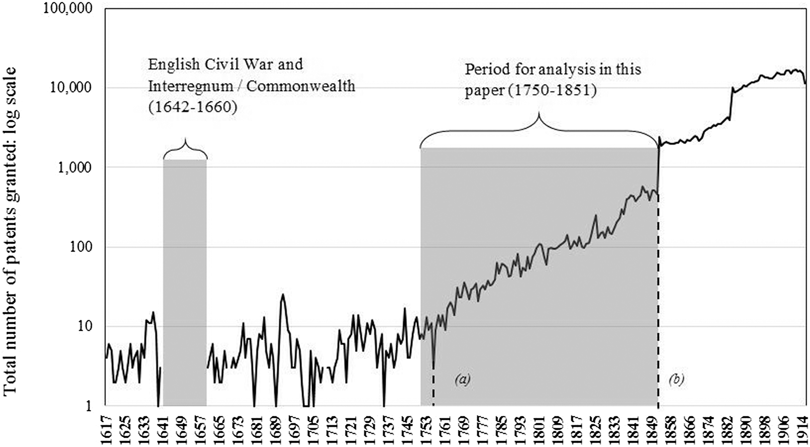
Figure 1 shows that from the middle of the eighteenth century, patenting took off in England and continued to grow with a marked increase after 1852.Footnote 37 The core sources for patents in the English pottery industry are three indexes compiled and published by the Superintendant of Specifications at the Patent Office, Bennett Woodcroft, during the 1850s and 1860s.Footnote 38 The Abridgments relating to pottery have not hitherto been used widely; and to this author’s knowledge, this is first such study to engage with this source in systematic detail.
Total patents granted each year in England, 1617–1915.
Note: Yearly observations; dotted line (a) highlights the structural break point identified by Sullivan; dotted line (b) marks introduction of Patent Amendment Act of 1852. Source: Author’s compilation. Used with permission.

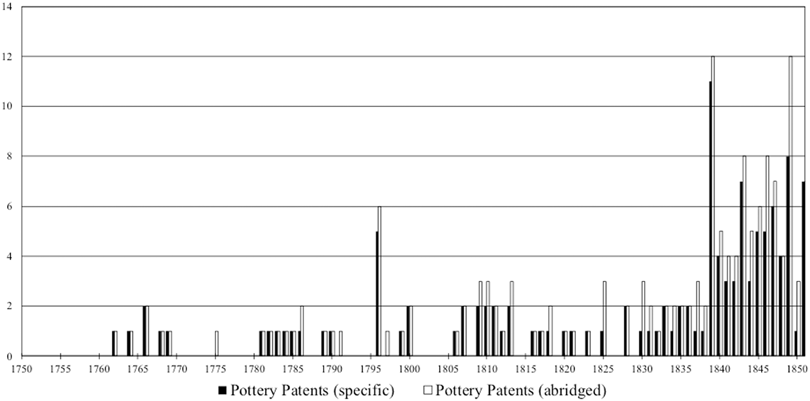
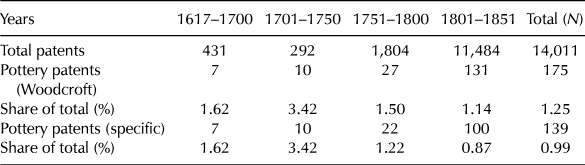
At the industry level, pottery did not experience such a strong trend in patenting; and the volume of patents granted was extremely low, as shown in Figure 2. By compiling Woodcroft’s indexes and cross-checking the titles of every patent granted in England for the period, it was found that there were 175 “pottery-related” patents granted between 1617 and 1851.Footnote 39 This number may be somewhat misleading due to the chance that any reference by the patentee to a specific industry “may be entirely speculative,” not to mention human error by Woodcroft’s employees at the Patent Office.Footnote 40 To mitigate this problem, each of the 175 “Woodcroft” specifications has been examined by this author to remove those very broad patents with tenuous or irrelevant references to pottery. This process leaves 139 “specific” patents for the entire period from 1617 to 1851.Footnote 41
Number of pottery-related patents granted in England, 1750–1851.
Note: The period 1617–1750 has been excluded from this graph. The solid columns represent patents which were specifically for pottery innovations as determined by the author. Where hollow columns appear, these represent those additional patents identified in Woodcroft’s Abridged list as being pottery related (hereafter referred to as Woodcroft patents).
Source: Author’s compilation. Used with permission.

Patenting in the industry was minimal until 1839, when there was an increase in patents for machinery of various descriptions. Before this, there was only one year, 1796, in which more than two patents were granted. Of the five patents granted in this year, coincidentally the year after Josiah Wedgwood’s death, three were held by one man: his cousin and business partner, Ralph Wedgwood. It seems at this stage more than a coincidence that Ralph Wedgwood would patent three innovations in the year immediately following the master potter’s death. To provide a relative measure, Table 1 shows both the Woodcroft patents and the author’s own specific pottery patents as a share of total patents granted in England. Even during the period 1701 to 1750, which saw considerable attempts outside of Staffordshire to imitate Chinese porcelain and produce English porcelain, pottery patents accounted for only 3.42 percent of all patents.Footnote 42
Pottery patents as a share of total patents, 1617–1851

Note: Text explains the distinction between Woodcroft and specific patents.
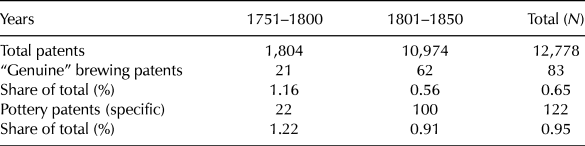
Table 2 shows the pottery patent data alongside those compiled by Nuvolari and Sumner for a similarly highly innovative industry—brewing—over roughly the same period, which showed a “remarkably low propensity to patent.”Footnote 43 Given this low number of patents, the next stage of analysis is to determine who the patentees were, and what was being patented.
Brewing and pottery patents, 1751–1850

Notes: Brewing industry data from Nuvolari and Sumner, “Inventors, Patents, and Inventive Activities,” 103–104. Their “genuine” brewing patents are comparable to specific patents.
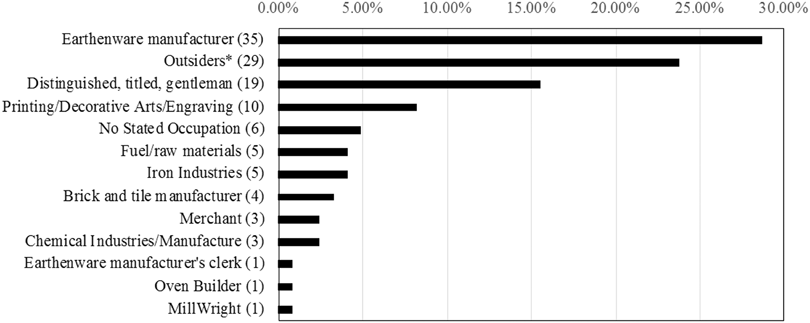
During the second half of the eighteenth century, 99 percent of all patents recorded both the occupation and place of residence of the patentees.Footnote 44 The majority of patentees listed in the newly constructed database as earthenware or pottery manufacturers were highly skilled master potters who ran their own businesses. Figure 3 shows the occupational distribution of pottery patentees for 1750 to 1851 and highlights the diverse origins of innovation. Clearly, the few patents that were granted were not restricted to potters. While the largest group of patentees were those directly involved in earthenware manufacture, they only held just under a third of patents. The second largest group were “outsiders” to the industry; individuals whose occupation was significantly outside of pottery production (as noted in Figure 3). The third largest group of patentees were the upper societal elite who held just over 15 percent of pottery patents. One sees the involvement of related industries such as printing, engraving, and chemical industries, although the number of patents held is relatively small. While this is a new finding and an addition to the empirical evidence relating to patenting in the Industrial Revolution period, it is not a phenomenon unique to the pottery industry by any means. To continue an earlier comparison, a quarter of all brewing patents for the same period were also held by “outsiders.”Footnote 45
Pottery patentees by occupation, 1750–1851 (absolute numbers in parentheses).
Notes: * This category contains the following occupations deemed to be significantly outside pottery production: architect, builder and architect, civil engineer, doctor in philosophy, doctor in physics, engineer, engineer and designer, gas engineer, gold and silver smith, manufacturer, mechanical draughtsman, paper maker, stove grate maker, victualler, and wharfinger.
Source: Author’s compilation. Used with permission.

The Geography of Pottery Patenting
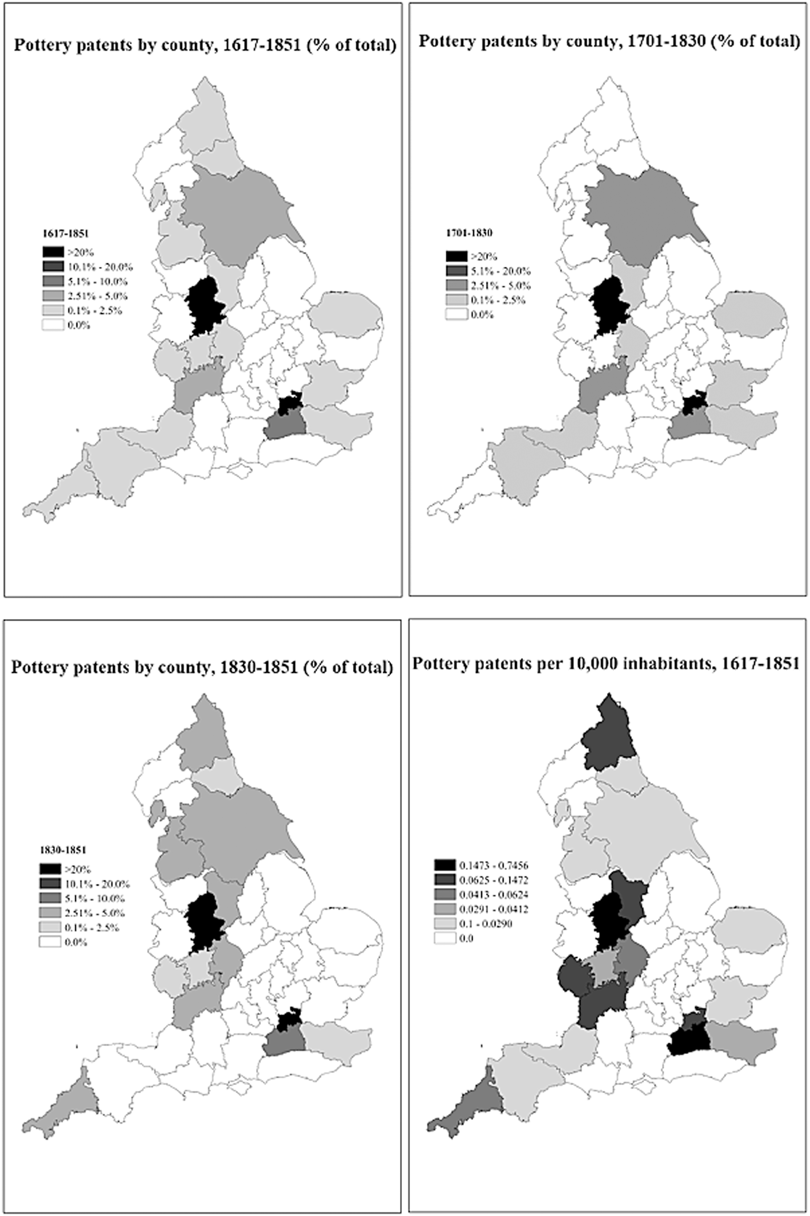
Figure 4 shows the distribution of patentees for the whole period from 1617 to 1851 in two categories: potters and nonpotters. The concentration of potters with patents in Staffordshire reflects the geographical concentration of the industry, and highlights and contrasts with the more scattered distribution of nonpotters with patents. Staffordshire, Middlesex (including London), and Surrey remained the dominant sources of pottery patenting. Staffordshire itself accounted for a third of all patents, with a peak of 40 percent during the “boom” period of pottery patenting from 1835 to 1851. Of the forty-seven pottery patents originating in Staffordshire, just one was held by a patentee who was not a resident in the Potteries district: George Thorneycroft, an iron founder from Wolverhampton, who designed a machine for “rolling, squeezing, or compressing puddle balls of iron” that could also be used for grinding raw materials for the production of pottery.Footnote 46 The geography of patenting activity in the pottery industry changed as the nineteenth century progressed, with more patents being granted outside of the region than inside.
Geographical distribution of pottery patents held by potters and nonpotters, 1617–1851.
Note: * Location of patents determined from compiling and cross-checking details across a range of patent sources.
Source: Author’s compilation based on Patent Sources in the bibliography. Used with permission.

Figure 5 shows the distribution of pottery patents in each county as a percentage share of total pottery patents for England. It also shows pottery patents per capita in 1851. The predominance of London, Middlesex, and Surrey, along with Staffordshire, is not surprising when national trends are considered in patenting overall: MacLeod estimates that London and the metropolitan parts of Middlesex and Surrey accounted for over half of England’s patents; and Inkster suggests a figure of 47 percent for London during the 1790s.Footnote 47 In his study of the Cornish mining industry, Nuvolari finds that London, Middlesex, and Surrey accounted for over 40 percent of steam-engine patents between 1698 and 1852. He attributes this to the urbanization and growth of London and the geographical location of the Patent Office, as noted by Inkster.Footnote 48 This is interesting when Nuvolari’s findings are compared to the ones presented here, as there are both parallels and differences between the two. First, steam engine patents were relatively spread out across the country and very few were issued to residents of Cornwall, perhaps a result of the increased usage of steam power for numerous purposes in industrializing areas. Pottery patents, on the other hand, were concentrated in Staffordshire and London’s surrounding area with a very light spread through an industrial belt running from Yorkshire and Northumbria in the northeast, through the midlands into Cornwall, and the southwest. Second, Cornwall had an extremely low number of patents for steam engines relative to the “major contribution” of the region to steam power.Footnote 49 Figure 5 shows that the geography of patenting activity in the pottery industry was somewhat more complex. While Staffordshire did command the largest share of pottery patents for a single county, the absolute number was relatively low given the extreme concentration of the industry.Footnote 50 Moreover, outsiders to the industry who held patents were spread far more widely across England and located in regions heavily involved in other industries, such as Yorkshire, Lancashire, Cornwall, and Devon. This shows, therefore, that the low propensity to patent a pottery innovation was exhibited at the industry level rather than the regional level.
Geographical distribution of pottery patents in England.
Note: * Location of patents determined from compiling and cross-checking details across a range of patent sources.
Source: Author’s compilation based on Patent Sources in the bibliography. Used with permission.

A recently updated index by Nuvolari and Tranchero allows this author to compare the patent data presented here to the quality of patents based on different variables.Footnote 51 Using this quality measure alongside the location data shows that, on average, patents that originated within Staffordshire were of a higher quality than those that came from outside the county. Occupational data shows that patents that were held by potters were, on average, higher quality than those held by nonpotters.
The key points to take from this analysis so far are, first, patenting was not widespread in the pottery industry but was extremely scarce until the 1840s. Patenting an innovation was not a strategy that was widely employed in the industry. Moreover, according to Nuvolari and Tranchero’s quality index, those patents that were held by Staffordshire potters were generally of a higher quality than those from outside the industry and district. Second, although earthenware manufacturers themselves were the largest single group of patentees, 70 percent of patents came from nonpotters, the majority of whom were not resident in Staffordshire. Thus, it is possible to confidently draw a similar conclusion from this analysis as has been found in other industries: much of the innovation and inventive activity, and the appropriation of knowledge, was conducted outside the patent system.Footnote 52 Such evidence provides a much-needed addition to the body of knowledge on patenting and inventive activity in individual industries to complement the broader studies by Nuvolari, Moser and their coauthors. The question remains as to what was being patented and what types of knowledge underpinned those innovations that were being patented.
Knowledge in Pottery Patents
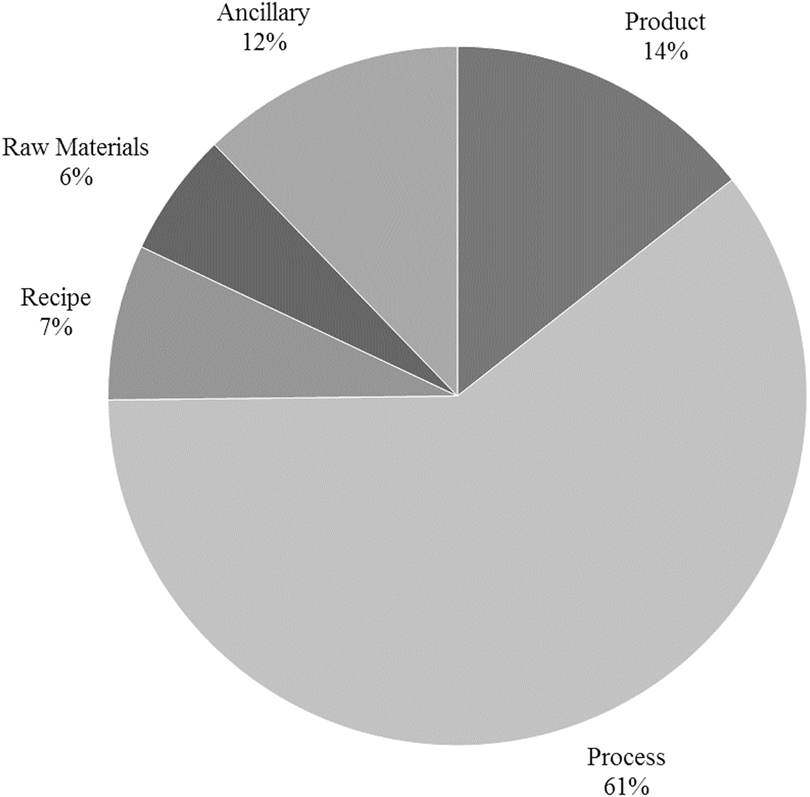
Patents granted in the pottery industry can be grouped into five main categories: products, processes, recipes, raw materials, and ancillary products. Product innovations resulted in an entirely new type of ware, such as Wedgwood’s black basalt ware (Patent 939). Process innovations increased efficiency of production by altering a stage in the production process, either through mechanical or chemical means. Recipes were new compositions for glazes or bodies that detailed the combination of materials being used. Raw materials innovations dealt with the grinding and preparation of flints, clays, and other ingredients. Ancillary innovations, while not completely removed from the manufacture of earthenware products, were mainly composed of broader applications of methods and techniques, such as Herbert Minton’s patent for earthenware clock faces (Patent 13558). The shares of each of these categories are shown in Figure 6.
Categories of all pottery patents granted in England, 1617–1851.
Source: Author’s compilation. Used with permission.

Pottery patents were dominated by process innovations such as John Pepper’s improved kiln construction to reduce fuel consumption, or John Ridgway and George Wall’s repeated attempts to mechanize flatware production in the 1840s.Footnote 53 Just 12 percent of patents were for product innovations, such as Cookworthy’s English porcelain or the garden pots of Cutten and Brown.Footnote 54 Of the patents issued between 1750 and 1851, over 40 percent of these related to process innovations that, to anyone with knowledge of the industry, were easily observable and reverse-engineered, such as kilns. The innovations in these patents were largely based on explicit practical or mechanical knowledge rather than tacit scientific knowledge. This type of knowledge was visible, had been embedded and articulated clearly in an object, and was therefore more easily defensible using a patent.
Specifications exist for the entire sample of patents and provide a great deal of information on a given innovation, the novel components, and the use for which it was intended. As the evidence shown below will demonstrate, patent specifications in the English pottery industry can be divided into two types based on their knowledge components. The first type, the detailed patent specification, offered potential readers a large amount of information and, in some cases (such as Trewhitt’s), almost certainly offered enough for a reader with a limited degree of experience or knowledge to reconstruct or replicate the invention. The knowledge disseminated here was mechanical knowledge, articulable and explicated by its embodiment in a tangible object such a mechanical lever, and therefore more easily defensible through the patent system.
A second type of patent—vague, abstract, and sometimes incomprehensible—offered little valuable information to a reader and often, though not always, only signified that some sort of innovation had occurred.Footnote 55 The knowledge in this second type of patent was clearly extremely valuable, and specifications revealed as little useful or actionable information as possible to readers and potential competitors. A degree of the scientific and chemical knowledge hinted at in these patent specifications was explicable, in the sense that quantities and procedures for recipes could be written down in considerable detail (as in Wedgwood’s patent; discussed below). This was largely not the case, however, and much of the valuable and useful knowledge that could be articulated was kept secret either in the head or experiment books of the Master Potter. The other component of this second type of knowledge was the tacit element that could not be articulated easily, and is best captured by Polanyi’s dictum that “we know more than we can tell.”Footnote 56 No amount of detail or written text could disseminate the skills and experience required to develop and make a new design, shape, pattern, or style. The patent specifications below are representative of the entire sample and are particularly revealing.
The first patent examined, Number 649, was that granted in 1749 to Thomas Frye, a painter from Essex who worked at the Bow porcelain factory and developed “a new method of making a certain ware.” Emphasis has been added to several vague terms and phrases.
Patent 649, 17th Nov. 1749: A grant unto Thomas Frye, of the parish of West Ham, in the county of Essex, painter, of his new invented method of making a certain ware.
FRYE, THOMAS: New method of making a certain ware, which is not inferior in beauty and fineness, and is rather superior in strength, than the earthenware that is brought from the East Indies, and is commonly known by the name of china, japan, or porcelain ware. Animals, vegetables, and fossils, by calcining, grinding, and washing, are said to produce an insoluble matter named virgin earth, but come, in greater quantities than others, as all animal substances, all fossils of the calcareous kind, such as chalk, limestone, &c,; take, therefore, any of these classes, calcine it, grind and wash it in many waters, and reiterate the process twice more, when the ashes or virgin earth will be fit for use. These ashes are mixed in certain proportions with flint, white pebble, or clear sand, and with water made into balls or bricks, highly burned, & ground fine, and mixed with a certain proportion of pipe clay; it is thrown on the wheel, & when finished, dried, burned, and painted with smalt or zaffre, when it is ready to be glazed with a glaze made first by making a glass with salt petre, red lead and sand flint or other white stones in certain proportions, grinding it up well, and mixing it with a certain proportion of white lead, adding a small proportion of smalt to clear the colour. After dipping and drying the articles are put in cases, and burned with wood, till the surface of the ware is clear and shining.Footnote 57
This patent specification, which was the second patent held by Frye for porcelain ware, is particularly interesting as it is rather vague in its detail. It seems almost any combination of many ingredients will render “a certain ware” purported to be English porcelain. No amount of tacit understanding or experience in pottery production would enable anyone to accurately decipher the recipe. There are so many instances of “certain proportions” and “quantities” that it is unclear exactly what the innovation is. This is a far cry from the “reliable, transparent and definitive statements” and specifications that inventors were officially required to provide.Footnote 58 Frye’s motives for taking out his solo patent are difficult to determine with any certainty, and the ambiguity of the specification, at a time when patent specifications were beginning to be scrutinized more closely, is at odds with an innovator who hoped to be able to successfully legally enforce a patent.Footnote 59 Here is an interesting example of a patent being used to protect knowledge that had, in all likelihood, not been articulated fully even in the head of Frye himself. This was most likely a deliberate attempt to obscure any detail of the process on the part of Bow porcelain factory, with the true purpose of the patent to grant protection over the use of and experimentation with the numerous materials listed.Footnote 60 This theory finds support in Frye’s first patent, Number 610, applied for December 6, 1744, and jointly held with Edward Heylin, who is listed as a merchant from Middlesex. This was also vague and obscure in detail.Footnote 61 At the turn of the twentieth century, Burton produced a history of porcelain development in England and set about testing Heylin and Frye’s patent through “exhaustive experiments” with bodies and raw materials. Despite his efforts, he was unable to produce anything equating to porcelain using the patent specification and was highly disparaging of the pair’s patent: “Not only were the proportions of Heylin and Frye entirely wrong, but the frit [an ingredient crucial for the consistency of the porcelain body] was useless for its supposed purpose.”Footnote 62
The second patent was granted to Josiah Wedgwood in 1769 for his famous black basalt ware and was the only patent held by the Master Potter.
Patent 939, 16th Nov. 1769: A grant unto Josiah Wedgwood, of Burslem, in the county of Stafford, potter, of his invention for the purpose of ornamenting of earthen and porcelaine ware an encaustic gold bronze, together with the peculiar species of encaustic painting in various colours.
WEDGWOOD, JOSIAH: The purpose of ornamenting earthen and porcelaine ware with an encaustic gold bronze, together with a peculiar species of encaustic painting in various colours in imitation of the antient Etruscan and Roman earthenware. In carrying out this invention, the patentee first prepares ten ingredients, among which is bronze powder, some of these are one chemical substance, whilst others are composed mostly of several chemical substances in certain proportions, and generally calcined together. The substances are Ayoree, a white earth in North America, gold, aqua regia, copper, oxide of antimony, tin ashes (oxide of tin), white and red lead, smalts, borax, nitre, copperas, flint, manganese and zaffre. By mixing these ingredients with the exception of the bronze power, in different proportions, he obtains seven colours, which he names as follows: - Red, orange, dry black, white, green, blue, yellow, and he produces another colour, which he names shineing black, by mixing some of these ingredients and one of the colours, namely, the green.
In applying the bronze powder, grind some of it in oil of turpentine, and apply this by sponge or pencil to the vessels finished, ready for burning, but not quite dry, polish it; heat the ware as high as is necessary for it; afterwards burnish the bronze. Applying the bronze after the ware is fired bisket, make a mixture in certain proportions of white lead and calcined ground flint, grind them well together; apply this thin with a sponge or brush, flux it, then apply upon it the bronze as before directed.
Shining black (and other colours) upon red vessels, antique Etruscan vases. These colors are ground with oil of turpentine before applying them to the vessels, and are proceeded with as in the first application of the bronze powder.”Footnote 63
A full and complete specification was printed in the Repertory of Patent Inventions published in 1797.Footnote 64 This specification contained weights and measurements and a description of the process required, although it is still far from a “how-to” guide to re-creating the encaustic decoration. Aside from being an extremely complex process, and one that was very difficult to get to work, the patent reveals the extent of Wedgwood’s knowledge of minerals and chemical processes. The knowledge underpinning this patent was complex, scientifically derived knowledge that was combined with experiential knowledge gained through extensive experimentation.
The third patent examined is for a decorative gold luster recipe granted to Godwin Embrey, a North Staffordshire potter, in April 1835.Footnote 65 There was considerable skepticism, albeit only published four years later in Newton’s London Journal, concerning the degree of novelty in this innovation, and indeed whether the specification provided any new information or knowledge.Footnote 66 The London Journal provides an account of the specification which is useful here: “This invention appears to us to possess but a very slight degree of novelty, the whole of the invention consisting in adding a little gum to the ordinary composition in use among potters, and known by the name of gold lustre […] but for what purpose this ingredient is added, the specification does not inform us.”Footnote 67
This may have been an attempt on Embrey’s part to capitalize on an existing set of techniques and knowledge that was already “commonly used” in the industry. In this instance, Embrey used the patent as a way of appropriating existing rather than newly created knowledge. The patent was not published or referenced in any repository other than the London Journal, and the late nature of this suggests that the patent did not garner much attention at the time it was awarded. It should be noted here that the majority of pottery patents were published or referenced in at least one publication, with 45 percent featuring in two or more; although 22 percent of pottery patents were not published or referenced in any way. It is not known whether this patent successfully prevented the use of the materials laid out by Embrey.
The final two patent specifications to be examined highlight the differences between patents pertaining to or containing valuable scientific knowledge, typically difficult to reverse-engineer, and those later patents granted during the 1830s and 1840s for mechanical innovations in which component pieces and mechanisms were more easily discernible. The first was held by John Ridgway, a celebrated North Staffordshire potter who, along with George Wall, was involved in early attempts to mechanize pottery production during the 1840s. Between them, the pair took out five patents in the decade, including one for a flatware machine known as a Jolly, which was installed at Mason’s manufactory in North Staffordshire in November 1844. Early attempts by the pair were largely unsuccessful, and it was not until the 1870s that this type of machine was in general usage.Footnote 68 Ridgway’s patent was relatively simple to understand and was clearly designed to be as detailed as possible, with some passages accompanied by qualifications such as “this term being well understood by potters and persons conversant with such manufacture.”Footnote 69
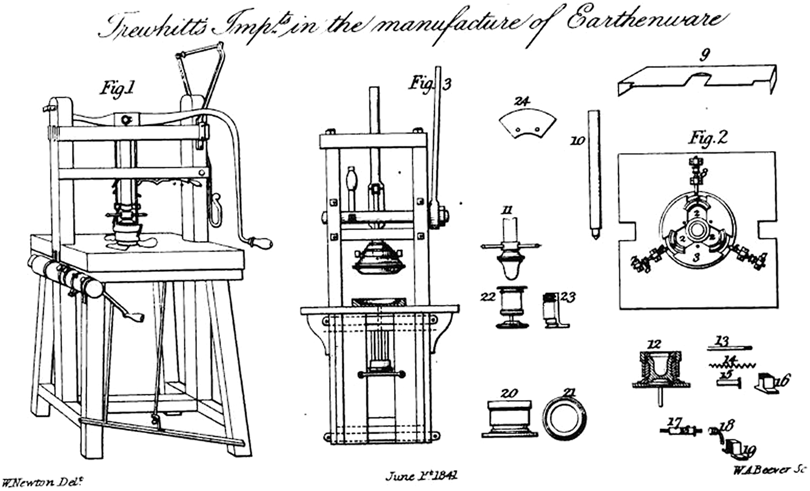
This difference in approach to the specification is even more pronounced when the patent of Henry Trewhitt, a gentleman from Newcastle-on-Tyne, is examined. The patent was granted in December 1839.Footnote 70 The full specification is extremely detailed and accompanied by numerous diagrams, such as those shown in Figure 7. Each component part was referred to in the specification, including the material they should ideally be formed of (copper, iron, etc.). The process of each mechanism was described along with the function of each part. From a technical perspective, there is no reason to believe that someone with experience of machine making would not be able to reproduce the machine to a reasonable degree of accuracy, thus allowing for tinkering and improvement. While this patent undoubtedly revealed a great deal about the machine, the specification itself is purely technical and does not contain any additional insight or information that could not be gleaned by viewing the machine in person.Footnote 71
Technical drawings for Henry Trewhitt’s patent, granted December 4, 1839.
Source: The London Journal of Arts, Vol. 18, 297-300, Plate XII. Used with permission.

Potters during this period had no recourse to other forms of intellectual property protection for their innovations. Registered designs or copyright protection in the pottery industry did not exist in England until the 1840s. While other trades such as printmakers, artists, and cotton textile printers were early beneficiaries of the 1735 Hogarth’s Act and the Copyright Act of 1787, earthenware goods had no such institutional protection until the introduction of the Copyright of Designs Act in 1839.Footnote 72 MacLeod argues that because this legal framework was absent before the middle of the nineteenth century, the tension around what constituted a novel invention “was at its most acute”; thus, the majority of potters refrained from patenting in acknowledgment of this issue.Footnote 73 Sherman and Bentley provide a finer analysis and point to a distinction, although short-lived, during the nineteenth century between different areas of intellectual property: copyright, on the one hand, and patents, on the other. Copyright was seen as the domain for art, or designs, whereas patents were upheld as examples of “industrial property” and generally held in higher regard; this opposition perpetuated as the nineteenth century progressed.Footnote 74 In short, outside of copyright law, protection for designs, such as those crucial to the pottery industry, sat somewhat uneasily alongside the technical, industrial protection provided by patents. This could help to explain the consistently low level of patenting in the pottery industry until the 1840s.
However, given the importance of tacit and uncodified knowledge in pottery production, the difficulty in reverse-engineering such knowledge, and the lack of widespread mechanical penetration into the industry, any explanation based solely on the legislative environment is not sufficient. If the argument put forward by Moser is accepted—that the level and type of knowledge in an industry largely determines the propensity to patent and the degree of innovation outside of the patent system—then one must engage further with the innovations themselves and evidence other than patents.Footnote 75
Knowledge and Innovation Outside the Patent System
Exhibition records offer an indicator of innovation in an industry regardless of whether they were patented or not. As Moser notes, a crucial weakness in exhibition data in general is that innovations that were easy to replicate or copy may be underreported if it is assumed that innovators may not wish to divulge their secrets.Footnote 76 With earthenware exhibits, this is not as serious an issue as the innovation or key component of potters’ wares: the composition of the body was inherently difficult, if not impossible, to determine once the ware was fired. The fact that most the pottery exhibits displayed at the Crystal Palace were finished wares and were freely open to examination by any paying visitor suggests that potters were not concerned that their trade secrets would be revealed or discovered in this way.Footnote 77 In this case, official reports of exhibitions and fairs are useful as they reveal the perception of novelty, innovation, and success in the pottery industry. Official reports relating to the Great Exhibition of 1851 contain detailed and remarkably balanced accounts for each of the thirty exhibition classes, in addition to strict industry-specific criteria upon which international prize juries must base their decisions.Footnote 78
Pottery prizes and awards at the Crystal Palace were given for “Important inventions and discoveries, or regularity combined with excellence of design; novel application of known discoveries; great utility combined with economy and beauty; excellence of workmanship and quality.”Footnote 79 The criteria of novelty, invention, and innovation were exacting and, overall, applied relatively evenly. In an industry in which aesthetics played a large part in the sale-ability of the end-product, novelty refers here not only to “novel application of known discoveries” but also new designs, colors, shapes, and styles. Novelty in design, for example, could be achieved without an innovation, per se. Given this, the awarding of a prize may be taken as an indication, albeit a very rough one, for international conceptions of what constituted leading quality, invention, and innovation in the pottery industry by the middle of the nineteenth century. The items displayed at the exhibition or those awarded prizes do not, however, constitute a measure of the quantity of innovation in the industry.
Based on the reports, the key reasons for the granting of each prize indicate that novelty, unsurprisingly, played a key role. Utility and practicality were also important, with several potters rewarded for modifying existing products through the addition of qualities and properties that enabled them to be more useful for a wider range of tasks, especially those involving chemicals. Within the earthenware exhibit awards, quality was almost never explicitly the principle or sole reason for an award, and it should not be a surprise given the prestige of the Great Exhibition and the challenging selection process.Footnote 80 In a study of exhibitions and prizes in the United States, Khan questions the degree to which award criteria were adhered to by judging panels. In the case of the Massachusetts Charitable Mechanics’ Association exhibitions between 1837 and 1874, novelty took a backseat to “appearance and workmanship” as a judging criteria.Footnote 81 Khan also notes that “British great inventors primarily depended on their background rather than on their productivity” to win a prize at a fair; especially whether they attended elite schools such as Oxford or Cambridge.Footnote 82 There is, therefore, no consensus concerning novelty and the awarding or impact of prizes at exhibitions such as those at the Crystal Palace or in Massachusetts. This is not to be unexpected, however, given the considerable differences in the intellectual property systems on either side of the Atlantic. For instance, in the United States public displays of inventions and innovations could compromise an inventor’s ability to claim novelty, and thus be granted a patent. In the United Kingdom, tensions over whether to display an innovation certainly existed (as it would reveal certain features), although the decision would not impact on the obtainment of a patent as these could be awarded later.
The award citations for 1851 suggest that novelty and innovation in the earthenware sector relied on knowledge-intensive efforts in the scientific- and chemical-based processes of glazes, colors, and body composition. The knowledge required to succeed in these aspects of production was protected by the virtue that the end-products had undergone a series of irreversible chemical reactions during the firing processes. This rendered the innovation somewhat elusive to the untrained eye, and very difficult to reverse-engineer even for an experienced practitioner. If Moser’s analysis for the second half of the nineteenth century holds for this period, this may have affected the strategies employed by producers to appropriate the returns to their innovations. The chemical-based innovations deemed to be the finest required high levels of scientific knowledge (not necessarily formal knowledge) and could thus be protected outside of the patent system through, for example, secrecy.
There were of course other ways in which producers could achieve recognition and remuneration for their innovations before the proliferation of world fairs after 1851. In 1822 Job Meigh II was awarded a “Large Gold Medal” by the Society of Arts for his production of a new lead-free glaze.Footnote 83 The details of this case were the subject of much comment and debate in trade literature of the time. An anonymous inquirer wrote to Mechanics’ Magazine in May 1824 referring to an unknown gentleman (Meigh) who had been awarded a medal for the discovery of a lead-free glaze. He suggested: “If that gentleman does not wish to monopolize to himself the advantages which may arise from his discovery, he would do well to give it publicity through the medium of the Mechanics’ Magazine.”Footnote 84
While this is suggestive of the notion that certain ideas and innovations were discovered but not appropriated by their inventors, perhaps in some altruistic manner, the response of a second anonymous contributor, “G. C.,” points toward a more logical explanation:
Specimens of the ware […] and of the glaze itself, as well as of the ingredients of which it is composed, are placed in the Repository of the Society [of Arts]. See Volume 40, of the Transactions of the Society of Arts, in which is detailed the ingredients of the above glaze, and also an improved composition for the ware itself.Footnote 85
The knowledge and secrets that could have been appropriated by Meigh himself were published, although in a very rudimentary format, and thus made publicly available.Footnote 86 A patent may have allowed Meigh to appropriate some of the gains from this discovery, although in the event he was bound by the decree of the Society, which published the information: “All articles rewarded by the SOCIETY, shall be freely given up to the public, to be made or manufactured by any person whatever.”Footnote 87
Sales catalogues are an excellent supplementary source as they are detailed and often illustrated, although very few from the eighteenth century survive. Wedgwood’s innovations in marketing and sales techniques are well known and researched.Footnote 88 Examination of a sales catalogues from the 1780s gives an indication of what one of the most successful and pioneering potters saw as novel and innovative.Footnote 89 The meticulously organized catalogue provides commentaries for each class of ware produced at Etruria, the majority of which came with a qualification of excellence: “no cameos […] of equal beauty, magnitude and durability […] have ever before been offered to the public”; and perhaps the most self-elevating: “persons of the most refined taste have acknowledged this to be a higher and more perfect species of painting than was known to the world before the date of this invention.”Footnote 90 This, of course, is to be expected. Wedgwood went to considerable efforts to illuminate the originality and innovation of a few choice pieces above all others: three pages and an illustration are reserved for Wedgwood’s Etruscan wares of a black basalt body and encaustic decoration, a style he pioneered during the late 1760s and had perfected by the 1770s.Footnote 91 This represented the pinnacle of experimentation, art, taste, and imitation: the “new species of encaustic colour [was] durable […], entirely free from the varnished or glassy aspect” of previous imitations, and above all, consistent; “[t]he colours never spread in the fire or run out of drawing.”Footnote 92 Although by the time of the publication of the catalogue, Wedgwood had attained a degree of efficiency in production of Etruscan wares; nevertheless, the potter was losing around 85 percent of production in the firing stages in the late 1760s and thus had to charge very high prices.Footnote 93 Not only did the innovation provide an entirely new product and solved imperfections and inconsistencies but also this encaustic decoration had the compound effect of reducing the skill level required to imitate objects of classical antiquity. The method allowed “moderately skilled painters” to achieve high levels of quality and likeness.Footnote 94 Wedgwood was careful not to reveal too much useful information regarding the composition or production process for his Etruscan ware, publicizing just enough to signal that this was both extremely difficult and innovative while the all-important recipe and specific knowledge remained elusive.
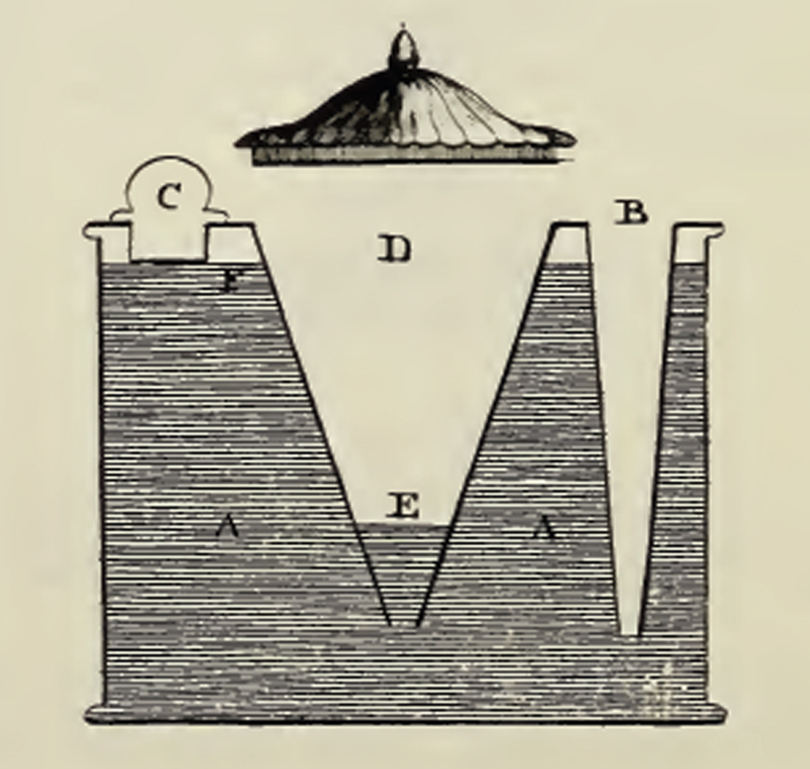
Wedgwood also diversified into developing new uses for earthenware. He was keen to promote his innovative new black basalt bodied ink-stand that “is neither corroded by the ink, nor absorbs it, nor injures its colour, as the metals used for these purposes do.” The entry was accompanied by an annotated technical drawing, shown in Figure 8.Footnote 95
Wedgwood’s black basalt ink-stand, advertised in his product catalogue of 1787.
Source: The Wedgwood Catalogue of 1787, 63. Used with permission.

The illustration and description clearly reveal the mechanical and design properties of the ink-stand. Moreover, these features could be examined in detail and reverse-engineered or imitated through purchase. This was not patented, however, and the chemical secrets of the composition of the black basalt body, the most crucial innovation in this product, remained intangible. Once more, Wedgwood was selective in the knowledge he revealed, publicizing only that which could be easily attained by fellow manufacturers. Here then are examples of two different types of knowledge related to innovation in the pottery industry. The first is that scientific knowledge allowed and produced innovations resulting in entirely new product ranges. This includes Wedgwood’s Etruscan ware, which was obtained through much experimentation and was protected by its very nature and the ability to keep it secret. The second type of knowledge relates to the visual and tangible elements of design and construction that are not rooted in scientific understanding. This type of knowledge, as seen in the Crystal Palace exhibits, can be freely publicized, advertised, and shared. Clearly there were decisions to be made between the disclosure of crucial knowledge or secrets and the advertisement and dissemination of the product.
An article on glazing in Mechanics’ Magazine from 1825 offered a recipe and instructions for a new lead-free glaze that had been developed by Mr. Rochinski, a potter in Berlin. While the recipe was relatively straightforward in terms of quantities, a certain amount of prerequisite knowledge or experience was required to get the consistency right: “a mixture fit to be readily applied on the earthenware, and to cover it equally all over.”Footnote 96 The comments made by Robert Campbell in 1747 were still pertinent almost a century later when an article in Mechanics’ Magazine described a “Lecture on Pottery” given by a Mr. Cowper at the Royal Institution in March 1839.Footnote 97 The content and delivery of his lecture are indicative of the “cognitive limitations” associated with the communication and transfer of technical and tacit knowledge in the pre- and early-modern period.Footnote 98 Although Mr. Cowper was a Master Potter, in order to demonstrate skills and techniques even at the most basic level he required a live demonstration by a potter working at a wheel.Footnote 99 Following Polanyi’s dictum once more, the type of skills required for pottery or any other intensive craft-based production rely on the craftsman’s “awareness of a combination of muscular acts for attending to the performance of a skill.”Footnote 100 Cowper’s lecture thus demonstrates the problems that can arise in the transfer of certain types of knowledge, especially when one considers that the way in which teaching or articulating a skill or piece of knowledge may be very different forms to when someone actually makes a product.Footnote 101 There were also examples of the tensions Collins highlights: between knowledge that “is not” explicated, on the one hand, and knowledge that “cannot” be explicated, on the other.Footnote 102
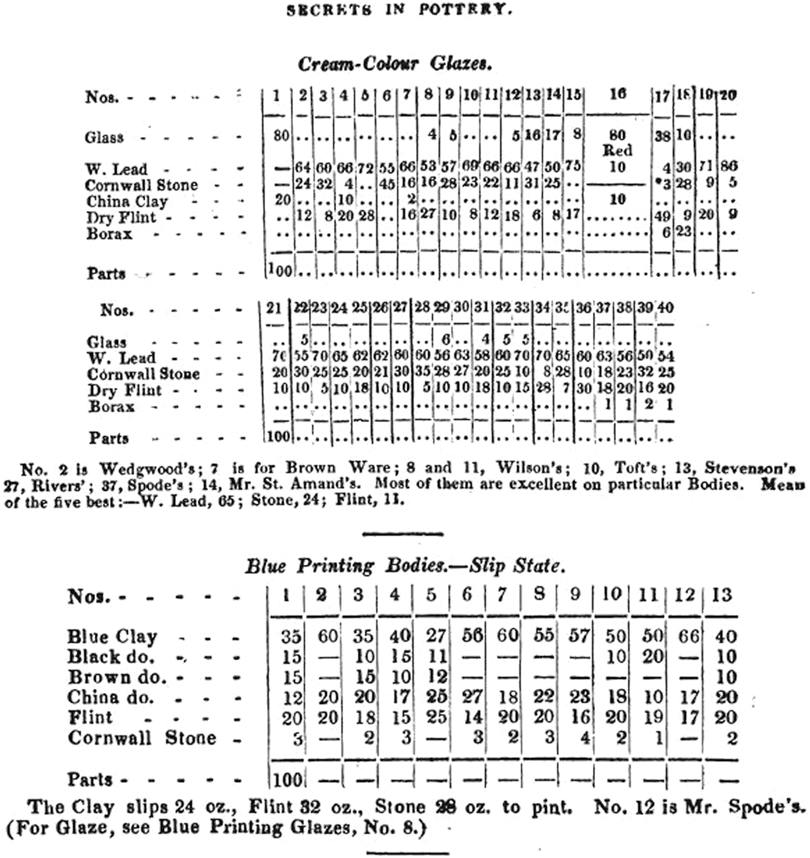
A fascinating exchange in Mechanics’ Magazine highlights the importance of secret, scientifically focused knowledge. In March 1833, a contributor writing under the alias of Friar Bacon of Hulton Abbey, responded to requests from readers for information on pottery glazes.Footnote 103 Under the title “Secrets in Pottery,” Friar Bacon submitted 108 recipes with “reason to believe that they include nearly all of those in any repute” (Figure 9). They included recipes for bodies and glazes used in the manufactories of Meigh, Spode, Davenport, Wedgwood, Clowes, Yates, and Moore, to name a few. These were far more detailed than those listed in patent specifications or other literature and were each composed of one hundred parts that were then apportioned for each ingredient.
“Secrets in Pottery,” compiled by Friar Bacon of Hulton Abbey.
Source: Mechanics’ Magazine, March 31,1833, 434. Used with permission.

To illustrate the level of disclosure that the publication of these secrets provided, comparisons with patent specifications that referred to recipes can be made. John and William Turner, who operated a pottery in Lane-End, Staffordshire, were granted a patent in 1800 for a new method of manufacturing porcelain and earthenware that involved the introduction of a new substance that was found in Staffordshire coal mines known as Tabberners Mine Rock, or Little Mine Rock.Footnote 104 The specification is relatively short and is vague when describing the characteristics of the new substance:
This stone, or rock substance […] between a hard marle and an iron-stone rock […] is an ash or greyish colour, but, when dry, becomes whiter; and, if bunt in a potter’s oven, with the degree of heat generally used in burning their wares, becomes very white, without any appearance of fusion.Footnote 105
The patent then went on to blur the description of the substance even further:
Any stone or substance corresponding with this description, or of a similar quality, wherever found, and whether known by the name or names of the Tabberners Mine Rock, Little Mine Rock, and New Rock, or by any other name or names, is the material for which we have applied for the said letters patent, and which we mean to appropriate to our own use, in the manufacturing of porcelain and earthenware.Footnote 106
This suggests the patentees were trying to widen the scope of their patent with this description, and it is clear that they were keen to gain a return on their discovery. When the specification turns to details of the recipe and preparation of the mixture, far less is revealed than in Friar Bacon’s recipes. John and William Turner referred to breaking the body down into parts, although they were far from precise in their description. Again, the proportions are loose and flexible enough to capture a wider range of body compositions.
The proportions we think the best, are from six to ten parts of the said new material to one part of the flint or siliceous earth. But, although we have described what we consider as the best proportions using the said new material, in the manufacturing of porcelain and earthen-ware, it is expressly to be understood, that we do not mean absolutely to confine it to these proportions, inasmuch as the proportions must necessarily vary, according to the particular article to be manufactured.Footnote 107
A similar style of patenting was continued by William Hodge, who was granted a patent for the introduction of a new substance to earthenware production known as hornstone porphyry, or elvan. The specification was vague when it came to any details of the recipe that was being employed and the materials being used: “I find that a large or a small proportion of elvan may be employed, and the effect in the ware produced will be in relation to the relative proportions; and therefore the workman will use his judgment in the quantity he employs, according to the effect he desires to obtain.”Footnote 108 Here, then, the onus was placed on the person interpreting the patent to get the correct proportions of materials. Just as the Turner’s sought to appropriate the use of Tabberners Mine Rock, so too Hodge sought to limit the use of elvan.
There were several other instances of patents for new recipes for bodies and glazes that followed the same pattern: the restricted detail when it came to being able to reproduce the innovation, and the loose and flexible definition of the materials used in order to capture a greater range. Patents granted to John White in 1809, Joseph Gibbs in 1841, and George Skinner and John Whalley in 1845 all referred to recipes and new compositions for the bodies of wares.Footnote 109 All these patents adopted a guarded style and sought to reveal the minimum amount of useful knowledge. The practice of patenting recipes was clear in the pottery industry.
By contrast, the recipes provided by Friar Bacon were far more useful in the details that they revealed. Whereas the patents did not reveal proportions or quantities, Bacon’s recipes were broken down into parts and annotated. Many of the recipes were accompanied by notes such as, “J. Clowes says, this is a much better Glaze” and “No. 1 is a good body, much approved in the American Market; requires a hard fire.”Footnote 110 The fact that the contributor was writing under an alias draws attention to the desire to remain unknown, perhaps due to the fact this is one of the only documented open publications of pottery recipes found. This in itself, along with the title, suggests that these were tightly held secrets.
Friar Bacon’s identity remains a mystery, although there are several possible scenarios based on conjecture. The choice of moniker is an interesting one. It could be a reference to Roger Bacon (c.1214–c.1292), the English natural philosopher and Franciscan friar with an interest and skill in optics and mathematics.Footnote 111 It is possible that the individual behind the name was a particularly well-traveled potter who had spent time working at many different workshops across the district. This is entirely plausible given, for example, the high turnover of firms and likely exposure to recipes if he worked in the dipping house. A less plausible alternative is that Friar Bacon’s contributions are the work of a disgruntled employee who felt the need to publicize the secrets of his past employers. Although for this to be the case, he must have held a grudge against a large number of potters. It is also possible that Friar Bacon was an outsider to the district, someone who had managed to procure detailed recipes by means of subterfuge. However, the motives are not clear, as one may assume that an outsider to the industry with access to such knowledge may try to sell the information privately rather than publish it publicly and freely.
The industry took secrets seriously, and recognized that many parts of the production process could leak or spill out of the boundary of a firm with the movement of labor between partnerships.Footnote 112 In the highly likely event that workers were exposed to secrets relating to production in any manufactory, in 1837 the local Chamber of Commerce saw fit to include a clause in their employment contracts to prevent, as far as possible, these secrets being revealed.
The said Workman agrees to do and perform his work in a good skilful and workmanlike manner, and to attend to the business of his said employer, during the regular and usual working hours; to execute lawful commands, preserve secrets, advance interests to the utmost of his power, and in all respects to behave as an honest and faithful servant.Footnote 113
Similar approaches to the protection of corporate knowledge and trade secrets can be found in the noncompete clauses common in high-tech industries today.Footnote 114
A response came in June 1833, several months after the publication of these original recipes, when a “constant reader” from Newcastle-under-Lyme in the Potteries raised concern over the publication of secrets. In a short statement, the reader noted that the friar’s actions had “put all in commotion.”Footnote 115 Objections to the disclosure were raised, though the reader went on to express his pleasure in receiving the information and requested further glaze and body recipes. This objection says two things that both point to the reliability of the recipes. First, the fact that an objection was made is an indication that the “constant reader” was concerned about secret knowledge being leaked into the wider community. If the recipes were bogus or ineffective, then it is unlikely that they would have caused such a stir. Second, the reader ended the objection on a positive note and placed a more specific request for “chalk and china bodies and glazes.”Footnote 116 Again, it is safe to assume that if the original recipes were not effective or trusted, further requests would not have been made. Clearly, then, while there were some moral or ethical issues raised, the pragmatic reader recognized the importance of the knowledge that was published. The magazine obliged the reader and continued the somewhat obvious deception and intrigue by explaining the delay in publication: “though [the Friar’s] knowledge is modern, [he] writes in so ancient and crabbed a fashion […] it takes more time than we have been recently able to command, to furnish the printer with an intelligible transcript of his manuscript.”Footnote 117 Dutifully, on July 13, the magazine published another 31 recipes provided by the friar under the title “More Pottery Secrets.” These had the same level of detail and were in turn followed by 36 more recipes a week later.Footnote 118 Unfortunately, the trail of Friar Bacon runs dry and there are no further references to this episode. The saga ended on July 20, 1833, but not without 175 detailed recipes being published.
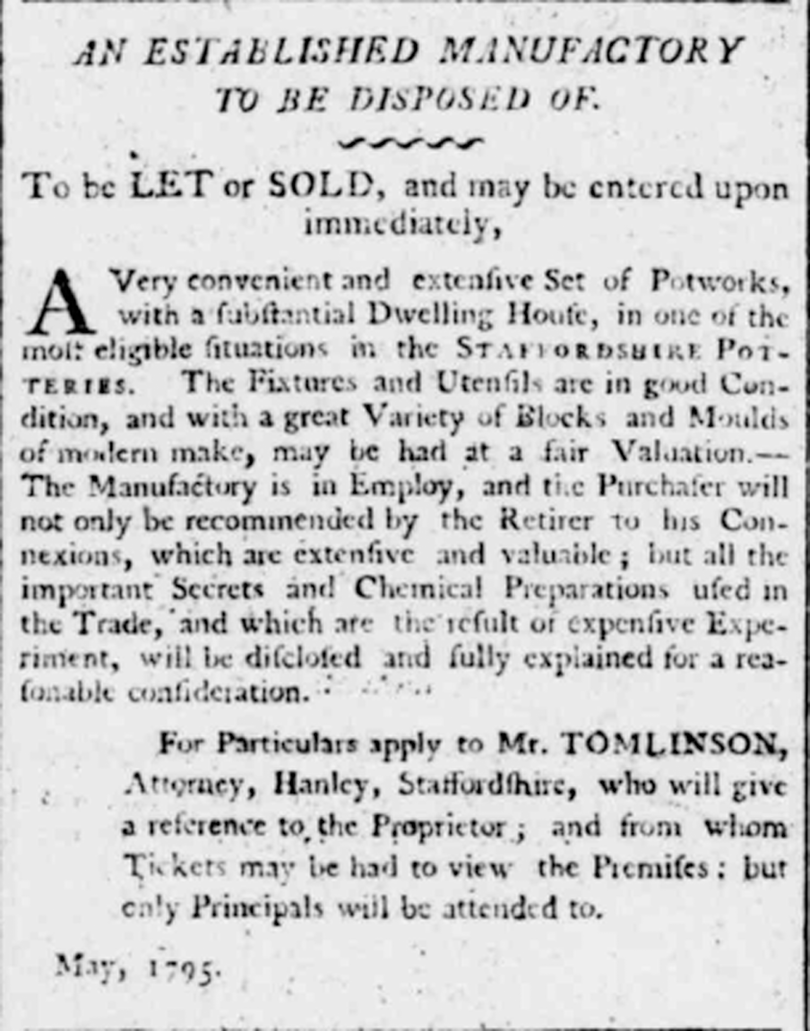
In terms of the impact of this episode, although there is clear recognition that divulging of secrets was a potential threat to a business and the wider industry, and the requirement that workers agree to a contract preventing this activity, it is not known whether mention of secrets was added specifically as a result of Friar Bacon’s divulgences. Moreover, the local newspaper for the region at the time, the Staffordshire Advertiser, made no mention of the leak, or of any secrets, in the pottery industry save one: an advertisement (see Figure 10). It is difficult to ascertain whether there were any new entrants to the market as a result of the glut of recipes that were published in the Mechanics’ Magazine. The number and composition of firms operating in the region between 1781 and 1846 has been reconstructed using trade directories. While there was a slight increase in the number of producers between 1830 and 1834 (two years of directory publication), it is not clear whether this is due to the different authors of the directories using different criteria for inclusion, or due to some other factor unrelated to this incident.
Advertisement placed in Staffordshire Advertiser.
Staffordshire Advertiser, Saturday, May 16, 1795. Used with permission.

Secrets and the Nature of Knowledge in the Pottery Industry
I conducted searches of local newspapers from their first publication until 1851 and found no references to secrets, trade secrets, or knowledge for sale in such a manner as the advertisement shown in Figure 10. The sale or letting of a pottery manufactory was placed by an anonymous proprietor in the Staffordshire Advertiser for several weeks over May and June 1795. It is suggestive of several features of the English pottery industry at the time: networks and connections mattered, “important secrets” of the trade could be acquired either through “expensive Experiment,” or purchased for a “reasonable consideration.” Producers could access an informal market for certain types of useful and reliable knowledge that were seen as providing competitive advantage in the industry. This is only known example of secrets in the pottery industry being openly offered in local newspapers for purchase between 1795 and 1851.Footnote 119
This informal market differs fundamentally in nature from the more formal markets for technology and knowledge noted by Lamoreaux and Sokoloff in the United States during the late nineteenth and early twentieth centuries.Footnote 120 In the American context, the patent system worked as an “institutional framework” for a market for technology, serving as an information and marketing channels enabling inventors and would-be inventors to keep up with developments in their field, or avoid potential infringements.Footnote 121 In the North Staffordshire context, knowledge and technical information flowed throughout the district despite the scarcity of inventors taking up formal intellectual property protection for their innovations. Of course, the two contexts differ substantially, with mechanization far more widespread in the former than in the latter.Footnote 122 Rather, in terms of a “market for technology,” the North Staffordshire Potteries could perhaps more closely resemble the brewing industry discussed by Nuvolari and Sumner: a wide range of “appropriability strategies” were employed as a means of sharing or protecting useful and technical information. Most notably, these were secrecy, partial publication, revelation, open innovation, and patenting.
Working in secret was a feature found in many industries, not just pottery. While they are scant, there are some legal cases relating to the sale of secrets in the 1680s and 1690s. This was a well-established practice in textile and chemical production at least.Footnote 123 Trading secrets, whether useful or not, was legal at the time the advertisement in Figure 10 was placed, although there were long-standing difficulties in enforcing this practice through the courts. The first known “trade secret” lawsuit was in 1682, and it attempted to enforce the purchase of unspecified chemical recipes (to the value of £500). It was ultimately unsuccessful in enforcing the decision due to the inability of the court and plaintiffs to assess the value of the secret without first knowing the secret.Footnote 124 Bottomley argues that this contributed to the confinement of legal transfer of trade secrets to medicine and chemicals on the basis that these innovations were especially suited to secret development.Footnote 125
The first conclusion to be drawn is that patenting was not a widespread strategy employed by North Staffordshire potters between 1750 and 1851. Innovating potters faced a dilemma in the tensions between the advantages of patenting an invention or idea and the disclosure of information. In theory, the more precise and detailed a patent specification was, the easier it was for a patentee to legally defend any abuse or contestation. This also offered the potential for an innovator to close-off competition from capitalizing on potential opportunities related to the innovation. In practice, this was not the case for many potters.
Josiah Wedgwood’s own views on patenting were deeply rooted.Footnote 126 He had established himself in a region and industry where patenting was infrequent and his aversion was shared by his local contemporaries. Richard Champion’s patent for English porcelain, which he purchased from William Cookworthy in 1774, was vehemently opposed by a considerable number of potters, led by Josiah Wedgwood. The potters objected to Parliament on the grounds that it was “injurious to the Community at large which neither the ingenious Discoverer [Cookworthy] nor Purchaser [Champion], for want perhaps of Skill and Experience in this particular Business, have been able […] to bring to any useful Degree of Perfection.”Footnote 127 Patents were opposed or encountered resistance and abuse whether they were for successful processes that were commercialized or not.
What the patent evidence shows is that aside from mechanical innovations, the natural tendency in the pottery industry was toward secrecy as a strategy. The fewer details revealed, the more ambiguous the innovation appeared to competitors, the freer the innovator was. This strategy was particularly appropriate in the pottery industry, where much of the innovation was of a chemical and scientific nature until well into the nineteenth century. This finding supports MacLeod’s more general statement that secrecy as a strategy was more prevalent in scientific rather than mechanical settings.Footnote 128
North Staffordshire potters were even more resolved to make access to their prized innovations and knowledge as difficult as possible for foreign outsiders and competitors. Travel diaries written during tours of industrial regions contain further evidence of cautious potters. S. H. Spiker, on his travels through the region in 1816, wrote the following after being denied access to certain rooms in Spode’s workshops: “Mr Spode, [declared] that he had been frequently deceived by persons, who, under the pretext of seeing the manufactory, merely sought to communicate its arrangements to others.”Footnote 129
This degree of caution toward outsiders was present in the eighteenth century too. In October 1785 Wedgwood wrote to the Secretary of the General Chamber of Manufacturers of Great Britain to voice his, and his fellow potters, concerns regarding “three different sets of spies upon our machines and manufactures now in England.”Footnote 130 Wedgwood told of accounts from his contemporaries of foreign spies gaining access to machinery and the inner workings of manufactories by pretending they themselves had important innovations to share.Footnote 131 Clearly there was a high degree of uncertainty and anxiety over keeping trade secrets secret.
The evidence discussed above also support Moser’s more recent findings for the second half of the nineteenth century regarding secrecy as opposed to formal protection of intellectual property. Moser asserted that for the second half of the nineteenth century, the “effectiveness of secrecy” was industry specific and the key determinant of the propensity to patent, and that this was underpinned by the degree of scientific or technical knowledge required.Footnote 132 This article has shown that the argument also holds for the pottery industry for 1750 to 1851, before Moser’s period of study. This is the case because the chemical base of many of the innovations in the pottery industry rendered them difficult to articulate, reverse-engineer, and make transparent. Much of the valuable knowledge could not easily be reverse-engineered and was therefore granted protection outside of the patent system. Despite Mokyr’s assertion that “any other form of protection worked even less well” than patents, North Staffordshire potters successfully employed secrecy as a strategy for success.Footnote 133
The evidence presented here suggests that the nature of knowledge in the pottery industry was extremely important in determining the behavior of producers with regard to articulating and disseminating knowledge. There is a wide variety of evidence for innovation in the English pottery industry during one of its most dynamic and successful periods of development. Patents offer much in the way of quantifiable evidence but are also extremely useful in disclosing information about the types of knowledge in the industry. Examination of additional sources reveals that the categorization of knowledge is more complex than a simple tacit/explicit division. First, there was knowledge that was articulable and defensible in the formal sense; that is, through patents. This included mechanical or prescriptive knowledge that was relatively easy to detect and decipher. Second, there was knowledge that did not require this type of protection by virtue of the fact that it was difficult to fully articulate and transfer in the written form. Third, there was knowledge that straddled the tacit and explicit distinctions. In its finished state, as embodied in a piece of earthenware, it was largely undecipherable except through extensive and expensive experimentation, with no guarantee of success or imitation. This author reminds readers of the lengthy and expensive attempts to successfully imitate Chinese and Japanese porcelain. However, in its articulable form in a recipe or instruction manual, this knowledge was extremely useful to those with the experience and tacit knowledge to understand and apply it. Thus, it was deemed to be of such value to a potter that it was kept secret, being revealed (somewhat cryptically) only when in its irreparably altered state. Potters thus adopted different strategies toward protecting their knowledge, depending on the type of knowledge.
To address the collective invention hypothesis discussed earlier in the article, one can draw a relatively robust conclusion. The pottery industry exhibited some, but not all, of the core features of collective invention. Innovation took place largely outside of the patent system. However, the remaining criteria are not satisfied. There is no evidence of open sharing of technology, or the willful dissemination of useful knowledge. In fact, the picture painted by the evidence suggests rather the opposite. Advances and innovations were highlighted and referenced in trade literature, patent specifications, advertisements, and sales catalogues, but the details and precise nature of the innovations remained secret. Indeed, they were accessible only for a “reasonable consideration” in one case.
In relation to the need for incremental innovation to qualify as collective invention, it is not entirely clear from the evidence discussed here that innovation in the Potteries met this criteria in the sense captured by Allen and Nuvolari. The nature and context of innovation in the pottery industry, and the two classic examples of collective invention (iron production in Cleveland and steam technology in Cornwall), are important in this regard. For instance, consider the core products of these three regions. The focus of Allen’s collective invention narrative was the Cleveland district, which produced pig iron. This was an input material for a range of other products, industries, and key innovations related to the size and heat of blast furnaces.Footnote 134 The Cornish mining districts, the locale for Nuvolari’s “collective invention settings,” produced copper and tin, neither of which were final products, with the core innovations being in steam technologies.Footnote 135 The North Staffordshire Potteries produced finished earthenware products that would be sold directly to final consumers, and key innovations tended to be focused on glazes, bodies, colors, and shapes (as well as design and style). These differences have important implications for the technological trajectories of the three regions, and thus important implications for collective invention. The technological trajectories of Cleveland and Cornwall were characterized by cumulative or incremental innovations. For example, the optimally efficient height of a furnace and its temperature were arrived at by small incremental design changes and additions of height several feet at a time. Likewise, the pumping engines that proved so crucial to the Cornish mining industry were the result of incremental improvements and increases in features such as steam pressure, boiler surface, and cylinder diameter.Footnote 136 Advances in glazes, body composition, and styles of earthenware products were perhaps somewhat more discrete. Of course, there were innovations in scientific knowledge and understanding of chemical compositions that were crucial to numerous subsequent innovations, such as the development of lead-free glazes.Footnote 137 Nevertheless, innovation in the pottery industry was far more varied and diverse in its trajectory and was not a series of incremental improvements along one key plane, such as the steam engine. Finally, in answer to the question raised earlier in the article: Does the assumption hold that a very low propensity to patent in an industry is accompanied by open knowledge sharing between producers? This author can state with confidence that this is not the case in North Staffordshire during the later eighteenth and early nineteenth centuries.