On June 23, 2016, an extreme tornado struck the Yancheng City of the Jiangsu Province, China. It was the most serious tornado to hit China in the past 50 years, with many schools, flats, and factory buildings severely destroyed. The tornado claimed 99 lives, injured approximately 800, and affected more than 1.6 million people. Reference Lyu, Wang and Cheng1 Beyond the financial and physical damages, individuals who experienced natural disasters could suffer from severe and prolonged psychological consequences, such as posttraumatic disorder, depression, and anxiety. Reference Neria, Nandi and Galea2–Reference Fan, Zhang and Yang4 Adolescents have been studied extensively by trauma researchers have been found to be a particularly vulnerable group. Reference Alisic, Jongmans and van Wesel5–Reference Zhou, Wu and An8 Some adolescents reported positive psychological changes following stressful and traumatic experiences, known as posttraumatic growth (PTG). Reference Zhou and Wu9,Reference Zhou, Wu and Zhen10
PTG refers to positive changes that occur from a person’s struggles with highly challenging life crises, Reference Calhoun and Tedeschi11 including positive changes in self, interpersonal relationships, and life attitude. Reference Tedeschi and Calhoun12 A few studies have found that adolescents experiencing traumatic events are likely to exhibit PTG. For example, a study showed that adolescents affected by the Ya’an earthquake in China, reported a 76.2% prevalence of PTG. Reference Chen and Wu13 Similarly, after 2008 Wenchuan earthquake, 60.2% of adolescents reported PTG. Reference Zhou, Wu and Zhen14 In another study following the 2016 Yancheng tornado, some adolescent survivors also demonstrated PTG. Reference An, Yuan and Zhang15 Considering the widespread and positive existence of PTG among posttraumatic adolescents, many researchers take considerable interests in exploring the factors affecting PTG, such as perceived social support, Reference Yuan, Goh and Xu16 positive cognitive coping, Reference An, Ding and Fu17 and deliberate rumination. Reference Zhang, Xu and Yuan18 In this study, we expected to conduct an in-depth study about factors promoting PTG among adolescent survivors, empirically investigate the positive psychological responses following trauma, and promote adolescents’ mental health after traumatic events.
Parents are important sources for adolescents’ ability to cope with traumatic experiences, Reference Man, Liu and Xue19,Reference Duru and Balkis20 and Tian et al. found that parental attachment significantly positively predicted PTG. Reference Tian, Wu and Wang21 The quality of teenagers’ relationships with their parents can significantly influence their mental health outcomes, Reference Helsen, Vollebergh and Meeus22–Reference Woodhouse, Ayers and Field24 especially when they experience adversities or traumatic events. Reference Song, Thompson and Ferrer25 Parental attachment is defined as the affectional ties that binds adolescents to their parents. Reference Bowlby26 Previous studies found that individuals possessing secure attachment reported less psychological problems following traumatic events. Reference Fraley, Fazzari and Bonanno27–Reference Cohen and Katz29 Moreover, securely attached individuals are more likely to demonstrate PTG. Reference Mikulincer, Shaver and Horesh30 These individuals may have more positive views and better interpersonal relationship, which was found to be helpful for them to handle traumatic events. Reference Arikan, Stopa and Carnelley31 Yuan found that parental attachment predicted PTG in adolescents. Reference Yuan, Xu and Liu32 However, to our knowledge, the mechanism through which parental attachment influences PTG is still not clear. The current study aims to fill in the gap.
Following trauma, individuals’ resilience deserves attention. Resilience refers to an individual’s ability to experience stress or traumatic events with positive adaptation instead of traumatic outcomes, Reference Masten and Cicchetti33 which is positively associated with PTG. Reference Bensimon34 The theory of resilience indicates resilient people are more likely to seek help from others, balance their emotions, and find new meanings of the self, others, and the world when dealing with traumatic events. Reference Arikan, Stopa and Carnelley31,Reference Seligman and Csikszentmihalyi35 Besides, the resilience-promoting model reveals resilience can help people alleviate the severity of traumatic response. Reference Masten and Monn36 Thus, resilience could promote individuals’ positive changes in self, relationships, and life attitude after adversity. There is evidence showing that adolescents with higher resilience were less influenced by the tornado and presented higher PTG. Reference Yuan, Xu and Liu32
In addition, early parental attachment may affect adolescents’ response to traumatic experiences. Previous studies have shown that secure attachment was positively associated with higher resilience. Reference Mikulincer, Shaver and Horesh30,Reference Karreman and Vingerhoets37,Reference Shibue and Kasai38 Attachment theory argues that the quality of early attachment relationship determines individuals’ internal working models of self and others. Reference Bowlby26 The working models then influence individuals’ relationships and coping with stressors. Reference Bartholomew and Horowitz39 Securely attached people hold positive working models, and it may lead to better interpersonal relationships, Reference Arikan, Stopa and Carnelley31 which could help individuals to adjust successfully and adapt positively when they experience adversity and traumatic events. Reference Hobfoll, Dunahoo and Monnier40 These positive processes may eventually lead to PTG. In other words, positive parental attachment could lead to adolescents’ resilience in the context of significant adversity, Reference Yuan, Goh and Xu16 which may in turn affect the development of PTG. Thus, we expect resilience to be a mediator that explains the relationship between parental attachment and PTG among adolescents.
There have been studies reporting the concurrent relationships among the parental attachment, resilience, and PTG in adolescents by using the cross-sectional data following the tornado. Reference Yuan, Goh and Xu16,Reference Zhou, Zhen and Wu41 However, the longitudinal effects of parental attachment on resilience and PTG remain unknown. A longitudinal study is necessary to examine the causal links among the 3 variables. In this study, we recruited adolescent survivors who experienced the 2016 Yancheng tornado and assessed parental attachment at 12 months (T1), and resilience and PTG at 18 months (T2) after the tornado. Based on the theoretical models and empirical studies mentioned above, we proposed two hypotheses: (1) parental attachment at T1 could positively predict PTG at T2; (2) parental attachment at T1 could indirectly influence PTG at T2 by means of increased resilience at T2.
Methods
Participants and Procedure
This study was a part of a follow-up survey about the mental health of adolescents who survived the Yancheng tornado on June 23, 2016. Reference Xu, An and Ding42 The sample at base line was already described in our previous cross-sectional studies. Reference Yuan, Goh and Xu16,Reference An, Yuan and Liu43 A total of 455 adolescent survivors were recruited from two middle schools, Yancheng City, Jiangsu Province, China. After excluding 12 invalid responses, data from 443 participants were available for analysis. Participants’ mean age was 14.44 y old (SD = .72), and the age ranged from 12 to 16 years old. There were 235 girls (53.0%) and 208 boys (47.0%). All participants experienced traumatic events brought by the tornado; 9 (2.0%) of them were trapped, and 6 (1.4%) were injured; 78 (17.6%) reported having relatives or friends who were trapped; 80 (18.1%) reported having relatives or friends injured; 27 (6.1%) reported having relatives or friends died. All participants completed the first assessment at 12 months (a year after the tornado, T1). A total of 351 participants completed the second assessment at 18 months (T2). In the missing 104 participants, 12 participants responses were invalid, because participants did not response some or all of the survey questions. Ninety-two participants moved to different high schools, and we lost contact with them, and they did not participate in the second test. Thus, data from the 351 adolescents were analyzed in the current study. Due to 92 respondents who were lost across the two measurements, we examined whether there were any significant differences between the lost respondents (n = 92) and the respondents who participated in the two measurements completely (n = 351). The results showed that there was no significant difference in gender (χ2(1) = -1.716; P > 0.05), but there was significant difference in age (t = 2.134; P < 0.05).
The research project was approved by the Ethics committeee of the School of Psychology, (edited out for blind review) In this study, we randomly selected 9 classes of 2 local middle schools damaged significantly by the tornado. The purpose of the study was introduced before the survey. After receiving the agreement of the school, we had the teachers, the participants, and their parents sign the informed consent form. We used pencil-and-paper questionnaires to assess the parental attachment, PTG and resilience of adolescents. The participants completed the questionnaires in a quiet classroom within 20 minutes. After the questionnaire packets were completed, participants were told that school psychologists or teachers were available to provide psychological/counseling services if they had such needs.
Measures
PostTraumatic Growth Inventory
The revised Chinese version of the Post-Traumatic Growth Inventory (PTGI-R) Reference Wang, Chen and Wang44 was used to measure adolescents’ PTG. It consists of 22 items and includes 5 dimensions Reference Tedeschi and Calhoun12 : personal strength (eg, “Feelings of self-reliance”), new possibilities (eg, “I have developed new hobbies”), relating to others (eg, “Knowing that I can count on people in times of trouble”), appreciation of life (eg, “I prioritize what is important in life”), and spiritual change (eg, “A better understanding of spiritual matters”). All the items were scored on a 6-point Likert scale, ranging from 0 (no change) to 5 (great degree of change), with higher scores indicating more PTG. The PTGI-R has shown good reliability and construct validity for the sample of adolescents who survived the 2008 Wenchuan earthquake.Reference Wu, Zhou and Wu45 In this study, the Cronbach’s α of the scale at T2 was 0.928.
Inventory of Parent and Peer Attachment
The revised Chinese version of Inventory of Parent and Peer Attachment (IPPA-R) Reference Zhang, Zhang and Zhang46 was used to measure adolescents’ parental attachment. This scale consists of 25 items and includes 3 dimensions: trust, communication, and alienation toward parents. All the items were scored on a 5-point Likert scale from 1 (never) to 5 (always), and higher scores indicate higher levels of parental attachment. This scale has shown good reliability and construct validity among Chinese adolescents. Reference Song, Thompson and Ferrer25,Reference Li, Delvecchio and Lis47 In this study, the Cronbach’s α of the scale at T1 was 0.884.
Connor and Davidson’s Resilience Scale
The Chinese version of the Connor and Davidson’s Resilience Scale (CD-RISC) Reference Connor and Davidson48,Reference Yu and Zhang49 was used to measure adolescents’ resilience. This scale consists of 26 items and includes 3 dimensions: strength, optimism, and tenacity. All the items were scored on a 5-point Likert scale from 0 (not true at all) to 4 (true almost all the time), and higher scores indicate higher levels of resilience. This scale was found to have good internal consistency, convergent validity, and discriminant validity in adolescent samples. Reference Ying, Wang and Lin50 In this study, the Cronbach’s α of the scale at T2 was 0.910.
Data analysis
Data collected in this study were analyzed by SPSS22.0 for descriptive statistics and correlations, and AMOS24.0 for construct structural equations. We conducted an analysis of missing data in the variables, finding that missing data across all items were 1.57%. Little’s Missing Completely at Random test suggested that the rate of missing data was equivalent across all measures (P > 0.05). A structural equation modeling (SEM) approach was used to explore the role of resilience at T2 in the relationship between parental attachment at T1 and PTG at T2. Model fit was evaluated using the standards proposed by McDonald and Ho Reference McDonald and Ho51 : good model fit indices include a chi-square minimization P-value above 0.05, a comparative fit index (CFI) above 0.95, a chi-squared ratio (χ2/df) below 2.0, and a root mean square error of approximation (RMSEA) below 0.08.
Because all measures were self-reports, Harman’s single factor test was applied to examine common method bias. Reference Podsakoff, MacKenzie and Lee52 Specifically, all items relevant to the study were subjected to an exploratory factor analysis, and the un-rotated factor solution was examined to determine the number of factors necessary to account for the overall variance. We found that no single factor could account for the majority of the covariance among the variables, indicating no significant common method bias in the current study.
Results
Descriptive Statistics and Correlations Among Main Measures
The means, standard deviations, and correlations among the 3 variables are shown in Table 1. Parental attachment at T1 positively correlated with resilience at T2 (r = .331; P < 0.001), and posttraumatic growth (PTG) at T2 (r = .193; P < 0.001). Besides, resilience at T2 was positively associated with PTG at T2 (r = .384; P < 0.001).
Descriptive statistics and correlation analysis of parental attachment at T1, resilience at T2, and PTG at T2

Abbreviations: PA-Alie, parental attachment-alienation; PA-Com, parental attachment-communication; PA-Tru, parental attachment-trust; PA, parental attachment; RES-Str, resilience-strength; RES-Opt, resilience-optimism; RES-Ten, resilience-tenacity; RES, resilience; PTG-PS, posttraumatic growth-personal strength; PTG-NP, posttraumatic growth-new possibilities; PTG-RO, posttraumatic growth-relating to others; PTG-SC, posttraumatic growth-spiritual changes; PTG-AL= posttraumatic growth-appreciation of life; PTG, posttraumatic growth.
*P < .05.
**P < .01.
***P < .001.
Mediating Effect of Resilience
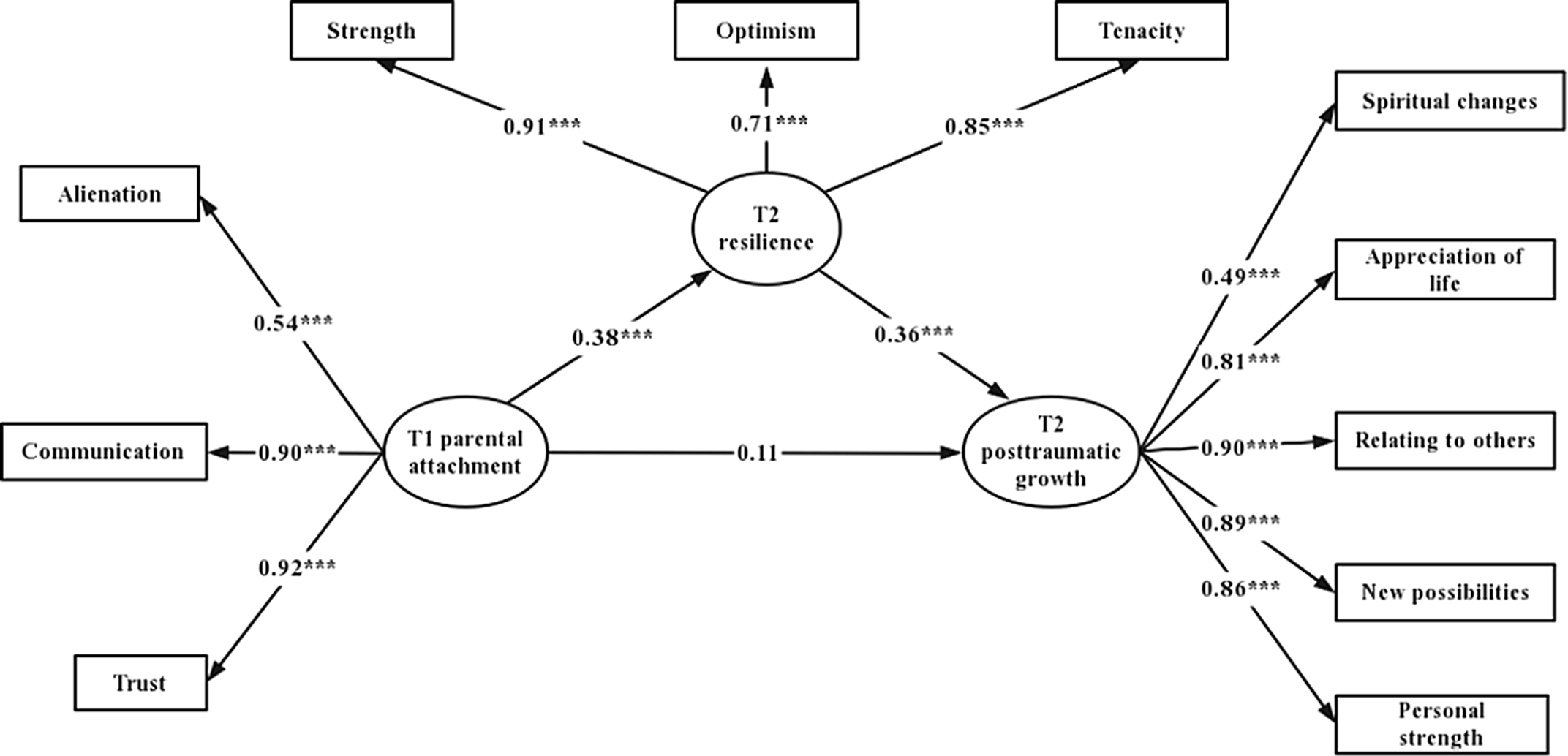
At first, a measurement model was built, including 3 latent variables: parental attachment at T1, resilience at T2, and PTG at T2. The parental attachment latent variable was evaluated by alienation, communication, and trust toward parents. The resilience latent variable was evaluated by strength, optimism, and tenacity. The PTG latent variable was evaluated by spiritual changes, appreciation of life, relating to others, new possibilities, and personal strength. In the measurement model, we assumed that there was a correlation between parental attachment at T1 and PTG at T2, and the factor loadings of the latent variables were freely estimated. The model was found to fit the data well (χ2/df = 2.641; NFI = .955; IFI = .971; TLI = .961; CFI = .971, RMSEA [90% CI] = .068 [.053-.084]), indicating that the measurement model was acceptable and could be used for subsequent structural model analysis.
Then, to examine the mediating effect of resilience at T2 on the effect of parental attachment at T1 on PTG at T2, we built a direct effect model with the link from parental attachment to PTG. This model also fit the data well (χ2/df = 2.557; NFI = .972; IFI = .983; TLI = .974; CFI = .983; RMSEA [90% CI] = .067 [.044-.090]). Path analyses revealed that parental attachment was a significant positive predictor of PTG.
At last, we established an indirect effect model to examine the mediating role of resilience. Results showed that the model again fit the data well, (χ2/df = 2.641; NFI = .955; IFI = .971; TLI = .961; CFI = .971; RMSEA [90% CI] = .068 [.053-.084]). Figure 1 shows the path coefficients of the model. Analysis of each path in the model revealed that parental attachment at T1 positively predicted resilience at T2 (β = .38; P < 0.001) and resilience at T2 can predict PTG at T2 negatively (β = .36; P < 0.001), while the direct effect of parental attachment at T1 on PTG at T2 was no longer significant. Thus, resilience at T2 fully mediated the relationship between the parent attachment at T1 and PTG at T2.
The mediation model from parental attachment at T1(12 months post event) to PTG at T2(18 months post event) through resilience at T2 among adolescents following the 2016 Yancheng.

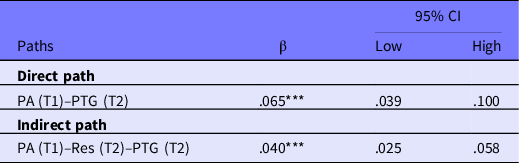
We further conducted bias-corrected bootstrap tests with 2000 replications to test the significance of the indirect effect. First, 2000 bootstrap samples were created from the original data. Then, an estimate of 2000 mediating effects were generated and saved; the effect values were sorted by size; the 95% median confidence interval is estimated using the 2.5th percentile and the 97.5th percentile. In this situation, if the 95% confidence interval of an indirect path coefficient does not include 0, the indirect path is indeed significant. Table 2 shows the bias-corrected bootstrap test results. After testing, the 95% confidence interval for the indirect effect from parental attachment at T1 to PTG at T2 through resilience at T2 did not include zero, indicating a significant mediating effect (Table 2).
Bias-corrected bootstrap tests for the mediating effect

Abbreviations: PA, parental attachment; Res, resilience; PTG, posttraumatic growth.
***P < .001.
Discussion
The current study explored the effect of parental attachment at 12 months on PTG at 18 months among adolescents who experienced traumatic events during the Yancheng tornado. It also tested resilience at 18 months as the mediator of the above effect. This is the first study to examine the mediation model with longitudinal data. Our hypotheses were confirmed, and the findings showed that parental attachment at 12-month was positively associated with PTG at 18-month, and the positive association was fully mediated by resilience at 18-month.
Specifically, result of the direct effect model showed that parent attachment at 12-month positively predicted PTG at 18-month, which was consistent with previous cross-sectional studies on the relationship between parental attachment and PTG. Reference Tian, Wu and Wang21,Reference Yuan, Xu and Liu32,Reference Zhou, Zhen and Wu41 Parent attachment reflects people’s bonding with the primary caregiver in early life. Once formed, the attachment is relatively stable and could affect people’s mental health in later life. Reference Helsen, Vollebergh and Meeus22,Reference Smokowski, Bacallao and Cotter23 Our results are in line with the attachment theory, Reference Bowlby26 indicating that higher levels of parental attachment can help adolescents who are struggling with adversity. Safe parental attachment may bring more encouragement and optimism, which would consequently promote PTG at at the next point in time. Reference Arikan and Karanci53
Furthermore, the mediation model revealed that, parental attachment at 12 mo can positively predict PTG at 18 mo by means of resilience at 18 mo. According to attachment theory, high levels of parental attachment provide individuals with substantial support, including individual and interpersonal resources, which can be used to cope with traumatic experiences. Reference Hobfoll, Dunahoo and Monnier40 A positive relationship between adolescents and parents can create an open and communicative family atmosphere. Reference Arikan, Stopa and Carnelley31 Adolescents would be more willing to seek help from and express emotions to their parents. Reference Pietrzak, Johnson and Goldstein54 In turn, by talking about the traumatic experience, parents may provide adolescents with coping advice as well as care and companionship. These resources could help adolescents with positive parental attachment to form positive beliefs, which subsequently aid them to better accept the difficulties they were facing and to make sense of the traumatic events. Reference Kilmer and Gil-Rivas55 Individuals’ response and coping to traumatic events influence their psychological well-being. Positive parental attachment can help adolescents avoid negative mental outcomes, Reference Brown and Grover56 and facilitate their positive and successful adaption, Reference Riaz, Sultana and Riaz57 which are all components of resilience. Eventually, it would contribute to PTG. Reference Fetchenhauer, Jacobs and Belschak58
Based on the above findings, this longitudinal study has important theoretical significance. It reveals the role of parental attachment in affecting post-traumatic psychological reactions at subsequent time points and uncovers the mechanism of the above effect. The findings support the Bowlby’s attachment theory and Tedeschi and Calboun’s PTG theory, Reference Tedeschi and Calhoun12,Reference Bowlby26 and generalize the application of these theories to adolescent survivors. The study also provides inspiration for psychological interventions for adolescents after natural disasters. Given that parental attachment and resilience can positively contribute to PTG, clinical interventions can focus on the improvement of parental attachment. Parents can provide more emotional and material support for adolescents to improve their sense of security. Reference Duncan, Coatsworth and Greenberg59 Also, cultivating adolescents’ resilience and encouraging them to adjust their emotions as well as holding a more positive attitude facing traumatic events or adversity may further enhance PTG.
We also acknowledge some limitations of the study. First, the questionnaires used in this study were all measured by self-report scales and the correlations between them might have been inflated by the shared method variance. Reference Richardson, Simmering and Sturman60 Also, the study was conducted one year after the Yancheng tornado. Participants may have experienced other traumatic events after the tornado. Owing to design limitations, we did not assess the severity of trauma exposure, which refers to the capacity to reflect on one’s own thoughts and feelings and might influence PTG and resilience should also be considered. Future studies should examine these main measures after controlling trauma expose and other traumatic events as potential factors.
Funding
The authors disclose the receipt of the following financial support for the research, authorship, and/or publication of this article: This work was supported by the The National Social Science Fund of China (grant number 20CSH068).