Introduction
Malnutrition among children aged under 5 years is currently a major health and well-being problem in Bangladesh (NIPORT, 2016). Malnutrition has three indicators (referred to as ‘forms’ in this paper): stunting (short stature for age), wasting (dangerously thin) and underweight (underweight for age) (Chowdhury et al., Reference Chowdhury, Rahman, Khan, Mondal, Rahman and Billah2016b). Children with malnutrition face both short- and long-term adverse health consequences, including poor cognitive development and increased risk of death from all causes, including diarrhoea, pneumonia and measles (Black et al., Reference Black, Victora, Walker, Bhutta, Christian and de Onis2013). The degree of cognitive impairment is directly related to the severity of stunting; mental impairment due to iodine deficiency is permanent, and such impairmant in a population has been directly linked to economic productivity loss (Development Initiatives, 2018). Extreme wasting results in high mortality, and being severely underweight is a result of chronic malnutrition (often referred to as ‘hidden hunger’), and this has a significant impact on an individual’s development and productivity over the lifespan. Chronic malnutrition has been shown to be associated with impaired development of the thymus, resulting in a decreased peripheral lymphocyte count, which can lead to increased susceptibility to infections. Severe malnutrition also impairs the innate host defence mechanism, further diminishing the body’s immune system (Khattak et al., Reference Khattak, Iqbal and Ghazanfar2017).
Several studies have identified the risk factors of one specific form (i.e. stunting, wasting and underweight) of child malnutrition (Islam et al., Reference Islam, Alam, Tariquzaman, Kabir, Pervin, Begum and Khan2013; Chowdhury et al., Reference Chowdhury, Rahman, Khan, Mondal, Rahman and Billah2016b; Islam et al., Reference Islam, Rahman, Rahman, Nomura, de Silva and Lanerolle2019; Sultana et al., Reference Sultana, Rahman and Akter2019), and the consequences of severe malnutrition are still under-reported. There is a lack of research on the health consequences for children of multiple adverse nutritional outcomes. Evidence suggests that children who are concurrently wasted, stunted and underweight experience an excessive mortality, which is higher still among those with severe malnutrition (Myatt et al., Reference Myatt, Khara, Schoenbuchner, Pietzsch, Dolan, Lelijveld and Briend2018).
About 255 million children worldwide aged under 5 years are suffering from malnutrition (Tebeje et al., Reference Tebeje, Bikes, Abebe and Yesuf2017). Of these, an estimated 52 million (around 8%) are wasted, 165 million (around 26%) stunted and 101 million (around 16%) underweight (Chowdhury et al., Reference Chowdhury, Rahman, Khan, Mondal, Rahman and Billah2016b). Approximately half of all deaths of under-5 children are attributable to malnutrition (UNICEF, 2015). These figures demonstrate that there is an avertable loss of many young lives. South Asia is home to approximately 38.9% of the world’s stunted children and 50% of wasted children, giving it the highest burden in the world (Development Initiatives, 2018). A total of 124 countries out of 141 are struggling with multiple forms of malnutrition, with 29% (41 countries) of these having high levels of all three forms of malnutrition. It is estimated that around 3.62% of children aged under 5 are both stunted and wasted, while globally 1.87% experience both stunting and overweight (Development Initiatives, 2018).
Bangladesh is considered to be in a ‘catastrophic’ situation, with more than 35% of children having one or more form of malnutrition, and more than 50% of under-5 child deaths being attributable to malnutrition (Chowdhury et al., Reference Chowdhury, Rahman and Khan2016a). It has made good progress in the last two decades in achieving Millennium Development Goals (MDGs) 1 (the eradication of extreme poverty and hunger) and 4 (decreasing child mortality), but much more needs to be done to address Sustainable Development Goal (SDG) 2 – ending hunger, achieving food security, improving nutrition and promoting sustainable agriculture (Chowdhury et al., Reference Chowdhury, Rahman and Khan2016a; Bhutta, Reference Bhutta2017).
Unfortunately, Bangladesh has not been very successful in addressing the problem of child malnutrition. Severe malnutrition increased from 16% in 2011 to 18% in 2013, possibly due to an increasing rate of malnutrition among mothers, poor socioeconomic status of parents, relatively low rate of full breastfeeding and food insecurity (Islam & Biswas, Reference Islam and Biswas2015). In addition, more than 30% of children aged under 5 are suffering from multiple forms of malnutrition (NIPORT, 2016). There was a marked decline in malnutrition rates in Bangladesh after the 1990s, but the current rate is one of the highest in the world.
The aetiology of malnutrition – more particularly, severe malnutrition – remains an issue of deliberation (Hossain & Khan, Reference Hossain and Khan2018). Epidemiological studies have suggested that malnutrition has many socio-demographic risk factors, including lack of household possessions, geographical location, lack of access to health care and poverty (Smith et al., Reference Smith, Ruel and Ndiaye2005; Pongou et al., Reference Pongou, Ezzati and Salomon2006; Kandala et al., Reference Kandala, Madungu, Emina, Nzita and Cappuccio2011; Rahman et al., Reference Rahman, Poudel, Yasuoka, Otsuka, Yoshikawa and Jimba2012; Aguayo et al., Reference Aguayo, Badgaiyan and Paintal2015; Chowdhury et al., Reference Chowdhury, Rahman, Khan, Mondal, Rahman and Billah2016b; Madhusudhan et al., Reference Madhusudhan, Shireesha and Ushashree2017; Walson & Berkley, Reference Walson and Berkley2018). Most previous studies on the risk factors for malnutrition have considered its forms (stunting, wasting and underweight) separately. There is general agreement that the socio-demographic risk factors for severe child malnutrition are not sufficiently well understood, with most previous studies only considering the socio-demographic risk factors for a single form of severe malnutrition, i.e. either stunting, wasting or underweight (Pravana et al., Reference Pravana, Piryani, Chaurasiya, Kawan, Thapa and Shrestha2017; Talukder, Reference Talukder2017; Madhusudhan et al., Reference Madhusudhan, Shireesha and Ushashree2017; Islam et al., Reference Islam, Rahman, Rahman, Nomura, de Silva and Lanerolle2019). Few studies have considered combinations of severe stunting, wasting and underweight. Evidence suggests that children with severe wasting will also be severely stunted (Ngari et al., Reference Ngari, Iversen, Thitiri, Mwalekwa, Timbwa, Fegan and Berkley2019).
Many studies have attempted to identify the risk factors for malnutrition in under-5 children in Bangladesh (Rahman et al., Reference Rahman, Poudel, Yasuoka, Otsuka, Yoshikawa and Jimba2012; Chowdhury et al., Reference Chowdhury, Rahman, Khan, Mondal, Rahman and Billah2016b; Talukder, Reference Talukder2017; Islam et al., Reference Islam, Rahman, Rahman, Nomura, de Silva and Lanerolle2019). However, these have not disentangled the complex mechanisms underlying malnutrition and the risk factors associated with a single form and multiple forms. The number of risk factors for malnutrition among children with only one form would probably be more distinctive than those among children with multiple forms due to the multifaceted outcomes of each malnutrition indicator. The present study had the following objectives: 1) to observe the epidemiological difference in terms of prevalence and socio-demographic determinants between one form and multiple forms of severe malnutrition among under-5 children in Bangladesh; and 2) to identify the most significant socio-demographic risk factors for one form and multiple forms of severe child malnutrition.
Methods
Data source
Three waves of data from the Bangladesh Demographic Health Surveys (BDHSs) of 2007, 2011 and 2014 were used for the study. Details of the survey questionnaire, sample design and data collection procedure are given elsewhere (NIPORT, 2009, 2013, 2016). The BDHS samples were drawn from Bangladeshi adults residing in non-institutional dwellings. Each survey wave used a multistage stratified sampling design to collect data from households within enumeration areas (clusters) taken from the 2001 and 2011 censuses compiled by the Bangladesh Bureau of Statistics and used as primary sampling units (PSUs). At the first stage of sampling, 600 PSUs were selected with probability proportional to size. The resulting lists of households were used as sampling frames for the second stage of sampling, where 30 households were selected from each PSU using equal probability systematic sampling.
All children in the survey were born in January 2002 or later and were aged under 5 years, so all of them were eligible for height and weight measurements. The implausible values of stunting, wasting and underweight were defined and based on WHO 2006 standard flag limits of z-score: stunting: <−6 or >6; wasting: <−5 or >5; and underweight: <−6 or >5. A total of 20,387 under-5 children from BDHS sample households were eligible for anthropometric measurements. However, complete and credible anthropometric and socio-demographic data were only available for 19,874 children (Figure 1). In the combined dataset (N=19,874) the contributions of the 2007, 2011 and 2014 waves of the survey were 27%, 38% and 35% of children, respectively. The surveys collected data on the health and nutritional characteristics of a wide range of the Bangladeshi population. Each wave used a standard questionnaire which differed little across waves.
Flowchart showing how study sample children were selected from the BDHS datasets.

Outcome variables and operational definitions
The primary outcome variables were ‘children with only one form of severe malnutrition’, i.e. severe stunting, severe wasting or severe underweight; and ‘children with more than one form of severe malnutrition’ i.e. two or three of the forms. A child was considered to be, respectively, severely stunted, severely wasted or severely underweight if their height-for-age, weight-for-height or weight-for-age indices were 3 SDs or more below the respective median of the WHO reference population (Kandala et al., Reference Kandala, Madungu, Emina, Nzita and Cappuccio2011). Children were categorized 0 for ‘normal’ and 1 for ‘severe malnutrition’ for each of the three indicators. After that, the values of all three indicators were added, which resulted in a score ranging from 0 to 3. The scores were again re-categorized as 0 for normal, 1 for only one severe form of malnutrition and 2 to 3 for multiple forms of severe malnutrition.
Independent variables
Socio-demographic variables that could be consistently measured across the three surveys and which had been found to be important in the literature were fitted to the unadjusted and adjusted models (Smith et al., Reference Smith, Ruel and Ndiaye2005; Pongou et al., Reference Pongou, Ezzati and Salomon2006; Jesmin et al., Reference Jesmin, Yamamoto, Malik and Haque2011; Kandala et al., Reference Kandala, Madungu, Emina, Nzita and Cappuccio2011; Rahman et al., Reference Rahman, Poudel, Yasuoka, Otsuka, Yoshikawa and Jimba2012; Islam et al., Reference Islam, Alam, Tariquzaman, Kabir, Pervin, Begum and Khan2013; Aguayo et al., Reference Aguayo, Badgaiyan and Paintal2015; Chowdhury et al., Reference Chowdhury, Rahman, Khan, Mondal, Rahman and Billah2016b). Theses included: age of child (0–11, 12–23, 24–35, 36–47 and 48–59 months); sex of child (male, female); mother’s education (no education, primary, secondary, higher); father’s employment status (currently not working, i.e. unemployed, student; manual labourer, such as farmer, agricultural worker, fisherman or rickshaw operator; professional, such as doctor, lawyer, accountant, teacher; businessman); mother’s working status (currently not working, currently working); watching television (not at all/do not know, less than once a week, at least once a week, almost every day); source of water (tube well, pipe connection or natural source such as river/dam/lake/ponds/stream/canal/irrigation/well/spring, and ‘other’, such as rain water, tanker water, bottle water); solid waste used in cooking (no, yes); mother experienced intimate partner violence [IPV] (no, yes) and birth cohort (2005 and before, 2006–2008, 2009–2011, 2012–2014).
Household socioeconomic status was based on wealth index quintile (poorest, poorer, middle, richest, richer) and community characteristics included rural/urban place of residence. In the BDHS, IPV was estimated and measured using a shortened and modified version of the Conflict Tactics Scale (Rahman et al., Reference Rahman, Poudel, Yasuoka, Otsuka, Yoshikawa and Jimba2012) and was based on available information on physical and sexual violence. Physical violence included a wife being beaten if she went out without telling her partner, neglected the children or ever argued with her partner. The incidence of sexual violence was calculated on a women’s positive response to a question asking whether she had ever been physically forced to have sexual intercourse when she did not want to. For each question, responses were re-coded dichotomously: 1=yes and 0=no. The IPV scores were calculated by summing the four binary IPV indicators, with maximum and minimum values of 4 and 0, respectively. These estimated scores were then re-coded as a binary variable with the categories ‘no’ and ‘yes’. Individuals who scored 0 were categorized as having ‘not experienced IPV’ and those who scored above 1 as ‘experienced IPV’’ (Rahman et al., Reference Rahman, Poudel, Yasuoka, Otsuka, Yoshikawa and Jimba2012). The wealth index was constructed using information about household assets collected in the BDHS. Data on household assets included ownership of durable goods (such as televisions and bicycles) and dwelling characteristics (such as source of drinking water, sanitation facilities and dwelling construction materials). Principal components analyses were performed to assign individual household wealth scores. These weighted values were then summed and re-scaled to range from 0 to 1, and each household assigned quintiles (poorest, poorer, middle, richer and richest) (Chowdhury et al., Reference Chowdhury, Rahman, Khan, Mondal, Rahman and Billah2016b).
Statistical analysis
The descriptive statistics of the study child sample were presented, and a Chi-squared test used to assess differences in child malnutrition by socio-demographic factors. Significance level was set at p<0.05 (two-tailed). Unadjusted and adjusted models were created to analyse single and multiple forms of child malnutrition. In the bivariate analysis, all independent variables were taken into account. All independent variables except child sex, source of drinking water and use of solid waste in cooking were simultaneously entered into the multiple regression models for adjustment as sex was not significant in bivariate analysis and source of water and solid waste used in cooking were proxies for wealth. No control group was considered. Strengths of associations were assessed with Odds Ratios (ORs) and 95% confidence intervals (CIs) used to test significance. Multicollinearity was checked by examining the standard errors (SEs) of regression coefficients in the logistic regression analyses. An SE >2.0 indicates multicollinearity among the independent variables (Chan, Reference Chan2004). The SEs for the independent variables in the adjusted models for each outcome were <1, indicating an absence of multicollinearity. Stata Version 14.2 (StataCorp LP, College Station, TX) was used for analyses, and sample weighting was based on the complex design of the BDHS.
Results
Descriptive characteristics
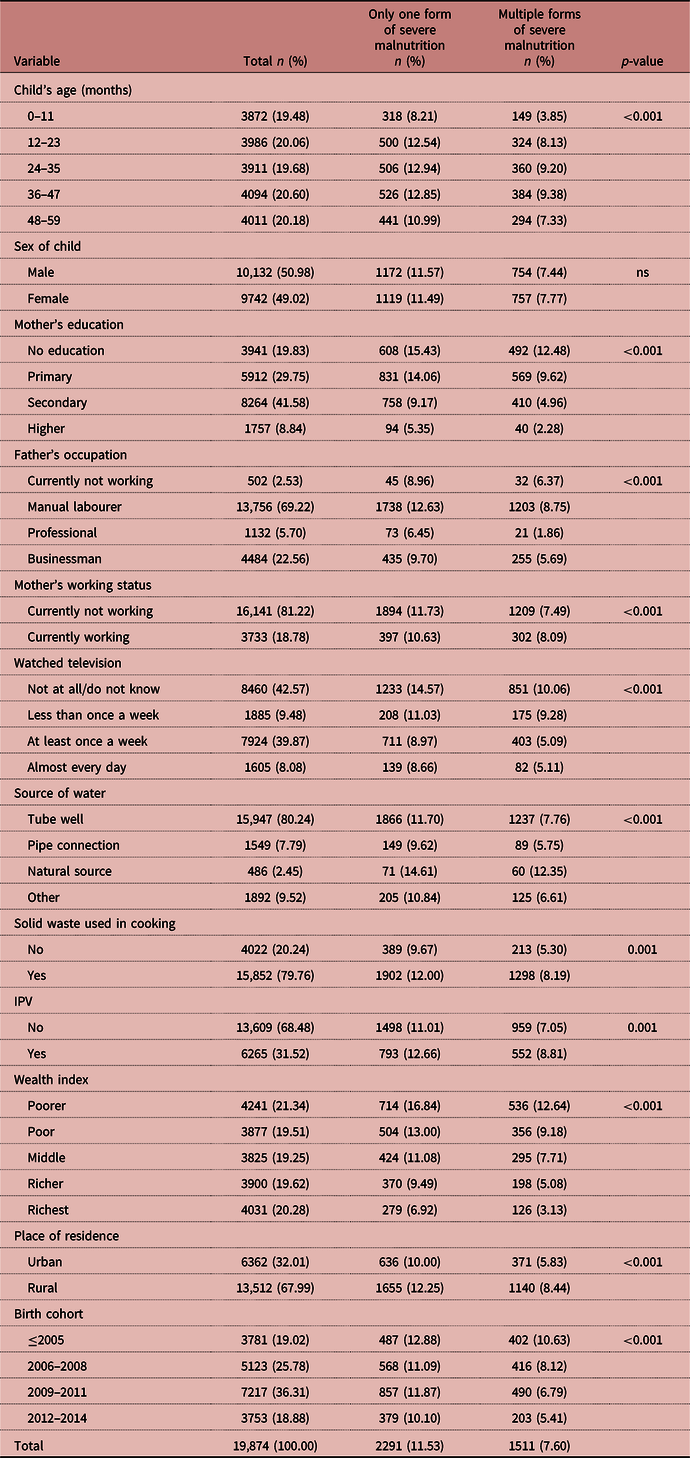
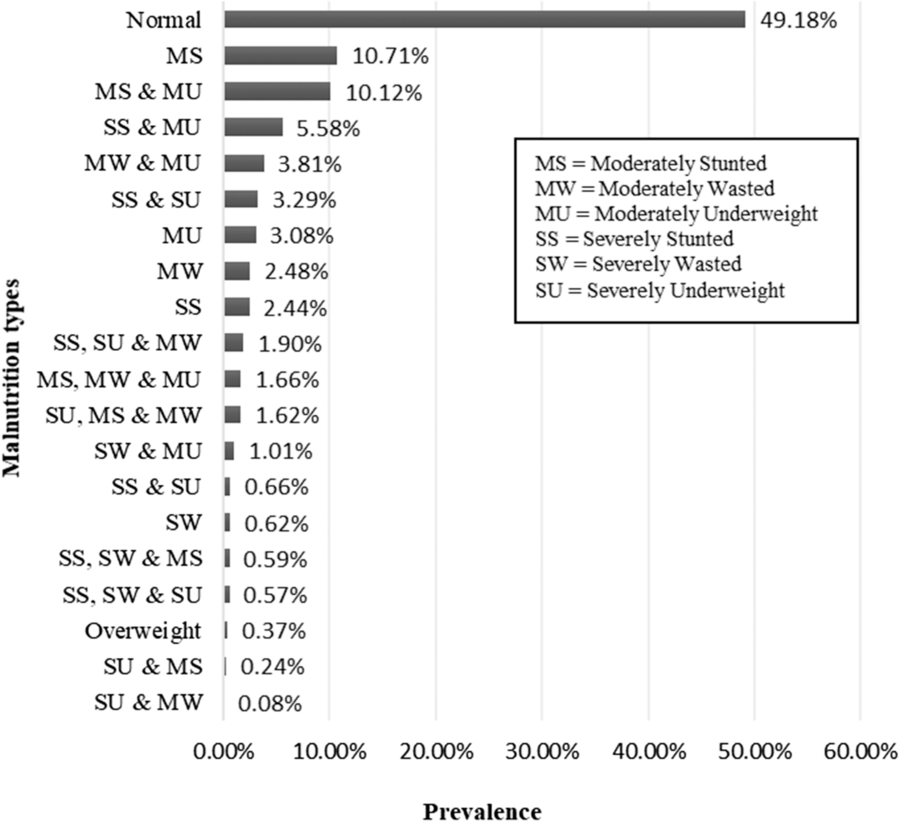
The descriptive characteristics of the study children are shown in Table 1. About half of the children were male (51%), with seven out of ten being from rural areas. About 42% of mothers had completed secondary education, around 40% of children were from low-income families and a similar proportion were from affluent families. Around 20% of mothers were uneducated, about 19% worked and 32% had experienced IPV. The principal category for father’s employment was manual labour (69.22 %) and about two-fifths (42.57%) of mothers didn’t watch television. Tube well water was used for drinking in around eight out of ten households, with a similar proportion using solid waste for household cooking. Figure 2 shows the prevalence rates of moderate and severe forms of malnutrition both singularly or in combination (multiple forms) from the 2014 BDHS. Five out of ten children had various forms of malnutrition and only 20% had just one form of malnutrition.
Prevalence of severe child malnutrition (only one form and multiple forms) among under-5 children by socio-demographic factors

ns, not significant.
Prevelance of types of child malnutrition singularly and in different combinations, Bangladesh (2014 BDHS).

Bivariate associations of outcomes with independent variables
The proportion of children with only one severe form of malnutrition was 11.53%, and the proportion with multiple forms was 7.60% (Table 1). All selected variables, apart from child sex, were found to be significantly associated with children having both one severe adverse nutritional outcome and multiple severe adverse nutritional outcomes. The proportions for both were significantly higher in the older age groups.
The proportions of only one severe form of malnutrition were significantly higher among children whose mothers were uneducated (15.43%), currently not working (11.73%), had experienced IPV (12.66%) and who did not watch television (14.57%). The proportion was also higher among children whose fathers were employed in labouring jobs (12.63%). Similarly, children from households that used natural sources of drinking water (14.61%) and used solid waste for cooking (12.00%) had significantly higher rates. The proportions were higher among children from the poorest families (16.84%) and rural dwellers (12.25%). Lastly, the proportion of only one severe adverse nutritional outcome was higher among children of the birth cohorts 2005 and earlier (12.25%).
Similar results were obtained for children with multiple forms of severe malnutrition. In this case, significantly higher proportions were observed among the children of uneducated mothers (12.48%) and those who were currently not working (8.09%), mothers who did not watch television (10.06%) and those who had experienced IPV (8.81%). The proportion of children with multiple severe forms of malnutrition was also higher for those whose fathers were employed in labouring jobs (8.75%). Similarly, the proportions were significantly higher in the categories natural sources of drinking water (12.35%), used solid waste for cooking (12.35%), children of households from rich families (12.64%) and rural dwellers (8.44%). Also, the proportions of children with multiple severe adverse nutritional outcomes were higher among those in the 2005 and earlier birth cohorts (10.63%).
Results of the logistic regression analysis
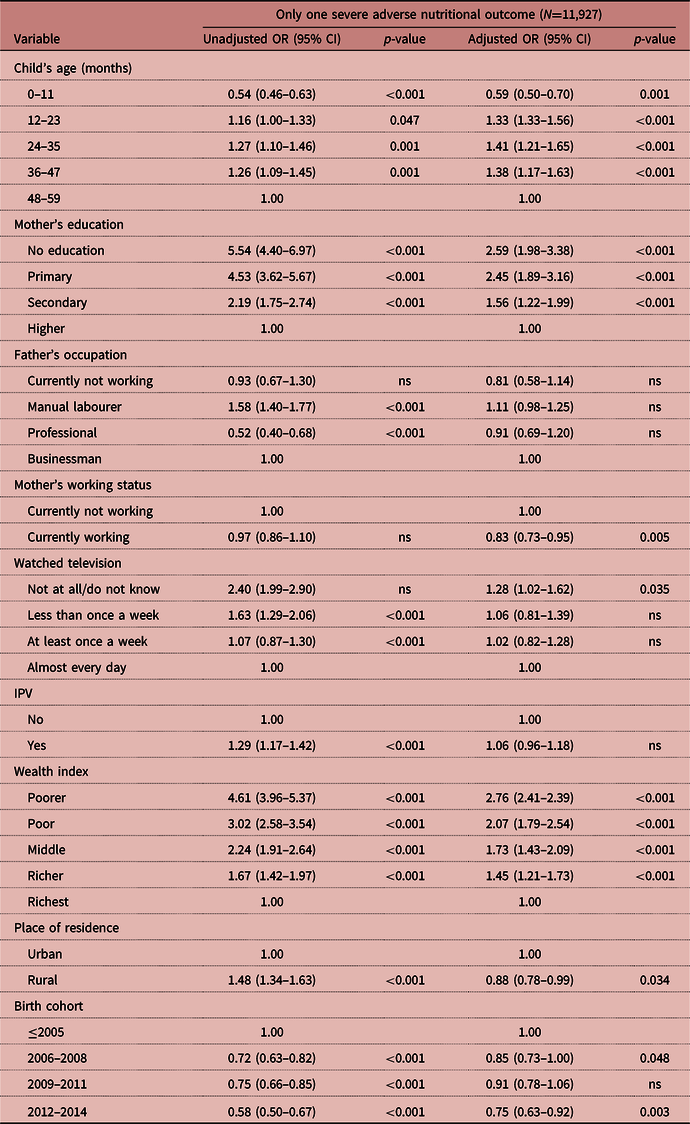
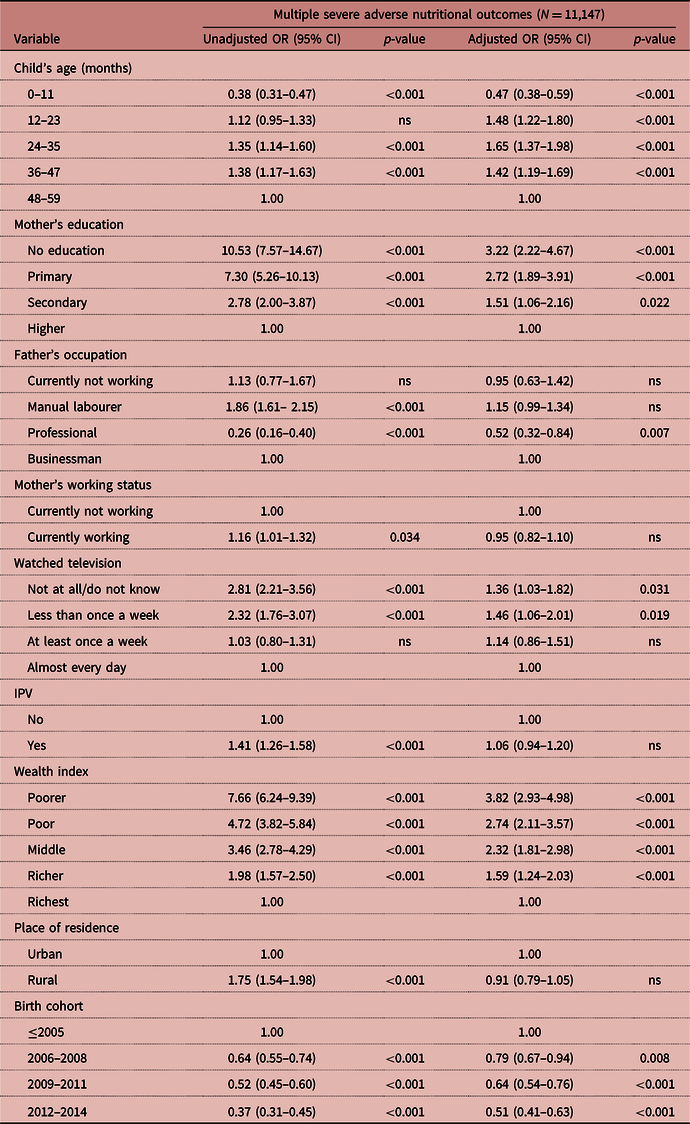
Logistic regression analyses were performed to identify the effects of selected socio-demographic variables on only one form (Table 2) and multiple forms (Table 3) of severe child malnutrition.
Results of unadjusted and adjusted models for risk factors for having only one form of severe child malnutrition

ns, not significant.
Results of unadjusted and adjusted models for risk factors having multiple forms of severe child malnutrition

ns, not significant.
In Table 2, the unadjusted models indicated that age of child, mother’s education, father’s occupation, watching television, IPV, wealth index, place of residence and birth cohort were significantly associated with children having only one form of severe malnutrition. In the adjusted model, age of a child, mother’s education, mother’s working status, watching television, wealth index, place of residence and birth cohort were significantly associated with children having only one form of severe malnutrition.
In Table 3, the unadjusted logistic regression models indicated that age of child, mother’s education, father’s occupation, watching television, IPV, wealth index, place of residence and birth cohort were significantly associated with children having multiple forms of severe malnutrition. In the adjusted models, age of child, mother’s education, father’s occupation, watching television, wealth index and birth cohort were significantly associated with children having multiple forms of severe malnutrition. However, significant variations in the effects among the categories of some variables were observed between the two cases (single and multiple forms).
Children in the youngest age group appeared to be at lower risk of developing severe adverse nutritional outcomes in both cases (single and multiple forms); the children of uneducated mothers were 2.59 times (95% CI: 1.98–3.38) more likely to have only one severe form of malnutrition (Table 2) whereas those with higher educated mothers were 3.22 times (95% CI: 2.22–4.67) more likely to have multiple forms of severe malnutrition (Table 3). Children whose fathers were professional workers were around 50% (OR: 0.52, 95% CI: 0.32–0.84) less likely to have multiple forms of severe malnutrition than were those with fathers who were businessmen (Table 3), whereas, father’s occupation did not show any significant effect for only one form of severe malnutrition (Table 2). Children of mothers who were currently working were 0.83 times (95% CI: 0.73–0.95) less likely to have only one form of severe child malnutrition (Table 2), but mother’s working status was insignificant for multiple cases (Table 3). Children of mothers who did not watch television were 1.28 times (95% CI 1.02–1.62) more likely to have only one severe form of malnutrition compared with mothers who watched television every day (Table 2). Mothers who did not watch television were 1.36 times (95% CI: 1.03–1.82) more likely to have multiple forms of severe malnutrition (Table 3). Children from poor families were more likely to suffer from multiple forms of severe malnutrition and were more vulnerable than those from rich families. Children from poor families with one form of severe malnutrition were less vulnerable (Table 2) than children from poor families with multiple forms of severe malnutrition (Table 3). In both cases, the likelihood of there being severe adverse nutritional outcomes among children followed declining trends from previous birth cohorts to recent birth cohorts.
Discussion
This study demonstrated differences in the combined prevalences of the different forms of severe malnutrition (stunting, wasing and underweight) among under-5 children, together with socio-demographic risk factors for these. The proportion of children with only one form of severe malnutrition was approximately 12%, and the proportion with multiple forms was around 8%. Of all the study variables, with the exception of sex of child, the proportions were estimated to be higher for one form of severe malnutrition compared to those with multiple forms of severe malnutrition. However, the chances of having only one form of severe malnutrition, and having multiple forms, were both significantly associated with age of child, mother’s education, father’s occupation, mother’s currently working, watching television, source of water, solid waste used in cooking, IPV, wealth index, place of residence and birth cohort.
Previous studies in Bangladesh, and elsewhere, have also found most of the variables considered in this study to be significantly associated with stunting, wasting and underweight (Kandala et al., Reference Kandala, Madungu, Emina, Nzita and Cappuccio2011; Rahman et al., Reference Rahman, Poudel, Yasuoka, Otsuka, Yoshikawa and Jimba2012; Aguayo et al., Reference Aguayo, Badgaiyan and Paintal2015; Chowdhury et al., Reference Chowdhury, Rahman, Khan, Mondal, Rahman and Billah2016b; Akombi et al., Reference Akombi, Agho, Hall, Merom, Astell-Burt and Renzaho2017; Das & Gulshan, Reference Das and Gulshan2017; Pravana et al., Reference Pravana, Piryani, Chaurasiya, Kawan, Thapa and Shrestha2017; Islam et al., Reference Islam, Rahman, Rahman, Nomura, de Silva and Lanerolle2019; Sultana et al., Reference Sultana, Rahman and Akter2019). More specifically, age and sex of children, mother’s education and occupation, toilet facilities, source of drinking water, place of residence and socioeconomic status have all been found to be significantly associated with stunting, wasting and underweight in under-5 children (Chowdhury et al., Reference Chowdhury, Rahman, Khan, Mondal, Rahman and Billah2016b; Das & Gulshan, Reference Das and Gulshan2017). Talukder (Reference Talukder2017) found mother’s education, father’s education, place of residence and socioeconomic status to be significantly associated with severe malnutrition in Bangladesh. Hossain and Khan (Reference Hossain and Khan2018) found child’s age, maternal education, maternal occupation and paternal occupation to be significantly associated with all forms of malnutrition in Bangladesh. Islam et al (Reference Islam, Rahman, Rahman, Nomura, de Silva and Lanerolle2019) found child’s age, sex of child, mother’s education, father’s education, place of residence and socioeconomic status to be significantly associated with severe stunting, wasting and underweight in Bangladesh. In a study conducted in Nepal, Pravana et al. (Reference Pravana, Piryani, Chaurasiya, Kawan, Thapa and Shrestha2017) found that mother’s educational status, father’s educational status and socioeconomic status were significantly associated with severe wasting. Although these particular studies explored the associations between various socio-demographic variables and single or precise malnutrition indicators (e.g. stunting, wasting, underweight, severe stunting, severe wasting and severely underweight), the findings were not analogous with the present study.
The inspiration for this study came from research by Myatt et al. (Reference Myatt, Khara, Schoenbuchner, Pietzsch, Dolan, Lelijveld and Briend2018) and McDonald et al. (Reference McDonald, Olofin, Flaxman, Fawzi, Spiegelman and Caulfield2013) based on large datasets from 51 countries plus anonymized data from ten prospective studies in Bangladesh, Ghana, Guinea-Bissau, India, Indonesia, Nepal, Peru, the Philippines, Senegal and Sudan. However, these looked at the association between simultaneous multiple anthropometric deficits and the risk of mortality. To the authors’ knowledge there have been no previous studies that have highlighted a significant association between socio-demographic factors and severe child malnutrition involving both one form and multiple forms. The present study revealed that the proportions of multiple severe forms of malnutrition were significantly lower among the youngest children compared with older ones. Other studies in Bangladesh and Africa have demonstared a lower prevalence of malnutrition in younger age groups (Olack et al., Reference Olack, Burke, Cosmas, Bamrah, Dooling and Feikin2011; Islam et al., Reference Islam, Alam, Tariquzaman, Kabir, Pervin, Begum and Khan2013; Mengistu et al., Reference Mengistu, Alemu and Destaw2013; Chowdhury et al., Reference Chowdhury, Rahman, Khan, Mondal, Rahman and Billah2016b). In the second year of life, children in Bangladesh tend to have the same diet as the family, along with breast milk; although they are often allowed to eat food themselves, they do not always have access to adequate amounts of solid food, and this might contribute to their poor nutritional status (Hong et al., Reference Hong, Banta and Betancourt2006). The proportions of multiple severe forms of malnutrition were significantly higher among children where mothers were uneducated, whose fathers had manual labour occupations and whose mothers were currently working. These findings have not been reported previously for children with multiple forms of malnutrition. However, the prevalences of specific forms of malnutrition (stunting, wasting and underweight) among children in Bangladesh, Mexico and Pakistan have been shown to be higher where mothers are uneducated, fathers are in manual labour occupations and mothers are currently working (Reyes et al., Reference Reyes, Perez-Cuevas, Sandoval, Castillo, Santos, Doubova and Gutierrez2004; Khattak et al., Reference Khattak, Iqbal and Ghazanfar2017; Islam et al., Reference Islam, Rahman, Rahman, Nomura, de Silva and Lanerolle2019). This could be because maternal education and employment status are strongly associated with good child care and good health.
Women’s autonomy is deeply embedded with their educational attainment and employment status, and this has an indirect impact on the growth of their children (Senarath & Gunawardena, Reference Senarath and Gunawardena2009). Women with higher educational attainment have the ability to increase family income, which could help provide a better quality diet and better health care for their children compared with women of lower educational level (Islam et al., Reference Islam, Alam, Tariquzaman, Kabir, Pervin, Begum and Khan2013). Educational attainment, therefore, along with employment status, can have a positive and significant effect on child malnutrition. Low-paid women of poor education status are not in as good a position to provide an adequate diet for their children. However, these findings were not universal. In Bangladesh, men are generally stereotypically considered to be the main family earners. Despite women’s employment status following an increasing trend due to the flourishing garment sector, family income is still strongly associated with father’s occupation. Fathers with low-level jobs will have lower incomes than those with more prestigious jobs, and their children consequently have a poor nutritional status (Islam et al., Reference Islam, Alam, Tariquzaman, Kabir, Pervin, Begum and Khan2013).
The proportions of multiple severe forms of malnutrition were significantly higher among children with mothers who experienced IPV. Maternal IPV has been shown to be associated with an increased risk of stunting, wasting and underweight among children in Bangladesh, India and Brazil (Hasselmann & Reichenheim, Reference Hasselmann and Reichenheim2006; Ackerson & Subramanian, Reference Ackerson and Subramanian2008; Rahman et al., Reference Rahman, Poudel, Yasuoka, Otsuka, Yoshikawa and Jimba2012). Rahman et al. (Reference Rahman, Poudel, Yasuoka, Otsuka, Yoshikawa and Jimba2012), in a study in Bangladesh, found that all forms of IPV were strongly responsible for long-term adverse mental health issues among women, including stress, depression and anxiety, which can affect women’s ability to cope with the everyday needs of a small child and diminish the quality of their caregiving. Again, the proportions of severe malnutrition were significantly higher for members of households, including children, that did not watch television, where drinking water was obtained from natural sources, and solid waste was used for cooking.
Documentation of the association between child malnutrition and mass media exposure, as well as between child malnutrition and source of water, are limited. However, in Bangladesh, Chowdhury et al. (Reference Chowdhury, Rahman, Khan, Mondal, Rahman and Billah2016b) established that there was a significant relationship between poor mass media exposure and inadequate complementary feeding, which has an indirect effect on child malnutrition, while Islam et al. (Reference Islam, Alam, Tariquzaman, Kabir, Pervin, Begum and Khan2013) found a significant association between child malnutrition and source of water. Safe drinking water is a pre-condition for good nutritional status as diseases can be transmitted through contaminated water, including ponds and rivers (WASH, 2007). Two studies found that child malnutrition was associated with solid waste being used in cooking (Mishra & Retherford, Reference Mishra and Retherford2006; Kyu et al., Reference Kyu, Georgiades and Boyle2009). Nearly 4 million people die prematurely each year from illnesses attributable to household air pollution due to inefficient cooking practices (WHO, 2018). The use of solid fuels for cooking can affect the lungs, and for women, its use can indirectly lead to low weight in newborns (WHO, 2018).
The prevalence of child malnutrition has been shown to be significantly higher among low-income families in rural areas (Chowdhury et al., Reference Chowdhury, Rahman, Khan, Mondal, Rahman and Billah2016b; Islam et al., Reference Islam, Rahman, Rahman, Nomura, de Silva and Lanerolle2019; Khan et al., Reference Khan, Zaheer and Safdar2019). Socioeconomic status is, therefore, a key influencal factor for malnutrition in children. This could be because of the limited capacity of poorer families to access essential health care services, lack of potable water and adequate sanitation, poor housing facilities and inadequate diets (Islam et al., Reference Islam, Rahman, Rahman, Nomura, de Silva and Lanerolle2019). A study in rural areas in Mexico highlighted that father’s occupation (labourer/farmer) was a risk factor for child malnutrition (Reyes et al., Reference Reyes, Perez-Cuevas, Sandoval, Castillo, Santos, Doubova and Gutierrez2004). Also, the availability of food in rural areas depends upon local production which, in turn, is related to the father’s occupation. Lack of food variability or inability to produce enough food may, therefore, lead to adverse nutritional outcomes.
The multivariable logistic regression analysis identified several determinants of severe child malnutrition with only one form and with multiple forms, incuding age of the child, mother’s education, watching television and wealth index. These factors were also identified as significant predictors by other studies, particularly for single malnutrition and severe malnutrition indicators (Rahman et al., Reference Rahman, Poudel, Yasuoka, Otsuka, Yoshikawa and Jimba2012; Tiwari et al., Reference Tiwari, Ausman and Agho2014; Das & Gulshan, Reference Das and Gulshan2017; Talukder, Reference Talukder2017; Nkurunziza et al., Reference Nkurunziza, Meessen, Van Geertruyden and Korachais2017; Pravana et al., Reference Pravana, Piryani, Chaurasiya, Kawan, Thapa and Shrestha2017; Islam et al., Reference Islam, Rahman, Rahman, Nomura, de Silva and Lanerolle2019). Mother’s working status and place of residence had significant effects on children with only one severe form of malnutrition, but were insignificant for multiple forms. Father’s occupation appeared to have a significant effect on children with multiple forms of severe malnutrition, but not for only one form. This distinctive result was observed after clustering the various forms of severe child malnutrition into two outcome measures. However, in Bangladesh, Islam et al. (Reference Islam, Alam, Tariquzaman, Kabir, Pervin, Begum and Khan2013) found that father’s occupation had insignificant effects on child malnutrition. In this study, birth cohorts had significant effects on child malnutrition for both only one severe form and multiple forms, and children born before 2005 had a higher risk of multiple forms of severe malnutrition. The implementation of advanced strategies and active policy initiatives aimed at eradicating hunger and malnutrition in order to meet SDG goals might be a reason for improvements in the current decade.
The insights provided in this study demonstrate the extent, severity and distribution of the different forms of severe malnutrition among under-5 children in Bangladesh. These could help inform the allocation of human and financial resources for effective implementation of policies and programmes aimed at reducing severe child malnutrition in the country. Concerted efforts to forge a strong collaboration between government, non-government, social, cultural and religious institutions are essential in order to strengthen nutritional campaigns, especially in rural areas. Bangladesh’s National Social Security Strategy needs to be revised to include nutritional protection in order to provide appropriate support to its most vulnerable citizens (Chowdhury et al., Reference Chowdhury, Rahman, Khan, Mondal, Rahman and Billah2016b). The existing Bangladesh National Nutrition Policy (2015) needs to be modernized to help address malnutrition (FAO, 2015). More research is urgently needed to explore how the environment interacts with child malnutrition, especially in the case of water, sanitation and use of solid waste for cooking (Vilcins et al., Reference Vilcins, Sly and Jagals2018).
The study had several strengths and limitations. The main strength is that the data came from large, nationally representative household surveys carried out in 2007, 2011 and 2014 that covered both urban and rural areas of Bangladesh. As a result, it was possible to generalize the findings to all Bangladesh with limited bias. In addition, it provided new data on severe child malnutrition. However, the study had certain limitations. It was not possible to establish a causal relationship between risk factors and the dependent variables due to the cross-sectional nature of the study. In addition, the current nutritional situation could not be explored due to the unavailability of more recent data. Children with implausible heights and flagged cases according to WHO recommendations were excluded from the study, and this might have resulted in inaccuracies in reported prevalences (Chowdhury et al., Reference Chowdhury, Rahman, Khan, Mondal, Rahman and Billah2016b). Another limitation is the information bias that may result from collecting data on self-reported age, education, occupation and household assets.
In conclusion, the prevalence of severe malnutrition in under-5 children in Bangladesh is one of the highest in the world. Risk factors include child age, mother’s education, watching television, wealth index and birth cohort. After classifying the various forms of severe child malnutrition into two outcome measures (single and multiple forms of malnutrition), the determinants were not identical for both cases; this need to be considered when formulating policies to address the issue of child malnutrition in Bangladesh.
Acknowledgment
The authors would like to thank the Demographic Health Survey for permission to use their data and the College of Nursing, Midwifery and Healthcare of the University of West London, UK, for giving the opportunity to conduct the research under the Split-site program of the Commonwealth Scholarship Commissions in the UK.
Funding
This research received no specific grant from any funding agency, commercial entity or not-for-profit organization.
Conflicts of Interest
The authors have no conflicts of interest to declare.
Ethical Approval
The BDHS was reviewed and approved by the ICF Macro Institutional Review Board (USA), which complies with all of the requirements of 45 CFR 46 Protection of Human Subjects. The Bangladesh DHS was also reviewed and approved by the National Research Ethics Committee of the Bangladesh Medical Research Council (Dhaka, Bangladesh). Informed consent was obtained verbally from each participant (every married woman aged 15–49 years) before being enrolled on the study. A significant number of the study sample was illiterate, so verbal consent was considered the most suitable option to confirm participation. The BDHS also included samples of very young children (under 5 years old, born in 2002 or later) in the data collection so mothers of these samples were asked to provide verbal consent on behalf of their children.