As the sequelae of widespread antibiotic overuse, namely the emergence of multidrug-resistant bacteria (MDRB) and the rising incidence of Clostridioides difficile colitis, continue to alarm the infectious diseases community, the demand for antibiotic stewardship programs has increased. These initiatives have been shown to reduce length of hospital admission, Reference Nault, Pepin, Beaudoin, Perron, Moutquin and Valiquette1 duration of antibiotic therapy, Reference Álvarez-Lerma, Grau and Echeverría-Esnal2–Reference Katzman, Kim and Lesher6 emergence of MDRB, Reference Barlam, Cosgrove and Abbo7 and medical costs. Reference Nault, Pepin, Beaudoin, Perron, Moutquin and Valiquette1,Reference Campbell, Decloe, Gill, Ho, McCready and Powis4,Reference Dellit, Owens and McGowan8,Reference McGregor, Weekes and Forrest9 Simultaneously, initiatives to save lives through early recognition and treatment of sepsis have been implemented widely. Reference Rhodes, Evans and Alhazzani10 Although stewardship programs encourage physicians to wait for more information before starting empiric antibiotic and to limit the use of broad-spectrum antibiotics, sepsis protocols encourage physicians to prescribe antibiotics early and broadly. Reconciling these stated goals into functional and internally consistent hospital policies and practices becomes even more complicated when applied to medically complex patients, such as those with cancer.
Certain cancer patients (eg, those with inherently immunosuppressive hematologic malignancies, those who receive myeloablative therapy with or without high dose steroids, and those with neutropenic fever) require prophylactic or empiric antibiotics, even when clinically stable, due to their elevated risk of acute decompensation. Reference Alibek, Bekmurzayeva, Mussabekova and Sultankulov11–Reference Perron, Emara and Ahmed15 Most patients with solid tumors, however, do not fall into these categories. Their underlying diseases are not inherently immunosuppressive, and their chemotherapeutic regimens carry much lower rates of myelosuppression. Reference Rolston16 Furthermore, with the widespread availability of prophylactic growth factor support and the emergence of personalized cancer care, in which myelosuppressive regimens are replaced with safer and more effective targeted and immune therapies, treatment-emergent bacterial infections are less of a concern than before. Nevertheless, patients with solid tumors continue to be regarded as categorically immunosuppressed and therefore treated as such, resulting in frequent administration of antibiotics in the absence of clear indications. Reference Haddad, Chaftari and Hachem17,Reference Abou Dagher, El Khuri and Chehadeh18
We hypothesized that physicians overprescribe early antibiotics to patients with solid-tumor malignancies under the assumption that they are universally immunocompromised and therefore prone to acute decompensation. In this study, we aimed to identify which clinical factors most strongly drive early antibiotics administration in solid-tumor patients and which factors may differentiate patients who need early antibiotics from those who may be safely observed without them.
Methods
Study design and population
This retrospective observational study included adults (≥18 years old) with solid tumors admitted through the emergency department (ED) of a large academic hospital between November 2017 and October 2019. Patients with a solid-tumor malignancy on their active problem list, regardless of ongoing antineoplastic therapy, were identified by searching records of hospital admissions through the ED for International Classification of Diseases, Tenth Revision codes for solid tumor (C00-C80, C7A, and C7B). Patients with neutropenic fever, hematologic malignancies, Kaposi sarcoma, transplant-related malignancies, recent trauma, cardiopulmonary arrest, and hemodialysis were excluded. A secondary screen for exclusion criteria was manually conducted prior to data analysis.
The study period included institutional adoption of 2 antibiotic stewardship initiatives: (1) use of the National Early Warning Score (NEWS) for identification of sepsis in the ED, 19 beginning December 2017 and (2) a computer-based antibiotic time-out procedure, beginning November 2018, which alerted physicians 48 hours after initiation of certain broad-spectrum antibiotics (ie, vancomycin, cefepime, piperacillin-tazobactam, meropenem, and fluoroquinolones). Both initiatives were accounted for in the analysis.
This retrospective study received a waiver of exemption from the Institutional Review Board of the Baylor College of Medicine.
Patient information
Variables included age, admission and discharge date and time, initial vital signs, and initial laboratory studies, including white blood cell count (WBC) and serum creatinine. Results and time of collection for up to 3 unique blood cultures were recorded for each case and were screened to exclude probable false-positive results (eg, coagulase-negative staphylococci, common skin flora, and results that included “likely contaminant”). These cases were reviewed individually and were considered negative in the absence of a second culture positive for the same pathogen. Antibiotic name, dosing frequency, and start and end times for up to 5 antibiotics per case were recorded.
All data were extracted from the Epic medical record system (2018, Verona, WI) by an Epic-trained reporting team based locally and nationally.
Outcome and process measures
Primary metrics were early antibiotics administration (defined as initiation within 8 hours of ED presentation), total duration of antibiotic therapy in days (DOT), and early bacteremia (defined as a positive blood culture drawn before antibiotics and within 48 hours of presentation).
Categorical variables were derived for temperature, heart rate, respiratory rate, and WBC according to systemic inflammatory response syndrome (SIRS) criteria (Table 1). Presenting SIRS were calculated for all cases, with SIRS ≥2 considered positive. Three principal reasons support our utilization of SIRS: (1) the data available were insufficient to calculate Sequential Organ Failure Assessment (SOFA) or quick SOFA, (2) recent data suggest that SIRS more accurately predicts infection in emergent settings and is more sensitive than SOFA or qSOFA, Reference Gando, Shiraishi and Abe20–Reference Lind, Phipps, Mooney and Liu22 and (3) our experience suggests that SIRS continues to guide clinical practice. Despite evidence that NEWS is more accurate than SIRS, the level of nuance makes bedside application difficult Reference Usman, Usman and Ward23 ; furthermore, NEWS was not fully integrated into institutional practice during this study.
Definition of Study Measures

Note. SIRS, systemic inflammatory response score.
a One point towards the SIRS is awarded for the presence of each of hypothermia or fever; tachycardia; tachypnea; and leukopenia or leukocytosis, as defined above.
Statistical analysis
Descriptive statistics were calculated for the entire cohort and subgroups of interest. Demographics, presenting vitals and laboratory test results, culture data, and treatment data were compared between groups using the Student t test and the χ2 test. Normality was assumed by the central limit theorem. Reference Kutner24 Use of early antibiotics and culture positivity were compared among ordinal SIRS groups (ie, 0–4) using the χ Reference Álvarez-Lerma, Grau and Echeverría-Esnal2 test with Bonferroni correction (significance level < .005).
The odds of receiving early antibiotics or having a positive blood culture, as predicted by presenting vitals and laboratory test results, were modeled using binomial regression. Candidate regression models were optimized using stepwise regression, and final models were chosen by the lowest corrected Akaike information criteria score. Outcomes of interest were modeled against categorical SIRS criteria and ordinal SIRS. The area under the curve (AUC) was used to determine model predictive ability. Dummy variables to control for initiation of the antibiotic time-out procedure and adoption of NEWS were included as controls but not reported.
For all analyses, P values < .05 were considered significant, except where Bonferroni correction was applied, as detailed above. Data analysis was conducted using R Studio version 1.2.5033 software (R Foundation for Statistical Computing, Vienna, Austria) and Microsoft Excel version 16.29.1 (Microsoft, Redmond, WA).
Results
SIRS and early antibiotics
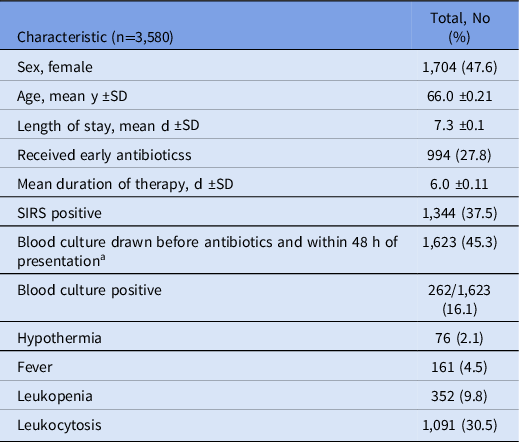
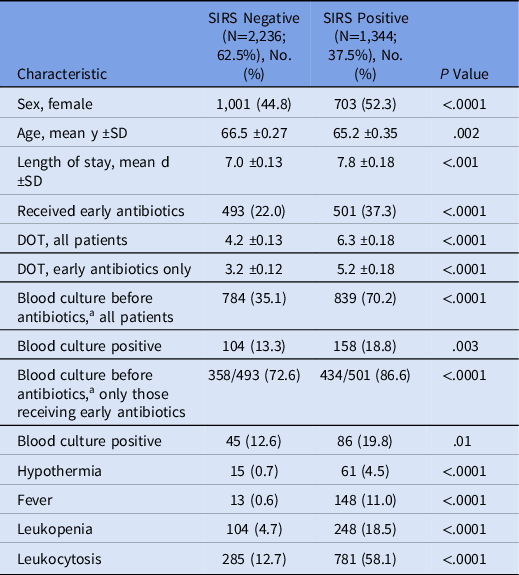
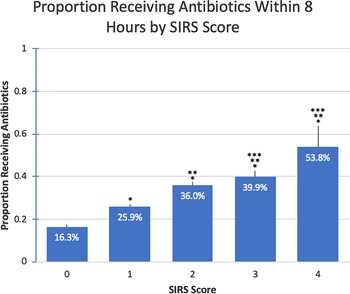
In total, 3,580 unique admissions from the ED of 2,673 individual patients met inclusion criteria. Descriptive characteristics can be found in Tables 2 and 3. Of the evaluable cases, 1,344 (37.5%) were SIRS positive and 2,236 (62.5%) were SIRS negative. Early antibiotics were administered in 994 evaluable cases (27.8%) and were more frequently administered in SIRS-positive cases than SIRS-negative cases (37.3% vs 22.0%; P < .0001). Of the SIRS-negative cases, early antibiotics were administered in 146 patients (16.3%) with a SIRS of 0 and in 347 patients (25.9%) with a SIRS of 1 (Fig. 1).
Descriptive Characteristics

Note. SIRS, systemic inflammatory response score.
a Not all patients received antibiotics.
Comparison of SIRS-Positive and -Negative Patients

Note. SIRS, systemic inflammatory response score; DOT, days of antibiotic therapy; SD, standard deviation. Early antibiotics indicates within 8 h of presentation.
a Culture drawn within 48 h.
Proportion of cases receiving early antibiotics therapy by number of SIRS criteria met. Note. SIRS, systemic inflammatory response score; *significantly different from a SIRS score of 0; **significantly different from a SIRS of 1; ***significantly different from a SIRS of 2; significance level <.005 by Bonferroni correction.

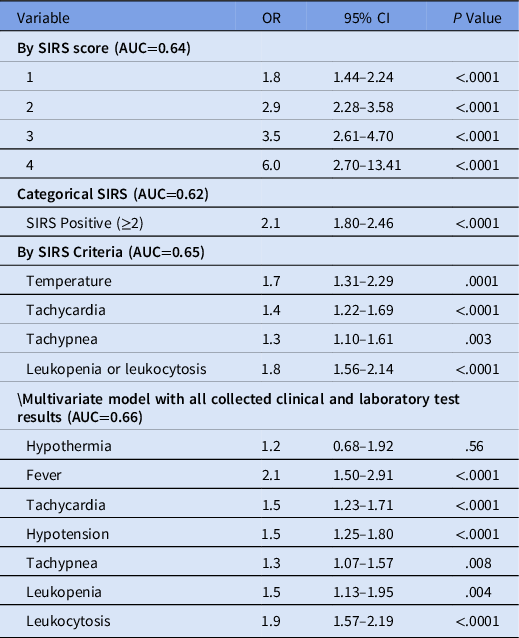
As shown in Fig. 1 and Table 4, the OR for receiving early antibiotics increased with a higher SIRS, from 1.8 with 1 SIRS criterion (95% confidence interval [CI], l 1.44–2.24) to 6.0 with 4 SIRS criteria (95% CI, 2.70–13.41). The presence of any SIRS parameter independently increased odds of early antibiotics administration, with white blood-cell count (WBC) abnormalities (odds ratio [OR], 1.8; 95% CI, 1.56–2.14) and temperature dysregulation (OR, 1.7, 95% CI, 1.31–2.29) having the greatest impact (Table 4). When we included all studied clinical and laboratory test results in our analysis (SIRS and non-SIRS alike), fever (OR, 2.1; 95% CI, 1.50–2.91) and leukocytosis (OR, 1.9; 95% CI, 1.57–2.19) were associated most strongly with early antibiotics (P < .0001) (Table 4).
Prediction Models for Administration of Early Antibiotics

Note. OR, odds ratio; CI, confidence interval; SIRS, systemic inflammatory response score; AUC, area under the curve. See Table 1 for definition of fever, tachycardia, tachypnea, leukopenia, and leukocytosis.
Bacteremia and the relationship to SIRS and early treatment
Blood cultures were drawn in 1,623 cases (45.3%), more frequently in SIRS-positive cases than in SIRS-negative cases: (70.2% vs 35.1%; P < .0001) (Table 3). Among those to whom early antibiotics were administered, blood cultures were drawn in 86.6% of SIRS-positive cases and 72.6% of SIRS-negative cases (P < .0001). Early bacteremia was documented in 262 cases, which comprised 7% of all cases and 16% of those with blood cultures drawn in the ED. Early bacteremia was more common in SIRS-positive cases than SIRS-negative cases overall (18.8% vs 13.3%; P < .01) and in the subgroup receiving early antibiotics (19.8% in SIRS-positive cases vs 12.6% in SIRS-negative cases; P = .01).
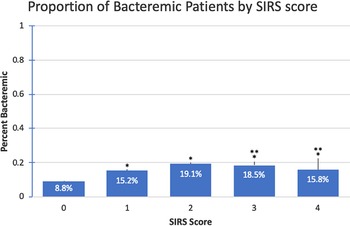
Figure 2 shows the proportion of cases with proven bacteremia in each SIRS category. Patients with an SIRS ≥1 were more likely to yield a positive culture than patients with an SIRS of 0 (all P < .0001), as were those with SIRS of 3 and 4 compared to those with SIRS of 1 (all P < .005). However, the absolute difference between the rate of bacteremia in patients with SIRS of 0 and SIRS of 2 was 10.3%; the absolute difference between patients with SIRS of 0 and those with SIRS of 3 was <10%; and the absolute difference between patients with SIRS of 0 and those with SIRS of 4 was only 7%.
Proportion of cases found bacteremic by number of SIRS criteria met. Note. SIRS, systemic inflammatory response score; *significantly different from a SIRS of 0; **significantly different from a SIRS of 1; significance level <.005 by Bonferroni correction.

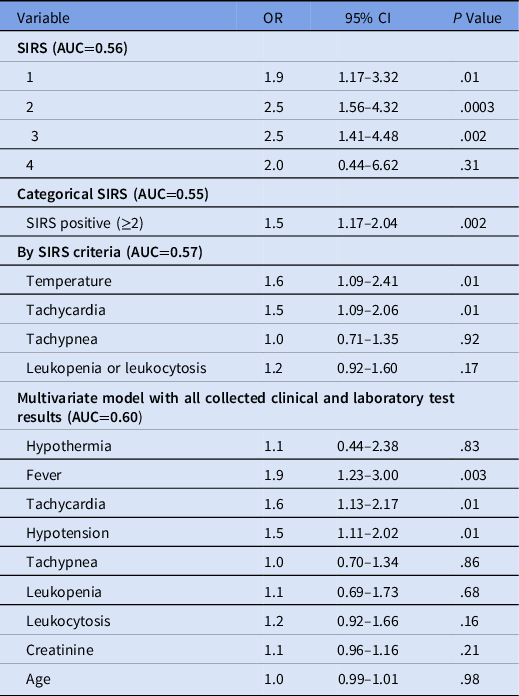
On multivariate analysis, only 2 SIRS components independently predicted bacteremia: fever (OR, 1.6; 95% CI, 1.09–2.41; P = .01) and tachycardia (OR, 1.5; 95% CI, 1.09–2.06; P = .01) (Table 5). In general, the SIRS model had a 55% chance of distinguishing between bacteremic and nonbacteremic cases. A more robust, maximally predictive model that included all studied laboratory test results and vital signs was marginally better, correctly classifying bacteremia with a probability of 60% (Table 5).
Prediction Models for Bacteremia

Note. OR, odds ratio; CI, confidence interval; SIRS, systemic inflammatory response score; AUC, Area under the curve. See Table 1 for definition of fever, tachycardia, tachypnea, leukopenia, and leukocytosis.
Treatment and length of stay
Among all cases treated with early antibiotics, DOT was longer in SIRS-positive caes (3.0 ± 0.15) than in SIRS-negative cases (1.8 ± 0.10 days; P < .0001), and DOT was longer in bacteremic cases than in nonbacteremic cases (5.3 ± 0.50 vs 2.7 ± 0.11; P < .0001). The difference between SIRS-positive cases and SIRS-negative cases did not persist when stratifying by culture positivity (5.3 ± 0.97 vs 5.2 ± 0.56; P = .97) or culture negativity (2.7 ± 0.17 vs 3.0 ± 0.17; P = .35). DOT was longer in patients who received early antibiotics (8.0 ± 0.22) compared to those who did not (3.8 ± 0.12, P < .0001). This difference persisted when stratified into the SIRS-negative group (8.3 ± 0.38 vs 5.6 ± 0.36; P < .0001), the SIRS-positive group (7.9 ± 0.29 vs 6.4 ± 0.33; P < .001), the culture-negative group (7.6 ± 0.23 vs 6.0 ± 0.21; P < .0001), and the culture-positive group (10.5 ± 0.79 vs 7.9 ± 0.58; P < .01). The mean LOS was similar between cases treated with early versus delayed antibiotics (7.4 ± 0.12 vs. 7.1 ± 0.19; P = .31). Although LOS was longer in bacteremic cases when compared to nonbacteremic cases (8.6 ± 0.39 vs 6.7 ± 0.15; P < .0001), the initiation of early antibiotics among bacteremic cases was not associated with a shorter LOS when compared to delayed antibiotics (9.2 ± 0.68 vs 8.0 ± 0.40; P = .14).
Conclusion
In this retrospective study of patients with solid-tumor malignancies presenting to the ED of a tertiary-care center, a substantial proportion of cases (28%) were treated with early antibiotics, and SIRS was poorly predictive of bacteremia. The rate of bacteremia was relatively low among SIRS positive cases (19%)—only 6% greater than among SIRS negative cases—whereas 40% of cases with early bacteremia did not meet SIRS criteria. SIRS did, however, appear to drive early antibiotics use, with a 15% higher rate among SIRS positive cases, indicating a disconnection between the influence of SIRS on medical decision making and its actual utility. Together, these findings demonstrate that relying on SIRS leads to excessive antibiotics use in some cases and failure to suspect serious infection in others.
When SIRS criteria were assessed individually, fever and tachycardia were each associated with early bacteremia and early antibiotics and an abnormal WBC count was associated with early antibiotics but not bacteremia. In fact, leukocytosis appeared to be the strongest driver of early antibiotics in our population. Leukocytosis, by definition, reflects a functional immune system and may arise from many noninfectious conditions common to solid-tumor patients, including pain, recent administration of granulocyte colony-stimulating factor (GCSF), corticosteroids, viral infection, or even the underlying malignancy itself. Clinicians must therefore maintain a broad differential diagnosis for leukocytosis in these patients and consider whether early antibiotics are warranted or can be withheld pending further evaluation.
The cancer population encompasses a heterogeneous group of individuals, hundreds of diseases, and an ever-expanding armamentarium of antineoplastic agents. The risk of complications therefore varies considerably by patient and depends on the underlying malignancy, type of therapy, and host factors. Although cancer patients can contract life-threating infections, they more frequently present to emergency departments with noninfectious complications of cancer and/or antineoplastic treatment (eg, dehydration, venous thromboembolism, bowel obstruction, pain), which can mimic sepsis by altering SIRS-related vital signs and laboratory test results. Reference Probst, Schalk, Liebregts and Zeremski21 Due to a pervasive misconception that all cancer patients are immunosuppressed, clinicians may attribute abnormal SIRS criteria to serious occult infections. Fearing rapid decompensation, they may initiate empiric broad-spectrum antibiotics, which can lead to antibiotic-associated complications and failure to consider other diagnoses. Reference Haddad, Chaftari and Hachem17,Reference Abou Dagher, El Khuri and Chehadeh18 In reality, however, most solid-tumor patients are neither inherently nor chemically immunosuppressed to the same degree as their liquid tumor or bone marrow transplant counterparts. Reference Rolston16 With newer chemotherapeutic regimens and the widespread use of GCSF, chemotherapy-induced neutropenia is significantly less common, short-lived, and less consequential than it was once was. Reference Rolston16–Reference Abou Dagher, El Khuri and Chehadeh18 With the increasingly widespread use of non–myelosuppressive targeted and immune therapies, neutropenic infections will likely become even rarer.
The propensity to start early antibiotics is amplified by the universal adoption sepsis “bundles,” which compel physicians to initiate early antibiotics in patients who meet certain clinical criteria even when life-threatening infection is not suspected. Reference Nicks, Manthey and Fitch25 These pathways are designed to be overly inclusive in selecting patients for early antibiotics. Unfortunately, their negative consequences are frequently downplayed with the rationale that 1 dose of antibiotics will not cause harm and that antibiotics can be discontinued at any time. In our study, administration of early antibiotics was associated with longer DOT and was not associated with shorter LOS. Although more severe illness may have driven both early antibiotics use and prolonged hospitalization, our findings persisted after stratifying by SIRS status and bacteremia. Published data have shown that de-escalation of empiric early antibiotics in clinical practice is much less common than warranted and that prolonged antibiotic use increases the likelihood of antibiotic-related complications. Reference Dellit, Owens and McGowan8,Reference Abou Dagher, El Khuri and Chehadeh18,Reference Akova, Paesmans, Calandra and Viscoli26–Reference Elkrief, Derosa, Kroemer, Zitvogel and Routy33 Although we did not specifically assess the negative consequences of longer DOT, antibiotic-related complications appear to be magnified in cancer patients. For example, both antibiotic-associated C. difficile colitis and MDRB infections are more common and are associated with higher mortality among cancer patients compared to the general population. Reference Rolston16,Reference Akova, Paesmans, Calandra and Viscoli26–Reference Gudiol and Carratalà31 Furthermore, a growing body of literature suggests that, by altering the microbiome, broad-spectrum antibiotics diminish the efficacy of approved immunotherapy (eg, nivolumab, pembrolizumab) and compromise cancer-related outcomes. Reference Elkrief, Derosa, Kroemer, Zitvogel and Routy33 In short, early administration of broad-spectrum antibiotics should not be considered innocuous in the cancer population. Initiation tends to trigger prolonged dosing, thereby increasing the risk of antibiotic-related and cancer-related morbidity and mortality.
Our study has several limitations. First, its retrospective design limited our ability to study newer sepsis scoring systems. The Glasgow Coma Scale and bilirubin were inconsistently recorded in medical records, precluding the assessment of SOFA. Furthermore, the utility of SOFA has not been established in the cancer population. Reference Gando, Shiraishi and Abe20,Reference Probst, Schalk, Liebregts and Zeremski21,Reference Costa, Nassar and Caruso34 NEWS was not introduced until halfway through the study period and, therefore, was not assessed. Second, documenting nonbacteremic infections from chart review is difficult since many infections are diagnosed without laboratory test results or radiologic confirmation. Uncomplicated upper-respiratory or skin infections, for example, are diagnosed clinically, but they do not typically require admission and therefore would not have been captured in our data set. Third, although we did not include urinalysis and urine culture results, a positive urinalysis without systemic signs of infection does not necessarily warrant early antibiotics. We did not include radiographic findings due to ambiguity in radiology reports, chest radiographs in particular, and inconsistency in clinicians’ application of results. Reference Albaum, Hill and Murphy35,Reference Self, Courtney, McNaughton, Wunderink and Kline36 Pneumonia, for example, is frequently diagnosed and treated clinically without clear radiographic evidence when, in reality, further evaluation may reveal a noninfectious, or at least a nonbacterial, cause. Reference Musher, Roig, Cazares, Stager, Logan and Safar37 Thus, our study may have underestimated the number of cases that warranted any antibiotic use, but our conclusions about the necessity for early empiric antibiotics were likely not appreciably affected. Fourth, this single-center study lacks generalizability given institutional standard practices and the initiation of stewardship interventions during the study period. Larger prospective studies should include these missing data, as well as recently adopted biomarkers of infection. Finally, these findings are not sufficient to change standard practice. Although emerging data suggest that delaying antibiotics is safe in hemodynamically stable patients who meet sepsis criteria, Reference Liu, Fielding-Singh and Greene32,Reference Seymour, Gesten and Prescott38,Reference Alam, Oskam and Stassen39 future investigation into more judicious use of early antibiotics in solid-tumor patients is warranted.
In conclusion, diagnosing sepsis in cancer patients is complicated by the heterogeneous nature of their underlying oncologic and nononcologic conditions, their treatment regimens, and their immune status at the time of presentation. Labeling all cancer patients as “immunosuppressed” and assuming severe infection based on clinical findings that may reflect a noninfectious etiology leads to empiric use of broad-spectrum antibiotics and the potential complications thereof. Educating hospital physicians about the potential safety of withholding early antibiotics in appropriate situations and the potential harm of overprescribing antibiotics may lead to more judicious use of antibiotics, which may in turn reduce antibiotic-related complications and improve cancer-related outcomes.
Acknowledgments
Financial support
No financial support was provided relevant to this article.
Conflicts of interest
B.L.M. receives salary from LOKON Pharma for serving as principal investigator for clinical trial LOKON-001 (oncolytic viral therapy for advanced pancreatic cancer). All other authors report no conflicts of interest relevant to this article.