1. Introduction
The present-day Dutch gender system is often described as a “mis-matched” one (Audring 2009, Booij & Audring 2009): The nominal domain distinguishes between two genders (common de-nouns and neuter het-nouns), while the pronominal one still partially preserves the original tripartite distinction of masculine, feminine, and neuter. For this reason, most studies have focused on pronoun usage in spontaneous speech leaving aside nominal gender agreement, which is considered an opaque lexically driven domain (Fletcher 1987; Audring 2006, 2009; De Vogelaer 2006, 2009, 2010; De Vos 2009; De Vogelaer & De Sutter 2010; De Vogelaer & De Vos 2011).
In fact, these studies have documented an emergence of new pro-nominal gender on semantic grounds, namely, natural gender for nouns with animate referents and different degrees of individuation for nouns with inanimate referents. This means that Dutch nouns, despite having fixed lexical gender, are treated in spontaneous conversation as “hybrid” controllers (Booij & Audring 2009:29). In other words, they “neither simply take the agreements of one consistent pattern nor belong to two or more genders” (Corbett 1991:183). For instance, in 1 the gender con-trollers are neuter nouns that denote humans. They can trigger either grammatical neuter agreement (zijn in 1a and het in 1b) or semantic feminine/masculine agreement (haar in 1a and hij in 1b).
(1)


While semantic agreement in 1 can be explained in terms of natural gender—that is, agreement is based on the sex of the referent—and is perceived by native speakers as the best choice, the cases in 2 contain nouns with inanimate referents and are more difficult to account for (Booij & Audring 2009:29).
(2)
In 2a, the mass noun melk ‘milk’ is a common gender controller—it can be replaced by either a masculine or a feminine pronoun due to the paradigmatic imbalance between nominal and pronominal gender: All de-nouns can potentially trigger either masculine or feminine agreement. While in 2a both pronoun choices can be considered syntactically cor-rect, the example in 2b contains a neuter controller that agrees not only with the neuter pronoun het but also with the common gender demon-strative die. Although the latter choice is not grammatically correct, it is the preferred one in spoken Standard Dutch.Footnote 1
These examples indicate that as far as pronominal gender is concerned, Dutch nouns can be associated with more than one agreement pattern. In some cases, as in 1, agreement depends on natural gender, while in other cases, as in 2a, the ambiguity is a direct consequence of the mismatch between the number of nominal and pronominal genders. Sometimes, as in 2b, the pronoun choice seems to be a matter of chance. Therefore, as far as Dutch pronominal gender is concerned, virtually all agreement possibilities seem to be permitted:
(3)
The instability of Dutch gender is not confined to pronominal agreement. The Dutch lexicon lists some nouns that belong to both lexi-cal genders (de/het-nouns), that is nouns that can “take agreements of more than one gender, with no difference in meaning” (Corbett 1991:67). In other words, these nouns are inherently hybrid as gender controllers:
(4)
This study focuses on nominal gender agreement and, in particular, on double gender nouns (DGNs) that have been deliberately avoided in pronominal studies because of their intrinsic lexical instability. Let us consider, for example, the case of de/het marsepein ‘the.comm/neut marzipan’ in 5.
(5) Je neemt wat marsepein, rolt die in de palm van je hand tot een bol en drukt hem dan plat. Leg dit op de tekening. Je drukt de marsepein voorzichtig uit tot je bij de buitenste lijn van de tekening bent. […] Het marsepein kan een beetje plakken an de tekening, maar je krijgt het er wel vanaf.Footnote 2
Take some marzipan.comm/neut?, roll it.comm up carefully in the palm of your hand till you form a ball and then mash it up. Put it.comm on the drawing. Mash up the marzipan.comm carefully until you arrive at the most external line of the drawing. […] The marzipan.neut can stick to the drawing a bit, but you can detach it.neut well.
As example 5 suggests, these nouns allow for more than one article option. This feature makes them particularly significant in exploring nominal gender agreement if one rejects the dominant view that in the case of these nouns, gender selection is simply a matter of chance and is mainly determined by geographical location (De Vogelaer & De Sutter 2010).
In fact, these nouns represent a grey area in the Dutch lexicon that remains largely unaccounted for by grammarians and lexicologists. The only existing explanation states that it is a matter of dialect, that is, the choice of one gender over the other is simply a consequence of dialectal variation (Pauwels 1938; De Vogelaer 2006, 2009). Thus, the instability of DGNs with respect to the article choice is generally treated as a matter of gender assignment. Consequently, the ability of a noun like matras ‘mattress’ to appear with both the common definite article de and the neuter article het follows from different assignment criteria. On this view, the gender instability is regarded as lexical and inherent, and it is resolved as a case of geographical inter-speaker variation. Such variation obviously exists and is very pervasive not only in the history of the lan-guage but also in present-day Dutch. This has been recently confirmed by De Schutter & Taeldeman (2009), who even identified certain phono-logical and morphological regularities underlying this variability.Footnote 3
It is important to stress that the present investigation does not deny the relevance of geographical variation for article selection with respect to DGNs. However, it points out another perspective from which the phenomenon could be investigated, namely, gender agreement. This per-spective allows for a more in-depth explanation in terms of the transition that the Dutch gender system as a whole is currently undergoing.
If one assumes that the ability of DGNs to appear with either of the two articles results from different agreement choices, the instability of DGNs could be analyzed as variation related to language use, and thus, a context-dependent phenomenon. This is exactly the line of reasoning proposed for pronominal gender: The article choice may be semantically or pragmatically driven, revealing a property of agreement rather than assignment. In fact, the main purpose of this corpus-based analysis is to explore the possibility that nominal gender agreement is not completely random or geographically driven but at least partially dependent on semantic or pragmatic considerations. To accomplish this, I investigated definite NPs that contain DGNs, following two main assumptions. First, the strict cognitive correlation exists among individuation, definiteness, topicality, and referentiality (that is, definite constructions and pronouns share the ability to point unambiguously at a certain referent). Second, different conceptualizations of the noun's referent play a role in how the speaker structures his or her utterance.
This article is organized as follows. First, in section 2, I discuss the distinction between gender assignment and gender agreement. In section 3, I provide a brief overview of gender in general. In section 4, I focus on the Dutch gender system considering its peculiarities and making refer-ence to previous studies on the subject. Then, in section 5, I turn to the main issue of the paper, that is, DGNs. I provide a definition of DGN and discuss problems that arise if one tries to account for DGNs from a strictly grammatical or lexicological point of view. The central part of the paper concerns the theoretical framework I chose for investigating DGNs (section 6). Sections 7 and 8 are dedicated to the discussion of the results, before drawing some conclusions and outlining avenues for pos-sible future research (section 9).
2. Some Remarks on Terminology
Before discussing DGNs agreement patterns, it is important to introduce the terminological distinction between gender agreement and gender assignment. According to Corbett (1991:4), “we can determine analy-tically the number of genders in a given language and the gender of a particular noun.” Moreover, “while nouns may be classified in various ways, only one type of classification counts as a gender system; it is one which is reflected beyond the nouns themselves in modification required of ‘associated words’” (Corbett 1991:4). Thus, one has to rely on syntac-tic evidence to state how many genders exist in a certain language.
On the one hand, gender agreement represents “the way in which gender is realized in language use,” and as a consequence, “gender agreement provides the basis for defining gender and for establishing the number of genders in a given language” (Corbett 1991:105). On the other hand, “native speakers have the ability to ‘work out’ the gender of a noun. Models of this ability are called ‘assignment systems’” (Corbett 1991:7). In other words, nouns are assigned to a certain gender by means of semantic or formal rules, whose relative degree of relevance depends on each specific gender system.
Therefore, gender assignment is a property of the noun and, more generally, of the gender system, according to which each noun is stored into the lexicon and assigned to a certain class. In contrast, gender agree-ment is a contextual feature; it is not a property of the noun but of those elements that associate with it in context and display systematic covar-iance depending on the noun they refer to, that is, it becomes only visible in language use and on linguistic items other than nouns. In other words, in a given language each noun (gender controller) is assigned to a certain gender and controls the gender of the agreeing elements, for instance, ar-ticles, adjectives, and pronouns (gender targets), that consequently show systematic contextual covariance with the noun.
Given that the main property of DGNs is that they trigger both common and neuter gender agreement on all targets, the present inves-tigation concentrates on gender agreement. The basic assumption here is that the article choice should be conceived of in terms of motivated gender agreement rather than arbitrary gender assignment.
3. What is Gender?
According to Hockett's (1958) famous definition, gender is a gram-matical category evident in the behavior of associated words. In his pioneering work, Corbett (1991:1) regards gender as “the most puzzling” of the grammatical categories, very pervasive in some languages but completely absent in others. Both Hockett and Corbett assume agreement to be the fundamental property of gender: The number of genders in a given language corresponds to the number of agreement patterns displayed by this language. For this reason, it is usually assumed that German has three genders (masculine, feminine, and neuter), while English has none, except for pronouns.Footnote 4
(6)
(7)
The examples above demonstrate quite clearly what gender agreement is, at least from a grammatical viewpoint: The noun (gender controller) triggers a specific agreement on the other elements (gender targets). These elements are controlled by the noun and inflect for gender. The German example set in 6 exemplifies three different agreement patterns for the NP (internal agreement), and the relative and personal pronouns (external agreement). In the English example set in 7, gender is visible only on the personal pronouns. However, in both cases, gender is covert (Corbett 1991), that is, it is not marked on the noun, while in some languages, for example, Italian, it is:Footnote 5
(8)
The examples above exemplify formal agreement—that is, the targets agree with the controller in gender following its phonological or morphological properties. However, in some cases agreement can be semantically based, depending on the properties of the noun's referent. This is the case of German Mädchen ‘girl’, which is lexically neuter but able to trigger feminine agreement on pronouns due to the natural gender (sex) of the referent:
(9)
Cases like these are quite common crosslinguistically and lead to the assumption that all gender systems—even the most strictly grammatical ones—have a “semantic core” (Corbett 1991:8): Even if the agreement patterns are lexically grounded, there is the possibility for agreement to be semantic at least for those nouns that have animate referents. Syn-tactic agreement is more characteristic of NP-internal elements (das Mädchen ‘the.neut girl’), while semantic agreement is more likely to occur NP-externally (die/sie ‘who.fem/she’).Footnote 6 Accordingly, the proba-bility of exhibiting semantic agreement is higher for pronouns, as a direct consequence of the increasing distance between the gender controller and the agreeing target. This tendency is clearly shown by the Agreement Hierarchy in figure 1 (Corbett 1979, 1991, 2006), according to which the probability of semantic versus formal agreement increases monotonically as one moves rightwards along the scale.
The agreement hierarchy (Corbett 1979, 1991, 2006).

Gender can be considered from two different perspectives: It can be viewed as a property of lexemes that is stored in the lexicon (lexical gender). Alternatively, it can be treated as a property of the specific NP that the noun appears in; as such, it is not given but related to the specific entity the noun refers to in each utterance (referential gender)—we can assume that lexical gender is the most influential for the attributive domain, while referential gender is more common for pronouns (Dahl 1999). Therefore, pronouns should be the first to display semantic/ referential agreement instead of syntactic agreement and, following the path of the Agreement Hierarchy, any change in a gender system towards a higher semanticity should have its starting point in the pronominal domain (Corbett 1991, Fernández Ordóñez 2009).
From a pragmatic viewpoint, the function of gender is believed to be the maintenance of the reference track in discourse (Greenberg 1978). Gender markers are responsible for textual coherence and allow the speaker to keep understandable what he or she is making reference to in discourse. This makes easier the recognition of the relationships that exist among the sentence elements. Therefore, in those systems where lexical gender has lost its transparency, gender agreement can follow different routes for keeping track of the referent and resort either to stored lexical gender or to the semantic core every gender system is based on. This pragmatic function of gender has been assumed in studies of pronoun usage, but it has been neglected in research that deals with the nominal domain. In this field it is still assumed that lexical gender is the rule, namely, that NP-internal agreement is governed by the morpho-logical properties of the noun. Therefore, DGNs are treated as mere exceptions, without being analyzed in more depth.
4. The Dutch Gender System
4.1. The Opacity of Lexical Gender
Historically, gender in Dutch was determined by the stem declension to which the noun belonged. The tripartite distinction of masculine, femi-nine, and neuter was formally motivated. It was marked both on gender controllers (nouns) and gender targets (determiners, adjectives, and pronouns), and had little to do with natural gender: “Gender was deter-mined purely according to the form of the word, a result of its declension, and had little to do with any sexual distinction” (Donaldson 1983:162). Gender was assigned based on morphological criteria as follows: a-stem nouns were all masculine or neuter, ô-stem nouns were all feminine, -i/-u stem nouns belonged to all genders but were mainly masculine and feminine, and n-stem (weak) nouns belonged to all three genders (Donaldson 1983:162).
The first step towards the loss of gender markers was the phono-logical simplification that started during the Middle Ages (1100–1500). The neutralization of unstressed vowels to -e ([?]), the apocope of the final -e and/or final -n, together with the lack of umlaut both in singular and plural forms, led to the simplification of the declensional classes and in some cases—to the loss of final endings (van der Horst 2008). In Middle Dutch, the weakening of morphological endings led to the col-lapse of the masculine/feminine distinction and to the general loss of gender as a morphological category (Donaldson 1983, van der Horst 2008, van der Wal & van Bree 2008). Masculine and feminine nouns became formally identical and began to merge into a unique gender class, a transition that gradually led to the contemporary bipartite system, based on the distinction between common and neuter gender (Booij 2002:36). In other words, the contemporary bipartite system is a consequence of the merger of the original masculine and feminine nouns into the “common” class.
Dutch nouns are now generally divided into de-nouns (masc/fem) and het-nouns (neut), while the pronominal domain still maintains the original tripartite distinction (masc/fem/neut). In addition, the gender of a noun can only be identified based on the agreeing target, which makes the Dutch gender system an unstable one: There are no gender markers on the noun (that is, gender is covert), and, therefore, gender agreement is the only indicator of the gender of the controller. The only exception is derived nouns whose gender is morphologically transparent due to the suffix regularly associated with a certain gender (Booij 2002).Footnote 7
For instance, based on the examples in 10 it is impossible to say how many genders Dutch has. Neither huis ‘house’ in 10a nor bal ‘ball’ in 10b reveal anything about their lexical gender, unless one considers the definite article they take. Moreover, while 10a shows a coherent pattern, with the NP and the pronouns agreeing with the neuter article het, in 10b there is a mismatch between the common gender (NP and relative pro-noun) of the definite article de and the personal pronoun that agrees with it taking masculine gender.
(10)
Traditional grammars explain this mismatch by saying that de-nouns with inanimate referents like bal ‘ball’ usually trigger masculine pro-nominal gender agreement “by default” (or the speaker must be able to recover the historical gender), while neuter nouns like huis ‘house’ trigger regular syntactic (neuter) agreement.Footnote 8 More examples of gram-matical gender agreement are given in 11 (see below).
To sum up, common gender nouns with animate referents trigger pronominal semantic/referential agreement (as predicted by Corbett's Agreement Hierarchy), while nouns with inanimate referents generally trigger masculine agreement. Besides, neuter nouns with inanimate referents trigger regular syntactic neuter pronominal agreement, while those with animate referents can trigger semantic/referential (masculine/ feminine) agreement (again, as predicted by Corbett's scale).
(11)
4.2. The Restructuring of Pronominal Gender
Recent studies on spoken Dutch have revealed that pronominal gender is sensitive not only to the natural gender of a noun's referent (according to the Agreement Hierarchy), but also to the degree of individuation of that referent (Fletcher 1987; Audring 2006, 2009; De Vogelaer 2006, 2009, 2010; De Vos 2009; De Vogelaer & De Sutter 2010). Besides, similar patterns of pronominal gender agreement have been found in other western Indo-European languages, such as English regional varieties (Siemund 2008), south-central Italian dialects (Haase 2000, Lüdtke 2001), Ibero-Romance dialects (Fernández Ordóñez 2009), and Scan-dinavian languages (Braunmüller 1999).
As far as Dutch is concerned, all previous studies on pronominal gender focused on anaphoric uses and did not consider the whole system. However, in pioneering work Fletcher (1987) observed that the gender of a given lexical item is by no means absolute but there exists, indeed, considerable variation, both regional and intra-speaker. In particular, Fletcher (1987:51) focused on certain tendencies “which either have gone unnoticed or have been misunderstood because they were con-sidered in isolation.” Observing the language as it was spoken in the Randstad, the author found many discrepancies between rule and reality that could not be considered mere slips of the tongue.Footnote 9 Consider the examples in 12.
(12)
Neither fles ‘bottle’ in 12a (pronominal domain) nor zout ‘salt’ in 12b (nominal domain) trigger grammatical agreement. In 12a, the speaker asks for the bottle using regular lexical common gender but then refers to it with a neuter pronoun (het rather than masculine hem). In 12b, the speaker selects the grammatically wrong article for zout ‘salt’ (common de rather than neuter het). Fletcher observed that these mismatches were very pervasive in spoken Dutch; he argued that “the semantic properties of the referent and contextual factors override lexical gender to a far greater extent than has heretofore been realized” (Flecher 1987:54), and that such results provided “evidence of a tendency toward a new seman-tically based motivation for manifestations of gender in Dutch for nonhuman referents” (p. 55). Therefore, he concluded that “clearly to the extent that the choice of such forms is independent of—whether or not in agreement with—lexical gender, the forms themselves carry the additional semantic content of ‘relative degree of salience’” (pp. 61–62).
After Fletcher's account, the most comprehensive work on Dutch pronominal gender has been Audring's (2006, 2009) investigation of spoken Standard Dutch. Studying pronominal reference in the Corpus of Spoken Dutch (CGN), Audring confirmed the great diffusion of the agreement patterns already noticed by Fletcher. She reanalyzed Fletcher's different degrees of salience in terms of different degrees of individuation, and those semantic dichotomies that Fletcher described as tendencies gained a stronger relevance in Audring's analysis which relied on a larger sample of spoken data. In particular, Audring claimed that Dutch pronominal gender follows the Individuation Hierarchy (Sasse 1993:659, Siemund 2008:140): Common gender pronouns are used for more individuated (countable, bounded) entities, while neuter gender pronouns are preferred for less individuated (uncountable, unbounded) entities, regardless of the lexical gender of the noun that stands for that entity (Audring 2009:88–95). Consider the examples in 13.
(13)
Indeed, each personal pronoun seems to have a specific domain of application in the Individuation Hierarchy: The feminine is used for female referents (humans and animals), the masculine—for male refer-ents and individuated inanimates (bounded objects and specific masses), and the neuter—for nonindividuated entities (nonspecific masses).Footnote 10
Audring's investigation—based on spoken Northern Dutch—has been partially corroborated by other studies carried out on more con-servative varieties of Dutch. Although the Dutch speaking area is characterized by great variation with respect to the maintenance of the original Indo-European tripartite gender system, Audring's observations have been confirmed by the analysis of Southern Dutch (Flemish vari-eties), where the same recategorization phenomenon seems to be at work.Footnote 11 In fact, pronominal gender in Flemish dialects is undergoing a very similar transition: a change that is carried out by young speakers and has been explained in terms of “imperfect transmission” (De Vogelaer 2009, 2010). In Flemish, it has been proven that gender agreement is semantically driven for nouns with animate referents (natureal gender); de-nouns that denote substances trigger pronominal neuter agreement, while collective nouns are more likely to trigger feminine agreement (De Vos 2009, De Vogelaer & De Vos 2011).Footnote 12
The most relevant discrepancy between the resemantization path-ways followed by northern and southern varieties, namely, that the masculine pronoun hij is only marginally observed to agree with count nouns in the South, suggests that Belgian speakers prefer the neuter gender. If this is indeed the case, one can suggest that shifts in gender usage start with those genders that are harder to distinguish within the attributive domain (masculine and feminine): As a matter of fact, the neuter gender is the most morphologically distinct (De Vogelaer 2006).
More generally speaking, all these studies suggest that Dutch pronominal gender is undergoing a significant change toward a semantic “recategorization,” a transition consistent with Corbett's Agreement Hierarchy. They may also indicate that, in cases of gender restructuring, the cognitive perception of inanimate referents plays a crucial role in gender agreement. Moreover, the fact that varieties of Dutch spoken in different geographical areas share certain semantic patterns (Cornips & De Vogelaer 2009) suggests that gender restructuring can be given a more in-depth explanation that also captures more marginal phenomena, such as DGNs. Given that these nouns are characterized by a double instability with respect to both lexical and pronominal gender, they con-stitute an intriguing research subject.
5 On the Particular Status of Dutch DGNs
5.1. Defining DGNs
The issue of gender agreement is more complicated with DGNs, as they do not trigger one type of agreement consistently. As Dutch DGNs (both de- and het-nouns) have inanimate referents, their agreement pattern can-not be explained in terms of natural gender. If one considers a noun like matras ‘mattress’, virtually all agreement options are possible, both in the pronominal (masc/fem/neut) and in the nominal (comm/neut) domain. This is shown in 14.Footnote 13
(14)
As is evident in 14, DGNs are not only compatible with pronouns of different genders—what is more relevant is that no regularity seems to underlie the choice of a specific agreement option, including the article choice, since common and neuter articles can both appear with the same controller. Consider, for example, the sentences in 15 that contain the DGN krat ‘crate’.
- (15)
a. Het krat van 64 liter is optimaal geschikt voor boodschappen en andere benodigheden.Footnote 14
The.neut 64-liter crate is perfectly suited for shopping and other necessities.
b. Ik drink af en toe nog wel een biertje of een breezer of een wijntje, maar ik ben geen slaaf meer die naar de krat wandelt!Footnote 15
I drink just a beer or a breezer or a wine now and then, but I am no longer a slave searching for the.masc crate!
The cases in 15 can be considered instances of inter-speaker variation—speakers simply feel that they can choose one option over the other depending on dialectal influences. However, the examples in 16 that contain the DGN filet ‘fillet’ are more difficult to account for simply as a matter of either dialect or chance.
(16) Eerst doe je het filet in een pan met water om het ergste zout uit te koken. Vervolgens gooi je het in een vergiet en spoel je de filet nog even extra af met water.Footnote 16
First of all, put the.neut fillet in a pan filled with water to boil most of the salt. Then put it.neut in a colander and cover the.masc fillet with extra water.
The shift from one article (het filet) to the other (de filet) by the same speaker suggests that at least for those cases of intra-speaker variation, the selection of a specific gender could be determined by some cognitive factors.
5.2. Delimiting the Field to the Extent Possible
The first problem that arises with Dutch DGNs is that of delimiting the field. The main task is to establish how many nouns allow for both genders. Grammars simply mention the phenomenon and provide no information about its extent, while various lexical databases yield very different outputs, with the number of DGNs varying between six hundred and one thousand. A comparison of four lexicological sources—the CELEX Lexical Database of Dutch, the Referentie Bestand Nederlands (RBN), the Dutch Woordenlijst 2005, and Lo Cascio's Bilingual Dictionary Italian/Dutch—reveals that DGNs lack a coherent classi-fication. After considering the total number of DGNs contained in each source and analyzing the overlaps among all entries (nouns listed as de/het-nouns in at least one source), the result was quite surprising: The common core of nouns coherently listed as DGNs in all sources (on a total number of 594 nouns in the RBN, 1197 in the WL05, 330 in the CELEX, and 867 in Lo Cascio's Dictionary) amounts to no more than 31 (plus 37 listed as homonyms in all sources) for a total of 1608 nouns.
The second problem concerns the systematization of DGNs. Indeed, from different sources one obtains very different accounts that reveal numerous inconsistencies in the treatment of these nouns: They are not accounted for in a uniform manner from either the grammatical or the lexicological perspective. This is partly due to the fact that nominal gen-der occupies the leftmost position on the Agreement Hierarchy scale—that is, it is governed by formal assignment. Therefore, DGNs are either not considered at all or simply treated as exceptions to the rule.
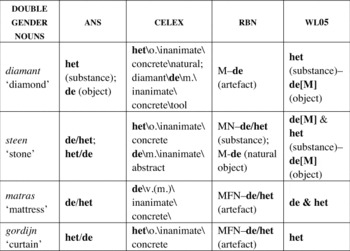
The most authoritative Dutch Reference Grammar, Algemene Neder-landse Spraakkunst (ANS), gives a brief account of DGNs, listing some nouns and describing some usage tendencies: Certain nouns seem to show a preference for the masculine article de (labeled “de/het nouns,” such as filet ‘fillet’, schort ‘apron’, bamboe ‘bamboo’, poeder ‘powder’, and zuivel ‘dairy product’), while others prefer the neuter article het (labeled “het/de nouns,” such as aanrecht ‘working surface’, knoflook ‘garlic’, marsepein ‘marzipan’, and gordijn ‘curtain’). In case of some nouns, the choice is explained in terms of the dichotomy stofnaam/ voorwerpsnaam ‘mass/count noun’: It is argued that the neuter article is preferred for mass nouns, whereas the masculine article most often occurs with nouns that refer to objects.
The lexicological treatment is even more complex. In the CELEX Dutch Lexical Database and the Referentie Bestand Nederlands (RBN) Lexical Database, one finds very different classifications of these nouns. The CELEX lists DGNs as double entries. Therefore, at first glance it is not possible to identify DGNs and, most importantly, to distinguish them from homonyms. In the majority of cases, the existence of the two options is not recognized (gordijn ‘curtain’ is listed as a neuter noun only, and matras ‘mattress’ as a de-noun). In some other cases, the double entries are related to the dichotomy stofnaam/voorwerpsnaam ‘mass/count noun’.
The RBN tends to list DGNs as single entries, which makes it possible to identify them and distinguish from homonymous lexemes. It also associates these nouns with a specific semantic type (for instance, matras is given the semantic type “artifact”). However, even here certain nouns are listed as double entries because they are associated with different semantic types (for instance, steen ‘stone’ is given the label “substance” and “natural object” without any change in gender assign-ment). Moreover, not all DGNs are recognized as such (for example, diamant ‘diamond’).
Finally, the Dutch Official Spelling Dictionary (Woordenlijst der Nederlandse Taal 2005, or WL05) gives an inconsistent classification of these nouns: In some cases, it provides detailed gender information (for example, diamant ‘diamond’), while in others it does not recognize them as DGNs at all (for instance, gordijn ‘curtain’). In the majority of cases, DGNs are classified according to the dichotomy stofnaam/voorwerps-naam ‘mass/count noun’, as in the case of diamant ‘diamond’ or steen ‘stone’. The double gender status is recognized for mass nouns but not for nouns that denote objects—such nouns are generally listed as de-nouns. Some examples are given in 17.
- (17)
(a) diamant1 [di·a·mant] (stofnaam), het
diamant2 [di·a·mant] (voorwerp), de[m.], diamanten [di·a·man·ten]
(b) steen1(stofnaam), de[m.] en het
steen2(voorwerp), de[m.], stenen [ste·nen], steentje [steen·tje]
As is clear from the table 1, which summarizes and compares the different treatments of four DGNs, these nouns represent a problematic area of the Dutch lexicon, difficult for grammarians and lexicographers to account for. It is sufficient to look at the classification of four DGNs to understand the challenges one faces when trying to account for them, and most importantly, to notice the inconsistencies among different at-tempts to systematize them.
Grammatical and lexicological classification of Dutch DGNs.

Again, in the majority of cases, the gender choice is explained in terms of the dichotomy stofnaam/voorwerpsnaam ‘mass/count noun’. However, this solution is not uniformly applied to those nouns that allow for both meanings. Besides, not all DGNs can be analyzed from this viewpoint: Nouns like matras ‘mattress’ or gordijn ‘curtain’ cannot be interpreted as mass nouns, yet they trigger either neuter or common agreement. Hence, even if these nouns occupy a small corner of the Dutch lexicon, they still deserve more attention. They deserve a more coherent classification, and most importantly, their double gender status itself begs a more careful analysis, as it can be determined by factors other than simple dialectal variation, such as different categorization of the same referent.
6. Theoretical Framework: Categorization and Individuation
Our categorization depends on the perception of the world and the way we interact with it. Our thought and language are embodied and structured based on our experience (Lakoff 1987:5):
There is nothing more basic than categorization to our thought, perception, action, and speech. Every time we see something as a kind of thing, for example, a tree, we are categorizing.
Conceptual representations can be considered as the most important cognitive function in human reasoning: Every time we utter a sentence using certain words instead of others we rely on a specific conceptu-alization of the environment. The structure of language is itself a mirror of our conceptualizing capacity (Croft & Cruse 2004:40):
All aspects of the grammatical expression involve conceptualization in one way or another, including inflectional and derivational morphology and even the basic parts of speech, whenever we utter a sentence we unconsciously structure every aspect of the experience we intend to convey.
Individuation plays a key role in categorization. The perception of an object as individuated is based on its gestalt properties (boundedness, discreteness, divisibility) and the function that speakers attribute to them. The cognitive notion “individual” relates to properties like countability, indivisibility, and boundedness, and corresponds approximately to “dis-crete bounded entity” (Parafragou 2005:259). From an ontological view-point, individuation is closely related to animacy, countability, and definiteness, all of them gradable concepts, as schematized in figure 2.
Individuation and its cognitive correlates.

The correlation between individuation and animacy is quite obvious: From the speaker's cognitive perspective, humans are more individuated than other animates, while animates are more individuated than inani-mates. This is evident in syntax—subjects tend to have animate referents (Givón 1976, Comrie 1981), and in gender assignment—for nouns with animate referents the probability of semantic instead of syntactic agree-ment is higher (Corbett 1991). For countability and definiteness the correlation is subtler and deserves special attention here, given that it can account for different ways speakers perceive the inanimate domain, where the referents of Dutch DGNs belong.
6.1. Individuation and Countability
According to the Cognitive Individuation Hypothesis (Wisniewski et al. 2003, 2004; Wisniewski 2009), perceptually similar entities may be con-ceptualized as individuated or nonindividuated, depending on the cognitive agent. The role of the human is fundamental in determining whether the perceptual input from the world is interpreted as individuated or nonindividuated. The distinction between more or less individuated referents depends on their scope of predication: People conceptualize an entity as individuated if they are able to predicate its properties as a whole, while people consider an entity as nonindividuated if they are able to predicate properties which apply to arbitrary portions or parts of that entity:
- (18)
a. This is a bench.
b. Move over and give me some bench. (Wisniewski et al. 2004)
In 18a, the bench is perceived as a whole (a seat) and conceptualized as a bounded individuated object (a bench), while in 18b, the cognitive agent focuses on its function (the bench as a surface to sit on) and conceptualizes it as an unbounded and less individuated entity (some bench). Therefore, speakers do not observe passively the perceptual characteristics of a referent but have an active role in conceptualizing an entity as more or less individuated (Wisniewski et al. 2004:589). As a direct consequence, the count/mass syntax is a mirror of the speakers' cognitive conceptualizations: People tend to use count nouns when they have distinct referents in mind and mass nouns when they refer to non-individuated entities (that is, a bench versus some bench in 18).
Since speakers may wish to refer to a particular aspect of an entity, they can do so by means of a syntactic construction that competes with the individuation function (Wisniewski 2009). The same idea is ex-pressed by Talmy (2000), who stresses that something can be perceived and construed either as having boundaries (individuated) or as having no boundaries at all (nonindividuated). Thus, speakers are allowed to coerce the semantic type of a noun if required by particular communicative functions (Krifka 1995, Pustejovsky 1995). For example, one can say an apple or a lot of apple depending on whether he or she is referring to a bounded fruit (prototypical meaning) or an unspecified amount of apples (count-to-mass coercion). It is also possible to say beer meaning the substance and three beers meaning the bottles containing it (mass-to-count coercion). Therefore, the count/mass distinction seems not to be fixed; rather, it needs to be determined for each utterance, as a direct consequence of the conceptualization of the referent the noun stands for once it enters the syntagmatic chain.
6.2. Individuation and Definiteness
From a cognitive perspective, there is also a close relationship between individuation and definiteness: High individuation correlates with high definiteness, and definiteness as a nominal feature implies the concept of individual expression (Abbott 2001, 2004). Definiteness is a very important linguistic feature that belongs to both semantics and pragmatics: Definiteness and referentiality must be considered as a semantic property and a discourse-pragmatic property, respectively (Givón 1978, Lyons 1999). The debate on definiteness as a morphosemantic category has led to many theories about its cognitive correlates, both from a semantic and a pragmatic viewpoint. Traditional linguistic theories of definiteness have described this nominal property in terms of uniqueness (Russell 1905), familiarity (Christophersen 1939, Kamp 1981, Kamp & Reyle 1993, Heim 1982, Prince 1992), accessibility (Ariel 1990), or identifi-ability (Gundel et al. 1993).
What is common to all these theories is “the basic idea involving uniqueness of applicability of a property” (Abbott 2001:1). The use of a definite NP presupposes that the hearer is able to access or identify the referent. The meaning of definite descriptions have to be accounted for in terms of “an assumption about an ability of addressees, whether this ability is couched in terms of identifying a referent or individuating a referent or accessing a referent” (Abbott 2001:6). For example, in I saw a dog, the indefinite NP does not have a unique referent; there is no speci-fic, familiar, or identifiable dog. In contrast, in I saw the dog the referent is specific and presumably known to the hearer.
The main function of definite NPs has been argued to be anaphoric in nature: The definite article gives the instruction to retrieve the referent indirectly, by activating a frame of accessible knowledge the referent is associated with in a unique way, while the demonstrative allows for dir-ect reference, being anchored in the specific universe of discourse (Hawkins 1978).
Following the familiarity theory, Löbner (1985) proposes that what all definite descriptions have in common is that they implicate a specific referent from a semantic or pragmatic point of view allowing for refer-ence to be unambiguous. Accordingly, he draws a systematic distinction between semantic definites and pragmatic definites: Semantic definites constitute functional concepts that exist independently of the context of utterance, while pragmatic definites can only be interpreted in a particular situation in which they are uttered.Footnote 17
- (19)
a. The sun is shining.
b. Can you pass me the salt?
In 19a, definiteness is semantically motivated (there is a unique object that the Sun can refer to), while 19b contains a pragmatic definite that can be disambiguated only considering the specific context of utterance (there is a saltshaker on the table and the speaker is asking for it). Löbner's theory is reinforced by Fraurud's (1988, 1990, 1996) corpus-based studies that reveal a great prevalence of nonanaphoric, or first-mention uses of definite NPs, especially those with inanimate referents. Therefore, the function of definite NPs is not exclusively anaphoric; their use can be determined by other pragmatic and semantic cognitive factors.
Another possible way to treat definites is that of saliency (Lewis 1979), that is, an expression is definite if it refers to a salient object. Accordingly, the use of a definite NP could depend on context and the degree of individuation of its referent in the specific universe of dis-course. Such a definition is reminiscent of conversational topic (von Heusinger 1997), a notion grounded in the discourse dichotomy of old and new information. Old information is represented by referents that have been already introduced into the discourse, while new information is represented by referents that have not been introduced yet. Hence, definite NPs constitute a very complex grammatical phenomenon where pragmatic and semantic criteria overlap. Moreover, if definite NPs imply unambiguous reference they must necessarily contain some information that would enable the hearer to identify the referent. Although typically, discourse antecedents function as such indicators (anaphoric use of definite NPs), the semantics of the noun (different degrees of indivi-duation of the referent) or the specific context of the situation (a particular discourse topic) can also be used to disambiguate the referent.
7. Double Lexical Gender and Multiple Agreement Patterns
7.1. Definite NPs Containing DGNs: The Hypothesis
Considering the diachronic loss of morphological markers (and the consequent loss of gender as a morphological category), as well as the semantic “reinvention” of pronominal gender according to the Agree-ment Hierarchy and the Individuation Hierarchy (Audring 2006, 2009), Dutch DGNs could be analyzed by proposing that nominal gender agreement follows the same cognitive pattern. Bearing in mind the strict cognitive correlation among individuation, countability, and definiteness, the selection of gender in definite NPs that contain DGNs could be at least partially motivated by the need to mark individuation.
The analysis of definite NPs can shed light on the gender status of DGNs for two reasons. The first and most obvious one is that Dutch marks gender almost exclusively on definite NPs by the determiner (article or demonstrative), whereas in indefinite NPs, the only indicator of gender is an attributive adjective that takes the -e ending with common controllers or zero inflection with neuter controllers; that is, the indefi-nite article has the unique genderless form een.Footnote 18 The second reason is that definite NPs by definition express some degree of definiteness; the speaker believes that their referent can be more or less easily identified by the hearer. In other words, the conceptualization of the referent is based on the real world knowledge supposedly shared by the hearer and the speaker. This view of definite NPs could have relevant semantic and pragmatic implications.
In fact, for nouns with unstable lexical gender, agreement could be motivated by semantic or pragmatic criteria, as in the case of a pronoun when the speaker is unable to work out the grammatical gender of the controller. In cases of lexical uncertainty, the selection of a certain agreement option could depend on the need to mark either a discourse topic or different conceptualizations of the same referent. From a prag-matic viewpoint, the more individuated entities are the topic of conversation (what is assumed by the speaker to be known to the hearer), while, from a semantic perspective, individuation can be related to different cognitive dichotomies, like concrete/abstract, specific/generic, and bounded/unbounded referent.
7.2. Data and Method of Analysis
The investigation of definite NPs containing DGNs was carried out based on two sources: the Spoken Dutch Corpus (Corpus Gesproken Nederlands—CGN) and the Webcorp tool for the use of Web texts. The CGN corpus consists of about nine million words used in everyday conversational Dutch (both Northern Dutch and Flemish). This speech corpus is characterized by a great variety of texts (face to face conver-sations, interviews, broadcasts, telephone conversations, discussion, reportages, and lectures) and is particularly suited for this kind of investigation as it enables one to analyze the use of DGNs in spontan-eous conversational contexts. Webcorp is a web search engine for exploring Web texts. Surfing the Web allows access to a great variety of topics and styles (from formal newspaper websites to informal chats and forums). Moreover, the Web language is a “hybrid” variety that has a written medium but a spoken attitude. In the CGN, the analysis was carried out using the Lexicon Tool Panel. A DGN would be typed into the search field, and then all the search results for this DGN would be analyzed. The same strategy was used in searching Web texts.
The investigation of definite NPs containing DGNs revealed some interesting tendencies with respect to gender choice. To avoid the pro-blem of dialectal variation, only the relevant cases within the same utterance were analyzed in depth (the cases of inter-speaker variation were not counted): selection of different articles by the same speaker in the same utterance. To be precise, by “case” I do not necessarily mean a single shift from one article to the other. In fact, in some utterances the speaker shifts between the articles more than once in the same context.
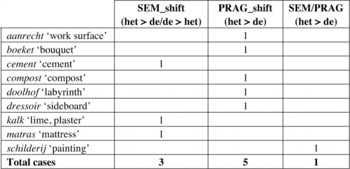
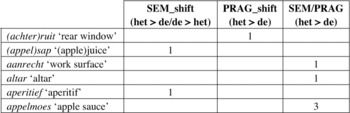
The analysis of the CGN yielded nine cases of intra-speaker variation, with a certain balance between semantically driven (three cases) and pragmatically driven (five cases) shifts, and one uncertain case. The same results were obtained from the Webcorp, where the total number of cases was higher (74) but equally balanced—28 semantic shifts and 20 pragmatic shifts—even though in many cases (26), it was hard to establish the reason (semantic or pragmatic) for the choice of gender; that is, both explanations were possible.
Even if the total number of cases is quite limited (83), what counts is the fact that all cases of nominal gender shift can be explained in terms of different degrees of individuation, either semantic or pragmatic. Moreover, gender instability in the nominal domain is assumed to be a very rare phenomenon (lexical gender should take precedence over extra-grammatical features), as the Agreement Hierarchy predicts (Corbett 1991). Therefore, the relative size of quantitative data does not diminish the significance of the phenomenon. Obviously, these numbers are only meant to prove the existence of the phenomenon itself; especially considering that when dealing with Web data, one cannot precisely calculate the probability of finding cases of nominal gender instability, and the number of these instances changes constantly (for each Web search carried out at different times).
Crucially, even though the phenomenon is rare, these findings sug-gest at least the possibility of a reason behind this kind of linguistic variation, so that these cases can be explained not as exceptions to straightforward (assignment) rules but as motivated types of agreement. In particular, the analysis suggests two possible ways of explaining gen-der agreement. First, gender agreement can be pragmatically motivated, and second, it can depend on the speaker's/writer's different conceptu-alizations of the same referent (according to different degrees of individuation).
The Appendix contains all cases of intra-speaker variation in the choice of a definite article (de versus het) for the same noun in the same context, found in both sources. In each case, it is indicated whether the shift was semantically or pragmatically motivated. In what follows, I present an in-depth analysis of these tendencies in gender agreement, and I give examples to demonstrate that there is a range of semantic and pragmatic factors behind the choice of an article for each DGN.
8. Discussion of the Results
8.1. Pragmatically Driven Choice of Gender
In some cases, the choice of gender seems to be related to the pragmatic dichotomy topic/new. As shown in 20–22, the DGNs doolhof ‘labyrinth’, aanrecht ‘work surface’, and bruistablet ‘soluble tablet’ can trigger either neuter or common gender agreement in the same context.Footnote 19
(20) doolhof ‘labyrinth’ (RBN de/het—CELEX de[M]—WL05 de[M])Footnote 20
A nou dit is het doolhof hè.
now this.neut is the labyrinth.neut!
B ja die ken ik ja. […] waar is waar is deze doolhof?
yeah I know that.comm yeah […] where is where is this labyrinth.comm?
A die zit uh hier uit recht… that.comm is hier to the right
B aan de noordwestkant van ‘t Liesbos achter ‘t Jachthuis ligt een stuk dat de doolhof word genoemd.
to the northwest of the Lies woods behind the Hunter's House there is a place that is named the labyrinth.comm
(21) aanrecht ‘work surface’ (RBN de/het—CELEX het—WL05 de[M]/het)Footnote 21
A hè en dan wil ik toch wel graag ook dat aanrecht wat jij hebt diezelfde platen ja dan is ‘t toch allemaal meer dicht gebouwd […]
Yes and I would also like that. NEUT work surface, similar to yours, and yes the same tiles to match
B maar je wil ook geen tegeltjes meer uh aan de muur?
but you don't want little tiles on the wall anymore?
A jawel ik… ja dat wil ik wel hoor want daar heb ‘k al over nagedacht maar nee niet boven de aanrecht
Oh yes I… yeah I want that ‘cause I have already thought about it but no not above the.comm work surface definitely
(22) bruistablet ‘soluble tablet’ (RBN de/het—CELEX het—WL05 de/het)Footnote 22
In een bekerglas, gevuld met water, wordt een half tablet gegooid.[…] het water waar het bruistablet fijngemalen in ging is helderder dan het water in het andere bekerglas. […] De bruistablet in het warme water was sneller opgelost dan de bruistablet in het koude water.
In a glass beaker filled with water there has been placed a half.neut tablet […] the water with the.neut milled soluble tablet is lighter in color than the water in the other glass beaker. The.comm soluble tablet in warm water melted more quickly than the.comm soluble tablet in cold water.
In 20, A and B (siblings) are looking for a place named “the labyrinth.” A introduces the referent using a neuter definite NP (het doolhof). Then B refers to the same referent using two definite NPs—first with the deictic demonstrative (deze doolhof), then with the definite article (de doolhof). Both NPs trigger common gender agreement.
The same pattern is observed for aanrecht in 21 and bruistablet in 22. In 21, the referent is first introduced by means of an NP that is neuter in gender and deictic in nature (demonstrative pronoun + N). Then, it is referred to by an NP that has common gender. The same happens in 22. In all three cases, the gender shift happens in the same direction (neuter agreement > common agreement): First-mention instances trigger neuter agreement, while second-mention uses trigger common agreement. In particular, in 22 one finds a more complex schema that suggests a close connection between gender selection and topicality: neuter gender/ indefinite NP > neuter gender/definite NP (article) > common gender/ definite NP (article).
Note that in 21, the shift neuter > common gender involves an NP containing the demonstrative deze ‘this’ (het doolhof > deze doolhof > de doolhof). If one compares this example with 22 (een half bruistablet > het bruistablet > de bruistablet), one can conclude that the common gender article functions as a weak demonstrative with a deictic function. In all cases, the relevant DGN represents a discourse topic. In particular, the choice of gender seems to depend on different degrees of topicality. If, following Givón 1978, 1983, topicality is a scalar concept and grammatical agreement is directly related to topicalization, gender agree-ment could be regarded as a means of topic identification, maintenance, and recoverability in discourse. The neuter gender is typically used to convey new information (first-mention), while the common gender is typically used to convey old, or given information (topic). Once the referent is well established in the universe of discourse, its topicality is signaled by the speaker through a specific gender choice (that is, common gender). This view seems to be confirmed by the pragmatic value of the common gender NPs, whose structure allows for a deictic reading: the+N to be read as ‘that thing I'm talking about’ (de doolhof ‘the labyrinth’ = deze doolhof ‘this labyrinth’; de aanrecht ‘the work surface’ = die aanrecht ‘that worksurface’; de bruistablet ‘the soluble tablet’ = die bruistablet ‘that soluble tablet’).
8.2. Conceptualization Shifts
In some other cases, the choice of gender does not follow the pragmatic topic/new pattern because both neuter > common and common > neuter shifts occur within the same context. However, a closer look at such cases reveals some regularities: The choice of gender can often be explained in terms of the resemanticization pathway described by Audring (2006, 2009) for pronominal gender agreement. The analysis of these pragmatically unmotivated shifts allows for at least three possible dichotomies in the cognitive perception of the referent, all of which pertain to individuation: specific/generic, concrete/abstract, and bounded/ unbounded.
Let us first consider the dichotomy specific/generic. Sometimes, gender shifts are clearly determined by the conceptualization of the refer-ent as either specific or generic. This is the case with the nouns hippodroom ‘race course’ in 23, circus ‘circus’ in 24, and doolhof ‘labyrinth’ in 25.
(23) hippodroom ‘race course’
(RBN de/het—CELEX de[M]—WL05 de[M]/het)Footnote 23
De hippodroom van Olympia is niet bewaard gebleven […] De Romeinen hadden voor paardenraces het circus, dat in tegenstelling tot het Griekse hippodroom echt een afgesloten bouwwerk was. Soms wordt hier ook wel de naam hippodroom voor gebruikt zoals in het geval van de Hippodroom van Constantinopel.
The.comm hippodrome of Olympia is not preserved […] The Romans had the circus for horse races, that in opposition to the.neut Greek hippodrome really was a closed off building. Sometimes the name hippodrome was used even here such as in the case of either the.comm Hippodroom of Constantinopolis.
(24) circus ‘circus’ (RBN de/het—CELEX het—WL05 de[M]/het)Footnote 24
Het circus werd gebruikt voor paardenrennen. […] Per jaar werd de Circus Maximus 240 dagen gebruikt. Tijdens de regeringsperiode van keizer Augustus waren er 12 wedstrijden, Caligula hield er 34 per dag en onder de Plavische keizers waren het er zelfs 100. Als er een race was kwamen bijna alle inwoners van Rome en alle bezoekers van de stad naar de circus.
The.neut circus was used for horse races. […]. The.comm Circus Maximus was used 240 days per year. During the governing of emperor Augustus there were 12 competitions, Caligula held 34 per day and under the Plavic rule there even were 100. When there was a race all Roman citizens and all visitors of the city came to the.comm circus.
(25) doolhof ‘labyrinth’ (RBN de/het—CELEX de[M]—WL05 de[M])Footnote 25
“Wie wil doolen in het groen, moet het in dit doolhof doen.” Dit staat in sierletters op de poort van De Doolhof in Ruurlo, Gelderland.
“Everyone who wants to wander in the green must do it in this.neut labyrinth.” This is written in silver letters on the door of the.comm Labyrinth of Ruurlo, Gelderland.
In 23, the structures of the three NPs that contain hippodroom clearly show that when the referent is specific—the hippodrome located in Olympia or in Costantinopolis—the writer chooses common gender agreement (de hippodroom van Olympia/de hippodroom van Constantin-opel). However, describing the hippodrome as a type of building—that is, referring to a kind of place rather than a specific place, the writer shifts to neuter (het Griekse hippodroom). Exactly the same pattern can be observed in 24 and 25, where the opposition is between the Circus Maximus in Rome and the circus as a building, and between the labyrinth in Ruurlo and the labyrinth as a place, respectively.
Let us now examine the concrete/abstract dichotomy. This dichotomy reflects the perception of a referent as more or less indivi-duated. In 26, the noun matras ‘mattress’ is used to refer to two different kinds of entity. The NPs that trigger common gender agreement make reference to the mattress as a concrete object: A is inviting B to stay the night offering B the mattress in the hall. The concrete reading is re-inforced by the deictic demonstrative die. However, when the speaker chooses neuter agreement (de matras > het logeermatras) he or she is no longer referring to the token but to the type: The mattress (token) stands for a guest bed (type), that is, the shift depends on different conceptu-alizations of the referent.
(26) matras ‘mattress’ (RBN de/het—CELEX de[F[M]]—WL05 de/het)Footnote 26
A heb jij die matras nodig?
Do you need that.comm mattress?
B nee
No
A die op gang staat. Mmm die kun je altijd gebruiken hoor kun je echt gewoon uh
that.comm is in the hall. Mmm you can use that.comm as you want for sure you can just simply uh
B ja?
Really?
A ja, dat is het logeermatras van 't huis een beetje … […]
yeah, that.neut is the.neut guest bed of the house a bit … […]
B nou dan gebruiken we die toch gewoon die matrasdie in de gang staat now so we use that.comm simply that.comm mattressthat.comm is in the hall
The same pattern is observed in 27. The speaker makes reference to klavecimbel ‘harpsichord’ as an instrument that belongs to a certain family and describes its origins—where family and origin are both abstract concepts—choosing neuter agreement. In contrast, while talking about the size of the object—having in mind a concrete entity—the speaker shifts to common agreement.
(27) klavecimbel ‘harpsichord’
(RBN de/het—CELEX de[M]—WL05 de[M]/het)Footnote 27
Het instrument speelde een belangrijke rol in het barokorkest.
The instrument played an important role in the baroque orchestra.
Familie, het klavecimbel behoort zowel tot de snaarinstrumenten als de toetsinstrumenten, omdat het instrument snaren en toetsen heeft.
Family, the.neut harpsichord belongs both to the string instruments and the keyboard instruments, because the instrument has both keyboard and strings.
Grootte, de gemiddelde grootte van de klavecimbel is 1,8m lang, 81cm breed en 91cm hoog.
Size, the medium size of the.comm harpsichord is a length of 1.8 m, a width of 81 cm and a height of 91 cm.
Afkomst, waarschijnlijk stamt het klavecimbel af van een psalterium (dit is een plankciter uit de Middeleeuwen).
Origin, the.neut harpsichord originates probably from a psalterium (this is a medieval cetra).
In 28, the noun thema ‘theme’ is used to refer to two different kinds of themes. The speaker uses neuter gender when talking about the abstract theme chosen each week for children's activities. However, when the speaker is referring to the activities related to this theme, he or she shifts to common gender. This suggests that the speaker has in mind the theme as a concrete example of a theme.
(28) thema ‘theme’ (RBN de/het—CELEX de[F[M]]—WL05 het)Footnote 28
Maar het leukste wat ik ga doen is natuurlijk met de kinderen. We beginnen elke ochtend om 10 uur met knutselen met de kinderen in de kidsclub. We hebben een 3 weken programma met elke week een ander thema! We hebben de thema's: Circus, Piraten en Be A Star. Dus in die week knutselen we ‘s ochtends alles wat met die thema te maken heeft. […] 3 dagen in de week wordt er met de kinderen geoefend voor de theater show die de kinderen dan op een avond gaan opvoeren voor de ouders. Voor het thema ‘Be A Star’ is er bijvoorbeeld een Mini Playbackshow.
But the most exciting thing that I'm doing is for sure with children. We begin every morning at 10 am doing bricolage with the children in the kids' club. We have a three-week program with a different.neut theme every week! We have the themes: circus, pirates, and Be a Star. So in that week we do bricolage in the morning which has to do with this.comm theme. […] 3 days per week children train themselves for the theater show that the children will perform one evening for the parents. For the.neut theme ‘Be a Star’ there is, for example, a Mini Playbackshow.
Finally, let us consider the bounded/unbounded dichotomy. This dichotomy has been found quite pervasive in spoken Dutch, at least as far as pronominal gender is concerned (Audring 2009; De Vogelaer 2006, 2009, 2010). The degree of individuation of the referent seems to be a basis for gender choice in the nominal domain as well. Consider, for example, the DGN omslag ‘cover’ in 29.
(29) omslag ‘cover’ (RBN de/het—CELEX de[M]—WL05 de [M]/het)Footnote 29
Eigen foto's en tekst op het omslag
Your own photos and texts on the.neut cover
fotoboeken met zachte omslag
photo books with soft.comm cover
In this web advertisement of photo books, the two sentences are placed one next to the other, and in the next few lines within the original text, the same neuter-to-common shift occurs. Therefore, the choice of a particular article cannot be considered random but should instead be given either a pragmatic or a semantic explanation. The shift from neuter to common could be explained in terms of the old versus new information contrast, but it could also be related to different ways in which the noun cover can be conceptualized: The immediate idea associated with it is that of a bounded object (the external part of a book); but it can also be conceptualized as a surface with images or text on it. This is the case of cover in the first NP—(op) het omslag—that triggers neuter agreement (this reading is triggered by the preposition op ‘on’). In the second case—(met) zachte cover—the NP allows for a prototypical reading of cover as a bounded entity (in this case, the adjective soft prompts the interpretation of cover as a concrete object).
A similar case is drop ‘licorice’ in 30 that contains a recipe for licorice ice-cream.
(30) drop ‘licorice’ (RBN de/het—CELEX de[F[M]]—WL05 de/het)Footnote 30
Doe de drop in het pannetje en zet deze op een laag pitje. Laat de drop smelten en voeg naar smaak suiker toe, om het dropijs zoeter te krijgen. Blijf goed roeren. Als de drop niet makkelijk smelt zou je een beetje water toe kunnen voegen. Een klein beetje water toevoegen kan helpen om het drop beter te laten smelten zonder dat het aankoekt.
Put the.comm licorice in the little pan and leave it.comm on a low heat. Let the.comm licorice melt and add sugar as much as you like to get a sweeter licorice ice cream. Keep mixing. If the.comm licorice does not melt easily you could add a bit of water. Adding a bit of water can help to melt the.neut licorice avoiding that it.neut overcooks.
When the speaker is referring to the licorice to be used—a licorice stick, probably—he or she selects the common gender article. However, once the speaker is talking about melted licorice, he or she turns to neuter gender. This suggests that the gender shift is driven by different conceptualizations of the same referent that can be perceived as either a bounded entity (a licorice stick) or an unbounded substance (melted licorice).
Another very interesting example is marsepein ‘marzipan’ in 31.
(31) marsepein ‘marzipan’
(RBN de/het—CELEX de[M]—WL05 de[M]/het)Footnote 31
Het marsepein kan je kopen bij de banketbakker […] Rechts zie je de marsepein. Links de tekeningen. […] Je drukt de marsepein voorzichtig uit tot je bij de buitenste lijn van de tekening bent. Op die manier vul je de hele omtrek. […] Je kan met een stokje relief maken op het marsepein: zo krijg je dan het idee van haren.
You can buy the.neut marzipan at the cake shop […] On the right you see the.comm marzipan and on the left—the drawings […] Mash up the.comm marzipan until you arrive at the most external line of the drawing. In this way, you fill the whole form. […] With a cocktail stick you can make relief on.neut the marzipan: In this way, you give the idea of the hair.
Here there are two cases of neuter agreement and two cases of common gender agreement. In the first definite NP, the selection of neuter gender seems quite obvious considering the semantic type of the noun—that is, mass noun. However, in both the second and third NPs, the gender shifts from neuter to common. The writer is still referring to the substance, but now it is conceptualized as a bounded entity. In both cases, the marzipan has a particular shape: The image on the web site shows colored pieces of marzipan for the second NP (de marsepein), while in the third instance (de marsepein), the reference is made to a bounded object, that is, the marzipan is mashed up on the drawing and therefore takes the form of the drawing itself.
The last instance (op het marsepein) displays neuter gender agreement. Here the neutral gender can be motivated if the marzipan is conceptualized as a surface one can work on with a cocktail stick. Recall the example in 29, where the conceptualization of omslag ‘cover’ as a surface triggers the preposition op ‘on’ as well: In both cases, the perception of the referent as an unbounded surface is prompted by the same syntactic construction, op het+N (op het omslag and op het marsepein). Therefore, in these examples the choice of one article over the other can be accounted for in terms of different degrees of individuation of the referent as it can be viewed as either a bounded object or an unbounded surface/substance.
8.3. Beyond DGNs: Some Unexpected Cases
The examples above reveal some interesting tendencies in gender selection in cases when a noun's gender is uncertain. If a noun's lexical gender cannot be determined, speakers select the agreeing determiner based on various pragmatic and semantic considerations. The analysis of definite NPs in the CGN and Web texts reveal that gender instability is not confined to the domain of DGNs. In fact, nouns with stable lexical gender can also trigger agreement that is different from the regular (lexically determined) one. The CGN contains only one noun with stable lexical gender, namely kalk ‘lime, plaster’, that shows nominal gender shift (common-to-neuter), even though it is generally regarded as a stable de-noun. Other interesting inconsistencies with respect to the article choice in spoken language are the common noun snoep ‘sweets’ that takes the grammatically wrong neutral article het, and the neuter noun maillot ‘singlet’ that takes the grammatically wrong common article de. In such cases, one would expect to be dealing with speech errors, but interestingly, these deviations can be given the same account as DGNs.
A more thorough search of the Webcorp demonstrated that on the Internet one could find more instances of nouns with stable lexical gen-der acceptable with more than one article. Although such cases are very rare (I counted only eight), they are, nevertheless, of great interest as neither grammars nor previous studies on Dutch gender account for the instances of semantic/pragmatic agreement in such NPs.Footnote 32 This is the case for widely used nouns such as boek ‘book’ in 32, pand ‘building’ in 33, boter ‘butter’ in 34, and zilver ‘silver’ in 35.
(32) boek ‘book’ (RBN het—CELEX het—WL05 het)Footnote 33
Het boek gaat over mensen: sterke mensen, onzekere mensen, helden […] Tot 11 november is de boek voor de actieprijs €25,- te koop, daarna is de prijs €29.95.
The.neut book deals with people: strong men, frightened men, heroes […] Until November the 11th, the.commbook can be bought for the special price of €25, then the price will be €29.95.
(33) pand ‘building’ (RBN het—CELEX het—WL05 het)Footnote 34
Kan je het pand niet huren en beginnen met een vof? Of is het noodzakelijk dat de pand wordt gekocht?
Cannot you rent the.neut building and begin with a vof? Or is it necessary that the.comm building is bought?
(34) boter ‘butter’ (RBN de—CELEX de—WL05 de)Footnote 35
De boter aan de buitenkant van de tosti is voor als je de tosti gaat keren en afbakken. Brood neemt namelijk al het boter uit de pan op.
The.comm butter on the outer side of the toast is useful as you turn and bake the toast. That is, bread absorbs all the.neut butter from the pan.
(35) zilver ‘silver’ (RBN het—CELEX het—WL05 het)Footnote 36
Alle restauraties aan zilver worden uitgevoerd in ons eigen atelier. Een flinke collectie antiek gereedschap dat terug in oude glorie is hersteld zorgt ervoor dat ons atelier de zilver hersteld op een manier waarop de originele makers van het zilver trots geweest zouden zijn.
All silver repairs are carried out in our own workshop. A lovely collection of ancient tools, which have been brought back to their old glory, allows our workshop to repair the.COMM silver in a way the original artisans of the.NEUT silver would have been very proud of.
In 32 and 33, the shifts het boek > de boek and het pand > de pand, respectively, can be accounted for as pragmatically driven: In the first mention, both nouns appear with grammatically appropriate articles (boek ‘book’ and pand ‘building’ are het-nouns, that is, neuter nouns) and are interpreted as new general information (low in individuation). In the second mention, they refer to the established conversation topic (high in individuation), and the most natural reading of the definite article should be that of a deictic anaphor (de boek/pand as die boek/pand ‘that book/building’). In other words, the article is used as a weakened demonstrative. Therefore, although the gender shift het > de is gram-matically irregular, it makes sense pragmatically.
In 34 and 35, the explanation for the gender shift depends on different conceptualizations of the referent. Boter ‘butter’ is a de-noun (a common noun), and from a semantic point of view, it is a mass noun. The first mention is grammatically regular (de boter), and the NP refers to butter in general. The second mention refers to melted butter (as drop ‘licorice’ in 30), and the agreement, though wrong from a grammatical perspective (het boter), is perfectly motivated from the semantic view-point (melted butter is lower in individuation than butter in general that could also be conceived as a stick of butter, that is, a bounded object). This shift is consistent with Audring's resemanticization theory.
Another interesting case is that of zilver ‘silver’ in 35, a neuter noun that denotes a metal, that is, a specific kind of substance that, according to grammars, triggers regular neuter agreement. In 35, the shift de zilver > het zilver is motivated by the existence of two different meanings. In the first case, the NP de zilver refers to silver objects that need to be repaired. In the second case, the speaker refers to silver as a substance some artisans worked on, and the noun's gender shifts to neuter—het zilver—which is motivated not only syntactically but also semantically.
9. Conclusion
All previous studies on Dutch gender indicate that the language is undergoing a transition from a three-gender to a two-gender system. It has been proposed that this development largely depends on the status of nominal gender, that is, on how many gender targets allow the three-way masculine/feminine/neuter distinction. In fact, the morphological simpli-fication of determiners and demonstratives seems to expedite the loss of grammatical gender (De Vogelaer & De Sutter 2010). Given that gender of Dutch controllers is covert, the only way to determine the gender of a noun is by looking at the article it appears with. If the morphological system still distinguishes between masculine and feminine, nouns trigger agreement according to the original gender they have been assigned to. However, if neither the noun nor the article carry markers of the original lexical gender, other agreement options become possible (Dekeyser 1980, Curzan 2003). As a result, the resemanticization of pronominal gender can be viewed as a process of “morphological regularization” (De Vogelaer & De Vos 2011:251), whereby a system that has lost its grammatical transparency is restructured through the application of a relatively small set of semantic rules.
In fact, both in the North and the South—though to different extents—the grammatical gender system is being abandoned in favor of a semantically based one (Fletcher 1987; Audring 2006, 2009; De Vogelaer 2006, 2009, 2010; De Vogelaer & De Vos 2011). For the purposes of choosing a pronoun the lexical gender of a noun seems to be of secondary importance (Audring 2009); what matters is the conceptu-alization of its referent. This resemanticization process contains different developmental stages: Interesting geographical variations have been proven to exist among different varieties (De Vogelaer 2006, 2009; De Vos 2009; De Vogelaer & De Vos 2011), depending on the different degrees of coalescence displayed by agreement targets other than personal pronouns, such as definite article, indefinite article, and demon-strative and relative pronouns. Northern varieties are ahead in this process provided that they no longer distinguish between masculine and feminine at the nominal level, whereas Southern varieties are more conservative in this respect.
While pronominal gender has been thoroughly investigated, previous accounts of DGNs mention the phenomenon only briefly, considering it a reflection of different gender assignment criteria that vary from location to location and from speaker to speaker (Pauwels 1938, De Vogelaer 2006, De Vogelaer & De Sutter 2010). However, if the article selection is reduced to lexical gender instability, the agreement patterns triggered by DGNs would be completely arbitrary and unpredictable. In contrast, if the article selection is taken as a matter of gender agreement, DGNs can be given the same analysis as pronouns. The distinction between gender assignment and gender agreement is a blurry one even in case of nouns with stable lexical gender—either de- or het-nouns—as they can trigger more than one type of agreement; but it is especially problematic in case of DGNs, where gender instability involves both lexical and referential gender (Dahl 1999).
In general, Corbett's distinction between agreement patterns and assignment rules works for those gender systems where the number of agreement options corresponds to the number of gender classes (espe-cially, if gender is marked overtly on the noun). However, this distinction is of very little help when it comes to those systems in which gender is covert, that is, systems where gender manifests itself only through agreement. There Corbett's distinction obscures rather than highlights a much more relevant fact, namely, that any changes in agreement pattern can easily percolate to the gender assignment system.
If one views article shifts in DGNs as a gender agreement phe-nomenon rather than a case of unstable gender assignment, then the relevant agreement patterns appear to be semantically and pragmatically motivated: Nouns whose referents are characterized by a high degree of individuation tend to trigger common agreement, while nouns with less individuated referents are more likely to trigger neuter agreement. From the pragmatic viewpoint, the common gender is employed to signal topi-cality, while the neuter gender is the most suited for newly introduced referents. This hypothesis is supported by the use of the common definite article de as a weakened demonstrative (see the shift het doolhof > deze doolhof in 20). In most cases, the definite article appears to function as a deictic-anaphoric device (see deze doolhof > de doolhof in 20 and dat aanrecht > de aanrecht in 21). Moreover, the relationship between grammatical agreement and topicalization has other manifestations in Dutch grammar: Neuter pronouns can replace an entire proposition, and both existential and impersonal constructions—characterized by an in-herent low individuation—trigger neuter agreement.
The semantic dichotomies specific/generic (hippodroom ‘hippodrome’ in 23 and circus ‘circus’ in 24), concrete/abstract (matras ‘mattress’ in 26 and thema ‘theme’ in 27), and bounded/unbounded (omslag ‘cover’ in 29 and drop ‘licorice’ in 30) seem to play a role in gender agreement: More individuated referents trigger common gender agreement, while less individuated entities show a preference for neuter gender agreement (Audring 2009). Gender agreement also appears to be closely related to the count/mass dichotomy (pervasive even in classifier languages), where neither of the two readings is lexically fixed but depends on the specific context of utterance (Krifka 1995, Wisniewski 2009, Talmy 2000). If the count/mass syntax is conceptually driven, in cases of uncertainty it is possible for gender to be chosen based on context, and in particular, on the degree of individuation of the referent in question (recall, for instance, the case of marsepein ‘marzipan’ in 31).
The agreement patterns displayed by DGNs seem to confirm what was demonstrated by previous studies of Dutch gender, namely, that for the purposes of agreement referential gender is more important than lexical gender. In this respect, the DGN agreement patterns represent the next step in the transition of Dutch gender toward a conceptual system, which is consistent with Corbett's Agreement Hierarchy. To sum up, the investigation of Dutch DGNs confirms the ongoing resemanticization of Dutch gender and indicates another possible area of the Dutch grammar, where the loss of grammatical markers is leading to the restructuring of a category that is perceived as no longer functional; the process that could lead to the loss of grammatical gender and establishment of a semantic gender system, as in contemporary English (De Vogelaer & De Vos 2011).
The analysis presented in this article is in line with recent studies on pronominal resemanticization. It sheds light on the role of the neuter gender in the restructuring of the Dutch gender system: According to all of these studies, neuter is the unmarked gender for expressing a low degree of individuation. This could indicate that neuter gender is the hidden force behind the restructuring of Dutch gender. The neuter gender is used on different grammatical levels for the conceptualization of what is perceived as less individuated. Support for this hypothesis comes from the original Proto Indo-European gender system with a two-way gender distinction—animate (more individuated) and inanimate (less indivi-duated)—that would subsequently divide into three (masculine, feminine, and neuter) as a result of the further split within the animate gender (Brugmann 1889; Lehmann 1958; Luraghi 2009, 2011). As animacy is closely related to individuation, the recategorization of Dutch gender—once it has lost its grammatical function—could be conceived of as a restoration of an original system based on the semantic animate/ inanimate distinction.
More work is needed to verify the connection between gender agreement and the mechanisms of type coercion. In particular, it would be useful to investigate the contexts in which gender shift is more fre-quent—for example, cases where the count/mass reading is induced by the aspectual properties of the verb or by a certain preposition. Bearing in mind that the meaning of a noun can be referential in nature and context-dependent rather than lexically fixed (Pustejovsky 1995), one can hypothesize that what a noun stands for could be related to the cognitive contextual perception of its referent as a pragmatically salient or semantically individuated entity. This hypothesis is consistent with the view that dynamic meaning is an inherent property of nouns.
Finally, let us suppose that the distinction between gender assign-ment and gender agreement is irrelevant for languages in which nouns do not carry any overt gender marking, and also that new rules in gender agreement can interact with rules of gender assignment and trigger changes in the gender system as a whole. This view opens up an avenue for a crosslinguistic study that would compare covert and overt gender systems. The prediction is that article shifts in DGNs—and unmotivated or semantically driven gender shifts in general—would be more frequently found in covert gender systems.
APPENDIX
Cases of intra-speaker variation with respect to DGNs (obtained from the Spoken Dutch Corpus).

Cases of intra-speaker variation with respect to DGNs (obtained with Webcorp tool for Web data).