Management Implications
Since the late 1800s, the floating species Eichhornia crassipes (waterhyacinth) has negatively impacted hundreds of thousands of hectares of freshwater sites (lakes, ponds, bayous, rivers, etc.) throughout the United States. Historically, aquatic herbicides are one of the most effective tools used to manage this ever-spreading weed, and for several decades, the auxin mimic 2,4-D has been one of the primary herbicides used in this role. In 2018, two formulations of a new auxinic herbicide—florpyrauxifen-benzyl (suspension concentrate [SC] and emulsifiable concentrate [EC])—were registered to control floating, emergent, and submersed vegetation, including E. crassipes. Because only one formulation of florpyrauxifen-benzyl is registered per state (SC in the southeastern states and EC elsewhere; both of which have substantial E. crassipes problems) and no control data have been published to confirm use rates referenced on labels, it is important to determine the efficacy of both formulations on E. crassipes so that resource managers across the United States will know which herbicide rate to use with the herbicide formulation available to them. No data have been collected to compare these two formulations simultaneously against the same target species, so research is needed to determine whether E. crassipes control can be obtained at similar rates, as there may be differences in physiochemical properties between the SC and EC formulations. Small-scale trials demonstrated ≥89% plant control with florpyrauxifen-benzyl SC and EC at 14.8, 29.5, and 58.9 g ai ha−1 at 5 wk after treatment. However, the lowest rate of florpyrauxifen-benzyl SC should be avoided due to plant recovery. Due to similarities in efficacy, these data provide evidence that federal, state, and local natural resource agencies, regardless of formulation registered in a particular state, can control E. crassipes with foliar applications of florpyrauxifen-benzyl SC or EC at multiple use rates.
Introduction
Waterhyacinth [Eichhornia crassipes (Mart.) Solms] is a floating aquatic plant species that is native to South America and has invaded every continent except Antarctica (Villamagna and Murphy Reference Villamagna and Murphy2010). Eichhornia crassipes impacts water use by forming large mats that block access to water and recreational and commercial navigation on water bodies, exacerbate flooding, increase siltation, affect hydropower generation, and negatively impact commercial fish harvest and fisheries stocks (Howard and Harley Reference Howard and Harley1998; Mailu Reference Mailu2001; McVea and Boyd Reference McVea and Boyd1975; Villamagna and Murphy Reference Villamagna and Murphy2010). The rate of water loss through evapotranspiration when compared with evaporation in open-water sites is increased by E. crassipes presence (Benton et al. Reference Benton, James and Rouse1978; Timmer and Weldon Reference Timmer and Weldon1967), which can negatively affect water used as irrigation and drinking water sources (Mailu Reference Mailu2001). Additionally, E. crassipes is composed of 90% water, and a mat 1 km2 in size is estimated to weigh 59 million kg, which could potentially damage piers, harbor and impoundment infrastructure, and boats (Howard and Harley Reference Howard and Harley1998). Finally, E. crassipes is known to affect human and livestock health by harboring diseases and disease-causing organisms, as well as decreasing water quality by increasing turbidity via an increase in suspended solids (Mitchell Reference Mitchell and Denny1985; Seabrook Reference Seabrook1962; Spira et al. Reference Spira, Huq, Ahmed and Saeed1981).
In North America, E. crassipes has been present since the 1800s and has invaded at least 34 U.S. states, three U.S. territories (Puerto Rico, the U.S. Virgin Islands, and Guam), and one Canadian province (Ontario) (EDDMaps 2020; Gangstad Reference Gangstad1971; USDA 2020). In the United States, E. crassipes is listed as a noxious, prohibited, or invasive plant in at least seven state noxious weed lists (USDA 2020). Many control strategies have been implemented against E. crassipes in the United States and elsewhere with varying levels of success (Alimi and Akinyemiju Reference Alimi and Akinyemiju1990; Bagnall Reference Bagnall1982; Haag Reference Haag1986; Ramaprabhu et al. Reference Ramaprabhu, Kumaraiah, Parameswaran, Sukumaran and Raghavan1987; Tabita and Woods Reference Tabita and Woods1962). In the United States, one of the most common control strategies for E. crassipes is the use of aquatic herbicides, which can rapidly reduce large plant infestations (Robles et al. Reference Robles, Madsen and Wersal2011; Tabita and Woods Reference Tabita and Woods1962). Several herbicides have been investigated as control agents of E. crassipes, with synthetic auxins being some of the most effective (Glomski and Mudge Reference Glomski and Mudge2013; Joyce and Haller Reference Joyce and Haller1984; Langeland et al. Reference Langeland, Haller and Thayer1983; Misra and Das Reference Misra and Das1969; Mudge and Netherland Reference Mudge and Netherland2014; Van et al. Reference Van, Vandiver and Conant1986; Wersal and Madsen Reference Wersal and Madsen2010, Reference Wersal and Madsen2012).
Until recently, the only auxinic herbicides labeled for use in aquatic sites in the United States were triclopyr and 2,4-D (Anonymous 2020a, 2020b) In 2018, a new auxinic herbicide, florpyrauxifen-benzyl (2-pyridinecarboxylic acid, 4-amino-3-chloro-6-(4-chloro-2-fluoro-3-methoxy-phenyl)-5-fluoro, phenyl methyl ester), was registered for use in aquatic sites in the United States (University of Florida 2018). Florpyrauxifen-benzyl is efficacious against floating, emergent, and submersed plants species and is active when applied to the foliage and as a subsurface injection. Limited research has been published in small-scale (i.e., growth chambers, mesocosms, and greenhouses) or field settings. Before product registration, Netherland and Richardson (Reference Netherland and Richardson2016) screened florpyrauxifen-benzyl (formerly referred to as SX-1552 [ester] and SX-1552A [acid metabolite]) as a subsurface treatment against the target species crested floating heart [Nymphoides cristata (Roxb.) Kuntze], dioecious hydrilla [Hydrilla verticillata (L.f.) Royle], and Eurasian watermilfoil (Myriophyllum spicatum L.) using the Economic Cooperation and Development protocol and found the herbicide to be highly active with EC50 (effective concentration to reduce biomass by 50%) values ranging from 0.1 to 23.9 µg ai L−1. In addition, Richardson et al. (Reference Richardson, Haug and Netherland2016) determined the same active ingredients provided EC50 values of <1 µg ai L−1 for the problematic species alligatorweed [Alternanthera philoxeroides (Mart.) Griseb.], monoecious hydrilla, parrotfeather [Myriophyllum aquaticum (Vell.) Verdc.], and variable-leaf watermilfoil (Myriophyllum heterophyllum Michx.).
Currently, two formulations of florpyrauxifen-benzyl are registered in the United States: an emulsified concentrate (EC) and a suspension concentrate (SC) (Anonymous, 2018a, 2018b). An SC, also known as a flowable (F), will typically not dissolve in either water or oil and is impregnated in a dry carrier (e.g., clay), which is ground into a fine powder (Bessin Reference Bessin2018). The powder contains tiny particles of active ingredient and is suspended in a small amount of liquid (typically water) and milled to reduce the average particle size (Bessin Reference Bessin2018; Cush Reference Cush2006). Conversely, EC formulations are composed of three components: oil-soluble liquid active ingredient, petroleum-based solvent, and an emulsifier that allows the active ingredient in the solvent to mix with water (Bessin Reference Bessin2018), which is designed to form an oil-in-water emulsion upon dilution (Cush Reference Cush2006). To date, limited publications showcase differences between pesticide formulations registered for aquatic use: chelated copper complexes (Turnage et al. Reference Turnage, Madsen and Wersal2015), diquat liquid (L) versus quality-improved technology (QIT) (Langeland et al. Reference Langeland, Hill, Koschnick and Haller2002), flumioxazin SC versus water-dispersible granules (WDG) (Mudge and Sartain Reference Mudge and Sartain2017), and fluridone aqueous solution/suspension (AS) versus SC (Poovey et al. Reference Poovey, Skogerboe and Getsinger2004).
The SC formulation of florpyrauxifen-benzyl has a greater amount of active ingredient per unit volume of formulated product than the EC formulation (approximately 11.9 times more florpyrauxifen-benzyl) and thus requires less formulated product to achieve the same dose as the EC formulation (Anonymous 2018a, 2018b), but the herbicide mode of action is the same. Although E. crassipes is listed on both pesticide labels as a species controlled using foliar and in-water applications (Anonymous 2018a, 2018b), efficacy data (rates, use patterns, timing, etc.) have not been published on this subject and should be further investigated. Because E. crassipes is highly susceptible to the older auxin herbicides (2,4-D and triclopyr), it is hypothesized that florpyrauxifen-benzyl will also be highly efficacious. Therefore, the purpose of this work was to evaluate the efficacy of the recently registered aquatic herbicide florpyrauxifen-benzyl formulations at various foliar application rates to determine efficacy against E. crassipes.
Materials and Methods
An outdoor mesocosm trial to evaluate two formulations (SC and EC) of florpyrauxifen-benzyl efficacy on E. crassipes was conducted at the Louisiana State University (LSU) AgCenter Aquaculture Research Facility, in Baton Rouge, LA, in June 2018 and repeated as a greenhouse trial at the R.R. Foil Plant Research Center at Mississippi State University (MSU) in Starkville, MS, in July 2020.
LSU Trial
Eichhornia crassipes plants of 28 to 33 cm in height were obtained from University Lake (Baton Rouge, LA). Six plants each were placed under full sunlight in 75.7-L mesocosms, which were filled with pond water (pH 8.0) and amended with Miracle-Gro® Lawn Fertilizer (24-8-16, Scotts Company, Marysville, OH 43040) at a rate of 2 g L−1. Plants were cultured for 1 wk before herbicide applications. The same rate of fertilizer was added to the experimental units at 3 wk after treatment (WAT). At 1 wk after establishment, all six E. crassipes plants were harvested from each of the four mesocosms to establish a baseline of E. crassipes growth. Pretreatment specimens were harvested, dried to a constant weight (65 C), and recorded as dry weight biomass. After pretreatment plants were harvested, the remaining mesocosms with E. crassipes plants received foliar applications of florpyrauxifen-benzyl SC (ProcellaCOR® SC, SePRO, Carmel, IN 46032) or EC (ProcellaCOR® EC, SePRO). A completely randomized design with a two by three factorial arrangement of treatment with formulation (SC vs. EC) and rate (14.8, 29.5, and 58.9 g ai ha−1) was used. In total, there were seven treatments: a nontreated reference, three florpyrauxifen-benzyl SC treatments, and three florpyrauxifen-benzyl EC treatments. Each treatment was randomly assigned to a mesocosm, and each treatment was replicated four times for a total of 28 treatment mesocosms (32 total mesocosms including the pretreatment mesocosms). A 1% v/v modified vegetable oil and surfactant blend (Turbulence™, Winfield Solutions, St Paul, MN 55164) was included with all SC treatments, while the EC formulation contained a premixed surfactant (B Willis, personal communication). Herbicide treatments were applied to E. crassipes foliage using a CO2-powered sprayer calibrated to deliver 935 L ha−1 solution at 172 kPa through a single TeeJet® 80-0067 nozzle (Spraying Systems, Memphis, TN 38113). At 5 WAT, all viable plant material in the remaining mesocosms was harvested and processed in the same manner as pretreatment specimens. A two-way ANOVA revealed no formulation differences (0.1131); therefore, biomass data were subjected to a one-way ANOVA, and means were separated using Fisher’s protected LSD test (P ≤ 0.05).
MSU Trial
Eichhornia crassipes plants, 25 to 31 cm in height, were obtained from stock cultures maintained at the Aquatic Plant Research Facility at MSU, and three plants were placed in 18.9-L mesocosms filled with well water (pH 7.8) amended with Miracle-Gro® (24-8-16) fertilizer at a rate of 2 g L−1. Plants were cultured in a greenhouse for 1 wk before herbicide applications, as well as throughout the trial. The same rate of fertilizer was also added to the experimental units at 3 WAT. Pretreatment harvest followed the same methodology as in the LSU trial, except that MSU plants were harvested from two mesocosms and dried at 70 C. After pretreatment harvest, the same herbicide treatments as in the LSU trial were administered using a CO2-powered backpack sprayer calibrated to deliver 935 L ha−1 solution at 207 kPa through a single TeeJet® 8002 EVS nozzle. At 5 WAT, plants in treatment mesocosms were harvested and processed in the same manner as pretreatment specimens. As in the LSU trial, a two-way ANOVA found no formulation differences (0.4897). Biomass data were consequently subjected to a one-way ANOVA, and means were separated using Fisher’s protected LSD test (P ≤ 0.05).
Results and Discussion
LSU Trial
Based on visual observations, all foliar rates of florpyrauxifen-benzyl resulted in injury to E. crassipes 1 d after treatment (DAT) regardless of formulation (injury data not shown). The initial injury symptom observed 1 DAT was minor leaf twisting (epinasty) followed by chlorosis (3 DAT) and necrosis (3 to 7 DAT). Although there were minimal differences in the initial speed and severity of injury symptoms between the two formulations of florpyrauxifen-benzyl, plant injury increased as the herbicide rate increased for both products, and eventually severity of injury was identical after approximately 2 wk. Eichhornia crassipes injury increased as the trial progressed for all treatments except florpyrauxifen-benzyl SC and EC at 14.8 g ai ha−1. Plants exposed to these two treatments showed signs of recovery by producing new, healthy leaves 14 to 17 DAT, whereas the 29.5 and 58.9 g ai ha−1 rates of both formulations resulted in ≥90% visual injury at 17 DAT with no recovery through the end of the trial.
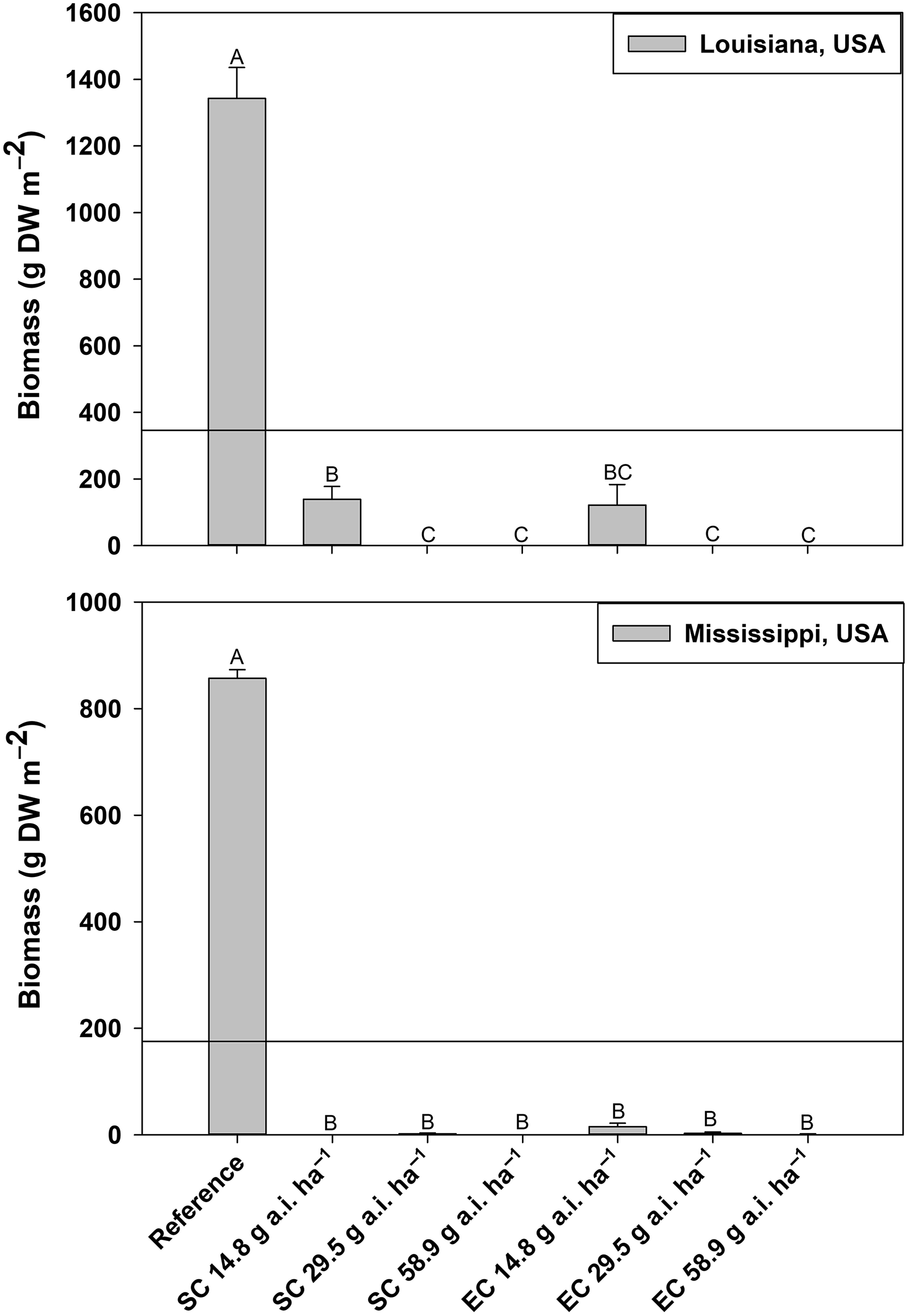
At 5 WAT, florpyrauxifen-benzyl SC and EC at 29.5 and 58.9 g ai ha−1 resulted in 100% reduction of E. crassipes biomass, while florpyrauxifen-benzyl SC and EC at 14.8 g ai ha−1 reduced dry weight biomass 90% and 91%, respectively (Figure 1). At harvest, florpyrauxifen-benzyl 14.8 g ai ha−1 provided less control of E. crassipes than SC and EC at 29.5 and 58.9 g ha−1 but had the same level of control as the EC formulation at 14.8 g ai ha−1; there was no difference among the SC (29.5 and 58.9 g ai ha−1) and all EC treatments.
Mean dry weight (DW) response of Eichhornia crassipes at 5 wk after treatment with foliar applications of suspension concentrate (SC) and emulsifiable concentrate (EC) florpyrauxifen-benzyl in Louisiana (2018) and Mississippi (2020). A modified vegetable oil and surfactant blend was applied at 1% v/v with all SC treatments. Means with the same letter are not different according to a Fisher’s protected LSD (P ≤ 0.05); n = 4. Error bars are 1 standard error of the mean. Horizontal lines represent pretreatment biomass levels.

MSU Trial
Injury progression and symptomology of E. crassipes treated with florpyrauxifen-benzyl under greenhouse conditions at MSU were similar to plants treated outdoors at LSU (data not shown). At 5 WAT, all florpyrauxifen-benzyl treatments controlled E. crassipes when compared with nontreated reference plants (Figure 1). Florpyrauxifen-benzyl SC at 14.8, 29.5, and 58.9 g ai ha−1 reduced E. crassipes biomass by 100%, 99%, and 100%, respectively, at 5 WAT when compared with reference plants. Florpyrauxifen-benzyl EC at 14.8, 29.5, and 58.9 g ai ha−1 reduced E. crassipes biomass by 98%, 99%, and 99% at 5 WAT when compared with reference plants.
These results (LSU and MSU) indicate both florpyrauxifen-benzyl formulations are highly efficacious at reducing E. crassipes biomass, especially at 29.5 and 58.9 g ai ha−1 under outdoor mesocosm and greenhouse conditions. It should be noted that the 29.5 g ai ha−1 rate is the minimum rate allowed by the florpyrauxifen-benzyl labels (Anonymous, 2018a, 2018b). There was no difference in efficacy between formulations at the 29.5 and 58.9 g ai ha−1 use rates. Using the lowest rate evaluated in this research (14.8 g ai ha−1) for operational management of E. crassipes may result in less than satisfactory control based on slower plant injury and recovery within some of the experimental units and is below the labeled rate; therefore, the 29.5 and 58.9 g ai ha−1 rates of both formulations would be suitable for managing this floating species.
Eichhornia crassipes reduction by foliar applications of florpyrauxifen-benzyl is similar to that reported by Joyce and Haller (Reference Joyce and Haller1984) for 2,4-D used at much higher rates of 2.24 to 4.48 kg ai ha−1 (94% to 100% reduction in density and 99% to 100% reduction in weight, respectively) to treat E. crassipes in Lake Dexter, FL. Similarly, Mudge and Netherland (Reference Mudge and Netherland2014) reported 100% control of E. crassipes in mesocosms at 8 WAT when treated with 2,4-D (1.065 and 2.130 kg ai ha−1) and triclopyr (0.841 and 1.682 kg ai ha−1). Although the three auxin herbicides have different use rates and use patterns, their herbicidal activity is similar, and products can likely be used interchangeably when permitted.
For resource managers facing pressure to reduce chemical inputs to aquatic systems infested with E. crassipes, florpyrauxifen-benzyl may provide a solution that reduces herbicidal inputs while simultaneously maintaining control of E. crassipes. Florpyrauxifen-benzyl rates used in this research are similar to those for some of the non-auxinic herbicides known to control E. crassipes (Mudge and Netherland Reference Mudge and Netherland2014; Wersal and Madsen Reference Wersal and Madsen2010). Wersal and Madsen (Reference Wersal and Madsen2010) reported >90% reduction in E. crassipes biomass at 10 WAT when penoxsulam was applied to the foliage at 24.5, 49.1, and 98.2 g ai ha−1. At 8 WAT, Mudge and Netherland (Reference Mudge and Netherland2014) reported 76% to 100% biomass reduction of E. crassipes grown in mesocosms using foliar applications of imazamox (105.1 and 210.2 g ai ha−1) and penoxsulam (43.8 and 87.6 g ai ha−1).
Because the low use rates of florpyrauxifen-benzyl can deliver similar levels of E. crassipes control compared with other auxinic herbicides used at higher rates, resource managers could potentially alleviate stakeholder concerns while not sacrificing E. crassipes management goals. Florpyrauxifen-benzyl is registered throughout the United States, but only one formulation is registered per state (M Shaner, personal communication, 2020). Regardless of product, both formulations will provide control of E. crassipes (Figure 1). Future research should evaluate florpyrauxifen-benzyl formulations alone and in tank mixes against other invasive aquatic plant species to determine suitable control rates. Additionally, native species should be included in future research to determine whether selective control of floating and emergent invasive species can be attained while minimizing collateral damage to native species.
Acknowledgments
This research was partially supported by the Florida Fish and Wildlife Conservation Commission Invasive Plant Management Section, U.S. Army Engineer Research and Development Center Aquatic Plant Control Research Program, and U.S Army Corps of Engineers Jacksonville District. This publication is a contribution of the Mississippi Agricultural and Forestry Experiment Station. Appreciation is extended to Trista Galivan, Bradley Sartain, Nick Firmin, Anna Sibley, Graham Lightsey, Colin McLeod, Olivia Robinson, Garrett Ervin, Chandler Bryant, and Andrew Sample for technical assistance throughout this research. Thanks to SePRO Corporation for providing herbicides and rate recommendations. Citation of trade names does not constitute endorsement or approval of the use of such commercial products over those not mentioned by the U.S. Army Engineer Research and Development Center or Mississippi State University. This document was reviewed in accordance with U.S. Army Engineer Research and Development Center policy and approved for publication. No conflicts of interest have been declared.