


Introduction
Although the urgency of swift and effective climate policy is widely recognized in Finland and across Europe (e.g., Stefkovics et al. Reference Stefkovics, Ágoston, Bukovenszki, Dúll, Hortay and Varga2024), this recognition does not necessarily translate into support for climate policies. This is particularly true for cost-imposing measures such as emissions trading systems (ETS), even though environmental economists widely regard them as among the most cost-efficient climate policy instruments available (Stechemesser et al. Reference Stechemesser, Koch, Mark, Dilger, Klösel, Menicacci, Nachtigall, Pretis, Ritter, Schwarz, Vossel and Wenzel2024). Securing support for such policies becomes especially difficult during periods of societal disruption that strain the economy, dominate public debate, or erode citizens’ sense of security (Ahonen et al. Reference Ahonen, Koivula and Sivonen2024; Sisco et al. Reference Sisco, Constantino, Gao, Tavoni, Cooperman, Bosetti and Weber2023). Understanding how support for climate policy can be strengthened across politically diverse audiences has therefore become a central challenge for climate policy communication.
One potential response to this challenge has been policy framing, which has attracted considerable scholarly attention (e.g., Ahonen et al. Reference Ahonen, Leino and Tiihonen2025; Bernauer and McGrath Reference Bernauer and McGrath2016; Feldman and Hart Reference Feldman and Hart2018; Lockwood Reference Lockwood2011; McCright et al. Reference McCright, Dunlap and Marquart-Pyatt2016; Stokes and Warshaw Reference Stokes and Warshaw2017). Framing refers to emphasizing specific aspects of an issue in ways that shape how people interpret and evaluate policies (Nisbet et al. Reference Nisbet, Hart, Myers and Ellithorpe2013). Policies can be communicated through justifications that seek to increase public acceptance by emphasizing certain rationales, additional benefits, or societal goals associated with a policy measure without concealing its original purpose. For example, justifications for climate policy may stress climate mitigation benefits, the costs of inaction, policy effectiveness, or various co-benefits and alternative benefits unrelated to climate itself (Gainous and Merry Reference Gainous and Merry2021; Lockwood Reference Lockwood2011). Importantly, justificatory framing may also turn societal crises into political opportunities if climate policies are framed as solutions to simultaneously salient concerns such as energy security or economic stability (Bertolotti and Catellani Reference Bertolotti and Catellani2014; Drews and van den Bergh Reference Bernauer and McGrath2016; Rinscheid and Koos Reference Rinscheid and Koos2023).
In this study, we focus on frames that either emphasize the effectiveness of a road traffic ETS in achieving its original climate-related goals or highlight its potential to alleviate other societal problems. We refer to these frames as justifications, as the policy itself is inherently a climate policy and the framing serves to justify, rather than redefine, its purpose.
However, framing effects are often inconsistent or modest in magnitude (Fesenfeld et al. Reference Fesenfeld, Beiser-McGrath, Sun, Wicki and Bernauer2024), partly because people interpret political messages through prior attitudes and identities. Framing research has therefore increasingly examined how political predispositions, particularly through motivated reasoning (Kunda Reference Kunda1990), condition responses to policy justifications. This is especially relevant in the politically divisive context of climate change (Baranowski et al. Reference Baranowski, Huber, Jabkowski and Szulecka2024), including Finland, where left-wing and Green party supporters are generally more supportive of climate policies than the populist radical right (Borg et al. Reference Borg, Kestilä-Kekkonen, Wass, Borg, Kestilä-Kekkonen and Wass2019; Crulli and Zulianello Reference Crulli and Zulianello2025; Hansen and Leino Reference Hansen and Leino2024; Sivonen and Koivula Reference Sivonen and Koivula2024).
At the same time, previous research suggests that framing can sometimes overcome ideological resistance when messages align with audiences’ underlying values. In the UK and US, right-leaning audiences have responded more positively to climate policies framed around energy security than climate mitigation alone (Chen et al. Reference Chen, Benoit, Whitmarsh and Loibl2025; Feldman and Hart Reference Feldman and Hart2018; Gainous and Merry Reference Gainous and Merry2021; Lockwood Reference Lockwood2011). However, similar effects remain relatively understudied in European multi-party systems, where experimental research has primarily focused on policy design and delivery mechanisms (Dharshing et al. Reference Dharshing, Hille and Wüstenhagen2017; Jagers et al. Reference Jagers, Erick, Johan and Simon2021) or on whether messages originate from one’s preferred political party (Slothuus and De Vreese Reference Slothuus and De Vreese2010). Less attention has been paid to justificatory frames that emphasize climate policies’ potential to address other simultaneously salient societal problems. Moreover, many previous survey experiments lack untreated control groups (e.g., Feldman and Hart Reference Feldman and Hart2018; Gromet et al. Reference Gromet, Kunreuther and Larrick2013; Lockwood Reference Lockwood2011). This motivates our first research question: How do different justifications for a climate policy affect acceptability across different political party preferences?
Alongside political ideology and party preference, trust in political institutions, such as politicians, political parties, and the national parliament, may also shape how justificatory frames are received. Political trust has been consistently linked to support for environmental and climate policies (Ahonen et al. Reference Ahonen, Koivula and Sivonen2024; Devine et al. Reference Devine, Stoker and Jennings2024; Fairbrother et al. Reference Fairbrother, Arrhenius, Bykvist and Campbell2021), particularly policies involving uncertainty, costs, and long-term societal benefits (Hetherington Reference Hetherington2005). Political trust may also shape the effectiveness of justificatory messages, as individuals with low trust are often more skeptical toward both the policy itself and its communicators. For example, low institutional trust can strengthen the appeal of populist narratives that challenge climate policy agendas, potentially increasing resistance to arguments that justify policies aimed at addressing complex transnational problems such as climate change (Ivanov Reference Ivanov2023). If political institutions are not perceived as credible, policy justifications may be interpreted as strategic “selling tactics” rather than sincere policy goals, which can reduce the persuasive power of framing and even provoke negative reactions toward the policy itself.
Despite these theoretical connections, the role of political trust in shaping the effectiveness of justification frames remains largely overlooked, especially in the European context (see Fesenfeld et al. Reference Fesenfeld, Beiser-McGrath, Sun, Wicki and Bernauer2024; Koivula et al. Reference Koivula, Marttila and Koiranen2024). To our knowledge, the only closely related study suggests that political trust can increase belief in climate change among climate-skeptical Republicans in the United States, particularly when climate messages are framed in a non-intrusive manner (Saunders Reference Saunders2017). This finding points to the possibility that political trust shapes not only policy preferences but also the reception of climate-related messages. This leads to our second research question: How do alternative justifications for climate policy affect people with varying levels of political trust?
To address these gaps, we collected experimental online survey data from Finland (n = 1,485) in March 2024 to examine how party preference and political trust influence the effectiveness of various justifications for the road transport ETS. This climate policy was selected as it is a price-based instrument expected to reduce CO2 emissions by creating market incentives for low-emission mobility (Baranzini et al. Reference Baranzini, Van den Bergh, Carattini, Howarth, Padilla and Roca2017). The ETS prices transport emissions by requiring fuel suppliers to purchase allowances based on fuel carbon content, with costs passed on to sellers and consumers. However, the policy’s direct costs may hinder public acceptance, as financial burden is a common argument against climate action (Dechezleprêtre et al. Reference Dechezleprêtre, Fabre, Kruse, Planterose, Sanchez Chico and Stantcheva2025; Hess and Renner Reference Hess and Renner2019).
In our experiment, respondents were divided into four groups, three receiving different justifications for the ETS and one serving as an untreated control group. Because the ETS cannot be reframed as something else than climate policy without misleading the public, we focus on framings that emphasize its different benefits, two related to energy independence and economic resilience and one highlighting policy effectiveness. Accordingly, we refer to these as justifications. We used interaction analysis to investigate how the impact of justifications varies based on respondents’ party preference and political trust.
Our study is set in Finland, one year into Russia’s full-scale invasion of Ukraine, a period when fossil phase-out was becoming increasingly linked to national sovereignty and lesser dependence on an aggressive neighbor. Russia’s use of energy as a geopolitical weapon and a means of financing its war had underscored the strategic importance of energy (Labelle Reference LaBelle2024; Sivonen and Kivimaa Reference Sivonen and Kivimaa2024). The support for reducing dependence on Russian fossil fuels had also gained traction among the Finnish public (Tiihonen et al. Reference Tiihonen, Leino, Kulha and Setälä2023), likely influenced by the country’s historical experience of geopolitical vulnerability to Russia. At the same time, however, the COVID-19 pandemic and Russian invasion had had negative economic consequences, including rising inflation. These trends, in turn, had caused widespread concern among the Finnish population, leading to a reduced willingness to compromise economic gains to protect the environment (Metelinen Reference Metelinen2023) and amplifying the narrative that environmental actions should not imperil national economic performance.
This unique context provides an invaluable opportunity to examine how reducing energy dependence on non-EU countries, such as Russia, as a justification for climate policy resonates across politically diverse groups. A second climate policy justification focused on economic resilience in the face of energy crises, a theme familiar to Finnish consumers in recent years as inflation has surged and consumer confidence has dropped to historic lows (Statistics Finland 2025). A third justification highlighted effective emission reduction, the primary goal of climate policy and a key driver of its acceptance (Drews and van den Bergh Reference Drews and Van den Bergh2016). Both economic considerations and perceptions of emission reduction are important drivers of support for price-based climate instruments (Carattini et al. Reference Carattini, Carvalho and Fankhauser2018).
Our analysis shows that the effectiveness of how justifications are framed varies significantly across political groups, depending on individuals’ party preferences, with the frame of energy independence notably resulting in higher policy support among the populist radical right Finns Party supporters. This effect was found to be partly accounted for by political trust. Furthermore, individuals with high political trust were unaffected by justification framings, while those with low trust reported slightly less acceptance when presented with emission reduction or economic resilience justifications. Our study contributes to climate policy communication research by offering causal evidence on how support for cost-increasing climate policies can be strengthened in polarized political contexts. By focusing on party preference and political trust, both underexplored in framing research, we highlight how framing strategies can be tailored to resonate with diverse audiences to enhance climate policy communication and provide evidence of political distrust as a potential factor that can trigger backlash in climate policy communication.
Partisan divides in the acceptance of climate policy measures
An individual’s views on societal and political issues often align with their existing beliefs. Political party preference frequently acts as a powerful filter through which political figures and the policies they advocate are perceived. This pattern has been widely studied within political psychology, which suggests that the evaluation of new information is not a neutral process; rather, it is shaped by an individual’s prior attitudes and identity (Kahan Reference Kahan, Scott and Kosslyn2015; see also Kunda Reference Kunda1990; Taber and Lodge Reference Taber and Lodge2006). Party preference strongly shapes opinions, and information is interpreted to reinforce pre-established group alignment and to distinguish groups from their opponents. In the case of climate change, studies (e.g., Poortinga et al. Reference Poortinga, Whitmarsh, Steg, Böhm and Fisher2019; Remsö et al. Reference Remsö, Schmidt, Geiger, Većkalov, Krajnc, Laughton, Shavgulidze, Renström and Ruggeri2025) have shown that individuals’ views on climate science and policy are influenced by these broader belief systems and political preferences. While findings are not entirely uniform, research suggests that climate attitudes are shaped by both personal commitments to political identity and underlying beliefs about the issue itself (Bayes and Druckman Reference Bayes and Druckman2021).
In Finland, the link between party preferences and climate policy support broadly mirrors international trends but is shaped by the country’s multi-party landscape. Left parties – the Social Democratic Party and the Left Alliance – in addition to the Green League, tend to advocate for more ambitious environmental goals. On the political right, the Centre Party and the National Coalition Party do so to a lesser extent, while the radical right populist Finns Party has even referred to environmental advocacy as “the moral hysteria of climate action” (Arter Reference Arter2020), consistent with its platform framing environmentalism and international climate cooperation as elite-driven threats to sovereignty and the economy (Hansen and Leino Reference Hansen and Leino2024; see also Hultman et al. Reference Hultman, Anna and Tamya2019; Kulin et al. Reference Kulin, Johansson Sevä and Dunlap2021). Since the early 2000s, climate change has become increasingly politicized, with party families adopting divergent environmental positions (Borg et al. Reference Borg, Kestilä-Kekkonen, Wass, Borg, Kestilä-Kekkonen and Wass2019; Vihma et al. Reference Vihma, Reischl and Nonbo Andersen2021; Wass et al. Reference Wass, Kärrylä, Luostari, Isotalo, Kestilä-Kekkonen, Rapeli and Söderlund2024). This polarization became particularly evident after the 2019 parliamentary elections, which revealed sharp partisan divides over climate policy. These political divisions align with the sociocultural dimension of political conflict, universalist and progressive values opposing traditionalist or nationalist ones (Grönlund and Söderlund Reference Grönlund, Söderlund, von Schoultz and Strandberg2024), a cleavage also observed in other Western European democracies (Knutsen Reference Knutsen2018).
At the European level, studies show that voters for populist radical right parties, such as the Finns Party (Lahti and Palonen Reference Lahti and Palonen2023), express significantly less concern about climate change than supporters of other parties (Kulin et al. Reference Kulin, Johansson Sevä and Dunlap2021). This pattern has been observed in Finland as well, where attitudinal polarization on climate and environmental issues is sharpest between supporters of Left-Green parties, especially the Left Alliance and the Greens, and Finns Party supporters, who are the most willing to prioritize economic growth over environmental protection. Supporters of the Social Democratic Party as well as center-right supporters tend to hold more moderate climate policy attitudes (Hansen and Leino Reference Hansen and Leino2024; Sivonen and Koivula Reference Sivonen and Koivula2024).
These attitudinal differences likely shape not only policy preferences but also how people respond to political messages: opponents of climate policy tend to be less receptive to justifications that stress its original purpose but are more accepting when it is framed in ways that align with their political views. Prior research from other countries suggests that conservative and center-right voters, who tend to emphasize economic and national security issues, are more responsive to frames stressing economic pragmatism or national interest, such as energy security (Chen et al. Reference Chen, Benoit, Whitmarsh and Loibl2025; Drews and van den Bergh Reference Drews and Van den Bergh2016; Feldman and Hart Reference Feldman and Hart2018; Gainous and Merry Reference Gainous and Merry2021; Lockwood Reference Lockwood2018). In contrast, left-wing voters are more likely to support climate action when it aligns with the values of environmental protection, intergenerational justice, and global responsibility (Kulin et al. Reference Kulin, Johansson Sevä and Dunlap2021; McCright et al. Reference McCright, Dunlap and Marquart-Pyatt2016).
Building on this, we conducted the survey to investigate whether economic, energy independence, and emissions-related justifications for the ETS affect acceptance differently across party supporters. Our analysis covers supporters of Finland’s six largest parties. Among these, the National Coalition Party (KOK) and the Centre Party (KESK) can be considered center-right parties, the Social Democratic Party (SDP) as a moderate center-left party, the Left Alliance (VAS) and the Greens (VIHR) as left-green parties, and the Finns Party (PS) as a radical right party (Sivonen and Koivula Reference Sivonen and Koivula2024). Drawing on the literature presented above, we formed two hypotheses:
H1: Compared to the control condition, energy independence as a justification results in higher acceptance of the ETS among individuals who support center-right or populist radical right parties.
H2: Compared to the control condition, national economy as a justification results in higher acceptance of the ETS among individuals who support center-right or populist radical right parties.
In contrast, left-green supporters, who see climate change as an urgent moral and environmental issue, were expected to respond more positively to emissions-focused justifications:
H3: Compared to the control condition, emissions reduction as a justification results in higher acceptance of the ETS among individuals who support left-green parties.
Finally, given the Finns Party’s climate skepticism and its supporters’ low concern for climate change, we expected an emissions-based justification, with no explicitly stated co-benefits, to reduce ETS acceptance among them:
H4: Compared to the control condition, emissions reduction as a justification results in lower acceptance of the ETS among individuals who support the populist radical right Finns Party.
Political trust, justification, and climate policy acceptance
The effect of policy justifications on policy acceptance likely depends not only on the content of the justification itself but also on individual predispositions, such as the level of political trust. We propose two intertwined mechanisms through which political trust may shape responses to climate policy justifications. The first relates to the established relationship between political trust and support for environmental policies that impose societal or individual costs. The second concerns the broader role of political trust in shaping receptiveness to political communication and persuasive messages. Together, these mechanisms suggest that the effectiveness of justificatory framing may vary substantially depending on citizens’ trust in political institutions and political actors.
Trust in general can be understood as a relationship between the trustor and the trustee, where the first judges the latter based on whether they see them as performing according to some positive expectation. Political trust specifically captures citizens’ evaluations of the responses of political institutions to a normative expectation (Citrin and Stoker Reference Citrin and Stoker2018). Political trust has been seen as “a necessary precondition for democratic rule” (van der Meer Reference van der Meer2017), social order and cooperation (Lewicki et al. Reference Lewicki, McAllister and Bies1998). At the same time, trust should not result in blind obedience, but rather in making considered judgements that reflect “active democratic citizenship” (Warren and Gastil Reference Warren and Gastil2015, p. 564).
Citizens’ judgements concerning the trustworthiness of public actors and institutions are case-specific; citizens have different expectations for different trustees. For example, citizens’ expectations for their representatives, such as politicians and parties, are different from those they have for civil servants (Warren and Gastil Reference Warren and Gastil2015). Citizens’ trust or distrust in political representatives is expected to develop based on the extent to which they perceive that their own preferences, values, and worldviews are congruent with those of their representatives (Warren and Gastil Reference Warren and Gastil2015) as well as the degree to which citizens identify with these actors (Setälä et al. Reference Setälä, Leino, Christensen and Strandberg2021). This is why trust judgements towards actors and institutions in a representative democracy, such as the parliament, parties, and elected politicians, can be regarded as particularly selective, creating a situation where perceptions and affective identifications strongly shape evaluations. Furthermore, while political trust judgements can be withdrawn when citizens perceive partisan actors to not act according to congruent interests, this kind of trust has been shown to be relatively stable (Devine and Valgarðsson Reference Devine and Valgarðsson2024) and to correlate with other forms of trust, such as social trust, i.e., generalized trust in other people (Keele Reference Keele2007).
The first reason that we can expect political trust to influence how policy justifications shape their acceptance is specific to our case. Based on existing literature, political trust is essential for support of long-term policies, with climate change mitigation serving as a prominent example. Political attitudes and trust are linked in that trust can act as a heuristic: people unknowingly utilize their perceptions regarding trustworthiness of institutional actors when forming opinions about policies these actors propose (Hetherington Reference Hetherington2005). Public rejection of such policies may stem less from short-sightedness than from distrust in representatives (Jacobs and Matthews Reference Jacobs and Matthews2012). This is why enhanced political trust is expected to benefit long-term policy, where the proposed benefits are not enjoyed immediately. Higher trust in political institutions can also increase citizens’ readiness to make sacrifices on behalf of others (Hetherington Reference Hetherington2005), including future generations. While high political trust can foster acceptance in such cases, low trust may fuel indifference, skepticism, or even backlash (Hetherington and Rudolph Reference Hetherington and Rudolph2017). Furthermore, low political trust is linked to greater self-reliance, individualism (Jäckle et al. Reference Jäckle, Trüdinger, Hildebrandt and Wagschal2022), and support for civil disobedience (Wang et al. Reference Wang, Lin, Hsiao, Chang and Weng2022), which in turn can be associated with lower acceptance of coercive policies, regardless of how they are justified.
Political trust is often regarded as a key determinant when assessing support for environmental policies and climate mitigation that entail uncertainty, individual or collective costs, for long-term societal benefits (see Ahonen et al. Reference Ahonen, Koivula and Sivonen2024; Devine et al. Reference Devine, Stoker and Jennings2024; Fairbrother et al. Reference Fairbrother, Arrhenius, Bykvist and Campbell2021; Konisky et al. Reference Konisky, Milyo and Richardson2008; Kulin and Johansson Sevä Reference Kulin and Johansson Sevä2021). Lower trust, on the other hand, has been found to make individuals more prone to prioritizing economic policy over environmental policy (Ahonen et al. Reference Ahonen, Koivula and Sivonen2024). By diminishing perceived economic costs and risks and fostering the view that these sacrifices are justified, political trust encourages greater support for policies that raise personal costs (Davidovic and Harring Reference Davidovic and Harring2020; de Blok and Haugsgjerd Reference de Blok and Haugsgjerd2025; Devine et al. Reference Devine, Stoker and Jennings2024; Jacobs and Matthews Reference Jacobs and Matthews2012).
Based on the above, political trust can be expected to serve as a heuristic for evaluating both policy proposals. As a result, individuals with lower levels of political trust should be less supportive of climate policy irrespective of the specific justification employed. Therefore, we hypothesize that:
H5: Lower political trust is associated with lower climate policy acceptance, regardless of the justification presented.
Political trust can be considered particularly important when assessing the impact of climate policy justifications for at least two reasons: one linked to its association with climate policy acceptance in particular and another related to how political messages are generally perceived. First, if individuals with low political trust do not initially support a given policy measure, doubt its effectiveness, or lack confidence in political institutions’ ability to implement it successfully, they may be motivated to oppose the policy from the outset. Such predispositions may make them less receptive to alternative policy justifications and, consequently, more difficult to persuade through framing efforts. For example, lack of trust towards representatives can be due to perceived corruption and incompetence, which is associated with a dwindling confidence that the government would carry out policies in an effective and timely manner (Davidovic Reference Davidovic2024; Fairbrother et al. Reference Fairbrother, Arrhenius, Bykvist and Campbell2021). Low trust can also strengthen the appeal of populist narratives that challenge climate policy agendas altogether, potentially increasing resistance to arguments that justify policies aimed at addressing complex transnational problems such as climate change (Ivanov Reference Ivanov2023). At the same time, highly trusting individuals may already exhibit very high levels of policy acceptance, leaving limited scope for justificatory frames to further increase support, whereas strongly distrustful individuals may remain resistant regardless of the justification provided.
Second, policy justifications in general can either be endorsed or discarded based on evaluations of trustworthiness of the source. While the extent to which framing effects can be conditional on individuals’ political trust levels remains understudied (see Fesenfeld et al. Reference Fesenfeld, Beiser-McGrath, Sun, Wicki and Bernauer2024; Koivula et al. Reference Koivula, Marttila and Koiranen2024), it is reasonable to assume that, if voters do not perceive political institutions as trustworthy, whether for partisan divisions, affective identifications, or other reasons, their political messages are unlikely to be carefully considered (Setälä et al. Reference Setälä, Leino, Christensen and Strandberg2021). This can result in the public disregarding messages from the authorities altogether. Low-trust individuals may be more inclined to interpret policy justifications as strategic attempts to sell or legitimize a policy rather than as sincere explanations of its objectives (Koivula et al. Reference Koivula, Marttila and Koiranen2024). As a result, justificatory frames may be less persuasive among these individuals and may even generate backlash against the policy itself.
Thus, we should expect to see heterogeneous effects in how justifications work for people with differing levels of political trust. Particularly, those with lower levels of trust can be expected to be less likely to report increased policy support and more likely to report lower policy support than their high-trust counterparts. Because lower trust is associated with both lower support for climate policies and stressing economic gains over environmental ones, justifications stressing purely environmental aspects, such as emission reductions, with no co-benefits, can be particularly susceptible to lack of trust. To maintain analytical parsimony, our final hypothesis focuses on the extent to which policy justifications increase policy support among individuals with varying levels of political trust:
H6: The positive effects of climate policy justifications on policy acceptance are weaker among individuals with lower levels of political trust than among those with higher levels of political trust.
This study
Data
The study was conducted in Finland using a population-based sample from Kansalaismielipide (Citizen Opinion), an online panel that includes over 4,000 respondents. The panel, part of the FIRIPO infrastructure, is maintained by researchers at Åbo Akademi University and the University of Turku. The survey experiment, run in Finnish and Swedish via Qualtrics, was conducted 6–29 March (2024) with 1,722 participants.
To ensure data quality, we excluded 237 respondents who had either completed the survey in under 3 minutes or taken over 60 minutes. Rake weights for gender, age, and education were applied to correct for sampling bias and nonresponse and are used in all analyses to improve population representativeness and address minor imbalances across treatment groups (Supplementary section D). A power analysis (G*Power; Faul et al. Reference Faul, Erdfelder, Buchner and Lang2009) indicated that, with 1,293 valid cases consisting of voters of the six largest parties, small effects (f = 0.10) would be able to be detected with 0.95 power.
Experimental design
In the survey experiment (see Supplementary Figure B.1), participants were randomly assigned to one of three treatment groups (T1–T3) or a control group. All respondents first answered background questions, including factors associated with climate policy support such as political party preference and political trust, before reading a neutral, minimally framed introduction to a policy on road transport emission trading and its core mechanism. The treatment groups then received one of three justifications for phasing out fossil fuels: economic resilience (T1), energy independence (T2), or emission reduction (T3), while the control group received no justification. As the ETS is inherently a climate policy aimed at reducing fossil fuel use, our intention was not to obscure this fact or misrepresent the purpose of the policy. This is why the focus is on the effect of additional justifications. The value of the control group, which included a mention of fossil fuel phase-out, lies in the absence of an explicit justification frame rather than in the absence of policy rationale altogether. The neutral introduction and the three justification texts are provided below (translated from Finnish and Swedish).
Introduction (to all respondents):
Road transport will implement emissions trading from 2027, requiring fuel suppliers to buy emission allowances matching the carbon dioxide content per liter of fossil fuel sold. This sets a price for transportation-related carbon dioxide emissions, which fuel sellers and consumers will shoulder. This action promotes the transportation sector’s transition away from fossil fuels…
Justifications (to T1–T3):
T1 …which mitigates the negative economic impacts of energy crises on Finland.
T2 …which increases Finland’s energy independence from non-EU countries (e.g., Russian fossil fuels).
T3 …which effectively reduces Finland’s carbon dioxide emissions.
We then measured outcome variables in a brief survey, assessing the participants’ acceptance of the road emission trading system, their attitudes toward climate policies, their beliefs about their societal impact, and their willingness to pay, to determine if potential justification effects extended to these attitudes.
Research ethics and preregistration
This research follows the Finnish National Board on Research Integrity guidelines (TENK 2019) for analysis and reporting. The experimental design was submitted to the ethical review board of the University of Turku, which approved the study in accordance with these guidelines (decision number TY/936/06.01.01/2023).
Individuals joining the online panel were informed about their rights under the European General Data Protection Regulation (EGDPR) and the use of their data in scientific research and publications, following national standards during participant recruitment. Participants gave informed consent to take part in the study and could withdraw at any time or ask for modifications or removal of their information. All participants were at least 17 years old.
The experimental procedure, treatments, and all variables were preregistered (Leino et al. Reference Leino, Tiihonen and Ahonen2024). However, the hypotheses presented in this study were not part of the initial preregistration and were later formulated to test the conditional impacts of different justifications.
Variables
Descriptive statistics are provided in Supplementary Section A. The main outcome variable, acceptance of the road transport ETS, was measured on a 0–10 scale in response to “[H]ow acceptable do you consider the policy measure in question?” To measure political party preference, participants were asked, “If the parliamentary elections were held now, which party would you vote for?” The alternatives included all the parties that held seats in the national parliament. In addition, respondents could choose “other party, which one?” or choose not to indicate their party preferences. Our analysis includes support for the six largest parliamentary parties as a determinant, as the support for other parties among our respondents was too low to confidently measure conditional effects.
To measure political trust, participants were asked, “To what extent do you trust the following institutions?” and could answer on a scale from 0 (“do not trust at all”) to 10 (“trust completely”). Trust in “the Finnish parliament,” “political parties,” and “politicians” was combined into a sum variable (Marien Reference Marien2017), with a Cronbach’s alpha of 0.92, indicating excellent consistency.
The six largest parties from the 2023 elections were included, grouping smaller parties under “Other” due to a limited sample size. Although the sample’s party distribution differs from that of election results, internal comparisons of treatment effects across party supporters remain valid. To assess the robustness of the results, we included controls for age (as a continuous variable), gender, education level, and self-perceived income.
Analysis procedure
We regressed ETS acceptance on different justification frames using Stata (v18), exploring interactions with party preference and political trust. The interaction analysis reveals whether a particular justification (e.g., energy independence) had varying effects based on respondents’ party preference or level of political trust. To visualize the predicted ETS acceptability for each justification group, we performed a marginal means analysis, focusing on the six largest political parties and political trust. The visualizations show predicted mean policy acceptability for each treatment at different levels of political trust. Trust levels are defined relative to the sample mean: very low (−2 SD = 0.72), low (−1 SD = 2.86), moderate (5.01), high (+1 SD = 7.15), and very high (+2 SD = 9.29).
Results
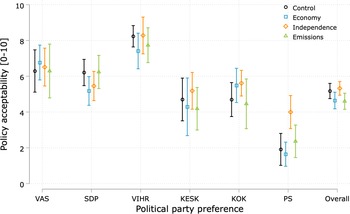
To compare treatment effects, Figure 1 presents regression-based predicted means of ETS acceptability by policy justification, displaying both total treatment differences and variation across political party preferences, while Figure 2 shows corresponding predicted means across levels of political trust. Error bars represent 95% confidence intervals, and non-overlapping intervals with the control group suggest statistically significant justification effects.
Predicted ETS acceptability by justification treatment and political party preference. Model-based predicted means with 95% CIs.

Figure 1. Long description
The figure is a dot-and-error-bar plot showing model-based predicted mean ETS acceptability (0–10 scale) with 95% confidence intervals for four treatment groups (Control, Economy, Energy Independence, and Emissions). Results are shown separately for supporters of VAS, SDP, VIHR, KESK, KOK, and PS, with overall treatment effects displayed on the far right. Acceptability is highest among VIHR supporters and generally higher among VAS and SDP supporters than among KESK, KOK, and PS supporters. Overall treatment differences are small. Across party groups, the estimates for the four treatments largely overlap, indicating limited justification effects. The only clear separation is among PS supporters, where the Energy Independence treatment has higher predicted acceptability than the Control group, while other treatments show little difference.
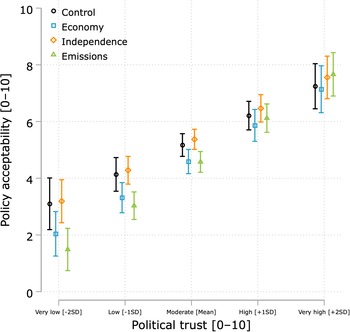
Predicted ETS acceptability by justification treatment and political trust levels. Model-based predicted means with 95% CIs.
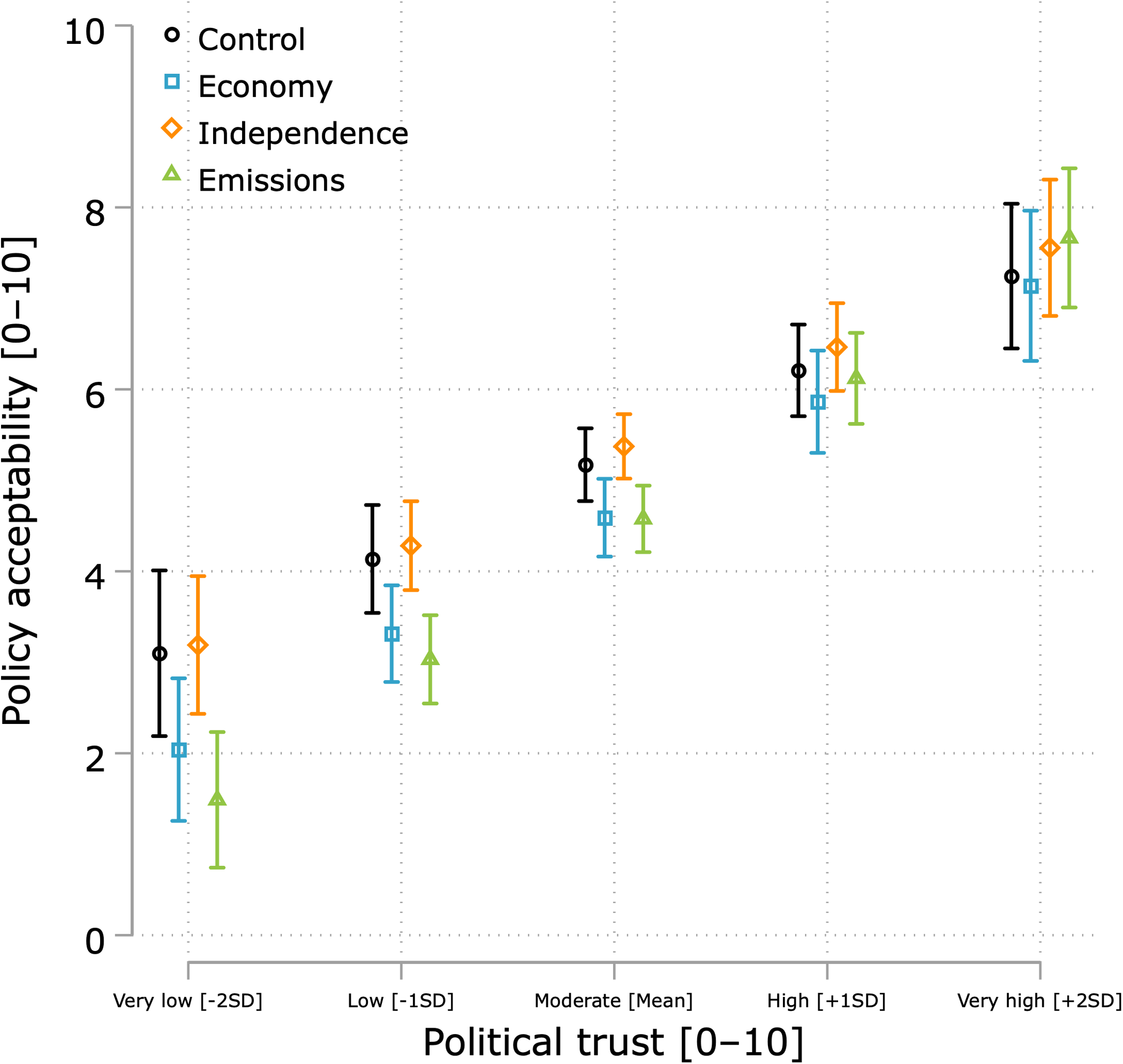
Figure 2. Long description
The figure is a dot-and-error-bar plot showing model-based predicted mean ETS acceptability (0–10 scale) with 95% confidence intervals for four treatment groups (Control, Economy, Energy Independence, and Emissions). Results are presented across five levels of political trust, from very low to very high. Predicted acceptability increases steadily with political trust regardless of treatment. At higher trust levels, the four treatment estimates largely overlap, indicating little difference between policy justifications. Among respondents with low political trust, the Economy and especially the Emissions treatments show lower predicted acceptability than the Control group, whereas the Energy Independence treatment remains close to the Control group. The separation between the Emissions and Control groups is most evident at low trust levels, while treatment differences diminish as political trust increases.
In Figure 1, the right-hand side “Overall” estimates are based on a separate model with only the treatment included, capturing the treatments’ total effects on the whole sample (Supplementary Table C.1, Model 1). These indicate weak treatment effects: policy acceptability is slightly lower in the emissions and economy groups and slightly higher in the energy independence group compared to the control group. However, none of these differences are statistically significant.
The remaining estimates in Figure 1 (by party category) are derived from a model in which the treatment effect is conditional on party preference, implemented through an interaction between treatment and party preference. The average marginal effects are presented in Supplementary Table C.2. Respondents preferring the left-leaning parties (SDP, VAS) and especially the Greens (VIHR) generally found the ETS more acceptable than those favoring right-leaning parties (KESK, KOK, PS). However, our focus is on whether the effects of justifications, rather than the level of acceptability, differ by party preference. The figure shows limited and inconsistent justification effects by party preference. Partially in line with H1, the “energy independence” justification raised ETS acceptance among right-wing populist Finns Party (PS) supporters statistically significantly compared to the control group (see Supplementary Table C.2). Contrary to H2, H3, and H4, the other justifications did not influence ETS acceptability among any of the supporter groups. Yet, small subgroup sizes may limit statistical power for detecting other party-specific treatment effects (see Supplementary material, Figure D.4), and conclusions should be drawn with caution.
A robustness check indicates that the positive effect of the energy independence treatment on acceptability among Finns Party supporters becomes statistically insignificant after controlling for political trust (Supplementary Figure D.1). This suggests that the positive effect of the justification on policy acceptance among PS supporters appears to be at least partly explained by differences in political trust.
Figure 2 displays the predicted means of ETS acceptability by justifications across political trust levels. The regression model is presented in Supplementary material (Table C.1, Model 3). Respondents with low political trust generally considered ETS less acceptable than those with high trust, supporting H5. The figure shows little evidence of treatment effects among high- and very high-trust respondents. Across trust levels, the energy independence treatment yields slightly higher policy acceptability than the control group, but the difference is small and non-significant. In contrast, among low-trust respondents, both the emissions and economy treatment groups report lower policy acceptance than the control group, although only the interaction involving the emissions treatment reaches statistical significance. Specifically, the two treatments reduce policy acceptability among low-trust respondents, while these negative effects are substantially weaker or absent among respondents with higher levels of political trust. These findings lend partial support to H6. Again, controlling for party preference weakens the conditional effect of political trust (Supplementary Figure D.2), indicating that the two are closely intertwined.
We note that differences between treatment conditions may exist and be substantively interesting. However, we focus on treatment-versus-control comparisons, as our hypotheses concern whether specific justifications increase support relative to a baseline condition. The differences between treatment conditions were not part of our pre-specified theoretical expectations and would require additional multiple-comparison adjustments.
Discussion and conclusions
This study explored how the effects of different justification framings for a road traffic ETS can vary based on audience characteristics, using an experimental survey design with Finnish respondents. Given mixed prior findings and a lack of control groups in many earlier studies (Fesenfeld et al. Reference Fesenfeld, Beiser-McGrath, Sun, Wicki and Bernauer2024), we sought to better identify which policy justifications resonate with which groups and for whom they are irrelevant. We focused on two key characteristics, party preference and level of political trust, that have received relatively limited attention, particularly in the context of European multi-party systems. To our knowledge, this is the first study to examine whether political trust moderates the effects of alternative policy justifications on support for climate policies. (Fesenfeld et al. Reference Fesenfeld, Beiser-McGrath, Sun, Wicki and Bernauer2024; Koivula et al. Reference Koivula, Marttila and Koiranen2024). The results add to the climate policy communication literature by demonstrating that framing effects depend not only on political preferences but also on levels of political trust. This underscores the need to understand audience segments and suggests that trust-building may be key in persuading some voters, namely supporters of the radical right.
While more extensive persuasion might have produced larger effects, we intentionally kept the treatment simple to isolate the justification effect and minimize cognitive burden that could otherwise reduce attention. Apart from restricting the sample to respondents who did not spend unusually little or long time responding, the study did not include explicit attention checks, leaving open the possibility that inattentiveness contributed to weaker treatment effects. Furthermore, conclusions regarding certain party-specific effects should be drawn with caution, as small subgroup sizes may limit the statistical power to detect treatment effects.
The central takeaway from this study is that framing effects were limited on average but highly conditional on audience characteristics. Simple policy justifications had only limited effects on climate policy acceptance when examining the full sample, consistent with previous research showing that framing often has modest influence on highly politicized issues shaped by strong prior attitudes and identities (Bernauer and McGrath Reference Bernauer and McGrath2016; Fesenfeld et al. Reference Fesenfeld, Beiser-McGrath, Sun, Wicki and Bernauer2024). This may partly reflect our deliberately simple framing strategy, particularly given that the road traffic ETS is explicitly a climate policy measure. In such a context, brief references to potential co-benefits may have been insufficient to substantially alter respondents’ evaluations, which could help explain the largely null effects observed across many of the framing conditions.
However, these modest aggregate effects masked important heterogeneity across audience segments. Of the first four hypotheses examining the role of party preference in shaping justification effects, only H1 received partial support: the energy independence justification, despite the minimal nature of the intervention, produced a clear increase in ETS acceptance among populist radical right Finns Party supporters, partly aligning with results from previous studies conducted in the UK (Chen et al. Reference Chen, Benoit, Whitmarsh and Loibl2025; Lockwood Reference Lockwood2011) and the US (Feldman and Hart Reference Feldman and Hart2018; Gainous and Merry Reference Gainous and Merry2021). This finding suggests that certain justifications can resonate strongly with specific groups, particularly when they align with values, concerns, and themes that are already salient to them. Taken together, the results indicate that framing is unlikely to substantially shift public support for climate policy across the population as a whole, but it can meaningfully influence acceptance among particular audience segments.
Prior research in Europe suggests that right-leaning voters are more likely to see energy security and the energy transition as conflicting rather than complementary (Stadelmann-Steffen et al. Reference Stadelmann-Steffen, Eder and Liem2026). For these groups, highlighting the additional benefits of energy independence may shift attention away from goals perceived as more idealistic, such as environmental protection and global cooperation, toward more pragmatic, national interest-based objectives, including national resilience, sovereignty, control, and security (see Drews and van den Bergh 2016; Feldman and Hart Reference Feldman and Hart2018; Gainous and Merry Reference Gainous and Merry2021; Gromet et al. Reference Gromet, Kunreuther and Larrick2013; Lockwood Reference Lockwood2018; Stokes and Warshaw Reference Stokes and Warshaw2017). Emphasizing themes such as national self-interest, sovereignty, and resistance to external influence aligns with the broader rhetoric of populist radical right parties in Europe, which may help explain why right-wing populist supporters were the most responsive to this justification. The strong positive response to the energy independence justification among right-wing populist supporters may indicate that it resonates with values salient to this group, thereby reducing the identity threat associated with climate policy (see also Saunders Reference Saunders2017).
The lack of treatment effects among left-wing supporters plausibly reflects their already positive attitudes toward climate policies. The effectiveness of policy justifications also likely diminishes among respondents with well-established prior attitudes, as found in prior studies (Chen et al. Reference Chen, Benoit, Whitmarsh and Loibl2025; Singh and Swanson Reference Singh and Swanson2017; Wolsko et al. Reference Wolsko, Ariceaga and Seiden2016). Justifications often fail to appeal to those with strong opinions on the policy (Ahonen et al. Reference Ahonen, Leino and Tiihonen2025; Bernauer and McGrath Reference Bernauer and McGrath2016; Nisbet et al. Reference Nisbet, Hart, Myers and Ellithorpe2013). A US study similarly found that left-wing voters were less responsive to framing, suggesting they focus more on policy content and engage more deeply with justifications due to their stronger concern about climate change (Feldman and Hart Reference Feldman and Hart2018). Also, this pattern may partly reflect a ceiling effect, where a respondent group scores near the maximum value of an outcome measure, leaving little room for a treatment or intervention to produce further increases.
There are also likely contextual differences in how the trade-off between the energy transition and energy security is perceived. Although tensions between energy security and climate goals in Finland may resemble those observed in other European countries, the country’s close proximity to and relationship with Russia may heighten perceptions of external threat linked to energy imports, making energy independence considerations especially salient and less likely to backlash as a policy justification. Because of historical tensions that have sometimes culminated in war, the Finnish public has traditionally held reserved attitudes towards Russia, which have intensified since the Russian invasion of Ukraine. Reliance on Russia for fossil imports became a national security issue, influencing public debate on energy policies (Sivonen and Kivimaa Reference Sivonen and Kivimaa2024). While the Russian invasion of Ukraine has sparked mixed reactions in other parts of Europe, in Finland, support for Ukrainian aid and Russian sanctions has remained strong, even among the populist radical right. Furthermore, unlike its many continental counterparts, the Finns Party has not traditionally held a strong pro-Russian camp among its members or supporters (Lahti and Palonen Reference Lahti and Palonen2023). Therefore, supporting reduced reliance on Russian energy imports does not conflict with their established party line.
Regarding political trust, which was strongly associated with ETS acceptance, as predicted by H5 (de Blok and Haugsgjerd Reference de Blok and Haugsgjerd2025; Devine et al. Reference Devine, Stoker and Jennings2024; Fairbrother et al. Reference Fairbrother, Sevä and Kulin2025; Jacobs and Matthews Reference Jacobs and Matthews2012), the modest backlash effects in the full sample were largely driven by low- and moderate-trust respondents, among whom the emissions and economic justifications reduced policy acceptance. High-trust respondents showed little response to the treatments, offering partial support for H6. Among the tested frames, the energy independence justification appeared to be the least risky, as it did not generate meaningful backlash in any respondent group.
Why did justification frames not affect high-trust individuals, while low trust led to backlash for two justifications? High trust was linked to high acceptance, likely reflecting stable, generally pro-climate attitudes among high-trust individuals. This resembles a similar ceiling effect that was potentially observed among left-wing voters also. Individuals with low levels of political trust, on the other hand, may be less receptive to environmental policy justifications because they question either the effectiveness of the policy itself or the ability of political institutions to implement it successfully (Jacobs and Matthews Reference Jacobs and Matthews2012). They may also be more skeptical of persuasive political communication in general (Setälä et al. Reference Setälä, Leino, Christensen and Strandberg2021). As a result, policy justifications may be viewed as manipulative or self-serving rather than informative, potentially reinforcing skepticism toward both government institutions and climate action (Druckman and McGrath Reference Druckman and McGrath2019; Koivula et al. Reference Koivula, Marttila and Koiranen2024).
Future research should examine more closely the framing strategies through which distrusters could be more effectively addressed. Based on our findings, this requires explicit consideration of political orientation, as it is closely associated with political trust, support for climate policy, and the appeal of different types of justifications. According to trust-as-heuristic theory, political trust should matter the most for individuals who perceive climate policies as threatening to their existing beliefs or social and political identities (Rudolph and Evans Reference Rudolph and Evans2005). We found that justification effects on policy acceptance among populist radical right supporters were partly explained by differences in political trust. Future research could examine how political trust conditions the impact of policy justifications across party supporters. Addressing this complexity would require a three-way interaction that goes beyond the scope of our research design.
Our research design focused on a specific policy action and is partially limited to a particular context. We examined the effects of the selected treatments on one price-based climate policy instrument. While the findings may extend to other price-based climate policies aimed at phasing out fossil fuels, such generalization remains speculative, as different policy instruments may elicit substantially different responses depending on factors such as their perceived coerciveness and distributional impacts (Schuitema et al. Reference Schuitema, Steg and Rothengatter2010). This may partly explain the weak justification effects. As noted, strong prior attitudes reduce such effects, and a price-based instrument like the ETS may itself evoke strong opinions. Further research assessing multiple instruments is therefore needed. Studies could examine how supporters of different parties respond similarly when different types of climate policies, such as fossil fuel taxes, renewable energy subsidies, or bans on inefficient household appliances, are justified using different rationales, and whether these responses are conditioned by political trust.
Also, the timing of data collection in March 2024 is likely to have impacted the results, as Russia’s invasion of Ukraine and the energy question were widely prominent issues. Our findings offer insight into how salient themes like national energy dependence, resonating with broad audiences, may increase climate policy acceptability more strongly than emphasizing the policy’s primary purpose. The energy independence justification showed the highest overall acceptability in the full sample, though not statistically significant, and did not reduce acceptability across political trust levels or among party supporters. This suggests that it is also the least risky option among the three justifications. Interestingly, while skepticism toward price-based climate instruments like the ETS often stems from economic concerns, the Russia-related justification resonated more than the one focused on economic resilience.
Overall, our findings suggest that simple framing alone is unlikely to substantially increase climate policy support across the broader population in polarized contexts. Instead, its effectiveness depends on how well justifications resonate with individuals’ political identities and levels of trust. Identifying distinct audience segments and the arguments that resonate with each of them, as well as those that do not, is key to crafting balanced communications that convey the urgency of climate action and generate broad-based support. At the same time, it is important to avoid overly segmenting communication across groups, as this may lead to fragmentation, undermine dialogue as well as hinder the development of a cohesive culture and shared understandings (Wolsko et al. Reference Wolsko, Ariceaga and Seiden2016).
Supplementary material
The supplementary material for this article can be found at https://doi.org/10.1017/S0143814X2610124X.
Data availability statement
Replication materials are available in the Journal of Public Policy Dataverse at https://doi.org/10.7910/DVN/FG3CCK (Ahonen Reference Ahonen2026). The simplified replication dataset is under embargo until 31 December 2026 while the data are being deposited and published by the Finnish Social Science Data Archive (FSD). During the embargo period, the replication materials are not publicly accessible. They will become openly available through the Dataverse repository once the embargo expires. The full dataset generated and analyzed during this study will be made available through the Finnish Social Science Data Archive (FSD) (https://www.fsd.tuni.fi/en/).
Acknowledgements
The authors thank their colleagues at the University of Turku and Tampere University for their valuable feedback and proofreading.
Funding statement
This research was supported by the Research Council of Finland (decision number 341373) and Strategic Research Council within the Research Council of Finland (decision number 358428).
Competing interests
The authors declare that they have no known competing financial interests or personal relationships that could have appeared to influence the work reported in this paper.
Use of artificial intelligence
The authors used ChatGPT (GPT-5.2, OpenAI) for editorial assistance, including language editing and stylistic refinement. The authors remain fully responsible for the content, interpretation, and conclusions presented in the article.


 Open access

