INTRODUCTION
Predators are crucial elements of ecosystems for maintaining and shaping the structure of communities by regulating the prey population and maintaining the biodiversity of ecosystems (Glasser Reference GLASSER1979). Several hypotheses have been proposed to explain food resource partitioning among predators as a part of their co-existence in a particular ecosystem such as prey behaviour, predator behaviour, size of prey, health of prey and habitat condition (Johnsingh 1993, Karanth & Sunquist Reference KARANTH and SUNQUIST1995, Rabinowitz Reference RABINOWITZ1989, Seidensticker Reference SEIDENSTICKER1976). According to Hunter (Reference HUNTER2011) ‘Syntopic generalist species make interesting competitors because the species typically share many resources and are extremely adaptable, allowing the competitors to partition resources in a variety of ways to coexist’.
The feeding ecology of large carnivores has been studied using different methods such as observation in the field, stomach content analysis, identifying kills and analysis of scat. The identification of food remains found in scats is the most common method for analysing carnivore food habits, particularly where other types of observation are impossible, or where time does not permit detailed observations (Johnsingh Reference JOHNSINGH1992, Karanth & Sunquist Reference KARANTH and SUNQUIST1995, Majumder Reference MAJUMDER2011). Although analysis of scat is a widely accepted method to understand carnivore diet, it only provides percentage use of prey at species level and does not provide insight into how these predators partition resources when principal prey remains the same for all of them. Therefore study of kills made by predators should also be utilized as a complementary technique (Majumder Reference MAJUMDER2011).
We studied the predation by three large sympatric carnivores, tiger (Panthera tigris tigris, Linnaeus), leopard (Panthera pardus, Linnaeus) and dhole (Cuon alpinus, Pallas) on chital (Axis axis, Erxleben), sambar (Rusa unicolor, Kerr), nilgai (Boselaphus tragocamelus, Pallas), gaur (Bos gaurus, Smith) and wild pig (Sus scrofa, Linnaeus) in a tropical deciduous forest of Central India. The study area, Pench Tiger Reserve (PTR), Madhya Pradesh, harbours high densities of ungulate prey and here large carnivores depend largely on wild prey rather than domestic livestock (Acharya Reference ACHARYA2007, Biswas & Sankar Reference BISWAS and SANKAR2002).
As suggested by Schoener (Reference SCHOENER1974), in our study we addressed issues of the niche complementarity hypothesis on large carnivores. Of the three main dimensions under this hypothesis, spatial, temporal and prey choice, we observed temporal and spatial segregation of three predators with varying degree but having high diet overlap (Majumder et al. Reference MAJUMDER, BASU, SANKAR, QURESHI, JHALA and GOPAL2012, Reference MAJUMDER, SANKAR and QURESHI2013). If sympatric predators partitioned their prey resources to coexist with each other then the following predictions that cover various seasonal responses should hold. We would expect when similar types of prey resources are available in a small natural reserve, the sympatric predators will consume different (1) age–sex of prey species; large-sized prey species will be consumed more by comparatively large-sized predators and (2) health condition of prey species; prey species in good health will be consumed more by comparatively large-sized predators.
STUDY AREA
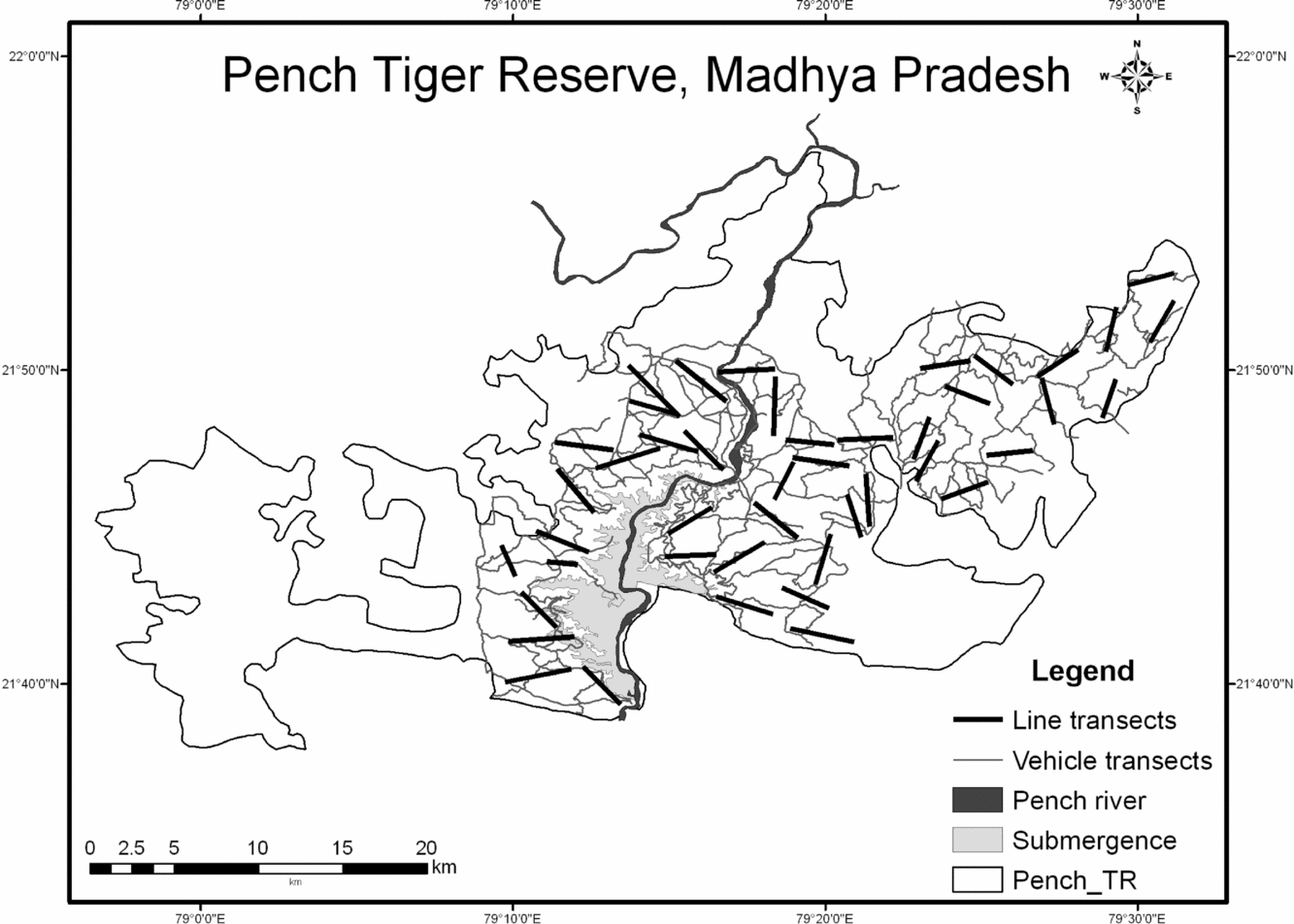
The 758 km2 of PTR, Madhya Pradesh (Figure 1) comprises Pench National Park (PNP) (292 km2), Pench Wildlife Sanctuary (PWS) (118 km2) and Reserved Forest (348 km2). PNP and PWS (410 km2) both constitute the Intensive Study Area (ISA). Vegetation in the area is broadly classified into tropical dry deciduous and tropical moist deciduous forests (Champion & Seth Reference CHAMPION and SETH1968). The draw-down area coming under the submergence of Totladoh (on Pench river) reservoir is 11.7 km2 and covers 1.55% of PTR, Madhya Pradesh (Sankar et al. Reference SANKAR, QURESHI, PASHA and AREENDRAN2001). The terrain is undulating (350–650 m asl) and the mean annual rainfall is 1400 mm. PTR experiences a marked seasonal climate with a cold season (October–February), hot season (March–June) and monsoon or rainy season (July–September) (Biswas & Sankar Reference BISWAS and SANKAR2002). Temperature ranged from 2°C in the cold season to 49.5°C in the hot season during the study period. Apart from tiger, leopard and dhole other carnivore species in PTR are golden jackal (Canis aureus, Linnaeus) and jungle cat (Felis chaus, Schreber). Wolf and Indian fox (Vulpes bengalensis, Shaw) occur on the fringes of the study area. Wild ungulates found other than the five study species are barking deer (Muntiacus muntjac, Rafinesque) and chowsingha (Tetraceros quadricornis, Blainville). Primate species found are common langur (Semnopithecus entellus, Dufresne) and Rhesus macaque (Macaca mulatta, Zimmermann). The Indian porcupine (Hystrix indica, Kerr), black-naped hare (Lepus nigricollis, F. Cuvier), flying fox (Pteropus giganteus, Brunnich), flying squirrel (Petaurista petaurista, Brandt), three-striped squirrel (Funambulus palmarum, Linnaeus) and Indian pangolin (Manis crassicaudata, Gray) are also present in the reserve (Biswas & Sankar Reference BISWAS and SANKAR2002). No human habitation is found inside the ISA, however, domestic livestock such as buffalo (Bubalis bubalis, Linnaeus) and cattle (Bos indicus, Bojanus) graze along the boundaries of the ISA (Sankar et al. Reference SANKAR, QURESHI, PASHA and AREENDRAN2001).
Line transects (n = 44) and vehicle transects (n = 10) laid for sampling of ungulates in Pench Tiger Reserve, Madhya Pradesh, India.

METHODS
Population structure and age–sex ratios of ungulate species
The present study was carried out between January 2007 and June 2010. Line transects (Buckland et al. Reference BUCKLAND, ANDERSON, BURNHAM and LAAKE1993, Burnham et al. Reference BURNHAM, ANDERSON and LAAKE1980, Jhala et al. Reference JHALA, QURESHI and GOPAL2005) and vehicle transects (Hirst Reference HIRST1969, Varman & Sukumar Reference VARMAN and SUKUMAR1995) were used to collect data on the population structure of wild ungulates.
Forty-four line transects varying in length from 2 to 4 km (Figure 1), were walked during the cold season (total effort = 1016 km) and hot season (total effort = 1168 km) for all 4 y. Ten vehicle transect routes (Figure 1) ranging from 2.7 to 13.6 km were monitored in each season (hot season and cold season) from 2007 to 2009 with a total effort of 176.8 km during the cold season and 214.5 km in the hot season. Student's t-test (Zar Reference ZAR1984) showed significant difference (P < 0.05) on sighting distance of prey species between the two seasons but not between same seasons of different years and hence we pooled 4 y and 3 y of cold-season and hot-season data for line and vehicle transects respectively. On each sighting of the target species along line and vehicle transects, data on population structure were recorded.
Age classification of chital, sambar and nilgai followed that of Sankar (Reference SANKAR1994) and Schaller (Reference SCHALLER1967). Classification of age and sex of gaur followed Ahrestani & Prins (Reference AHRESTANI and PRINS2011) and Ramesh (Reference RAMESH2010). Wild pig was classified according to Chauhan (Reference CHAUHAN, Sankar and Goyal2004). Prey was categorized into small (5–30 kg), medium (31–175 kg) and large (176–1000 kg) following Karanth & Sunquist (Reference KARANTH and SUNQUIST1992) and Sankar & Johnsingh (Reference SANKAR and JOHNSINGH2002).
Data on population structure of prey species was estimated for cold and hot seasons in terms of their percentage occurrence as suggested by Johnsingh (Reference JOHNSINGH1983), Karanth & Sunquist (Reference KARANTH and SUNQUIST1995) and Schaller (Reference SCHALLER1967). Percentage of male and young ratio to available female population was calculated from group composition data of the target species for both seasons.
Predation (kills) of wild ungulates by large carnivores
Kills made by three carnivores were recorded opportunistically in the study area for both cold and hot seasons. Only fresh kills were recorded. Prime indicators of the presence of kills were the presence of predators in the vicinity, the calls of the jungle crow (Corvus macrorhynchos) and hovering or descending vultures (Gyps spp.). The location of the kills was usually identified by sighting of carnivores or scavengers, by the odour of the decomposing carcass and, occasionally, by the signs of dragging of the carcass by the predator. For identification of predators, both direct (intensive search method using camp elephant and foot patrolling) and indirect evidence (pugmarks, canine mark on neck of prey species and scrape marks) were used (Johnsingh Reference JOHNSINGH1992). For each kill, prey species, age and sex were recorded. Since prey distribution and abundance varies seasonally, diet and prey selection of sympatric carnivores were compared between seasons.
The age–sex class distribution of each major prey species in kill data was compared with the available corresponding population structure recorded from line and vehicle transects, to determine whether carnivores selected a particular age–sex class category of prey species, using Ivlev's selectivity index (PI) (Acharya Reference ACHARYA2007, Ivlev Reference IVLEV1961). The utilized proportion of each age–sex class was obtained from kill data while the proportion available was obtained from prey species population structure from line and vehicle transects. To evaluate any bias in kill detection, we compared our study with scats during the same period. Fresh scats of tiger, leopard and dhole were collected wherever encountered in the intensive study area during cold and hot seasons (Majumder et al. Reference MAJUMDER, BASU, SANKAR, QURESHI, JHALA and GOPAL2012).
Seasonal variation in mean prey body mass consumed by all three predators was evaluated by two-sample t-test with mean and standard error (Zar Reference ZAR1984) using the program NCSS (www.ncss.com ). Wilcoxon paired test (Zar Reference ZAR1984) was applied (SPSS ver 17, SPSS Inc.) to study seasonal differences in predation and also to compare prey remains between kills and scats.
Health condition of kills (ungulate prey species)
In addition to kill data, bone marrow condition from the femur bone of prey species was recorded to ascertain their health condition. Femur marrow fat of prey species was examined for health condition and categorized as good, medium or poor (Riney Reference RINEY1982, Sinclair Reference SINCLAIR1977). The G-test (Zar Reference ZAR1984) was used to compare choice of prey species with different health conditions by three large carnivores.
RESULTS
The detailed population structure and age–sex ratios of all ungulate prey species is given in Tables 1 and 2.
Proportions of different age and sex classes (AM = adult male, YM = yearling male, AF = adult female, YF = yearling female, YG = young) among five ungulate species in Pench Tiger Reserve, Madhya Pradesh (January 2007–June 2010).

Seasonal variation in age-sex ratios (AF = adult female, AM = adult male, Y = young) among five ungulate species in Pench Tiger Reserve, Madhya Pradesh (January 2007–June 2010).

Predation
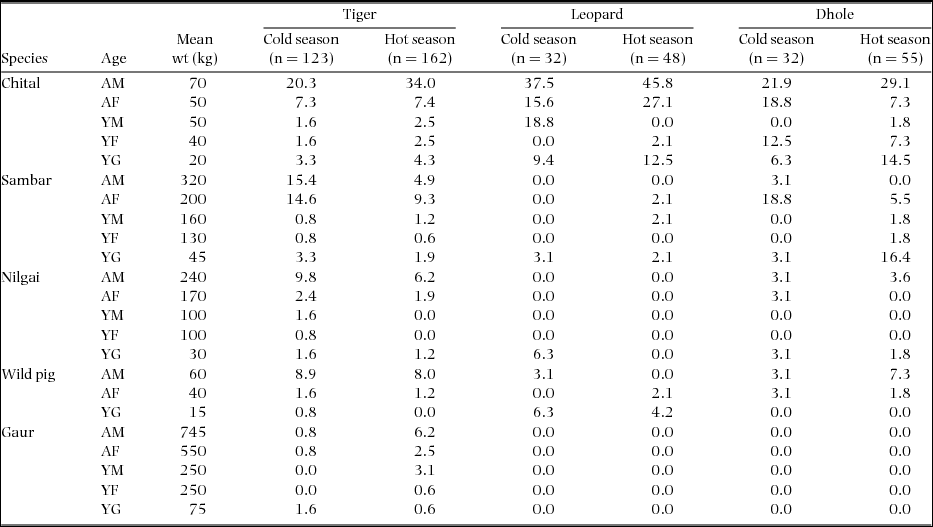
We recorded in total 285 tiger kills, 80 leopard kills and 87 dhole kills (Table 3). Detection of kills during the cold season was reduced as compared with the hot season in the case of all three carnivores because of thick vegetation cover and less detection of scavenging activities by crows, vultures and mammalian scavengers in this season. No significant seasonal differences were observed on overall species preyed by tiger (Z = −0.365, P = 0.7), leopard (Z = −0.435, P = 0.6) and dhole (Z = −0.142, P = 0.8). Percentage frequency of occurrence for age–sex of each prey species preyed on by tiger, leopard and dhole is shown in Table 3.
Predation of five ungulate species by tiger, leopard and dhole, as shown by kill (%) data in Pench Tiger Reserve, Madhya Pradesh (January 2007–June 2010) (AM = adult male, YM = yearling male, AF = adult female, YF = yearling female, YG = young). Data on mean weight are from Acharya (Reference ACHARYA2007) and Prater (Reference PRATER1980).
In total 469 tiger scats were collected during the cold season and 157 during the hot season, 107 leopard scats in the cold season and 82 in the hot season and 199 dhole scats in the cold season and 139 in the hot season. The scat analysis revealed the presence of 10 prey species in the cold-season and seven prey species in the hot-season diet of tigers, eight prey species both in the cold-season and the hot-season diet of leopard and nine prey species in the cold-season diet and seven prey species in the hot-season diet of dhole. Of the prey species found in tiger scats chital constituted major prey in terms of number (52.8% in the cold season and 62.7% in the hot season) followed by sambar (31.7% in the cold season and 18.6% in the hot season), common langur (5.7% in the cold season and 9.3% in the hot season), wild pig (6.2% in the cold season and 3.1% in the hot season), nilgai (0.4% in the cold season and 3.1% in the hot season), domestic cattle (0.2% in the cold season and 2.5% in the hot season), rodents (1.6% only in the cold season), gaur (0.6% in the cold season), hare (0.2% in the cold season), unknown birds (0.4% in the hot season) and porcupine (0.6 % in the hot season). In leopard scats chital contributed as major prey (55.5% in the cold season and 42.7% in the hot season) followed by common langur (16.4% in the cold season and 29.2% in the hot season), sambar (9.1% in the cold season and 6.7% in the hot season), wild pig (8.2% in the cold season and 8.9% in the hot season), hare (3.6% in the cold season and 4.5% in the hot season), nilgai (2.7% in the cold season and 1.1% in the hot season), rodents (3.6% in the cold season and 2.3% in the hot season), unidentified birds (0.9% in the cold season and 2.3% in the hot season) and cattle (2.3% in the hot season). In dhole scats chital contributed the maximum (57.4% in the cold season and 61.5% in the hot season) followed by sambar (20.6% in the cold season and 17.5% in the hot season), common langur (8.6% in the cold season and 8.4% in the hot season), hare (7.2% in the cold season and 2.8% in the hot season), wild pig (2.4% in the cold season and 3.5% in the hot season), rodents (1.4% in the cold season and 2.1% in the hot season) birds (1.4% in the cold season and 1.4% in the hot season), nilgai (2.1% in the hot season), cattle (0.7% in the hot season), porcupine and reptiles (0.5% both in the cold). No attempt was made to identify the species of rodents, birds and reptiles in the scats of tiger, leopard and dhole (Majumder et al. Reference MAJUMDER, BASU, SANKAR, QURESHI, JHALA and GOPAL2012).
There was no significant difference observed in proportion of prey in scats and kill in the case of tiger (Z = −0.674, P = 0.5 in the cold season and Z = −0.677, P = 0.5 in the hot season), leopard (Z = −0.730, P = 0.4 in the cold season and Z = −0.365, P = 0.7 in the hot season) and dhole (Z = −1.83, P = 0.07 in the cold season and Z = −1.46, P = 0.1 in the hot season).
There was no significant seasonal variation observed in the case of mean prey body mass consumed by tiger (P = 0.58), leopard (P = 0.17) and dhole (P = 0.08).
Prey selection by large carnivores
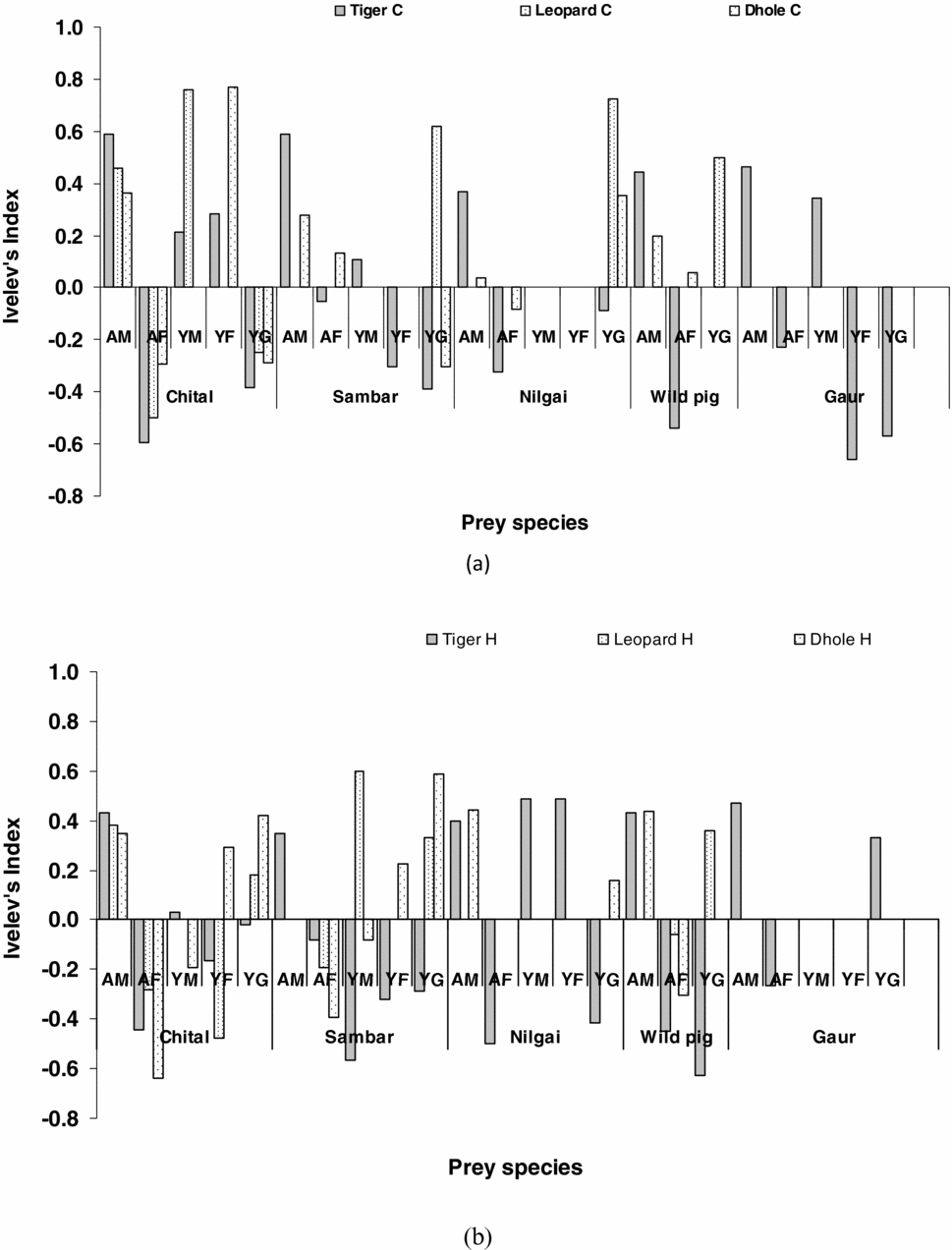
It was observed that during the hot and the cold seasons, adult male chital were preferred by all three carnivores as compared with their availability (Figure 2). The index of prey selection in different age classes by tiger, leopard and dhole for the hot and the cold season is shown in Figure 2.
Prey selection (Ivlev's Index) of tiger, leopard and dhole as shown by kill data in Pench Tiger Reserve, Madhya Pradesh in the cold season (C) (January–March, between 2007 and 2010) (a) and the hot season (H) (April–June, between 2007 and 2010) (b). AM = adult male, YM = yearling male, AF = adult female, YF = yearling female, YG = young.
Health condition of kills
In total, 109 tiger, 59 leopard and 50 dhole kills were evaluated to study the health condition of individuals preyed on by large carnivores. Of the 109 tiger kills, 42% comprised prey species in good health, 26.1% in medium health and 31.7% in poor health. Of the 59 leopard kills, 30.3% comprised prey species in good health, 24.2% in medium health and 53.1% in poor health. Of the 50 dhole kills, 29.2% comprised prey species in good health, 10.1% in medium health and 60.8% in poor health.
A significant difference was observed (G (adj) = 20.9, df = 4, P = 0.0003) while comparing overall health condition of different prey species predated by these three large carnivores. A significant difference (χ2 = 37.0, df = 4, P < 0.05) was also observed while comparing prey species with good health condition between tiger and leopard.
DISCUSSION
Population structure and prey choice
Studies of vigilance have shown age–sex class to be an important factor influencing anti-predatory scan behaviour (Childress & Lung Reference CHILDRESS and LUNG2003). Chital sex ratio (female:male) in the study area was female-biased and similar findings were reported by other studies (Dinerstein Reference DINERSTEIN1980, Graf & Nichols Reference GRAF and NICHOLS1966, Johnsingh Reference JOHNSINGH1983, Karanth & Sunquist Reference KARANTH and SUNQUIST1992, Khan et al. Reference KHAN, CHELLAM, RODGERS and JOHNSINGH1996). Selective predation on chital males by all three carnivores may be the reason for the female-biased population structure and sex ratios in chital. Sartaj et al. (Reference SARTAJ, GHUMAN, SANKAR and JHALA2010) reported that chital was more common in open areas in the same study site; the observed low fawn ratio in chital in the present study may be attributed to predation by dhole and golden jackal as reported by Majumder et al. Reference MAJUMDER, SANKAR, QURESHI and BASU(2011a) and Sankar & Acharya (Reference SANKAR, ACHARYA, Sankar and Goyal2004). Our finding is also in accordance with other studies that young ones are the most vulnerable members of the herd and are selectively targeted by predators (Curio Reference CURIO1976, Ramesh Reference RAMESH2010, Smith et al. Reference SMITH, MURPHY and GUERNSEY1999).
During this study, among the total tiger kills recorded, predation was male-biased in sambar, chital and gaur. The observed low male ratio in sambar might be due to selective predation by tiger on male sambar. Leopard preyed on both the sex classes of adult chital whereas dhole largely preyed on yearlings and young ones of chital. Similar findings were reported in other studies (Johnsingh Reference JOHNSINGH1983, Karanth & Sunquist Reference KARANTH and SUNQUIST1992). In South Asian ungulates, solitary habits, proneness to injuries from intraspecific aggression and dispersal behaviour have been considered as some of the factors that make males more vulnerable to selective predation (Johnsingh Reference JOHNSINGH1983, Karanth & Sunquist Reference KARANTH and SUNQUIST1992, Schaller Reference SCHALLER1967). This male-biased predation may also be attributed to the presence of large antlers in deer that may hamper their navigation through thick bush and solitary habits during the rut (Johnsingh Reference JOHNSINGH1983, Ramesh Reference RAMESH2010). The solitary behaviour of males increases their individual probability of encountering predators and keeps them away from group vigilance which makes them more vulnerable to predation (Childress & Lung Reference CHILDRESS and LUNG2003). Wild pig being an aggressive prey can retaliate viciously when attacked by predators but the piglets are vulnerable to predation. Adult wild pig was preyed on by tiger on two occasions and piglets were killed by leopard and dhole on three occasions during the study period. Karanth (Reference KARANTH1993) also observed male-biased predation on wild pig by tiger. The influence of predation on young and old animals and animals in poor condition is important in population dynamics of prey species (O’Gara & Harris Reference O’GARA and HARRIS1988).
Usually tiger and leopard drag their kill into dense cover while foraging and protect it from scavenging animals (Karanth Reference KARANTH1993, Ramesh Reference RAMESH2010). In a few incidents, the kill of leopard was observed at the top of a tree in open areas and also in dense semi-evergreen forest in Pench which is similar to the findings of Seidensticker (Reference SEIDENSTICKER1976) in Chitwan.
With regard to prey choices by all three predators, no difference was observed between scats and kills, but food resource partitioning was observed on the basis of body size, age and sex of kills.
Health condition of kills
Among the species predated in the study area, 40% of kills in tiger diet comprised individuals in good health whereas more than 60% kills in both leopard and dhole diet comprised individuals in poor health. Karanth & Sunquist (Reference KARANTH and SUNQUIST1995) reported that 13–23% of the kills in Nagarahole were in poor health and the rest of them in good/medium health. Ramesh (Reference RAMESH2010) reported that more than 95% of kills of tiger, leopard and dhole in Mudumalai Tiger Reserve were in good health. Although both tiger and leopard are stealthy predators (Seidensticker Reference SEIDENSTICKER1976), tiger is larger in size and probably killed more prey in good health than did leopard. Comparatively large-sized prey species in poor health killed by dhole in the present study is in accordance with the findings of Atwood et al. (Reference ATWOOD, GESE and KUNKEL2007) that group hunting by coursing predators can facilitate capture of large-sized prey, particularly when prey experience direct effects of poor physical condition.
Food resource partition among large sympatric carnivores
In many areas of the Indian subcontinent (Karanth & Sunquist Reference KARANTH and SUNQUIST1995, Ramesh Reference RAMESH2010, Seidensticker Reference SEIDENSTICKER1976), tiger, leopard and dhole inhabit similar areas, but they are usually separated ecologically by prey selection and sometimes by their temporal activity cycles (leopard being nocturnal, tiger crepuscular and dhole diurnal) (Majumder et al. Reference MAJUMDER, BASU, SANKAR, QURESHI, JHALA and GOPAL2012).
Many studies have also found that sympatric carnivores are able to coexist by selecting different habitats (Majumder et al. Reference MAJUMDER, SANKAR and QURESHI2013, Schaller & Crawshaw Reference SCHALLER and CRAWSHAW1980, Seidensticker Reference SEIDENSTICKER1976).
Although the kill data underestimated small-prey occurrence, our study is concerned with ungulates which constitute more than 90% of prey biomass of all three predators (Majumder Reference MAJUMDER2011). According to Radloff & Du Toit (Reference RADLOFF and DU TOIT2004), prey size range is entirely dependent on mean prey size, which increases significantly with predator body mass. This confirms the findings of both Cohen et al. (Reference COHEN, PIMM, YODZIS and SALDAÑA1993) and Gittleman (Reference GITTLEMAN1985) that increased predator size is associated with increased variation in prey size.
The analysis of kills confirmed that tiger predated mainly large and medium-sized ungulate prey, but both leopard and dhole mainly killed medium-sized ungulate prey. Although all three predators selectively preyed on both chital and sambar, tiger consumed more adult age classes of these cervids, whereas both leopard and dhole consumed more yearlings and young age classes. In addition, tiger utilized a negligible amount of small-sized prey while leopard consumed small-sized prey in high proportion (Table 4). The large size predator (such as leopard) achieved the highest prey/predator body mass ratios. Pack-hunting dholes, for example, were able to kill prey that was disproportionately large for the size of dhole (Table 4). By taking median pack size of dhole in PTR i.e. 12 (Majumder et al. Reference MAJUMDER, QURESHI, SANKAR, BASU and JHALA2011b), the overall prey and dhole body mass ratio was 0.33:1. A similar finding was reported by Radloff & Du Toit (Reference RADLOFF and DU TOIT2004) in the case of the African wild dog in Mala Mala Private Game Reserve of South Africa. Husseman et al. (Reference HUSSEMAN, MURRAY, POWER, MACK, WENGER and QUIGLEY2003) also reported that group hunting behaviour clearly fails to represent absolute energy gain for group- or pack-living animals. Our findings support the prediction of both Griffiths (Reference GRIFFITHS1975) and Karanth & Sunquist (Reference KARANTH and SUNQUIST1995) that vertebrate predators would be selective energy maximizers in prey-rich habitats. The findings were therefore related to the foraging theory (Scheel Reference SCHEEL1993), which suggests that all three predators selected species containing the most profitable prey by the ratio of energy gain (Table 4). Food resource partitioning among sympatric large carnivores as per their body weight may also influence their co-existence in tropical deciduous forest.
Descriptive statistics for the mean body mass data (kg) of prey killed by each predator type, as determined from their kill records in Pench Tiger Reserve, Madhya Pradesh (January 2007–June 2010) (n = number of kill records).

Conservation implications
The study on dietary patterns of tiger, leopard and dhole based on both kill (Karanth & Sunquist Reference KARANTH and SUNQUIST1995, present study) and scats (Andheria et al. Reference ANDHERIA, KARANTH and KUMAR2007, Johnsingh Reference JOHNSINGH1983, Karanth & Sunquist Reference KARANTH and SUNQUIST1995, Majumder et al. Reference MAJUMDER, BASU, SANKAR, QURESHI, JHALA and GOPAL2012, Ramesh Reference RAMESH2010, Wang & MacDonald Reference WANG and MACDONALD2009) revealed that chital and sambar, the two cervid species, contributed the most to their diet in the Indian subcontinent. Conservation of these two cervid species is therefore crucial for long-term sustenance and growth of large carnivore populations in this tropical deciduous forest.
Although the intensive study area is relatively undisturbed and no poaching of wild ungulates was recorded during the present study, there is continuous biotic pressure from 99 villages located around the notified buffer zone of PTR, Madhya Pradesh (Qureshi et al. Reference QURESHI, GOPAL, KYATHAM, BASU, MITRA and JHALA2006). Hunting of wild ungulates for ceremonial and commercial purposes is one of the major threats in the surrounding areas of ISA. The locals are predominantly tribes (62%) belonging to Gond and Baiga communities and depend on animal meat as a supplementary dietary protein (Sankar et al. Reference SANKAR, QURESHI, PASHA and AREENDRAN2001). As large-carnivore densities are dependent on their available prey densities (Karanth et al. Reference KARANTH, NICHOLS, KUMAR, LINK and HINES2004), protection is needed for the population and habitat of wild ungulates to conserve large carnivores in Pench and its surrounding areas.
ACKNOWLEDGEMENTS
We thank Madhya Pradesh Forest Department, National Tiger Conservation Authority (NTCA), all officials and staff of Pench Tiger Reserve, Madhya Pradesh, Director and Dean of Wildlife Institute of India (WII) for their support in various ways. Our field assistants are also acknowledged for helping us in the field data collection.