INTRODUCTION
An increasing variety of scientific investigations require a large number of radiocarbon analyses to address their underlying research questions, as exemplified by recent studies assessing the degree of time-averaging in natural or anthropological shelly accumulations (Kowalewski et al. Reference Kowalewski, Casebolt, Hua, Whitacre, Kaufman and Kosnik2018; New et al. Reference New, Yanes, Cameron, Miller, Teixeira and Kaufman2019; Parker et al. Reference Parker, Yanes, Hernández, Hernández Marreno, Paris and Surge2019; Albano et al. Reference Albano, Hua, Kaufman, Tomašových, Zuschin and Agiadi2020). These types of studies are generally constrained by their analytical budget rather than by the number of samples suitable for analysis, whereas some are limited by the size of the targeted specimens. This is true for a variety of sample types, including those based on biogenic carbonate. The standard graphite accelerator mass spectrometry radiocarbon (AMS 14C) technique requires 8–10 mg of carbonate, which excludes dating individual small bivalve shells, for example. In response to this growing need, a direct carbonate AMS 14C sputter method was developed by Longworth et al. (Reference Longworth, Robinson, Roberts, Beaupre, Burke and Jenkins2013) that allows submilligram samples of carbonate powder to be analyzed quickly and efficiently. Several publications have highlighted the utility of direct carbonate 14C dating where it has been used on its own or in combination with amino acid racemization to determine time-averaging in taphonomic studies (Dominguez et al. Reference Dominguez, Kosnik, Allen, Hua, Jacob, Kaufman and Whitacre2016; Kosnik et al. Reference Kosnik, Hua, Kaufman, Kowalewski and Whitacre2017; Ritter et al. Reference Ritter, Erthal, Kosnik, Coimbra and Kaufman2017; Parker et al. Reference Parker, Yanes, Hernández, Hernández Marreno, Paris and Surge2019; Albano et al. Reference Albano, Hua, Kaufman, Tomašových, Zuschin and Agiadi2020) or coupled with standard precision 14C and uranium/thorium dating to determine coral age distributions (Grothe et al. Reference Grothe, Cobb, Bush, Cheng, Santos, Southon, Edwards, Deocampo and Sayani2016).
The direct carbonate AMS 14C technique uses a cesium sputter source and a metal powder as a binder without the need to convert the carbonate sample to graphite but yields beam currents about an order of magnitude lower than the standard graphite method (Bush et al. Reference Bush, Santos, Xu, Southon, Thiagarajan, Hines and Adkins2013; Hua et al. Reference Hua, Lavchenko and Kosnik2019) which leads to the lower precision. Longworth et al. (Reference Longworth, Robinson, Roberts, Beaupre, Burke and Jenkins2013) analyzed several materials with percent Modern Carbon (pMC) between 0.25 and 94.21. Using titanium powder, the direct carbonate method produced 1σ errors that ranged from 0.07 and 0.94 pMC, whereas 1σ errors on the same materials ranged from 0.08 and 0.87 pMC using graphite. Bush et al. (Reference Bush, Santos, Xu, Southon, Thiagarajan, Hines and Adkins2013) analyzed numerous coral samples containing 0.10 to 89.06 pMC. Using iron powder, the direct carbonate method produced 1σ errors that ranged from 0.31 and 0.62 pMC, whereas 1σ errors on the same materials ranged from 0.03 and 0.11 pMC using graphite. Subsequent study by Hua et al. (Reference Hua, Lavchenko and Kosnik2019) further established the utility of the direct carbonate technique, testing iron (Fe), niobium (Nb), and silver (Ag) powders before concluding that Nb powder was superior because it produced the highest beam current and lowest background.
Several studies have compared small numbers of paired direct carbonate and graphite 14C results, showing that the two methods are comparable (Bush et al. Reference Bush, Santos, Xu, Southon, Thiagarajan, Hines and Adkins2013; Longworth et al. Reference Longworth, Robinson, Roberts, Beaupre, Burke and Jenkins2013; Kosnik et al. Reference Kosnik, Hua, Kaufman, Kowalewski and Whitacre2017; Kowalewski et al. Reference Kowalewski, Casebolt, Hua, Whitacre, Kaufman and Kosnik2018; Hua et al. Reference Hua, Lavchenko and Kosnik2019; New et al. Reference New, Yanes, Cameron, Miller, Teixeira and Kaufman2019; Albano et al. Reference Albano, Hua, Kaufman, Tomašových, Zuschin and Agiadi2020). In this paper, we have compiled a comprehensive dataset (n = 153) of published and unpublished direct carbonate and graphite 14C determinations from biogenic carbonates belonging to several taxonomic groups (mollusks, corals, echinoderms, brachiopods) to further quantify any bias in the results based on the direct carbonate method.
MATERIALS AND METHODS
The carbonates featured in this study are all biogenic, as opposed to inorganically precipitated carbonate (e.g., limestone, speleothems). Samples comprise primarily aragonitic valves from the clams Arctica islandica (Linnaeus Reference Linnaeus1767), Chamelea gallina (Linnaeus Reference Linnaeus1758), Codakia orbicularis (Linnaeus Reference Linnaeus1758), Corbula gibba (Olivi Reference Olivi1792), Dosinia caerulea (Reeve Reference Reeve and Reeve1850), Mactra isabelleana (d’Orbigny Reference d’Orbigny1846), Mulinia edulis (King Reference King1832), Tawera spissa (Deshayes 1835), Tucetona pectinata (Gmelin Reference Gmelin1791), from open nomenclature species of the clams Timoclea and Transennella, from shells of the terrestrial snails Actinella nitidiuscula (Sowerby Reference Sowerby1824) and Polygyra septemvolva (Say Reference Say1818), and from skeletal material of unidentified corals. As for the calcite polymorph, samples include valves from the brachiopod Gryphus vitreus (Born Reference Born1778) and plates from the sand dollars Peronella peronii (Agassiz Reference Agassiz1841) and Leodia sexiesperforata (Leske Reference Leske1778). Several samples are shells that contain a mixture of aragonite and calcite polymorphs. These are the gastropods (limpets) Fissurella maxima (Sowerby Reference Sowerby and Sowerby1834) and Patella candei (d’Orbigny Reference d’Orbigny1840), the mussel Choromytilus chorus (Molina Reference Molina1782), the cockle Fulvia tenuicostata (Lamarck Reference Lamarck1819), the scallop Argopecten purpuratus (Lamarck Reference Lamarck1819), and an open nomenclature species of the mussel Modiolus. References pertaining to the mineralogical composition of the biogenic material used in this study are provided in the Supplemental Information.
Ninety-three paired carbonate samples were processed at Northern Arizona University’s (NAU) Amino Acid Geochronology Lab (AAGL) and NAU’s Center for Ecosystem Science and Society (Ecoss) between 2015 and 2019. Most of the samples processed at NAU have been previously published (Kosnik et al. Reference Kosnik, Hua, Kaufman, Kowalewski and Whitacre2017; Oakley et al. Reference Oakley, Kaufman, Gardner, Fisher and VanderLeest2017; Ritter et al. Reference Ritter, Erthal, Kosnik, Coimbra and Kaufman2017; Kowalewski et al. Reference Kowalewski, Casebolt, Hua, Whitacre, Kaufman and Kosnik2018; Albano et al. Reference Albano, Hua, Kaufman, Tomašových, Zuschin and Agiadi2020) and are detailed in the Supplemental Information.
Sample preparation at NAU followed protocols modified from Bush et al. (Reference Bush, Santos, Xu, Southon, Thiagarajan, Hines and Adkins2013). Blanks, standards, and unknowns were sonicated in deionized distilled water (DDI water; 16.7 Mohm*cm), rinsed three times with DDI water, leached ~30% of their mass using 2N ACS grade hydrochloric acid to remove surface contaminants, and then finally rinsed three times with DDI to before being dried in a 50°C oven overnight. Samples for direct carbonate 14C analysis were ground to a fine powder using an agate mortar and pestle and manually mixed with 6.0–7.0 mg of metal powder in pre-baked (3 hr at 500°C) Kimble borosilicate glass culture tubes (6 mm OD × 50 mm). Samples processed at NAU before June 2018 were mixed with Fe powder (Alfa Aesar, -325 mesh, reduced, 98%) whereas samples processed after June 2018 were mixed with Nb powder (Alfa Aesar Puratronic, -325 mesh, 99.99%), following a change from Fe to Nb powders at the Keck Carbon Cycle AMS facility at the University of California, Irvine (UCI) in 2018. Powdered carbonate sample masses ranged between 0.30 and 0.50 mg, which equates to 36–60 µg of carbon, respectively. The culture tubes were flushed with N2 gas to reduce contamination from atmospheric carbon and capped with Supelco plastic column caps (1/4″ OD) until the carbonate-metal powder mixture was pressed into targets.
Samples processed at NAU for standard graphite AMS 14C analysis were graphitized at NAU’s Ecoss lab following UCI protocols (sites.uci.edu/keckams/protocols). An aliquot of 7–8 mg of carbonate was placed in 13 × 75 mm BD Vacutainer plastic collection tubes (No. 366704). Ambient atmosphere was removed via vacuum before a small-bore needle was used to dispense 8 mL of ACS grade 85% phosphoric acid into each tube. The tubes were placed in a heating block at 70°C until the effervescence stopped. The evolved gas was removed via vacuum. Water vapor was removed by passing the gas through a mixture of liquid nitrogen and ethanol at approximately –80°C. Carbon dioxide was condensed to a solid using a liquid nitrogen bath and the remaining gasses were drawn off. The purified CO2 was converted to graphite by reaction with Fe powder (Alfa Aesar, -325 mesh, reduced, 98%) in a hydrogen reducing environment at 550°C for 3 hr (Vogel et al. Reference Vogel, Southon, Nelson and Brown1984).
The carbonate-metal or graphite-metal mixtures were pressed into pre-drilled (4.1-mm depth) aluminum targets at 400 psi, rotated 90°, and pressed again at 400 psi. Direct carbonate targets were pressed within 72 hr of powdering the first sample to minimize adsorption of CO2. The IAEA C1 blank and IAEA C2 standard were pressed on the same day they were powdered. Limited testing reveals that powdered IAEA C1 and 14C-dead mollusk shell blanks can be kept under N2 for several days without adsorbing measurable amounts of CO2 (see Results and Discussion). Targets were sent to UCI for AMS 14C analysis (Southon and Santos Reference Southon and Santos2007).
We compiled 60 additional paired determinations generated at UCI or the Australian Nuclear Science and Technology Organisation (ANSTO) from Bush et al. (2011), New et al. (Reference New, Yanes, Cameron, Miller, Teixeira and Kaufman2019), Parker et al. (Reference Parker, Yanes, Hernández, Hernández Marreno, Paris and Surge2019), and Hua et al. (Reference Hua, Lavchenko and Kosnik2019). The respective publications provide the lab procedures and methods used for the additional paired determinations. Coauthors contributed all unpublished ages and previously unreported supporting information from UCI and ANSTO.
14C concentrations are given as pMC standard following the conventions of Stuvier and Polach (Reference Stuvier and Polach1977). Sample preparation backgrounds (procedural blanks) have been subtracted based on measurements of 14C-free calcite (IAEA C1 marble blank) using an isotope mixing calculation (Donahue et al. Reference Donahue, Linick and Jull1990). Procedural blanks for direct carbonate and standard graphite 14C determinations use powdered or graphitized IAEA C1, respectively. All graphite 14C determinations have been corrected for isotopic fractionation according to conventions of Stuvier and Polach (Reference Stuvier and Polach1977) with δ13C values measured on prepared graphite using the AMS spectrometer. These can differ from the δ13C values of the original material and are not provided.
Differences were calculated as “direct carbonate – graphite pMC,” with errors calculated in quadrature. The bivariate relationship between direct carbonate and graphite pMC values was evaluated using a reduced major axis regression (RMA) analysis. Unlike the classic ordinary least squares regressions (OLS), the RMA—also known as standardized major axis, geometric mean regression, or model II regression—minimizes the residual variation across both axes, not only the Y-axis, and hence accounts for measurement error in both axes (Quinn and Keough Reference Quinn and Keough2002; Smith Reference Smith2009). The RMA regression avoids assumptions about the cause-and-effect between direct carbonate and graphite pMC values (Smith Reference Smith2009). The PAST 4.03 statistical program (Hammer et al. Reference Hammer, Harper and Ryan2001) was used for the RMA with 95% bootstrapped confidence intervals [N = 1999].
RESULTS AND DISCUSSION
Blank (IAEA C1) and Holocene Standard (IAEA C2) Performance
Graphite 14C analysis of NAU’s marble blank (IAEA C1) yields 0.44 ± 0.25 pMC (n = 8). Direct carbonate 14C analysis of NAU’s C1 blank yields 2.10 ± 0.33 pMC (n = 21) using Fe and 1.49 ± 0.66 pMC (n = 115) using Nb powder. Our direct carbonate blank results are similar to Hua et al. (Reference Hua, Lavchenko and Kosnik2019) who demonstrated that Nb powder yields lower blanks than either Fe or Ag powders. The source of the direct carbonate 14C contamination in the NAU blank is unclear but likely stems from a variety of sources including, but not limited to, contamination during processing, carbon contamination in both the metal powders and the C1 powder itself, and uptake from atmospheric sources (Longworth et al. Reference Longworth, Robinson, Roberts, Beaupre, Burke and Jenkins2013). It is well known that powdered carbonate adsorbs atmospheric CO2 over several years (Gagnon and Jones Reference Gagnon and Jones1993) but it also rapidly adsorbs CO2 after being baked at 500°C to oxidize indigenous and adsorbed carbon (Bush et al. Reference Bush, Santos, Xu, Southon, Thiagarajan, Hines and Adkins2013). A preliminary test conducted at NAU reveals that C1 powder mixed with Nb and stored in capped glass ampules under N2 and then pressed immediately, pressed after four days, and pressed after nine days yields similar pMC (2.5 ± 0.4 (n = 2); 2.3 ± 0.3 (n = 4); 2.1 ± 0.2 (n = 2), respectively). A subsequent test used a 14C-dead Rangia lecontei (Conrad Reference Conrad1853) shell from the Early and Middle Pleistocene Brawley Formation (Kirby et al. Reference Kirby, Janecke, Dorsey, Housen, Langenheim, McDougall and Steely2007). Targets pressed immediately after powdering and pressed after four and nine days storage under N2 yielded similar pMC (1.7 ± 0.1 (n = 4); 1.6 ± 0.1 (n = 4); 1.8 ± 0.1 (n = 4), respectively). The small difference in pMC between the C1 blank and the R. lecontei blank is within the range of analytical variability of our C1 blank, thus, we contend that the marble and Rangia shell powders do not behave differently during processing. As standard practice, all direct carbonate 14C blanks processed at NAU are pressed into targets on the same day they are powdered. Neither the marble nor the Rangia blanks suggest that adsorption of atmospheric CO2 during processing is a significant source of contamination, unless it occurs almost instantaneously upon powdering. The metal powder itself is probably a larger source of carbon contamination (Bush et al. Reference Bush, Santos, Xu, Southon, Thiagarajan, Hines and Adkins2013; Hua et al. Reference Hua, Lavchenko and Kosnik2019) than is adsorption of atmospheric CO2.
Graphite 14C analysis of NAU’s Holocene carbonate standard (IAEA C2) yields 40.52 ± 0.74 pMC (n = 7). The C2 standard is consistent with the consensus value within 1σ error (41.14 ± 0.03 pMC; Rozanski et al. Reference Rozanski, Stichler, Gofiantini, Scott, Beukens, Kromer and van der Plicht1992). Direct carbonate 14C analysis of NAU’s C2 standard yields 41.30 ± 0.53 pMC (n = 25) using Fe powder and 40.70 ± 0.60 pMC (n = 117) using Nb powder. Both values are consistent with the consensus value within 1σ error (41.14 ± 0.03 pMC; Rozanski et al. Reference Rozanski, Stichler, Gofiantini, Scott, Beukens, Kromer and van der Plicht1992). Thus, there is evidence for extraneous young carbon contamination for the C1 and R. lecontei blanks (see previous section), but not for the C2 standard. Recently, Hua et al. (Reference Hua, Lavchenko and Kosnik2019) demonstrated that the pMC of carbon contamination at ANSTO is similar to the C2 standard pMC. Thus, extraneous carbon contamination would be detectible in the C1 blank, but not in the C2 standard.
Key Differences between Direct Carbonate and Graphite 14C Determination for Biominerals
Standard graphite 14C processing involves dissolving biominerals in phosphoric acid followed by converting the resultant CO2 to graphite. Negatively charged carbon ions are produced by sputtering a mixture of graphite and iron powder with cesium ions and then extracting the negatively charged carbon ions using an electric potential (Middleton Reference Middleton1983; Longworth et al. Reference Longworth, Robinson, Roberts, Beaupre, Burke and Jenkins2013). The direct carbonate 14C method bypasses the graphitization process and uses cesium ions and an electrical potential to extract negatively charged carbon ions from powdered carbonate mixed with a metal powder.
The presence/absence of the acid dissolution step is a key difference between two methods and might have interesting implications regarding the sources of carbon measured by the two methods. Various studies suggest that mollusk shells (and other biominerals) contain a few tenths of a percent up to 5% by mass organic material, or “conchiolin” (Fremy Reference Fremy1855), which is an integral structural component within the biomineral (Galstoff Reference Galstoff1964; Keith et al. Reference Keith, Stockwell, Ball, Remillard, Kaplan, Thannhauser and Sherwood1993; Cuif et al. Reference Cuif, Dauphin, Berthet and Jegoudez2004; Zhang and Zhang Reference Zhang and Zhang2006; Hadden et al. Reference Hadden, Loftis, Cherinsky, Ritchison, Lulewicz and Thompson2019). It is unlikely that the phosphoric acid dissolution of a biomineral during standard graphite 14C processing oxidizes organic carbon to gaseous CO2. Converting the residual acid insoluble organics to CO2 requires the use of a strong oxidizer like sodium persulfate (e.g., Mills and Quinn Reference Mills and Quinn1979; Hadden et al. Reference Hadden, Loftis, Cherinsky, Ritchison, Lulewicz and Thompson2019) or additional purification and combustion (e.g., Hadden et al. Reference Hadden, Loftis and Cherkinsky2018). However, we are aware that the Cs sputtering of carbonate powder could liberate negative carbon ions from a shell’s organic fraction. Non-graphitized organic material, such as charcoal and charred organics, do produce weak negative carbon currents when sputtered in the presence of a metal powder (e.g., Hedges et al. Reference Hedges, Wand and White1980; Bonani et al. Reference Bonani, Balzer, Hofmann, Morenzoni, Nessi, Suter and Wölfli1984; Keller et al. Reference Keller, Günter and Erne1984). Thus, we suspect that conchiolin-bound carbon could be an additional source of carbon present in direct carbonate 14C measurements. Previous studies have shown that paired shell and conchiolin 14C ages (or 14C activities) are similar (e.g., Berger et al. Reference Berger, Fergusson and Libby1965; Burliegh Reference Burleigh1983; Haynes and Mead Reference Haynes and Mead1987; Hadden et al. Reference Hadden, Loftis, Cherinsky, Ritchison, Lulewicz and Thompson2019). In some environments, however, organisms may preferentially incorporate significant amounts of 14C-dead carbon in their conchiolin that is not present in their soft tissues or shell carbonate (Masters and Bada Reference Masters and Bada1977; Hadden et al. Reference Hadden, Loftis and Cherkinsky2018). We cautiously assume that small amounts of conchiolin in the biominerals featured in this study do not significantly influence the direct carbonate pMC values, but the topic deserves additional study.
Direct Carbonate versus Graphite pMC Determinations
We compiled pMC values from 153 individual carbonate specimens analyzed using both the direct carbonate and graphite 14C techniques. Seventy-eight and 75 direct carbonate targets used Fe and Nb powder, respectively (Supplemental Information). Bush et al. (Reference Bush, Santos, Xu, Southon, Thiagarajan, Hines and Adkins2013) concluded that the direct carbonate 14C technique is less reliable for their oldest coral samples (> 30 ka BP), thus, their samples yielding ≤ 1.3 pMC using graphite are excluded in this comparison. One sample of Mactra isabelleana powder yielded strongly dissimilar graphite (78.5 pMC) and direct carbonate (105.7 pMC) results when analyzed seven months apart. Two samples of Actinella nitidiuscula material also produced strongly dissimilar graphite (0.91 and 0.36 pMC) and direct carbonate (2.0 and 2.5 pMC) results, respectively. The reason for the discrepancies is unclear. All three samples used Fe powder in the direct carbonate 14C determinations. Two of the samples yield pMC values close to background and are therefore sensitive to contamination, and the third sample yielded pMC showing bomb 14C contamination when analyzed with the direct carbonate technique whereas it did not when analyzed as graphite, thus, these three samples were excluded from further discussion. The remaining 150 specimens yield graphite and direct carbonate pMC values between 2.2 and 106.0 (see Supplemental Information).
Notably, the 1σ pMC analytical errors associated with the direct carbonate 14C technique are typically two to eight times higher than for their graphite counterpart (Figure 1A). For samples that are late Holocene or younger in age, the larger uncertainty in the direct 14C measurements is primarily derived from the combination of an order of magnitude lower beam currents (Bush et al. Reference Bush, Santos, Xu, Southon, Thiagarajan, Hines and Adkins2013; Hua et al. Reference Hua, Lavchenko and Kosnik2019) and the smaller number of replicate analysis (0.5×) that the direct carbonate targets receive, compared to graphite targets. For early Holocene and older samples, the same sources of uncertainty apply but the dominant source of uncertainty becomes the large (± 30%) uncertainty that is included in our blank correction. Typical precision (1σ error) in our direct carbonate 14C compilation is less than 1.5% pMC for samples with pMC higher than 50 (Figure 1B), similar to the value reported by Hua et al. (Reference Hua, Lavchenko and Kosnik2019). Given that the direct carbonate 14C technique is a rapid and inexpensive survey method, this level of precision should be suitable for many research goals.
Cross-plots comparing analytical errors for direct carbonate and graphite pMC from the same biogenic carbonates. A—cross-plot of 1σ analytical errors produced by the graphite 14C method versus the 1σ analytical errors produced by the direct carbonate 14C method. Dashed line is a 1-to-1 line. B—cross-plot of direct carbonate 14C pMC versus precision (1σ error) as a percentage of direct carbonate pMC. Solid black circles in both panels—Fe powder. Solid white circles in both panels—Nb powder.

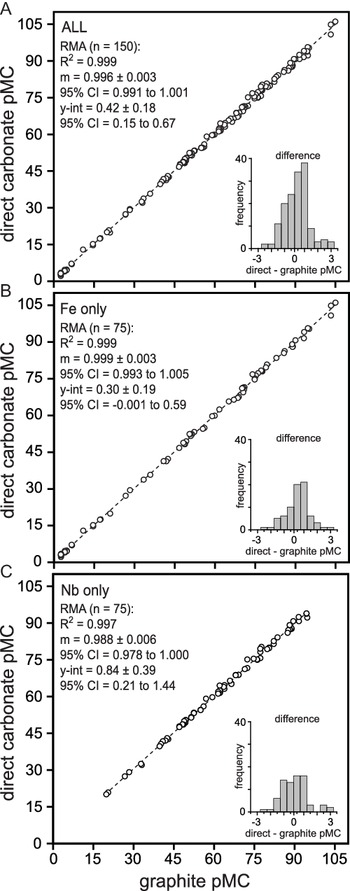
An RMA regression shows a strong relationship between direct carbonate and graphite pMC (n = 150) (Figure 2A). The slope of an RMA regression line is defined as the standard deviation of the y-axis values (direct carbonate pMC) divided by the standard deviation of the x-axis values (graphite pMC). The y-intercept is defined by the regression line passing through the bivariate centroid, or the point ( ${\rm{\overline x}},{\rm{\overline y}}$), which here would be the mean of the graphite pMC values and the mean of the direct carbonate pMC values, respectively. The RMA regression using our entire compilation (Figure 2A) yields a slope near 1.000 (0.996 ± 0.003; 95% bootstrapped CI [N = 1999] of 0.991–1.001), and a y-intercept slightly above 0.00 (0.42; 95% bootstrapped CI [N = 1999] of 0.15–0.67) (Figure 1A). We observe slight differences in the RMA regression results when the direct carbonate 14C determinations using Fe and Nb are assessed individually (Figures 2B and 2C). Variability in the direct carbonate 14C determinations using Fe powder is similar to that of their graphitized counterparts (i.e., RMA slope of 0.999± 0.003; Figure 2B). In contrast, the lower RMA slope of 0.988 ± 0.006 for the Nb-graphite pairs (Figure 2C) reveals that the direct carbonate 14C determinations using Nb powder yield pMC values that are slightly less variable than their graphite counterparts. The difference in the Fe-only and Nb-only RMA regression slopes is small and overlap at 2σ errors. Thus, we contend that the differences in pMC values between the direct carbonate and graphite 14C techniques is insignificant for most research goals.
Reduced major axis (RMA) regression of paired direct carbonate and graphite pMC determinations. A—relationship using all data. B—relationship using iron (Fe) powder. C—relationship using niobium (Nb) powder. Analysis performed using PAST 4.03 statistical software (Hammer et al. Reference Hammer, Harper and Ryan2001). Inset diagrams are frequency histograms of pMC differences, calculated as “direct – graphite pMC”.

The vast majority of direct carbonate pMC values are comparable to their graphite counterparts. Seventy-seven percent of differences are ±1.0 pMC, and 94% percent are ±2.0 pMC. Overall, we observe that 61% of direct carbonate pMC measurements are higher than their graphite counterpart (Figure 2A). When considered individually, however, 69% of the direct carbonate 14C determinations using Fe yield positive differences whereas the direct carbonate 14C determinations using Nb yield differences that are more equally distributed, with 53% of the differences being positive (Figures 2B and 2C). The mean value of the differences is 0.19 pMC (95% CI: 0.04–0.34 pMC) for the entire compilation, indicating that the direct carbonate 14C technique yields pMC values slightly higher than the graphite technique. Much of the offset is contained in the direct carbonate determinations using Fe powder, however. When considered individually, the mean value of the Fe-graphite differences is 0.26 pMC (95% CI: 0.06–0.46 pMC), whereas the mean of the Nb-graphite differences is roughly half that, at 0.11 pMC (95% CI: –0.12–0.34 pMC). Dividing the differences by the direct carbonate pMC value yields a coefficient of variation of 0.9% (95% CI: –0.65% to 1.58%) for the entire compilation. When considered individually, the coefficient of variation for the Fe and Nb differences are 1.6% (95% CI: 0.3% to 2.8%) and 0.3% (95% CI: –0.3% to 0.6%), respectively. Collectively, this reveals a slight positive bias in direct carbonate 14C measurements relative to the graphite technique, with a more pronounced bias when using Fe powder.
The reason for the higher frequency of positive differences, especially when using Fe powder, (Figures 2A and 2B) and for why the two metal powders perform differently is unclear. One potential explanation is the adsorption of young atmospheric CO2 during the powdering process (e.g., Kosnik et al. Reference Kosnik, Hua, Kaufman, Kowalewski and Whitacre2017). However, adsorption of CO2 reasonably should affect all of the biomineral powders similarly, and not show a preference for the samples using Fe powder. Kosnik et al. (Reference Kosnik, Hua, Kaufman, Kowalewski and Whitacre2017) suggested that perhaps the blank (marble) powder adsorbs CO2 less efficiently than the biomineral powders, which would lead to excess adsorbed atmospheric CO2 influence on biomineral pMC after blank subtraction. A blank under-correction of this sort should also affect the carbonate powders mixed with both metals similarly, rather than preferentially affecting the carbonate powders mixed with Fe (Figures 2B and 2C). Finally, we did not detect any adverse adsorption of atmospheric CO2 in our blank marble powder or on 14C-dead mollusk shell powder after storage under N2 for up to 9 days (see previous discussion of blank performance). Thus, adsorption of CO2 during powdering does not adequately explain the higher tendency for positive differences when using Fe powder (Figure 2B). The discrepancy may be, in part, an artefact of the relatively small sample size (n = 75). A more normal distribution in Fe-graphite differences might appear if the sample size was increased. It is also possible that the Fe powder imparts a slightly more frequent positive influence on the direct carbonate 14C pMC values. Recall in the earlier discussion of our C1 blank performance, we report that, on average, our C1 blank was about 0.7 pMC higher when using Fe powder than when using Nb powder. The blank correction process should remove contributions from both metal powders, however, rendering this an unsatisfactory explanation. And finally, the more equitable differences using Nb powder (Figure 2C) may be related to the improved beam current and reduced uncertainties when using Nb powder (Hua et al. Reference Hua, Lavchenko and Kosnik2019). We believe that our compilation is the largest of its kind, but it may still be too small to determine why there is a higher occurrence of positive differences when using Fe powder (Figure 2B).
With better counting statistics and less proportional background interference, direct carbonate pMC measurements on young samples tend to be indistinguishable from their graphite counterpart measurements as compared to older samples. The majority of the individual differences in our compilation (76%) are statistically indistinguishable at 95% CI (Supplemental Information). However, 36 of the differences (24%) do not meet this criterion. These differences are evenly split between direct carbonate 14C determinations using Fe powder (n = 19) and Nb powder (n = 17) (Table 1). Thirty-one of the 36 differences that do not include 0 at 95% CI are from samples that yield > 50 pMC as graphite, and the remaining five come from samples that yield < 50 pMC as graphite (Table 1). All five of the older samples yield differences that miss the 95% CI threshold by 0.5 pMC or less (Table 1). For the younger samples, 28/31 of the differences miss the 95% CI threshold by less than 1.2 pMC. The remaining three differences miss the 95% CI threshold by 1.3, 1.7, and 1.8 pMC (Table 1).
Detailed breakdown of the taxa, generalized biological group, carbonate polymorph, standard graphite pMC values, direct carbonate metal powder, and pMC value of individual differences that exceed the 95% CI threshold.

a “Mixed” refers to shells that contain both calcite and aragonite polymorphs.
We acknowledge and caution that our study is limited to comparing the results of one direct carbonate and one graphite 14C analyses per individual biomineral specimen. Several of the results complied from Bush et al. (Reference Bush, Santos, Xu, Southon, Thiagarajan, Hines and Adkins2013) comprise multiple analyses per coral specimen, but the overwhelming majority of our comparisons are based on single paired results (Supplemental Information). We calculated the weighted mean of the graphite and direct carbonate 14C values (weighted by 1/variance) and determined the number of biomineral specimens with 1σ analytical errors that overlapped the weighted mean. Ninety-three percent of the graphite pMC values overlap the weighted mean (versus the expected 68%), but only 45% of the direct carbonate pMC values overlap the weighted mean (versus the expected 68%). Thus, the reported uncertainty in the direct carbonate 14C determinations underestimates the actual variance. We also suspect that some of the differences noted in this study may reflect slight variability between subsamples of a single biomineral specimen. Future comparative studies would benefit from analyzing each specimen multiple times with each AMS 14C technique to more fully assess if there are statistically significant differences between the two techniques. Researchers typically only date a biomineral specimen once rather than multiple times, thus our study is more directly analogous to that approach. Keeping in mind that the direct carbonate pMC variance is underestimated and that we are using a single paired graphite and direct carbonate comparison per specimen, we contend that our study shows that the differences between the direct carbonate and graphite 14C techniques is insignificant for most research goals.
We also observe a potentially interesting association between particular taxa and the differences that do not include 0 at a 95% CI. For example, the clams Arctica islandica (6/6 analyses) and Modiolus sp. (4/10 analyses), the sand dollar Peronella peronii (5/12 analyses), and the brachiopod Gryphus vitreus (3/6 analyses) appear to be disproportionately affected (Tables 1 and 2). The cause of this pattern is unclear. Carbonate mineralogy can be excluded because both aragonitic samples and calcitic samples populate the group (Table 1). Furthermore, some differences from the same taxon do include 0 at a 95% CI, for example, the remaining 3/6 Gryphus vitreus shells (Table 2). Thus, neither the organism (in a broader taxonomic sense) nor the carbonate mineralogy of the various skeletal materials is a satisfactory explanation. Using Fe or Nb powder for direct carbonate 14C analysis does not explain why some taxa seem more affected than others (Table 1). The apparent patterns in Tables 1 and 2 may be an artifact of the small sample sizes per taxon, but it may hint that taxonomy or perhaps environmental variables specific to the habitat or life cycle of each taxon requires further consideration (e.g., Kosnik et al. Reference Kosnik, Hua, Kaufman, Kowalewski and Whitacre2017; Hadden et al. Reference Hadden, Loftis and Cherkinsky2018). Larger sample sizes and additional tests are needed to better understand what may be causing differences between direct carbonate and graphite pMC determinations.
Summary of the taxa, sample size (n), generalized biological group, carbonate polymorph, number of differences that are statistically indistinguishable (SI) at 95% CI, and publication information for samples featured in this study.

a Two analyses of Actinella nitidiuscula and one analysis of Mactra isabelleana yield widely different direct carbonate and graphite pMC values and are excluded from discussion and statistical analysis. See Supplemental Information.
b “Mixed” refers to shells that contain both calcite and aragonite polymorphs.
To further explore the relationship between the direct carbonate and graphite 14C methods, the pMC differences shown in Figure 2A are plotted with respect to their respective taxonomic classifications in Figure 3. As noted previously in our discussion, the direct carbonate pMC values are more consistently higher than their graphite equivalents (Figure 3). Some biogenic carbonates might be prone to producing direct carbonate pMC values that are systematically offset from their graphite counterpart (Figure 3), although again, the sample sizes per taxon are admittedly small (1–24 individuals per taxon). The metal powder used in the direct carbonate 14C technique again does not appear to be a controlling factor at the taxonomic level (Figure 3). Note that the brachiopod Gryphus vitreus yields exclusively negative differences using Nb powder, the clams Tucetona pectinata and Transennella sp. yield exclusively positive differences using Fe powder, and the echinoderm Peronella peronii yields positive differences in nine of 11 analyses using Nb powder (Figure 3). Additional work is needed to determine whether the perceived taxonomic differences are real, for example if different taxa or perhaps different shells from different environments contain consistently different amounts of conchiolin with different 14C activities than the surrounding shell carbonate (Hadden et al. Reference Hadden, Loftis and Cherkinsky2018), or whether the perceived differences are merely an artefact of small sample sizes.
Differences in pMC (direct carbonate—graphite) from an assortment of biogenic carbonates. Bp—brachiopod, G—gastropod, E—echinoderm, B—bivalve mollusk. Note that most differences are positive and that some biogenic carbonates more consistently yield either negative (e.g., Gryphus vitreus) or positive (e.g., Transennella sp.) differences, while others are more evenly distributed (e.g., Dosinia caerulea, coral skeletons). See Supplemental Information for additional information on taxonomy and carbonate polymorphs. Solid black circles—Fe powder. Solid white circles—Nb powder.

To summarize, we find that 114/150 (76%) of the direct carbonate pMC values in this compilation are statistically indistinguishable from their paired graphite pMC values at the 95% confidence interval, and of the 36 samples that are not, all but three are less than 1.2 pMC beyond the 95% confidence threshold. All direct carbonate 14C determinations, even the three with the largest differences exceeding the 95% CI threshold, show offsets from their graphite pMC values that are insignificant for most research goals. Even though the direct carbonate 14C method incorporates added uncertainty from lower beam currents, from fewer replicate analyses per target, and from using less homogenized material compared to standard graphite 14C measurements, the results are comparable to the standard graphite 14C method. We confidently demonstrate that in the large majority of cases, the direct carbonate 14C technique yields pMC values from a variety of biogenic carbonates that are indistinguishable to pMC values produced using the more costly and time-intensive graphite 14C technique. Thus, the direct carbonate 14C technique is appropriate for a wide range of applications.
CONCLUSIONS
This study compared 153 individual biogenic carbonate samples from echinoderms, mollusks, brachiopods and corals that have been dated using both direct carbonate and graphite 14C techniques. Three samples were excluded from discussion because their direct carbonate and graphite pMC values were strongly discordant. The remaining 150 samples range from 2.2 to 106.0 pMC. The direct carbonate 14C technique produces 1σ pMC errors that are primarily two to 8 times higher than the associated graphite errors, and there is a weak negative correlation between the magnitude of the 1σ error differences and a sample’s graphite pMC value. Our comparison of 150 paired direct carbonate and graphite 14C determinations reveals a strong RMA regression relationship between the two techniques (m = 0.996; 95% CI [0.991–1.001]), and pMC values that are statistically indistinguishable from each other in 76% of the samples (at 95% CI). The variance in direct carbonate pMC values is underestimated, however. All but three of the direct carbonate 14C determinations in this study were within 1.2 pMC of the 95% CI threshold of being statistically indistinguishable from their graphite equivalent. Some types of biogenic carbonates appear to produce direct carbonate pMC values that are consistently higher or lower than their graphite values, but sample sizes are small and the paired pMC values still statistically overlap in the vast majority of cases. The direct carbonate 14C technique yields pMC values that overwhelmingly are indistinguishable from the standard graphite 14C technique, but with the added benefit of more efficient laboratory preparation and processing.
ACKNOWLEDGMENTS
This study is a collaboration between the Amino Acid Geochronology Laboratory and the Center for Ecosystem Science and Society at Northern Arizona University, the Keck Carbon Cycle AMS Laboratory at the University of California-Irvine, and the Australian Nuclear Science and Technology Organisation.
This work is supported by grants NSF-1855381 (DSK), EAR-1559196 (DS), FONDECYT 3170913 (CF), FONDECYT 3160342 (JCM), FONDECYT 1140841, 1181300 and 1191452 (MMR), IODP/CAPES-091727/2014, and CNPq/MCTI-422766/2018-6 (MNR), EAR-1559196 (MK), NSF-1802153 (YY), and NSF-GRFP-1610397 (WGP). We thank Dan Cameron, Kathryn Geyer, and Aibhlin Ryan (NAU) for assisting with the direct carbonate 14C samples. We thank Jenny E. Ross for providing the R. lecontei shell from the Brawley Formation, and both Austin Hendy (Natural History Museum of Los Angeles County) and Charles L. Powell, II, for assistance with the taxonomic references. Thoughtful comments from the Associate Editor Pieter Grootes and two anonymous reviewers greatly improved this manuscript.
Supplementary material
To view supplementary material for this article, please visit https://doi.org/10.1017/RDC.2020.131