One of the most important concerns in today’s professional sport is to know the balance between sport demands and the effectiveness of coping psychological resources in young athletes mainly, in order to avoid desertion or maintaining a desirable engagement level without interfering their global development as individuals as well. This positive proposal approach can explain Psychological Well-being perception of young athletes and their autonomous coping strategies within highly demanding competitive contexts.
Despite other theoretical approaches based on vitality and encouragement (Castillo, Duda, Álvarez, Mercé, & Balaguer, Reference Castillo, Duda, Álvarez, Mercé and Balaguer2011), or from Perceived Emotional Intelligence perception (Núñez, León, González, & Martín-Albo, Reference Núñez, León, González and Martín-Albo2011), we will consider Psychological Well-being from a global perspective as the personal perception that life is well and satisfactorily lived, and that the person is aware of her correct potential development (Ryff & Singer, Reference Ryff and Singer1998). Ryff’s proposal consists of a Psychological Well-being multidimensional model, framed within human potential development (eudaimonic Well-being), which has extended its denomination to Psychological Well-being as opposed to the happiness perspective (hedonic Well-being), also denominated subjective Well-being. The concept of Psychological Well-being has been recurrently tested through the use of the questionnaires Scale of Psychological Well-Being (SPWB, van Dierendonck, 2004), and Psychological Well-Being Scale (PWS, Ryff, 1995). Most recently, van Dierendonck (Reference van Dierendonck2012) confirmed validity construct of the 6 Dimensions measurement of Ryff’s Psychological Well-being model from van Dierendonck (Reference van Dierendonck2004) research. van Dierendonck, Díaz, Rodríguez-Carvajal, Blanco, and Moreno-Jiménez, (2008), have confirmed validity factor of Ryff’s Psychological Well-Being scales (1989), by using the short version option of Psychological Well-being suggested by van Dierendonck (Reference van Dierendonck2004), which is an instrument that counts with good psychometrical properties being its reliability and factorial validity tested for example by Díaz et al., (Reference Díaz, Rodríguez-Carvajal, Blanco, Moreno-Jiménez, Gallardo, Valle and Dierendonck2006), with the Spanish translated version.
In the research of van Dierendonck et al., (Reference van Dierendonck, Díaz, Rodríguez-Carvajal, Blanco and Moreno-Jiménez2008), they inferred that when Ryff’s Psychological Well-being scales are to be utilized in the various cultures, it is strongly recommended in order to have a complete perspective of the Psychological Well-being construct, to maintain the six dimensions intact, since each dimension represents a different challenge for the person to positively perform within the environment. On the other hand, two new dimensions of Psychological Well-being scale had been extended: Internal Resources and Vitality, confirming a valuable amelioration of validity construct (Rodríguez-Carvajal, Díaz, Moreno-Jiménez, Blanco, & van Dierendonck, Reference Rodríguez-Carvajal, Díaz, Moreno-Jiménez, Blanco and van Dierendonck2010).
Moreover, the direct experience as much as other researches as well had clearly estated that coping strategies (through the use, efficacy perception and preference within professional sport) are positively related to Psychological Well-being (Romero et al., Reference Romero, Zapata, García-Mas, Brustad, Garrido and Letelier2010), being essential tools to meet requirements and psychological demands of competition and to reach an appropriate performance (Kim et al., Reference Kim, Duda, Tomas and Balaguer2003).
The identification of specific coping strategies has been based on the transactional model of Lazarus and Folkman (Reference Lazarus and Folkman1984), which considers coping as situationally specific process, with a primary response aimed at reducing negative emotional condition associated primarily to the person’s cognitive assessment of the stressful condition, which determines the elicitation of a coping strategy.
From this model, Psychological Well-being would depend, in part, on the choice and success, both objectively and subjectively of the type of coping strategy each individual use (active or passive, behavioral, cognitive or emotional) whether autonomously developed, through sport career, or specifically trained. Therefore, as long as coping style is appropriate to the individual characteristics and the situation will lead to health, performance and Psychological Well-being, the unsuccessful coping style will prove sooner or later to be dysfunctional in any determined field (Lazarus & Folkman, Reference Lazarus and Folkman1984). Furthermore, its improvement is made through a preventive perspective, especially for children and youth sports, that should also endow sport engagement to foster specifically the person global development. Its importance increases if we consider that in sport there is a continuing relationship between the agonism of competition and individual Psychological Well-being since sport engagement means challenge, the desire to overcome obstacles and personal improvement, and on the other, a better knowledge of their own capabilities to cope with intrinsic emotional estates inherent to the changing dynamics of sport competition (Núñez et al., Reference Núñez, León, González and Martín-Albo2011).
From a neurophysiological perspective, we can infer that autonomy and Psychological Well-being are significantly related. Evidenced that positive relations with others predicted physiological functioning and health, including the secretion of oxytocin which is associated with results of positive mood and stress relief. Other researches suggest that social support and personal resources might act as “buffering” of stress and to the risk that produces in mental and physical health of individuals through changes in cardiovascular and autoimmune endocrine systems (Taylor et al., Reference Taylor, Burklund, Eisenberger, Lehman, Hilmert and Lieberman2008).
The core conception that emerge from the above mentioned perspective is the relation between autonomy perception and sustained sport engagement, as to the correct and health performance as well. DeCharms (Reference DeCharms1968) suggested already that when talking about motivation of an expected behavior what really matters (as might be the sport, he refers specifically), is bear in mind the idea of the personal “intention” as a decision making that should have consequences to be considered. Furthermore, Mack et al. (2011), had recently suggested that the need of autonomy represent a nuclear condition of eudamonic Psychological Well-being.
Underpinning previous considerations, Self-Determination Theory (Deci & Ryan, Reference Deci and Ryan2000) had directly linked conception of eudaimonia to self-actualization as a nuclear aspect of Psychological Well-being definition (Vásquez, Hervas, Rahona, & Gomez, Reference Vásquez, Hervás, Rahona and Gómez2009). Within the three basic needs this theory bring forward, or “essential nutrients for psychological growth, integrity and Psychological Well-being” (Deci & Ryan, Reference Deci and Ryan2000, p. 229); along with the need for competition (the effective interaction with the environment) and the need of relations with others (the connection with others and the sense of belonging to a given social environment), stands out the need of autonomy (the desire to engage in self determined activities and to be the beginner of her own behaviors). And on the same line, these basic psychological needs coincide with three of the dimensions of Ryff’s Psychological Well-being model (autonomy, environmental mastery and positive social relations), despite conceptually there are significant differences between both models (Lent, Reference Lent2003).
In this regard, some previous researches had confirmed that young athletes coping strategies does not totally depend on the amount of training or what they expected given their age or situation regarding psychosocial factors around them (family, coaches), but in large extent to the intentional and autonomous athletes decisions (Romero et al., Reference Romero, Zapata, García-Mas, Brustad, Garrido and Letelier2010). Additionally, these decisions were not rigorously related to the effectiveness of their coping strategies perception (Romero et al., Reference Romero, Zapata, García-Mas, Brustad, Garrido and Letelier2010); although young athletes continue to maintain a high concern for their own Psychological Well-being aligned with similar previous research.
Bearing in mind previous considerations, we decided to use the construct of Perceived Autonomy from predictions of Self-determination Theory (Deci & Ryan, Reference Deci and Ryan2000) considering that autonomy is directly related to health and Psychological Well-being; since this theoretical framework remarks that when behaviors are consistent with values and the person is holistically engaged, eudaimonic Well-being is developed (Balaguer et al., Reference Balaguer, Castillo and Duda2008). On the other hand, the experience of autonomy is multifaceted, which involves the realistic sense of choosing and making decisions, together with perceived internal locus of causality (IPLOC) (e.g., the feeling that the person is the beginner of their own actions) since both factors have been related to Psychological Well-being (Reinboth & Duda, Reference Reinboth and Duda2006). This hypothesis had received empirical support from different contexts for example, in labor organizations (Baard, Deci, & Ryan, 2000); in sport (Balaguer et al., Reference Balaguer, Castillo and Duda2008; Núñez et al., Reference Núñez, León, González and Martín-Albo2011; Reinboth & Duda, Reference Reinboth and Duda2006), and education (Patrick, Knee, Canevello, & Lonsbary, Reference Patrick, Knee, Canevello and Lonsbary2007).
Therefore, according to the above mentioned matters, the main purpose of this research was to figure out between two samples of young professional athletes characterized with a high and low global perceived autonomy, eventual differences in perceived autonomy, coping strategies and Psychological Well-being. At the same time, this research describes the extent of the relationship among the three psychological variables (Psychological Well-being, Coping Strategies and Perceived Autonomy), apart from describing the extent in which differences observed among participants are explained by decision making and volitional aspects within Psychological Well-being dimensions and coping strategies.
Method
Participants
Participants were 155 male professional tennis players, with a mean age of 14.61 years (range: 11-18 +/- 1.71 years; SD = 1.86) that belonged to twenty clubs and / or academies in three Chilean cities; Santiago, Viña del Mar and Concepcion (Chile). Selected players had the highest competitive level, they formed part of the selection or elite category within their clubs, and participating at that moment in the South American Confederation of Tennis and tournaments from the International Tennis Federation. Their training routine was five days a week, three hours daily, competing 100 days a year as average.
Instruments
The assessment of coping strategies was performed using the Spanish version of Cuestionario de Aproximación al Afrontamiento en el Deporte ACSQ-1 (Kim et al., Reference Kim, Duda, Tomas and Balaguer2003), the Approach to Coping in Sport Questionnaire, ACSQ-1, (Kim & Duda, Reference Kim and Duda1997) that consists of a 28 items questionnaire and a 5-point Likert scale to answer the frequent use of certain strategies in competitive situations, in which number 1 means “never” and number 5 “always.” The five subscales or factors of the instrument are: 1) Emotional calmness, 2) Active planning / Cognitive restructuring, 3) Mental withdrawal, 4) Risk behaviors, and 5) Seeking social support. Religion factors were not considered in this research because of difficulties to perform transculturization. Examples of questions by factors were: Emotional calmness “I imagined myself performing the correct technique”; Active Planning: “I did what I felt I had to do, one thing at a time”; Mental withdrawal “I thought there was nothing to do and I accepted it”; Risk behaviors: “I used more complex techniques to cope with the situation”; Seeking social support: “I asked my coach for advice about how to manage the situation”.
Assessment of Psychological Well-being was performed using the Spanish version (Psychological Well-being Scale, EBP, Díaz et al., 2006), of the Scale of Psychological Well-being (SPWB, van Dierendonck, 2004) based on the eudaimonic approach (Ryff, Reference Ryff1989; Ryff & Singer, Reference Ryff and Singer1998). It is a 29 items questionnaire, with six-point Likert scale. The scale has six dimensions: 1) Self acceptance; 2) Positive relations; 3) Autonomy; 4) Environmental mastery; 5) Personal Growth, y 6) Purpose in Life. Examples of questions by dimension: Self acceptance: “When I review the story of my life, I’m happy about how things have turned out”. Positive relations: “I feel that my friends would provide many things to me”. Autonomy: “I rely on my opinions even if they are contrary to the ordinary people”. Environmental Mastery: “I feel that in general I am responsible about situations I live”. Personal growth: “I feel that in general, with my effort I continue to learn about myself”. Purpose in life: “I enjoy making plans for the future and working to make them true”.
Assessment of perceived autonomy was accomplished by using the Spanish version Escala de Autonomia Percibida en el deporte, (Balaguer et al., Reference Balaguer, Castillo and Duda2008) from the original scale of Basic Psychological Needs (Reinboth & Duda, Reference Reinboth and Duda2006) that was based on an instrument developed by Ntoumanis (Reference Ntoumanis2001). This scale was designed with 10 items with a seven-point Liket Scale that assess two dimensions of perceived autonomy: election / decision making (6 items), an example of the question: “I feel free to express in my sport my ideas and opinions”. And volition perspective of autonomy in the sport context (4 items), an example of the question: “I feel that I can be myself to a great extent in my sport”.
Procedure
In order to accomplish the investigation we obtained the authorization of coaches and psychologists following with academies and/or tennis clubs involved. The athletes were then informed about the purpose of the study and obtained their consent to answer the questionnaire. They were also informed that their responses would remain anonymous, that participation was unpaid, strictly voluntary and the option opened to abort at any time during the process. Athletes answered the three self-administered questionnaires out from training schedule, during the same day without exceeding 30 minutes, in front of research team members.
Data Analysis
In order to achieve statistical calculations planned it was utilized the SPSS (19) program. It was determined basic descriptive statistics (arithmetic average and standard deviations) for the differences analysis between arithmetic average of groups with “high” and “low” perceived autonomy, meanwhile in order to study the relationship and explanatory capacity between variables it has been utilized Pearson correlations and regression analysis (Fernández-Fernández, Cordero, & Córdova, Reference Fernández-Fernández, Cordero and Córdova2002). For the (standard) regression analysis, we used the same statistical program, using as the criteria each dimension of Psychological Well-being and coping strategies, and both factors of perceived autonomy as predictors.
Results
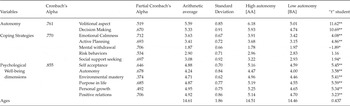
Table 1 provides the means for the instruments and the subscales utilized and significant differences were apparent between “high” and “low” autonomy subgroups. Therefore, we can observe that there are significant differences regarding both components of autonomy (volitional aspects and decision making) and among the different coping strategies such as “emotional calmness”, “active planning”, “seeking social support “and “mental withdrawal”. Regarding the difference found in “mental withdrawal”, suggests that the subgroup of “low autonomy” obtained higher scores than “high autonomy” subgroup. Regarding Psychological Well-being we observed significant differences at .01, between groups of “high and low autonomy”. Both subgroups did not differ in age.
Descriptive statistics, Alpha coefficient, “t” student test for “high” and “low” autonomy

[AA y BA]: High and Low autonomy correspond to subgroups formed when the sample of Global Perceived Autonomy is ordered, and separated by the average.
** p < .01; *p < .05
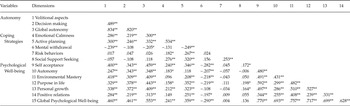
Table 2 exhibits correlations between coping strategies, autonomy perceptions and Psychological Well-being. Regarding coping strategies and perceived autonomy we found that athletes who perceived themselves to be more autonomous utilized strategies such as emotional calmness, active planning and social support. In the case of perceived autonomy and mental withdrawal, the correlation was significant, but in the reverse direction, that is to say that the more autonomous individuals were the ones that revealed less mental withdrawal, meanwhile the less autonomous revealed that withdrawal was the most utilized strategy. Simultaneously, there was a strong positive correlation between perceived autonomy and global Psychological Well-being. Finally, regarding correlations between coping strategies and global Psychological Well-being, a significant relationship was found between emotional calmness and active planning but a significant negative relationship was found with mental withdrawal. Within the relationship among dimensions of Psychological Well-being appeared the same relational pattern, although are added to the self acceptance, purpose in life and personal growing, the direct and significant utilization of social support.
Pearson’s coefficients correlation among Perceived Autonomy variables, Coping Strategies and Psychological Well-being

** p < .01; *p < .05
In order to establish the extent that Psychological Well-Being dimensions and coping factors explain perceived autonomy, it was carried out a regression analysis of the six Global Psychological Well-being dimensions and for the five factors of coping strategies, by utilizing as predictive variables both factors of perceived autonomy: “decision making” and “volition”. The stepwise method was utilized in every analysis. Within results, the Durbin Watson value was within the recommended range (1,5 – 2,5).
Regression analysis corresponding to Psychological Well-being dimensions evidenced how self acceptance, together with purpose in life and personal growth appeared to be significantly explained from perceived autonomy, decision making and volitional aspects (see table 3). It could be observed also how the environmental mastery strategy is explained by volition from perceived autonomy, and finally, the global Psychological Well-being appeared to be significantly explained by decision making and volition from perceived autonomy. Coping strategies regression analysis show how none of the strategies appeared to be significantly explained by perceived autonomy.
Regression Analysis: Psychological Well-being, Coping Strategies y Perceived Autonomy

Roughly 18% of the variance in the self-acceptance dimensions was explained (R2 adjusted =.178) by decision-making factors (β =.194, p = .001) and volitional aspects (β = .305, p = .001). Similarly, about 16% of the variance in the purpose in life dimension was explained (R2 adjusted = .159) by decision-making factors (β = .286, p = .001) and volitional aspects (β = .189, p = .027). For the dimension of personal growth, approximately 16% (R2 adjusted =.160) of the variance was explained by decision making factors (β = .271, p = .002) and volitional aspects (β = .206, p = .016). Roughly 18% of the variance in the environmental mastery dimension was explained (R2 adjusted = .178) by decision making factors (β = .137, p = .104) and volitional aspects (β = .350, p = .001). Global Psychological Well-being is explained approximately about 27% (R2 adjusted = .273) from decision making factors (β = .304, p = .001) and volitional aspects (β = .312, p = .001).
Discussion
In the sample of young professional tennis players examined, their perceived autonomy, their preferred coping strategies and global Psychological Well-being, were variables directly related, that provided relevant theoretical and applied information in order to gather further knowledge regarding the mental processes in connection to athletes in training.
Therefore, our results supported the expectation that perceived autonomy of young tennis professional players utilize coping strategies such as; active planning, cognitive restructuring and emotional calmness, and seeking social support, that match in large extent with similar previous studies (Kim & Duda, Reference Kim and Duda1997; Romero et al., Reference Romero, Zapata, García-Mas, Brustad, Garrido and Letelier2010).
These coping strategies are of approach - not of denial or avoidance, usually utilized when the situation is perceived as controllable, the person knows the source of stress and would feel in disadvantage if he do not solve the problem (Roth & Cohen, Reference Roth and Cohen1986). In this regard, it is expected that when a person identify herself consciously with the action that expresses or its value, there is a high degree of perceived autonomy. Pointed out that when students understood their role in the learning process claimed major control of the situation and increased their learning involvement.
Two of the strategies utilized were consistent with cognitive abilities to control the situation. Emotional Calmness (Kim & Duda, Reference Kim and Duda1997, Reference Kim and Duda2003; Kim et al., Reference Kim, Duda, Tomas and Balaguer2003) related to the efforts to approach the situation (Roth & Cohen, Reference Roth and Cohen1986) to calm down, regain positive feelings (through positive visualization and muscle relaxation, such as breathing and relaxing), and re-focus on the task. Meanwhile, active planning targets to change or control some aspects of a situation perceived as stressful (Lazarus & Folkman, Reference Lazarus and Folkman1984) and as an active strategy oriented to the present challenge is adapted to the reinterpretation of the adverse situation and the organization of own actions and thoughts in order to achieve a specific goal (Kim & Duda, Reference Kim and Duda1997, Reference Kim and Duda2003; Kim et al., Reference Kim, Duda, Tomas and Balaguer2003).
The third preferred strategy of young professional tennis players was social support, which is also an approach strategy with behavioral characteristics and is defined as being understood by others, and the close relation with other significants in difficult times has the result of emotional control (Kim & Duda, Reference Kim and Duda1997, Reference Kim and Duda2003; Kim et al., Reference Kim, Duda, Tomas and Balaguer2003). Likewise, the use of this strategy in other areas has been explained in terms of the functional content of social relations among individuals and has been directly linked to Well-being, expressed in terms of quality life and perceived health (Rodríguez, Pastor, & López, Reference Rodríguez, Pastor and López1993), other authors suggest a direct relation between social support and Psychological Well-being to the extent that social support improve identification and efforts of insertion in the group, although not always appeared as the preferred strategy in the sport field (Romero et al., Reference Romero, Zapata, García-Mas, Brustad, Garrido and Letelier2010).
In order to explain the apparently paradoxical relationship between social support and perceived autonomy, Deci and Ryan (Reference Deci and Ryan1987) suggested that when people learn to experience that social environment supports autonomy, this may increase, and even obtain long-term health positive effects. Furthermore, emotional support given indirectly by other significants may also increase self-esteem and sense of control, facilitating the implementation of other coping strategies.
In contrast, the most preferred coping strategy used by non-autonomous athletes was avoidance which reflects the desire to consciously reject the source of stress or when the situation turns out to be uncontrollable (Roth & Cohen, Reference Roth and Cohen1986), that is to say, they are not able to make decisions about what they would think, feel or make to solve the problem in front. Thus, the less autonomous tennis players preferred mental withdrawal, as an avoidance cognitive strategy that involved acceptance thoughts instead of their own capacity to achieve an objective (Kim & Duda, Reference Kim and Duda1997, Reference Kim and Duda2003; Kim et al., Reference Kim, Duda, Tomas and Balaguer2003) which has been defined in several contexts as maladaptive. Also, this coping strategy had been negatively linked to sport persistence (Kim & Duda, Reference Kim and Duda2003), which highlights therefore perceived autonomy volitional aspect. Likewise, the use of avoidance strategies had been linked with failure to achieve aims established, and with the advent of negative affect associated (Gaudreau & Antl, Reference Gaudreau and Antl2008), influencing autonomy perception because of the lack coherent and consistent goals system, and the lack of emotional effect on the inherent satisfaction of their achievement or the attempt to obtain them (Deci & Ryan, Reference Deci and Ryan2000).
Regarding the relationship between perceived autonomy and athletes global Psychological Well-being, apart from knowing that coping strategies are significant determinants of both athletic performance and Psychological Well-being as well results achieved suggest that decision making factor and volition aspects had been relevant and significant, which in the case of decision making coincide with some similar previous researches performed an individual sport (Reinboth & Duda, Reference Reinboth and Duda2006).
Autonomy suggests an internal endorsement of proper actions meaning that they belong and emerge from the self, assuming the person action and personal responsibility (Deci & Ryan, Reference Deci and Ryan1987). Therefore autonomous actions are decided, but this is not a decision made among other options, but must be understood as a more global concept tied to a more complete integrated functioning of the individual.
It should be noted in this regard, that the concept of autonomy raised from Self-Determination Theory (SDT), is not exactly the same as the one derived from Psychological Well-being, because if Ryff’s proposal is an autonomous and personal approach raised from independence of others and individualism (Ryff & Singer, Reference Ryff and Singer2006), SDT is focused on the feeling and the degree of volition associated with actions accomplished, being them dependant or independent, collectivist or individualist (Deci & Ryan, Reference Deci and Ryan2000), although both models have in common concepts such as self-determination and locus of control. Underpinning the above and together with Korean and U.S. cross-cultural researches, we found more positive relationship between autonomy and collectivist attitudes than between autonomy and individual attitudes to the contrary to other studies in which the IPLOC aspect of autonomy has emerged as a Psychological Well-being unique and powerful predictor (Reinboth & Duda, Reference Reinboth and Duda2006).
Regarding autonomous behaviors, another remarkable characteristic of volition is the motivational energy they encourage, that may even lead athletes to carry out more adapted and flexible responses to stressful situations since autonomy is considered to be directly related to the will and the origin of own behaviors (Mageau & Vallerand, Reference Mageau and Vallerand2003). Extrapolating from this, we might think that from the own person stems a series of actions, behaviors, emotions, and cognitions that working together lead to a better functioning with a less self-consciousness or conscious control (Skinner & Edge, Reference Skinner, Edge, Deci and Ryan2002). Therefore, a positive relationship is expected to be found between autonomous motivation (but not between controlled motivation) and an effective coping. The above is based in the regression analysis between Psychological Well-being and perception of autonomy.
Psychological Well-being is related to the own life experiences content and is considered the result of a life well lived (Ryff & Singer, Reference Ryff and Singer1998), which is based on different challenges that people face through their efforts to positively function and is directly related to the self-determination through self-actualization conception since autonomy satisfaction needs, competence and athletes sport relations provide essential nutriment to originate Psychological Well-being from an eudaimonic perspective. Conversely, it has been found that when the person feel more autonomous they also feel a greater autonomy, motivation, greater performance persistence and perception of Psychological Well-being (Deci & Ryan, Reference Deci and Ryan2000), and when competitive athletes act autonomously, their actions are consistent with their values, subsequently sport emerge as a positive practice promoting Psychological Well-being as well (Balaguer et al., Reference Balaguer, Castillo and Duda2008).
Within this context, if we observe regression analysis results, we will find that Psychological Well-being possesses adequately predictive characteristics of Psychological Well-being. From this perspective the relation is bidirectional, since appeared to be a feedback cycle between Psychological Well-being and perceived autonomy. In fact in this estudy perceived autonomy explained one third of the global Psychological Well-being variance observed.
In summary, according to our overall discussion that strengthened the conception that when athletes feel themselves more autonomous, they also perceive Psychological Well-being, it is likely because they choose - voluntarily, through decision making – the coping strategies that influences their perception of being more autonomous, perhaps because they develop a challenge assessment of the stressful situation that may increase their control perception of the situation, allowing at the same time to sustain their self confidence, awareness and an appropriate arousal level (Anshel, Kim, Kim, Chang, & Eom, Reference Anshel, Kim, Kim, Chang and Eom2001; Roth & Cohen, Reference Roth and Cohen1986). The significant decision-making role and volition aspects suggests us that when the individual is consciously identified with the action realized or the value that expresses, there is a great level of perceived autonomy.
In other researches performed with young people (Cornejo & Lucero (Reference Cornejo and Lucero2006) it was confirmed how those with high levels Psychological Well-being perception, mainly utilized the coping strategies active planning and seeking of social support. These strategies are considered to encourage a more satisfactory Psychological Well-being, which, together with regression results obtained between perceived autonomy and Psychological Well-being, strengthen even more important, the relationship between both variables.
The same as in the research accomplished with young professional athletes by Smith, Ntoumanis, Duda, and Vansteenkiste (Reference Smith, Ntoumanis, Duda and Vansteenkiste2011) considering the precedent that pursuing successfully significant aims is important for the Psychological Well-being , it was found that individuals utilized significantly and positively active planning and seeking of social support when they had autonomous aims. Nevertheless, those athletes whose motives were controlled utilized more mental withdrawal strategy.
On the contrary, the observed role not essential of coping strategies identified, leads us to think that more than its specific nature, which must be valued is its approach or avoidance characteristic especially in relation to perceived autonomy. Because in addition to our conceptual framework, and according to the cognitive stress assessment through person-environment relationship (Folkman, Lazarus, Gruen, & Delongis, Reference Folkman, Lazarus, Gruen and Delongis1986), we would might note that in the case of athletes who perceive themselves as autonomous, this assessment would have the character of challenge, whereas for non-autonomous athletes it would be threatening, with the effects observed on the preference for different coping strategies.
Practical implications
From an applied and sport psychology intervention perspective, our results suggest that if young athletes more global aim in sport is Psychological Well-being, while they continue practicing without deserting, it is paramount to remark the need for coaches to contribute to their athletes autonomy perceptions development, by dealing with them as people that deserve to self-determine their behaviors and future, and not as mere pawns that need to be externally controlled in order to obtain certain results (DeCharms, Reference DeCharms1968). This type of teaching of sport approach involves the assumption of rationality in training and play, gaining the feeling of belonging, and being fairly treated with by their coaches.
Our results also suggest the need to develop athletes volition and decision making so as to overcome difficulties, since it has been demonstrated the direct impact of this aspect of autonomy as predictor of athletes eudaimonic Psychological Well-being. The above was confirmed by researches of the authors Mack et al. (Reference Mack, Wilson, Oster, Kowalski, Crocker and Sylvester2011).
It would be interesting to strengthen and enhance coping strategies related to emotional calmness, active planning and social support since this would talk about more autonomous athletes. On the other hand, to be aware of athletes mental withdrawal strategy would alert us about less autonomous individuals with a lower global Psychological Well-being. The role of coaches and parents in coping strategies learning will be essential for adaptive patterns development and/or maladaptive coping strategies of athletes and sons respectively (Tamminen & Holt, Reference Tamminen and Holt2012) on the other hand, as young people gain more experience dealing with stress their portfolio of coping strategies also increase.
The results obtained must be limited to the sample under study, though, on the other hand, its relative specificity, may enable us to extrapolate them to similar populations. Moreover, since our findings are based on information obtained non experimentally, causal relations cannot be inferred.
New developments
First, longitudinal studies should be accomplished (experimental, if possible) through previous control of Psychological Well-being in order to verify perceived autonomy causality, and coping strategies instrumental utilization, and then to associate results considering longitudinal Psychological Well-being. Secondly, in order to verify some hypothesis proposed from our results, it might be interesting to include some objective performance indicators as independent variable, either absolute (results, rankings) as well as relative and individual (satisfaction, progression, goals) in order assess whether there is relationship between Psychological Well-being and autonomy with those indicators, as has been confirmed in other studies.
And finally, it would be convenient to consider also the perceived locus of control, since we would think that there is a relationship between internal locus and perceived autonomy (that may have a greater trend to mastery the situation, would be dissatisfied and struggling trying to control and be demanding with others, assuming more responsibilities and offensive game strategies, tending to be prompt and attribute failure to the lack of own ability) and a relationship between external locus of control and perceived lack of autonomy (they would be more vulnerable to external factors, would be more compliant and passive, would not try to control and demand others, would avoid to assume responsibilities and making decisions, use more defensive strategies, and would tend to attribute failures to external factors). This research would allow us to gain further knowledge about the relative importance of decision-making in autonomy volitional aspects, by considering its relationship to Psychological Well-being.