Introduction
Terracotta nails from Mesopotamia are little understood. Numerous problems arise as soon as one tries to characterize these objects more specifically, beginning with the question of terminology, since they may be defined or labelled as knobs, wall nails, wall pegs or wall cones.Footnote 1 It should be noted that these different terms may reflect either a form (cone) or a function (nail, peg, knob). However, it should also be noted that the objects denoted by these terms are always associated with a wall. They are commonly attributed a decorative function, which originates in the first forms of earthen architecture, or are associated with a utilitarian function, such as a hanging system for clothes or a door closing system, as well as having a symbolic function as foundation deposits, among others.Footnote 2 Here, I use the term ‘terracotta nail’, admitting that ‘nail’ already implies a function, but this term emphasises its shape, as an object composed of a shank and a head.
Terracotta nails are found throughout the ancient Near East, dating from the late fourth until the first millennium B.C. Regarding architectural contexts, it is recognized that they are mainly associated with temples, although they are also found associated with palaces and enclosure walls, as textual mentions from Assur attest. Some examples also link them to doorways.Footnote 3
In 2019, three fragments of terracotta nails were discovered at the site of Amyan, located in the Kurdistan region of Iraq, and apparently dated to the second half of the second millennium B.C. This article presents these nails but also contextualises them in a reliable regional and chronological framework by comparing them to other nails found in northern Mesopotamia. In order to sketch out an initial typology, this article concentrates on uninscribed terracotta nails dated to the second half of the second millennium B.C., either from the time of the Mitanni kingdom (c. 1600‒1300 B.C.) or the Middle Assyrian period (c. 1300‒1000 B.C.).Footnote 4
The Archaeological Site of Amyan
Amyan is located in the Navkur Plain (Fig. 1), an extremely fertile plain which has been heavily occupied since the Neolithic period.Footnote 5 The site of Amyan is composed of a main mound, 26 meters high and measuring 4 hectares, surrounded on its eastern and southern sides by a lower town of around 15 hectares, partly covered by a modern village (Fig. 2). The survey and surface collection carried out on the site by the Land of Nineveh Archaeological Project (hereafter LoNAP) team has evidenced an almost continuous occupation from the Late Chalcolithic to the Islamic period.Footnote 6 The most heavily represented periods are the Early Bronze Age and the Middle Bronze Age. On the periphery of the main mound, nine other smaller sites have been identified, occupation of which goes back to the Hassuna period.
Map showing the location of Amyan and other sites mentioned in the text (after Sauvage 2020).

Aerial view of the main mound of Amyan and its lower town covered by the modern village (image courtesy LoNAP).

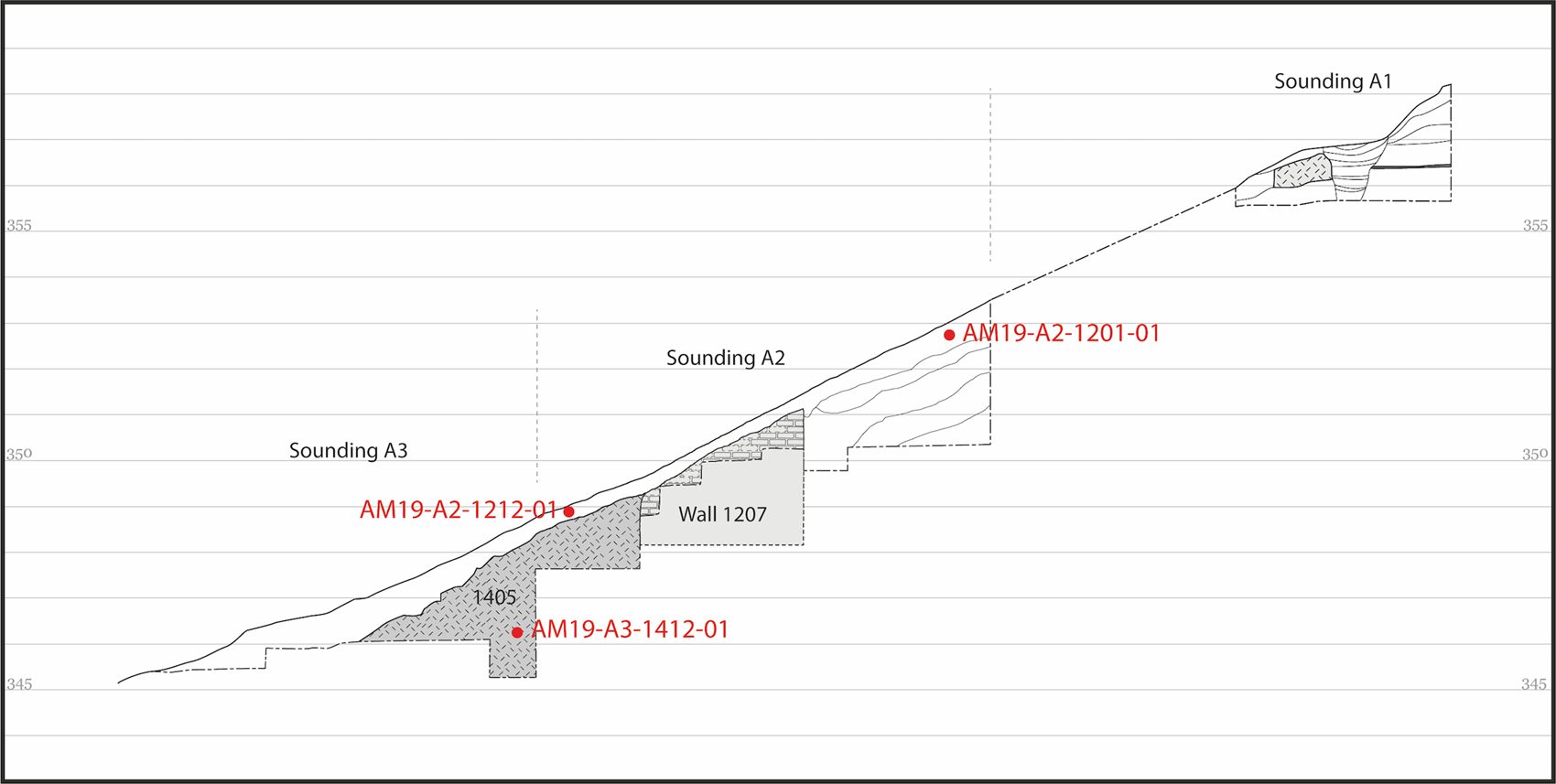
During the first season of fieldwork in 2019, a step trench was excavated in order to better understand the high mound and its levels of occupation (Fig. 3).Footnote 7 However, the step trench did not reveal a succession of occupation levels but massive structures resulting from urban planning (Fig. 4). First, a wall, probably an enclosure wall if not a rampart, was excavated halfway along the step trench (Wall 1207).Footnote 8 This wall was 3.60 metres wide and preserved to a height of 2.60 metres, oriented north-south, slightly off-axis to the east (Fig. 5). It was built of square mud-bricks (36 x 36 x 12 cm) and half-bricks (18 x 36 x 12 cm).Footnote 9 This wall rests on a massive structure, either a glacis or a terrace, at the bottom of the trench (1405).Footnote 10 Roughly oriented north-south, this lower structure is composed of square bricks (40 x 40 cm), which are characterized by their poor state of preservation and heterogeneity, filled with gravel, small stones and sherds.Footnote 11 A small sounding within the core of this structure has shown, on the contrary, that the bricks of the inner part of this mass were more compact and purer. This difference could correspond to different phases of construction, or to differentiated building techniques. Unfortunately, due to time constraints, the full width of this structure has not yet been revealed, but within the limits of the sounding, the minimum width excavated is almost 4 metres, and a height of c. 3 metres.
View of the step trench at the end of the excavation (MAA).

Section of the excavation of the step trench at Amyan and location of the nails (MAA).

Wall 1207 in sounding A2 (MAA).

Slightly above the wall is another building of which only one wall and a part of a possible courtyard were excavated in the upper part of the trench (Fig. 6).Footnote 12 The wall, most probably the outer wall of the building, measures 1.50 metres wide, which seems to indicate that the building was probably of some importance and linked with an administrative function. On the floor was a set of square baked bricks, which may correspond either to a remnant of a courtyard pavement largely removed, or to a fireplace installation.Footnote 13 The building rests on a levelling layer, which indicates that it is a new foundation. A later phase was also uncovered, but probably belonging to a squatter occupation.
The courtyard of the building excavated in sounding A1 (MAA).

Regarding the dating of these different types of architecture, the ongoing study based on the ceramic assemblage has proved to be more complicated than expected, mainly due to the contexts excavated: monumental architecture and too few floors and closed contexts.Footnote 14 Indeed, the pottery comes mainly from erosion or fill layers, a situation which largely explains the presence of ceramics dating from different periods in most of the stratigraphic units excavated during this campaign. However, it seems, although final determination must wait for the completion of the study of the material, that the remains can be dated to the second millennium B.C.Footnote 15
The Terracotta Nails Found at Amyan
Three nailsFootnote 16 were found at Amyan during the first excavation season in 2019. One is complete and the other two are fragmentary, although it is quite possible that the latter two are fragments of the same nail. Unfortunately, these fragments were not found in well-defined closed contexts. Nevertheless, ongoing research seems to point to the excavated contexts most probably dating from the second half of the second millennium B.C., from the period associated with the Mitanni kingdom (c. 1600‒1300 B.C.) or the Middle Assyrian period (c. 1300‒1000 B.C.).Footnote 17
The first nail, found complete and registered as AM19-A2-1201-01 (Fig. 7A), is 12.7 cm long. The shank is round, with a diameter of 4.6 cm, and it was shaped by hand; the traces of fingers from a closed hand are still visible. The end of the shank is flat. The head of the nail is round and slightly convex, with a diameter of 7.6 cm and a thickness of 1.2 cm. The nail is pinkish-beige in colour.
Terracotta nails found at Amyan: A: AM19-A2-1201-01; B: AM19-A2-1212-01; C: AM19-A3-1412-01 (MAA).

This nail was found in sounding A2, located in the central part of the step trench, where remains of the big wall, Wall 1207, were excavated (Fig. 4).Footnote 18 As mentioned previously, this wall is most probably an enclosure wall, perhaps to enclose a specific district of the town, or it may be a fortification wall. The occupation surface associated with the wall has unfortunately not been discovered, but on its inner side, many erosion layers were excavated, sloping in the same direction as the slope of the mound. All these layers contained many pottery sherds, stones and animal bones. The nail was found in layer 1201, the upper erosion layer that runs across the whole sounding. Other objects found in this layer include a clay scraper and pieces of terracotta slag,Footnote 19 along with animal bones. Obviously, the main problem regarding the discovery context of the nail is that it is not clear whether it belongs to the sounding in which it was found, or if it originally came from the upper area of the mound and slipped down through erosion.
The second fragment, registered as AM19-A2-1212-01 (Fig. 7B), was also found in sounding A2, in the same layer 1201 described above, but located in the unexcavated section between soundings A2 and A3, referred to as layer 1212 at this location of the sounding (Fig. 4). Here again, we have little information about the original context of this nail, only the lower part of which is preserved. The section is rectangular, measuring approximately 3 cm × 4 cm, with a length of 8.4 cm. This lower part tapers slightly, ending in a flat bottom. The colour of this fragment is slightly more orange than the previous nail, but the consistency of the clay is the same, very dense, with a fine granulometry. It is decorated with four parallel, horizontal incisions.
It is very likely that this fragment is the lower part of, or at least from the same type of nail, as the third nail fragment found at Amyan in sounding A3 and recorded as AM19-A3-1412-01 (Fig. 7C).Footnote 20 This nail, 8.3 cm long and of the same colour as the previous nail described above, is almost perfectly square in cross-section, measuring 4.2 cm × 4.1 cm. This slight offset between the sides, added to the fact that, in the same way as the previous nail, it tapers slightly towards the bottom, suggests that it could belong to the same type of nail – if not the same object – the shank of which begins with a square section and ends with a rectangular section, demonstrating great crafting ability. The head of this nail is flat and square, and the edges flare slightly outwards, to a height of 0.8 cm.
The archaeological layer in which this last nail was recovered is numbered 1412 (Fig. 4). It is one of the layers constituting the imposing structure, numbered 1405, on which the enclosure wall rests. The connection between the wall excavated in sounding A2 and this massive structure remains unclear, but the difference in the methods of construction is obvious. Indeed, while the bricks of the wall are of good quality and well-shaped, the bricks of the glacis/terrace are characterized by their poor state of preservation, their friability, and their heterogeneity, as mentioned above. The nail was found in layer 1412, in which we could not trace the bricks: it was perhaps a layer of packed earth, or bricks whose joints were not recognizable. It should be noted that although the last two fragments were recovered roughly in the same area, there was a difference of approximately 2.5 m in elevation between them.
Some Other Terracotta Nails: Description and Contexts
The nails of Amyan are not the first nails to be discovered, although their shape makes them typologically unprecedented. Since the reopening of excavations in the Kurdistan region of Iraq in the 2010s, a few new discoveries of nails have been made. The best contextualized ones are certainly those found in the Mitanni palace of Kemune (Kemune 1, Fig. 8A), located today on the shores of the artificial lake of Mosul and partially submerged depending on the season and the year. Spotted in 2013 by a team from the Directorate of Antiquities, it was excavated in 2018 by a Kurdish-German team thanks to a drop in the water level.Footnote 21 The excavated part of this palace covers 900 m2. Twenty rooms were excavated, and the nails were found in rooms A and B, in the northwestern part of the building, against the western wall. Room A revealed no openings. In phase 4b, a level that, according to the excavators, followed destruction perhaps caused by an earthquake, two upper fragments of nails were found, along with a fragment of a tablet and a silver ring. Both fragments are made of terracotta, with a round, protruding head and a shank with a circular cross-section; the ends, flat or pointed, are not present.Footnote 22 The dimensions of the nails are not specified, but the photograph that shows three fragmentary examples indicates that the best-preserved example must measure a little less than 10 cm in length. In Room B, nails of the same type were also found in phase 4b, parts of a rich inventory including pottery, a silver ring, seven tablet fragments, six seal impressions, beads and stone tools.Footnote 23 The texts on the tablets mention goods, rations and activities related to metal crafts.Footnote 24 In short, everything points to an administrative context related to the Kemune nails.
A, B: Terracotta nails found in Kemune (after Puljiz and Qassim Reference Puljiz and Qassim2019; Duhok National Museum archives); C: Grd-ĩ Āş-ĩ Geūre (Koliński Reference Koliński2020); D: Bakr Awa (Miglus et al. Reference Miglus, Bürger, Fetner, Mühl and Sollee2013); E–H: Tell ar-Rimah (Carter Reference Carter1964; Postgate et al. Reference Postgate, Oates and Oates1997); I–N: Nuzi (Starr Reference Starr1937); O: Fakhariyah (McEwan et al. 1958); P: Kar-Tukulti-Ninurta (Eickhoff Reference Eickhoff1985); Q, R: Emar (Margueron Reference Margueron and Beyer1982). All nails are scaled except those of Nuzi and Fakhariyah.

Another nail was found at Kemune on the surface of the site during the work directed by the Directorate of Antiquities; it is now kept in the National Museum in Duhok (Kemune 2, Fig. 8B).Footnote 25 Unfortunately, there is no detailed description of its context of discovery. This specimen is complete, 14.1 cm long; the shank is cylindrical with a diameter of 3 cm ending in a point. The head is round, with a diameter of 4.5 cm and very slightly convex, unlike the previous specimens with a clearly protruding head. It was also modelled by hand, in a fine clay. Its colour is pink-orange.
Two nail shanks were also found during surveys conducted by the Upper Greater Zab Archaeological Reconnaissance projectFootnote 26 (Fig. 8C). One is the lower part of a nail and the other most certainly a middle part. The heads are not preserved. Interpreted by the excavators as cones or the feet of dishes, we see here the same prototype of nails as at Kemune, the shanks of which, of circular section, are moulded by hand, as attested by the visible finger marks. The lower part, which ends in a point, is 9.5 cm long, and between 1.5 cm and 2.9 cm in diameter. The middle part is 9.1 cm long and has a diameter of 3.1 cm. These two specimens were found on the surface of the site of Grd-ĩ Āş-ĩ Geūre, which consists of a high mound and a lower town on the banks of the Kurabak River, 15 km east of Amyan.Footnote 27 The site was occupied discontinuously from the mid-third millennium B.C. to the Early Islamic period. The most intense periods of occupation were during the first half of the second millennium B.C., the Seleucid period and the Early Islamic period.
At the other end of the Kurdistan region of Iraq, the excavations at the site of Bakr Awa have provided a specimen dated by the excavators to the Late Bronze Age, found in a layer on the edge of the high mound, but without a precise context, during the excavation of Area 1 (Fig. 8D).Footnote 28 This fragment is larger than the others, approximately 10 cm long, and is decorated with a round, protruding head that dominates a shank of circular section, unfortunately broken under a small flange, very similar to the examples found at Tell ar-Rimah, Fakhariyah and some examples at Nuzi (see below).
Outside the present-day Kurdistan region of Iraq, several examples of nails were found in earlier excavations. At Tell ar-Rimah in the Sinjar region of Iraq, nails were found in the palace of Site C, either in the rubble of a level dating to the Mitanni period,Footnote 29 or in the levelled fill preceding the building,Footnote 30 and at least one nail belonged to the following period, the Middle Assyrian period.Footnote 31 About a dozen fragments were found, only partially published, but at least four types may be distinguished, according to their size and shank shape (Rimah 1–4, Figs. 8E–H).Footnote 32 The nails measure between 15 and 30 cm, they all have a flange, and the head is always round and slightly convex. The shank end is either flat or pointed, and they are mostly of circular section, but some photos seem to indicate that in some cases the section of the shank could be quadrangular (Rimah 2 and 4, Figs. 8F and H). The specimens with circular sections and flat shank ends are partially covered with bitumen, an interesting piece of information that is not mentioned for the other finds (Rimah 1, Fig. 8E).Footnote 33
At Nuzi, near Kirkuk, many nails were found,Footnote 34 fourteen of which are drawn in the publication catalogue – unfortunately without dimensions – that I have divided into six types (Nuzi 1–6, Figs. 8I–N).Footnote 35 All have round heads and date from the second half of the second millennium B.C. One group has no flange and includes the nails found in a residence. Of this group, two types (Nuzi 1 and 2, Figs. 8I and J) have a long shank with a circular section – hand-moulded in one case; the end is pointed and has either a flat or slightly protruding round head. The other two types of this first group (Nuzi 3 and 4, Figs. 8K and L) are characterized by a very short shank that is flat at the end, with a square or circular section, and a convex or very slightly protruding round head. This first group of nails is made of a yellowish clay. They were found in different rooms of a residence (room L20 stratum II, and rooms L21 and H60, stratum III). According to the excavators, they were used to decorate the walls. A second group of nails is characterized by a flange (Nuzi 5 and 6, Figs. 8M and N). The most numerous nails have a circular shank with a flat end, topped by a round convex or slightly protruding head (Nuzi 5, Fig. 8M). The other type is characterized by a flat and round head, and a quadrangular section with a pointed end (Nuzi 6, Fig. 8N). Some of the heads of this type are covered with a blue-green glaze. All these flanged specimens were found in temple A, some of them were in situ, stuck in the walls, 1.78 m above the ground.Footnote 36 Since all the nails are different one from another, the excavators put forward the hypothesis that they were votive gifts, affixed in the walls of the temples.
Another type of flanged nail is attested at Fakhariyah in the Khabur region of northeast Syria (Fig. 8O).Footnote 37 The two published fragments, which could belong to the same nail, were found on the floor of the building excavated in Sounding VI, dated to the 13th century B.C. This is possibly a temple in view of the objects found there, among which were figurines, rosettes and numerous beads which, according to the excavators, could have been used as garlands hung on the nails.Footnote 38 One of the fragments consists only of the upper part of the head, which is round and protruding, while the other fragment is the shank, beginning under the flange. It is clear that the shank, which has a circular section and ends in a point, but without reported dimensions, was moulded by hand.
At the site of Kar-Tukulti-Ninurta, near Ashur on the Tigris river, fragments of nails were found near the façade of the Middle Assyrian palace.Footnote 39 The best-preserved and most interesting example measures 19 cm (Fig. 8P).Footnote 40 It is a flanged nail with a circular section whose shank has a flat end. The head is round and protruding.
Finally, moving away from Amyan, it is worth mentioning a batch of several dozen fragments dated to the 13th century B.C., found in the temple M2 at Emar, on the Middle Euphrates in Syria.Footnote 41 These nails, which are hollow, unlike the other examples we have listed, were found in front of the temple façade and are of two types (Emar 1 and 2, Figs. 8Q and R). The first type, between 20 and 30 cm long, has a shank with a circular section that ends in a point, with a round, flat head (Emar 1, Fig. 8Q). The second type is about 50 cm long, has the same kind of round and flat head, but the shank, also of circular section, is straight and has a flat end (Emar 2, Fig. 8R). According to the excavators, these nails would have decorated the walls of the temple.
Towards a Better Definition of Terracotta Nails
From the study of the terracotta nails found at these nine sites, all dating to the second half of the second millennium B.C. and all in northern Mesopotamia, an initial typology of these objects can be presented. This consists of 21 types based on site, date, archaeological context, length, shank and head (Table 1). It must be noted that though they all date to the second half of the second millennium B.C, it is generally difficult to attribute them to a more specific period, except for those from the palace of Kemune, which belongs to the Mitanni period (Kemune 1, Fig. 8A), and those from Fakhariyah, Kar-Tukulti-Ninurta and Emar (Figs. 8O–R), which belong to the Middle Assyrian Period, around the 13th century B.C. These datings, of course, are based on the dates of the archaeological contexts in which the objects were found and cannot firmly attest the date of production of the objects, given the possibility that they could have been reused over time.
Typology of nails, based on site, date, archaeological context, length, shank and head.

Regarding the archaeological contexts, when data are known, the nails come from prestige buildings linked to the elite of the cities, associated in one way or another with royal or religious status and administrative function: palaces, temples, or elite residences. The nails of Amyan are the only ones found next to an enclosure wall, be it the fortification wall of the city or a district enclosure. However, the excavation in this area is still in progress and it is possible that further investigation will show the presence of an elite building close to the wall.
The lengths vary a great deal, but this dimension is not very reliable since most of the objects are incomplete. The longest examples are those from Emar, up to 50 cm, but it must be noted that these are also unique, since the shape is known only from this site (Emar 2, Fig. 8R). The smallest complete example comes from Tell ar-Rimah and measures 10 cm (Rimah 4, Fig. 8H). However, the average length of complete examples – when the length is published – is around 20–25 cm. In this regard, the complete nail from Amyan (Amyan 1, Fig. 7A), at 12.7 cm, can be considered as rather small.
Regarding the shapes of the nails, most of them have a shank which is round in section. Two examples from Nuzi are quadrangular (Nuzi 4 and 6, Figs. 8L and N), as well as two examples from Tell ar-Rimah that could be quadrangular according to the photographs, although this is not confirmed in the publication (Rimah 2 and 4, Figs. 8F and H). Given this tendency, the quadrangular nails from Amyan are an exception in this typology (Amyan 2 ands 3, Fig. 7B and C). The ends of the shanks can be either flat or pointed. No preference can be seen in the examples listed in this study, though it seems that the thinnest shanks end with a point, which makes sense if they were pegged into a wall; a pointed end obviously helps to insert the nail in a wall without weakening the shank.
All heads are round, except for the quadrangular nail from Amyan (Amyan 3, Fig. 7C). Interestingly, the two nails with a quadrangular shank from Nuzi have round heads (Nuzi 4 and 6, Figs. 8L and N), which shows that the shape of the shank does not determine the shape of the head. In most cases, the head is either slightly protruding or convex. In fewer cases it is flat. In the present state of the documentation listed in this study, it was not possible to determine how the link between the shape of the shank and the shape of the head is made. In other words, it does not seem to me that there was any systematization regarding the type of shank and head of the nail.
Except for the round nail from Amyan (Amyan 1, Fig. 7A), which is quite thick, it is notable that all nails that were moulded by hand are thin and present a pointed end (Kemune 2, Grd-ĩ Āş-ĩ Geūre, Nuzi 1 and Fakhariyah; Figs. 8B, C, I and O). Almost half of the twenty-one types listed above present a flange between the head and the shank (Bakr Awa, Rimah 1-4, Nuzi 5–6, Fakhariyah and Kar-Tukulti-Ninurta; Figs. 8D, E–H, M–N, O and P). Interestingly, it seems that this type is mainly located in the southeastern fringe of the area under study, although it cannot be too firmly stated that there is a direct connection between the shape and the geographical area. Some of the nails from Rimah are covered with bitumen (Rimah 1, Fig. 8E), and some from Nuzi are covered with glaze (Nuzi 5 and 6, Figs. 8M and N). The quadrangular nail from Amyan is the only one that bears incisions on the shank (Amyan 2, Fig. 7B).
This list of nails does not help in determining the function of these objects but shows that the variation in the typology is not very wide. Indeed, although belonging to a category of artefacts well-known throughout Mesopotamia, the specimens from upper Mesopotamia present specific characteristics, such as the flange, for instance. In any case, the three types at Amyan clearly show their originality in this corpus, regarding their shape, size or the incisions on one of them, and it is to be hoped that further archaeological investigations will help shed more light on these objects.