On March 11, 2011, the Great East Japan Earthquake and resulting tsunami devastated the northeastern coast of Honshu, Japan, leaving about 18500 people dead or missing. 1 Such experiences increase disaster-related emotional problems, not only among survivors but also among rescue workers.Reference Benedek, Fullerton and Ursano 2 , Reference Norris, Friedman and Watson 3 Rescue workers are known to be at risk of developing mental disorders. For instance, of the rescue workers who responded to the September 11, 2001, terrorist attack in New York, 16.7% exhibited post-traumatic stress disorder (PTSD) and 21.7% exhibited depression at 13 months.Reference Fullerton, Ursano and Wang 4 Other studies have shown that predictors of PTSD among dispatched rescue workers include anger, somatization, and smoking.Reference Jayasinghe, Giosan and Evans 5 - Reference van der Velden, Kleber and Koenen 7 In the aftermath of the Great East Japan Earthquake, rescue workers belonging to the national network of Disaster Medical Assistance Teams (DMATs), which was established by the Ministry of Health, Labour and Welfare of Japan, were dispatched to the disaster area. In a previous study, we reported that peritraumatic distress and watching television for 4 hours or more daily predicted PTSD symptoms among dispatched DMATs 4 months after the Great East Japan Earthquake.Reference Nishi, Koido and Matsuoka 8
However, there have been few studies on medical rescue workers (medical doctors, nurses, and other personnel) and, in particular, no longitudinal studies regarding the immediate and long-term mental health of these workers. Burnout is also a problematic health condition and is observed more frequently than PTSD. Numerous studies have examined burnout among medical professionals.Reference Piergiorgio and Ilaria 9 - Reference Yasuaki, Shigeru and Eiji 12 Although the importance of burnout is widely recognized, there have been no previous studies on burnout among dispatched medical rescue workers.
This study aimed to evaluate the factors associated with PTSD symptoms and burnout among medical rescue workers of the Great East Japan Earthquake by comparing their baseline characteristics, observed 1 month after the disaster, with their psychological condition 4 years later.
METHODS
Participants
Participants were those from our previous studyReference Matsuoka, Nishi and Nakaya 13 who agreed to participate in the present longitudinal follow-up study, namely, DMATs who were involved in providing medical aid during the period of March 11 to 22, 2011 to those affected by the Great East Japan Earthquake and the resulting tsunami. DMATs are specialized mobile medical teams capable of providing medical aid during the acute phase of a large-scale disaster (typically, within about 48 h), although this period was longer following the earthquake of March 11. For the APOP study, we considered DMAT members irrespective of role, and so physicians, nurses, and operational coordination staff are included. The inclusion criteria were the same as for our previous study, namely: (1) aged ≥18 years, (2) native Japanese speaker or non-native speaker with Japanese conversational abilities, (3) physically and psychologically capable of understanding and providing consent for study participation, and (4) participated in DMAT activities during the acute phase after the Great East Japan Earthquake.Reference Matsuoka, Nishi and Nakaya 13
Procedure
The present observational study investigates the long-term prognosis of the DMAT members as an extension of our earlier APOP study (Attenuating posttraumatic distress with omega-3 polyunsaturated fatty acids among disaster medical assistance team members after the Great East Japan Earthquake: the APOP randomized controlled trial).Reference Matsuoka, Nishi and Nakaya 13 Four years after the disaster and the original 12-week trial of omega-3 polyunsaturated fatty acids supplementation in 2011, we contacted previous participants via the DMAT mailing list and requested that they respond to a web-based survey (Survey Monkey, https://www.surveymonkey.com), submitting responses online or by postal mail.
In the original APOP trial, a baseline assessment was conducted 1 month after the earthquake, the details of which have been reported elsewhere.Reference Matsuoka, Nishi and Nakaya 13 The following variables, which have been previously identified as risk factors for PTSD,Reference Epstein, Fullerton and Ursano 14 , Reference Schlenger, Caddell and Ebert 15 were collected: period of deployment, level of stress prior to deployment, injury sustained during deployment, saving a child during deployment, contact with corpses, concern about radiation exposure, and duration of time spent watching televised earthquake news reports.
We also administered the Peritraumatic Distress Inventory (PDI) 1 month after the earthquake. The PDI is a 13-item self-report questionnaire intended to assess distress as experienced both during and immediately after a critical incident.Reference Brunet, Weiss and Metzler 16 The response format is a 5-point Likert-like scale (0=“not at all true,” 1=“slightly true,” 2=“somewhat true,” 3=“very true,” and 4=“completely true”), yielding a score in the range 0 to 52. Most people can complete the entire PDI in only a few minutes. The Japanese version has been demonstrated to have good internal consistency, concurrent validity, and test–retest reliability.Reference Nishi, Matsuoka and Noguchi 17
The primary results of the present study, conducted 4 years after the earthquake, are the total scores for respondents on the Impact of Event Scale-Revised (IES-R). The IES-R is a self-report questionnaire that asks about PTSD symptoms and is composed of 22 items covering the 3 most common symptoms from among the diagnostic criteria for PTSD: re-experiencing, avoidance, and hyperarousal. Internationally, the IES-R is the most widely used measure for all forms of PTSD-related studies in disaster-area research.Reference Weiss 18 Respondents rate symptoms as experienced during the previous week. The validity and reliability of the Japanese version of the IES-R has been confirmed.Reference Asukai, Kato and Kawamura 19
The secondary results of this study are the total scores for respondents on the Maslach Burnout Inventory (MBI), a 17-item self-report questionnaire inquiring about burnout symptoms. Burnout exhibits as a prolonged response, resulting from chronic emotional and interpersonal job stressors. Results in 3 dimensions characterize burnout: emotional exhaustion, depersonalization, and diminished personal accomplishment.Reference Maslach and Jackson 20 The validity and reliability of the Japanese version of the MBI has been confirmed.Reference Kubo and Tao 21
Ethical Considerations
This study was conducted in accordance with the Declaration of Helsinki as revised in 2004 and the ethical principles laid out by the Ministry of Health, Labour and Welfare of Japan. The original study was approved by the Ethics Committee of the National Disaster Medical Center on April 1, 2011, and this follow-up investigation was approved on September 18, 2014.
Statistical Analysis
The relation between (1) the PDI total score and PDI individual item scores and (2) PTSD symptoms was examined by univariate regression analysis. To test the relative value of PDI, multiple linear regression analysis was applied to the relation between PDI total score and PTSD symptoms adjusted for age, female sex, and history of psychiatric illness (defined as any kind of psychiatric disorder). These are well-established pre-traumatic risk factors, applicable across trauma type.Reference Ozer, Best and Lipsey 22 , Reference Brewin, Andrews and Valentine 23 The scores were further adjusted for known risk factors for developing PTSD after a disaster.Reference Epstein, Fullerton and Ursano 14 , Reference Schlenger, Caddell and Ebert 15 We also examined the relation between the PDI total score and covariates by calculating Pearson’s correlation coefficients and by using significance testing (t-test or analysis of variance, as appropriate). Additionally, we examined the relation between the covariates and PTSD symptoms by applying univariate regression analysis. Discovered relations between the dependent variable and an independent variable are expressed in this study as regression coefficients (beta weights) with 95% confidence intervals (95% CIs). All statistical analyses used two-tailed tests. An alpha score of 0.05 was used as the threshold for statistical significance. We used SPSS statistical software, version 22.0J for Mac (SPSS, Tokyo, Japan), for all statistical analyses.
RESULTS
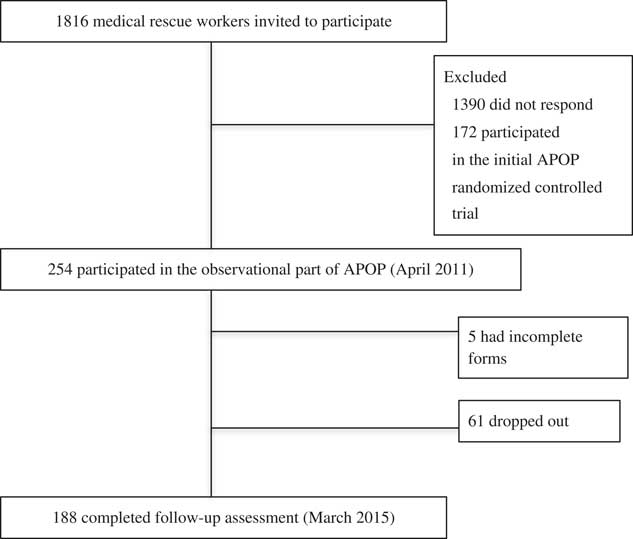
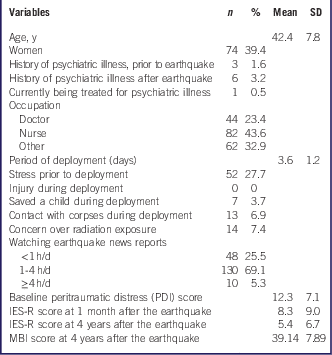
Among the 1816 DMAT workers deployed to disaster areas after the earthquake who were invited to participate in the original APOP randomized controlled trial, 1390 did not respond and 254 participants provided baseline data, which was collected between April 2 and 22, 2011 (172 participated in the initial APOP randomized controlled trial). Among these 254 participants, 188 (74.0%) completed the follow-up assessment in the present observational part of the APOP Study, with data collected between December 11, 2014 and March 31, 2015 (Figure 1). There were no significant differences in baseline results between participants who completed the follow-up and those who did not. Table 1 shows demographic and exposure characteristics of the 188 completers. Most participants did not personally save a child or have contact with corpses, and no participant was physically injured. The duration from baseline assessment to follow-up assessment was 44.9 months (range: 43-47 months).
Diagram of the follow-up study.

Demographic and Exposure Characteristics of Rescue Workers Who Participated in the Follow-up Study (n=188)

Abbreviations: PDI, Peritraumatic Distress Inventory; IES-R, Impact of Event Scale-Revised; MBI, Maslach Burnout Inventory; SD, standard deviation.
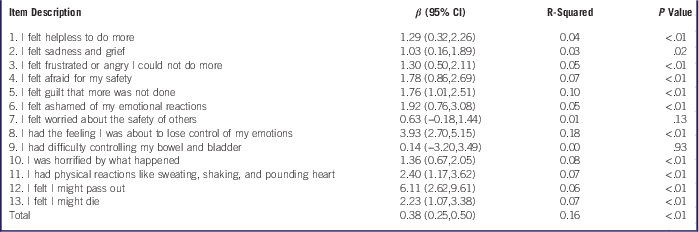
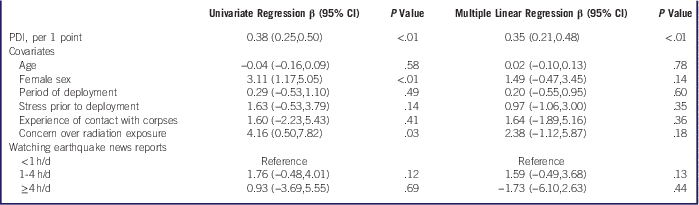
Table 2 shows results of univariate regression analysis of the PDI score against IES-R score 4 years after the earthquake. Table 3 shows results of univariate and multiple linear regression analysis of the relation between IES-R score at 4 years and baseline characteristics, and Table 4 shows such results for the association between MBI score at 4 years and baseline characteristics. Each of history of psychiatric illness, injury during deployment, and saving a child during deployment had less than a 5% response rate, and so these factors were excluded from multiple linear regression analysis. The PDI total score and most individual item scores were significantly associated with PTSD symptoms, as shown by univariate regression analysis. Additionally, the PDI total score was significantly associated with PTSD symptoms after adjusting for covariates (β=0.35; 95% CI: 0.21-0.48; P<.01). The R-squared value for the multiple linear regression model was 0.21.
Results of Univariate Regression Analysis (n = 188) Association of PDI with IES-R, at 4 Years After the Earthquake

Abbreviations: PDI, Peritraumatic Distress Inventory; IES-R, Impact of Event Scale-Revised; CI, confidence interval; R-Squared, multiple correlation coefficient, index of goodness of fit in the model.
Results of Association Between IES-R at 4 Years and Baseline Characteristics, Univariate and Multiple Linear Regression Analysis (n = 188)

Abbreviations: CI, confidence interval; IES-R, Impact of Event Scale-Revised; PDI, Peritraumatic Distress Inventory.
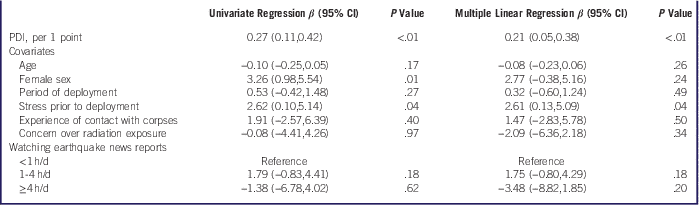
Results of Association Between MBI at 4 Years and Baseline Characteristics, Univariate and Multiple Linear Regression Analysis (n=188)

Abbreviations: CI, confidence interval; PDI, Peritraumatic Distress Inventory; MBI, Maslach Burnout Inventory.
PDI total score was also associated with burnout symptoms in univariate regression analysis. After adjusting for covariates, PDI total score was significantly associated with burnout symptoms (β=0.21; 95% CI: 0.05-0.38; P<.01). The R-squared value for the multiple linear regression model was 0.14. Among the covariates, stress prior to deployment was a related factor for burnout symptoms after adjusting for covariates (β=2.61; 95% CI: 0.13-5.09; P<.05). However, we observed no significant relations between independent variables (IES-R and MBI scores) and other covariates.
DISCUSSION
This study indicated that PDI scores 1 month after the earthquake were associated with symptoms of PTSD and burnout 4 years after the earthquake among medical rescue workers dispatched to the disaster area, even after adjusting for covariates. To the best of our knowledge, this is the first study to suggest that PDI score is associated with PTSD symptoms so long after trauma, although some previous studies have shown a relation between PDI score and PTSD symptoms 1 year after the traumatic event.Reference Jehel, Paterniti and Brunet 24 , Reference Skogstad, Toien and Hem 25 These results suggest that the PDI can serve as a useful tool for screening medical rescue workers who are at risk of developing early or delayed PTSD.
Interestingly, the PDI items for “I had the feeling I was about to lose control of my emotions” showed higher predictive power for PTSD symptoms than did the PDI total score. This result is consistent with findings 4 months after the earthquake.Reference Nishi, Koido and Matsuoka 8 In a disaster area, medical rescue workers often must undertake physical triage, where limited medical resources might prevent them from treating patients as they would in a hospital, leading to feelings that they could have saved lives or treated patients better under normal circumstances. Therefore, in a disaster area, rescue workers may be more emotionally affected than usual. The importance of identifying peritraumatic emotional distress, as revealed by responses on items such as “I had the feeling I was about to lose control of my emotions” might warrant emphasizing the screening of medical rescue workers at high risk of developing PTSD over the long term.
As for burnout, the results of this study showed that PDI score 1 month after the earthquake was associated with burnout symptoms 4 years after the disaster (here, the earthquake) among medical rescue workers dispatched to the disaster area, even when scores are adjusted for covariates. These findings suggest that PDI score relates to not only psychopathology but also a decline in job performance. Distress, as assessed by the PDI, includes emotional exhaustion (as mentioned above), so it is not surprising that the PDI score can be associated with burnout. However, the finding that the PDI score 1 month after a disaster was associated with burnout as many as 4 years later may provide new insights relevant to mental health treatment after disasters.
In addition to the above, we found a significant association between stress prior to deployment and burnout symptoms and the PDI score, after controlling for other covariates. A previous study indicated the need to reduce potential chronic stress factors (eg, number of hours dedicated to rescue work) to prevent onset of burnout and to guarantee rescue workers time to recover their energy, as well as the need for a working environment that offers support to reduce the probability of developing burnout.Reference Piergiorgio and Ilaria 9 , Reference Landsbergis 26 Therefore, it might be important to either not dispatch medical rescue workers who have higher stress prior to deployment or to reduce their stress whenever possible before deployment.
This study has several limitations, many of which are shared with our prior study. First, as shown in Figure 1, there were 1390 DMAT members invited to participate in the study who did not respond, and this may affect the external validity of the present findings. One possible reason for nonresponse is that many medical rescue workers might have not had the time to participate in this study immediately after returning from deployment, choosing instead to focus on work at their usual hospitals. Another reason is that rescue workers who were not severely affected by their rescue work experiences may have been unmotivated to participate in the present study. In other words, at the time of enrollment, those medical rescue workers who had a feeling of losing control of their emotions and began to have mental health problems or difficulties with their work during the rescue operations may have been more interested in participating in the study than those who had experienced the same emotions but had no mental health problems or difficulties with the job. This difference might explain the association between PDI and PTSD or burnout syndrome. Second, the attrition rate in this study was relatively high. Because those who did not have high stress levels prior to deployment seem more likely to have dropped out, a much lower attrition rate might have indicated a higher prevalence of PTSD symptoms. Third, the constructed model did not explain the dependent variables very well, as indicated by the low R-squared value. This indicates that other confounding factors might have been present. In particular, 4 years elapsed between the initial study and this study, and the dependent variables are likely to have been influenced by other factors during that time.
CONCLUSIONS
The PDI scores at 1 month after the Great East Japan Earthquake were associated with symptoms of PTSD and burnout even 4 years after the earthquake among medical rescue workers dispatched to the disaster area. Additionally, stress prior to deployment was related to burnout symptoms. It is feasible for medical rescue workers to complete the PDI independently, quickly, and soon after traumatic events; therefore, it seems important for DMAT headquarters to establish a routine system of checking the PDI score of dispatched medical rescue workers as well as screening those who have high stress prior to deployment. Further, we have already established a routine system of checking the PDI score of dispatched medical rescue workers in clinical situation.
Acknowledgments
The original study was supported by CREST, the Japan Science and Technology Agency (JST), and this follow-up study was supported by a grant from Pfizer Health Research Foundation.
The authors thank Dr Hisayoshi Kondo and Mr Masayuki Ichihara for coordination of participants and Mrs Kyoko Akutsu for data management.
DN and YM conceived and managed the whole research project. YK, DN, MU, HN, and YM designed the follow-up investigation. DN, HN, and YM collected baseline data. YK collected follow-up data. YK, HN, DN, and YM analyzed and interpreted the data. YK drafted the manuscripts. YK, DN, MU, HN, AY, YK, YO, and YM critically revised the manuscript for important intellectual content. YM obtained funding. All authors read and approved the final manuscripts.