How do resource-poor Black populationsFootnote 1 participate in politics? And what are the interpretive impacts of their participation? In the mid-1990s, Verba, Schlozman, and Brady concluded that “the resources of time, money and skills are … powerful predictors of political participation in America” (Reference Verba, Schlozman and Brady1995, 285). While very few scholars have contested this claim in the past two decades, even fewer scholars have investigated the multiple ways resources may be distributed to the poor to facilitate participation in politics and their varied political impacts (e.g., Mettler Reference Mettler2007).
I focus on resource-poor Black groups who have had traditionally low levels of political and civic participation. Focusing on these groups, my study investigates how they respond to a policy that directly affects their lives—the threat of mass public school closure—and examines their interpretations of its political impacts. Indeed, consistent with existing literature, their perceptions of their participation may be positive or negative (e.g., Soss Reference Soss1999). Yet these perceptions may also be positive and negative or may even change over time.
Using qualitative data collected between 2012 and 2017, this paper illustrates how a school closure policy facilitated the distribution of resources necessary for the community meeting participation of the poor Black groups affected. I then show how participation in the policy process is interpreted by these groups, particularly low-income Black residents, as contributing positively to their perceptions of internal efficacy and civic skill development, but negatively to their perceptions of the policy, the government, and their future participation. These negative observations persist even among those who are successful in saving their school from closure.
The investigation theorizes that this lack of interest in future participation by affected citizens is a consequence of “collective participatory debt,” a type of mobilization fatigue that transpires when citizens engaged in policy processes are met with a lack of democratic transparency and responsiveness despite high levels of repeated participation. This concept, explained in more detail later, recognizes that each effort to participate in an unfair political process is remembered by those who had engaged and believed in it. With each negative experience that citizens have, it becomes more difficult to justify participating in the future, even if they have been successful at securing some policy “wins.” Citizens develop not only a deepened mistrust of government, based on how they are treated during the process but also mobilization fatigue and disillusionment, based on how they feel after. Altogether, this work has clear implications for improving our understanding of how poor Black populations participate in politics, for deconstructing the dichotomy of winners and losers (Hajnal Reference Hajnal2009), and for better assessing the counterintuitive interpretive impacts of community political engagement.
How the Policy Process Facilitates Participation and Perceptions of Politics
Theories of collective action and political participation emphasize the absence of a shared identity, low availability of resources and time, and the desire to free ride as barriers to collective action and participation (see, e.g., Verba, Schlozman, and Brady Reference Verba, Schlozman and Brady1995; Olson Reference Olson1965). Yet theories of policy feedback and political participation demonstrate how policies can mitigate these barriers through their construction of certain groups as targets and the provision of resources to that target population (e.g., Schneider and Ingram Reference Schneider and Ingram1993; Mettler Reference Mettler2007). Through the process of targeting, social policies send messages to citizens about who is worthy of receiving public services and goods and who is not. These messages contribute to social constructions based on stereotypes, cultural characterizations, or popular images about the targeted group that policymakers utilize and that citizens internalize. For example, Soss (Reference Soss1999) demonstrates how recipients of Social Security Disability Insurance (SSDI) are essentially constructed as “deserving” and respond positively to their experiences with this federal government program, whereas recipients of Aid to Families with Dependent Children (AFDC) are constructed as “undeserving” and thus view their experiences with government bureaucracy negatively. Both groups generalize their experiences with the program and its administrators to the nature and goals of the political system more broadly.
In this study, as well as several others (Barnes and Henley Reference Barnes and Henly2018; Burch Reference Burch2013; Bruch and Soss Reference Bruch and Soss2018; Michener Reference Michener2018; Rose Reference Rose2018), positive or negative experiences with the policy process are associated with positive or negative policy experiences and subsequent political attitudes. Yet, this paper illustrates how experiences with the policy process may also have positive and negative consequences for the political understandings of those affected. Furthermore, it highlights how citizens’ interpretations of the policy’s impact can change over time and result in negative attitudes toward government and participation, even after citizens targeted by the policy have achieved so-called policy success.
More specifically, I investigate how citizens participate in, and thus experience, the public-school closure policy process across two large U.S. cities. I then examine the consequences of their experiences for their political understandings. The analyses focus on the role of the school closure policy in constructing those affected as targets, in providing resources to those targeted in the form of community meetings, and finally in shaping the political interpretations of those who participate in the community meeting process. Contrary to established literature, the investigation reveals the counterintuitive effect of achieving positive policy outcomes yet still retaining negative attitudes toward government and future participation as citizens develop collective participatory debt. Before delving into the theory further, the next section provides a brief background of the policy.
The Process of Closing a School
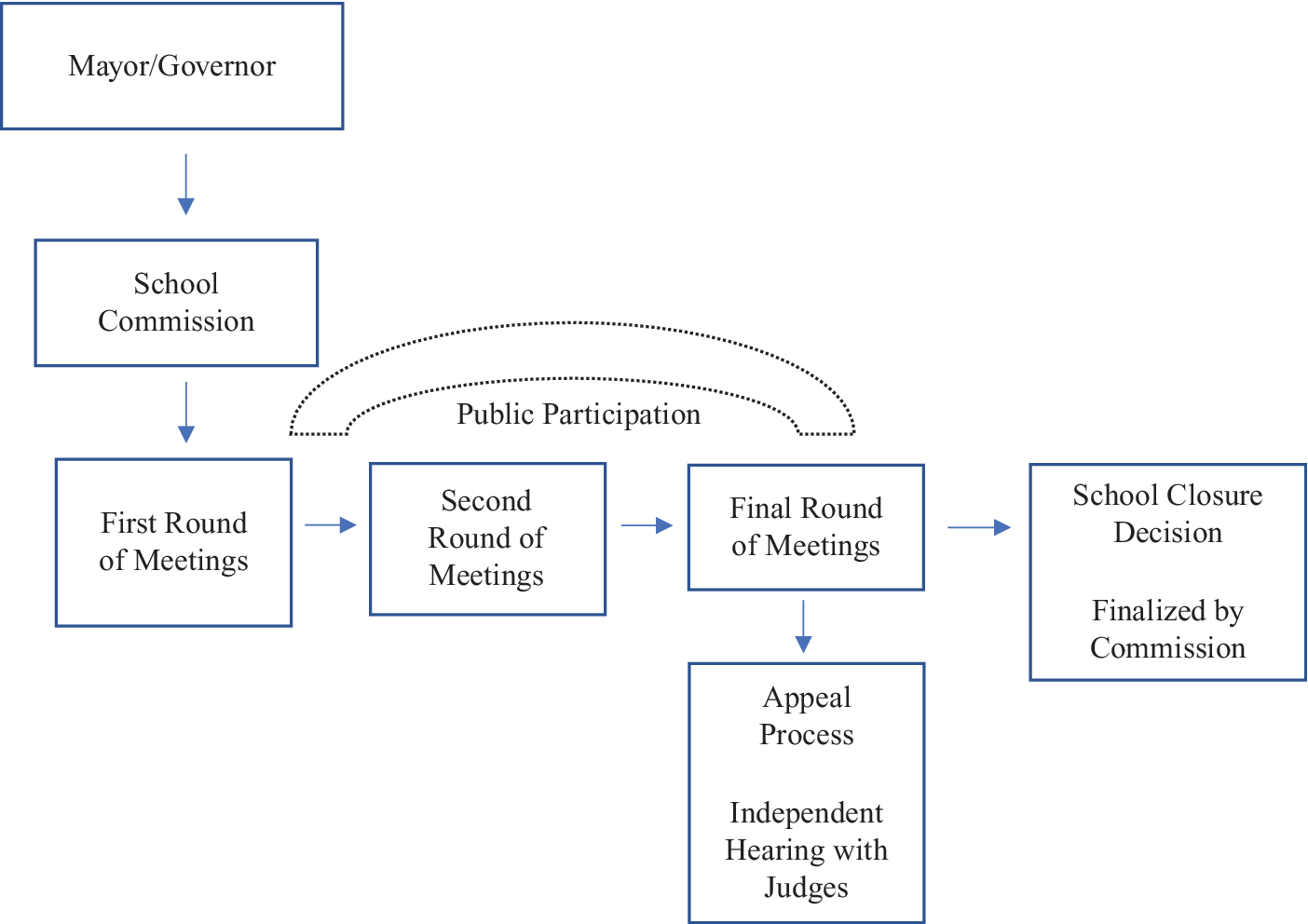
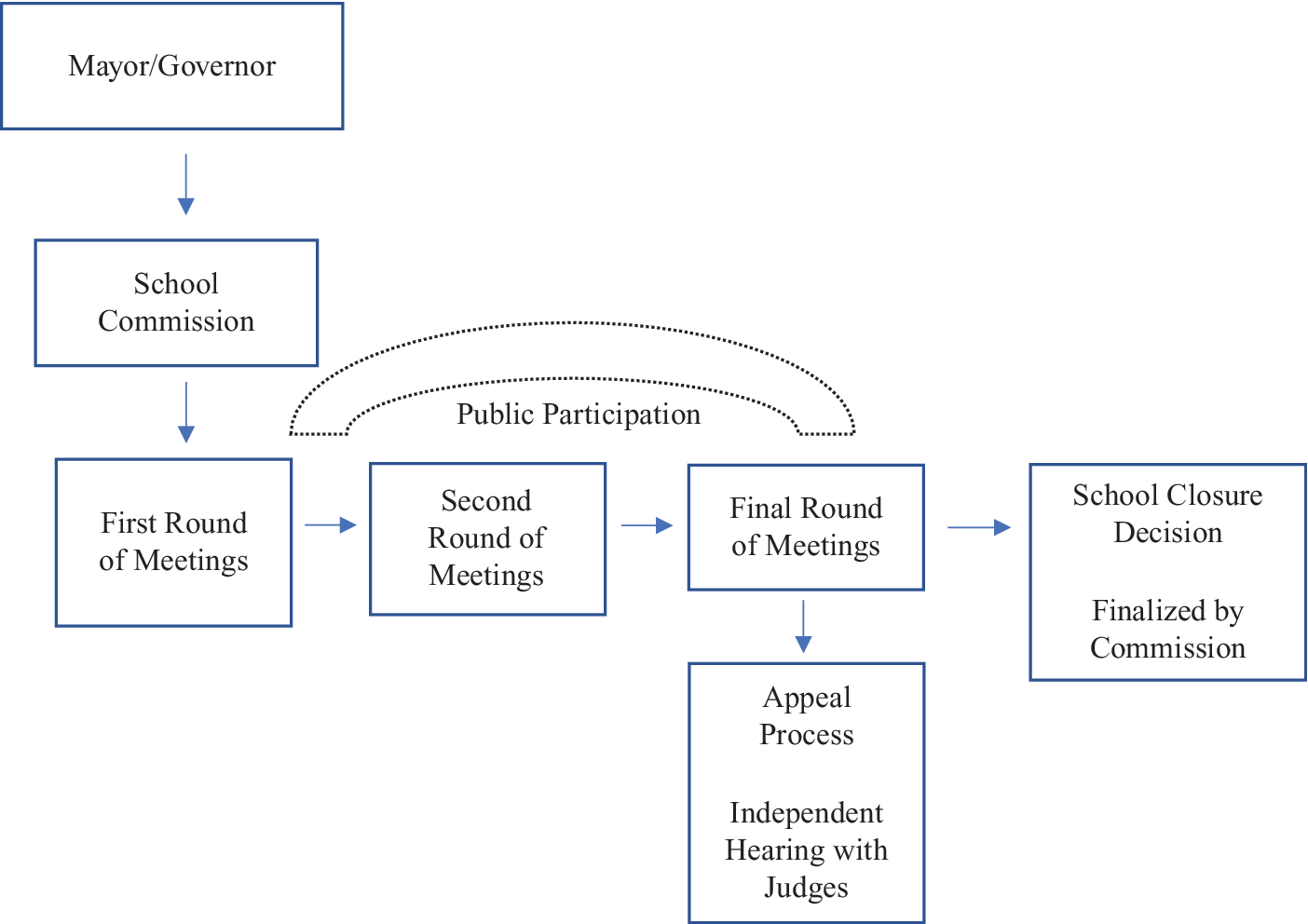
In 2009, the U.S. Department of Education proposed a “turnaround”Footnote 2 of the nation’s 5,000 lowest performing public schools within five years. In late 2012, public school officials in Chicago and Philadelphia announced the highest number of potential school closures in the history of each district, with nearly 400 between them. The decision, based in part on under-enrollment and low performance, would affect over 20,000 students. Following the announcements, both cities laid out a process for those who would be affected to participate in public meetings about the potential closure of their schools (see Figure 1).
Typically, school districts generate a closure list based on a set of criteria such as under-enrollment and low performance. These criteria can change based on the priorities of a school district, and they can change from year to year or even within the year. Once the criteria are established, all the schools that fit are placed on a closure list that the district distributes to the public and to the bodies that have the power to make final decisions about closure. In Chicago, the school board, appointed by the mayor, is charged with this task; in Philadelphia, a School Reform Commission (SRC), with three members appointed by the governor, and two by the mayor, is convened for this task (it has since dissolved). In the 2013 round of closures, Chicago Public Schools (CPS) listed 330 schools for closure, and the School District of Philadelphia (SDP) listed 60 schools; this number was calculated based on the respective school district’s estimate of each school’s enrollment capacity relative to its actual student population. While underutilization figured as the primary reason for closure, academic performance was also a potential reason, especially in Philadelphia. Once the schools were placed on the list for potential closure, the school board in Chicago and the SRC in Philadelphia were given the final say on which schools would be closed.Footnote 3
After a closure list is generated but before a board or commission takes a final vote, the district makes a public announcement about the meetings scheduled for public comment on the proposed school closings. At these meetings, participants offer arguments about why their schools should not be closed and information about issues the district may have overlooked. Individuals affiliated with the schools and other interested organizations also offer alternative proposals in the hope that they can save their school from being closed. School board members are tasked with listening to feedback that, ideally, will contribute to the final decision. Thus, at least in theory, these meetings could be examples of participatory democracy at work, spaces where people can be heard and can participate in ways that might influence decisions that affect them (Pateman Reference Pateman1970, Reference Pateman2012; Polletta Reference Polletta2002; Fung Reference Fung2004; Fung and Wright Reference Fung and Wright2001, Reference Fung and Wright2003).Footnote 4
Providing Resources to the Community to Participate while Poor in the Policy Process
While the meetings outlined earlier marked the single mechanism provided by the school district for those affected to contest the decision, nearly 90% of these affected individuals belonged to resource-poor communities of color that traditionally participate at low levels, particularly around school issues (refer to table 1C in the online appendix; Henig et al. Reference Henig, Hula, Orr and Pedescleaux1999). Thus, it was unclear whether those affected would participate in these public meetings to contribute their opinions on the school closure decision.
In both Chicago and Philadelphia, laws mandate a ninety-day window between the announcement of school closure and the closing of a school building/program to ensure public input on school closure decisions.Footnote 5 To facilitate public input, CPS developed the Office of Family and Community Engagement, which appointed community engagement officers across the city’s fourteen established school networks. In addition, CPS developed a community engagement process and provided space, transportation, and financial support to encourage participation at community meetings and public hearings.
The SDP also developed a process “that provided multiple opportunities for public comment.” In addition, “the mayor’s chief education advisor hired a staffer whose focus is on community outreach” (Cucchiara, Gold, and Simon Reference Cucchiara, Gold and Simon2011, 297) and developed the Office of Family and Community Engagement. District officials from this office reached out to community groups and residents nearly two years in advance of the final decision and created additional opportunities for students, school administrators, and community leaders to discuss alternative options in smaller venues than the community meetings. As one of the teachers who held a leadership role in the campaign to save University City High School summarized, “To show the district was listening, they arranged a meeting with students and the deputy superintendent, I think, to discuss what options there were that took place in early January [2012?].” The SDP wanted to be perceived as responsive, due to its mandate, and thus provided resources to enable the community’s participation. And indeed, these resources facilitated the participation of groups that typically are associated with low participation (Bobo and Gilliam Reference Bobo and Gilliam1990). In the end, at least sixty community meetings related to closure were held between December 2012 and March 2013 across the two cities. Attendance at these meetings ranged from 500 to 1,000 people in Chicago, and between 200 to 500 people in Philadelphia (refer to table 2.1., 2.2, and 2.3 in the online appendix).
School Closure Participation, Policy Feedback, and Participatory Democracy
Participation in the school closure process followed, in part, patterns described in the policy feedback and participation literature. The policy defined the target population by specifying certain schools as eligible for closure and then provided resources to those target groups in the form of access to public officials through community meetings that removed traditional barriers to participation. The construction of these groups as targets and the resources they accessed likely facilitated not only their increased participation but also perceptions of that participation as either positive or negative (Nuamah Reference Nuamah2020a, Reference Nuamah2020b). However, the analysis also reveals some findings that are distinct from traditional work on these topics.
First, the analysis demonstrates how the policy target category may include not only those directly affected by the policy but also those who are not directly affected and yet share the same demographic or geographic characteristics (e.g., a Black parent whose child attends a school threatened for closure, as well as a Black person who lives in a neighborhood where a school closure occurs). I label this expanded conception of policy feedback “shared policy targets” as it encompasses those who identify with the directly affected group. Second, this study adds to our understanding of how these targeted groups react to specific local policy decisions (closures, land distribution), thereby moving the literature beyond its traditional focus on federal programs (SSI, AFDC). Third, the study challenges existing notions that citizens’ encounters with government are either only positive or negative. More specifically, the experience of participating in the public school closure process, according to those affected, is understood as contributing positively to their civic skills and perceptions of internal efficacy, while at the same time contributing negatively to their views on policies, politics, and their future participation. These negative attitudes persist even when the citizens seemingly achieved policy success. In particular, the investigation documents the temporal dynamics for citizens of being a policy target, as they become short-term winners and long-term losers in the contest for a key resource. In so doing, it shows that citizens’ feelings toward the policy process are not static and singular, but rather dynamic and plural. Finally, the study concludes by offering a theory to encapsulate how affected participants’ experiences with the policy process and its aftermath contributed to their collective participatory debt, or a deepened mistrust, fatigue, and disillusionment resulting from the negative experience of participating repeatedly in processes that essentially “have no bite on policy decisions” (Besley, Pande, and Rao Reference Besley, Pande and Rao2005, 649). As a whole, the study reveals the difficult lessons Black citizens learn when participating while poor.
Data, Methods, and Strategies for Analysis
My investigation relies on data from research conducted in Chicago and Philadelphia over forty-two months in the period between 2012 and 2017. Chicago and Philadelphia are valuable cases for multiple reasons. First, both cities experienced the largest numbers of school closures in their respective histories in 2013. In that year, Chicago closed forty-nine public schools, and Philadelphia closed twenty-three. Second, while Black residents made up approximately 47% of the total public-school population in both cities, 88% and 81% of students attending the schools threatened for closure in Chicago and Philadelphia, respectively, were Black. Over 90% were eligible for free or reduced lunch (i.e., were low income) (Chicago Public Schools, N.d.; School District of Philadelphia, 2012).
Regarding the differences between these cities, in Chicago, those affected by closure were notified three months in advance, while in Philadelphia public school closures were first announced nearly two years before the final decision to close eight schools in 2012 followed by twenty-three more in 2013. In addition, Chicago had begun systematically closing schools in 2001, and the process took on a large scale in 2011. In Philadelphia, 2012 marked the first time the city experienced large-scale school closure in a single year. The differences in experience with large-scale closure over time enable valuable comparisons between Chicago and Philadelphia. Footnote 6
Data Collected
Qualitative interviews are most useful for understanding how citizens articulate their own experiences (Walsh Reference Walsh2012; Mettler and Soss Reference Mettler and Soss2004). Although surveys facilitate the ability to generalize from findings, and to some extent to determine causality, they rarely ask in-depth questions about policy experiences. In addition, because of my interest in examining community meetings as sites of political learning, ethnographic observations of community meetings were optimal for investigating community members’ experiences with the school closure process and their interpretations of its impacts (Fung Reference Fung2004). Footnote 7
Between 2012 and 2015, I collected semi-structured interviews, observed community meetings, and analyzed community meeting transcripts in Chicago and Philadelphia. I collected semi-structured interviews with parents and community residents that ranged from twenty-five minutes to one hour to understand citizen’s reasons for participating and their feelings about their participation and politics. The primary questions asked were the following: Describe your feelings toward school closings? Have your recent experiences with school closings affected your desire to participate in community education-related issues? How about politics, more generally? Did your experience with school closings teach you skills you did not have (or help you discover skills you did not know you had)? If so, what skills? Did your experience with school closings teach you lessons about government? If so, what lessons? Do you believe your participation can/did make a difference?
I then conducted semi-structured interviews with leaders of organizations (school district and community), also ranging from twenty-five minutes to one hour, to determine the methods they used to encourage citizens to participate in the closure process and to examine their perceptions of the utility of participation. I asked school district officials about their rationale for closure, tactics for ensuring participation, and perceptions of the actions of affected communities. I also asked community activists what tactics they used to mobilize citizens. In particular, how did they develop campaigns against closure? How did they train citizens to participate? What was the impact of their efforts? Finally, I observed community meetings and analyzed transcripts to learn how meetings were run and to investigate citizens’ experiences with participation. The central goal was to gauge which issues were raised the most regarding concerns about closure and to identify people to interview.
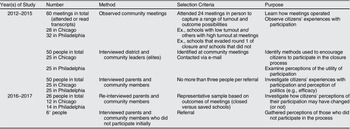
In 2016–2017, I returned to both Philadelphia and Chicago and re-interviewed nearly one-third of the original interlocutors, who were interviewed between 2012 and 2015. To begin, the same questions from the original interviews were asked. Citizens were then asked whether their experiences with school closings impacted their engagement with other political activities and whether their perceptions on school closures, political engagement, and efficacy had changed. Table 1 summarizes the sample, approach, selection criteria, and purpose.Footnote 8
Number of participants, method, selection criteria, and purpose
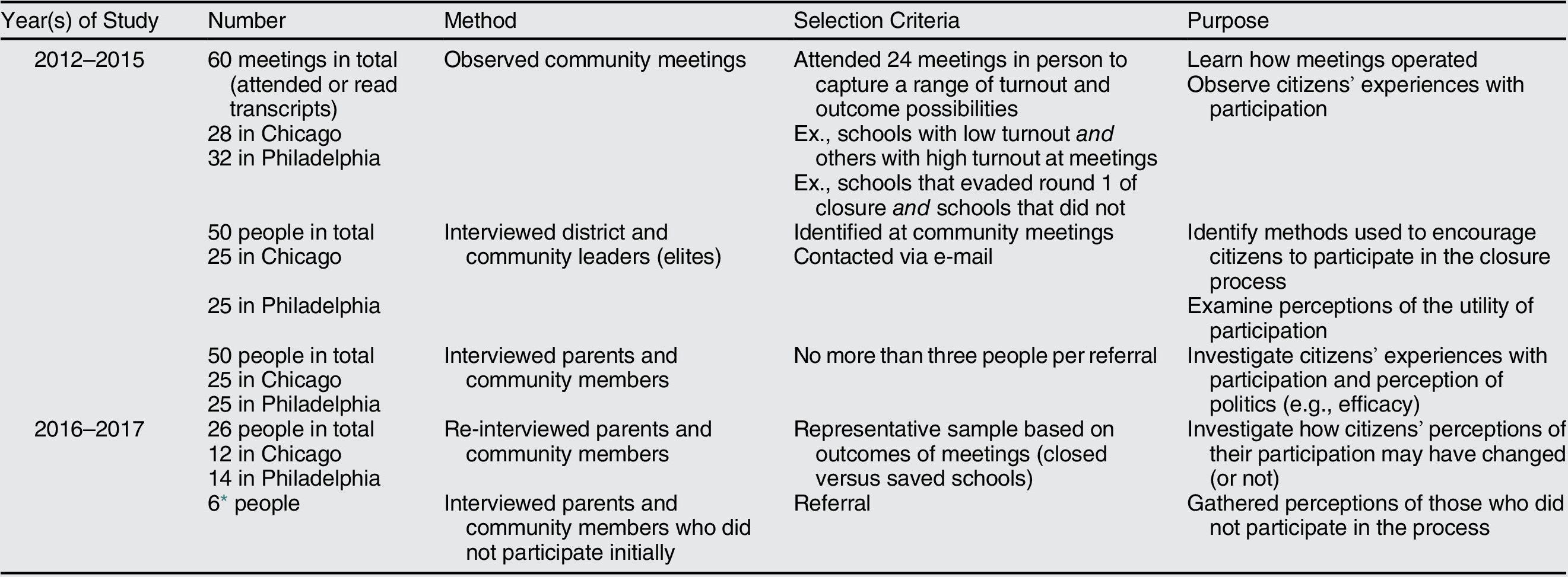
* Note: Data is not directly analyzed in the paper
How school closure decisions are made
Selecting Interviewees
Given the large number of schools on the closure list, selection of interviewees was focused on members or supporters of schools that varied in their level of organization (community turnout at meetings) and outcome (see table 1). For example, if a community meeting had relatively low attendance from one school when compared to that of another school, members from both the low attendance and high attendance schools were selected and then their outcomes were followed. In addition, individuals from schools that evaded closure and others that did not were also followed in order to facilitate asking members from both schools about their perception of participation and political efficacy.
While members of schools threatened for closure were the primary people selected for interviews, a combination of snowball sampling and purposeful selection was used to ensure variation among them. When using snowball sampling, no more than three people per referral were interviewed to reduce self-selection issues. In addition to using personal referrals, parents and elites at community meetings were identified and interviews with them either at the meeting site or at a future date were requested, based on their preference.
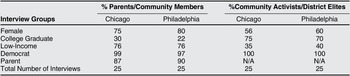
Altogether, transcripts of community responses from sixty meetings produced by the school districts in Chicago and Philadelphia were collected. Twenty-four of these meetings were attended in person (for transcripts and sample coding of meetings, refer to the online appendix). Both during and after these meetings, parents/community members and elites (e.g., local activists and district officials) in Chicago and Philadelphia were interviewed, and those interviews were recorded and transcribed. One hundred people were interviewed in total: twenty-five parents/community members in Chicago, twenty-five elites in Chicago, twenty-five parents/community members in Philadelphia, and twenty-five elites in Philadelphia (see table 2 for demographic information). With these data, this project investigates how those targeted for closure participate in the policy process, and how they interpret its political consequences.
Demographic information of interviewees
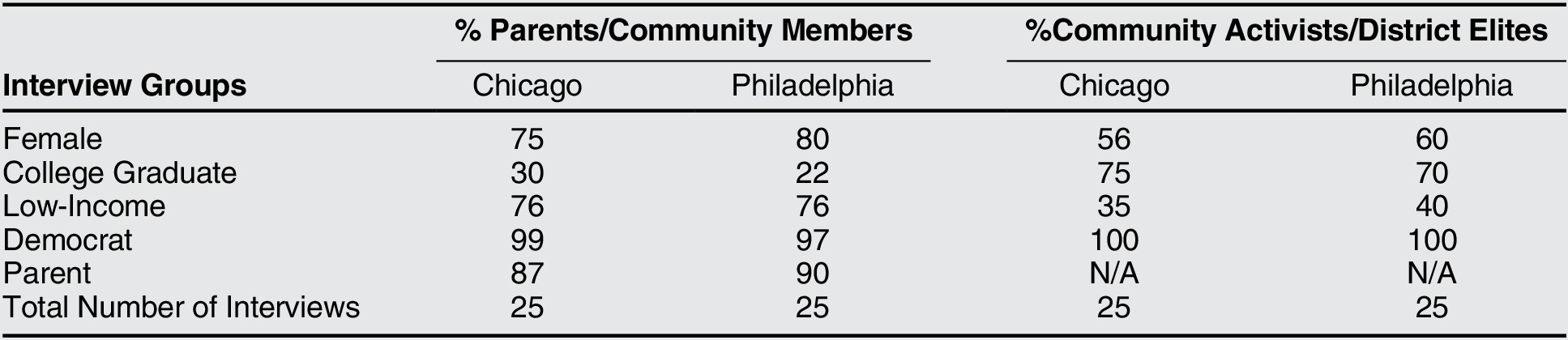
Note. Data collected from original interviews
Qualitative Data Coding
To start, the data is coded into a set of categories based on the themes in the existing literature on participation: resources (e.g., time, money), group cohesion, and political trust (see, e.g., Skogan and Hartnett Reference Skogan and Hartnett1997; Emerson, Fretz, and Shaw Reference Emerson, Fretz and Shaw1995; Miles and Huberman Reference Miles and Michael Huberman1994). Based on observed patterns and themes that emerged in early interviews, the data were then recoded into an expanded and more refined set of categories focused on citizens’ reason for participating, their method of participating, and their perceptions of the impact of their participation (for more detail, refer to the online appendix).
Coding Their Reasons for Participating
On the question of why individuals participated, the following themes stood out: concerns that school closures would increase neighborhood crime and overcrowding in classrooms, disrupt family ties and community stability, increase the number of charter schools, lead to the unfair distribution of public goods, disproportionately affect Black and Brown schools, and increase mistrust between the school district and the community.
To gauge the pervasiveness of one issue more than the other within these categories, issue mentions from community meeting transcripts were counted. For example, in the reason for participating category, violence and gangs were both issues that were mentioned. Therefore, if violence was mentioned 100 times and gangs mentioned 200 times, each of these issues was added together, thereby resulting in a total of 300 mentions for the crime code within the reason category. The purpose of counting issue mentions is to gauge which concerns were most commonly raised in relation to one’s policy attitude, in this case, opposition to school closure, before determining how citizens are activated to participate (for more, refer to table 1A in the online appendix).
Next, memos summarizing the qualitative interviews were developed and notes were taken on questions that remained unclear (Feldman Reference Feldman1995). Borrowing from the categories mentioned earlier, a memo was developed that grouped community responses to societal concerns related to the racial disparities of closure. A typical example of a statement that articulated this concern is the following: “They [are] not trying to close those schools on the North Side, it’s only the schools on the South Side, where the kids are Black and Brown.” In this quote, the interviewee expressed a concern that the policy targeted people of color concentrated in specific areas of the city. Data from the interviews suggest that this concern contributed to the development of a shared identity as targets of closure, or what I label as “shared policy targets,” among otherwise disparate groups (see also Anderson Reference Anderson2009).
Coding Their Method and Impact
Next, the data was divided into categories to determine how affected groups participated in practice (and what acted as a barrier to their participation). The responses could be categorized into the theme of “resources” including transportation, meetings, and civic partners.Footnote 9 In fact, across all neighborhoods examined except one,Footnote 10 the announcement of a potential closure contributed to an increase in the number of community partners available to assist in the fight against closure.
In 2014 and again in 2017, citizens were asked to assess the impacts (benefits or disadvantages) of their participation in the closure process. In 2014, affected citizens referred to their experiences of “seeing other schools win” and “learning how to make a case.” These factors were labeled “civic skills.” In addition, they expressed belief in their ability to get policymakers to respond to their concerns even though they maintained generally negative perceptions of the policy process and policymakers. The former responses were classified as “affirmations of internal efficacy” and the latter as negative interpretations of the policy process.
By 2017, it appears that the policy wins of affected participants did not necessarily contribute to positive attitudes toward the government or future participation. There were multiple references to the term(s) “fatigue,” “tired,” and “wore out.” These responses were labeled, “fatigue and disillusionment.” Furthermore, citizens expressed a deepened mistrust for government. From the follow-up interviews, their experiences appear to contribute to their collective participatory debt.
Table 3 previews how coding decisions were made as new information was learned over time. In particular, it illustrates how citizens move from suspicion of whether they can trust government, between 2012 and 2015, to a deepened mistrust for policymakers and the political process by 2017. Further, it highlights how citizens moved from describing themselves as using their positive civic skills and efficacy to fight, between 2012 and 2015, to describing themselves as too worn out to fight by 2017 (refer to the online appendix for more on coding decisions and methods). The next section uses these data to detail the findings.
Sample quotes of issue classifications over two sets of interviews

Note. Collected from original interviews
Empirical Analysis
Their Reason (Why): Defining Shared Policy Targets of Closure
To start, the school districts described the closures as an issue that directly affected families with children enrolled in underutilized schools. For example, officials from Chicago Public Schools claimed that the “primary driver of underutilized schools was population decline,” and that their closure would enable “the distribution of more resources to fewer schools (CPS Presentation, Austin-North Lawndale, Network Meeting, January 31, 2013, 1).” Yet local community groups promoted a counternarrative that described school closures as affecting not only families with kids but also the Black and Brown community more generally. In their view, “Schools more than 99% students of color (‘Apartheid schools’) have been the primary target of CPS School Actions,” suggesting that racial bias—and not under-enrollment—is the driver of closures (Nuamah Reference Nuamah2020b). This line of thinking helped developed a narrative around being a shared policy target as community members began to draw the connection between school closures and racial bias. As stated by one parent in Chicago, “Malcolm X fought against racism and segregation, and here we are fifty years later fighting to save Black and Brown children.” Such statements were indicative of broader claims related to a person’s racial group rather than to a person’s position as a parent, teacher, or staff member. These broader claims appear to contribute to the construction of a shared identity as targets of school closure based on race.
The idea of being a shared policy target was especially clear in Latinx communities in Chicago, where residents faced only one-tenth of the closures of Black neighborhoods but participated at similarly high levels and exhibited similarly high opposition to the policy. One lifetime resident of a majority Latinx neighborhood in Chicago stated:
When I heard about closing schools in [a nearby neighborhood], my heart dropped, so I wanted to show solidarity… . I just don’t like how they are treating us at this meeting… . sending us here and there… . It’s divisive. But hopefully, this issue brings us together … and show[s] the powers-that-be that you can’t just step on us.Interviewer: Is your school closing?Interviewee: No, but I am here to support.
In this case, a resident of a majority Latinx neighborhood unaffected by the threat of closure expressed support for a nearby Black neighborhood marred with such threats. Many of the recorded interviews included statements such as, “It’s not a coincidence that these closings are only happening in Black and Latino neighborhoods.” This quote illustrates an awareness that potential school closings affected some communities more than others and suggests that these differential impacts were intentional. Together, these data suggest that it is this shared perception of being a target of closure, particularly based on race, that widened the pool of people who could participate in the process made available by the school district.
Their Method (How): Mobilizing Resources
Community groups played a critical role not only in broadening the definition of who was affected by the school closure policy but also in connecting community members to the resources made available by the school district. Further, these groups created specific tactics for participating in these meetings, tactics that further facilitated community participation (Han Reference Han2009, Reference Han2014; Morel Reference Morel2018).
As detailed earlier, the school district (both CPS and SDP) provided resources in the form of access to public officials through meetings that took place in the communities affected by the closures. Prior to these meetings, parents made references to the “poor timing” of school-related events by the district, particularly for those who had to work double shifts at their places of employment. Furthermore, when meetings were not clearly within walking distance, parents and community members raised issues with the transportation options available to them. Yet the advent of school closure facilitated new partnerships with community organizations and the provision of resources by the school district, which helped community members overcome traditional barriers to participation and engage in the policy process.
The organizing of these communities typically began as soon as the list of schools targeted for closure was released. As one parent activist in Philadelphia explained, “Here is the thing: most of them didn’t realize the school was up to be closed—and we rallied on the school steps and then people would come up and sign up.” After parents on the list and their wider community were notified through the school or a community group, they became part of the process. In particular, community organizers, which include union leaders, developed strategy-building sessions that focused on how to present an effective case against closure in preparation for the district meetings. A parent in Philadelphia stated, “We found out at first there was threats … and they were calling these meetings about the school and that was the first warning sign… . Then the letters came, then you would go to these meetings, call your politicians, write letters, do this and do that.” In addition to these efforts, community groups mobilized the local media to raise public awareness of potential school closures and the activities to protest them. A parent activist explained:
We had a meeting… . The radio stations were there … a bunch of people … a lot of community leaders… . Everybody came in. They agreed to give us three hours to talk about the Philadelphia situation with the school system.
A teacher activist in Chicago added, “You know, the average person doesn’t really understand the fight. And so … we have to make the story important to them so that we can have momentum.” Ultimately, the goal of these community organization efforts was to help parents and community members understand their investment in the school closure issue before moving to help them defend against the closure of their schools (see also Cohen et al. Reference Cohen, Golden, Quinn and Simon2018). And indeed, this strategy appeared to work. As stated by a parent in Philadelphia, “we went down to rallies, we blocked traffic, went to the SRC [meetings], marched to the school, what didn’t we do?” The fact that there was already an available mechanism to participate, community meetings, likely played a key role in the effectiveness of these organizations in getting resource-poor groups to engage in the policy process.
Impacts: Learning How to Win
Civic Skills
Collectively, the parts of the closure process demanded that community groups, teachers’ unions, and schools organize parents to participate in ways that were previously not afforded to them. Consequently, the data reveal that the school district and local community organizations enabled parents to develop and strengthen their civic skills throughout the closure process. As an organizer against the school closure in Philadelphia explained: “When people are at the mic and must present an argument, it’s a learning experience. You know, you have to figure out how do you get a response.” Getting a positive response from school officials was a central goal that community organizers conveyed to community meeting participants, especially parents. A Chicago Teachers Union representative described it in the following way: “Schools were given orders … on how they should speak and what they should speak about.” Parents strongly desired to keep their schools open and willingly implemented these strategies, most of which focused on the use of surveys and school data. For example, in Chicago community-meeting data revealed the ways participants publicly expressed their feelings about school closings shifted from more open responses, such as, “I’m not a great speaker, but all I have to say is please don’t close our school,” to more focused responses particular to a school, such as, “We have established a very strong and safe and supportive school environment, according to your My Voice/My School Survey so don’t close our school.” These shifts in arguments were a response to the guidelines school districts provided for how participants should present their case. Participants did not fully adhere to these guidelines until the second meeting. As one parent in Philadelphia observed, “You have [to] fight facts with facts, you can’t just go up there saying anything.” Many parents adopted this approach if the tactic was consistent with their general opposition to closing the school.
Still, the level of organization that coalesced around school closure meetings led to the development of strategies beyond the use of data. Participants learned skills not only from participating themselves but also from watching how others faced the threat of school closure. As a Philadelphia participant in the effort to save Beeber Elementary School stated,
We took those lessons from seeing [Samuel] Gompers [Elementary] keep their school open, seeing Overbrook [Elementary] keep their school open, seeing some schools that were having traction… . If I didn’t go to some of the facility master plan meetings, I was watching it on live stream… . I didn’t go to South Philly but I watched it on TV… . But I went to Southwest Philly, I went to all the West Philly meetings, I went to the North Philly meetings, ’cause I really wanted to understand the complexities and the issues, and seeing how the district was handling that. And so I think that gave us a lot of … foundation, in terms of coming up with our strategy.
Parents whose children’s schools were targeted for closure learned to engage in the district’s closure process to “understand the complexities and the issues” and come up with a strategy for defending their schools. These experiences of organizing groups, planning meetings to prepare groups to participate, making presentations, or simply attending meetings played important roles in the development of skills associated with effective civic participation.
Affirmations of Internal Efficacy
A key contributor to effective civic participation is a perception that he or she can affect the political process and that it is worthwhile to get involved (Campbell, Gurin, and Miller Reference Campbell, Gurin and Miller1954), known as political efficacy. Political science literature has examined both internal efficacy (the extent to which citizens believe they can influence the political process) and external efficacy (the extent to which citizens believe the government is responsive to their needs) over the decades (see, e.g., Lane Reference Lane1959; Craig and Maggiotto Reference Craig and Maggiotto1982; Finkel Reference Finkel1985; Niemi, Craig, and Mattei Reference Niemi, Craig and Mattei1991; Soss Reference Soss1999). The levels of political efficacy among different populations are often structured by their encounters with public policies, such as SSDI, AFDC, and the GI Bill (Schneider and Ingram Reference Schneider and Ingram1993; Soss Reference Soss1999; Mettler Reference Mettler2007; Bruch and Soss Reference Bruch and Soss2018; Michener Reference Michener2018). Yet the data reveals that internal efficacy can also be fueled by the victories secured from school closure meetings.
Following the actions of participants, the school district in each city agreed to several concessions, including the removal of certain schools from the closure list: performance level 1 schools (high-performing schools), high schools (in the case of Chicago), and schools that had recently experienced a school action.Footnote 11 By the end of 2013, a one-year moratorium was passed in Philadelphia through a city council vote of 14 to 2 (Mayes Reference Mayes2013). The next year in Chicago, the CPS CEO Barbara Byrd-Bennett announced a moratorium that would limit the school districts’ ability to close schools over the next five years (Chicago Public Schools 2012).
Most important, in both Chicago and Philadelphia some parents and community groups were successful in saving their schools from being closed. The 2013 school closure list in Chicago began at 330 schools, was reduced to 129, and was finally narrowed down to forty-nine. The school closure list in Philadelphia began at sixty, was reduced to forty, and was finally narrowed down to twenty-three. These reductions were presumably a result of evidence that organized parents and activists provided at community meetings and appear to have affirmed to participants their internal efficacy.
As one parent from University City High School in Philadelphia stated, “it was a good lesson in civic engagement, but we weren’t just fighting just because, we thought we could win.” Perceptions that one could win (efficacy), the data suggests, were fueled by the public celebration of the victories secured from previous closure meetings as attributable to collective action and participation. For instance, a community member who participated at the first official community meeting on closure in Philadelphia stated, “We shut it down, because it was like, ‘You lied… . Your people are not being truthful and honest.’ … The pressure got to them and the next year they announced they weren’t closing any schools.” A community organizer who attended the same meeting explained to me, “We thought it was a victory of sorts that the number of schools was de-scaled and the year after they didn’t close any. So we felt it was because of us.” Both participants viewed their actions as contributing directly to the decisions of the school district to save their school from closing. In another case, when asked how parents of students at Beeber Elementary succeeded in keeping their school open, one organizer responded, “Yeah. Alright, number one … we had a really good Home and School president, Ms. [Lynne].”Footnote 12 A parent activist from the same school identified another factor that led to success: “We became a committee to stop the closing, we formed a committee to come together and we were able to save almost all the schools.” These participants connected their success in saving schools from closure to their ability to organize people or to have a strong advisory council. The earlier findings provide suggestive evidence that the opportunity for resource-poor citizens to participate may be valuable for affirming their internal efficacy and civic skills.
But Even When We Win, We Lose? Toward a Theory of Collective Participatory Debt
Indeed, although the 2013 school closure process may have taught parents some positive civic lessons and led to some positive outcomes, several parents interviewed (even those parents who succeeded in defending their children’s schools from closure) expressed high levels of disinterest in continuing to participate in education-related actions thereafter, between 2016 and 2017. Footnote 13 As one member of the school reform commission in Philadelphia stated, “after the schools were closed we didn’t have very many parents coming to the SRC meetings and no parents were at the hearings that were held over two Saturdays.” If community members affected by closure had the civic skills and internal efficacy to participate, why did they lose interest in participating?
To start, the number of groups that once supported the schools affected by closure dropped by almost half as they redirected their resources to new battles. In addition, the structure that the school district put in place such as making school officials available to meet with community members and parents in their neighborhood was removed after the final closure list was established. Thus, lower interest in participating after schools closed was likely shaped by the fact that most of those affected by the policy no longer had access to the conditions that facilitated their participation in the first place. One might expect a decreased interest in participating when the resources that facilitated engagement are reduced or removed.Footnote 14
Collective Participatory Debt
Nonetheless, the observations make clear that the removal of resources alone does not explain the decreased interest in participation among those affected by the closings. One must also account for affected participants’ experiences with the actual policy process and their interpretation of its long-term impacts. In the long term, the analysis reveals that affected citizens express a combination of deepened mistrust, fatigue, and disillusionment with the policy process and their future participation. These negative attitudes are indicative of their Collective Participatory Debt (CPD).
The source of their CPD is two-fold: it begins with negative experiences with the policy process and is exacerbated by the lack of substantive policy response once the policy process concludes. More specifically, CPD accrues because of the non-democratic way that participation is organized (i.e., overcrowded meetings, lack of language translators, strict two-minute time limits for each participant to speak to officials) and because of the non-democratic responsiveness that results from that participation (i.e., the lack of preferred outcomes in the long term; short-lived victories). The adverse effects are seen once possible school closure is announced and lasts long after decisions are made. Thus, communities learn that even if they successfully save their school from closure, the damage has already been done.
Deepened Mistrust
Regarding the school closure process, specific decisions such as dividing participants into separate rooms and sending them “here and there” contribute to perceptions that the district sought to “isolate people …separate them,” in similar ways to “the hunger games.” For example, when an official would not allow more people into an overcrowded meeting room in Chicago in 2013, one community resident received a round of applause after declaring, “You knew it would be a big meeting. It’s been huge all over the city, and now you’re going to try to tell us no. We want to be in the same room! You’re are trying to divide us!”
Failure by officials to address language barriers at meetings also agitated participants. Several people interviewed recalled multiple meetings in which the only district officials in attendance did not speak or understand Spanish and also did not bring a translator to ensure that non-English speakers could participate. As stated by one community organizer in Philadelphia in 2014, “I remember one meeting in Kensington [where] three-quarters of the parents were Spanish-speaking. The [school district] sent a team but didn’t have a single person who could speak Spanish, which to me said a lot. If it was an obligation they thought about it, they wouldn’t have made these mistakes.”
Despite these negative experiences, these same people continued to participate in the 2013 process because they were hoping to “work together” to “not step on each other’s toes” and save all the schools.
What citizens eventually learn through their repeated participation in the community meeting process is that even if they do save some schools from closure, it may be at the expense of others as there is likely no reality under which all schools will be saved, thus preventing them from stepping “on each other’s toes.” In the words of one parent in Chicago: “The board is not asking whether [closing schools] is a valid option, they are asking which schools.” And yet they also observe that those who are supposed to have the power to make these decisions are not present at the meetings to receive their feedback. As said by another community member in Chicago, “My first question is where is the board of education? Where is the Barbara Byrd Bennet? Where is Rahm Emmanuel? Who truly is the puppet master? We know that you all are not making these decisions over our community school and if they are not here what does this say about our input?” The more citizens recognize these inconsistencies in their school closure experiences, they begin to view the policy process and the policy outcome as undemocratic. The evidence of this learning is best illustrated in the case of Philadelphia in 2015, two years post mass school closure:
Parent: I think the people were in denial. They didn’t know that this could possibly happen so we all attended the meetings and went along and thought we would win, and it turned out we didn’t win, we lost our school.Interviewer: But didn’t many people save their schools?Parent: I don’t think those people actually won. There was a number … say it was 120, we are going to close 120 hypothetically speaking. Parents were outraged so the district gave in and said that is too much to close at one time so we will just close 100, so they had to pick which 100 and they got that small margin of twenty and it just happened to be that school.Interviewer: How are you so sure?Parent: Because they are not telling us the truth about the future of education. Just tell us the truth about education and what we need to actually do to save our schools, what do we need to do? What is the real picture of the funding? … Just tell the truth instead of having all of us fight over the limited resources.
As illustrated in this interview, key components of people’s experiences with the process raise questions about the policy that were left unanswered by the district. These experiences confirm citizens’ suspicions of the futility of their participation as they move from “denial … that this could possibly happen” in 2013 to attendance and a belief that they could “win” to, finally, a complete reevaluation as to whether any schools had “actually won” between 2015 and 2017.Footnote 15
While both school districts claim that the meetings represent the “greatest source of community input” and that the input from the meetings will “inform recommendations that [they] make,” those affected learn that these meetings appear to represent a type of democratic responsiveness in themselves; one in which accountability is measured simply through participation, rather than by the democratic outcome of that participation. In other words, “everyone gets an equal opportunity for input into a decision, not an equal opportunity for impact on a decision.” (Polletta Reference Polletta2012, 49). Ultimately, then, affected citizens determine that their policy “wins” do not reflect the type of democratic responsiveness they want the most: “the truth about the future of education and what [they] need to actually do to save [their] schools,” rather than another “fight over… limited resources.”
Fatigue and Disillusionment
Over time, it becomes more difficult for citizens to justify their participation due not only to a distrust of the system but also to mobilization fatigue, which leaves them disillusioned about the prospect of future participation. The feeling of fatigue is a critical distinguishing aspect of the CPD concept as it recognizes that the poor likely pays a higher price (relative to high resourced individuals) for their repeated participation when there is little responsiveness from the government.
For example, in 2015 a parent of Beeber Elementary School explained why she stopped participating after successfully defending the school against closure in 2013:
Right now it’s like zzzzz (haha), and I hate to say it, because I am not there. But the parent involvement is like… . I think they were tired, we done fought to … keep the school open. It was one [school] right after the other… . It wore me out, it took me three months to get myself together.
This sense of being worn out was common among parents who had successfully fought to keep their children’s school open. Another parent from Beeber added, “And so now … like you say, we’re spared … so when the budget hit the fan … it was like, Whoa! So, now it’s like we moved to the point where … now we were fatigued.” References to fatigue continued as each year passed and the outcomes of their efforts failed to be realized. For example, in the case of Beeber, although parents and community members were technically successful in defending their school against closure, the school district decided to co-locate the school with a new independent school called SLA-Beeber. Theoretically, the two schools would work together to improve the overall academic performance of Beeber. Yet the school district also decided to slowly integrate the two schools by phasing out Beeber. Upon returning in 2017, the school no longer existed, and unfortunately, many of the initial parents and community members involved were too “tired” and “wore … out” to fight against the decision.
Across the data, it became clear that several schools that won their battles to remain open in 2013 lost everything that enabled them to win by 2017. For example, another school that won their battle to remain open in 2013, Steel Elementary, lost 80% of its teaching staff and had their principal removed by 2017. The school district’s decision to remove the principal, specifically, kept the parents and community members who had fought for Steel from benefiting from their success. As stated by one parent from Steel, once they “broke up the family the commitment wasn’t there.” It also raised serious questions about the efficacy of their engagement. While these same parents have often been blamed in the past for lack of participation, what did their participation actually get them? In the words of this same parent from Steel, “this is not what we fought for.”
Indeed, by definition, the poor have fewer resources to spare and direct toward participation, thus it is perhaps unsurprising that they may be more prone to fatigue and disillusionment when those resources are used without evidence of a return. Yet, parents and community members across Chicago and Philadelphia initially believed that after they defended their schools against closure, they would be able to leave the memory behind them and work toward building the school they deserved. As explained in 2017 by one parent (turned parent activist), “When you win, you want to walk away … you want to win and go on with your life … you don’t want to win and be back … you don’t always want that pit in your stomach.”
Nonetheless, parents were asked to continue to advocate against a myriad of proposed reforms (e.g., budget crisis) following their closure battles. While many of those affected by the previous actions had the civic skills to fight against these proposed reforms and the internal belief that they could, many others lacked the energy and economic resources to do so, thereby contributing to their collective participatory debt. The result is that many parents and community members did not participate in these political actions, and the few who did continued to report negative feelings toward government and participation: “This place was jam-packed,” a parent remarked to a school district official in Chicago after the 2013 school closures; she continued, “people were here, and they were lied to. They are not going to keep coming out when they are being lied to.” In Philadelphia in 2016, a parent described it in the following way: “They had to go back and change based on our actions … but I don’t have any more faith in government.” Both parents’ remarks demonstrate how participants may develop distrust and disillusionment after engaging in the policy process, regardless of whether their actions led the policy purveyors “to go back and change” their decision. Even something like the election of anti-school closure advocates to the city council is described by parents as a “win and a loss.” One parent explained, “It’s a win and a loss right now with Helen and Susan being in politics because we won a voice in politics, but we lost their voice in the community.”
From the data, it appears that parents understand the value of having a voice in politics, but only to the extent that it enables the type of structural change that can at the very least facilitate a more transparent closing process that tells them “the truth.” Without this type of democratic responsiveness, these data suggest, those who participated in the 2013 school closure process interpret their actions as possibly contributing to short-term victories for some, but also to long-term losses for all. In the words of one Philadelphia parent who won their fight against closure, “I feel like we won the battle, but we lost the war.”
Comparing Chicago and Philadelphia
In the short term Philadelphians appeared to gain some clear political successes including the election of Democrats Mayor Jim Kenney and Governor Tom Wolf, who both express opposition to school closure, school advocates elected on the city council, the dissolution of the school board, and a lower rate of new charter school openings. Chicagoans, in contrast, re-elected Rahm Emanuel, despite a significant decline in support for him among those affected by closure, and elected a Republican governor, Bruce Rauner, who appeared to be unsympathetic to their demands to increase funding for public schools. Chicago also retained a mayoral appointed school board, rather than an elected school board, and suffered an even higher enrollment decline leading to a proposal by the district in 2017 to close more schools (for more on this comparison, refer to the online appendix).
Regardless of these varied political outcomes, by 2017 the general responses from those interviewed in Chicago and Philadelphia revealed a similar belief in the idea that the most damaging effects of the school closure process had occurred once the announcement was made by school officials in 2012, thereby undermining their efforts to defend their schools thereafter. As a CPS official involved in the closures explained, “the minute you tell a teacher that their school is closing in a year is the minute that school becomes unstable, because teachers immediately begin looking for jobs … and it becomes a chaotic school environment … extended across a whole year. … You see a huge uptick in a need for substitute teachers.”Footnote 16 (interview, school district leader, Chicago Public Schools, 2015). For example, in the case of Steele the “principal was forced out…and then the first year [they] lost 50% of [their] teachers.” The example of Steele demonstrates how just the act of putting a school on a closure list can induce setbacks, even if the school ultimately achieves the desired outcome of staying open. Once this occurs, the same persons who fought the hardest often become too “tired and overwhelmed” to fight again, contributing to the CPD of those communities.
Additional Considerations
As suggested by school officials interviewed, it could be the case that those affected by the threat of closure blindly adopt the attitudes of activists, or that the study only captures those who already participated a great deal in the policy process. To account for this possibility, the interviewer intentionally spoke to people who attended community meetings but did not speak at the microphone. They were then asked to connect the interviewer to those who lived in their community but did not participate. This practice allowed the interviewer the opportunity to hear from people who range from those directly affected (e.g., a parent of a child who attends a school threatened for closure) to those indirectly affected (e.g., a community member who lives in a neighborhood with schools threatened for closure). To be sure, the data revealed that those affected by closure, whether as parents or community members, largely expressed negative perceptions of the policy. It also revealed that some parents and community members borrowed presentation techniques or survey data from activists to buttress their claims. Yet parents backed their use of data with examples from their personal experiences and the experiences of others. For example, a parent in Chicago made the following statement to an official in 2013: “I already said these things the last time I was up here. Why do I have to keep coming up here?” Statements such as this provide suggestive evidence of how those affected by the threat of closure developed interpretations of the school closure policy within experiential parameters. In other words, their claims were largely contextualized within their specific personal experiences.
Conclusion
I demonstrate the countervailing interpretive impacts of participating while poor and Black in the policy process. Resource-poor minorities who participate in the school closure process appear to have initially gained unintended benefits, including access to school officials through mandatory meetings, affirmations of their internal efficacy, and the development of civic skills. In addition, some participants successfully saved their schools from closure.
Nonetheless, in Chicago and Philadelphia, three times more schools were closed in 2013 than the year before, totaling nearly 10% of their respective public-school systems. Furthermore, whether the schools were saved or not, those affected failed to receive democratic spaces to participate, satisfactory responses to their participation, and eventually lost the resources that enabled them to participate in the first place, likely contributing to negative interpretations of the policy’s impact as well as to their collective participatory debt. Despite the collective action of the resource-poor in the school closure process, then, the impact of their participation, in terms of real policy change, appears elusive.
These findings contribute to research on policy feedback by expanding conceptions of the target group to include those who are ordinarily left out but who play a similarly significant role as those directly affected in working to secure policy successes. Furthermore, I add to research that seeks to move from an exclusive focus on federal programs (SSI, welfare) to policy occurring at the state and local levels (closures, land redistribution) (Trounstine Reference Trounstine2018). Finally, I contribute to research on participatory democracy and mobilization by delineating the counterintuitive impacts of an ability to participate despite a lack in the personal resources typically associated with participation. This ability, due to government interventions, facilitates the securing of policy wins, and yet still leads to negative attitudes toward the policy, the government, and one’s future participation as those wins fail to materialize in the ways expected. I thus demonstrate how citizens’ experiences with policies are not static but rather dynamic as they become short-term winners and long-term losers in the contest to save a public good.
Ultimately, these findings raise serious normative questions: Given the experiences of those affected by closure, should civic participation (as a mechanism for enabling policy response) play such an important role in conceptions of liberal democracy? In the long term, what do resource-poor Black groups gain from their participation in the policy process? Or, to put it crudely, should poor Black citizens be expected to participate?
Over ten years ago, Zoltan Hajnal found that Black voters tend to lose “more regularly than other voters” in American democracy (Reference Hajnal2009, 50). He went on to conclude that this persistent loss “could, if not addressed, lead to disillusionment with the democratic process” (55). I find evidence of Black disillusionment with the democratic process. Further, I highlight the temporal dynamics of democratic loss for Black people beyond the ballot box, focusing instead on other forms of non-electoral participation, particularly those considered to be more accessible to, and representative of, commonly marginalized groups: community meetings.
To be sure, Carole Pateman’s classic work on participatory democracy makes clear that “the major function of participation in … participatory democracy is … an educative one, educative in the very widest sense” (Reference Pateman1970, 41). And indeed, citizens affected by closure learn lessons about democracy and their position in it, regardless of the outcome. Yet, as stated by Francesca Polletta, if “democracy comes to mean simply public participation, then spectacles of participation may be made to stand in for mechanisms of democratic accountability” (Reference Polletta2012, 41). In other words, while there is value in participation for the sake of education, the ultimate goal should be that citizens receive a democratic response from government.
While democratic responsiveness cannot exist without participation, for some Americans—particularly low-income Black Americans—participation may not guarantee democratic responsiveness. Even if they are heard, many participants find that theirs is a Pyrrhic victory: they have won but at too great a cost.
Resource provision from government to citizens should, and likely does, instill a sense that, maybe this time, democracy will be different. And indeed, citizens look for opportunities to give democracy a second chance. But then democracy disappoints them, and the distance to reinvest and believe becomes even steeper. The result is that poor racial minorities appear to be less trusting of government as well as increasingly weary of trying to make this relationship with democracy work. Together, these negative experiences contribute to their collective participatory debt. In short, democracy’s good credit runs out.
Supplemental Materials
Community Meeting Descriptions
Coding for Reasons Raised
Coding for Method and Impact
Participant Details
Questionnaire for Community Members
Additional Considerations
To view supplementary material for this article, please visit http://dx.doi.org/10.1017/S1537592720003576.
A list of permanent links to Supplemental Materials provided by the authors precedes the References section.