




No CrossRef data available.
Article contents
- Extract
- Introduction
- Coptic Textiles with Scenes from the Life of Christ: A Brief Survey of the Evidence
- The Social Function of Images Worn on the Body: and
- Putting on Christ: The Art of Dressing Divinely
- Contested Bodies: Reconstructing a Late Antique Controversy over Clothing
- Conclusions: Tying Up Loose Threads
Fashioning a Divine Body: Coptic Christology and Ritualized Dress
Published online by Cambridge University Press: 20 December 2005
Article contents
- Extract
- Introduction
- Coptic Textiles with Scenes from the Life of Christ: A Brief Survey of the Evidence
- The Social Function of Images Worn on the Body: and
- Putting on Christ: The Art of Dressing Divinely
- Contested Bodies: Reconstructing a Late Antique Controversy over Clothing
- Conclusions: Tying Up Loose Threads
Extract
In the ancient church, human bodies were contested commodities. Early Christian writers frequently wrangled over the ethical implications of dress and bodily adornment, and sought to regiment various forms of physical interaction and movement within their communities, from sexual contact to pilgrimage travel. Bodies—and how they were used—functioned as privileged markers of Christian identity, as valuable capital in the complex economies of Christian discourse and practice. Nowhere was this more the case than in discussions about Christ's body and its relation to his divinity. While such christological discussions took place throughout the Mediterranean world, in this article I have a keen interest in the ways in which the body of Christ was represented in Alexandria and Egypt from the fourth through the eighth century. Specifically, I want to explore late antique Coptic Christian understandings of the incarnation, and I propose to do so from a new theoretical perspective.
Information
- Type
- ARTICLES
- Information
- Copyright
- © 2005 Cambridge University Press
Introduction
In the ancient church, human bodies were contested commodities. Early Christian writers frequently wrangled over the ethical implications of dress and bodily adornment, and sought to regiment various forms of physical interaction and movement within their communities, from sexual contact to pilgrimage travel. Bodies—and how they were used—functioned as privileged markers of Christian identity, as valuable capital in the complex economies of Christian discourse and practice. Nowhere was this more the case than in discussions about Christ's body and its relation to his divinity. While such christological discussions took place throughout the Mediterranean world, in this article I have a keen interest in the ways in which the body of Christ was represented in Alexandria and Egypt from the fourth through the eighth century. Specifically, I want to explore late antique Coptic Christian understandings of the incarnation, and I propose to do so from a new theoretical perspective.
Traditional treatments of ancient christology have tended to focus on dogmatic and systematic questions, emphasizing primarily the conceptual categories employed in doctrinal disputes, while devoting proportionately little attention to the implications christology had for the various ways people “lived out” their faith. This artificial split between “thought” and “action” (or between “mind” and “body”) in the study of religion has been critiqued in the past fifteen years by the ritual theorist Catherine Bell (among others), who has pointed out the strategic function of ritual in shaping people's perceptions of the world and in configuring human bodies in relation to that perceived world.1
Catherine Bell, Ritual Theory, Ritual Practice (New York: Oxford University Press, 1992) esp. 6.
Here, I want to use theories of ritual practice—and of the ritually constructed body—in order to show how the Coptic theology of the incarnation may have been enacted or performed. My particular interest is in the way that ritualized activities—such as the wearing of special forms of dress—helped shape late antique Christians' perceptions of their bodies and their world. As a case study, I will examine Coptic tunics with scenes from the life of Christ, and raise questions about how Christians in Egypt ritually “put on” the incarnation. How did the wearing of such images reflect and promote Coptic understandings of Christ, and of the incarnation as a saving event? What might such dress tell us about the practices that helped produce particular kinds of “Christian” bodies in late antique Egypt? In order to answer such questions, I will first examine the surviving evidence for such tunics, and then discuss recent theories about their social function. Finally, I will interpret this material evidence in light of ancient Christian discourses that exhorted the faithful to clothe themselves with immortality, and in light of ancient Christian controversies over the use of clothing with pictorial images.
Coptic Textiles with Scenes from the Life of Christ: A Brief Survey of the Evidence
In studying extant collections of Coptic textiles, one is struck almost immediately by how relatively rare visual representations of Christ are. Even rarer still are examples of narrative scenes from the life of Christ (as opposed to non-narrative, stylized representations of Christ enthroned or of the Christ child seated on the lap of the Virgin).2
Pierre du Bourguet, S. J. (“Textiles, Coptic: Iconography of Woven Textiles,” The Coptic Encyclopedia [8 vols.; New York: Macmillan, 1991] 7:2224) seeks to explain the relative rarity of surviving Christian figural representation on late antique Coptic textiles on the basis of either “wear and tear” in everyday use or “the fact that so many surviving Coptic materials, generally the garments serving as shrouds for the dead in Coptic cemeteries, have suffered damage.” However, neither of these explanations is fully satisfactory, since both of these factors would also apply in the same measure to nonfigural evidence, as well as figural evidence that is not explicitly Christian.
Paris, Musée du Louvre, inv. E 13945; Pierre du Bourguet, Catalogue des étoffes coptes I. Musée national du Louvre (Paris: Éditions des Musées Nationaux, 1964) 212–13, fig. E 67 (X 4855); Maximilien Durand and Florence Saragoza, Égypte, la trame de l'Histoire. Textiles pharaoniques, coptes et islamiques (Paris: Somogy, 2002) 93, fig. 3. While there is some degree of uncertainty related to the identification of the two figures immediately below the infant Christ, they most likely represent Joseph and a reclining Mary. Alternatively, it is possible that in this scene we see a conflation of the Nativity with early Christian iconography of the Annunciation and/or the Dormition of Mary, where Mary is conventionally depicted on a bed or couch. In any case, within the context of the primary scene of the Nativity, the partially obscured figure in the lower right would appear to be one of the shepherds who were guided by angels to visit the Christ child (Luke 2:8–20). The other two non-narrative depictions of Christ in the Louvre collection are both dated from the tenth century C.E.
a) A roundel depicting Christ enthroned between two imperial figures, perhaps the emperor and his wife: Paris, Musée du Louvre, inv. AF 5737; du Bourguet, Catalogue des étoffes coptes I, 477, fig. G 334 (X 4418); Marie-Hélène Rutschowscaya, Tissus coptes (Paris: Adam Biro, 1990) 75.
b) A band with a bust of Christ accompanied by an alpha-omega inscription: Paris, Musée du Louvre; du Bourguet, Catalogue des étoffes coptes I, 478–79, fig. G 337 (X 4841).

Linen band with a scene of the Nativity embroidered in silk (eighth century CE): Paris, Musée du Louvre, inv. E 13945; courtesy of Réunion des Musées Nationaux/ Art Resource, NY.
Evidence from elsewhere tells a similar story. A limited number of ancient and medieval Egyptian textiles (or textile fragments) displaying scenes from the life of Christ has been documented in museum catalogues and collections found in Europe, North America, and Egypt. And, even in the case of such surviving examples, their fragmentary state of preservation often precludes researchers from reconstructing their original setting and function. As a result, it is sometimes difficult to determine whether any particular scrap of textile had a monumental or liturgical function (such as on a church hanging or an altar cloth), or whether it originally was part of a person's dress.
In order to illustrate problems and possibilities in the study of this material, let me focus initially on two particularly rich, documented collections: 1) the Coptic textiles in the Victoria and Albert Museum, catalogued by Kendrick in 1922, and 2) the Coptic textiles in the Staatliche Museen in Berlin, catalogued by Wulff and Volbach in 1926. Taken together, these two collections constitute a veritable treasure trove of data in comparison to the relatively meager evidence preserved in other museums.
The Victoria and Albert collection contains nine textile pieces decorated with identifiable scenes from the life of Christ: five embroidered fragments from ancient tunics, along with four dyed linen fabrics, probably the remnants of wall hangings. The seventh- or eighth-century embroidered fragments include four roundels (orbiculi) and one probable shoulder band with various Gospel images: the Annunciation (fig. 2), the Last Supper, Mary Magdalene's witness to the resurrection of Christ, and two scenes depicting the Adoration of the Magi.4
London, Victoria and Albert Museum; A. F. Kendrick, Catalogue of Textiles from Burying-Grounds in Egypt (3 vols.; London: H. M. Stationery Office, 1922) 3:57, no. 777, pl. XVIII (Annunciation); 57, no. 778, pl. XVI (Last Supper); 58, no. 780, pl. XVIII (Mary Magdalene and Christ); 59, no. 781, pl. XVII (Magi); 59, no. 782, pl. XVII (Magi). Kendrick tentatively identifies the fragmentary image on the shoulder band (no. 782) as the Adoration of the Shepherds, but I think the iconography that survives—especially, three pairs of legs approaching a seated figure (probably the Virgin)—conforms more closely to late antique representations of the Magi. The figure of a duck in the embroidered border, a common gift brought by the Magi in early Christian art, would seem to bolster this interpretation of the fragment.
London, Victoria and Albert Museum, inv. 1103–1900; Kendrick, Catalogue of Textiles, 3:64–65, no. 785, pl. XIX (Annunciation; see also Rutschowscaya, Tissus coptes, 132–33); 65, no. 786, pl. XIX (Nativity); 65–66, no. 787, pl. XX (Christ's healings and miracles); 66–67, no. 788 (Judas' betrayal?). For a comparison of iconography on embroidered and dyed fabrics, see du Bourguet, “Textiles, Coptic: Iconography of Woven Textiles,” and “Textiles, Coptic: Iconography of Resist-Dyed Fabrics,” in The Coptic Encyclopedia, 7:2221–27, 2227–30.

Coptic textile with a scene of the Annunciation (sixth century C.E.): London, Victoria & Albert Museum (Kendrick, no. 777, pl. XVIII); courtesy of Victoria & Albert Museum/ Art Resource, NY.
The vast collection in the Staatliche Museen, Berlin, includes eight embroidered fragments with scenes from the life of Christ. One piece of linen textile shows the flight of the Holy Family to Egypt stitched in wool. It dates to the sixth- or seventh-century, and was originally found near the Upper Egyptian town of Achmim.6
Berlin, Staatliche Museen, inv. 4663; O. Wulff and W. F. Volbach, Spätantike und koptische Stoffe aus ägyptischen Grabfunden (Staatliche Museen zu Berlin; Berlin: E. Wasmuth, 1926) 98, Tafel 96, no. 8.
Berlin, Staatliche Museen, inv. 4668; Wulff and Volbach, Spätantike und koptische Stoffe, 105, Tafel 96, no. 17.
Berlin, Staatliche Museen, inv. 4608, 4667, 4614; Wulff and Volbach, Spätantike und koptische Stoffe, 98, Tafel 96, no. 3 (= inv. 4608); 98, Tafel 96, no. 9 (= inv. 4667); and 100, Tafel 96, no. 2 (= inv. 4614). In the same collection, Wulff and Volbach also documented a textile fragment with a representation of the enthroned Virgin and Child, set within a square-shaped border with slanted corners: Berlin, Staatliche Museen, inv. 4667; Wulff and Volbach, Spätantike und koptische Stoffe, 98, Tafel 96, no. 9.
Berlin, Staatliche Museen, inv. 4584 and 4677; Wulff and Volbach, Spätantike und koptische Stoffe, 86, Tafel 96, no. 4 (= inv. 4584); 87, Tafel 96, no. 1 (= inv. 4677).
Berlin, Staatliche Museen, inv. 17 530; Wulff and Volbach, Spätantike und koptische Stoffe, 87, Tafel 111.

a–b Two clavi with scenes of the Nativity (sixth or seventh century CE): Berlin,Staatliche Museen, inv. 4584 and 4677; courtesy of Bildarchiv Preussischer Kulturbesitz/Art Resource, NY.

A pair of clavi attached to the remains of a woolen Coptic tunic, with scenes of the Nativity (sixth or seventh century C.E.): Berlin, Staatliche Museen, inv. 17 530; courtesy of Bildarchiv Preussischer Kulturbesitz/ Art Resource, NY.
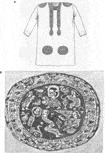
The popularity of the three Magi as a visual motif on textiles is attested not only in the case of these examples from Berlin, but also in the case of a remarkably well-preserved, seventh-century tunic in the British Museum on which one finds multiple images of the Adoration of the Magi.11
London, British Museum, inv. no. 1901–3–14; O. M. Dalton, Catalogue of Early Christian Antiquities and Objects from the Christian East in the Department of British and Medieval Antiquities and Ethnography of the British Museum (London: Trustees of the British Museum, 1901) 168–69, no. 951; Henry Maguire, “Garments Pleasing to God: The Significance of Domestic Textile Designs in the Early Byzantine Period,” Dumbarton Oaks Papers 44 (1990) 221, fig. 29. Another disputed example is preserved on a textile in the Musées royaux d'art et d'histoire in Brussels. A seventh- or eighth-century medallion (orbiculus), made with silk and linen, depicts a scene variously identified as the Adoration of the Magi (Matt 2:1–12), or the two Marys' encounter with the angel at the tomb of Christ (Matt 28:1–7): Brussels, Musées royaux d'art et d'histoire, inv. A.C.O. Tx. 1053; Marie-Cécile Bruwier et al, eds., Égyptiennes, étoffes coptes du Nil (Mariemont: Musée royal de Mariemont, 1997) 186, cat. no. 70.

a–b Coptic tunic with multiple, repeated scenes depicting the Adoration of the Magi (above: drawing of tunic; below: photo of one roundel; seventh century C.E.): London, British Museum, inv. no. 1901–3–14; © Copyright The Trustees of The British Museum.
The clavus strips, which extend down the torso in front and in back, have a series of panels on which the same scene is rendered “in abbreviated form.”12
H. Maguire, “Garments Pleasing to God,” 221.
These tunics with double-clavi from Berlin and London provide all-too-rare glimpses of christological images in their original configuration on pieces of clothing. Contemporary parallels are few and far between. In an exhibition volume of Weavings from Roman, Byzantine, and Islamic Egypt in the Krannert Art Museum at the University of Illinois at Urbana-Champaign, Eunice Dauterman Maguire documented one example of a child's tunic with Christian imagery, including a roundel with a scene of the Annunciation.13
Private collection, Rose Choron; Eunice Dauterman Maguire, Weavings from Roman, Byzantine and Islamic Egypt: The Rich Life and the Dance (Urbana: Krannert Art Museum at the University of Illinois at Urbana-Champaign, 1999) 168–69, C26.
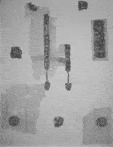
For a better basis of comparison, one may turn to a seventh- or eighth-century tunic in the Field Museum of Natural History in Chicago with scenes from the life of Christ (fig. 6).14
Chicago, Field Museum of Natural History, inv. no. 173758; H. Maguire, “Garments Pleasing to God,” 220, figs. 25–26. For my familiarity with this tunic from the Field Museum in Chicago, and for my identification of iconographic themes, I am indebted to Vasileios Marinis and his paper, “Wearing the Bible: Fashion and Magic in Early Christian Egypt” (presented at the Institute for Sacred Music, Yale Divinity School, 16 April 2003). Special thanks to Stephen E. Nash and the staff at the Field Museum of Natural History in Chicago for giving me special access to their collection.

Coptic tunic with scenes from the life of Christ (seventh or eighth century CE): Chicago, Field Museum of Natural History, inv. no. 173758; © The Field Museum, #173758.

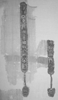
Detail of clavi on Coptic tunic (Fig. 6).
In addition to the clavi, five roundels belonging to this same tunic are extant. One roundel occupies the shoulder area of the main fragment, but is badly damaged; another mirrors the first in its iconography, which displays three as-yet-unidentified figures. While it is now detached from its linen host fabric, its original placement may have been on the other shoulder of the tunic. The three lower roundels bear scenes of the Nativity with only slight variations in color scheme. In each, the Christ child is flanked by two figures, presumably Mary and Joseph (fig. 8).

Detail of roundel with a scene of the Nativity on Coptic tunic (Fig. 6).
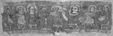
The final surviving pieces of this artifact are the remains of the sleeve bands, now detached from the main portion of the tunic. Even though the right band is virtually complete, its iconography is again somewhat enigmatic (fig. 9). In the middle of the panel, one observes a familiar scene of Christ's baptism. Less easy to identify are two figures standing on either side of this central image: on the right, a man—probably Christ himself—adorned with a cruciform nimbus; on the left, a haloed woman dressed in blue. They face each other, and the male figure gestures to the woman with his left hand upraised. What we have here is probably a scene of Christ's encounter with the Samaritan woman (John 4:1–42), or alternatively one of the healing scenes from the Gospels. Finally, at the far left and right of this full sleeve band are two woven images that show solitary figures approaching the Virgin Mary with some sort of offering while she sits on a chair or couch with the infant Christ in her lap. A similar scene is rendered on the fragmentary remains of the other sleeve band (fig. 10). While there are problematic elements in these parallel scenes that still require explanation (in particular a disembodied head in the scene on the right!), these images are probably still best explained as replications of the Adoration of the Three Magi in abbreviated form (where one Magus in each scene stands for the full company).15
The representation of what looks like a duck's head in the left scene conforms to other examples where ducks are portrayed as part of the offerings brought by the Magi to the Christ child (Marinis, “Wearing the Bible”). The tunic in the British Museum (inv. no. 1901–3–14) mentioned above in footnote 10 provides an example of this iconographic motif: Dalton, Catalogue of Early Christian Antiquities, 168–69; H. Maguire, “Garments Pleasing to God,” 221, fig. 29.

Detail of right sleeve band on Coptic tunic (Fig. 6), with scenes of Christ's baptism, the encounter with the Samaritan woman, and the Adoration of the Magi.

Detail of fragmentary left sleeve band on Coptic tunic (Fig. 6), with a scene of the Adoration of the Magi.
The Social Function of Images Worn on the Body:  and


This brief (and by no means complete) survey of textiles featuring scenes from the Gospels prompts questions about the social function of such images and the garments on which they appear. Were gospel-decorated tunics worn by priests as liturgical vestments? Probably not—while liturgical vestments with Christian scenes are in evidence from the later Byzantine period, there is no indication in late antique sources of such usage.16
H. Maguire, “Garments Pleasing to God,” 220. For a later Byzantine example of a gospel-decorated liturgical vestment, see figure 20, a fourteenth-century sakkos with an elaborate scene of the Transfiguration on the back preserved in the Vatican Collection and displayed in 2004 as part of the Metropolitan Museum of Art exhibit, “Byzantium: Faith and Power (1261–1557)”; Helen C. Evans et al, eds., Byzantium: Faith and Power (1261–1557) (New York: The Metropolitan Museum of Art, 2004) 300–301, no. 177.
Articles by Gary Vikan and Henry Maguire (both written in 1990) help us begin to address these questions. In studying pilgrimage art embossed on pewter flasks (ampullae) from around the year 600 C.E., Gary Vikan observes how pilgrim supplicants to the holy places were frequently portrayed in the guise of the Magi, with “bushy beards and flowing hair” and “exotic clothing” such as pantaloons and Phrygian caps.17
Monza, Monza Cathedral Treasury, 1; Gary Vikan, “Pilgrims in Magi's Clothing: The Impact of Mimesis on Early Byzantine Pilgrimage Art,” in The Blessings of Pilgrimage (ed. R. Ousterhout; Urbana: University of Illinois Press, 1990) 97–107, esp. 103 and fig. 21.
Detroit, Detroit Institute of Arts, U.L.26.152; Vikan, “Pilgrims in Magi's Clothing,” 104 and fig. 23.
Vikan, “Pilgrims in Magi's Clothing,” 104–5 and fig. 24.
Ibid., 103. H. Maguire has used the term “analogic” to describe the function of the Magi as archetypes for early Christian travelers: see Joseph D. Alchermes, “Notes on ‘The Age of Theodora’ (Connecticut College, October 7, 2000),” Hugoye: Journal of Syriac Studies 4 (2001) § 1–10 (on H. Maguire's conference paper, “The Empress's New Clothes: Domestic Art and the Cult of the Virgin in Early Byzantium”). Online: http://syrcom.cua.edu/Hugoye/Vol4No1/HV4N1CRAlcherm es.html#S0100.
What are the implications of Vikan's work for reconstructing the social function of Coptic tunics bearing images from the Gospels? In my brief survey of documented textile remains in London, Berlin, and Chicago, I made note of the formulaic ways that Magi scenes were recycled on Egyptian clothing—sometimes interspersed with other gospel images, sometimes as the dominant iconographic motif. Could it be that such clothing was designed with pilgrimage practice in mind, as a way that Christian pilgrims visually assimilated themselves to their famous biblical predecessors? It is not inconceivable that this was one way that such garments were put to use. In this context, it is also noteworthy that one of the textile fragments from Berlin bears images of the Holy Family's flight to Egypt (fig. 11).21
Berlin, Staatliche Museen, inv. 4663; Wulff and Volbach, Spätantike und koptische Stoffe, 98, Tafel 96, no. 8.
Cairo, Coptic Museum, no. 10517 (fifth or sixth century C.E.); Hishmat Messiha, “Two Coptic Textiles,” Annales du Service des antiquités de l'Égypte 55 (1958) 143 and pl. II; idem, “Jesus Christ in Coptic Antiquities: His Life and Symbols,” in Actes du IVecongrès copte. Volume 1: Art et archéologie (ed. M. Rassart-Debergh and J. Ries; Louvain-la-Neuve: Université catholique de Louvain, Institut orientaliste, 1992) 128 (A4).
William Lyster, Cornelis Hulsman, and Stephen J. Davis, Be Thou There: The Holy Family's Journey in Egypt (ed. Gawdat Gabra; Cairo: American University in Cairo Press, 2001) esp. ch. 3.

Linen textile fragment with a scene from the Holy Family's fl ight to Egypt stitched in wool (sixth or seventh century): Berlin, Staatliche Museen, inv. 4663; courtesy of Bildarchiv Preussischer Kulturbesitz/ Art Resource, NY.

Coptic textile fragment with a scene from the Holy Family's flight to Egypt stitched in wool (fifth or sixth century C.E.): Cairo, Coptic Museum, no. 10517; courtesy of the Coptic Museum and the Egyptian Supreme Council of Antiquities.
In evaluating ampullae, tokens, and jewelry as artifacts of early Christian pilgrimage, Vikan goes on to recognize their common function as objects “made to be worn or carried as amulets,” and argues that the representation of the divinely-guided Magi on these objects would have conveyed to their wearers a sense of “sympathetic magic” and divine protection.24
Vikan, “Pilgrims in Magi's Clothing,” 105.
H. Maguire, “Garments Pleasing to God,” 220.
Copenhagen, National Museum, inv. 12137; H. Maguire, “Garments Pleasing to God,” 221, fig. 31; London, British Museum, inv. 30806; Florence D. Friedman, Beyond the Pharaohs: Egypt and the Copts in the 2nd to 7th Centuries A.D. (Providence: Museum of Art, Rhode Island School of Design, 1989) 217, no. 130. On the seventh- or eighth-century clavus strip from the National Museum in Copenhagen, one finds a series of images depicting Christ's miracles from the Gospels. In two scenes, Christ reaches out to supplicants who are lying on a bed or mat, while in another, a supplicant kneels before him. These scenes may have been meant to evoke specific episodes like the healing of the paralytic (Mark 2:1–12; Matt 9:2–8; Luke 5:17–26) or the lame man at the pool of Beth-zatha (John 5:2–9). Alternatively, they may have been meant to highlight the healing character of Jesus' entire life and ministry, as expressed in Mark 6:55–56: “(The people) began to bring the sick on mats to wherever they heard he was. And wherever he went, into villages or cities or farms, they laid the sick in the marketplaces, and begged him that they might touch even the fringe of his cloak; and all who touched it were healed.” The clavus-fragment in the British Museum displays a similar array of healing scenes. As in the Copenhagen example, the specific references of the individual scenes are difficult to determine, due to the iconographic compression characteristic of this medium. However, it is possible to identify scenes in which the supplicant is bedridden or kneeling before Christ, as well as two scenes in which Christ heals a young child.
The protective function of such garments would also surely have informed their use in burial settings. Almost all the tunics extant today were originally recovered from Egyptian graves. In some cases, the deceased were dressed in clothing that had seen previous use in life (as evidenced by the wear of fibers); in other instances, however, the deceased were dressed in tunics that were made—or specially altered—for the burial rite itself. In the case of the child's tunic mentioned above, E. D. Maguire has noted that “the unmatched length of the clavi, and their mounting in such a way as to hide their worn condition as much as possible, indicate that they were sewn onto the garment either before or after the child's death, in the hope of heavenly protection.”
27E. D. Maguire, Weavings from Roman, Byzantine and Islamic Egypt, 168.
On the inclusion of amulets in Egyptian graves from the Late Old Kingdom to Roman times, see Wolfram Grajetski, Burial Customs in Ancient Egypt: Life in Death for Rich and Poor (London: Duckworth, 2003) chs. 4–11.
The fifth-century Egyptian archimandrite Shenoute of Atripe rails against the use of amulets as protective devices, and identifies monks in his monastery as distributors of the items: Shenoute, C. Orig. 255–57; ed. Tito Orlandi, Shenute: Contra Origenistas (Rome: C.I.M., 1985) 19. An excerpt of Shenoute's diatribe is translated by David Frankfurter in Religions of Late Antiquity in Practice (ed. Richard Valantasis; Princeton: Princeton University Press, 2000) 474.

) designed to protect them on their journey to heaven after death.
30The Second Book of Jeu 52; ed. and trans. Carl Schmidt and Violet MacDermot, in The Books of Jeu and the Untitled Text in the Bruce Codex (Nag Hammadi Studies 13; Leiden: E. J. Brill, 1978) 127–38; see also Ancient Christian Magic: Coptic Texts of Ritual Power (ed. Marvin Meyer and Richard Smith; San Francisco: HarperSanFrancisco, 1994) 66–68 (“39. Spell for ascending through the heavens”).
The studies by Vikan and H. Maguire prove extraordinarily valuable in helping us begin to imagine the ways that Coptic textiles may have been used in everyday life, and how those uses correlate with particular religious views and practices in late antiquity. Of course, the social functions that they highlight would not have been mutually exclusive. For example, tunics with Christian imagery may have been perceived as having both mimetic and apotropaic functions for the wearer in the context of specific practices like pilgrimage and even burial, where the deceased was often conceived of as embarking on a journey to the heavenly Jerusalem.31
For an example of the early Egyptian Christian association of mortuary space and the deceased's journey to the heavenly Jerusalem, see my discussion of the early Christian wall paintings at the Chapel of the Exodus at the Necropolis of El Bagawat in the Kharga Oasis: Stephen J. Davis, The Cult of St. Thecla: A Tradition of Women's Piety in Late Antiquity (Oxford: Oxford University Press, 2001) ch. 5.
However, despite the insights we can draw from Vikan and H. Maguire, I believe it may be possible to say something more about the significance of such christological images woven into the fabric of Coptic dress, and thereby to set the mimetic and apotropaic functions of these images within the larger context of Coptic theology and ritual practice. I want to allow the two questions I raised in my introduction to guide my reflections during the rest of this article. First, how did the wearing of such images reflect and promote Egyptian understandings of Christ and, more specifically, of the incarnation as a saving event? Here I want to situate this christological iconography in the context of traditional Egyptian doctrines of the incarnation and

, the “divinization” of human beings through “participation” in Christ's incarnation. Second, what might such dress tell us about the ways in which Egyptian christological conceptions were ritually enacted—about the practices that helped produce particular kinds of “Christian” bodies? In pursuing this second question, I intend to draw on insights from ritual and performance theory to try to get a better sense of how Coptic Christians in late antiquity, through the donning of what I would identify as ritualized dress, “performed” bodies that participated “iconically” in the divinized body of the incarnate Word.
Putting on Christ: The Art of Dressing Divinely
My interest in turning my discussion toward Coptic theological understandings of the incarnation is not a gratuitous one. It is based not only on the thematic character of the images themselves, but also on ancient testimony about the wearing of clothing embroidered with scenes from the life of Christ, and about the controversies such clothing engendered.
One source of support for the christological function of fabrics embroidered with biblical motifs is a fifth-century sermon from the Egyptian archimandrite, Shenoute of Atripe.
32Shenoute, And It Happened One Day; ed. L. Th. Lefort, “Catéchèse christologique de Chenoute,” Zeitschrift für ägyptische Sprache und Altertumskunde 80 (1955) 40–45; see also H.-F. Weiss, “Zur Christologie des Schenute von Atripe,” Bulletin de la Société d'archéologie copte 20 (1969/70) 177–209; and Stephen Emmel, Shenoute's Literary Corpus (2 vols.; CSCO, Subsidia 111–12; Leuven: Peeters, 2004) 2:665–66, 854. The sermon is dated to the last period of Shenoute's life, sometime after the Council of Chalcedon (451 C.E.) and the death of Nestorius (ca. 455 C.E.).

) as testimonies or proofs (

) of such doctrines.
33Shenoute, And It Happened One Day, *f. 83v; ed. Lefort, “Catéchèse christologique,” 42.

), and the “holy Mary Theotokos” (

), and actually describes how he used the embroidery as a didactic tool in identifying and correcting some of the monks' crypto-Nestorian christological errors.
34Shenoute, And It Happened One Day, *f. 83v–84r.
Another important ancient source attesting to this practice comes from a fourth-century homily by Asterius, bishop of Amaseia, a town located in northern Asia Minor (modern Turkey). In this sermon, Asterius speaks out strongly against those who dress themselves in clothes adorned with gospel-images, as well as those who produce them:
They have invented some kind of vain and curious broidery (

) which, by means of the interweaving of warp (

) and wool (

), imitates the quality of painting and represents upon garments (

) the forms of all kinds of living beings, and so they devise for themselves, their wives and children gay-colored dresses (

) decorated with thousands of figures…. When they come out in public dressed in this fashion, they appear like painted walls to those they meet…. You may see lions and leopards, bears, bulls and dogs, forests and rocks, hunters and [in short] the whole repertory of painting that imitates nature…. The more religious among rich men and women, having picked out the story of the Gospels, have handed it over to the weavers (

)—I mean our Christ together with all His disciples, and each one of the miracles the way it is related. You may see the wedding of Galilee with the water jars, the paralytic carrying his bed on his shoulders, the blind man healed by means of clay, the woman with an issue of blood seizing [Christ's] hem, the sinful woman falling at the feet of Jesus, Lazarus coming back to life from his tomb. In doing this they consider themselves to be religious and to be wearing clothes that are agreeable to God (

). If they accepted my advice, they would sell those clothes and honor instead the living images of God. Do not depict Christ (for that one act of humility, the incarnation, which he willingly accepted for our sake is sufficient unto Him), but bear in your spirit and carry about with you the incorporeal Logos (

).”
35Asterius of Amaseia, Homily 1 (PG 40:165C–168B); trans. Cyril Mango, The Art of the Byzantine Empire, 312–1453: Sources and Documents (Englewood Cliffs, N.J.: Prentice-Hall, Inc., 1972) 50–51.
H. Maguire cites this passage in support of his argument that garments embroidered with gospel images were primarily worn by lay persons and that they had an apotropaic function in late antiquity. He focuses his attention especially on Asterius's claim that certain people considered themselves “to be religious and to be wearing clothes that are agreeable (or pleasing) to God.” Indeed, H. Maguire ends his quotation of Asterius with this phrase, and interprets it to mean that, by means of such clothing, certain early Christians were seeking to obtain divine “favor” or protection.36
H. Maguire, “Garments Pleasing to God,” 220.
H. Maguire's reading of this phrase is prescient, but he misses out on a crucial aspect of Asterius's commentary by breaking off his quotation at this point. In what follows, Asterius goes on to forbid his listeners from depicting Christ on their clothing because, according to him, “that one act of humility, the incarnation,… is sufficient unto Him” (

). I would argue, here, that Asterius is not simply expressing a rote aniconic sentiment, but instead is giving us a subtle insight into one aspect of the theology espoused by those who engaged in such practices. Why does Asterius feel it necessary to say that Christ's incarnation was “sufficient” in and of itself? We know that the sufficiency, and indeed the very nature, of Christ's incarnation was a contested issue in the theological debates of the fourth and fifth centuries. Did Asterius's opponents on this issue perhaps see the incarnation not as an isolated and autonomous act, but rather as an act that called for (and indeed required) certain kinds of human participation and agency? Wearing clothes with images from the Gospels may have been one way that certain early Christians believed they were mimetically (and visually) assimilating themselves to Christ's incarnation.
The notion that Christians were called to assimilate themselves to Christ was, of course, not a new one. It had roots in the first-century writings of Apostle Paul, who often used the metaphor of dress to describe what this assimilation was supposed to look like. For Paul, baptism was a privileged ritual locus of identification with Christ, one in which disrobing and re-robing were constitutive gestures. Thus, in the baptismal formula of Gal 3:27, Paul writes, “As many of you as were baptized into Christ have clothed yourselves with Christ.”37
In this article, unless otherwise indicated, I cite the New Revised Standard Version (NRSV) in translating biblical texts.
On the idea of “putting on Christ,” see Edgar Haulotte, S.J., Symbolique du vêtement selon la Bible (Théologie 65; Paris: Aubier, 1966) 210–33). Sebastian Brock also discusses this Pauline language in his article, “Clothing Metaphors as a Means of Theological Expression in Syriac Tradition,” in Typus, Symbol, Allegorie bei den östlichen Vätern und ihren Parallelen im Mittelalter. Internationales Kolloquium, Eichstatt 1981 (ed. M. Schmidt and C. F. Geyer; Eichstätter Beiträge, Band 4, Abteilung Philosophie und Theologie; Regensburg: Pustet, 1982) 11–38, esp. 15.
This passage from Colossians echoes the image-language in Paul's letter to the Romans, where he describes how God predestines Christians “to be conformed to the image of his Son” (8:29): Joseph A. Fitzmyer, Romans (AB 33; New York: Doubleday, 1993) 525. See also Hans Dieter Betz, (Galatians [Hermeneia; Philadelphia: Fortress Press, 1979] 181–82) and J. Louis Martyn (Galatians [AB 33A; New York: Doubleday, 1997] 375–76) who discuss the Pauline notion of conformance to the image in relation to the baptismal formula in Galatians 3:27.
These Pauline images took on a special resonance in late antique Alexandria and Egypt, especially in conjunction with the parallel notion (from 2 Pet 1:4) that Christians are enabled to become “participants in the divine nature.”
40Norman Russell, “‘Partakers of the Divine Nature’ (2 Peter 1:4) in the Byzantine Tradition,” in

Essays Presented to Joan Hussey for Her 80th Birthday (Camberley, Surrey: Porphyrogenitus, 1988) 51–67.
Clement of Alexandria, Paed. 1.12.98.2; ed. O. Stählin, GCS 12 (1905) 148.

),” he describes how, with the help of the Word, we are to be “well-girded up” (

) in readiness for our journey toward “an eternity of well-being” (

).
42Clement of Alexandria, Paed. 1.12.98.3–4.

).
43Ibid., 2.10.109.3–4.

) with “the pure vestment, woven of faith, of those who have been shown mercy” (

).
44Ibid., 2.10.110.2.
This confluence of themes—becoming divine, putting on immortality—found significant development in the writings of Athanasius and Cyril, the two theologians who definitively shaped Alexandrian christology during the theological controversies of the fourth and fifth centuries. For both of these writers, the Christian's assimilation to Christ was conceived of as a form of deification or divinization (

). The logic went as follows. In taking on a human body, the divine Word enlivened—or deified—that body (the body of Christ), and, by extension, the Word likewise transformed and enlivened all of human nature, transforming it from the mortal to the immortal, from the corruptible to the incorruptible.
45Athanasius of Alexandria, Inc. 7.5 (ed. C. Kannengiesser, SC 199 [Paris: Cerf, 1973] 288): “For it belonged to (the Word) to restore the corruptible to incorruptibility.” Cyril of Alexandria, in his First Letter to Succensus (Ep. 45.9; PG 77:233C–D), similarly highlights how the divine Word “became a human being (

)… in order to destroy corruption in (the flesh), on account of the fact that he is Life and Life-giver (

).” In his treatise On the Unity of Christ (Chr. un.; PG 75:1269A–C; trans. McGuckin [Crestwood, N.Y.: St. Vladimir's Seminary Press, 1995] 60–61), Cyril asks “For how could his body possibly give life to us if it were not the very own body of him who is Life?” (

) and then goes on to affirm that “the Word… is ineffably united with it (the body) in a manner beyond all description. Thus it is a holy and life-giving thing (

), full of divine energy. And we too are transformed in Christ, the first-fruits, to be above corruption and sin.”
Thus, Athanasius writes in his treatise On the Incarnation: “For (the Word) became human (

) in order that we might be made divine (

).”
46Athanasius of Alexandria, Inc. 54.3.
Clement of Alexandria, Protr. 1.8.4; ed. Stählin, GCS 12 (1905) 9.
For in this way he took on a human, originate body, in order that, having renewed it as its creator, he might deify it in himself (

), and thus might lead all of us into the kingdom of heaven according to his likeness. For, once again, humankind would not have been deified if it had been joined together with a creature, or if the Son had not been true God. Nor would humankind have come to be in the presence of the Father, if the one who had put on the body (

) had not been the Father's true Word by nature. And by the same token, we would not have been freed from sin and the curse, if the flesh that the Word put on (

) had not been human in nature, for we would have had nothing in common with that which is foreign (to our nature). In the same way, humankind would not have been deified (

), if the Word who became flesh had not been from the Father and true and proper to him by nature. Indeed, it was for this reason that the union (

) was of this kind, so that he might unite that which is human by nature with the one who exists according to the nature of the Godhead, and so that the salvation and deification (

) of humankind might be sure.
48Athanasius of Alexandria, Ar. 2.70 (PG 26:296A–B). The importance of 2 Pet 1:4 for Athanasius' ideas about deification comes across clearly in his Letter to Adelphius (Ep. Adelph. 4; PG 26:1077A): “For (the Word) became a human being, in order that he might deify us in himself (

); and he was born of a woman, and begotten of a virgin, in order that he might transfer to himself our wayward act of generation, and that we might become thenceforth a holy race, and ‘partakers of the divine nature’ (

), as the blessed Peter wrote.”
In this particular way, soteriology and christology come together for Athanasius: as he describes it, the divine Word “has been made manifest to us in a human body for the sake of our salvation (

).”
49Athanasius of Alexandria, Inc. 1.3; see also 4.3 (“for the sake of our salvation (the Word) demonstrated lovingkindness by being born and appearing in a human body”), and 32.6 (“The Father's own Word, Wisdom, and Power… took a body for the salvation of all”).
Cyril similarly describes the incarnation as being “for the salvation of us who are on the earth,”
50Cyril of Alexandria, Ep. 45.9 (= First Letter to Succensus); PG 77:233C.

).
51Cyril of Alexandria, Jo. 3.6 (325c); ed. P. E. Pusey, Sancti patris nostri Cyrilli Archiepiscopi Alexandrini In D. Joannis Evangelium (3 vols.; Oxford: Clarendon Press, 1872) 1:476.26–27.
Cyril of Alexandria, Jo. 11.12 (1001e). In the same section of text, Cyril goes on to distinguish this “corporeal” indwelling of the Son from a correlative “spiritual” indwelling by the Spirit.
It is worth highlighting here the way in which Athanasius (and Cyril after him) often articulated this salvific transaction in unapologetically bodily terms, and (as in the case of Clement) used the image of clothing oneself with Christ as a metaphor to describe what participation in the divine might look like for human bodies. In his treatise On the Incarnation, Athanasius writes, “For being over all, the Word of God, … the incorruptible Son of God, being joined with all by means of a like nature, suitably clothed all with incorruption.”
53Athanasius of Alexandria, Inc. 9.2.

), in order that the body, having been woven together with life (

), should no longer remain in death as a mortal thing, but instead, when it had clothed itself in immortality (

), should thenceforth rise again and remain immortal. For, once it had clothed itself with corruption (

), it would not have risen again unless it had clothed itself with life (

).”
54Ibid., 44.6.
Athanasius of Alexandria, Ep. Fest. 4.3 (trans. H. Burgess, NPNF2F 4:516). For the Syriac edition of Athanasius's Festal Letters, see William Cureton, ed., The Festal Letters of Athanasius (London: Society for the Publication of Oriental Texts, 1848).
Athanasius of Alexandria, Ep. Fest. 7.10.
In comparison to Athanasius, Cyril's emphasis on the indivisible union of the human and divine in Christ, and his opposition to Nestorius's so-called two-nature christology, made him increasingly reticent about using metaphors of dress to describe the Word's union with the body in the incarnation. In his view, such language might suggest that this union of human and divine was merely superficial (and potentially reversible).
57Sebastian Brock (“Clothing Metaphors,” 17–18) observes the application of clothing metaphors to the incarnation in the Syriac tradition.

) have put off the poverty of their own nature; having been splendidly attired (

) with the grace of the one who honors (them), as if dressed in a radiant garment (

), they ascend to a status beyond nature.”
58Cyril of Alexandria, Jo. 1.9 (91e–92a).
How does the christological language of Athanasius and Cyril inform my study of Coptic tunics? The tunics that I have been examining in this paper raise the possibility that, in late antique Egypt, discourses of “putting on” Christ were not always restricted to the metaphorical realm. Indeed, I would like to suggest that the representation of gospel scenes on Coptic clothing helps us envision one way that Egyptian Christians enacted such discourses through ritualized dress.
Catherine Bell has defined “ritualization” as “a way of acting that is designed and orchestrated to distinguish and privilege what is being done in comparison to other, usually more quotidian, activities.” In other words, ritualization involves “specific strategies for setting some activities off from others, for creating and privileging a qualitative distinction between the ‘sacred’ and the ‘profane.’”59
Bell, Ritual Theory, Ritual Practice, 74.
Ibid., 90.
To borrow language from performance theory, such tunics became means by which christological realities were performed and im-personated.61
Erving Goffman, The Presentation of Self in Everyday Life (New York: Doubleday, 1959) 36 and 59ff.
Stanley Tambiah, “A Performative Approach to Ritual,” Proceedings of the British Academy 65 (1979) 121.
In observing the actions of a waiter in a café, Jean-Paul Sartre describes how he “plays with his condition in order to realize it,” and argues that his bodily actions and postures constitute a form of “ceremony” (Being and Nothingness [trans. H. E. Barnes; New York: Philosophical Library, 1956] 59; cited by Goffman, The Presentation of Self in Everyday Life, 76). On the concept of “ritualized bodies,” see Bell, Ritual Theory, Ritual Practice, 94–117.
In the modern context, Simone de Beauvoir argues that women of fashion not only project themselves into various capital goods through their choice of dress and expression, they actually “make” themselves into a kind of commodity (The Second Self [trans. H. M. Parshley; New York: Knopf, 1953] 536; cited by Goffman, The Presentation of Self in Everyday Life, 236).
Ritual theorists have long recognized the transformative character of ritual activity. For example, Victor Turner, in commenting on the reflexivity of ritual performance, writes that such performance involves “acting upon the self-made-other in such a way as to transform it.”65
Victor Turner, “Images and Reflections: Ritual, Drama, Carnival, Film, and Spectacle in Cultural Performance,” in The Anthropology of Performance (New York: PAJ Publications, A Division of Performing Arts Journal, Inc., 1986) 21–32. Richard Schechner (Performance Theory [revised and expanded edition; London and New York: Routledge, 2003] xviii) sometimes describes ritual transformations almost as a form of possession: “How beings of one order inhabit beings of another order as in a trance.”
Schechner, Performance Theory, 192–93. On “actuals” and “actualization” in ritual performance, see also pages 26-65 and 127 of the same work, where, in describing a ceremonial pig-kill at Kurumugl, Schechner observes that “the performance both symbolized and actualized the change in status” (from actuality 1 to actuality 2) in the relationship between the two participating groups.
Schechner, Performance Theory, 191.
Contested Bodies: Reconstructing a Late Antique Controversy over Clothing
Let me return briefly to the text from Asterius of Amaseia and his objections to the wearing of “christological” garb. We know from Asterius that the wearing of clothes adorned with images of Christ was a contested practice in the early church (at least in some places). What was at the root of such controversy? One detail from Asterius's homily may give us a clue. He identifies “rich men and women” in the church as the ones who were commissioning and wearing clothing embellished with scenes from the Gospels.68
Asterius of Amaseia, Hom. 1 (PG 40:168A); trans. Mango, The Art of the Byzantine Empire, 51.
However, Asterius's identification of the wearers as “rich men and women” also may explain something about how his theological objections were intimately intertwined with concerns about social and ecclesiastical authority. There is evidence from various locales in the early church that bishops and influential laypersons (or aristocratic families) continued to vie over patronage claims and the exercise of authority. The cult of the martyrs was one well-known locus for such conflict.69
Peter Brown, The Cult of the Saints: Its Rise and Function in Latin Christianity (Chicago: University of Chicago Press, 1981) 34–36; Stephen J. Davis, “Patronage and Architectural Adaptation in the Roman Cult of the Martyrs,” Anistoriton 3 (1999) E993, http://www.anistor.co.hol.gr/english/ enback/index.htm (see “Essays”).
Victor Turner, “Images and Reflections,” 25.
Conclusions: Tying Up Loose Threads
The survival of Coptic tunics with christological images from the fifth through eighth centuries (and even later) suggests that the efforts of bishops like Asterius, in the end, were not completely successful. Wealthy Egyptian Christians in late antiquity continued to commission such articles for their use. What can we say finally about the social function—the use and setting—of these garments?
Earlier, I highlighted the potential mimetic and apotropaic functions of gospel imagery on early Christian clothing. Both of these functions correlate well with my arguments concerning Coptic christology and ritual dress. The wearing of clothing with images from Christ's life produced ritualized bodies that mimetically participated in the incarnation, bodies vested with apotropaic power. Of course, such processes would have looked quite different depending on the specific social setting, and here we must give our imaginations free tether. For Christian pilgrims traveling to Bethlehem or Jerusalem, or to local Egyptian shrines, the donning of such garments would have highlighted their identification with biblical and apocryphal models (e.g., as represented in the stories of the Magi or the flight of the Holy Family to Egypt) and would have produced transformed bodies resonant with the christological charisma of the holy sites they were visiting. In the context of burial, the body of the deceased would have been marked as having “put on” the body of Christ and thereby as having been “charged” with protective power: the result was a posthumous performance of human assimilation to the divine image, an assimilation that was enabled and effected through the incarnate Word's conquering of death.71
Schechner (Performance Theory, 192) identifies funerals, along with a range of initiatory rituals, as “sites of transformation.”
Asterius of Amaseia relates how people in his city dressed themselves (

) in elaborate garments to be seen by others (Hom. 1; PG 40:165D; trans. Mango, The Art of the Byzantine Empire, 50). In the early third century, Clement of Alexandria likewise had criticized the wearing of luxurious and elaborately-decorated clothing, notably associating it with public pageantry (

) (Paed. 2.10.108.5). Public exhibition of dress may be recognized as one form of ritual activity. Schechner (Performance Theory, 114) describes such ritual display as “a showing of a doing,” an act that is simultaneously symbolic and actual(izing) of a certain kind of status or position.
In any case, I hope that such imaginative reconstructions of how Copts enacted their christology through ritual dress might at the very least help begin to break down traditional disciplinary divides between theology and social history in the study of early Egyptian Christianity. If so, then these tunics will have had a valuable social function for us in the academy today—namely, that of challenging (and perhaps overturning) our own lingering and cherished epistemological dichotomies of mind and body.
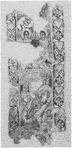
Linen band with a scene of the Nativity embroidered in silk (eighth century CE): Paris, Musée du Louvre, inv. E 13945; courtesy of Réunion des Musées Nationaux/ Art Resource, NY.
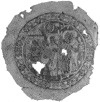
Coptic textile with a scene of the Annunciation (sixth century C.E.): London, Victoria & Albert Museum (Kendrick, no. 777, pl. XVIII); courtesy of Victoria & Albert Museum/ Art Resource, NY.
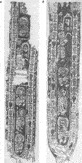
a–b Two clavi with scenes of the Nativity (sixth or seventh century CE): Berlin,Staatliche Museen, inv. 4584 and 4677; courtesy of Bildarchiv Preussischer Kulturbesitz/Art Resource, NY.
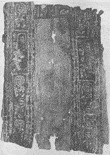
A pair of clavi attached to the remains of a woolen Coptic tunic, with scenes of the Nativity (sixth or seventh century C.E.): Berlin, Staatliche Museen, inv. 17 530; courtesy of Bildarchiv Preussischer Kulturbesitz/ Art Resource, NY.
a–b Coptic tunic with multiple, repeated scenes depicting the Adoration of the Magi (above: drawing of tunic; below: photo of one roundel; seventh century C.E.): London, British Museum, inv. no. 1901–3–14; © Copyright The Trustees of The British Museum.
Coptic tunic with scenes from the life of Christ (seventh or eighth century CE): Chicago, Field Museum of Natural History, inv. no. 173758; © The Field Museum, #173758.
Detail of clavi on Coptic tunic (Fig. 6).

Detail of roundel with a scene of the Nativity on Coptic tunic (Fig. 6).
Detail of right sleeve band on Coptic tunic (Fig. 6), with scenes of Christ's baptism, the encounter with the Samaritan woman, and the Adoration of the Magi.

Detail of fragmentary left sleeve band on Coptic tunic (Fig. 6), with a scene of the Adoration of the Magi.

Linen textile fragment with a scene from the Holy Family's fl ight to Egypt stitched in wool (sixth or seventh century): Berlin, Staatliche Museen, inv. 4663; courtesy of Bildarchiv Preussischer Kulturbesitz/ Art Resource, NY.

Coptic textile fragment with a scene from the Holy Family's flight to Egypt stitched in wool (fifth or sixth century C.E.): Cairo, Coptic Museum, no. 10517; courtesy of the Coptic Museum and the Egyptian Supreme Council of Antiquities.
 You have
Access
- 4
- Cited by