Implications
Selection for fertility in natural spring matings of non-lactating ewes during the anticipated anestrous period was effective in developing ewes with improved fall lambing rates and a reduced seasonal anestrus. Results of the current study suggest that these ewes are also capable of rapid rebreeding during lactation following winter and spring lambings and may therefore be appropriate for use in accelerated lambing systems. Rebreeding of lactating ewes in spring would be particularly useful to avoid the early weaning of lambs that is normally considered essential to successful accelerated lambing programs.
Introduction
Increasing frequency of lambing to levels consistent with the 5-month gestation of the ewe has been proposed as a means to increase efficiency of sheep production, but realization of this potential has largely been thwarted by the seasonal anestrus commonly observed in spring and early summer. Various accelerated lambing systems have been proposed (Hunter, Reference Hunter2010) but generally do not achieve their theoretical potentials (Notter and Copenhaver, Reference Notter and Copenhaver1980; Lewis et al., Reference Lewis, Notter, Hogue and Magee1996). These systems all recommend early weaning of lambs in order to improve fertility in spring matings, but early weaning is often not consistent with forage-based lamb production. Attempts to breed lactating ewes in spring have consistently been disappointing (Bourke, Reference Bourke1964; Whiteman et al., Reference Whiteman, Zollinger, Thrift and Gould1972; Cognie et al., Reference Cognie, Hernandez-Barreto and Saumande1975; Pope et al., Reference Pope, McClure, Hogue and Day1989), and use of hormone or light manipulation to improve spring fertility has generally not been successful in lactating ewes (Restall et al., Reference Restall, Kearins, Herdegen and Carberry1978; de Nicolo et al., Reference De Nicolo, Morris, Kenyon and Morel2006; Martemucci and D’Alessandro, Reference Martemucci and D’Alessandro2010). Selection to improve ewe fertility in a crossbred (50% Dorset, 25% Rambouillet, 25% Finnish Landrace) sheep population mated in May and June at Virginia Tech (37°N latitude) resulted in significant selection response (Notter and Cockett, Reference Notter and Cockett2005) and correlated increase in duration of the breeding season (Vincent et al., Reference Vincent, McQuown and Notter2000; Notter et al., Reference Notter, Smith and Akers2011; Goff et al., Reference Goff, Knight, Pelzer, Akers and Notter2013). However, fertility of ewes from this out-of-season breeding (OOS) line has not been evaluated during lactation.
Short-term calf removal to temporarily remove the suckling stimulus improved cow fertility in programs involving estrus synchronization and artificial insemination (Yelich et al., Reference Yelich, Holland, Schutz and Odde1995), but short-term lamb removal has not been evaluated as a strategy to improve rebreeding of lactating ewes. In addition, tropical sheep types such as the St. Croix hair sheep have been described as ‘aseasonal’ (Parker et al., Reference Parker, McClure and Herd1991) and reported to lamb ‘year-round’ (Wildeus, Reference Wildeus1997), suggesting that ewes of this breed may have potential for rapid rebreeding in the spring.
The objective of this study was to assess the potential for rapid spring rebreeding of lactating ewes using non-traditional genetic resources and a previously untested management intervention. The first of three studies evaluated effects of short-term lamb removal on rebreeding performance of January-lambing OOS and Dorset ewes beginning at an average of 64 days postpartum. The second study compared rebreeding of January-lambing OOS and St. Croix ewes beginning at an average of 60 days postpartum. The final study evaluated rebreeding performance in March-lambing OOS ewes beginning at an average of 40 days postpartum.
Material and methods
Experimental procedures
All procedures were approved by the Virginia Tech Institutional Animal Care and Use Committee. Studies were carried out at the Virginia Tech Sheep Center, Blacksburg (37°N latitude and 80°W longitude).
Experiment 1
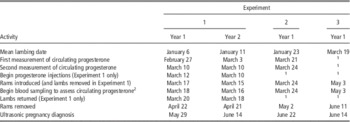
Experiment 1 evaluated effects of acute lamb separation on rebreeding performance and was replicated in two consecutive years (Table 1). Animals came primarily from the Virginia Tech out-of-season breeding (OOS) line, but also included 10 Dorset ewes from the Virginia Tech flock in year 2, giving totals of 32 OOS ewes in year 1 and 29 OOS and 10 Dorset ewes in year 2. Ewes were at least 3 years of age in year 1 and 2 years of age in year 2, had lambed in early January, and were nursing an average of 1.49 lambs. Jugular blood samples were collected in late February or early March and again 7 or 11 days later and assayed for circulating progesterone in order to identify ewes that ovulated before experimental treatment. Ewes also received twice-daily (0800 and 1700 h) injections of 12.5 mg of progesterone (Sigma, St. Louis, MO, USA) for 5 days before lamb separation and ram introduction. Prior exposure to circulating progesterone has been shown to facilitate expression of estrus in ewes induced to ovulate by acute ram exposure (Oldham et al., Reference Oldham, Pearce and Gray1985; Kassem et al., Reference Kassem, Owen and Fadel1989; Knights et al., Reference Knights, Ramgattie, Siew, Singh-Knights and Bourne2011). The first nine progesterone injections were given subcutaneously but the tenth injection was given intramuscularly to allow more rapid clearance and therefore more abrupt withdrawal of progesterone before ram introduction.
Treatment schedules

1 Not used, or measured, in this experiment.
2 Samples were taken three times per week in Experiment 1 and twice weekly in Experiments 2 and 3. Sampling ended when rams were removed.
Ewes were stratified by breed, age and lambing date and assigned to control or lamb-separation groups. Ewes in the lamb-separation group were separated from their lambs for 72 h beginning on the morning following the last progesterone injection, and two OOS rams were placed with each group of ewes that afternoon. Lambs were consuming creep feed ad libitum before separation from their mothers and remained in the same pen with control ewes and lambs during the period of lamb separation. Ewes and lambs from both treatment groups and the four breeding rams were combined and managed together following lamb separation. Jugular blood samples were collected three times per week for 5 weeks beginning on the day after the start of lamb separation and assayed for circulating progesterone. Rams were fitted with marking harnesses, and marks were recorded at each bleeding. Ewes in all experiments were isolated from rams for at least 2 months before the study began. Ewes and lambs were on pasture during mating, with water ad libitum and supplemental grain daily.
Rams were removed in late April. Ewes averaged 64 days postpartum at the start of breeding and 104 days postpartum when rams were removed. Pregnancies were diagnosed by transabdominal ultrasonography in late May or early June using an Aloka 500 console (Corometrics Medical Systems, Inc., Wallingford, CT, USA) and a 7.5 MHz probe, and lambing dates were recorded.
In year 1, one ewe died in July and seven ewes were killed by dogs on August 7 before lambing. Lambing rates in year 1 were thus reported using results of pregnancy tests to determine which of the ewes that died were expected to lamb. Of the eight ewes that died in year 1, all had been diagnosed as pregnant, and they were equally divided between lamb separation and control groups. In year 2, one ewe in the lamb separation group was killed by dogs before pregnancy diagnosis and was excluded from analyses of pregnancy and lambing rates.
Experiment 2
This study compared spring rebreeding of OOS (n=24) and St. Croix ewes (n=23). Ewes were 2- to 9-year old, with average ages of 4.75±0.33 years for OOS ewes and 5.00±0.33 years for St. Croix ewes. St. Croix ewes lambed between January 14 and 31, and OOS ewes lambed between January 4 and 30, with mean lambing dates of January 28 and January 18, respectively (P<0.001). St. Croix and OOS ewes thus averaged 55 and 65 days postpartum, respectively, at ram introduction, and nursed averages of 1.83 and 1.63 (±0.09) lambs per ewe, respectively.
Blood samples were taken 3 days before, and on the day of, ram introduction (Table 1) and assayed for progesterone. Ewes with progesterone concentrations below 1 ng/ml were considered to be anestrus. Five intact OOS rams passed breeding soundness examinations and were joined with ewes on March 24. Three of the rams were fitted with marking harnesses, and colors of marking crayons were changed every 2 weeks. Rams and ewes were together for 39 days. Ewes were checked for mounting marks and blood samples were taken twice weekly by jugular venipuncture during this period. Pregnancies were diagnosed by ultrasonography 51 days after ram removal, and lambing dates were recorded.
Experiment 3
This study (Table 1) was conducted to describe the reproductive performance of March-lambing OOS ewes introduced to rams 4 to 7 weeks after lambing. The study used 34 OOS ewes ranging in age from 2 to 8 years, with an average age of 4.2±0.3 years. Ewes lambed between March 12 and 31, with an average lambing date of March 19, and averaged 39.6 days postpartum at ram introduction on May 3. Ewes nursed an average of 1.88±0.07 lambs. Rams passed breeding soundness exams, were fitted with marking harnesses, and stayed with ewes for 39 days. Blood sampling and monitoring of matings followed procedures used in Experiment 2. Pregnancies were diagnosed by ultrasound on June 14, and lambing dates were recorded.
Assay procedures
Blood samples were initially stored at 4ºC to allow clotting. Samples were then centrifuged at 3000×g for 20 min, and serum was collected within 24 h and frozen at −20ºC in plastic tubes. Progesterone concentrations in serum were determined in duplicate in a single assay for each experiment using the Coat-A-Count Progesterone RIA Kit (Siemens Healthcare Diagnostics, Inc., Los Angeles, CA, USA) as validated by Minton et al. (Reference Minton, Coppinger, Spaeth and Martin1991). The assay was sensitive to 0.1 ng/ml progesterone; intra- and inter-assay coefficients of variation were 9.5% and 14.5%, respectively. Progesterone concentrations greater than 1 ng/ml were assumed to indicate the presence of a corpus luteum.
Statistical methods
In Experiment 1, differences between treatment groups in frequencies of ovulation, mating, pregnancy and lambing were tested by χ 2 with correction for year effects using the Cochran–Mantel–Haenszel statistic (Landis et al., Reference Landis, Heyman and Koch1978) in the Frequency Procedure of SAS (Ver. 9.2, SAS Institute, Inc., Cary, NC, USA). In Experiment 2, breed differences in reproductive outcomes were also initially tested by χ 2 test. Because breeds differed in mean lambing date, breed differences were also estimated following adjustment for linear effects of lambing date in supplemental analyses using the General Linear Models procedure of SAS. In the third study, ewes were characterized for proportions that marked after 21 or 39 days of ram exposure, were diagnosed pregnant 51 days after ram removal, or produced viable lambs.
Results
Experiment 1
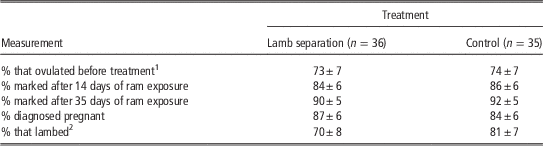
No undesirable effects of acute lamb removal were observed. Excessive engorgement of udders was not observed, and no cases of mastitis were reported. Pregnancy and lambing rates were higher (P<0.05 and P=0.10, respectively) in year 2 (94% and 84%, respectively) compared with year 1 (77% and 67%, respectively), but no effect of lamb separation was observed (P>0.20) within years (not shown) or across years (Table 2). Dorset and OOS ewes in year 2 did not differ (results not shown). An average of 74% of the ewes had circulating progesterone levels above 1 ng/ml in at least one blood sample collected before the start of exogenous progesterone injections and were considered to have ovulated at least once by this point in the experiment. The incidence of apparent prior ovulations did not differ between years or treatment groups. An average of 85% of the ewes mated within 2 weeks of ram introduction, and an additional 6% mated over the next 3 weeks. Eighty five percent of the ewes were diagnosed as pregnant in late May or early June. However, lambing rates in August and September were lower than predicted, suggesting that some lamb losses occurred in late gestation.
Effects of lamb separation on reproductive performance of January-lambing, lactating OOS ewes introduced to rams at an average of 63 days postpartum

1 Based on circulating progesterone levels of ⩾1.0 ng/ml before treatment.
2 In year 1, one ewe died in July and seven ewes were killed by dogs on August 7 before lambing. Ultrasound pregnancy rates were use to predict if these ewes would have lambed.
Experiment 2
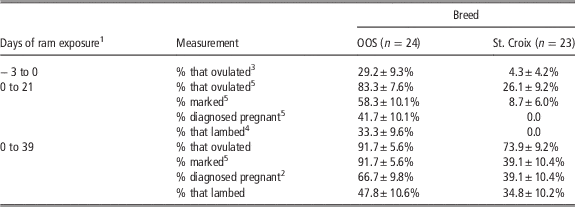
Over half of the OOS ewes mated during the first 21 days of ram exposure, and all but one OOS ewe mated by 39 days (Table 3). By contrast, only 8.7% of St. Croix ewes mated during the first 21 days of ram exposure (P<0.01), and 43.5% mated by day 39 (P<0.001). Pregnancy rates at 51 days after ram removal tended to be higher for OOS compared with St. Croix ewes (66.7% v. 39.2%; P=0.06), but breeds did not differ in percentage lambing (47.8% for OOS ewes and 34.8% for St. Croix ewes; P>0.20). St. Croix ewes were thus more likely than OOS ewes to establish pregnancy following mating (90.0% v. 69.6%) and maintain established pregnancies to term (88.9% v. 73.3%). Results were not affected by adjustment for lambing date; unadjusted frequencies were shown in Table 3.
Reproductive performance of January-lambing, lactating OOS and St. Croix ewes introduced to rams at an average of 60 days postpartum

OOS=out-of-season breeding.
1 Day 0 is the day of ram introduction.
2,3,4,5Breeds differ at P=0.06, P<0.05, P<0.01, P<0.001, respectively.
Progesterone profiles for individual ewes revealed a relatively predictable pattern in St. Croix ewes. Only one St. Croix ewe appeared to have ovulated before ram introduction. This ewe also ovulated near day 7, but did not show estrus; she subsequently ovulated a third time, mated on day 28, and lambed. Five additional St. Croix ewes ovulated in the first 21 days after ram introduction; three of these ewes had premature luteal regression, which is typical of the first ovulation following ram introduction (Oldham and Martin (Reference Oldham and Martin1978); none became pregnant. All pregnancies in St. Croix ewes thus resulted from matings that occurred after at least 24 days of ram exposure.
Estrous behavior in OOS ewes was more complex, with greater levels of ovarian activity. Seven OOS ewes had elevated progesterone titers before ram introduction. Three of these ewes had progesterone concentrations of 1 to 6 ng/ml for at least the first 35 days of the study, suggesting the presence of persistent luteal cysts. Two of these ewes mated on the last day of the study; neither became pregnant. The four ewes that appeared to be cycling normally before ram introduction became pregnant within the first 21 days of ram exposure, and three lambed. None of the OOS ewes had premature luteal regression, at least within the limits of detection imposed by twice-weekly blood sampling.
Ten OOS ewes ovulated in the first 21 days of ram exposure but did not conceive. All of these ewes ovulated again and mated between days 22 and 39 of ram exposure. Pregnancy rates at this second ovulation (80.0±12.6%) were higher than those observed for the 20 ovulations that occurred before days 21 (50.0±11.2%; P<0.10), but lambing rates were similar for the two groups (30.0±14.5% and 40.0±11.0%, respectively; P>0.50). Thus, OOS ewes that did not conceive at the first ovulation had somewhat higher pregnancy rates at their subsequent ovulation but were not more likely to lamb than ewes that ovulated before day 21.
Experiment 3
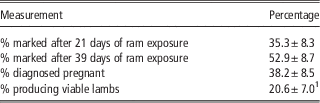
When exposed to rams in May at an average of 40 days postpartum, 12 of 34 OOS ewes mated within the first 21 days of ram exposure and 18 ewes mated by day 39 (Table 4). Thirteen ewes were diagnosed pregnant 88 days after ram removal, but only 10 ewes lambed, and three of those ewes produced underweight, apparently prematunre, lambs that did not survive. Therefore, 52.9% of ewes mated, but only 20.6% produced viable lambs.
Reproductive performance of 34 March-lambing, lactating OOS ewes introduced to rams at an average of 40 days postpartum

OOS=out-of-season breeding.
1 Three additional ewes lambed but produced underweight, apparently premature lambs that did not survive.
Discussion
Results of this study suggest that lactating OOS ewes exposed to rams in the spring ovulated, exhibited estrus, and established pregnancies at rates well above those commonly reported in the literature. The proportion of ewes that lambed was 75% in Experiment 1, when breeding began on March 15 or 17 and ewes were an average of 64 days postpartum, and 48% in Experiment 2, when mating began on March 24 and ewes were an average of 60 days postpartum, but declined to 29% when mating of OOS ewes began on May 3 and ewes were an average of 40 days postpartum. In addition, the ability of the March-lambing, lactating ewes to deliver fully developed lambs at term was compromised. Levels of fertility achieved by spring-bred lactating OOS ewes in this study appear to be unprecedented for temperate sheep breeds, and are consistent with results of Vincent et al. (Reference Vincent, McQuown and Notter2000), Notter et al. (Reference Notter, Smith and Akers2011) and Goff et al. (Reference Goff, Knight, Pelzer, Akers and Notter2013) demonstrating that selection for fertility in May and June has extended the breeding season until at least early summer.
The OOS ewes were more likely to mate and establish pregnancy during lactation than St. Croix ewes, but these advantages were negated by their lower ability to maintain those pregnancies. Proportions of ewes that lambed did not differ between OOS and St. Croix ewes, although OOS ewes initiated estrous behavior sooner and therefore had earlier mean lambing dates. St. Croix ewes are often anticipated to perform well in spring matings (Parker et al., Reference Parker, McClure and Herd1991; Wildeus, Reference Wildeus1997), but in some cases this expectation is based on observed performance in tropical environments. In temperate environments, Chemineau et al. (Reference Chemineau, Daveau, Cognie, Aumont and Chesneau2004) observed a period of seasonal anestrus in the related Barbados Blackbelly breed, and Brown and Jackson (Reference Brown and Jackson1995) reported reduced fertility for St. Croix ewes mated in April and May. Goff et al. (Reference Goff, Knight, Pelzer, Akers and Notter2013) reported that St. Croix ewes that were isolated from rams were anestrus from, on average, April 12 through September 8 and did not differ from Suffolk ewes in timing or duration of breeding season. Favorable spring mating behavior by St. Croix ewes may thus be dependent on stimulation of ovulation and estrus by breeding rams.
Pope et al. (Reference Pope, McClure, Hogue and Day1989) evaluated effects of season and lactation on postpartum estrous behavior and fertility in St. Croix, Polypay, Dorset and Targhee ewes. The Polypay, a composite breed with 25% Dorset, 25% Rambouillet, 25% Finnish Landrace and 25% Targhee ancestry (Hulet et al., Reference Hulet, Ercanbrack and Knight1984), is similar in origin to our OOS ewes, and their Dorset ewes were selected for performance in the STAR accelerated lambing system (Lewis et al., Reference Lewis, Notter, Hogue and Magee1996; Smith, Reference Smith2006). Ewes lambed in spring or autumn and were exposed to rams for 80 days beginning at birth. Lambs were weaned at 1 or 40 days of age. Spring-lambing ewes with lambs weaned at 40 days of age ovulated for the first time at an average of 39 days postpartum, which was 13 days later (P<0.01) than the average ovulation date for nonlactating ewes and indicated that ∼50% of the ewes ovulated before weaning. However, only 58% of these ewes lambed, and most did not exhibit estrus and conceive until after weaning. Similar proportions of St. Croix (60%), Dorset (70%) and Polypay ewes (70%), but only 30% of Targhee ewes, lambed, and the times from lambing until mating averaged 44, 50, 54, and 55 days, respectively. In common with some of the OOS ewes in Experiment 2, 71% of Targhee ewes had abnormally long periods of luteal function in spring, and, in common with March-lambing OOS ewes, the Targhee ewes had acceptable frequencies of mating but lower frequencies of lambing. When lambs were removed at either days 1 or 40 of lactation, the overall percentage of ewes lambing following spring mating was 48%, the same as the fertility achieved by lactating OOS ewes in the current study but somewhat higher than the value of 35% observed for lactating St. Croix ewes.
De Nicolo et al. (Reference De Nicolo, Morris, Kenyon and Morel2006) reported that weaning of spring-born lambs at ram introduction at 69 days postpartum did not improve fertility compared with ewes that continued to lactate for an additional 21 days when ewes in both groups were treated with CIDR and eCG; pregnancy rates averaged only 35%. Whiteman et al. (Reference Whiteman, Zollinger, Thrift and Gould1972) reported that only 23% of lactating Dorset, Rambouillet and Dorset×Rambouillet crossbred ewes managed in a twice-yearly lambing system in Oklahoma lambed again following spring lambing and 60 days of ram exposure beginning on April 20 (i.e. ∼16 days after the mean lambing date). Lambs in that study were weaned at ∼10 weeks of age, which was ∼1 week before the end of breeding.
In Experiment 1, short-term (72-h) lamb removal had no effect on frequencies of ovulation, estrus, pregnancy or lambing in lactating ewes. However, 74% of the ewes appeared to have ovulated by 63 days postpartum, 91% mated and 75% subsequently lambed in August and September, so acute ram exposure, preceded by a series of progesterone injections to assist in avoiding silent ovulations, had limited scope to improve reproductive performance. Short-term calf removal improved conception rates in cattle with estrous synchronization and artificial insemination (Yelich et al., Reference Yelich, Holland, Schutz and Odde1995). The interval to first postpartum ovulation was reduced by an average of 23 days (P<0.02) if cows suckled calves only once per day beginning at 30 days postpartum (Stagg et al., Reference Stagg, Spicer, Sreenan, Roche and Diskin1998). Effects of calf removal were most favorable when associated with timed inseminations (Kiser et al., Reference Kiser, Dunlap, Benyshek and Mares1980; Geary et al., Reference Geary, Whittier, Hallford and MacNeil2001b) and if cows were in sub-optimal body condition (Kiser et al., Reference Kiser, Dunlap, Benyshek and Mares1980), but were less reliably observed in cows mated at estrus (Geary et al., Reference Geary, Salverson and Whittier2001a). In sheep, reducing suckling intensity by separating spring-lambing ewes from their lambs during the daylight hours had no obvious positive effect on spring fertility (Whiteman et al., Reference Whiteman, Zollinger, Thrift and Gould1972), but that study did not include a control group. Further study is thus required to determine if lamb separation and progesterone injections are beneficial in less-fertile ewes.
Pregnancy losses between pregnancy assessment and term were consistent with those observed by Dixon et al. (Reference Dixon, Knights, Winkler, Marsh, Pate, Wilson, Dailey, Seidel and Inskeep2007), who reported that 15% of pregnant ewes spontaneously terminated pregnancy. Cognie et al. (Reference Cognie, Hernandez-Barreto and Saumande1975) observed particularly high levels of embryonic mortality in lactating ewes in spring, and Mavrogenis and Chimonides (Reference Mavrogenis and Chimonides1992) reported that abortions were twice as frequent (P<0.01) in accelerated compared with annual lambing systems. In our study, fetal losses between pregnancy diagnosis and lambing were substantial in OOS, but not St. Croix, ewes in Experiment 2, and increased further when OOS ewes were exposed to rams at an average of 40 days postpartum. Selection for fertility in spring matings thus apparently reduced seasonal effects on ovulation and estrus but did not relieved constraints on uterine capacity in early-postpartum lactating ewes.
Fertility of Dorset ewes in Experiment 1 was surprisingly high and raises issues about factors influencing spring fertility. Dorset sheep have long been considered to be less seasonal than other British sheep breeds (Hafez, Reference Hafez1952) but have also, more recently, been shown to not differ from, or be somewhat inferior to, crosses involving the Finnish Landrace and Rambouillet breeds in spring matings (Fogarty et al., Reference Fogarty, Dickerson and Young1984; Quirke et al., Reference Quirke, Stabenfeldt and Bradford1988). Dorset ewes in the Virginia Tech flock were normally mated in April to Dorset rams in single-sire breeding pastures for September lambing and had much lower lambing rates than OOS ewes lambing in October. In two autumn lambing seasons before, and one autumn lambing season after, year 2 of Experiment 1, 74±3% of adult (2-year old and older) OOS ewes (n=292) lambed in October but only 53±3% (n=206) of adult Dorset ewes lambed in September. Yet in this study, fertility in this small sample of Dorset ewes did not differ from that of OOS ewes: 50±16% of Dorset ewes appeared to ovulate before initiation of progesterone injections and 80±13% lambed after mating within the first 2 weeks of breeding.
Breed differences in ability of rams to induce ovulation in anestrus ewes have been reported (Tervit and Peterson, Reference Tervit and Peterson1978; Nugent et al., Reference Nugent, Notter and McClure1988), and Al-Shorepy and Notter (Reference Al-Shorepy and Notter1997) acknowledged that a correlated response in ability of males to elicit ram effect may have occurred in the OOS line. Nugent and Notter (Reference Nugent and Notter1990) reported that non-lactating Suffolk and Hampshire ewes penned with OOS ewes had higher frequencies of ovulation than those that were isolated from OOS ewes, but frequencies of ovulation were far below those observed for Dorset ewes in the current study. These results suggest that female–female interactions could have had a favorable effect on the mating behavior of Dorset ewes in the current study.
Ewes that conceived and lambed in Experiment 1 had average lambing dates of August 14 and average lambing intervals of 225 days. These lambing intervals were consistent with the average lambing interval of 244 days required to allow three lambings in 2 years and the average lambing interval of 219 days permitted by the STAR system (Smith, Reference Smith2006). Our results compare to mean lambing intervals of 283 days for
 ${\scale60%{\vskip-7pt1}{\hskip-3pt\vskip-5.6pt\rot160/}{\scale60%{\hskip-4pt\vskip0pt2}$
- and
 ${\scale60%{\vskip-7pt1}{\hskip-3pt\vskip-5.6pt\rot160/}{\scale60%{\hskip-4pt\vskip0pt4}$
-Finnish Landrace ewes allowed to lamb three times in 2 years for 4 to 7 years with lambs weaned before rebreeding (Notter and Copenhaver, Reference Notter and Copenhaver1980); 294 days over 5 years in Chios ewes maintained in an accelerated lambing system in Crete with lambs weaned at an average of 42 days postpartum (Mavrogenis and Chimonides, Reference Mavrogenis and Chimonides1992); 242 days for Pelibuey and Blackbelly ewes evaluated over 7 years in Mexico with near-constant ram exposure, first exposure to rams at 45 days postpartum, and lambs weaned at 70 to 110 days of age (Galina et al., Reference Galina, Morales, Silva and López1996); and 294 days in 13 years of data on Spanish Churra ewes suckled for ∼30 days, milked for ∼120 additional days after weaning, and managed to lamb 3 times in 2 years (El-Saied et al., Reference El-Saied, de la Fuente and San Primitivo2006). However, comparisons between short- and long-term studies must be made with caution, because there is precedent for declining fertility over time in accelerated lambing systems (Bourke, Reference Bourke1964; Duncan and Black, Reference Duncan and Black1978).
In conclusion, results of this study suggest that selection for fertility in non-lactating ewes in natural matings during the anestrous period was effective in developing ewes for use in accelerated lambing systems and may allow acceptable fertility levels to be achieved without requiring the early weaning of lambs that is normally considered essential to successful accelerated lambing programs. Short-term lamb separation and administration of exogenous progesterone before breeding had no apparent positive effects in these ewes, but might be useful in breeds with lower levels of postpartum fertility.