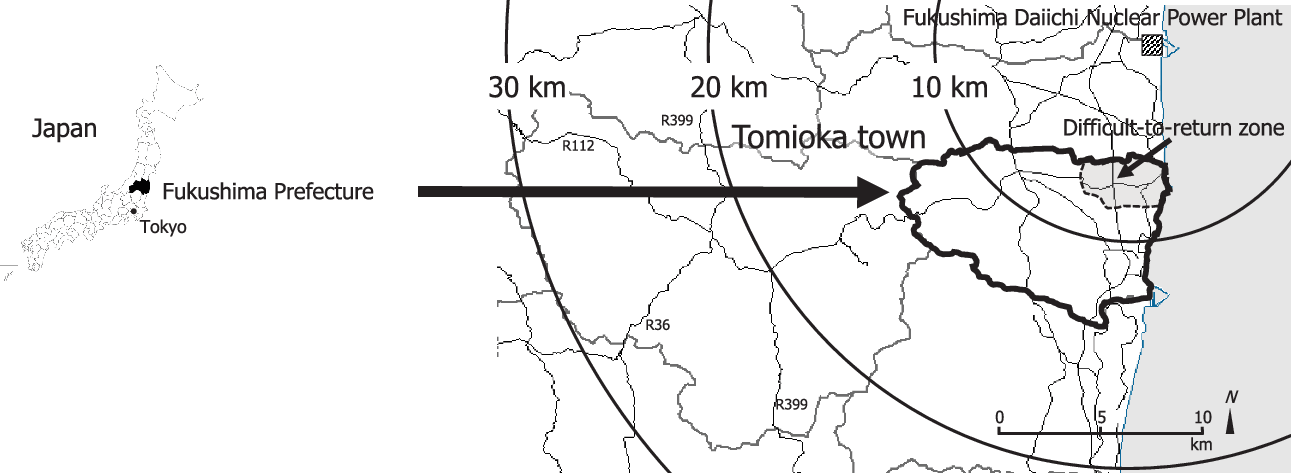
On March 11, 2011, the Great East Japan Earthquake and its resultant tsunami, severely damaged Tokyo Electric Power Company’s Fukushima Daiichi Nuclear Power Station (FDNPS).1-3 Just after the accident, the Japanese Government issued an evacuation order in order to minimize the external exposure of residents around the FDNPS.1-Reference Nagataki and Takamura7 Tomioka town is located about 10-20 km from the FDNPS (Figure 1). At the time of the accident, the population of Tomioka town was 15839, and the aging rate (i.e., the frequency of residents over 65 years of age) was 21.3%. Tomioka town was severely damaged by the 9.0-magnitude earthquake and resultant tsunami which had a maximum height of 21.2 m, and was contaminated by the radionuclides released from the FDNPS including Iodine-131, Cesium-134, and Cesium-137. As a result of the accident, almost all residents of Tomioka town were forced to evacuate immediately. The residents moved mainly to Iwaki city (about 30 km from Tomioka town) and Koriyama city (about 50 km from Tomioka town) in Fukushima Prefecture (Figure 1). On April 22, 2011, the Japanese government classified the evacuation order zone for Tomioka town into the following 3 parts: a ‘difficult-to-return’ zone, a ‘restricted residence’ zone, and an ‘evacuation order cancellation preparation’ zone.8 Recovery efforts to rebuild infrastructure and start the tedious decontamination process for Cesium-137 were implemented in all areas except for the difficult-to-return zone. On April 1, 2017, the Japanese government lifted the evacuation order for Tomioka town while excluding the ‘difficult-to-return zone.’ Over the 6-year period following the accident, the level of environmental radioactive contamination continuously decreased in the zone in Tomioka town where the evacuation order had been lifted. However, the number of residents who have returned to their homes remains limited. As at October 1, 2018, only 791 (6.0%) of the 13132 registered residents had returned to Tomioka town. Furthermore, the aging rate of the residents has increased up to 41.0%, compared with the pre-accident level of 21.3% and the average aging rate in Japan of 27.7%.8,9
Location of Tomioka town, Fukushima Prefecture, Japan.

Previously, we showed that the intention to return (ITR) among residents to Tomioka town was associated with risk perception about radiation exposure and health effects.Reference Orita, Hayashida and Urata10 In addition, we recently showed that being male, living with children younger than 18 years of age, shopping facility usefulness, a reluctance to drink tap water, anxiety regarding the genetic effects of radiation in the next generation, and requests for individual consultation with experts on the health effects of radiation were associated with an ITR among all residents of Tomioka town aged over 20 years.Reference Matsunaga, Orita and Iyama11
For the recovery of areas affected by the FDNPS disaster such as Tomioka town, it is important that younger residents return home and live with peace of mind. However, the rate of return among the young generation is limited not only for Tomioka town, but also in most of the other affected towns and villages for which evacuation orders have been lifted by the Japanese government. Actually, in Tomioka town, the rate of return of residents aged less than 20 years was 6.1% (85/1404), whereas that of residents aged over 65 years was 30.4% (427/1404). Although we previously clarified the ITR of residents to affected towns and villages for which evacuation orders had been lifted by the Japanese government,Reference Orita, Hayashida and Urata10,Reference Matsunaga, Orita and Iyama11 to our knowledge, no studies have attempted to clarify the ITR stratified by gender and generation. Therefore, in this study, we evaluated the ITR to Tomioka town and risk perception regarding the health effects of radiation exposure as stratified by gender and generation.
MATERIALS AND METHODS
Study Participants
The study was conducted in the town of Tomioka in Fukushima Prefecture in August and September, 2017. We sent questionnaires by regular postal mail to about 8000 former residents aged 20 years or older. All residents who still held a resident card permitting them to return to Tomioka town were invited to participate in this study. We obtained the current home addresses of former residents from the Tomioka town office. Our university reached a comprehensive agreement with the Tomioka town office regarding cooperation for the recovery of Tomioka town, and we conducted the present study based on this agreement. As a result, we obtained responses from 2185 residents (27.3%). After excluding 325 residents due to insufficient responses, 1860 (85.1%) were included in the analysis.
This study was approved by the ethics committee of the Nagasaki University Graduate School of Biomedical Sciences (project registration No. 16102103). Before commencing the research, we obtained permission to conduct the study from the municipal government of Tomioka town.
Data Collection
We asked the residents to describe their ITR to Tomioka town within 3 years after the lifting of the evacuation order by using the following 4 options: “want to return,” “want to return if possible,” “do not want to return if possible,” and “do not want to return.” We also asked the residents to evaluate their risk perception regarding the health effects of radiation exposure such as acute radiation syndrome, the risk of cancer in themselves and their children, and the genetic effects in the next generation; which may be caused by living in Tomioka town, on a 4-point scale (“Yes,” “Probably yes,” “Probably not,” and “No”). In addition, we asked the residents whether they were anxious about drinking tap water and consuming food collected in Tomioka town. We also collected demographic characteristics, including gender, age, employment, whether they were born and living in the restriction zone in Tomioka town, whether they had regular medical checkups, and whether they were living with children younger than 18 years of age. We also asked about life-related factors such as envisioning a life in Tomioka town and their satisfaction with the available housing after the accident (Supplement 1).
Statistical Analyses
The purpose of this study was to clarify the factors related to the ITR to Tomioka town among the younger generation. We defined ‘young males’ and ‘young females’ as those under the age of 49 years who were physiologically capable of having and rearing children. We divided the study participants into 4 categories according to gender and age as follows: older males (over 50 years old), young males (20-49 years old), older females (over 50 years old), and young females (20-49 years old). Furthermore, we classified residents who ‘have already returned or want to return’ and ‘want to return if possible’ as ITR (+), and those who ‘do not want to return if possible’ and ‘do not want to return’ as ITR (–). Thus, all responses were divided into the following 2 categories: “Yes” or “Probably yes” as “YES,” and “No” or “Probably not” as “NO.” We used the chi-square test to compare demographic factors such as ITR, anxiety about drinking tap water and consuming food collected in Tomioka town, and risk perception regarding radiation exposure in Tomioka town by gender and generation. We evaluated the ITR to Tomioka town, satisfaction with current housing, envisioning a life in Tomioka town, and having a perception of risk of radiation exposure and adverse health effects in older males, young males, older females, and young females using binominal logistic regression analysis. After confirming the absence of collinearity for dependent variables and excluding statistically confounding factors by binominal logistic regression analysis; older males, young males, older females, and young females born in Tomioka town were included in the model. We defined older males as the “reference” value, and then calculated the odds ratios (OR), 95% confidence intervals (CI), and p-values. In addition, we clarified the factors independently associated with an ITR stratified by gender and generation using binominal logistic regression analysis.
After excluding statistically-confounding factors; being born in Tomioka town, living in a restriction zone, employment status, living with children, living with children under the age of 18 years, regular medical checkups, satisfaction with current housing, reluctance to drink tap water and consume food collected in Tomioka town, as well as anxiety regarding possible genetic effects in the next generation and adverse health effects from radiation exposure in themselves were included as factors in models. The results of the binominal logistic regression analysis showed statistical collinearities between anxiety about the consumption of ‘tap water’ and ‘food,’ and radiation health effects in ‘themselves’ and ‘offspring.’ Therefore, to avoid statistical collinearities, we created 2 models (Tables 4a and 4b). P-values of 0.05 were considered significant. Statistical analysis was performed using IBM SPSS Statistics (version 19; SPSS Japan, Tokyo, Japan) and SAS 8.2 software (SAS Institute, Cary, NC).
RESULTS
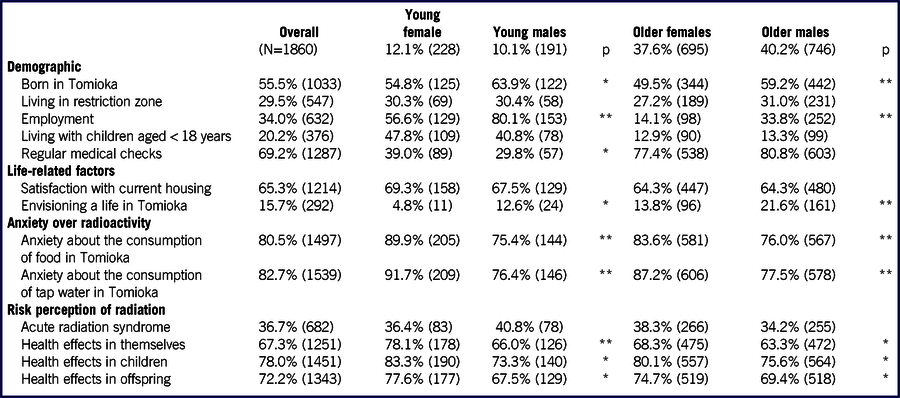
The residents’ basic characteristics are described in Table 1. Rates of anxiety about drinking tap water and consuming food collected in Tomioka town, as well as anxiety regarding possible genetic effects in the next generation and adverse health effects from radiation exposure in themselves, and in their offspring were significantly higher in females than in males in both generations.
Characteristics of study participants stratified by gender and generation

Note. p<0.05* p<0.01**, vs. male, χ2 test
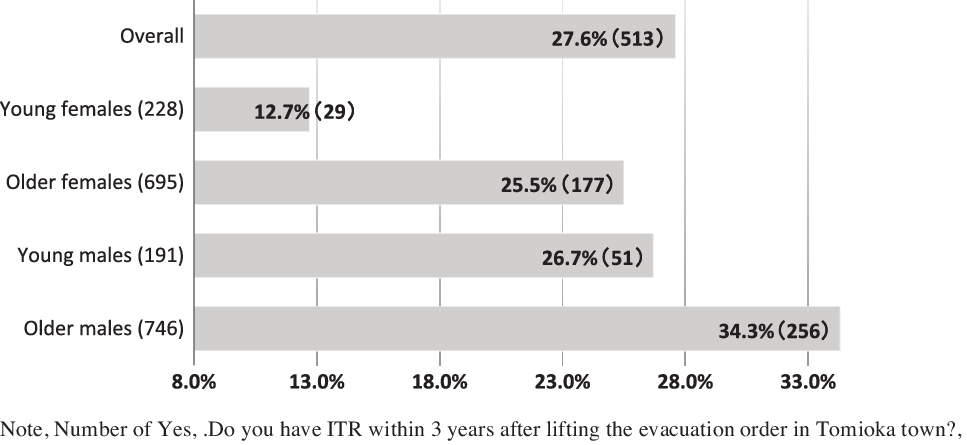
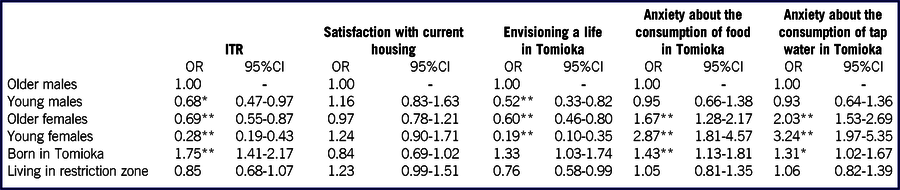
We then compared the ITR as stratified by gender and generation. The ITR was extremely low in females, especially in young females (Figure 2). Table 2a shows the ITR to Tomioka town, satisfaction with current housing, envisioning a life in Tomioka town, and anxiety about drinking tap water and consuming food collected in Tomioka town in old and young males, as well as females. Compared with the older males, ITR was significantly lower in young males (OR=0.68, 95% CI: 0.47–0.97, p < 0.05), older females (OR = 0.69, 95% CI: 0.55–0.87, p < 0.01), and young females (OR = 0.28, 95% CI: 0.19-0.43, p < 0.01). Envisioning a life in Tomioka town after the nuclear disaster was significantly lower in young males (OR = 0.52, 95% CI: 0.33-0.82, p < 0.01), older females (OR = 0.60, 95% CI: 0.46-0.80, p < 0.01), and young females (OR = 0.19, 95% CI: 0.10-0.35, p < 0.01) than in older males. Furthermore, rates of anxiety about consuming food collected in Tomioka town were significantly higher in older females (OR = 1.67, 95% CI: 1.28−2.17, p < 0.01) and young females (OR = 2.87, 95% CI: 1.81-4.57, p < 0.01). Similarly, rates of anxiety about drinking tap water in Tomioka town were significantly higher in older females (OR = 2.03, 95% CI: 1.53−2.69, p <0.01) and young females (OR = 3.24, 95% CI: 1.97-5.35, p <0.01). On the other hand, rates of satisfaction with current housing were not significantly different by gender and generation.
Intention to Return to Tomioka Town Within 3 Years After Lifting the Evacuation Order by Gender and Generation.

Intention to return to Tomioka town and concerns over radioactivity stratified by gender and generation

Note. ITR=Intention to return, OR=odds ratio, CI=confidence interval, p<0.05* p<0.01**, logistic regression analyses.
Table 2b shows the risk perception of radiation health effects stratified by gender and generation. The rates of risk perception of health effects in offspring caused by living in Tomioka town were significantly higher in young females (OR = 1.54, 95% CI: 1.08-2.18, p < 0.05) and older females (OR = 1.31, 95% CI: 1.04-1.66, p < 0.05) than in older males. In addition, the rates of risk perception of an increased cancer risk in themselves and their children by living in Tomioka town were significantly higher in young females (themselves: OR = 2.08, 95% CI: 1.47-2.95, p <0.01; their children: OR = 1.62, 95% CI: 1.10−2.39, p <0.05) and older females (themselves: OR = 1.27, 95%CI: 1.02−1.58, p<0.05; their children: OR = 1.31, 95% CI: 1.02-1.69, p < 0.05) than in older males. On the other hand, rates of risk perception of acute radiation syndrome caused by living in Tomioka town were not significantly different by generation.
Risk perception of radiation stratified by gender and generation

Note. OR=odds ratio, CI=confidence interval, p<0.05* p<0.01**, logistic regression analyses.
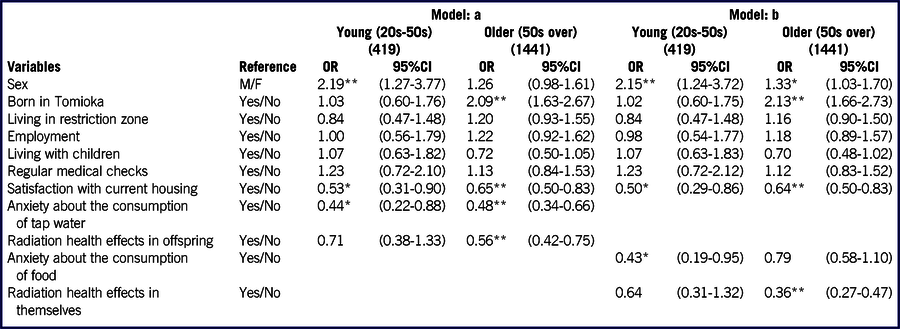
Next, we identified the factors independently associated with an ITR stratified by gender and generation (Table 3). In both young and older residents, the ITR was independently associated with satisfaction with current housing and anxiety about drinking tap water. On the other hand, the ITR was independently associated with ‘born in Tomioka town’ (OR = 2.09, 95% CI: 1.63-2.67, p <0.01) and ‘concern about radiation health effects in offspring’ (OR = 0.56, 95% CI: 0.42–0.75, p < 0.01) in only the older generation. In the young generation, the ITR was independently associated with male gender (OR = 2.19, 95%CI: 1.27–3.77, p < 0.01), whereas in young residents, the ITR was independently associated with ‘anxiety about consuming food’ (OR = 0.43, 95% CI: 0.19-0.95, p < 0.05), and in older residents, with ‘concern about radiation health effects in themselves’ (OR = 0.36, 95% CI: 0.27–0.47, p < 0.01).
Factors associated with Intention to return by generation

Note. OR=odds ratio, CI=confidence interval, p<0.05* p<0.01**, logistic regression analyses.
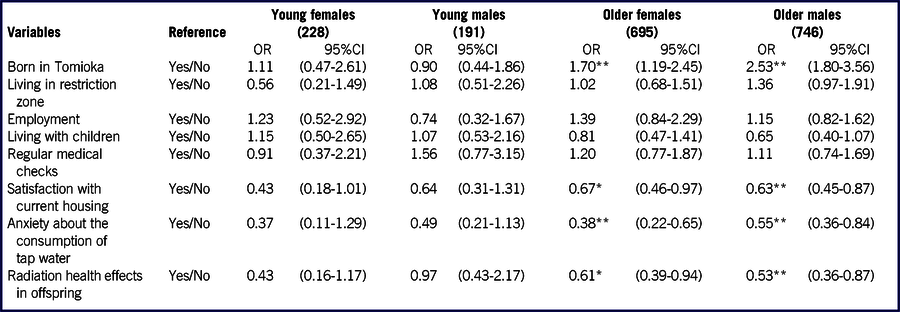
Factors associated with Intention to return by gender and generation, including “Anxiety about the consumption of tap water” and “Radiation health effects in offspring” in variables

Note. OR=odds ratio, CI=confidence interval, p<0.05* p<0.01**, logistic regression analyses.
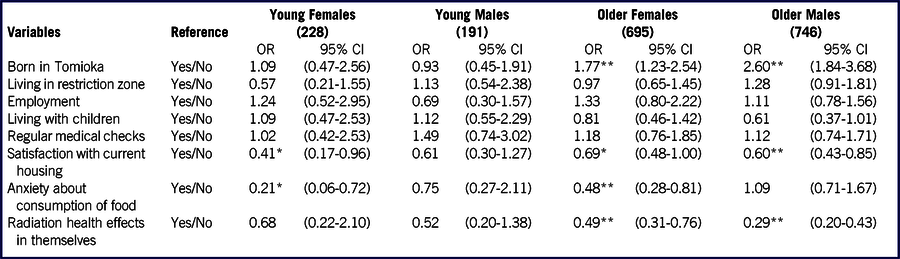
Factors Associated with Intention to Return by Gender and Generation, Including “Anxiety About The Consumption Of Food” and “Radiation Health Effects in Themselves” in Variables

Note OR, Odds Ratio; CI, Confidence Interval; *p <0.05, **p <0.01, logistic regression analyses.
In addition, we analyzed the factors independently associated with an ITR stratified by gender and generation (Table 4a). In older females and older males, the ITR was independently associated with ‘born in Tomioka town,’ ‘satisfaction with current housing,’ ‘anxiety about drinking tap water,’ and ‘concern about radiation health effects in themselves.’ On the other hand, in young females and young males, no factors were independently associated with the ITR.
In another logistic regression analysis model (Table 4b), the ITR was independently associated with ‘satisfaction with current housing’ (OR = 0.41, 95% CI: 0.17-0.96, p < 0.05) and ‘anxiety about consuming food’ (OR = 0.21, 95% CI: 0.06−0.72, p < 0.05) in young females. On the other hand, the ITR was independently associated with ‘born in Tomioka town,’ ‘satisfaction with current housing,’ and ‘concern about radiation health effects in themselves’ in older females and older males. Furthermore, the ITR was independently associated with ‘anxiety about consuming food’ in young and older females.
DISCUSSION
In this study, we assessed the ITR and risk perception about the health effects of radiation exposure as stratified by gender and generation among residents living in municipalities where evacuation orders had been lifted following the FDNPS accident.
It is well known that younger residents were reluctant to return to evacuated areas after the disaster.12 This was true for not only Tomioka town, but also all municipalities where evacuation orders had been lifted in Fukushima Prefecture. In this study, we showed that young females were particularly hesitant to return to their hometown. Rates of envisioning a life in Tomioka town after the nuclear disaster were significantly lower in young females and males than in older males. These results suggest that to accelerate the return of the younger generation, it is important to implement recovery efforts that target these residents.
We showed that many residents of Tomioka town had anxiety about drinking tap water and consuming food collected in Tomioka town. We also showed that these types of anxiety were more common in the younger generation, particularly in young females. More importantly, these types of anxiety were independently associated with the ITR to Tomioka town. After the accident, the Japanese government implemented a food control policy to minimize internal exposure to radioiodine and radiocesium.1-3 Due to such policies, it has been clarified that the internal exposure doses of residents were relatively limited in Fukushima compared with those around the Chernobyl Nuclear Power Plant.Reference Nagataki, Takamura and Kamiya5-Reference Nagataki and Takamura7 Nevertheless, many residents remain hesitant to drink tap water or consume food products collected in Fukushima, and females had a higher sensitivity than males to the potential risks of internal exposure by consuming food.Reference Sugimoto, Shinozaki and Naruse13,Reference Murakami, Nakatani and Oki14 To reduce unnecessary anxiety and distress about food and water consumption, the continuation of risk communication education targeting the younger generation, in collaboration with the mass media and local authorities, as well as the future development of risk education for children, is needed in Fukushima Prefecture.
We also showed that the rates of risk perception of the genetic effects in offspring caused by living in Tomioka town were significantly higher in young and older females. Similarly, the rates of risk perception of the increase in cancer risk in themselves and their children by living in Tomioka town were significantly higher in the younger generation, which is consistent with previous studies conducted in Fukushima Prefecture.Reference Suzuki, Yabe and Yasumura15,Reference Sugimoto, Nomura and Masaharu16 Furthermore, we showed that young females had much higher risk perception than the other gender and generation. After the FDNPS disaster, young females, particularly mothers, had concerns about food safety, outdoor safety, the effects of radiation on gestating embryos, the health effects of radiation exposure in children, and their economic status.Reference Yoshii, Saito, Kikuchi, Ueno and Sato17 In addition, they distrusted the announcements in the media regarding food safety and radiation values.Reference Yoshii, Saito, Kikuchi, Ueno and Sato17 Particularly for young females, the health effects of radiation exposure in children were the main concern; therefore, continuous risk communication is essential in this group.
This study had several limitations. First, the questionnaire was developed based on our previous studies involving residents of Kawauchi village in 2014,Reference Orita, Hayashida and Nakayama18 the mental health and lifestyle survey conducted within the framework of the Fukushima Health Management Survey,19 and the question and answer data that we published for residents of Fukushima Prefecture after the accident.Reference Takamura20 Second, although we revised the questionnaire through discussions with staff members of the Tomioka town office, we could not assess its validity and reliability through a small focus group, nor could we update/enhance the questionnaire prior to utilizing it. Third, the response rate was relatively low and we could not send reminders to the residents which might have led to selective responses. In total, 2185 former residents responded to our study, but 325 (14.9%) of these residents returned insufficient replies, which suggests that the questionnaire was not easy to complete correctly. In addition, we could not obtain sufficient information on potential confounding factors, such as detailed lifestyle habits of residents, as well as their economic and educational status. Finally, as this was a cross-sectional study, we could not evaluate causality.
CONCLUSION
We investigated residents’ ITR to Tomioka town and their risk perception about the health effects of radiation exposure as stratified by gender and generation. Our results suggest that special attention should be paid to the younger generation, particularly to younger females, in order to promote the recovery of communities after nuclear disasters. In addition, our findings strongly suggest that such attention should include information on radiation exposure and health effects, as well as visions of future possibilities for the younger generation. To promote further the recovery of Tomioka town, careful risk communication regarding radiation exposure and health effects will be needed while considering the background of each resident.
Acknowledgments
We would like to thank all study participants, and the staff members of the Tomioka town office.
Funding Statement
This work was supported by Research on the Health Effects of Radiation organized by the Ministry of Environment, Japan.
Supplementary Material
To view supplementary material for this article, please visit https://doi.org/10.1017/dmp.2020.319