

10.1 Distribution, Soils, and Management
A landform is a large, contiguous area of similar geomorphologic history and chemical and physical properties that distinguish it from other landforms [Reference Easterbrook1]. About fifteen kinds of landforms exist, distributed irregularly in various sizes from quite small to larger than the country of Spain. They adjoin each other and continuously cover the Earth, including beneath oceans and seas. Each landform has similar properties wherever it occurs that make it useful for some things and difficult for others (Table 10.1). Along with climate, landforms strongly determine the biodiversity, lifestyles, and resources of people living on them.
The study of landforms emerged from both soil science and geomorphology. Soil science first focused on the productivity of each field for crop growth. Much was learned; but the perspective was narrow for integrating processes across larger areas for water, agriculture, buildings, land use allocation, mineral extraction, and other purposes. Consequently, conservationists integrated soil science with geomorphology to manage broader areas of similar properties for many uses.
Soils develop from “parent material” – either bedrock or usually inorganic material that is transported from elsewhere by wind, water, or ice and covers the bedrock deeply. Parent materials have a variety of characteristics that influence the developing soil properties. Landforms and their soils support agriculture and biodiversity, moderate water movement, provide building materials, and serve as stable or unstable places for living or traveling. This chapter will first discuss soils and then general characteristics of landforms. Subsequent chapters will discuss different landforms in detail.
10.2 Soil Properties and Variations
Igneous, metamorphic, and/or sedimentary rocks in various stages of weathering underlie all landforms (Chapter 26). In places, overlying deposits from elsewhere characterize the landform. Where these overlying deposits are absent or thin, the landform is characterized by the “bedrock,” which is the hard layer of solid rock of different types covering the Earth. Bedrock is usually covered by loose rocks and soil (Figure 11.3a), but is sometimes exposed (Figures 11.2a–b). The covering of loose rocks, sand, silt, and clay is the soil’s “parent material.” It can be either decomposed (“weathered”) from bedrock or transported from elsewhere.
Rocks break apart physically and chemically and form soils, a property common to all landforms known as “weathering” [Reference Huddart and Stott2–Reference Plummer, McGeary and Carlson5]. Weathering becomes deeper with time, with soils many hundreds of millions of years old being 6 meters or more deep (Figure 11.3a). Soils differ in moisture, particle size distribution, structure, chemical composition, tendency to erode, angle at which they maintain slope stability (“stable angle of repose”), and other factors. The differences are caused by the parent rock material and how they were physically and chemically converted to soils. These differences cause landforms to be useful and hazardous in specific ways that can be anticipated and managed.
Soil is “the unconsolidated mineral” and/or “organic material on the immediate surface of the Earth that serves as a natural medium for the growth of land plants” [6]. It commonly consists of decomposing organic matter, living plant roots, microorganisms, animals, elements (Table 10.2) and other cations and anions, air, water, and mineral particles. It exists in the surficial one to several meters of land. Soils vary dramatically in productivity for plant growth because of differences in moisture holding capacity, aeration, elements, and other factors.
10.2.1 Soil Moisture-Holding Capacity, Texture, and Structure
A soil’s moisture holding capacity is based on its structure and texture. Texture is the distribution of mineral particle sizes [7]. Clays have the smallest diameter (<0.002 mm), silt next (0.002–0.02 mm), sand (0.02–2 mm), then various rocks (pebbles, cobbles, and boulders). Larger soil particles leave larger spaces (pores) between them when packed. This pore space is necessary for plant roots to get both air and water, allowing rain and irrigation water to infiltrate the soil instead of rapidly washing off its surface, and allowing soils to drain and restore air.
Moisture is held in pores between soil particles and is available for drainage and plant growth based on the pore size [Reference Huddart and Stott2]. Water adheres to soil particles and crevices between particles in varying magnitudes of adhesive force. Water molecules adjacent to the particle (hygroscopic water) are held so tightly that very high pressures are needed to remove them. At increasing distances from the particle, the water molecules are held less tightly but not so loose that they drain with gravity. Finally, water at greater distances drains with the low force of gravity (“gravity water,” about 0.5 atmospheres of pressure). Water retained in the soil after this gravity water has drained out is referred to as “field capacity.”
Plants grow by removing water from soil between about 0.5 and 6 atmospheres of pressure (“surface tension”) although some plants survive but grow little at over 15 atmospheres. Pore size determines how much water is available under different surface tensions. Soils with large pores, such as sandy soils, can take a lot of water into the pore spaces following a rain; but this water is held so loosely that it drains rapidly with gravity, leaving little left at field capacity for plant growth. Plants growing on such sandy soils commonly experience water shortages within one or several days following rain or irrigation.
Conversely, pores between clay particles are small and numerous. They can take in moderate amounts of water, but the water adheres tightly to the particles and does not drain away, nor is it available for plant growth. Soils with small pore spaces can remain saturated for a long time; no oxygen-containing air can get into the soil because the pores are full of water instead of air; and plant roots of most species suffer. Silt soils generally contain ideal pore sizes (not too large or small) so there is some air space and much water available for plant growth at field capacity and many days afterward. Soils occur in mixtures of textures (Figure 10.1).
Soil texture triangle chart, based on proportions of sand (Sa), silt (Si), and clay (C) in the soil; L=loam [7].

Soils of pure clay or with enough clay to fill all pore spaces between any sand or silt that may be present are not good for plant growth unless they have a “structure” with suitable pore sizes. Roots, small animals, fungi, and frost penetrate clay and other soils and create holes; insert organic matter; bind soil particles together with roots, fungal hyphae, or sticky organic material; and so form larger pores than would otherwise be found in tightly packed clay soils. This arrangement is referred to as the soil’s “structure” and can provide pores of appropriate size for good growth and moisture drainage. A soil’s structure can be ruined by compacting it – grazing, driving heavy machinery, or otherwise manipulating it when wet. A ruined soil structure can be redeveloped by consciously plowing in organic matter or allowing regrowth of a forest, whose tree roots and soil flora and fauna can redevelop a structure over decades.
Sandy and gravelly soils are less prone to compaction and loss of structure. All soils can become “fluffed” – full of air – so that the pore spaces are too large to retain water. Natural fluffing can occur in windblown sand and silt, and the structure can later collapse. Fluffing is sometimes induced by plowing to reduce water evaporation and prevent weed growth.
Soils can be deficient in air in extremely rainy or poorly drained areas where the pore space is constantly refilled or elsewhere if clays and a poor structure keep the soil saturated for extended periods. This airless condition kills roots and prevents the plants from obtaining water, thus leading to the physiological equivalent of a drought. Plant species vary in their ability to endure different times of both water-saturated and dry soils (Chapter 13).
Depending on the rain intensity, available soil pore space, and surface slope, water can flow across the top of a soil; infiltrate the soil and be taken up by plants and evapotranspired into the atmosphere; or be allowed to percolate deeper to subsurface water where it remains, moves as subsurface flow into streams and rivers, or moves as groundwater to aquifers (Figure 17.1, Chapter 17).
Soils of different structures and textures will remain stable on slopes of different steepness – different “angles of repose.” Loess soils generally remain stable at nearly vertical angles of repose (Figure 12.4a), while sands have quite flat stable angles of repose (Figures 12.3a, 14.7a). A slope is highly likely to fail (slump) if it exceeds its stable angle of repose.
Water and air move soil particles through suspension and “pushing, rolling and scraping” along the ground surface or river bed – a “bed load.” In both methods, the size and volume of soil material moved is directly proportional to the velocity and volume of water or air (Lane’s relationship) [Reference Oliver and Larson8]. Clay particles on steep slopes are most easily eroded, and flat gravelly areas are difficult to erode. Soil held together by plant roots increases the effective size of the “particle” and makes erosion more difficult.
10.2.2 Variations in Soil Uses
Each soil texture and structure has advantages and disadvantages for different uses.
Agriculture and forest crops such as peanuts and some pines are effectively grown on sandy soils, while soybeans and cottonwoods only grow well on moist, well-drained soils of finer texture.
Moist, well-drained sandy clay loam soils are generally highly productive for agriculture. These soils need to be carefully tended to ensure they do not lose their structure, organic matter, and fertility.
Most forest tree species grow fastest on the most productive soils; however, these soils are generally so valuable for agriculture that forests are cleared. Forests are generally grown commercially on slightly less productive soils (Chapter 28).
Clay soils can have difficulty retaining their structure if plowed or grazed when wet and so are often poor for agriculture.
Clay soils can be useful for dams, levees, and fish ponds if their structure is destroyed so they become compact and nonporous.
Some clay soils can be used for making bricks, china, and other ceramics when the upper, organic layers are removed (Chapter 27).
Forests are commonly harvested throughout the year. Harvesting is done on sandy and gravelly soils during wet seasons, and the more productive but compactible soils are operated on when dry and less prone to compaction.
Sandy soils are preferred for golfing, horse riding, and similar recreation because the soils drain well and can be accessed soon after rains.
Road construction is generally easier on sandy and gravelly soils; and gravel is often extracted to make roads and concrete. Landforms absent of sand and gravel have difficulty constructing roads or buildings unless the gravel and sand are transported from elsewhere.
Cement is made largely from limestone, which is common in karst landforms but found in smaller deposits elsewhere as well.
10.3 Soil Chemical Composition and Development
Seventeen elements are needed for plant growth (Table 10.2). All but four – carbon, hydrogen, oxygen, and nitrogen – originate in the soil. Nitrogen originates in the air; but some can be found in developed soils, certain kinds of rocks, and organic matter (Table 8.1). Before other plants can use it, nitrogen often needs to be incorporated into soil in appropriate forms (Table 10.2) by a few plant groups (Legume family [“pulses” of Chapter 19] and Alder genus) or artificial fertilizers. Oxygen comes from the atmosphere and is used by plants in carbon dioxide and diatomic oxygen molecule forms.
| Element | Chemical symbol | Form required by plants | Adequate concentration in plants (%) |
|---|---|---|---|
| Oxygen | O | O2, H2O | 45% |
| Carbon | C | CO2 | 45% |
| Hydrogen | H | H2O | 6% |
| Nitrogen | N | NO3−, NH4+ | 1.5% |
| Potassium | K | K+ | 1.0% |
| Calcium | Ca | Ca++ | 0.5% |
| Phosphorus | P | H2PO4−, HPO4− | 0.2% |
| Magnesium | Mg | Mg++ | 0.2% |
| Sulfur | S | SO4− | 0.1% |
| Iron | Fe | Fe+++, Fe++ | 0.01% |
| Chlorine | Cl | Cl− | 0.01% |
| Manganese | Mn | Mn++ | < 0.005% |
| Zinc | Zn | Zn++ | < 0.005% |
| Boron | Bo | Bo3−, Bo47 | < 0.005% |
| Copper | Cu | −Cu+, Cu++ | < 0.005% |
| Molybdenum | Mo | MoO4− | < 0.005% |
| Nickel | Ni | Ni++ | < 0.005% |
Other elements come from the soil’s parent material. Parent material is composed of rocks and minerals of various ionic compounds, covalent molecules, crystalloids, crystals, and other solids (Chapter 26). It consists primarily of oxygen, silicon, aluminum, with much smaller amounts of iron, calcium, magnesium, sodium, potassium, and other elements (Figure 26.2). Silicate (for example, quartz) and aluminum oxide (bauxite) rocks form the bulk, with carbonate rocks (limestone, gypsum, and marble) together forming lesser amounts (Chapter 26). Other elements, including the ones needed by plants (Table 10.2), are found in smaller amounts bonded within the parent material.
Parent material decomposes through both chemical weathering with rain and organic acids from roots and physical weathering such as frost cracking. Mineral aggregates weather as their weaker molecules break apart, fragmenting the rocks, and leaving intact harder molecules such as quartz (Figure 11.3b). Plants, microbes, arthropods, and small mammals grow within the fragments and further decompose (weather) them, creating soils (Figure 10.2) [Reference Monroe and Wicander3, Reference Craig, Vaughan and Skinner11, Reference Hamblin and Christiansen12]. The weathering frees cations and anions that are then held in loose ionic bonds within the soil, taken up by plants, or leached into the groundwater. Elements in organic matter within the soil can become available to plants as the organic matter decomposes [Reference Huddart and Stott2–Reference Plummer, McGeary and Carlson5, Reference Craig, Vaughan and Skinner11]. Potassium, magnesium, calcium, phosphorus and other elements needed for plant growth leach through the soil with rainwater. In rainy climates, they may leach into the water table and beyond, making soils unfertile.
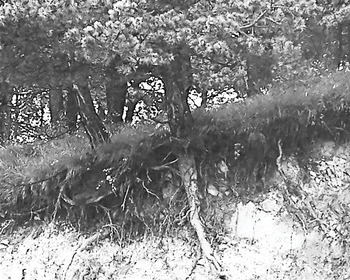
Pine tree showing roots penetrating and utilizing a gradient from well-developed soil downward to parent material and bedrock (Armenia).

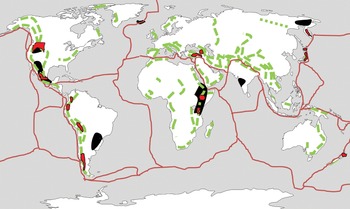
Predominant faults (thin dark lines), mountain areas (thick gray dashes), ash soils (gray with black borders), basalt flows (black) [Reference Monroe and Wicander3, Reference Plummer, McGeary and Carlson5, 20–Reference Shur and Jorgenson22].

Soils commonly turn red as they age because of the dominating color of even small amounts of iron in the oxygenated condition (ferric ion); they can be blue when unoxygenated conditions turn the iron to its ferrous condition. Despite their similar red appearances (Figures 11.1, 11.3), temperate and tropical soils behave quite differently.
Silicate minerals decompose into clays that help arrest the leaching of mineral elements by loosely adhering them. Soil organic matter similarly arrests leaching minerals. The adhering ability of a soil is known as its “cation exchange capacity.” The amount of clay increases as temperate soils age. Different parent materials and weathering patterns generate soils with different cation exchange capacities.
Different clays can expand when wet, reduce the pore space, and make some temperate soils saturated, prone to slumping, prone to losing their structure if plowed or grazed when wet, and prone to erosion as water washes away the clays. Some clays shrink dramatically when drying, creating problems with overlying roads and buildings.
Typical tropical conditions of high temperatures and rains dissolve the silicate clays and leave porous soils of very few elements but generally with less tendency to erode or become saturated. These soils are known as “laterites” and can form porous, hardened rocks or can remain soft (Figure 11.1). Their pore spaces can be eliminated with compaction, especially in surface soils. They are poor in elements, but can become more productive by using fertilizers and organic matter to increase their fertility and cation exchange capacity.
Elements can leach somewhat with rain or irrigation and accumulate at lower soil depths or in aquifers, creating such salty soils and aquifers that plant growth and human use are inhibited (Figure 17.4). (See “Goulburn–Broken Catchment” Case Study, Chapter 3.) Very old soils (Figure 11.1) tend to be poor in elements and sometimes have salty aquifers both because of the long period of leaching and because old landforms probably passed through tropical, lateritic-forming processes at some past time (Figures 10.4–5).
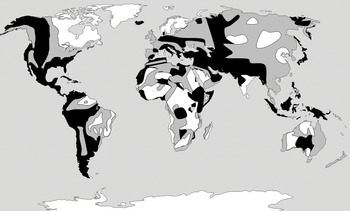
Predominant bedrock of different ages [Reference Huddart and Stott2, Reference Monroe and Wicander3, 20]. Shields (older than 500 million years) = white, Paleozoic and Mesozoic (500 million to 65 million years) = gray, Cenozoic (younger than 65 million years) = black.

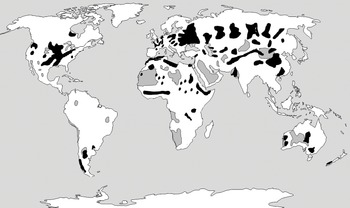
Predominant karst (light gray, heavy borders), relict lateritic soils (dark gray) and current laterites (black) [Reference Monroe and Wicander3, Reference Craig, Vaughan and Skinner11].

A soil’s pH (relative acidity) is the result of the parent material’s chemical composition, the quantity of cations within the soil, and the organic matter. Forest soils generally are acidic. Agriculture soils can be less acidic and often basic. Generally, broadleaf trees live in less acidic soils than do conifers.
Different parent materials contain more of some elements than others. Each element is taken into plants in only certain forms (Table 10.2), none of which are organic. The molecules can dissolve into the soil solution and be “sucked” (passively or actively) into the plant root with the soil water (Figure 10.2). Roots also pluck elements directly from the parent material [Reference Voigt13].
Each year elements (Table 10.2) and organic matter containing carbohydrates (celluloses, sugars, starches) fall to the ground in plant litter or rainwater. They are taken up by soil microorganisms, which sometimes transport elements to the plants. Most microorganisms keep the elements for themselves, grow, and consume and respire the carbohydrates until none are left. Then, the microorganisms die and release the elements to the soil solution where they are taken up by plants, adhere to clay or organic particles, or wash into the subsurface water (Figure 17.1).
Elements can be unavailable to plants because they are bound in organic molecules in cold or wet soils where organic matter decomposition is slow (Chapter 12).
Microbes decompose organic matter extremely rapidly in hot climates with sufficient soil oxygen, making the organic cation exchange capacity low; there, elements not rapidly taken up by trees can leach out of the soil. Disturbances such as fires, forest harvesting, or agricultural production in hot climates or elsewhere in soils with low cation exchange capacities can leach elements from the soil. The disturbance usually increases direct sunlight and heats the soil, further increasing microbial decomposition of organic matter. It also removes living plants that take up elements before they can be leached and that add organic matter. Agriculture, grazing, and other activities that do not allow vegetation to regrow cause element losses. With soil element loss, plant growth can be poor unless fertilized or until further decomposition of the parent rock material replaces the elements, often many decades later.
Soil nitrogen is lost by volatilization in fires, leaching following disturbances, and harvesting of the leaves, fruits, and bark – the plant parts with highest nitrogen concentrations. Nitrogen is part of an element flush to the groundwater and streams following a disturbance; however, it is uncertain how much “flushed” nitrogen was in the soil or plants from before the disturbance and how much was newly added by nitrogen-fixing plants that invaded after the disturbance.
Bedrocks characteristic of different landforms can contain unusual concentrations of precious metals, crystals, and other minerals (Chapter 27). The concentrations are often created as the rocks form. Cracks of saturated water can lead to quartz and other crystal and crystalloid formations (Figure 11.3b; Chapter 27). Differential temperatures of melting and solidifying of bedrock concentrate minerals such as gold. Some landforms have concentrations of radioactive materials, with local areas being quite radioactive.
Despite variations, nearly all soils develop “horizons,” or layers, parallel to the soil surface where various root and animal penetrations, leachings, and element accumulations occur. The horizons have specific characteristics and appearances [14]. Soils have been organized into hierarchical classification systems that are internationally standardized [15, 16].
10.4 Distribution of Landforms
There are patterns to landform locations based on the world’s geomorphology. Bedrocks form, move, and disappear with geologic processes as parts of “geologic plates” (Figures 9.1, 10.3). Geologic plates consist of above- and below-water areas of very old rocks (“shields”), younger rocks formed from molten materials beneath (“igneous”), and rocks reformed from surface deposits hardened by pressure and heat (“metamorphic”) [Reference Skinner, Porter and Park4]. The moving plates run into, over, and beneath each other; scrape past each other; and split apart [Reference Skinner, Porter and Park4, Reference Plummer, McGeary and Carlson5]. Instead of colliding, an ocean crust will commonly dip beneath the continent when they meet, creating a “subduction zone” along the continent and a volcanic mountain chain nearby within the continent. Active non-collision subduction zones currently exist near the Asian and American coasts of the Pacific Ocean, creating many active volcanoes (the “ring of fire,” Figure 10.3).
Two continents can collide when the ocean between them is fully subducted; these can buckle and form mountains, with earthquakes but much less volcanic activity than during subductions because the rocks fold or gradually uplift and sink. Such activities are occurring in the Pyrenees, Alps, Carpathians, Pontus and Taurus, Caucasus, Zagros, Himalayas, Serra do Mar Brazil, and Great Dividing Range of eastern Australia.
Plates scraping past each other can also cause earthquakes, such as along the San Andreas fault of California.
The plates can also split apart, allowing hot rock from within the Earth to rise, cool, and form mountains, such as is in the middle of the Atlantic Ocean. The splitting can also create “rift” valleys such as the Rhine Valley in Germany, the Rio Grande Rift in southwestern USA, the Baikal Rift of Russia, the submerged rift within the mid-Atlantic ridge, and the East African Rift – not to be confused with the Rif Mountains in northwestern Africa [Reference Monroe and Wicander3].
“Holes” can also occur in the plates, where the molten rock comes near the surface and forms hot springs and/or volcanoes. The basalt flows in eastern Oregon and Washington, USA about 16.5 million years ago were such a “geologic hotspot.” The North American crust has now moved westward and that hot spot formerly in eastern Oregon and Washington erupted as a volcano many times before arriving at what is now Yellowstone National Park 2.1 million years ago. Since then, it has had three extremely large, explosive eruptions and is due for another (Chapter 12) [17].
Gravity, geologic uplift, wind, water, volcanos, or glaciers can move broken bedrock material. Eroded soil can slowly create new landforms where it collects as alluvial floodplains, coastal plains, sand dunes, or sea beds from water erosion, or as loess hills, ash-cap soils, or sand dunes from wind erosion. The sea deposits can slowly form sedimentary rocks and then metamorphic rocks as they compact, harden, and chemically alter. In aggregate, these changes maintain the large array of landforms [Reference Huddart and Stott2–Reference Plummer, McGeary and Carlson5]. The circulation of rock particles, other landform materials, and dead plants and animal in some cases, keeps landforms more capable of providing resources than if landforms were static.
Landforms have been classified in different ways [Reference Shimer18, 19]. For this book, they will be divided into fifteen types (Figures 10.3–9). Five occur from direct weathering of the underlying bedrock:
1) weathered shield bedrock,
2) other recent igneous and very old metamorphic bedrock,
3) other old sedimentary and recent metamorphic bedrock (excluding karst),
4) large basalt flow bedrock,
5) karst landforms.
Seven landforms are caused by surface mineral layers transported and deposited from elsewhere, and so are different from the underlying bedrock:
6) volcanic ash and tuff,
7) sand dunes,
8) loess,
9) alluvial floodplains,
10) coastal plains,
11) glaciated areas,
12) bogs.
Three other landforms have unique features:
13) permafrost areas,
14) mountains,
15) wetlands.
Globally, landforms are not consistently mapped, probably because various mapmakers are more knowledgeable about different places. The maps above are coarse amalgamations of different sources into an approximation of world landform locations.
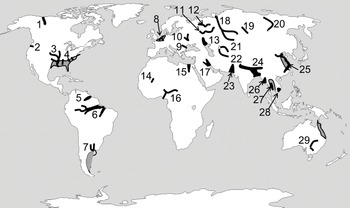
| 1 | Mackenzie River, Canada | 16 | Niger River, Nigeria |
| 2 | Columbia River, USA | 17 | Mesopotamia (Tigris and Euphrates Rivers), Iraq and Kuwait |
| 3 | Mississippi–Missouri–Arkansas Red Rivers, USA | 18 | Ob River, Russia |
| 4 | Southeastern rivers, USA | 19 | Jenesej (Yenisey) River, Russia |
| 5 | Orinoco River, Venezuela | 20 | Lena River, Russia |
| 6 | Amazon & Tocantins Rivers, Brazil | 21 | Syr Darya, Uzbekistan |
| 7 | Parana and Uruguay Rivers, Argentina and Uruguay | 22 | Amu Darya, Uzbekistan |
| 8 | Rhine, Weser, Ems Rivers, European Union | 23 | Indus River, Pakistan |
| 9 | Danube River, Romania | 24 | Ganga, Bhramaputra, Jamuna, Padma, and other rivers, India and Bangladesh |
| 10 | Dnieper River, Ukraine | 25 | Yellow (Huang) and Yangtze (Huang) Rivers, China |
| 11 | Severnaja River, Russia | 26 | Ayeyarwady River, Myanmar |
| 12 | Pecora River, Russia | 27 | Chao Phrayn and other Rivers, Thailand |
| 13 | Volga River, Russia | 28 | Mekong River, Cambodia and Viet Nam |
| 14 | Niger River, Sudan | 29 | Murray–Darling River Basin, Australia |
| 15 | Nile River, Egypt |
Loess deposits (black) and sand dunes (gray) [Reference Monroe and Wicander3, Reference Plummer, McGeary and Carlson5, Reference Davidson23–25].

Major coastal plains (gray with black borders) [Reference Monroe26, 27] and alluvial floodplains (black) [Reference Plummer, McGeary and Carlson5, Reference Hamblin and Christiansen12, 28] Table 10.3 is river legend.

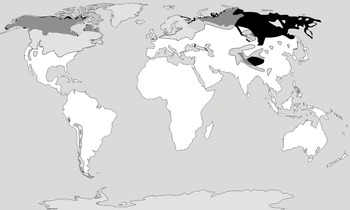
Recently glaciated areas (light gray) [Reference Monroe and Wicander3, Reference Plummer, McGeary and Carlson5, Reference Maslin and Fagan24, Reference Yafeng, Zhijiu and Zhen29], current permafrost (black) [Reference Plummer, McGeary and Carlson5, 20–Reference Shur and Jorgenson22, Reference Heginbottom, Brown, Humlum, Svensson, Williams and Gerrigno30], and overlap (dark gray).

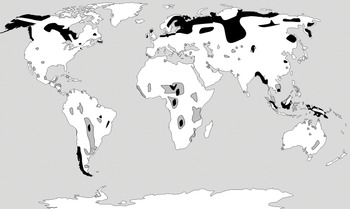
Major areas of bogs (black) and wetlands (gray) [Reference Prigent, Papa and Aires31–33].

Asia and South America seem to have the most balanced landform distribution (Figure 10.10). Europe, Asia, and North America have the greatest proportion of mountains, with Africa and Australia having the least. Recently glaciated areas are primarily in Europe, Asia, and North America. Large shield (very old – Precambrian) areas can be found in North America, Africa, and Oceania – especially Australia. These are generally highly weathered, unproductive soils. Precambrian areas of South America, Africa, Australia, and Asia have a strong impact on resources because they lie in potentially productive climates and, unlike North America and Europe, have not been modified by glaciers. Europe contains the greatest proportion of loess and productive Mediterranean and temperate oceanic forest climates (Chapter 8); consequently, it is agriculturally productive except in the far northern and mountainous areas. Ash soils are found downwind from present or former volcanic areas, primarily along the “ring of fire” (Figure 10.3) in Asia and the Americas; ash soils are also found in Iceland and Asia Minor. Africa and Oceania (Australia) contain the greatest proportions of sand dunes. Karst landforms are most dominant in Africa and Oceania and least dominant in South America. Coastal Plains are present in all continents, but only in small amounts in Africa. Africa and Oceania also have the least productive soils for agriculture, with large amounts of low productivity Precambrian and sand dune formations and relatively little productive alluvial floodplains. Unlike Africa, Oceania (mainly Australia) has considerable loess; however, it is in dry areas and so is not too productive.
Rough distribution of selected landforms as a proportion of each continent. (Areas add up to more than 100% because transported soils cover bedrock in many places.) Estimated from Figures 10.3–9.

Bog formations usually contain peat and are common on cold or water-saturated soils – in formerly glaciated areas, coastal plains, and river floodplains and the islands of southeast Asia. Permafrost is found primarily in Asia and North America, with some in Europe and very small areas in South American and Australian mountains.
Conditions within a landform are not always uniform; but the variations in soil, topography, drainage, and other factors can be anticipated. The variations can often be traced to events that occurred during bedrock formation; redeposition; or subsequent disturbances, weathering patterns, or land use history [Reference Hjort, Gordon, Gray and Hunter34, Reference Lawler, Ackerly and Albano35].
Soils generally accumulate in valleys by eroding, washing, creeping, or slumping from surrounding hills. Consequently, ridges generally contain shallow soils and exposed bedrock while valleys are more productive because of their deeper soils and water drained from the slopes. Exceptions are glaciated and alluvial areas. Glaciated valley bottoms tend to be infertile because they contain coarse sand and gravel. Alluvial floodplains are generally flat, but their lower areas (often less than a meter lower) commonly contain clay soils that are less productive because of little aeration.
Elevation differences within a landform create different climates; hills and valleys; and rockfalls, soil slumping, and snow avalanches.
Landforms can have small amounts of other landforms interspersed within them. Alluvial floodplains and coastal plains can contain peat bogs; and metamorphic soils can contain karst, volcanic, and loess areas. The variations can be locally mapped.
10.5 Managing Landforms
All landforms change, each in characteristic ways [Reference Monroe and Wicander3]. They often change slowly or infrequently and so appear static – and are commonly treated as such (Figure 1.3). River channels [Reference Guccione, Prior and Rutledge36], shorelines [Reference Morton37, Reference Frihy38], city locations [Reference De Carolis and Patricelli39], and harbors [Reference Delile, Blichert-Toft and Goiran40, Reference McPhee41] occasionally change or disappear. These transitions are generally considered harmful because people are not prepared for them (Chapter 3); however, they sometimes provide future opportunities.
For example, abandonment of historic Ephesus (Figure 10.11) is sometimes considered an environmental tragedy. Its harbor was silted in by erosion caused by heavy farming and grazing upstream about 2,900 to 800 years ago [Reference Delile, Blichert-Toft and Goiran40]. Despite mitigating efforts, the city was eventually abandoned because of lack of harbor access and mosquitos in the silted harbor. The former harbor has now become highly productive alluvial farmland that probably provides more food at greater efficiency than the former uplands. Also, Ephesus’ harbor would have been far too small to accommodate modern ships. Non-sustained management of Ephesus’ harbor may have been appropriate and efforts to sustain it may have been wasted in retrospect.
(a) Ancient Ephesus (circled) and vicinity (Turkey). Rich, alluvial soil where bay and harbor were silted is shaded. (b) Present, partially restored ruins of Ephesus center. Figure 10.11a courtesy of Google Earth.

Each landform has unique patterns of stability and change that can be anticipated and that offers opportunities to adjust the geologic system to provide more ecosystem services through infrastructures, including dams, levees, bridges, plowed soils, terraces, irrigation systems, tunnels, highways, and others [Reference Petroski42]. Infrastructures are generally used to make landforms safer or more useful; and people have been adjusting landforms for millennia (Figure 18.7a). Unlike climate and weather systems, many benefits have come from modifying landform systems.
Landform features often appear unchanging until they reach a threshold and undergo a rapid and sometimes violent change (Figure 3.2b). Infrastructures such as grouting for sinkholes (karst), terraces for erosion (loess), levees and dams for floods (alluvial), and dune stabilizers can avoid or mitigate violent changes. Other infrastructures can mitigate landslides, snow avalanches, and GLOFs (Chapters 12, 19). Infrastructures that are poorly installed, maintained, replaced, or dismantled can create dangers – such as collapsing dams [Reference Johnson43–Reference Adamo and Al-Ansari45], collapsing bridges [Reference Larsen46], collapsing agricultural terraces [Reference Xiang-zhou, Hong-wu and Ouyang47], sediment entrapment and eroding floodplains [Reference Stanley48], failing levees [Reference Sills, Vroman, Wahl and Schwanz49], and eroding agriculture fields [Reference Pimentel, Harvey and Resosudarmo50].
Infrastructures can increase people’s wellbeing, such as irrigation reservoirs and ditches, dams, levees, and terraces providing more food per hectare – and thus saving energy as well as biodiversity by concentrating agriculture and not clearing more forests. Hydroelectric dams presently provide as much renewable energy to the world as all other renewable energy combined except nuclear power (Figure 25.6). Ditches that drained swamps or straightened river channels in alluvial floodplains reduced the danger of malaria [Reference Keiser, Singer and Utzinger51]. Remote cattle drinking troughs can provide water for wildlife species and so extend their ranges. Reservoirs can create new wetlands and aquatic habitats even as they are destroying other areas. Highways, bridges, and tunnels enable people, food, and other things to move rapidly.
On the other hand, infrastructures can have negative effects (Chapter 19). Dams harm or destroy some habitats and species such as migrating fish. Dams and reservoirs can also displace villages in areas to be dammed. Bridges, tunnels, and highways can fragment habitats and enable human encroachment on biodiverse areas. Agriculture ditches and straightened river channels that allow rapid drainage can reduce the amount of water that percolates to an aquifer (Figure 17.1). New infrastructures often appear unattractive; over time, they sometimes become locally appreciated as historical relicts (Figures 10.11, 18.7a).
People are now faced with several decisions relative to infrastructures: