INTRODUCTION
New geographical records of non-native species presence provide important information about spread rates, routes and vectors (Lockwood et al., Reference Lockwood, Hoopes and Marchetti2007). The records of non-native species in terrestrial environments are more common and abundant than in marine environments (Ruiz et al., Reference Ruiz, Fofonoff, Carlton, Wonham and Hines2000). Among marine environments, coastal and estuarine regions are the most invaded, with decapod crustaceans being commonly reported as non-native invertebrates (Ruiz et al., Reference Ruiz, Fofonoff, Carlton, Wonham and Hines2000). One such species is the blue crab, Callinectes sapidus Rathbun, 1896. Blue crabs are native to the western Atlantic Ocean, ranging from Nova Scotia to Uruguay and inhabiting coastal waters and estuaries from the intertidal area to 90 m deep (Hines et al., Reference Hines, Lipcius and Haddon1987). The species is a known invader in the eastern Atlantic margin where its presence dates back to the early 1900s with the first known record from Rochefort harbour, in north-western France (Bouvier, Reference Bouvier1901). Later records in the mid-1900s came from several locations in the North Sea and western Europe off Denmark, The Netherlands and Belgium (Wolff, Reference Wolff1954, and references therein; Maes et al., Reference Maes, Taillieu, Van Damme, Cottenie and Ollevier1998). Records from off northern Spain (Gijón), in the Cantabrian region (Cabal et al., Reference Cabal, Millán and Arrontes2006), from western Portugal, in the Tagus estuary (Gaudêncio & Guerra, Reference Gaudêncio and Guerra1979), and from southern Iberia (Guadalquivir, WWF/ADENA, 2002 in Cabal et al., Reference Cabal, Millán and Arrontes2006) confirm the southwards expansion of blue crabs along the estuaries of western Europe. The blue crab has also reached the Mediterranean Sea, with the earliest confirmed records dating to the 1940s (Nehring, Reference Nehring, Galil, Clark and amd Carlton2011). Since then, the species dispersed throughout the eastern Mediterranean basin and Black Sea in the following decades (Galil, Reference Galil2000, and references therein), and has recently reached the western basin (Castejón & Guerao, Reference Castejón and Guerao2013).
Interestingly, after the original record of C. sapidus off Portugal in the mid-1970s, no further blue crabs were detected in the Tagus estuary despite the intensive research surveys conducted (P. Chainho, personal communication). Thus, blue crabs were until recently considered as a non-established species in Portuguese territory (ICES, 2011). The present paper provides a new record on the occurrence of C. sapidus in another Portuguese estuary (Sado estuary), extending its distribution in south-western Europe and confirming the expansion of this species along western European estuaries.
MATERIALS AND METHODS
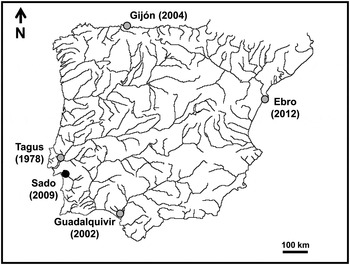
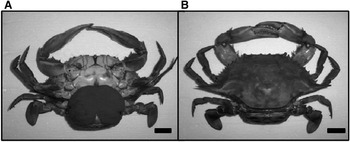
One blue crab specimen was caught with gillnets by local fishermen in the Sado estuary (Figure 1) on the 5 April 2009 (38°32′55.14″N 8°44′24.91″W). The specimen was an ovigerous female with a carapace length of 68 mm and carapace width of 166 mm, and is deposited in the National Museum of Natural History and Science (MUHNAC) with the collection number MB12-004202 (Figure 2). The identification of this specimen followed the description by Williams (Reference Williams1974), and was based on the following diagnostic characters of Callinectes: carapace broader than wider; two broad-based frontal teeth between the inner orbitals; nine antero-lateral teeth; chelipeds similar in length and longer than the ambulatory legs; and fifth pereiopods natatorial, with flattened propodus and dactylus. The specimen was identified as C. sapidus due to the presence of two broad-based frontal teeth; antero-lateral teeth similar in size except for the ninth, which is strongly elongated (Figure 2).
Previous records of Callinectes sapidus in the Iberian Peninsula (grey circles) and a new record (black circle) in the Sado estuary (western Iberia); references are cited in text.

Callinectes sapidus ovigerous female specimen with carapace width of 166 mm, from the Sado estuary (eastern Atlantic Ocean, Portugal): (A) ventral view; (B) dorsal view. Scale bar = 20 mm.

DISCUSSION
The mechanism(s) responsible for the presence of blue crabs along the European Atlantic and Mediterranean coasts remain(s) speculative, and may include multiple introduction events as well as natural dispersion via migration from primary introduction locations (Nehring, Reference Nehring, Galil, Clark and amd Carlton2011). The occurrence of the blue crab in the Sado estuary (western Europe) might result from natural secondary or tertiary introduction events from neighbouring estuaries from either the Atlantic (e.g. Tagus estuary, Cantabria region) or Mediterranean coasts (e.g. Catalonia/Andaluzia or Cantabria). Further research should be done in order to determine the invasion route of the species.
The abundance of blue crabs in the Sado estuary is thought to be very low since the species was undetected in a recent survey targeting the decapod community in this area (Neves et al., Reference Neves, Cabral and Gordo2007). However, occasional and unconfirmed records of the blue crab have been consistently reported by local fishermen in the Sado estuary since the mid-1990s (D. Sobral, personal communication), and mainly during winter and spring.
Low abundance of C. sapidus has been observed in most western European locations, including the other Iberian estuaries where the species has been reported (i.e. Cabal et al., Reference Cabal, Millán and Arrontes2006). Low water temperatures, poor habitat conditions or pollution may lead to limited population growth and ultimately to failed introduction events (Nehring, Reference Nehring, Galil, Clark and amd Carlton2011). In contrast, populations of blue crab have shown considerable increase in abundance in the warmer Mediterranean waters (e.g. in Croatia: Dulčić et al., Reference Dulčić, Tutman, Matić-Skoko and Glamuzina2011; in south-east Italy: Mancinelli et al., Reference Mancinelli, Carrozzo, Constantini, Rossi, Marini and Pinna2013), supporting local commercial fisheries and being sold in local markets (Galil, Reference Galil2000). The authors also found live blue crabs, allegedly obtained from Greece, being sold at an Asian goods supermarket in Lisbon.
The current low abundance of C. sapidus in Portuguese waters suggests a likely minimal impact on local estuarine communities. However, with the forecasted increase in mean seawater temperatures for this region in the next decades (Lemos & Pires, Reference Lemos and Pires2004), blue crab populations may increase in abundance as reported for the Mediterranean region, and this might significantly influence the composition of the native fauna (Neves et al., Reference Neves, Cabral and Gordo2007). Moreover, economic impacts are also to be expected, since this species supports an important fishery along the Atlantic coast of the USA and is starting to penetrate the southern European markets. On the other hand, further population increases in established areas may lead to economic losses by damaging fish caught in nets and by tearing gillnets (Dulčić et al., Reference Dulčić, Tutman, Matić-Skoko and Glamuzina2011).
ACKNOWLEDGEMENTS
The Portuguese Science Foundation supported F. Ribeiro (SFRH/BPD/46761/2008) and A. Veríssimo (SFRH/BPD/77487/2011). The authors are indebted to the local fisherman Valdemar Pardal for specimen donation. P.M. Chainho provided insightful comments on an early draft of this manuscript and D. Boutov provided invaluable assistance in figure construction.