INTRODUCTION
Whitemouth croaker (Micropogonias furnieri) is a marine species widely distributed along the western Atlantic coast (from Mexico, 20°N to Argentina, 41°S; Vazzoler, Reference Vazzoler1991; Isaac, Reference Isaac1998). It is a multiple spawner that lays small pelagic eggs in the inner part of the Río de la Plata estuary from November through to March (Austral spring–summer) (Macchi & Christiansen, Reference Macchi and Christiansen1996; Acha et al., Reference Acha, Mianzan, Lasta and Guerrero1999). After spawning, adults move to coastal marine waters adjacent to the Río de la Plata estuary (Jaureguizar et al., Reference Jaureguizar, Bava, Carozza and Lasta2003). This reproductive strategy differs from the general pattern observed for coastal ichthyofauna with planktonic eggs. The most common nekton life history cycle involves offshore spawning with production of a large number of small pelagic eggs and recruitment of larvae or juveniles towards estuaries (Day et al., Reference Day, Hall, Kemp and Tañez-Arancibia1989; Potter & Hyndes, Reference Potter and Hyndes1999; Whitfield, Reference Whitfield1999; Nordlie, Reference Nordlie2003). Micropogonias furnieri has never been reported as an estuarine spawner in other estuaries, e.g. Patos Lagoon (Vieira & Castello, Reference Vieira, Castello and Seeliger1997) or Cananeia Lagoon (Sinque, Reference Sinque1980). In Brazil, M. furnieri adults live and reproduce in coastal areas and early life stages develop in estuaries and coastal lagoons (Castello, Reference Castello1986; Sinque & Muelbert, Reference Sinque, Muelbert and Seeliger1997; Haimovici, Reference Haimovici and Seeliger1998; Tundisi et al., Reference Tundisi, Matsumura-Tundisi and Seeliger2001).
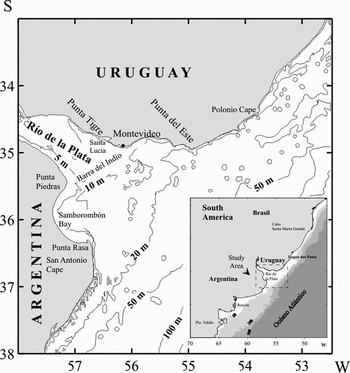
The Río de la Plata estuary, located on the eastern South American coast (36°S–56°W) (Figure 1) is one of the largest estuarine systems worldwide. The broad, microtidal estuary (320 km long and 230 km wide at the open mouth) has 20 m average depth and covers approximately 38,000 km2 (Mianzan et al., Reference Mianzan, Lasta, Acha, Guerrero, Macchi, Bremec and Seeliger2001). Water circulation is driven mainly by winds (Simionato et al., Reference Simionato, Dragan, Meccia and Núñez2004). During autumn and winter winds are weak, blow mainly from the west and produce an outflow of water from the estuary along the Uruguayan coast (north–north-easterly drift). In spring and summer the direction is from the east and north-east; therefore, outflow of water goes from the estuary along the Argentinean coast (Guerrero et al., Reference Guerrero, Acha, Framiñan and Lasta1997a; Simionato et al., Reference Simionato, Dragan, Meccia and Núñez2004). The penetration of a marine wedge into the riverine system over an area 100–250 km long defines a zone of strong vertical stratification (Guerrero et al., Reference Guerrero, Acha, Framiñan and Lasta1997a). The area of greatest vertical salinity stratification associated to the landward limit of salt intrusion into the estuary (Guerrero et al., Reference Guerrero, Acha, Framiñan and Lasta1997a) correlates well with the highest turbidity region (Framiñan & Brown, Reference Framiñan and Brown1996). The area, with the largest plankton concentration (Mianzan et al., Reference Mianzan, Lasta, Acha, Guerrero, Macchi, Bremec and Seeliger2001; Kogan, Reference Kogan2005), results in elevated prey abundance for M. furnieri. Preys include Isabel surf clam (Mactra isabellana; Giberto, 2001), copepods (Bersategui et al., Reference Bersategui, Menu Marque, Gomez-Erache, Ramírez, Mianzan and Acha2006) and opossum shrimp (Neomysis americana; Schiariti et al., Reference Schiariti, Berasategui, Giberto, Guerrero, Acha and Mianzan2006). The region has also been reported as reproductive ground for species such as M. furnieri, Brazilian menhaden (Brevoortia aurea), king weakfish (Macrodon ancylodon), banded croaker (Paralocnhurus brasiliensis) and Jenyns's sprat (Ramnogaster arcuata) (Acha et al., Reference Acha, Mianzan, Lasta and Guerrero1999; Acha & Macchi, Reference Acha and Macchi2000; Macchi et al., Reference Macchi, Acha and Militelli2003; Militelli & Macchi, Reference Militelli and Macchi2004; Rodrigues, Reference Rodrigues2005).
Location and bathymetry of the study area.

Due to the confluence of riverine and estuarine waters, a convergent flow on the bottom, at the head of the salt wedge intrusion, can be expected (Largier, Reference Largier1993). The vertical structure of the water column at the head of the salt wedge was linked to Micropogonias furnieri selection of a spawning site in the Río de la Plata estuary (Acha et al., Reference Acha, Mianzan, Lasta and Guerrero1999). The convergence of water masses at the bottom salinity front would retain eggs and embryos at the head of the estuary thus preventing exportation to the adjacent coastal waters (Acha et al., Reference Acha, Mianzan, Lasta and Guerrero1999; Acha & Macchi, Reference Acha and Macchi2000). However, winds stronger than 10 m s−1 can fully mix the salt wedge (Guerrero et al., Reference Guerrero, Acha, Framiñan and Lasta1997a). Under those conditions, eggs and larvae are exposed to low salinity ranges and mixed estuarine waters could cause advection from the estuary (Acha et al., Reference Acha, Mianzan, Lasta and Guerrero1999). Besides the vertical retention mechanism, there may exist horizontal retention produced by the marine flow that acts as a barrier to offshore transport and retains most of the front close to Barra del Indio, away from the influence of strong winds frequent in the region. The aim of this paper is to examine the relation between M. furnieri maturity stages distribution patterns and environmental conditions. The main factor considered was the way in which the bottom salinity gradient, the water column stratification index and variables such as depth, temperature and salinity influence whitemouth croaker post-juvenile distribution. This study represents the first attempt to estimate the influence of environmental factors on Micropogonias furnieri maturity stages spatial distribution within the Río de la Plata estuary. The understanding of the environmental conditions present in the estuary will allow us to define whitemouth croaker habitat preferences and lead to a more efficient fishery management.
MATERIALS AND METHODS
Micropogonias furnieri specimens and oceanographic data in the Río de la Plata estuary were obtained during INIDEP fisheries evaluation cruises carried out in spring 1994–2003 (Figure 1). Fish were collected in 194 bottom trawls sets (1994, N = 30; 1995, N = 30; 1996, N = 30; 1997, N = 21; 1998, N = 36; 1999, N = 13; 2003, N = 34). Individuals were sexed and reproductive development stages macroscopically determined. To that end, following Macchi & Díaz de Astarloa (Reference Macchi and Díaz de Astarloa1996), a five-stages maturity key was employed: (1) immature; (2) developing or partially spent; (3) gravid (with hydrated oocytes) or running; (4) spent; and (5) resting. At each station, M. furnieri abundance (thousands nm−2) for each maturity stage was estimated for both sexes.
Oceanographic data (depth, temperature and salinity) at each sampling station were obtained using a CTD (conductivity–temperature–depth) profiler. Data were calibrated for 1 m vertical resolution, with a final precision of ±0.03°C for temperature and ±0.05 for salinity. Water stratification (SI) was estimated using the Simpson stratification index (φ) defined as the energy required to completely mix the water column calculated from:

where g is gravitational acceleration, h total depth, ρ in situ density, ρ0 water column mean density, and z depth (Simpson, Reference Simpson1981).
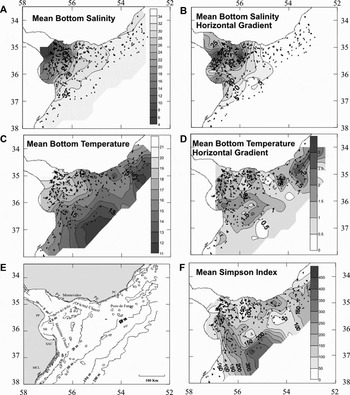
To examine environmental variables horizontal distribution in the study area, bottom salinity (BS), bottom temperature (BT), water stratification (SI), bottom salinity horizontal gradient (BSHG) and bottom temperature horizontal gradient (BTHG) were mapped. Parameters were interpolated onto a 0.3° latitude × 0.3° longitude grid using an inverse distance squared algorithm. Horizontal gradients were reported as °C/10 km and psu/10 km for temperature and salinity, respectively.
The effects of environmental variables (depth, BS, BT, SI, BSHG and BTHG) on M. furnieri stage-specific spatial distribution along the estuarine gradient were analysed using the canonical correspondence analysis (CCA). The CCA is a direct analysis performed with the computer program CANOCO (v. 4.02) that selects the linear combination of environmental variables and maximizes the dispersion of the maturity stage scores along orthogonal axes. Micropogonias furnieri stage scores are restricted to be a linear combination of measured environmental variables; the correlation of environmental variables with the first two axes is named intra-set correlation. The ordination output shows distribution patterns that are directly related to the environmental conditions being examined. The significance test was based on the Monte Carlo permutation test (103 permutations) for the sum of all eigenvalues. The significance of relation between gradients and the individual environmental variables were evaluated using a t-test (CANOCO, v.4.02). Maturity stages abundance data (1000 ind/nm2) were log (X + 1) transformed before CCA to reduce the dominance effect of some maturity stages.
RESULTS
Environmental conditions
Bottom salinity (BS) varied from low values (0–5) in the shallow inner estuary to high (>30) in the outer estuary (Figure 2A). The maximum horizontal gradient (>30 psu/10 km) in the BS field occurred in the inner estuary and weakened offshore towards an area with higher salinity and deeper waters (Figure 2B). The bottom temperature (BT) field showed warm, shallow waters within the inner estuary and cold ones along the deeper outer estuarine-shelf region (Figure 2C). The horizontal gradient in BT was, in general, weak (<1.5°C/10 km) and patchy with a relative maximum in the northern outer estuarine-shelf region (Figure 2D), probably associated to the outer Oriental channel and Pozo de Fango (Figure 2E). The BT field seemed to follow bathymetry while the BS minimum and BSHG maximum extended further westward within the estuary. Vertical water stratification (SI, Figure 2F) displayed its minimum within the inner estuary and intensified offshore in a southward direction (Figure 2E). The SI maximum seemed to follow the cold temperature intrusion along the Maritimo channel (Figure 2C). The SI maximum in the Río de la Plata estuary is the result of salinity stratification. South-east of the mouth, the highest SI value (>350 units) seemed to coincide with the coldest BT (<12°C) (Figure 2F).
Distribution of environmental parameters.

Environmental influence on Micropogonias furnieri spatial distribution
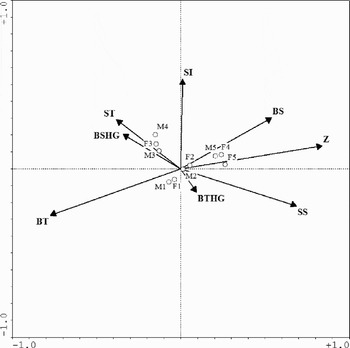
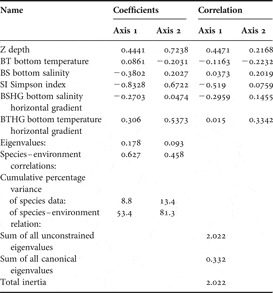
The first two axes of the CCA ordination diagram explained 81.3% of the variance of M. furnieri maturity stages spatial distribution (Table 1; Figure 3). The variance explained by the whole ordination, including the first axis, was significant (P = 0.01). The Monte Carlo permutation test was also significant (N = 199, P = 0.01 for both tests).
Canonical correspondence analysis ordination diagram showing Micropogonais furnieri spatial distribution per sex (M, male; F, female); maturity stages (1, immature; 2, developing and partially spent; 3, gravid (with hydrated oocytes) or running; 4, spent; 5, resting); and environmental variables (BT, bottom temperature; BS, bottom salinity; Z, depth; SI, Simpson index; BSHG, bottom salinity horizontal gradient; BTHG, bottom temperature horizontal gradient).

Canonical coefficients (100 × c) and intra-set correlation (100× r) of environmental variables with the first two axes of canonical correspondence analysis.

Values for the first canonical axis showed that BSHG and depth were factors with a major influence on M. furnieri maturity stages spatial distribution. The largest discontinuities along Axis 1 indicated that spent and resting females (F4, F5) were associated mainly to areas with the weakest BSHG and deepest waters; developing or partially spent (F2, M2) and immature specimens (M1, F1) occurred in waters with moderate BSHG and intermediate depth; gravid and running individuals (F3, M3) and spent and resting males (M4, M5) were associated to high BSHG and the shallowest depths.
Discontinuities along the second axis, driven by bottom salinity and temperature, indicated that spent and resting females (F4, F5) occurred mainly in high bottom salinity and low temperature; developing or partially spent individuals (F2, M2) in moderate conditions; immature (M1, F1), gravid and running individuals (F3, M3) and spent and resting males (M4, M5) were more abundant in areas with low bottom salinity and warm temperature.
DISCUSSION
Although the entire Micropogonias furnieri spawning cycle seems to occur within the estuary (Mianzan et al., Reference Mianzan, Lasta, Acha, Guerrero, Macchi, Bremec and Seeliger2001), results support the idea that different maturity stages have different habitat preferences within the Río de la Plata estuary and that environmental factors play an important role in the habitat differentiation. The oceanographic conditions evaluated in this study were close to the mean conditions observed in spring in other years (Guerrero et al., Reference Guerrero, Acha, Framiñan and Lasta1997a, Reference Guerrero, Lasta, Acha, Mianzan and Framiñanb) and may be considered typical of the season for the estuary. The highest BSHG occurred in a shallow area (Barra del Indio) between Punta Piedras and Montevideo (see Figure 2) and coincided with the mean position of the salinity fronts reported by Guerrero et al. (Reference Guerrero, Acha, Framiñan and Lasta1997a).
The BSHG is by far, the most important variable in M. furnieri maturity stages spatial distribution. Bottom temperature and salinity rank second (Figure 3). Resting individuals inhabit the outer area of the estuary (colder, saltier and deeper); immature and gravid or running stages are found in the inner area (warmer, fresher and shallower). Results confirm the maturity stages distribution observed by Macchi et al. (Reference Macchi, Acha and Lasta1996) in a single year and coincide with the spring age-classes distribution obtained by Jaureguizar et al. (Reference Jaureguizar, Bava, Carozza and Lasta2003). The influence of salinity on the spatial distribution of the species, that inhabits waters with a wide salinity range (Rico, Reference Rico2000), may be indirect (Jaureguizar et al., Reference Jaureguizar, Bava, Carozza and Lasta2003). Therefore, the adult stages distribution observed could be related to other factors such as the gradient stress present in the estuary. Specimens caught in the inner region of the Río de la Plata estuary showed a decrease of immunoglobulin M (IgM) concentration related to environmental stress which indicates a marked reduction of the immunological response capacity (Romano et al., Reference Romano, Macchi, Acha and Lasta1999). However, results of this study indicate a high correlation between spawners and BSHG areas. As suggested by Vizziano et al. (Reference Vizziano, Forni, Saona and Norbis2002), the influence of temperature could be associated to gonad development.
Although juveniles and spawning individuals were associated to similar bottom salinity and depth (Macchi et al., Reference Macchi, Acha and Lasta1996; Macchi & Christiansen, Reference Macchi and Christiansen1996; Jaureguizar et al., Reference Jaureguizar, Bava, Carozza and Lasta2003), results show that spent stages are linked to habitats characterized by high BSHG and moderate vertical stratification of the water column (SI) while juveniles are linked to low BSHG and low SI. In the Río de la Plata estuary, the area inhabited by immature individuals coincided with the estuarine turbidity maximum zone (ETM) (Jaureguizar et al., Reference Jaureguizar, Bava, Carozza and Lasta2003). The relation of immature individuals to ETM could be associated to feeding benefits produced by an increase of abundance or the visual contrast of prey items (Chesney, Reference Chesney1989). The ETM, a region of high plankton concentration (Mianzan et al., Reference Mianzan, Lasta, Acha, Guerrero, Macchi, Bremec and Seeliger2001; Kogan, Reference Kogan2005; Berasategui et al., 2006) and prey abundance (Giberto, Reference Giberto2001; Schiariti et al., 2006), offers juveniles protection from avian predation (Favero et al., Reference Favero, Silva and Mauco2000, Reference Favero, Mariano-Jelicich, Silva, Bó and Garcia-Mata2001; Mauco et al., Reference Mauco, Favero and Bó2001).
Micropogonias furnieri spawning takes place during the Austral spring–summer (from November through to March) (Macchi & Christiansen, Reference Macchi and Christiansen1996). The spatial distribution of gravid females showed that spawning occurs where the halocline intersects the bottom (Macchi & Christiansen, Reference Macchi and Díaz de Astarloa1996; Acha et al., Reference Acha, Mianzan, Lasta and Guerrero1999). Acha et al. (Reference Acha, Mianzan, Lasta and Guerrero1999) suggested that M. furnieri reproductive success may be linked to the vertical structure of the water column. However, the higher correlation found between spawning individuals and BSHG rather than with the water column vertical stratification (SI) supports the hypothesis that BSHG determines the spawning ground.
Simionato et al. (Reference Simionato, Berasategui, Meccia, Acha and Mianzan2006) suggested that physical forcing may generate a high larvae retention within the inner part of the Río de la Plata estuary that, whatever the wind direction, coincides with the highest BSHG. In spring and summer, when the species spawns, north-east winds (retention-favourable) prevail; north-west winds, neither frequent nor intense, induce export of particles from the estuary (Simionato et al., Reference Simionato, Berasategui, Meccia, Acha and Mianzan2006). The horizontal retention mechanism keeps planktonic eggs and larvae close to the frontal system thus preventing drift or advection (exportation) to the adjacent marine coastal waters. Winds stronger than 10 m s−1 may cause breakage of the vertical stratification of the water column (Guerrero et al., Reference Guerrero, Acha, Framiñan and Lasta1997a). That happens when strong winds that blow south-easterly (sudestadas) reach their maximum frequency during summer and at the beginning of spring and autumn (Escobar et al., Reference Escobar, Vargas and Bischoff2004). It should be considered that microtidal advection in the estuary implies a horizontal drift in the order of 3–5 km d−1 (Simionato et al., Reference Simionato, Meccia, Dragani and Nuñez2005). In estuaries as large as the Río de la Plata one (100 km scale), drifting keeps eggs and larvae in a relatively constant water mass thereby reducing physiological stress and increasing larval survival.
Bottom salinity horizontal gradient can be considered the retention mechanism of planktonic eggs for other coastal species that spawn in the inner area of the estuary, among which are Brazilian menhaden (Brevoortia aurea), king weakfish (Macrodon ancylodon), banded croaker (Paralocnhurus brasiliensis) and Jenyns's sprat (Ramnogaster arcuata) (Acha et al., Reference Acha, Mianzan, Lasta and Guerrero1999; Acha & Macchi, Reference Acha and Macchi2000; Macchi et al., Reference Macchi, Acha and Militelli2003; Militelli & Macchi, Reference Militelli and Macchi2004; Rodrigues, Reference Rodrigues2005).
The general pattern that characterizes temperate marine fish with estuarine dependence involves spawning in marine areas and use of estuaries as nursery habitats (Day et al., Reference Day, Hall, Kemp and Tañez-Arancibia1989; Potter & Hyndes, Reference Potter and Hyndes1999; Nordlie, Reference Nordlie2003). According to Castello (Reference Castello1986), Vieira & Castello (Reference Vieira, Castello and Seeliger1997) and Sinque & Muelbert (Reference Sinque, Muelbert and Seeliger1997) that is the strategy of M. furnieri along the Brazilian coast (e.g. Patos Lagoon). Although reproductive activities in estuarine environments, within bays and lagoons near inlets were reported for some Sciaenids (e.g. Cynoscion nebulosus, Leiostomus xanturus, Micropogonias undulatus, Cynoscion nebulosus and Pogonias cromis), spawning seems to occur mainly outside estuaries, within the Gulf of Mexico and along the South Atlantic coast where larvae enter estuaries using selective or passive tidal transport to move into and through the systems; other species enter as juveniles (Nordlie, Reference Nordlie2003). Nevertheless, as it was already stated, spawning in the Río de la Plata estuary occurs in the inner part. This behaviour is similar to that observed for estuarine-spawning species with planktonic eggs (Engraulis australis and Platycephalus speculator) in south-west Australian estuaries where laying occurs when tidal forcing and freshwater discharge are weak and the risk of eggs and larvae being flushed from the estuary is low (Potter & Hyndes, Reference Potter and Hyndes1999).
The spatial scale (38,000 km2) and stable environmental gradients of the Río de la Plata estuary allow for a favourable combination of properties that guarantees a reproductive success (enrichment, concentration, transport and retention processes) (Bakun, Reference Bakun1996). Within the Río de la Plata estuary, nutrients enrichment is associated with freshwater discharge (24,000 m3/seg, Jaime et al., Reference Jaime, Menéndez, Uriburu Quirno and Torchino2002). When discharge is high, inorganic nutrients (silicate, nitrite, nitrate and phosphate) exceed the threshold of phytoplankton cellular growth (Gómez-Erache et al., Reference Gomez-Erache, Lagomarsino, Nunez, Vizziano, Nagy and Vizziano2002). Vertical fluxes of nutrients produce a high chlorophyll-a concentration and, presumably, a high phytoplankton standing-stock (Carreto et al., Reference Carreto, Negri and Benavides1986). Nutrients enrichment leads to a high production of food items for larvae (Mianzan et al., Reference Mianzan, Lasta, Acha, Guerrero, Macchi, Bremec and Seeliger2001; Kogan, Reference Kogan2005; Berasategui et al., 2006) and prey abundance for fish (Giberto, Reference Giberto2001; Schiariti et al., 2006). Therefore, retention within the zone with high BSHG provides both hydrological and nutritional stability during and immediately after M. furnieri spawning, which favours eggs and larvae development.
Larvae of the most abundant fish species in the Río de la Plata estuary are planktonic, distribution coincides with the peaks of abundance of potential preys and Sciaenids feeding (Berasategui, Reference Berasategui2000) does not show any difference from that of other systems such as the Gulf of Mexico coastal zone (Govani et al., 1993; Holt & Holt, Reference Holt and Holt2000) and Patos Lagoon (Concalves et al., Reference Conçalves, Feijó de Souza and Paes Vieira1999). Therefore, potential consequences of spawning taking place outside the frontal zone could include differences in food availability, temperature, exposure to predators and recruitment to the resident population.
Fisheries productivity is associated with the stock–recruitment relation although not in a simple linear way. It should also be mentioned that regulatory factors are not directly correlated (see Santos et al., Reference Santos, Nogueira and Martins2005). Changes in the geographical location or intensity of BSHG (e.g. El Niño and La Niña events) can drift M. furnieri spawned eggs and larvae to nursery areas thus affecting the annual recruitment. Therefore, future research should aim at studying those phenomena.
ACKNOWLEDGEMENTS
Thanks to A. Lucas, J. Fodrie and anonymous referees for their contributions to redraft the manuscript. Raúl Guerrero was partially supported by Fundación Antorchas (Project 13900-13) and by CONICET (Project PIP 5009). Contribution INIDEP No. 1485.