
I. INTRODUCTION
The adsorption and oxidation of CO on metal electrodes fundamental problems in heterogeneous catalysis, electrochemistry, and fuel cell technology. Fuel cells function as electrochemical engines that convert the chemical energy released into the reaction of H2 and O2 and then into electrical energy. Polymer electrolyte fuel cells (PEFCs) have applications in a variety of areas such as electric vehicles and mobile devices because of their high electrical power densities and low working temperatures. However, several problems need to be solved before commercializing PEFCs. One of the most challenging tasks is related to electrodes. Pt is used for both the anode and cathode sides of PEFCs. At the anode side, H2 gas is adsorbed on the surface of the Pt electrode and is transformed into protons and electrons catalyzed by Pt. One problem is caused by CO impurities contained in the fuel gas. Even if contamination is of the order of parts per million, CO molecules almost fully cover the surface of the Pt electrode and prevent H2 fuel gas from reacting on the Pt surface. Reference Hoogers and Thompsett1 This loss of catalytic function caused by CO gas is known as CO poisoning.
Bimetallic catalysts are useful due to their versatility; their catalytic activities and selectivity's can be tuned by varying properties such as composition, particle size, and support. CO oxidation on transition metal and oxide catalysts has attracted much interest in recent years. Tremendous efforts have been devoted to the removal of CO contamination from H2 fuel. Attempts to increase activity by alloying Pt with a second metal have also been reported recently. The presence of a second metal such as Ru, Sn, or Mo in the anode catalyst, either alloyed or co-deposited with Pt, has provided remarkable improvements in CO tolerance. Reference Gasteiger, Markovic, Ross and Cairns2–Reference Ferrando, Jellinek and Johnston7 Among the many reports, Pt–Ru alloys have been studied most intensively because they are known to be the most promising electrodes for overcoming the CO poisoning problem. Reference Yajima, Uchida and Watanabe8–Reference Park and Sung10 Thus far, the alloying effects have been interpreted in terms of ligand and bifunctional effects. Reference Yajima, Uchida and Watanabe8,Reference Lu, Rice, Masel, Babu, Waszczuk, Kim, Oldfield and Wieckowski11 In these mechanisms, the Ru sites act as adsorption centers for the O-containing surfaces species reacting with the CO to produce CO2. However, several authors have suggested the weakening of the CO chemisorption bonds to Pt–Ru with respect to pure Pt, which was confirmed by the recent ultrahigh vacuum (UHV) studies of Pt-modified Ru(0001) surfaces by Behm et al. Reference de Mongeot, Scherer, Gleich, Kopatzki and Behm12 Watanabe et al. reported that, for the methanol decomposition reaction, dehydrogenation occurs at Pt sites, and the oxidation of CO proceeds at Ru sites with easily formed OH species.
Ge et al. investigated CO adsorption on Pt–Ru bulk and surface alloys. They noted that CO adsorption resulted in increased Ru–CO bond strength, whereas the Pt–CO bonds were weakened in the bulk alloy. On the other hand, both the Ru–CO and Pt–CO bonds were strengthened in the surface alloys. Reference Ge, Desai, Neurock and Kourtakis13 Based on their comparative analysis of H adsorption on Pt(111) and Pt–Ru(111) surfaces, Pistonesi et al. showed that Ru atoms induce changes in the electronic structure of Pt, and the adsorption energy of H on the Pt–Ru alloy was significantly reduced compared to that on the Pt(111) surface. Reference Pistonesi, Pronsato and Juan14
Orita et al. studied the adsorption characteristics of CO on Pt(111) for different calculation parameters and confirmed atop as the most preferred site. Reference Orita, Itoh and Inada15
Koper et al. theoretically examined CO and OH adsorption on Pt–Ru alloys and reported that OH preferentially adsorbed at the Ru sites, whereas CO preferentially adsorbed at the Pt sites; they also predicted that the surface of a good catalyst must have a well-mixed distribution of Pt and Ru. Reference Koper, Shubina and van Santen16 In a density functional theory (DFT) study of the adsorption phenomena of CO and H2 on different Pt-based binary alloys, Shimodaira et al. reported that Pt atoms were enriched in the surface layer of Pt–Ru alloy, which was suggested by experimental work. Reference Shimodaira, Tanaka, Miura, Kudo and Kobayashi17 In the CO electro-oxidation process, alloying Pt with Ru or Sn provides new surface sites that are better than the Pt sites at dissociation. Reference Liu, Logadottir and Nørskov18 In a theoretical study of CO oxidation on Pt and PtMo, Ji et al. reported that the barrier to CO oxidation on PtMo surfaces is lower than that on pure Pt. Reference Ji and Li19 This same group also reported that OH is much more localized on PtMo than on pure Pt, increasing the probability of OH reacting with CO. Reference Ji, Jalbout and Li20
Koper et al. investigated the bonding mechanisms of water dissociation products (i.e., H, O, and OH) on various metal surfaces and observed that when an electric field was applied, O and OH adsorbates donated some electric charge to the surface; however, the effect of an applied electric field on H adsorption was negligible. Reference Koper and van Santen21 Han et al. investigated the coadsorption of CO with O or OH on Pt and Pt–Ru alloys and noted that when Ru was oxidized by O or OH, the Pt–CO bond strength changed dramatically. Reference Han and Ceder22 Some experimental studies have reported that the ratio of Pt to Ru is important in the design of efficient anode catalysts; these studies suggested that Pt:Ru = 2:3 is a good composition for CO-tolerant anode catalysts. Reference Sato, Kunimatsu, Okaya, Yano, Watanabe and Uchida23–Reference Takeguchi, Yamanaka, Asakura, Muhamad, Uosaki and Ueda25 They reported on particle size and composition on CO tolerance at Pt2Ru3/C investigated by in situ attenuated total reflection Fourier-transform infrared Reference Sato, Okaya, Kunimatsu, Yano, Watanabe and Uchida24 and structures of anode catalysts were analyzed by extended x-ray absorption fine structure spectroscopy. Reference Takeguchi, Yamanaka, Asakura, Muhamad, Uosaki and Ueda25 The mechanisms of CO tolerance are thought to involve the adsorption of O-containing species (OH) at Ru sites so that CO adsorbed at Pt sites can participate in the bimolecular reaction with activated O species. Ishikawa et al. reported from their theoretical study that a secondary metal (M) is necessary for activating H2O which produce OH and from the COads(Pt) + OHads(M) combination reactions and predicted the best alloying metal with Pt for CO oxidation. Reference Ishikawa, Liao and Cabrera26 The adsorption of CO and OH on Pt–Ru alloys with different Pt-to-Ru mixing ratios has been theoretically studied Reference Koper, Shubina and van Santen16,Reference Shubina and Koper27 ; however, those theoretical studies did not consider the mixing ratio of Pt:Ru = 2:3 and also still not clear the atomic conformation (Pt–Pt, Ru–Ru, Pt–Ru) in the active sites on metal surface which can accelerate CO oxidation.
In this paper, we report the results of DFT calculations on the interactions of H, CO, and OH with the Pt2Ru3 alloy surface. Since the stoichiometry of Pt2Ru3 alloy has not been studied theoretically, different active pair sites (Pt–Pt, Pt–Ru, and Ru–Ru) that may affect the adsorption properties of adsorbates on the surface and subsurface were investigated in this study. The results of the quantum chemical calculations provide information that will be valuable in correctly interpreting experimental results as well as a direction for modeling large-scale molecular systems, which can help to predict realistic phenomena quantitatively.
II. METHODS
DFT calculations were performed with program package DMol3 in Materials Studio supplied by BIOVIA, Inc. Reference Delley28–Reference Delley30 The physical wave functions were expanded in terms of accurate numerical basis sets. The effective core potential and double numerical basis with polarization functions basis set were chosen for all calculations. The generalized gradient approximation functional developed by Perdew–Burke–Ernzerhof Reference Perdew, Burke and Ernzerhof31 was used. The convergence tolerances for energy, maximum force, and maximum displacement were less than 1.0 × 10⁻⁵ Ha, 0.002 Ha/Å, and 0.005 Ha/Å, respectively. The K-point mesh was set to 2 × 2 × 1. The adsorption energies of the adsorbates were computed by subtracting the energies of the gas phase (H, CO, and OH) and surface from the energy of the adsorption system:
 $${E_{{\rm{ad}}}} = E\left( {{{{\rm{gas}}} \mathord{\left/ {\vphantom {{{\rm{gas}}} {{\rm{surface}}}}} \right. \kern-\nulldelimiterspace} {{\rm{surface}}}}} \right) - E\left( {{\rm{gas}}} \right) - E\left( {{\rm{surface}}} \right)\quad ,$$
where gas = H, CO, and OH. With this definition, a negative E ad corresponds to stable adsorption on the surface. All of the calculations were carried out in the spin-unrestricted mode.
We performed the periodic slab calculations considering Pt2Ru3(111) alloys as having ordered face-centered cubic (fcc) structures. The metal alloy Pt2Ru3(111) slab consisted of five layers. We prepared various models with different conformations of Pt and Ru atoms while keeping Pt:Ru = 2:3. A periodic five-layer slab with four atoms per layer was modeled to represent a 2 × 2 unit cell, and it was expanded to create a vacuum phase with a thickness of about 10 Å above the (111) surface. The metal atoms in the bottom three layers of the slab were fixed at their positions, while the metal atoms in the top two layers and the adsorbate (CO, H, OH) atoms were allowed to relax in the subsequent geometry optimization and energy calculations. The cell parameters for all models were a = b = 5.5492 Å, c = 19.05 Å, α = β = 90°, and γ = 120°. The calculated nearest-neighbor Pt–Ru bond distance in our Pt2Ru3(111) alloy surface was 2.759 Å, which is in good agreement with previously reported theoretical values Reference Koper, Shubina and van Santen16,Reference Shubina and Koper27 ; the previously reported bulk lattice constants were 2.756 Å for PtRu2 and 2.78 Å for Pt2Ru, Reference Koper, Shubina and van Santen16,Reference Shubina and Koper27 although the mixing Pt:Ru mixing ratio in our system was slightly different.
III. RESULTS AND DISCUSSION
A. Adsorption of H
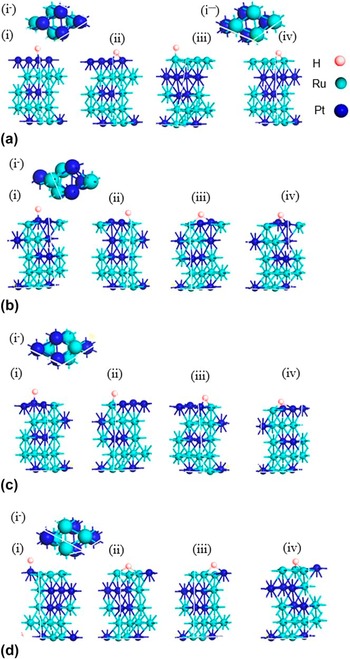
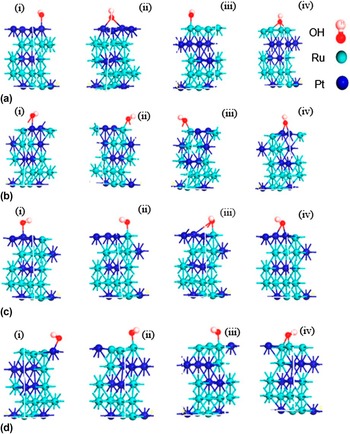
Table I lists the binding energies and equilibrium distances for H adsorption at the atop, bridge, and hollow sites on the Pt2Ru3 surface for different conformations of Pt and Ru atoms. In the five-layer Pt2Ru3 surface, the top two layers are composed of Pt and Ru atoms with the same ratio but different conformations of Pt and Ru atoms (Fig. 1). In the metal alloy, atomic conformations of the top two layers in Fig. 1 are [a(i–iv)] Pt4/Ru4, Ru4/Pt4, [b(i–iv)] Pt2Ru2/Pt2Ru2, [c(i–iv)] Pt3Ru1/Pt1Ru3, and [d(i–iv)] Ru3Pt1/Pt3Ru1. Top view of the top two layers shown in [Figs. 1(a-i−), 1(a-i—), 1(b-i−), 1(c-i−), and 1(d-i−)] to visualize adsorption sites clearly. In Figs. 1(a-i−) and 1(a-i—), top surface is covered with homogenous Pt and Ru atom, respectively. On the other hand, in Figs. 1(b-i−), 1(c-i−), and 1(d-i−), Pt/Ru atom ratio of the top surfaces are 2:2, 3:1, and 1:3, respectively. Of course there are number of combinations possible but in this study for H adsorption, we considered the adsorption sites for only the abovementioned mixing combinations. Based on the adsorption energies of H on the Pt2Ru3 surfaces, for most surface compositions, H preferably adsorbed on the hollow sites compared to the atop and bridge sites which follow previous report by Ishikawa et al. about adsorption phenomena of hydrogen at the Pt(111)/water surface. Reference Ishikawa, Mateo, Tryk and Cabrera32 The calculated adsorption energies of H on the Pt4/Ru4 surface are −2.580, −2.422, and −2.612 eV for atop (Pt site), bridge site, and hollow site, respectively [Figs. 1(a-i) and 1(a-ii)], and hollow site is not shown here. The adsorption energies of H on the Ru4/Pt4 are −2.778, −3.156, and −3.159 eV for the atop (Ru), bridge (Ru–Ru), and hollow sites (not shown in figure), which are summarized in Table I. The calculated adsorption energies of H on the Pt site of the Pt4/Ru4 surface are in excellent agreement with experimental value of −2.64 eV and with previously reported theoretical values. Reference Koper and van Santen21,Reference Gdowski, Fair and Madix33 The adsorption energies of H on the Pt2Ru2/Pt2Ru2 surface for the atop (Pt), atop (Ru), bridge (Pt–Ru), and hollow sites, respectively, are shown in Figs. 1[b(i)–b(iv)] and Table I. We also calculated the adsorption energies of H on the Pt3Ru1/Pt1Ru3 and Pt1Ru3/Pt2Ru1 surfaces at the atop (Pt), atop (Ru), bridge (Pt–Ru), and hollow sites (Table I). From the adsorption energies of H on the Pt2Ru3 surfaces with different conformations of Pt and Ru atoms, we note an energetically stable H–Pt2Ru3 complex for adsorption at the hollow site.
Calculated adsorption energies E ads (in eV) for H adsorbed on atop, bridge, and hollow sites on Pt2Ru3.

Adsorption models of H on Pt2Ru3: (a) (i−) top view for Pt4/Ru4, (i—) top view for Ru4/Pt4, H adsorption on Pt4/Ru4 and Ru4/Pt4 at, (i) Pt atop, (ii) bridge, (iii) Ru atop, and (iv) bridge sites; (b) (i−) top view for Pt2Ru2/Pt2Ru2, H adsorption on Pt2Ru2/Pt2Ru2 at (i) Pt atop, (ii) Ru atop, (iii) bridge, and (iv) hollow sites; (c) (i−) top view for Pt3Ru1/Pt1Ru3, H adsorption on Pt3Ru1/Pt1Ru3 at (i) Pt atop, (ii) Ru atop, (iii) bridge, and (iv) hollow sites; and (d) (i−) top view for Pt1Ru3/Pt3Ru1, H adsorption on Pt1Ru3/Pt3Ru1 at (i) Pt atop, (ii) Ru atop, (iii) bridge, and (iv) hollow sites.

The optimized structures are confirmed from the calculated Pt–H and Ru–H bond distances in the H–Pt2Ru3 complex and also from the adsorption strength of H at the Pt or Ru site. For adsorption at the atop site, H preferentially adsorbed at the Pt site rather than at the Ru site. The calculated Pt–H bond distances on the Pt2Ru3 surface are listed in Table I which obtained from the optimized structure in Figs. 1(a-i), 1(b-i), 1(c-i), and 1(d-i), respectively. On the other hand, the calculated Ru–H bond distances on the Pt2Ru3 complex are shown Table I which obtained from the optimized structures in Figs. 1(a-iii), 1(b-ii), 1(c-ii), and 1(d-ii), respectively. If H was located on the bridge site (Pt–Ru) in the initial structure, H bent slightly toward the Pt sites in the optimized structure, as shown Figs. 1(b-iii), 1(c-iii), and 1(d-iii). For Fig. 1(c-iii) model, the measured bond distances are 1.759 Å for Pt–H and 1.889 Å for Ru–H, clearly indicating that H preferentially adsorbed at the Pt sites on the surface. From the adsorption energies and bond distances of Pt–H and Ru–H, we confirmed that H adsorbed preferentially at the Pt sites compared to the Ru sites. The DFT results also confirmed that the stable site for H adsorption depends not only on the adsorption site, but also on the atoms neighboring of the adsorption site and the subsurface. A conformation with a top surface containing both Pt and Ru atoms but with more Pt and a second layer rich in Ru is most stable conformation for H adsorption among the investigated H–Pt2Ru3 systems shown in Table I.
B. Adsorption of CO
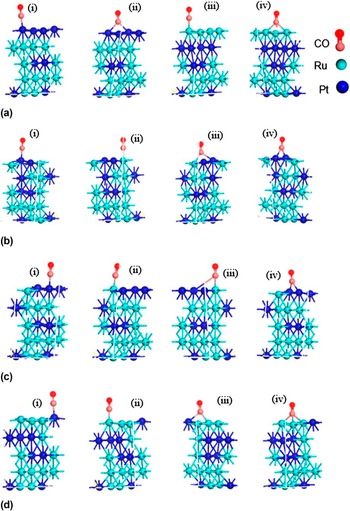
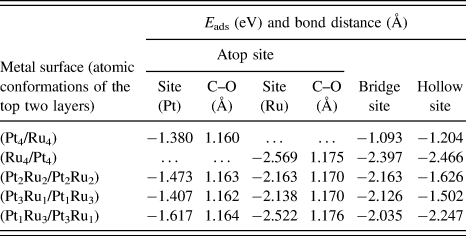
Five types of Pt2Ru3 alloys with different conformations of Pt and Ru atoms are depicted in Fig. 2. Table II shows the calculated adsorption energies of CO on the Pt2Ru3 alloy surfaces with different conformations of Pt and Ru atoms. Using DFT, we simulated the CO adsorption phenomena on all five of the surfaces. On the Pt2Ru3 alloy surface, we considered different adsorption sites, as shown in Figs. 2(a)–2(d). From the results summarized in Table II, the calculated adsorption energies of CO at the Pt sites of the Pt4/Ru4, Pt2Ru2/Pt2Ru2, Pt3Ru1/Pt1Ru3, and Ru3Pt1/Pt3Ru1 surfaces of the Pt2Ru3 alloy are −1.380, −1.473, −1.407, and −1.617 eV, respectively.
Adsorption models of CO on Pt2Ru3: (a) CO adsorption on Pt4/Ru4, Ru4/Pt4 at (i) Pt atop, (ii) Pt4/Ru4 bridge, (iii) Ru atop, and (iv) Ru4/Pt4 bridge sites; (b) CO adsorption on Pt2Ru2/Pt2Ru2 at (i) Pt atop, (ii) Ru atop, (iii) bridge, and (iv) hollow sites; (c) CO adsorption on Pt3Ru1/Pt1Ru3 at (i) Pt atop, (ii) Ru atop, (iii) bridge, and (iv) hollow sites; and (d) CO adsorption on Pt1Ru3/Pt3Ru1 at (i) Pt atop, (ii) Ru atop, (iii) bridge, and (iv) hollow sites.

Calculated adsorption energies E ads (in eV) for CO adsorbed on atop, bridge, and hollow sites on Pt2Ru3.

The adsorption energies at the atop (Ru site) are −2.569, −2.163, −2.138, and −2.522 eV, on the Ru4/Pt4, Pt2Ru2/Pt2Ru2, Pt3Ru1/Pt1Ru3, and Ru3Pt1/Pt3Ru1 surfaces, respectively. The calculated adsorption energies of CO on the bridge sites are −1.093 eV (Pt–Pt), −2.397 eV (Ru–Ru), −2.163 eV (Pt–Ru), −2.126 eV (Pt–Ru), and −2.035 eV (Pt–Ru) for the Pt4/Ru4, Ru4/Pt4, Pt2Ru2/Pt2Ru2, Pt3Ru1/Pt1Ru3, and Ru3Pt1/Pt3Ru1 surfaces, respectively, as shown in Figs. 2(a-ii), 2(a-iv), 2(b-iii), 2(c-iii), and 2(d-iii), respectively. The corresponding adsorption energies at the hollow sites are summarized in Table II. These calculated adsorption energies indicate that the atop site (CO–Ru) is the most stable.
The CO adsorption on the bridge site for all combinations in which the surface was covered by Pt and Ru can be explained by the fact that in the optimized structure, CO moves to the Ru site from the initial Pt site, which indicates higher affinity of CO to the Ru site than to the Pt site as shown in Figs. 2(b-iii), 2(c-iii), and 2(d-iii). The CO adsorption strength at the atop sites (Ru) of the Ru4/Pt4 and Ru3Pt1/Pt3Ru1 conformation of top two layers were higher than those at the same adsorption sites of other surface conformation (Table II) because both Ru4/Pt4 and Ru3Pt1/Pt3Ru1 conformations, top surfaces were fully covered with Ru or with Ru rich as shown in Figs. 2(a-iii) and 2(d-iii). There were noticeable changes in the internal bond length of chemisorbed CO on the Pt2Ru3 alloy. The calculated equilibrium bond distances of C–O when adsorbed at the Pt sites on Pt2Ru3 for different combinations of Pt and Ru in the top two layers are listed in Table II that were obtained from the optimized CO–Pt2Ru3 complex are shown in Figs. 2(a-i), 2(b-i), 2(c-i), and 2(d-i), respectively. On the other hand, the calculated equilibrium bond distances of C–O at the Ru sites are summarized in Table II, on the same surfaces, from the optimized structure shown in Figs. 2(a-iii), 2(b-ii), 2(c-ii), and 2(d-ii), respectively. The measured bond distances of CO indicate that CO preferentially adsorbed at the Ru sites. In addition, CO adsorption on the Pt2Ru3 alloy not only depended on the adsorption site, but also on the natures of the neighboring atoms and the subsurface atomic combination. The calculated adsorption strength of CO on the Pt2Ru3 alloy and the change in the internal bond distance of adsorbed CO indicated that the Ru-rich top surface is the most stable conformation of the CO–Pt2Ru3 complex.
C. Adsorption of OH
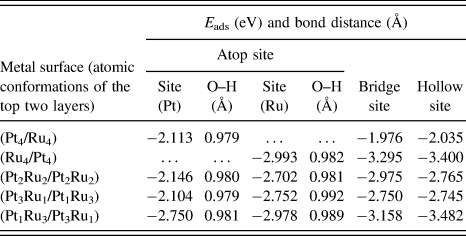
As mentioned in the introduction, the mechanisms of CO tolerance are believed to involve the adsorption of O-containing species (OH) at Ru sites. The DFT-computed adsorption energies and equilibrium bond distances of OH with Pt2Ru3 alloy surfaces for different combinations of Pt and Ru atoms are listed in Table III. In our calculations, we considered the atop, bridge, and hollow sites for OH adsorption on alloy surfaces with different combinations of Pt and Ru [Figs. 3(a)–3(d)]. In the Pt2Ru3 alloy, there are five possible conformations of Pt and Ru atoms. We considered OH adsorption at the Pt, Ru, bridge, and hollow sites of the Pt2Ru3 alloy. The calculated adsorption energies of OH on the Pt atop sites on the Pt4/Ru4, Pt2Ru2/Pt2Ru2, Pt3Ru1/Pt1Ru3, and Ru3Pt1/Pt3Ru1 surfaces of the Pt2Ru3 alloy are shown in Table III. On the other hand, the adsorption energies at the Ru atop sites are summarized (Table III), on the Ru4/Pt4, Pt2Ru2/Pt2Ru2, Pt3Ru1/Pt1Ru3, and Ru3Pt1/Pt3Ru1 surfaces, respectively. In the OH adsorption at the bridge site (Pt–Ru) of the optimized structure, OH moves to the Ru site from the Pt site, as noted in Figs. 3(b-iii), 3(c-iii), and 3(d-iii). The calculated adsorption energies of OH on the Pt4/Ru4, Ru4/Pt4, Pt2Ru2/Pt2Ru2, Pt3Ru1/Pt1Ru3, and Ru3Pt1/Pt3Ru1 surfaces at the bridge sites and at the hollow sites are summarized in Table III. The calculated adsorption energies indicate that OH is preferentially absorbed at the hollow sites. For the model shown in Fig. 3(a-iv), in which the top surface was fully covered with Ru atoms, the calculated adsorption energy was −3.400 eV. In another system in which the first two layers were Ru3Pt1/Pt3Ru1, the calculated energy is −3.482 eV, indicating that the Ru-rich top surface was preferable for OH adsorption. In our previous study, for pure Pt and pure Ru, OH binding to Ru sites was almost 1.5 times stronger than the binding to Ru sites. Reference Alam and Takaba34 The adsorption energy of OH depends not only on the adsorption site, but also on the subsurface. These adsorption characteristics of OH on Pt2Ru3 agree with the theoretical observations of OH adsorption on Pt–Ru. Reference Koper, Shubina and van Santen16
Calculated adsorption energies E ads (in eV) for OH adsorbed on atop, bridge, and hollow sites on metal Pt2Ru3.

Adsorption models of OH on Pt2Ru3: (a) OH adsorption on Pt4/Ru4, Ru4/Pt4 at (i) Pt atop, (ii) Pt bridge, (iii) Ru atop, and (iv) bridge sites; (b) OH adsorption on Pt2Ru2/Pt2Ru2 at (i) Pt atop, (ii) Ru atop, (iii) bridge, and (iv) hollow sites; (c) OH adsorption on Pt3Ru1/Pt1Ru3 at (i) Pt atop, (ii) Ru atop, (iii) bridge, and (iv) hollow sites; and (d) OH adsorption Pt1Ru3/Pt3Ru1 at (i) Pt atop, (ii) Ru atop, (iii) bridge, and (iv) hollow sites.

The geometric change of absorbed OH reveals a general correlation between O–H distance and calculated adsorption energy, although there are some deviations in this trend due to the size limitations of the system. The equilibrium bond distances of O–H at the Pt site are 0.979 Å, 0.980 Å, 0.979 Å, and 0.981 Å when the first two layers in the Pt2Ru3 surface are Pt4/Ru4, Pt2Ru2/Pt2Ru2, Pt3Ru1/Pt1Ru3, and Ru3Pt1/Pt3Ru1, respectively; on the other hand, the corresponding O–H bond distances for adsorption at the Ru site are 0.982, 0.981, 0.992, and 0.989 Å, respectively. Tables II and III indicate nearly the same trends for both OH and CO adsorption on the Pt2Ru3 alloy surfaces. Our analysis indicates that the adsorption properties of OH depend on the adsorption site, the natures of the atoms neighboring the adsorption site, and the subsurface atomic arrangement.
D. CO coadsorption with OH and H
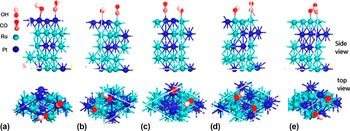
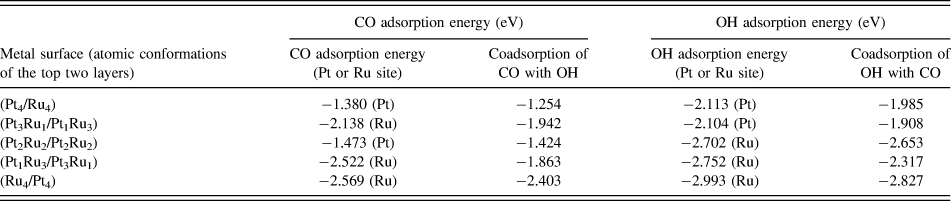
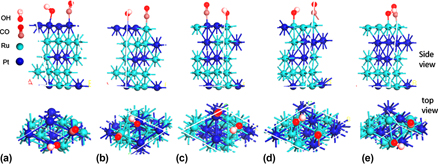
OH is another important chemical species in the oxidation of CO; it is observed experimentally as an intermediate of water dissociation on a Pt electrode. In the bifunctional mechanism, OH plays an important role as an adsorbate that facilitates CO oxidation by providing a source of O on the surface. Reference Volkening, Bedurftig, Jacobi, Wintterlin and Ertl35,Reference Fisher and Sexton36 In Sec. III. A, III. B, and III. C, we discussed the separate adsorption phenomena of H, CO, and OH, respectively, on different surfaces. To study the coadsorption of CO and OH, we considered two types of Pt2Ru3 alloy surfaces (Fig. 4). Both adsorbates were placed at the atop sites, as shown in Figs. 4(a)–4(e). The calculated adsorption energies are listed in Table IV and compared to the CO and OH coadsorption energies. The calculated adsorption energies of CO in the presence of coadsorbate OH are summarized (Table IV), when the first two layers of the Pt2Ru3 surface were Pt4/Ru4, Pt3Ru1/Pt1Ru3, Pt2Ru2/Pt2Ru2, Ru3Pt1/Pt3Ru1, and Ru4/Pt4, respectively [Figs. 4(a)–4(e)]. Table IV indicates that the adsorption energies of CO were decreased for coadsorption with OH compared to CO-only adsorption at the same adsorption sites.
Coadsorption models of CO with OH on Pt2Ru3: (a) both CO and OH coadsorb on Pt4/Ru4 at Pt sites; (b) CO and OH coadsorb on Pt3Ru1/Pt1Ru3 with OH at Pt site and CO at Ru site; (c) CO and OH coadsorb on Pt2Ru2/Pt2Ru2 with OH at Ru site and CO at Pt site; (d) both CO and OH coadsorb on Pt1Ru3/Pt3Ru1 at Ru site; and (e) both CO and OH coadsorb on Ru4/Pt4 at Ru site.

Calculated coadsorption energies E cads (in eV) of CO with OH on Pt2Ru3.

We also considered the adsorption energies of OH on different surfaces in the presence of CO and found that the adsorption energies of both Pt–OH and Pt–CO decreased. The calculated adsorption energies of OH in the presence of CO on Pt4/Ru4, Pt3Ru1/Pt1Ru3, Pt2Ru2/Pt2Ru2, Ru3Pt1/Pt3Ru1, and Ru4/Pt4 conformations [Figs. 4(a)–4(e)], and in most cases, the adsorption strength of OH on Pt2Ru3 decreased in the presence of CO (Table IV). The coadsorption energies of OH at the Ru sites (−2.653, −2.317, and −2.827 eV) and Pt sites (−1.985 and −1.908 eV) indicate that OH preferentially adsorbed at the Ru site compared to at the Pt site. The results suggest that if only a single species (CO or OH) adsorbed on the Pt2Ru3 surface, it would preferentially be adsorbed at the Ru sites. In contrast, for the coadsorption of CO and OH, OH preferentially bound to the Ru-rich sites [Figs. 4(d) and 4(e)]. For coadsorption on the Pt4/Ru4 surface, the Pt–CO bond strength was −1.254 eV, while the Pt–CO strength was −1.424 eV for the Pt2Ru2/Pt2Ru2 surface.
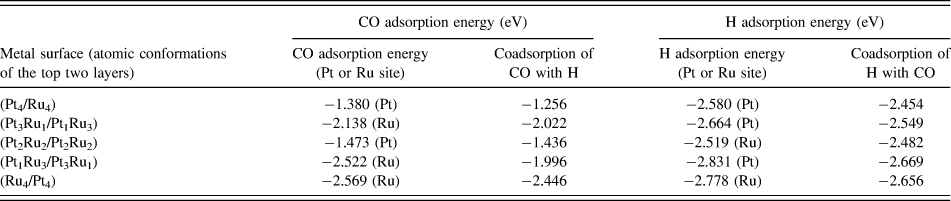
To study the coadsorption of CO with atomic hydrogen, we calculated the adsorption energies for models in which H and OH were placed at the Pt or Ru sites [Figs. 5(a)–5(e)]. The calculated coadsorption energies of CO with H are shown in Table V for the Pt4/Ru4, Pt3Ru1/Pt1Ru3, Pt2Ru2/Pt2Ru2, Ru3Pt1/Pt3Ru1, Ru4/Pt4 surface conformations of Pt2Ru3. These results indicate that the adsorption energy of CO on Pt2Ru3 decreased in the presence of H for all surface conformations. We also calculated the adsorption energies of H in the presence of CO; the energies are summarized (Table V) for the Pt4/Ru4, Pt3Ru1/Pt1Ru3, Pt2Ru2/Pt2Ru2, Ru3Pt1/Pt3Ru1, and Ru4/Pt4 conformations, respectively. These results indicate that the adsorption energy of H on Pt2Ru3 decreased in the presence of CO for all surface conformations shown in Fig. 5. In addition, CO preferentially adsorbed at Ru or Ru-rich sites, while the H species preferred to be located at Pt or Pt-rich surface sites.
Coadsorption models of CO with H on Pt2Ru3: (a) both CO and H coadsorb on Pt4/Ru4 at Pt site; (b) CO and H coadsorb on Pt3Ru1/Pt1Ru3 with CO at Ru site and H at Pt site; (c) CO and H coadsorb on Pt2Ru2/Pt2Ru2 with CO at Pt site and H at Ru site; (d) CO and H coadsorb on Pt1Ru3/Pt3Ru1 with CO at Ru site and H at Pt site; and (e) both CO and H coadsorb on Ru4/Pt4 at Ru site.

Calculated coadsorption energies Ecads (in eV) of CO with H on Pt2Ru3.

In general, the adsorption and coadsorption energies of H, CO, and OH on Pt2Ru3 indicate that CO and OH preferentially adsorbed at Ru sites, whereas H preferentially adsorbed at Pt sites. In our previous study, Reference Alam and Takaba37 we have investigated the stability of Pt2Ru3 alloy for bare surfaces and noticed that the Pt energetically prefer to stay on the surface, while the alloying atoms Ru favor to stay on the subsurface which agrees well with the study of surface segregation energies of different metal alloys by Nørskov group using tight binding and linear muffin tin orbital method. Reference Ruban, Skriver and Nørskov38 In this current study, we also noticed in presence of different adsorbents stability of the Pt2Ru3 alloy and ratio of the alloying atoms on the surface and subsurface depends on the adsorption strength of adsorbents to the alloying atoms.
Koper et al. reported that both Pt and Ru must be available on the surface of a good CO oxidation catalyst so that oxygenated spices can bind to Ru sites and CO can bind to Pt sites, facilitating CO oxidation. Reference Koper, Shubina and van Santen16 In our study, when the top two layers had the same mixing ratio, CO was adsorbed at the Ru sites [atop; Figs. 2(a-iii), 2(b-ii), 2(c-ii), and 2(d-ii)]. When CO coadsorbed with OH on the Pt2Ru3 surface containing both Pt and Ru, OH preferentially adsorbed at the Ru sites. These observations are consistent with a previous report. Reference Koper, Shubina and van Santen16 Han et al. reported that competitive adsorption at Ru and Pt sites for single Ru site with the neighboring Pt sites in that case both adsorbates (CO, OH) favor Ru site but thermodynamically favorable state has CO on the Pt site and OH on the Ru site. Reference Han and Ceder22 Our calculation results also show a similar tendency. The calculated adsorption energies of CO in the presence OH are −1.863 and −2.403 eV on the Ru3Pt1/Pt3Ru1 and Ru4/Pt4 conformations, respectively, while the corresponding energies of OH in the presence of CO are −2.317 and −2.827 eV (Table IV), indicating that OH adsorption is more favorable at Ru sites compared to CO adsorption.
From the optimized structures in Fig. 2 and summarized adsorption energies of CO on the Pt2Ru3 alloy, it is clearly shown that Pt–CO bond strengths decrease with increasing Pt/Ru ratio on the top surface. On the other hand, opposite behavior in case of Ru–CO adsorption strength is shown in Table II. Hence it can be concluded that well-mixed top surface with Pt rich and subsurface with Ru-rich conformation weakens adsorption strength of Pt–CO which can reduce amount of CO on the catalyst surface. These results certainly help in understanding and designing high CO-tolerance anode catalysts.
IV. CONCLUSION
In this paper, we presented the results of a DFT study on H, CO, and OH adsorption on Pt2Ru3 (111) surfaces with a variety of Pt and Ru conformations with the goal of obtaining stable Pt2Ru3 alloy for designing high CO-tolerant catalyst in PEFC. Our calculation results show that the adsorption behaviors of the investigated gases depend not only on the mixing ratio of alloying atoms, but also on the conformation of the adsorption site, the atoms neighboring the adsorption site, and the subsurface conformation. Our results indicate that the most suitable conformation for weakening the Pt–CO bond on Pt2Ru3 surface covered with both Pt and Ru atoms and a second layer containing Ru. Coadsorption with either H or OH was found to decrease the CO adsorption energy for all of the investigated Pt2Ru3 alloy surface conformations. For the coadsorption of CO with OH on a well-mixed Pt2Ru3 surface, OH was observed to preferentially be adsorbed at Ru sites, while CO was adsorbed at Pt sites, which is important for CO removal from Pt by oxidation to CO2, as predicted by another theoretical study. Reference Han and Ceder22 The present study indicated that Pt2Ru3 composition could be a good choice for developing high CO-tolerant anode catalyst in PEFC. In the future, we will extend these studies by using larger molecular systems to investigate and stability of Pt2Ru3 against CO.
ACKNOWLEDGMENTS
We are grateful to the New Energy and Industrial Technology Development Organization (NEDO) for providing financial support.