1 INTRODUCTION
This article investigates the alternation of mid-open and mid-close vowels in southern French, a pattern known as the loi de position, and its relation to schwa.Footnote 1 I offer a critical survey of the main analyses that have been put forward in the literature, showing how different conceptions of schwa influence the interpretation of the loi de position. I demonstrate that even in varieties where the pattern is considered fully productive, there exist a number of exceptional cases that call for a usage-based analysis. I develop an analysis of the phenomenon in the framework of Cognitive Grammar, based on work by Ronald Langacker (Reference Langacker1987a, b) and George Lakoff (Reference Lakoff1993): the loi de position is formalized as the result of the interplay between substantive and symbolic constructions which emerge through usage.
The article is organized as follows: section 2 gives an overview of the loi de position; section 3 discusses the most important analyses that have been put forward; section 4 describes a number of genuine exceptions to the pattern and shows that they call for a usage-based approach; section 5 introduces the framework of Cognitive Grammar; section 6 provides an analysis in this framework.
2 OVERVIEW OF THE LOI DE POSITION
2.1 The vowel system of southern French
The vocalic system of southern French contains 11 surface oral vowels and four nasal vowels.Footnote 2 Temporarily leaving aside schwa, the surface oral vowels are [i y u e ø o ɛ œ ɔ a]. While standard French has phonological oppositions among the mid vowels /e, ɛ, o, ɔ, ø, œ/ (see for instance Tranel Reference Tranel1987 and Walker Reference Walker2001) we find no such contrast in southern French. The pairs in (1), which are minimal in standard French, are thus homophonous in southern French:
(1) Lack of contrast among mid vowels in southern French


The vowel referred to as ‘schwa’, which is usually written e (e.g. salle ‘room’), is usually transcribed as a central vowel [ə]. As we shall see, this is indeed one common realization but by no means the only one. Because not all authors agree on the nature of this segment, my definition will rest on two phonological criteria which I consider fairly uncontroversial, and which I shall refer to as the narrow definition of schwa:
(2) Narrow definition of schwa in southern French:
a. deletion condition: schwa is systematically deleted when it precedes a vowel.
b. stresslessness condition: schwa never bears stress.
These two criteria are necessary conditions that have to be met whenever they are applicable. For instance, the final vowel of bête ‘stupid’ is deleted in bête et méchant [bɛtemeʃaɴ] ‘stupid and mean’, according to (2a), but is (usually) realized in other contexts, in which case it is stressless ([ˈbɛ.tə]), as required by (2b). We will discuss the status of schwa in more detail in section 3.
The status of nasal vowels is somewhat controversial. These vowels are realized as a vowel with varying degrees of nasalization followed by a nasal appendix which is more or less prominent and typically realized in the velar region.Footnote 3 At the phonological level, there is evidence that they should be analyzed as /VN/ and not as /Ṽ/ (Durand Reference Durand1988, Eychenne Reference Eychenne2006: 115–119). Their distribution is as follows: /ɛɴ œɴ ɔɴ aɴ/. The front unrounded mid vowel is usually pronounced [ɛɴ], but it is realized [eɴ] by some speakers, especially older ones.
2.2 Mid vowel alternations
The distribution of mid (oral) vowels is governed by the loi de position, which can be stated as follows:
(3) The loi de position (southern French): a mid vowel is
a. close in an open syllable
b. open in a closed syllable or in an open syllable followed by a schwa-headed syllable (after Rizzolo, Reference Rizzolo2002: 11, translation mine)
Examples in (4) illustrate this pattern in open syllables (4a), closed syllables (4b), and open syllables followed by schwa (4c) respectively.
(4) Illustration of the loi de position
Since there is no contrast between mid vowel pairs, it is common practice to represent them as /E, Œ, O/ at the phonological level for [e] ~ [ɛ], [ø] ~ [œ] and [o] ~ [ɔ] respectively. These phonological vowels can be understood as underspecified vowels (Durand Reference Durand1995, Watbled Reference Watbled, Smith and Maiden1995). For instance, the word net ‘neat’, which is pronounced [nɛt], will be represented as /nEt/ at the phonological level.
Within the generative tradition, most work on the loi de position has focused on reducing and explaining the disjunctive context of (3b) (see Durand, Reference Durand1976; Reference Durand1995 in Dependency Phonology, Rizzolo, Reference Rizzolo2002 in Government Phonology, Turcsan, Reference Turcsan2005 in Head-Driven Phonology and Eychenne, Reference Eychenne2006 in Optimality Theory (OT) for different theoretical proposals).
2.3 Domain of application of the loi de position in southern French
Since Durand (Reference Durand1976), it is generally accepted that the domain of mid vowel adjustment is the foot. According to Durand's analysis, which was framed in Dependency Phonology (Anderson and Ewen, Reference Anderson and Ewen1987), all vowels but schwa project a foot, whereas a schwa-headed syllable is adjoined to a syllable on its left to form a trocheeFootnote 4. This approach captures the fact that stress always falls on the last syllable except if it is schwa-headed: it suffices to say that stress falls on the head syllable of the last foot.
Importantly, foot formation in French is limited to the domain of the prosodic word (see the discussion of the lexical foot in Durand, Reference Durand1986a). As a result, the loi de position cannot apply across prosodic words. The French prosodic word corresponds to a base + suffix(es) or to a prefix. By way of example, consider the examples in (5), where vowel-initial suffixes cause the final consonant of the base to be syllabified as the onset of the suffix, yielding a mid-close vowel in the base.
(5) Vowel adjustment in derived words (base + suffix)

Sequences formed by a prefix + base, however, do not display this behaviour. This can be clearly seen in tautomorphemic /sC/ clusters, where /s/ is usually syllabified as a coda and triggers mid-vowel lowering (e.g. despote [dɛspɔtə] ‘despot’ or hospice [ɔspisə] ‘almshouse’). Yet, when /s/ and the preceding vowel are heteromorphemic, as in (6), mid vowel lowering does not apply:
(6) Lack of mid vowel adjustment in prefixes (after Durand Reference Durand1990: 26)

This pattern suggests that the prefix constitutes an independent prosodic domain, which is independently supported by other phonological processes such as glide formation: in most varieties of French, morpheme-final high vowels become a glide after a vowel if they are followed by a suffix (mendie [m di] ~ mendier [mdje] ‘to beg’), but not if they are followed by a word (parti avant *[partjav] ‘left before’) or belong to a late-attaching prefix (anti-atomique *[tjatomikə] ‘anti-atomic’) (see Basbøll Reference Basbøll1978; Hannahs Reference Hannahs1995: 28‒32).
2.4 Clitics
It is a well-known fact of French phonology that the CV words je, me, te, ce, que, le and ne are prosodic clitics: they are prosodically bound to the following word and cannot ordinarily bear stress,Footnote 5 and cannot be left-dislocated (cf. ça, c'est bien and not *ce, c'est bien ‘THAT is good’). In southern French, the vowel in these clitics, which corresponds to e in the spelling, is realized phonetically as [ø] in proclitic position (e.g. je crois [ʒøkχwa] ‘I believe’).Footnote 6 There is nevertheless evidence that these vowels are bona fide schwas from a phonological point of view. First, their vowel is categorically deleted before another vowel, as reflected by the apostrophe in the spelling (j'attends [ʒataɴ] ‘I am waiting’). Secondly, they do not attract stress in postclitic position: suis-je [ˈsɥi.ʒə] ‘am I’, vais-je [ˈvɛ.ʒə] ‘am I going (to)’. The latter example also shows that the postclitic triggers the lowering of the preceding vowel (Durand Reference Durand1995: 42), which indicates that it is integrated into the verb's prosodic word, like a regular suffix. In postclitics, too, the vowel is deleted if another vowel follows (puis-je avoir [pɥiʒavwaχ] ‘may I have’). Since they satisfy both the deletion and stresslessness criteria, these vowels correspond to the narrow definition of schwa given in (2).
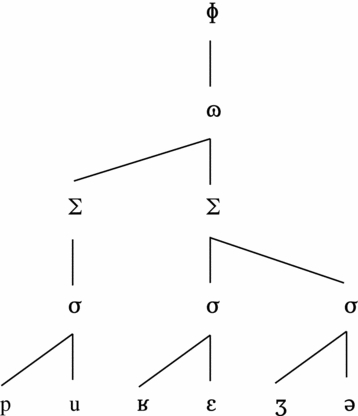
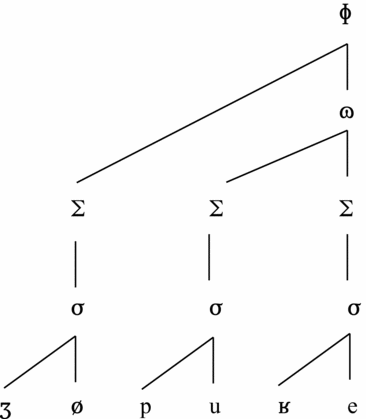
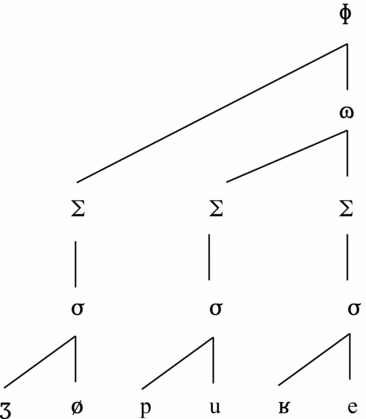
Figure 1 shows the prosodic structure of pourrais-je (‘may I’) where schwa is in a foot dependent (postclitic) position, while Figure 2 illustrates je pourrais (‘I could’) where schwa is the head of a unary foot (proclitic). The realization [ø] is compulsory in the latter position in all southern accents I am familiar with. I cannot offer a full account of CV clitics in southern French, but these have been discussed in some detail in Eychenne (Reference Eychenne2006: 255‒259). What is important for the present discussion is that their behaviour illustrates the fact that schwa in southern French is not solely a phonetic central vowel (that is [ə]) but a phonological construct that is involved in complex patterns. This fact must be born in mind as we move on to discussing the loi de position in more depth.
Prosodic representation of pourrais-je
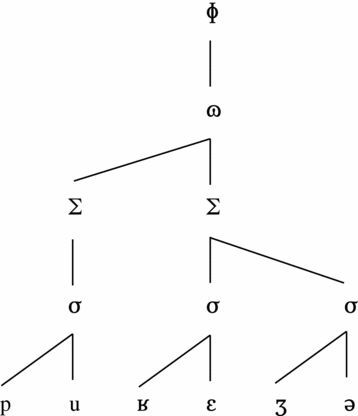
Prosodic representation of je pourrais
3 PREVIOUS ANALYSES
In this section, I discuss three accounts of the loi de position which can be considered representative and authoritative. We will see that these authors differ in the properties they attribute to schwa and in its relation to mid-vowel adjustment.
3.1 Durand's Analysis
The first approach that needs to be discussed has been advocated by Durand and his colleagues (see in particular Durand et al. Reference Durand, Slater and Wise1987; Durand Reference Durand1995). This line of thinking I shall call the prosodic view for it assumes a straightforward correlation between the melodic content of vowels and prosodic structure, as summarized in (7). This pattern is assumed to be fully productive in synchrony; as a consequence, the loi de position is considered exceptionless.
(7) The Prosodic Hypothesis:
Full vowels access prosodically strong positions (i.e. head of a foot), whereas weak vowels (schwas) are limited to prosodically weak positions (i.e. dependent position in a trochee).
Let us flesh out this approach in more detail. The narrow definition of schwa given in (2) is only relevant when schwa is morpheme-final, since the deletion condition requires that schwa delete when it precedes a vowel, which only happens in sandhi contexts. Besides the criteria in (2), Durand (Reference Durand1995) recognizes two additional criteria that according to him identify a schwa in southern French. First of all, schwa is phonetically variable: while it can be realized as a genuine central vowel (e.g. pâte [ˈpa.tə] ‘pasta’), it displays a range of phonetic values. In word-final position, it is often realized as an Œ-like vowel (e.g. [ˈpa.tø] or [ˈpa.tœ]), and it is not uncommon to hear realizations like [e] or [ʌ], especially among older speakers (Séguy Reference Séguy1951: 28; Durand Reference Durand1995: 41); in word-internal position, it is frequently realized [ø],Footnote 7 as in bêtement [bɛtømaɴ] ‘stupidly’ (see Rochet Reference Rochet1980: 92). Secondly, as we have seen, schwa triggers the lowering of a preceding mid-vowel. I shall refer to this criterion set as the extended definition of schwa:
(8) Extended definition of schwa in southern French:
a. deletion condition: schwa is deleted before a vowel.
b. stresslessness condition: schwa is stressless.
c. realization condition: schwa is phonetically variable.
d. mid-vowel lowering condition: schwa triggers the lowering of a preceding mid vowel within its domain.
(adapted from Durand Reference Durand1995: 40–42)
In a morphologically complex word like salement ‘dirtily’, a schwa can be postulated even though it may not be realized as [ə], because it is present in the non-derived form (sale [ˈsalə] ~ [ˈsalœ] ‘dirty’) where it can be deleted (salir [salir] ‘to sully’) and does not attract stress. In the medial syllable of monomorphemic words (e.g. céleri ‘celery’, médecin ‘doctor’), however, the narrow definition of schwa cannot be appealed to. In such cases, the other two criteria can help determine whether a vowel is a schwa or not. Let us consider the word écrevisse, which some speakers pronounce [ɛkrəvisə]: according to Durand et al. (Reference Durand, Slater and Wise1987), the e in the spelling corresponds to a schwa since it triggers the lowering of the preceding vowel. By contrast, in the word céleri, when pronounced as [seløri], the vowel corresponding to e in the spelling does not trigger the lowering of the preceding vowel and is realized as a stable [ø]: the authors argue that in this case, the phonological vowel is not a schwa but a stable /Œ/. According to this analysis, mid-vowel lowering plays a critical role in identifying a schwa, and while it is not a necessary condition, it is a sufficient one in environments where it applies.
As we can see, the prosodic approach adopts a definition of schwa which is purely phonological and that is not based on the orthography. There is, however, an apparent circularity: the definition of schwa crucially relies on the definition of the loi de position (as given in (3)), which in turn relies on that of schwa (as given in (8)). In fact, this analysis relies on an assumption which, to the best of my knowledge, has never been made explicit: schwa is assumed to display ‘free’ variation (e.g. écrevisse can equally be realized [ɛkχəvisə] or [ɛkχøvisə]), whereas /Œ/ is not: the distribution of its allophones [ø] and [œ] is strictly governed by the loi de position. As we have seen, schwa is syllabified in the weak position of a trochee while full vowels project their own foot. This means that [ɛkχəvisə] is actually pronounced [ˌɛ.kχə.ˈvi.sə] (or [ˌɛ.kχø.ˈvi.sə]), where the first vowel bears a secondary stress, whereas [seløʁi] is [se.lø.ˈʁi] with no secondary prominence. I will refer to this putative asymmetric behaviour as the Asymmetry Hypothesis:
(9) The Asymmetry Hypothesis:
/ə/ can be realized as an Œ-like vowel but /Œ/ cannot be realized as [ə].
This hypothesis makes a noteworthy prediction: forms like [seləʁi], where a phonetic central vowel follows a mid-close vowel, should not occur. Of course, nothing prevents a speaker from having a schwa in céleri (and indeed many do), but in that case the preceding vowel must be mid-open, yielding [sɛləʁi]. (Conversely, a speaker may have a stable /Œ/ in écrevisse and pronounce it [ekχøvisə].)
Under this hypothesis, the chicken-and-egg problem that has been mentioned above becomes less problematic provided that /ə/ is the actual representation of schwa. This is quite plausible since [ə] is one of the allophones of ‘schwa’ and it is well attested cross-linguistically that this vowel tends to be limited to prosodically weak positions (van Oostendorp Reference van Oostendorp2000). It nevertheless raises an important challenge from a learnability perspective: since schwa can be ‘coloured’ (say as [ø]) at the surface level, as in /Ekʁəvisə/ realized [ɛkχøvisə], the loi de position is fundamentally opaque.Footnote 8 From a derivational standpoint, we can say that foot formation must precede schwa colouration. Were schwa colouration to apply before footing (creating an intermediate representation /EkʁŒvisə/), the output of the derivation would be *[ekχøvisə], meaning that the opposition between /ə/ and /Œ/ would be in absolute neutralization.Footnote 9 Schwa colouration counterbleeds trochee formation: trochee formation is not surface-apparent and seems to have over-applied. At the same time, schwa colouration counterfeeds unary foot formation: unary foot formation is not surface-true because there are instances of a full vowel that do not project a foot, for instance the [œ] in [ˈbɛ.tœ] (unary foot formation seems to have under-applied). The reason why the loi de position displays features of both counterbleeding and counterfeeding opacity is because, in derivational theory, it involves footing which is an iterative process that needs several rules to be expressed (see for instance Selkirk's Reference Selkirk1978 analysis), each of which can interact with other rules. In section 6.2, we will see that this opacity can be formalized as a mismatch between levels of schematicity.
One challenge faced by the prosodic analysis is that criterion (8d) cannot be appealed to in the medial position of monomorphemic polysyllables where a putative schwa is not preceded by a mid vowel, e.g. patelin ‘village (familiar)’ and matelot ‘sailor’. In such words, the only criteria that can be used are stresslessness (if the vowel is a schwa, it must be able to surface as the weak position of a trochee) and realization (the vowel must be able to surface as a genuine central vowel). In my own system, which is very close to that described by Durand and his colleagues, patelin is always realized [patølɛɴ] and cannot be pronounced *[patəlɛɴ] with a central vowel, in accordance with the Asymmetry Hypothesis. In any case, the vowel is no different from that of pharmaceutique [faʁmasøtikə] ‘pharmaceutical’.Footnote 10 It is an empirical question to determine whether, and to what extent, the Asymmetry Hypothesis holds across southern French varieties. It is to be hoped that further studies exploring both the phonological and fine-grained phonetic properties of schwa will shed some light on this problem, but I shall leave this issue open here.
3.2 Watbled's analysis
Watbled (Reference Watbled, Smith and Maiden1995) has put forward an analysis of schwa and of the loi de position which, in several respects, builds upon the prosodic analysis developed by Durand. Watbled observes, in the variety of French spoken in Marseilles and its surroundings, that borrowings from Provençal (a local/regional language) are typically pronounced with a paroxytonic stress pattern, as in (10). In that case, the vowel is mid-open.
(10) Borrowings from Provençal
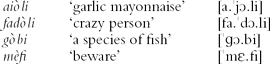
This fact provides an insight about the loi de position that is independent of schwa and suggests that mid-vowel lowering is not triggered by schwa, but rather by prosodic structure. A mid vowel is low when it is the head of a trochee, whatever the dependent vowel is.
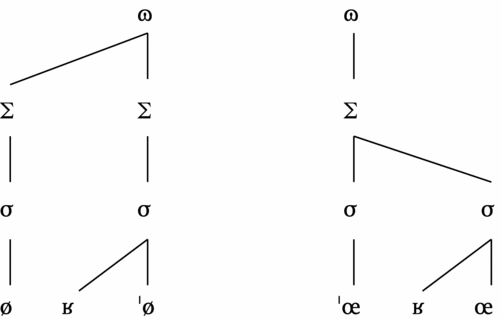
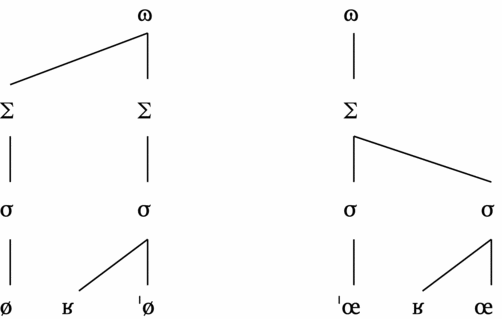
Since the quality of mid vowels can be read off prosodic structure, Watbled argues that one needs not postulate a schwa in southern French. We have seen that schwa is often realized as an Œ-like vowel (e.g. bêtement [bɛtømaɴ]). Since /Œ/ is a vowel of the inventory of this variety, and since one needs to encode prosodic structure lexically to account for forms like [a.ˈjɔ.li] anyway, it is possible to rid the phonological inventory of schwa and to account for it by a difference in prosodic structure: ‘schwas’ would actually be instances of /Œ/ that appear in the dependent position of a trocheeFootnote 11. This difference is illustrated in Figure 3,Footnote 12 with the ‘minimal pair’ heureux [ø.ˈrø] ‘happy’ vs heure [ˈœ.rœ] ‘hour’. In the case of heureux, both vowels are the head of a unary foot, and are thus pronounced as mid-close vowels, as predicted by the loi de position (as defined in (3)). In heure, however, the first vowel is mid-open because it is in the head of a trochee, whereas the final vowel's quality is due to the fact that it is in the dependent position of a trochee. Watbled furthermore argues that whenever /Œ/ is realized as a central vowel (as in heure [ˈœ.rə]), the phenomenon should be understood as the reduction of a full vowel in a prosodically weak position, a phenomenon which is well attested cross-linguistically.
Prosodic representation of heureux vs heure according to Watbled's analysis
Although Watbled does not discuss explicitly why such an analysis is preferable to an analysis that recognizes an underlying schwa (à la Durand), one must acknowledge that it removes a lot of opacity from the phonology of southern French. As we have seen, very little distinguishes schwa and /Œ/ in medial position of monomorphemic polysyllables such as céleri. Watbled's analysis makes the system overall more transparent by positing only one vowel, whose prosodic structure is lexically encoded. A plausible scenario would be that if there ever were a genuine schwa in this variety, the vowel was too opaque and eventually got merged with /Œ/.
This analysis nevertheless faces a number of challenges. First of all, it must be noted that the stressed vowel in Provençal borrowings is already mid-open: the vowel [o] is absent in Provençal, which only has /u/ and /ɔ/, and even though there is a contrast between /e/ and /ɛ/ (e.g. metre /metre/ ‘to put’ vs mètre /mɛtre/ ‘metre’, peu /peu/ ‘hair’ vs pèu /pɛu/ ‘skin’, see Martin et al., Reference Martin, Moulin, Bréchet and Baquié1998: 18), the few paroxytonic borrowings with a front mid vowel that I am aware of (mèfi, balèti ‘village dance’) already have an [ɛ] in Provençal. This shows that the argument from Provençal is somewhat inconclusive as it might well be the case that speakers simply adopted these borrowings as unassimilated forms, in which case the mid-open vowel would not be caused by an active process of French.
More importantly, even though it could be the case that paroxytonic borrowings are subject to mid-vowel lowering, there is a clear asymmetry between native and borrowed paroxytons: while the latter tend to be regularized as oxytons, or at least have an oxytonic variant (aïoli [a.jo.ˈli], gòbi [ɡo.ˈbi]), the former never do so: *[ba.ˈlø] is not a grammatical variant of balle ‘ball’, because stress must fall on the penultimate syllable. This fact is difficult to explain since in both classes there is, according to this view, a full vowel whose prosodic structure is lexically determined. It is not clear whether the few minimal pairs such heure ~ heureux, houle ~ houleux could explain this resistance to regularization. If the final vowel of words like heure is a schwa, however, the fact that it cannot be stressed is hardly surprising, as we have already seen. Another difference between native and borrowed paroxytons is that in the former the final vowel is obligatorily deleted before another vowel (e.g. ce globe est gros [søɡlɔbeɡʁo] ‘this globe is big’) whereas in the latter it cannot (e.g. ce gòbi est gros [søɡɔbieɡʁo] ‘this gòbi is big’). Everything being equal elsewhere, we would expect exactly the opposite pattern since high vowels are phonetically less marked than front rounded mid vowels (the assumed underlying representation of schwa) and are more easily subject to weakening (e.g. gliding). Here again, if the final vowel of words like heure is a schwa, this asymmetry poses no problem at all since schwa is usually considered the weakest vowel and is usually assumed to be featureless (Crosswhite Reference Crosswhite2001: 22) or articulatorily ‘targetless’ (Browman and Goldstein Reference Browman and Goldstein1992).
Another problem that this approach faces is the variety of realizations of schwa (see 8c). It is not the case that the only phonetic qualities of this vowel are [ø], [œ] and [ə]. As mentioned above, other qualities such as [e] and [ʌ] have been reported. The key point here is that variation is not limited to inter-speaker variation, but is also found within individual speakers’ systems. For instance, in my own system, schwa in word-final position can harmonize in casual speech with a preceding low vowel: pâte [ˈpa.tɐ] ‘pasta’, chasse [ˈʃasɐ] ‘flush’. Yet this low realization of schwa is not found with high vowels: mite *[ˈmi.tɐ] ‘clothes moth’, flûte *[ˈfly.tɐ] ‘flute’, soute *[ˈsu.tɐ] ‘boat hold’. It is not clear why an underlying /Œ/ would harmonize in such a way with a preceding low vowel. However, phonetic research has shown that [ə] is often the target of such coarticulatory effects (Flemming Reference Flemming and Minova2010).
Last but not least, it is worth mentioning that the status of clitics (je, me, etc.) is not entirely clear in this framework. According to Watbled, ‘some occurrences of /Œ/ are “strong” (within the domain of [the foot]); that is, they are not governed by the preceding nucleus. . . Other occurrences of /Œ/, in non-initial syllables, are “weak”, that is, they are governed by the preceding nucleus’ (Reference Watbled, Smith and Maiden1995: 194). In other words, all /Œ/'s that appear in the head position of foot (whether it is a trochee or a unary foot) are ‘strong’ (e.g. pleurer ‘to cry’, seule ‘alone (fem.)’), whereas /Œ/'s that appear in the dependent syllable of a trochee are weak (e.g. seule). The behaviour of clitics, as discussed in 2.4, thus seems difficult to explain. When they are proclitic, they cannot be weak in Watbled's sense because they would trigger the lowering of a preceding vowel (e.g. mais je dis *[mɛʒədi] ‘but I say’). When they are postclitic, however, they do behave as weak since they trigger mid vowel lowering and do not attract stress (cf. pourrais-je [purɛʒə]). Such differences cannot be accounted for if prosodic structure is purely lexical, as we would expect clitics to behave consistently in both positions, being either strong or weak. One could of course postulate a stronger domain boundary in mais#je dis than in pourrais+je, but it is not clear that this would be sufficient: if proclitics are stray syllables, one would expect them to be able to reduce to a phonetic schwa (e.g. je dis [ʒødi], not *[ʒədi]); if, on the other hand, the asymmetry between proclitics and postclitics is caused by prosody alone, it is not clear why clitics other than je and ce fail to attach to the previous syllable (compare serait-ce ‘would it be’ [sø.ˈrɛ.sə] vs serais-tu ‘would you be’ [sø.re.ˈty]). In addition, as far as I can tell, it is difficult to explain the asymmetry between pairs such as je ‘I’ (a clitic) and jeu ‘game’ (a lexical word). Both words are pronounced [ʒø] before a consonant, but jeu always retains its vowel before another vowel whereas je loses it in the same contextFootnote 13, as shown in (11):
- (11)

All the problems we have discussed vanish if one recognizes that there exists a schwa that is different from /Œ/. Except in the very specific case of prosodically unassimilated Provençal borrowings, the suprasegmental structure of southern French can be fully predicted from segmental information alone. It is however critical that schwa be properly defined, as will be shown in the next subsection.
3.3 Moreux’ Analysis
Durand's and Watbled's approaches, despite their differences, have in common that they are strictly phonological and do not resort to orthography. The properties of schwa are determined solely on the basis of the sound patterns in which it is involved. But not all authors adopt such an attitude, and schwa is often understood by implicit reference to standard French (where its core property is that it can be deleted, see Dell Reference Dell1985Footnote 14), and ultimately to the spelling.
In his study of the loi de position in Béarn, Moreux (Reference Moreux1985a: 65‒66) offers a detailed discussion of the underlying status of schwa and of mid vowels. It must first be emphasized that there are significant differences between the Béarn variety he describes and the Languedoc variety analysed by Durand; as a matter of fact, the loi de position is much less absolute in the former. For instance, some speakers have an opposition between /e/ and /ɛ/ word-finally (été [ete] ‘been’ vs était [etɛ] ‘was’ (3rd sing.)). This indicates that at least for [e] and [ɛ], there cannot be a common underlying vowel for those speakers. Moreux proposes that the loi de position is actually a process which raises a mid-open vowel in a light foot (or open foot in his terminology). For instance, the underlying form of bêtise would be /bɛtizə/ and the /ɛ/ would be raised to a mid-closed vowel in the initial light foot, giving the surface form [be.ti.zə]. Diachronically, this can also explain the ongoing merger of the opposition /e/ vs /ɛ/ in this accent, since the final vowel of /etɛ/ matches the structural description of the loi de position. Interestingly, this approach straightforwardly accounts for words like écrevisse and céleri. In his survey, écrevisse has an initial [e] whereas céleri has [ɛ] (note that this is the mirror image of what is found in Durand et al. Reference Durand, Slater and Wise1987). He suggests that écrevisse has the underlying representation /ekrəvisə/: since the loi de position is a rule closing a mid-open vowel in a light foot, /ekrəvisə/ is not subject to this rule and is realized [ekrəvisə]. In other words, we can say that what appears to be an exception to the loi de position (a closed vowel in an open syllable followed by a schwa-headed syllable) is not an exception at all because the loi de position is only a rule of vowel raising.
This analysis relies on the implicit assumption that the second vowel in écrevisse or céleri is indeed a schwa. While Moreux does mention that the realization of schwa is variable (Reference Moreux1985a: 55), all his transcriptions use the phonetic symbol [ə] and he does not address the problem of the phonetic quality of this vowel. If the e in écrevisse corresponds to a genuine central vowel, this is evidence that the Asymmetry Hypothesis does not hold in this accent, which in itself would be an important finding. However, Moreux does not spell out explicitly the properties of schwa, and instead relies on the spelling. By way of example, he states that word-internal /ə/ is shorter in duration than other vowels in this position in measurements he made for three young speakers, but he does not distinguish morpheme-final (as in bêtement) from morpheme-internal (as in céleri) ‘schwas’. Interestingly, the difference he measured is not significant for one of the three speakers (Reference Moreux1985a: 131, note 4). It is thus difficult to draw any clear-cut conclusion from those measurements. In addition, Moreux (Reference Moreux1985b: 105) cites the variety described by Durand (Reference Durand1976) as displaying a categorical loi de position except in words like céleri, where /E/ is closed, but Durand's position is precisely that such cases are not exceptions to the loi de position but rather involve a stable underlying /Œ/.
It may be possible that there is a genuine schwa in words like céleri (realized with an [e]) and that the Asymmetry Hypothesis does not hold in the accent described by Moreux, at least for some speakers. It is however crucial not to rely solely on the spelling in assessing the behaviour of this vowel. Morpheme-final schwas (e.g. bêtement) are an order of magnitude more frequent than morpheme-internal (putative) schwas (e.g. céleri), so results can easily be blurred if the morphological structure of the lexicon is not taken into account and the two categories are not distinguished.
Having discussed the interrelation between schwa and mid vowel alternations in some detail, let us now consider facts that must be considered exceptional under any account of the loi de position.
4 EXCEPTIONS TO THE LOI DE POSITION
Whether or not one considers the loi de position as a categorical phenomenon, there are genuine exceptions to this pattern that need to be taken into account in any adequate treatment of mid vowel alternations.
4.1 Sporadic exceptions
First of all, let us mention a few problematic words that I have observed in my own accent. The words autochtone ‘native’ and spectacle ‘spectacle’ are realized [otoktɔnə] and [spektaklə] respectively. The vowel before /kt/ should be mid low, as evidenced by forms like nocturne [nɔktyʁnə]. One could argue that autochtone is actually felt like a Greek scientific word and is analysed like a compound formed of the prefix auto and the non-autonomous base -chtone (see autostop [otostɔp]). But this argument is void in the case of spectacle, which is clearly monomorphemic.
Nouns and proper names ending in -et form another series of exceptions: while this ending is generally pronounced [e], some (older) speakers pronounce it as [et] in numerous words.Footnote 15 I have observed forms like pet [pet] ‘stroke’, Bousquet [busket], Périset [perizet] (PFC, speaker 11ald1, guided interview) and even le Fouquet's [løfukets], which is the name of a restaurant made infamous by Nicolas Sarkozy. The fact that the pattern can be generalized to forms like Fouquet's suggests that it is somewhat productive, but not a fully-fledged regular process, in which case one would expect forms like internet *[ɛɴtɛʀnet]. As we will see in (6.3), such a phenomenon can be straightforwardly captured in a usage-based framework.
Another interesting exception is the pair of antonyms heureusement ‘fortunately’ and malheureusement ‘unfortunately’, which are realized [œʁœzəmaɴ] and [malœʁœzəmaɴ] respectively, with an initial mid-open vowel in an open syllable. The adjectives from which these adverbs are derived, however, are well-behaved (cf. heureuse [øʁœzə] ‘happy (fem.)’ and malheureuse [maløʁœzə] ‘unhappy’ (fem.)). Here, it should be noted that the adverbs have drifted semantically from their base (as shown by the English glosses) and more often than not, they are (left-)dislocated and function as evaluative attitudinal satellites, in the terminology of Dik (Reference Dik1997: 297). Searching the PFC database, I found 8 occurrences of malheureusement and 15 of heureusement (15 tokens). Of these 23 tokens, only two occurrences of heureusement are pronounced with an [ø], one realized [øʁœzmaɴ] (31asb1, junior female from Toulouse), the other [ˌʔøɾœzəˈmaɴ] (11ajp1, senior male from Languedoc), with a noticeable prominence (accompanied by an emphatic glottal stop) on the first syllable. The latter speaker pronounces two other occurrences with [œ]. The exceptional behaviour of these adverbs may be the result of a local height harmony, the first /Œ/ harmonizing with the second in these frequent words.Footnote 16 This behaviour may have been facilitated by the fact that in both adverbs, the target vowel is further away (and hence weaker) from the main stress than it is in the non-derived forms. Whatever the cause of these exceptions, it is clear that these words are not constructed online and that they must be stored and retrieved as single units in/from the mental lexicon, possibly with competing forms for speakers who display variation.
4.2 Constructions
Yet another interesting set of exceptions has been documented by Rochet (Reference Rochet1980) in his study of the loi de position in Bordeaux. It concerns collocations where the loi de position seems to have applied across prosodic words, as in (12). As the author puts it, ‘there are numerous examples in which two items are actually fused together semantically and syntactically and must be viewed as one single word (as in bonhomme) in spite of the fact that this fusion is obscured by conventional spelling’ (1980: 82).
(12) Application of the loi de position across prosodic words
Rochet argues that the over-application of the loi de position only takes place when the construction is lexicalized. For instance, in c'est une bonne heure pour travailler ‘it's a good time to work’, bonne heure is realized regularly as [bɔnœʁə]. All these constructions are fairly frequent, although they may be geographically circumscribed like Cours Victor Hugo in Bordeaux, and they appear to have a non-compositional meaning. As the unit becomes more entrenched, it becomes semantically opaque and starts behaving as a synthetic (e.g. [bonne heure]), as opposed to an analytic (e.g. [bonne][heure]) prosodic domain. Such facts naturally lend themselves to a usage-based account (Bybee Reference Bybee2001). Of course, one could argue that these constructions are simply listed in the lexicon and coexist with analytical forms. But there are cases which suggest that such formulaic units may be used in compositional structures. Let us first consider the examples in (13)Footnote 17:
(13) Mid-vowel adjustment in neuf + N

We see a clear asymmetry between (13a) and (13b): in the former, the structure neuf + N constitutes a single phonological domain, where the final /f/ is realized as a voiced fricativeFootnote 18 (which happens before a vowel-initial word in this item) and the loi de position applies across words, whereas in the latter, the two words constitute autonomous domains: /f/ is realized faithfully and is syllabified as the coda of the first syllable, yielding the expected mid-open vowel. (13a) is similar to what is observed in derivation (cf. neuvième [nøvjɛmə]). At first sight, one might be tempted to attribute the difference between (13a) and (13b) to the voicing of the fricative: the mid vowel would be realized as a ‘tense’ [ø] before a voiced obstruent and as a ‘lax’ [œ] before a voiceless vowel. Even though tenseness is relevant in some varieties of French (for instance in Canada, where tense mid vowels tend to diphthongize), there is no phonetic nor independent phonological argument to analyze mid close vowels as tense in southern French; the difference between mid close and mid open vowels is fundamentally a difference in aperture. More importantly, as noted in footnote 16, the asymmetry that we observed is not limited to neuf, but is also found with sept, as in sept heures [setœʁə] vs sept enfants [sɛtaɴfaɴ], where the consonant is a voiceless obstruent in both cases. The difference between (13a) and (13b) can only be explained in terms of degree of lexicalization: neuf ans and neuf heures are particularly frequent and are therefore stored as units in the lexicon. In support of this claim I have looked for all occurrences of neuf followed by a noun in the PFC database, which provides samples of spontaneous speech. The raw frequencies are given in (14):
(14) Token frequency of (NUM-)neuf + N from three surveys in the PFC database
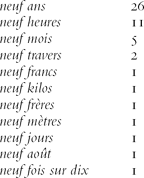
These figures confirm that neuf is much more likely to co-occur with ans (51%) and heures (21.6%), totalling 72.6% of occurrences, than with any other noun. Interestingly, the fact that neuf + {heures,ans} constitute synthetic phonological domains shows that semantic opacity is not a necessary condition. Indeed, while it may be argued that neuf heures, used as a time reference (‘nine o'clock’), is semantically non-compositional, it is always realized (in my speech) as a synthetic domain even when the meaning is compositional, as in la traversée prendra neuf [nøv] heures ‘the journey will take nine hours’.Footnote 19
Let us now consider the case where neuf is the last element of a complex numeral, as in (15):Footnote 20
(15) Mid-vowel adjustment in trente-neuf + N
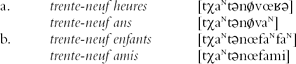
We can see that mid vowel adjustment behaves just as in (13), but this is quite unexpected: from a morpho-syntactic point of view, these constructions are analysed as NUM+N, for instance [trente-neuf][heures], whereas the over-application of the loi de position suggests on the contrary that there is no morphological boundary between neuf and heures. In fact, it can be demonstrated that neuf must be parsed both with the numeral and with the following noun. Consider the form dix-neuf heures, which is realized [diznøvœʁə]: neuf heures constitutes one domain from the point of view of the loi de position, suggesting the structure [dix][neuf heures], whereas the presence of [z] in dix-neuf points to the structure [dix-neuf][heures], since the final consonant of dix would otherwise be truncated,Footnote 21 as in dix navets [dinave] ‘ten turnips’Footnote 22. This kind of constituent mismatch is reminiscent of ‘bracketing paradoxes’ (see Spencer Reference Spencer1988 for an overview), which were studied extensively in the 80's in morphology.Footnote 23 Such cases would be difficult to analyse in a theory in which the phonology is conceived of as a purely interpretative component that is fed morpho-syntactic information. Since the pattern described in (15) is displayed in all numerals ending in neuf, even those created online (e.g. l'expérience a duré 239 [nøv] heures ‘the experiment lasted for 239 hours’), one would need to postulate an ad hoc rule (or process) that prosodifies the sequences neuf heures and neuf ans into the same prosodic word. But such an approach would fail to explain why these patterns are observed, in precisely those frequent constructions.
The exceptions discussed in this section call for an analysis that is able to directly incorporate the effect of usage frequency into the model. The rest of this article develops such an approach in the framework of Cognitive Grammar.
5 COGNITIVE GRAMMAR
5.1 Overview
Cognitive Grammar (Langacker Reference Langacker1987a, Reference Langacker1987b, Reference Langacker2008; Taylor Reference Taylor2002), henceforth CG, is a usage-based theory of language that can be situated in the broad trend of cognitive linguistics (see Croft and Cruse Reference Croft and Cruse2004 for an overview). CG rejects the nativist hypothesis according to which language acquisition is driven and constrained by formal universals that are innately available to the learner. In contrast, it claims that language emerges from usage (see also Barlow and Kemmer Reference Barlow and Kemmer2000; Bybee Reference Bybee2001inter alia) and that grammar is the by-product of general cognitive abilities such as categorization, inference and figure-ground organization, which are not language-specific. The most central claim in CG is that language is fundamentally symbolic: it consists of pairings of sounds and meanings linked by a symbolic relation:
‘A symbolic structure (∑) consists in the pairing of a semantic structure (S) and a phonological structure (P): [[S]/[P]]∑. It is thus bipolar, S being its semantic pole and P its phonological pole. . . symbolic structures combine with one another to form more elaborate symbolic structures: [∑1] + [∑2] = [∑3]. These three structures constitute a symbolic assembly. At a higher level of organization, [∑3] may itself combine with another symbolic structure to form one that is still more elaborate: [∑3] + [∑4] = [∑5]. And so on indefinitely.’ Langacker (Reference Langacker2008: 161)
A language can be described as a (very large) set of such symbols. Symbols can be maximally simple (‘morphemes’) but can correspond to large and complex assemblies such as idioms. Note that although all symbolic structures are bipolar (i.e. they have a semantic and a phonological pole), an assembly need not necessarily be bipolar: it can be unipolar, that is be either purely semantic or purely phonological.
In CG, a structure which has become conventionalized is said to be entrenched. For practical purposes, an entrenched structure (or unit) is enclosed between square brackets, for instance [kick the bucket], whereas a structure which is not conventionalized is enclosed between parentheses, as in (kick the blue ball).
The process of categorization consists in abstracting schemas (i.e. shared commonalities) from similar instances. As Langacker (Reference Langacker2008: 170) puts it, ‘if [an expression] fully conforms to [a] schema's specifications, so that it fully instantiates the schema, the relationship is one of elaboration: [SCHEMA] ➝ [EXPRESSION]. If there is some conflict in their specifications, the relationship is one of extension: [SCHEMA] → [EXPRESSION]’ (emphasis in the original). Extension has been widely studied in cognitive semantics for such phenomena as metaphor and polysemy but, as we shall see, it also plays an important role in phonology.
5.2 Cognitive Phonology
The phonological side of linguistic structure has not received much attention within CG (but see Taylor Reference Taylor2002: chapters 5, 8, 13 and references therein). In my view, the most articulate proposal is the framework of Cognitive Phonology (Lakoff Reference Lakoff1993), which is closely related to Harmonic Phonology (Goldsmith Reference Goldsmith1993a). Lakoff explicitly situates Cognitive Phonology within the general framework of CG, although the details of the integration have not been worked out. The model, as it is outlined in Lakoff's seminal paper, recognizes three levels of interest for phonology:
- the M-level: the morphemic level, the level at which morphemes are phonologically specified;
- the W-level: the word level, the level at which constraints on word-level phonology are stated.
- the P-level: the phonetic level, a level of broad phonetic description that is the interface with the articulatory and acoustic devices.
Generalizations are expressed in terms of schemas (constructions) which ‘state well-formedness constraints within levels and correlations across levels’ (Lakoff Reference Lakoff1993: 118). Cognitive Phonology recognizes intra-level schemas, which are well-formedness conditions on forms stated at one level, and cross-level constructions, which operate across levels; cross-level constructions are direction-neutral and can be used either in production or recognition. It is important to emphasize that Cognitive Phonology is not a derivational theory: the three levels are three parallel levels of description which are simultaneously satisfied; they should not be thought of as feeding one another.
Wheeler and Toureztky (Reference Wheeler and Touretzky1993), who developed a connectionist implementation of Lakoff's model, have shown that intra-level schemas are problematic: it is not always clear whether a generalization should be stated as a cross-level or intra-level construction, nor at exactly which level intra-level constructions should be formulated. I follow them in adopting a more stringent version of the theory where only cross-level constructions are recognized.
Lastly, while Lakoff does not explicitly address the issue, it must be stressed that for Cognitive Phonology to fit in the general framework of CG, levels should not be conceived of as distinct ontologies, but rather as emerging strata resulting from the self-organization of grammatical structure.Footnote 24 More specifically, I consider (P-W) and (W-M) cross-level mappings as instances of what Langacker calls unipolar constructions whereas M-level constructions are treated as signs, that is conventionalized pairings of a (schematic) phonological expression and a meaning. In other words, (P-W) and (W-M) schemas are instrumental in mapping a specific instance to its semantic interpretation.
For the sake of simplicity, I will from now on refer to the whole theoretical enterprise of Cognitive Grammar/Cognitive Phonology simply as Cognitive Grammar. Let us now examine how this framework can shed some light on the pattern of the loi de position.
6 ANALYSIS
6.1 Emergence of the loi de position
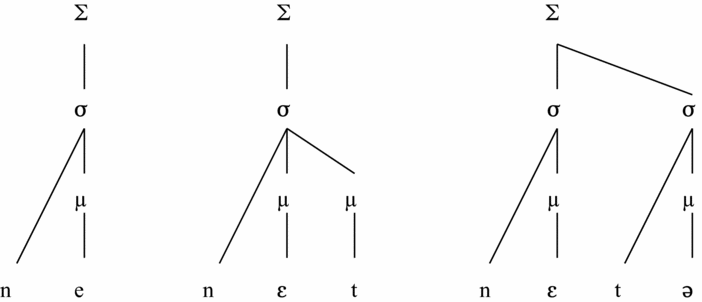
While the diachronic motivation of the loi de position is unclear, one way in which the synchronic pattern can be captured is in terms of moraic weight. Assuming that all vowels (including schwa) and coda consonants are associated with a mora, the generalization can be stated as follows:Footnote 25
(16) Moraic interpretation of the loi de position
a. mid vowels that head a light (i.e. monomoraic) foot are mid-close
b. mid vowels that head a heavy (two moras or more) foot are mid-open
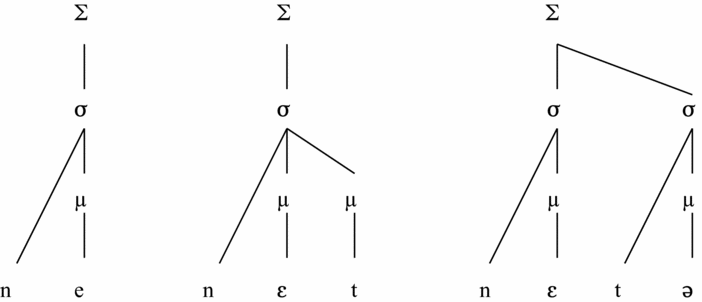
An illustration is given in Figure 4. The intuition that this analysis captures is that in order to withstand the structural complexity of a heavy foot, a mid vowel needs to be open. I believe that this analysis is fully in line with Durand's prosodic approach.
Moraic representation of nez, net and nette
Let us now examine how the loi de position affects the vocalic system. Although the analysis does not crucially dependent on a particular featural framework, I adopt a traditional binary feature for the sake of familiarity. Since, as stated earlier, there is no compelling evidence to analyse mid close vowels as [+tense] or [+ATR], I adopt the binary feature [±open]Footnote 26 put forth by Clements (Reference Clements, Laks and Plénat1993) (note that schwa is featureless):
(17) Emergent feature specification of oral vowels
These features, however, should not be interpreted as innate but as emerging from the patterns in which they are involved.Footnote 27 Specifically, the feature [±open] emerges from the mid vowel alternation governed by the loi de position. The emergence of these features at the P-level constitutes a first level of schematization over specific instances. By way of example, we have seen that schwa can be realized on the surface in a variety of ways. Let us assume that a given speaker has the following variants in word final position: [œ], [e] and [ə], which may have become entrenched schemas emerging from specific instances such as (ˈpate), (ˈpatœ), (ˈbɔnœ), (ˈnɛtə), and so forth. In CG, we will consider that these vowels emerge at the P-level as free variants, the realization of which may be controlled by phonetic and/or sociolinguistic factors.
At the W-level, these vowels are schematized even further on the basis of their distributional properties, which yields more abstract schemas. Since [ə] = {}, [œ] = {[-hi][-bck][+rnd][-low][+open]} and [e] = {[-hi][-bck][-rnd][-low][-open]}, the variants get categorized as a [{}] (a vowel devoid of features), which is the most general schema that generalizes over the P-level vowels. The mapping between the P-level and W-level representations is captured by the following (cross-level) schemas (using phonetic symbols for clarity):
(18) (W-P) mapping for the realization of schwa

Mid vowels need to be fully specified at the W-level since, as we have seen, their realization is bounded to the domain of the (prosodic) word. As a result, they are identical across the P- and W-levels. However, they are further schematized at the M-level, where the feature [±open] is abstracted away, yielding the ‘underspecified’ schematic vowels [E] = {[-hi][-bck][-rnd][-low]} [Œ] = {[-hi][-bck][+rnd][-low]} and [O] = {[-hi][+bck][+rnd][-low]}, as is illustrated in (19) for the pair [e] ~ [ɛ].
(19) (M-W) mapping for the pair [e] ~ [ɛ]
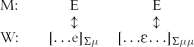
At the M-level, which is the level at which morphemes get recognized in perception, only distinctive features are present, and morphemes are represented in their most schematic form. Generalization over mid vowels occurs on the basis of their shared phonetic properties (i.e. the feature [+low] and either of (or both) the features [-bck] and [+rnd]) and of the fact that they follow the same pattern with respect to the loi de position.
Let us now consider the case where schwa is categorically deleted when it precedes a vowel, which corresponds to the schema given in (20):
(20) W-P schema for schwa deletion before a vowel
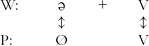
In this schema, a W-level schwa has no correspondent at the P-level, which is formally expressed by a correspondence with the null symbol.Footnote 28 This schema is responsible for schwa deletion in production, but it is also active in perception to recover a lexical schwa in instances that elaborate this schema (e.g. elle a [ɛl∅a] → /Elə a/).
6.2 Opacity of the loi de position
The opacity of the loi de position can be insightfully captured in the three-level model of CG. Let us first consider the example in (21), where opacity results from the fact that a full vowel appears in the dependent position of a foot.
(21) Cross-level mapping for bête /bEtə/
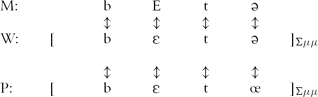
The P-level form bête is schematic for a given instance (bɛtœ), either in production or perception. The word is sanctioned by the (P-M) schema (19) whereby [E] is realized mid-open in the head of a heavy foot. The dependent vowel is in turn sanctioned as a schwa following the (W-P) schema (18). The opacity of this form arises because the crucial generalizations involved in the loi de position are not stated at the same level: prosodification is an (M-W) (roughly, ‘lexical’) schema whereas schwa colouring is a (W-P) (roughly, ‘post-lexical’) one. However, it is important to emphasize that in this approach, the three forms are not representations in the generative sense: there is no notion of precedence or symbolic computation involved. They are schemas of different degrees of abstractness that are immanent in their instantiations and they emerge as a result of the (dynamic) activity of categorization of the cognitive system.
Let us now consider the case where opacity results from external sandhi as in (22).
(22) Cross-level mapping for bête et (méchant)
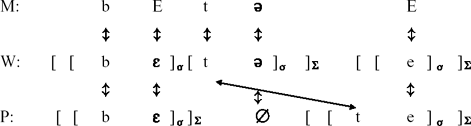
First of all, it must be noted that bête et méchant is a socially conventionalized construction and as such it is an entrenched unit in the lexicon of most speakers. This form is nevertheless licensed by the schemas that shape the loi de position. The P-level form [bɛt] is sanctioned as [bɛtə] at the W-level by virtue of the (W-P) schema (20). However, the final consonant of bête is syllabified as the onset of the following syllable, according to the phenomenon of enchaînement that pervades the phonology of French (Encrevé Reference Encrevé1988). This ‘resyllabification’ renders W-level footing opaque since the mid-open vowel [ɛ] is the head of a light foot. This type of opacity has been discussed in a similar three-level framework by Turcsan (Reference Turcsan2005: 156‒163), who calls it a ‘structural paradox’. In the case at hand, opacity arises from the fact that a P-level form violates a W-level generalization.
6.3 Exceptions and sub-regular patterns
In a usage-based framework, exceptional forms do not raise any problem at all since they are stored as such in the mental lexicon. Forms like autochtone [otoktɔnə], spectacle [spektaklə] or heureusement [œʁœzəmaɴ] simply do not participate in the general pattern of mid vowel alternation and do not instantiate the schemas that shape it. Such forms are hapax legomena and may even undergo regularization, especially if they are weakly entrenched.
On the other hand, when similar exceptional forms are numerous enough, they reinforce one another and may give rise to a new schema, thus becoming (partially) productive. Such is the case for words ending in [et] for some southern French speakers, for whom the pattern is strong enough to get entrenched and to apply productively to new forms, as in le Fouquet's [fukets].Footnote 29 It is possible that this pattern originated in Occitan native speakers, who already had a schema allowing [e] in closed syllables, and that the pattern spread to French through borrowings and proper names, the latter being shared by both languages.
A similar situation is observed with borrowings from Provençal, as discussed in 3.2. The importance of this phenomenon should not be under-estimated, as south eastern French contains many borrowings from Provençal, many of which are more or less assimilated: aïgue [ajɡə] ‘water’ (< aiga), néguer [neɡe] ‘to drown’ (< negar), péguer [peɡe] ‘to be sticky’ (< pegar), etc. The paroxytonic pattern that Watbled described can also be observed in words from Italian, for instance spaghetti [spa.ˈgɛ.ti], gnocchi [ˈnjɔ.ki] (types of pasta). Interestingly, I have even observed the forms [tɔr.ti.ˈkɔ.li] for torticolis ‘stiff neck’ and [pa. u.li] for patchouli (used with the meaning ‘nauseating perfume’) for one speaker. This suggests that forms like mèfi, balèti, aiòli, gòbi, fadòli, which are all fairly frequent and must therefore be very entrenched for many speakers, give rise to a substantive schema, which may be represented informally as [[. . .]
 [. . .i]σ]Σ, that is in turn able to sanction new expressions. It is plausible that for some speakers, torticolis and patchouli are felt as ‘foreign’ (and indeed, they are both assimilated borrowings) and as such are sanctioned by this schema.
6.4 Synthetic phonological domains
We now move on to the discussion of synthetic phonological domains, where the loi de position seems to apply across prosodic words. Let us first consider the forms in (23).
(23) Synthetic vs analytic forms

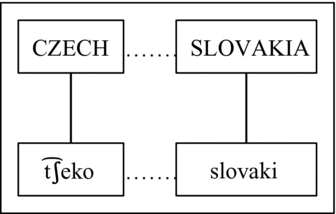
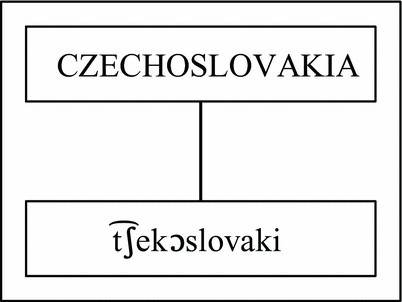
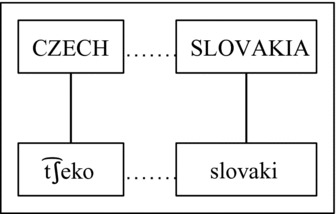
From the point of view of the loi de position, forms in (23a) are phonological synthetic domains since the rule applies regularly. Rocamadour is a famous medieval city in the Lot département that was built clinging to a cliff, and the pronunciation given for Tchécoslovaquie is my own. The corresponding forms in (23b) are analytic: Roc-Amadour is a spelling variant that can be found on site and which is the etymon of the modern form. Interestingly, it triggers an analytic realization where [ʁɔk] and [amaduχ]Footnote 30 form two distinct prosodic domains. In that case, the form is morphologically and semantically compositional and it can be understood as ‘Rock Amadour’. The situation for Tchécoslovaquie in (23b) is comparable: since the /s/ does not close the previous syllable, like in (6), the fact that the vowel is realized as mid-close in this context provides a phonological cue that signals that it is domain-final: the form is therefore parsed as a compound word and is interpreted as made up of the two morphemes ‘CZECH’ and ‘SLOVAKIA’. Figure 5 offers a symbolic representation of the word in its analytic interpretation: each phonological domain is coextensive with a semantic unit. The form (23a), on the other hand, has a non-compositional meaning (‘CZECHOSLOVAKIA’), which is simply the result of it being learnt without the encyclopedic knowledge of the fact that Czechoslovakia was made up of two countries. Figure 6 gives a symbolic representation of this form; here again, there is a clear mapping between the semantics and the phonology, but both poles are unanalysable.
Analytic symbolic assembly for Tchécoslovaquie (dotted lines in an assembly indicate a relationship of symbolic composition)
Synthetic symbolic assembly for Tchécoslovaquie

To finish this discussion, let us consider examples like dix-neuf heures realized [diznøvœrə] instead of the expected [diznœvœrə], where there is a conflict between the phonology and the semantics. As we have seen, the fact that dix is realized [diz] is consistent with the analysis of dix-neuf as a single domain but the ‘over-application’ of the loi de position suggests that neuf and heures belong to the same domain. While it cannot be ruled out that dix-neuf heures is a single domain (it is likely that this form is highly entrenched for many speakers), it is not possible to account for it in purely compositional terms. CG and related frameworks treat language as a large network of constructions that can sanction one another. In the case at hand, neuf heures becomes a construction because of its high entrenchment: the two component structures are integrated with each other and, as the whole assembly becomes more autonomous, its phonological pole is reanalyzed as a synthetic domain. This construction is in turn able to sanction other expressions. This analysis is in line with Spencer's ‘Lexicalization Requirement’, which states that ‘[bracketing] paradoxes can only be formed from members of the permanent lexicon, where this includes lexicalized phrases’ (Reference Spencer1988: 675). When neuf heures becomes lexicalized, it is able to take precedence with other schemas with which they conflict linearly.
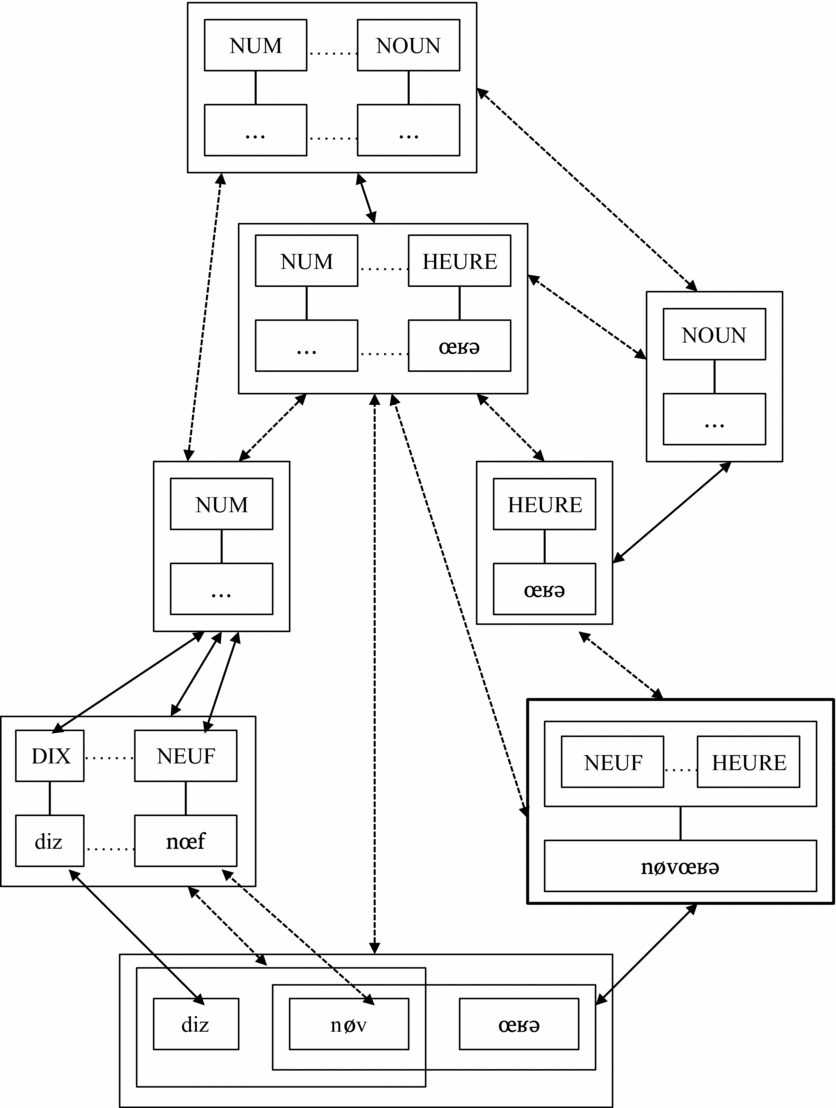
Figure 7 offers an overview of this state of affairs:Footnote 31 plain arrows indicate a relationship of elaboration whereas dashed arrows indicate a relationship of extension. As we can see, the instance (diznøvœʁə) is involved in a complex multiple-inheritance network. The construction neuf heures, which is enclosed in a thick box, is highly entrenched and is therefore directly instantiated by the instance. As a result, the numeral dix-neuf, which is realized [diznøv] in the instance, diverges from the prototypical form [diznœf] and is therefore an extension, not an elaboration, of [diznœf]. Nevertheless, the forms are sufficiently similar to each other for the symbolic assembly dix-neuf to be activated whenever [diznøv] is realized. At a more abstract level, dix-neuf heures instantiates the NUM+heures schema, which is itself a sub-schema of the more general schema NUM+NOUN. However, dix-neuf heures is not simply the concatenation of a numeral and a noun: it is the result of the partial satisfaction of several (partially conflicting) schemas, all at once.
Partial constructional network for dix-neuf heures realized as [diznøvœʁə]
7 CONCLUSION
We have seen that mid-vowel alternations and schwa are both involved in complex phonological patterns and that they interact in several important respects. The status that one grants to schwa has far-reaching consequences on one's analysis of the loi de position. This discussion has demonstrated that there exists a schwa in southern French and that it must be defined on phonological, not orthoepic grounds. A consequence of this fact is that the loi de position is an inherently opaque phenomenon. The superficial differences between /ə/ and /Œ/ are indeed subtle but nonetheless exist.
This article has put forward a number of exceptions to the loi de position, several of which have not been discussed before in the literature; these exceptions strongly support a usage-based approach to linguistic structure. CG, I believe, offers a compelling framework for phonological analysis since it is able to capture much of the essence of traditional generative phonology while taking into account frequency effects. The three-level architecture adopted here is able to capture the kind of phonological opacity that characterizes the loi de position by stating conflicting substantive generalizations at different levels. At the same time, the apparent over-application of the loi de position across prosodic words (as in neuf heures, sept ans) can be readily explained as the result of the entrenchment of these constructions: because of their relatively high usage frequency, these collocations become fossilized as one phonological synthetic domain. In addition, because CG constructions can combine semantic and phonological information into symbolic assemblies, the framework is able to explain why phonological and semantic opaqueness can sometimes influence (or reinforce) each other, as in the forms Rocamadour and Tchécoslovaquie: a non-compositional structure on one pole may influence the other pole.
The reader will have probably noticed that the representations that emerge at the W-level and M-level bear a lot of resemblance to underspecification theories. The key difference is that CG's schemas are immanent, i.e. they are not ‘extracted’ from the linguistic expressions from which they are drawn. But the fact that they are not autonomous does not mean that they are not cognitively relevant (they obviously are). I believe that the similarity between the two approaches is a welcome achievement and one can only hope that insights gained from underspecification theory be integrated into Cognitive Grammar.
Lastly, whether or not one agrees with the analyses that have been presented in this article, the empirical facts and the explicit set of hypotheses that have been discussed will hopefully provide a fertile ground for future investigations of the behaviour of schwa and mid vowels in southern French.