Introduction
For more than 30 years, the Philippines fruit fly Bactrocera philippinensis Drew & Hancock has been reared successfully in the laboratory using a sweet potato–rice bran diet. This rice bran and yellow sweet potato diet has enabled consistent mass production of this fruit fly for research purposes, fruit disinfestation studies and feasibility studies on the sterile insect technique (SIT) (Rejesus et al., Reference Rejesus, Fernandez-Garcia and Bautista1975). In 1998, a feasibility study was conducted on Guimaras Island to assess the potential of applying the SIT to control the Philippines fruit fly. The project aimed to produce and sterilize 10 million pupae per week (Manoto et al., Reference Manoto, Resilva, Obra, Golez, Covacha and Bignayan1998; Obra and Resilva, Reference Obra and Resilva2003).
The artificial diet used to date for rearing the Philippines fruit fly includes yellow sweet potato. This potato is very difficult to prepare because it requires cooking and mashing, is expensive and scarce and, as it is perishable, is hard to store, especially during the rainy season. Considering the labour involved in preparing this diet and its high cost, the use of yellow sweet potato becomes a prohibitive factor when rearing millions of insects for a SIT programme.
An alternative low-cost bulking agent, e.g. sugarcane bagasse, yellow corn or rice straw, is needed to replace yellow sweet potato in the larval diet. In this study, a simplified rearing method was used to improve the quality of B. philippinensis produced in a mass-rearing facility for SIT programmes. Strategies for large-scale operation and insect handling were also improved.
Materials and methods
Design of cages for adult Bactrocera philippinensis
Two new types of adult cages were tested (aluminium screen cages with three or five egg collection tubes), and the production parameters were compared with those obtained from the standard aluminium screen cage currently being used for rearing purposes.
Aluminium screen cage with three egg collection tubes
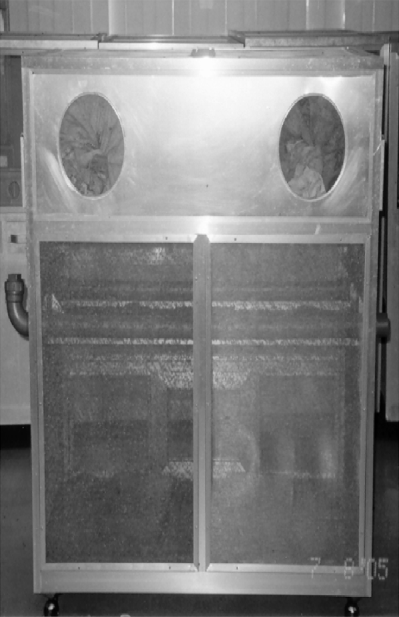
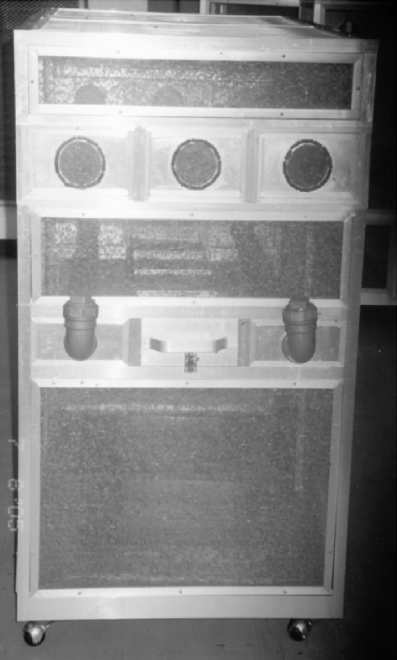
The aluminium screen cage (72 × 122 × 122 cm) with three egg collection tubes was completely covered with an aluminium screen (Fig. 1) and had two openings (24 cm in diameter) in the upper half of the cage for adult food delivery. Three openings at the side of the cage permitted the horizontal insertion of polyvinyl chloride (PVC) pipes for egg collection (Fig. 2). Each PVC pipe was perforated with about 1000 oviposition holes that were 10 mm apart. During egging, a sponge (5 × 5 × 100 cm) saturated with guava juice was placed inside the PVC pipes to provide an oviposition stimulus and to prevent egg desiccation (Tanaka, Reference Tanaka1965; Vargas, Reference Vargas1984). Both ends of the PVC egging tubes were covered with polyethylene plastic sheets during egging to avoid Drosophila fly infestation.
Front view of an aluminium screen cage with three egg collection tubes.

Side view of an aluminium screen cage with three egg collection tubes.
Aluminium screen cage with five egg collection tubes
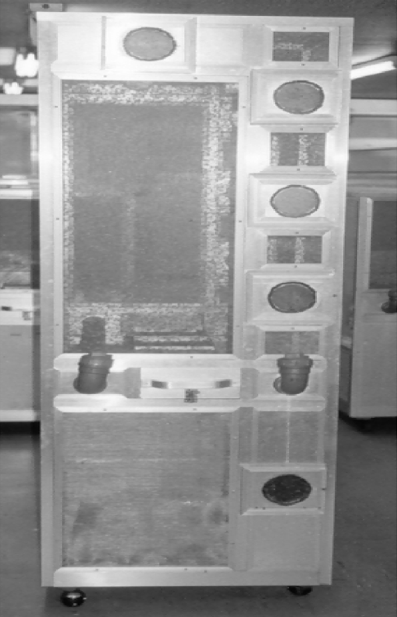
Figure 3 shows the aluminium screen cage with five egg collection tubes. This type of adult cage is larger (72 × 122 × 183 cm) than the cage described previously. There were two large holes for food delivery at the centre of the front side of the cage, while five smaller holes for the insertion of egg collection tubes were mounted from top to bottom along the sides of the cage.
Side view of an aluminium screen cage with five egg collection tubes.
Standard aluminium screen cage
Serving as the control, a standard aluminium screen cage (72 × 122 × 122 cm) was modelled after a previously used wooden nylon screen cage (Resilva and Obra, Reference Resilva and Obra2003). The front side was covered with a metal sheet with six holes for the insertion of artificial egging devices. Two bigger holes covered with cloth were mounted on the lower part to permit adult food delivery. A rack, at the centre of the cage, was divided into five sections to hold the adult diet (a mixture of sugar and yeast hydrolysate in a 3:1 ratio). Two PVC pipes, fixed perpendicular to the food rack, contained a wet cotton rope to provide water for the flies. The top and upper sides of the cage were made of an aluminium screen, while the lower and front sides including the bottom part were made of aluminium metal sheets. Six holes were mounted in the front side of the cage for the insertion of egging receptacles during egging. A plastic cylinder with 500–600 oviposition holes was used as an egging device in which gravid female flies could oviposit their eggs.
Rearing protocol
Inside each cage, 2 litres (approximately 70,000) of pupae were placed. Females started ovipositing 10 days after adult emergence, and the eggs were collected once a week for three consecutive weeks. Eggs were harvested by collecting and washing the receptacles or PVC tubes, and then the volume of eggs per cage was measured. Samples of 100 eggs were counted and spread on a moistened piece of black cloth to determine egg hatch. The efficiency and suitability of each cage were evaluated based on the quantity (volume/cage per week) and quality (weekly egg hatch) of eggs collected for one generation of flies. The quantity of eggs was determined by harvesting the eggs from all egging tubes in each cage deposited by gravid females over 24 h. Egg samples were collected at random and counted on a piece of black cloth to determine egg hatch. Five replicates were made.
Bulking agents as substitute for sweet potato in the larval diet
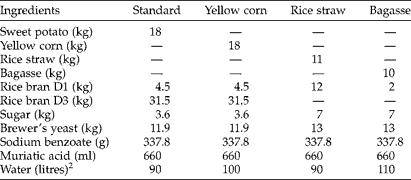
Various bulking agents (sugarcane bagasse, rice straw and powdered corn) were tested as a substitute for sweet potato in the Philippines fruit fly larval diet (Table 1). Sugarcane bagasse was obtained from the Central Azucarera de Don Pedro, Nasugbu, Batangas, Philippines. Rice straw was obtained directly from the field after a rice harvest, and corn grain was purchased in the local market. Rice straw and powdered corn were prepared by crushing the raw materials in a heavy-duty grinder (Brook Crompton Series 2000, Christy Hunt Armfield FT2, Armfield Limited, England). Sugarcane bagasse was used directly after obtaining it from the sugar mill. The bulking agents were added to the other ingredients according to the quantity of materials indicated and mixed in a diet mixer with a capacity of 150 kg. The final mixtures with the various bulking agents were adjusted to a pH of 4.5–4.9.
Ingredients and bulking agents in the larval diets1
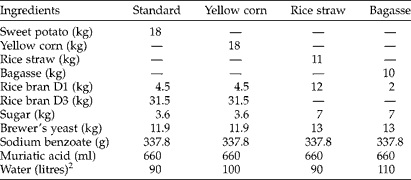
1 Amount that can be mixed in a 150 kg diet mixer, which can fill 20 trays.
2 Water can be adjusted to attain the desired diet consistency.
Eggs were weighed and seeded on trays (4 g eggs per tray, approximately 80,000 eggs), each containing 6 litres of the larval diet. All the four types of diets tested were held in the larval room at 25 ± 0.5 °C and 65% relative humidity. After the hatching of eggs, the larvae fed on the diet and developed until maturity. Mature larvae left the diet trays by popping at 6 days and dropped to the floor, which was covered with a layer of water. Larvae were then collected from the water using a hand sieve (USA Standard Testing Sieve, A.S.T.M.E-11 Specification No. 12, Arthur H. Thomas Company, Philadelphia, USA) and placed in a coconut coir dust medium for pupation. The total number of pupae collected was estimated from a volume measurement. The efficiency of the various bulking agents was compared and monitored using biological parameters, e.g. development times of the immature stages, pupation, pupal weight, pupal recovery, adult emergence, fliers, fertility (egg hatch) and fecundity (Vargas et al., Reference Vargas, Miyashita and Nishida1984). For fertility and fecundity studies, 10 pairs of newly emerged adults reared as larvae on the diets with various bulking agents were placed in small cages provided with the adult diet. Eggs were collected using a small egging receptacle containing a small slice of ripe guava fruit. For 24 h starting at 08.00 h, eggs were collected once a week for three consecutive weeks The collected eggs were spread out and counted on a piece of black cloth and held in Petri dishes to determine egg hatch. These tests were conducted with five replications per treatment for five consecutive generations.
Quality control procedures
Effects of temperature on egg viability
Egg viability was measured at various temperatures (10, 15, 19 and 28 °C) and at room temperature (28–34 °C). The experimental units were samples of 100 eggs collected 1 h after oviposition. Five replicates were made. Eggs were incubated at the designated temperature in a controlled environment chamber (EchoTherm Chilling Incubator; Cole Parmer Instrument Co., Vernon Hills, Illinois, USA). Egg samples were also held in a room with uncontrolled temperature to simulate the natural environment. Egg hatch was closely monitored and compared with the egg-holding standard (room temperature).
Optimal age for sieving pupae with a mechanical sifter
Mature larvae of B. philippinensis were collected and mixed with coconut coir dust (1 litre of larvae per 4 litres of dust). The larvae mixed with the pupation medium were placed in plastic boxes and held in the pupation room maintained at 25 °C. The newly formed pupae were sieved when 1, 2, 3, 4, 5, 6, 7 and 8 days old using a mechanical sifter. Three boxes of pupae from each pupal age group were sieved and separated from the coconut coir dust. Pupal weight, pupal mortality, adult emergence and fliers were determined from samples of 100 pupae selected randomly from each of the pupal age groups (FAO/IAEA/USDA, 2003). Five replications in three trials of all pupal age groups were made.
Effect of sodium benzoate in the pupation medium
The addition of sodium benzoate might reduce pupal pathogenic infection and thus have a positive effect on adult emergence and flight ability. Therefore, the effect of this chemical preservative on the quality of pupae was assessed.
A sodium benzoate solution was prepared at the rate of 1 g/l of water. The solution was used to moisten the pupation medium (coconut coir dust) of B. philippinensis larvae. Mature larvae were collected and allowed to pupate in plastic pupation boxes held in the pupation room. To assess the effect of sodium benzoate on pupae, the biological parameters of insects (pupal weight, pupal mortality, adult emergence and fliers) grown in the pupation medium with sodium benzoate, water or no liquid were measured in three trials and replicated five times.
Data analysis
Data on fecundity, fertility, pupation, pupal recovery, pupal weight, adult emergence, fliers and mortality were analysed for normality and subjected to a one-way analysis of variance using SAS (SAS Institute, 1990). Tukey's studentized range test was used for multiple comparisons of means.
Results
Design of adult cages
The cage design and oviposition device significantly affected the volume of eggs harvested from the three adult cages tested. Even though each cage contained the same volume of flies, significantly more eggs were collected in cages with five egg collection tubes in the first (F= 234.7; df = 2, 14; P< 0.0001), second (F= 187.3; df = 2, 14; P< 0.0001) and third (F= 40.2; df = 2, 14; P= 0.0001) weeks of egg collection, followed by those with three egg collection tubes, than in the standard cage with a standard egging receptacle (Table 2). Egg hatch was high in all types of cages, with no significant differences being observed among the types (F= 0.85; df = 2, 14; P= 0.4509) (Table 2). Therefore, it is recommended that aluminium screen cages with five egg collection tubes be used to harvest large numbers of eggs in the mass production of B. philippinensis.
Egg production and egg hatch of Bactrocera philippinensis collected from adult cages of various designs

Mean values ( ± SE) within a column followed by the same letter are not significantly different (Tukey's studentized range test; P>0.05).
Bulking agents as substitute for sweet potato in the larval diet
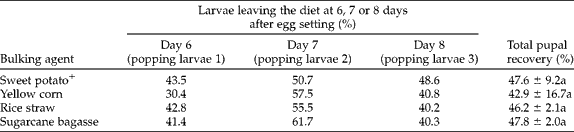
The percentages of larvae leaving the diet and pupal recovery when reared on diets containing different bulking agents for five generations are given in Table 3. No significant differences (F= 0.30; df = 3, 16; P= 0.8245) were observed in larval recovery during a 3-day collection period for all the bulking agents tested. A high percentage of larvae left the diet on the seventh day of larval development.
Percentage of larvae leaving the diet and pupal recovery of Bactrocera philippinensis on using various bulking agents in the larval diet
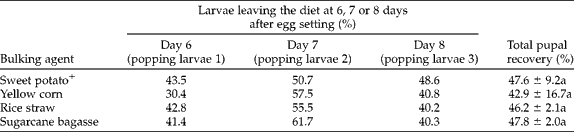
Pupal recovery mean values ( ± SE) within a column followed by the same letter are not significantly different (Tukey's studentized range test; P< 0.05).
+ Standard diet.
Table 4 summarizes the quality of B. philippinensis reared on diets containing the bulking agents. No significant differences were observed in pupation (F= 0.49; df = 3, 16; P= 0.6916), pupal recovery (F= 0.30; df = 3,16; P =0.8245), adult emergence (F= 1.2; df = 3, 16; P= 0.3428), fliers (F= 0.84; df = 3, 16; P= 0.4915), fecundity (F= 1.34; df = 3, 16; F= 0.2952) and fertility (F= 0.28; df = 3, 16; P= 0.8387) for all the bulking agents tested. Sugarcane bagasse was as good as or better than the other three bulking agents based on the high values of the biological parameters measured.
Biological parameters of Bactrocera philippinensis on using various bulking agents in the larval diet

Mean values ( ± SE) within a column followed by the same letter are not significantly different (Tukey's studentized range test; P>0.05).
+ Standard diet.
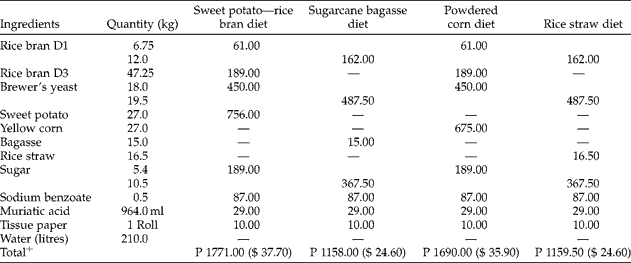
Cost estimates for the various diets were derived. The costs of sugarcane bagasse and rice straw consist of the transportation expense of hauling the materials from the field to the production facility. A breakdown of the costs to produce 1 million flies on each of the four diets is given in Table 5.
Composition and cost (Philippine Pesos) of various larval diets to produce 1 million pupae
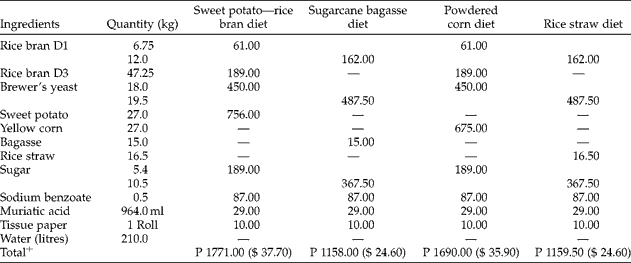
+ Peso exchange rate: 1 US $ = P 47.00 as of September 2008.
Protocols and product quality control procedures
Effects of temperature on egg viability
Data on egg hatch for eggs incubated at different temperatures are given in Table 6. Significant variations were observed when eggs were stored at different temperatures. As expected, eggs held at 25 and 28 °C had shorter incubation periods (F= 91.78; df = 4, 20; P< 0.0001) than those held at lower temperatures. The percentage of egg hatch was significantly higher for eggs incubated at 25 and 28 °C than for those incubated at 19 and 15 °C. Pupal recovery was significantly higher at higher temperatures. However, differences were not significant for pupal weight (F= 1.40; df = 4, 20; P= 0.2700), adult emergence (F= 1.35; df = 4, 20; P= 0.2676), fliers (F= 1.15; df = 4, 20; P= 0.3593), fecundity (F= 3.38; df = 4, 20; P= 0.0288) and fertility (F= 0.28; df = 4, 20; P= 0.9672).
Biological parameters of insects developing from Bactrocera philippinensis eggs held at various temperatures
Mean values ( ± SE) within a column followed by the same letter are not significantly different (Tukey's studentized range test; P>0.05).
Optimal age for sieving pupae with a mechanical sifter
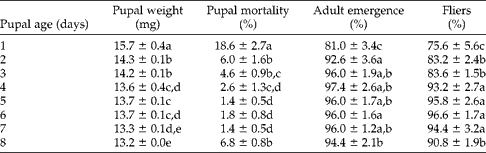
Over an 8-day period, some pupae of B. philippinensis were sifted each day from the day of pupation to the day of emergence; Table 7 summarizes the data obtained. The weight of a pupa generally decreased as it matured. When 1-day-old pupae were sifted, mortality was high and adult emergence (F= 28.98; df = 7, 32; P= 0.0001) and percentage of fliers (F= 32.34; df = 7, 32; P= 0.0001) were low. When pupae aged between 1 and 3 days were sifted, the half-emerged and abnormal flies with wrinkled wings remained in the flight tubes. Pupae sifted at 4–7 days exhibited low mortality and high adult emergence and percentage of fliers. Therefore, it is recommended that pupae be sifted between 4 and 7 days after pupation.
Biological parameters of insects developing from Bactrocera philippinensis pupae sifted at various ages
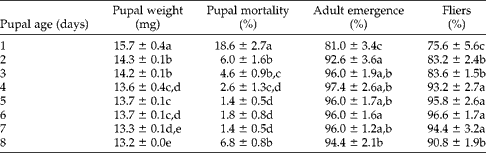
Mean values ( ± SE) within a column followed by the same letter are not significantly different (Tukey's studentized range test; P>0.05).
Effect of sodium benzoate in the pupation medium
At room temperature, larvae grown in the various media pupated within 24 h. No significant differences were observed in pupal weight (F= 101.80; df = 3, 16; P< 0.0001), pupal mortality (F= 49.51; df = 3, 16; P< 0.0001) and adult emergence (F= 56.51; df = 3, 16; P< 0.0001) between larvae grown in the two coir dust media moistened with sodium benzoate solution or water (Table 8). This result suggests that sodium benzoate has virtually no direct effect on the pupal development of B. philippinensis, but that it is beneficial to moisten the coir dust. Larvae held in dry coir dust differed significantly from those subjected to the other two treatments with respect to all the biological parameters, i.e. pupal weight (F= 101.80; df = 3, 16; P= 0.0001), pupal mortality (F= 49.51; df = 3, 16; P= 0.0001), adult emergence (F= 56.51; df = 3, 16; P< 0.0001) and fliers (F= 101.80; df = 3, 16; P< 0.0001). The low pupal weight and high pupal mortality observed for larvae subjected to the dry coir dust pupation medium treatment were due to the desiccation of the pupae.
Effects of sodium benzoate on developing Bactrocera philippinensis pupae

Mean values ( ± SE) within a column followed by the same letter are not significantly different (Tukey's studentized range test; P>0.05).
Discussion and conclusions
The increase in the number of eggs harvested from cages using egg collection tubes is due to the increased opportunity for female flies to find oviposition sites to lay their eggs when compared with a standard cage having a standard egging receptacle with only a limited number of oviposition holes. In the case of a standard egging receptacle, during the peak of the egging period, four or five gravid females were found to be congregated around one oviposition hole to lay their eggs. Evidently, the inability of some gravid females to find oviposition sites forced them to lay their eggs on the screen of the cage, resulting in a low number of eggs being harvested from the standard screen cage. Nevertheless, egg hatch was not affected by the type of egging device. It is recommended that an aluminium screen cage with five egg collection tubes be used to increase egg harvest in a mass production system.
Larvae of B. philippinensis reared on diets with different bulking agents exhibited the same feeding pattern, especially in the early days of development. Most of the larvae concentrated at the centre and then moved to the edges of the diet trays. As they matured, the larvae burrowed down, distributing themselves uniformly until the whole volume of the diet was fully occupied. The duration of larval development was similar for all the bulking agents; the first popping started with 6–8-day-old larvae. Similar results were obtained by Vargas et al. (Reference Vargas, Harris and Nishida1983) for the mass production of the Mediterranean fruit fly Ceratitis capitata (Wiedemann) in Hawaii.
The standard sweet potato–rice bran diet is more expensive than sugarcane bagasse, powdered corn and rice straw diets, and sweet potato is the most expensive ingredient in the diet. On the other hand, corn is moderately inexpensive and can be purchased anytime in the local market. Sugarcane bagasse can be obtained from a sugar mill at little or no cost, and rice straw can be gathered in the field without any cost during the harvest season. Also, corn, sugarcane bagasse and rice straw can be stored for long periods of time, especially in lean months. Thus, it is very practical and economical to use corn, sugarcane bagasse or rice straw diet as a substitute for the standard sweet potato–rice bran diet. Powdered corn and rice straw can be used as replacements for sweet potato because they pass the minimum specification for routine quality control set for B. philippinensis (Resilva et al., Reference Resilva, Obra, Zamora and Gaitan2007). However, as of 2006, sugarcane bagasse is being used as the bulking agent in our artificial larval diet in the mass-rearing facility.
The results indicate that eggs hatched from embryos held at room temperature (28–34 °C), 25 and 28 °C have shorter incubation period ranging from 30.4 to 33.2 h. As expected, the incubation temperature affected egg development – the higher the temperature, the faster the development. These three holding temperatures can be used for storing B. philippinensis eggs for the mass production of flies in a rearing facility. The pupation medium, coconut coir dust, should be moistened with water to enhance pupal survival. Pupal survival was the highest when the pupation medium was sifted at 4–7 days after pupation.
Acknowledgements
The authors acknowledge the International Atomic Energy Agency (IAEA) for providing financial support through Research Contract No. 13025/RO and the Philippine Nuclear Research Institute (PNRI).