Implications
Breeding systems tend to increase the proportion of forages in the total diet of ruminants, both for economic gain and in response to social demand for environmental protection and welfare. However, their use remains to be optimised. To do this we need a better understanding of how food characteristics influence feeding behaviour.
The post-ingestive consequences of hays are important in meeting an animal’s nutritional requirements. Yet sheep express a strong motivation for a diversity of pre-ingestive characteristics regardless of post-ingestive consequences. Breeders should thus offer animals a mixed diet to improve their welfare.
Introduction
Increasing forage in the diet of ruminants offers a way to lower production costs while at the same time meeting social demand for environmental protection and welfare. To optimise forage use we need a better understanding of how forage characteristics influence feeding behaviour as intake rate, eating time and choices largely determine intake.
Two types of forage characteristics influence choices and feeding behaviour: pre-ingestive characteristics perceived by the animals before the food is swallowed (taste, texture, odour, etc.), and post-ingestive consequences experienced after the food is swallowed (nutritive value, rumen fill, toxicity, etc.).
Post-ingestive consequences are widely acknowledged as influencing feeding behaviour. For instance, the negative relationship between rumen fill and voluntary intake has been demonstrated experimentally by Campling and Balch (Reference Campling and Balch1961). Post-ingestive consequences contribute to the satiation process and are integrated in the control of intake to prevent excess (Faverdin et al., Reference Faverdin, Baumont and Ingvartsen1995; Baumont et al., Reference Baumont, Prache, Meuret and Morand-Fehr2000).
By contrast, the pre-ingestive control of feeding behaviour has been less considered in the literature and is still a subject of debate. Greenhalgh and Reid (Reference Greenhalgh and Reid1971) were among the first to demonstrate the influence of food palatability on intake in sheep by experimentally separating its effects from those of digestibility. Intake in sheep was only 0.4 kg/day when they ate straw and received grass in the rumen, but rose to 0.9 kg/day in the reverse situation, even though the digestibility of the diets was similar. Unpleasant sensations when eating straw may explain its very low intake. Palatability can be considered to reflect those characteristics of a food which invoked a sensory response in the animal (Greenhalgh and Reid, Reference Greenhalgh and Reid1971; Baumont, Reference Baumont1996). For instance, the sensory motivation induced by offering a fresh meal of a palatable hay in satiated sheep could override satiety signals and induced a new meal (Baumont et al., Reference Baumont, Seguier and Dulphy1990a). However, the food learning theory considers that palatability and post-ingestive consequences are interrelated (Provenza, Reference Provenza1995), because ruminants can learn to associate the pre-ingestive characteristics of a food with its post-ingestive consequences and adjust their choices accordingly (Forbes and Provenza, Reference Forbes and Provenza2000). Pre-ingestive characteristics are thus first considered as a tool to discriminate between food items and then to be calibrated by post-ingestive consequences (Garcia, Reference Garcia1989) but not to influence intake on their own.
Using a methodological approach close to that used by Greenhalgh and Reid (Reference Greenhalgh and Reid1971) to dissociate the effects of pre-ingestive characteristics and post-ingestive consequences of two different hays, our study aimed to determine to what extent choices and feeding behaviour were affected by (i) modifying the post-ingestive consequences associated with the same hay and (ii) changing the nature of the hay consumed orally, with post-ingestive consequences held constant.
Material and methods
The experiment was conducted from mid-November 2008 to mid-February 2009 at the UR1213 INRA experimental farm, in central France. The experimental protocol has been submitted to and validated by the Auvergne Region Ethical Committee (ref. CE 7-07).
Animals and forages
Six Texel wethers (2 to 3 years old) weighing 61.8 ± 0.9 kg at the beginning of the experiment were used. At least one year before the experiment, they were fitted with a polyamide cannula (i.d. 75 mm) in the dorsal region of the rumen by an authorised surgeon. They were anesthetised by Halothane in a sterile environment and received analgesic (flunixine) during 4 days. They were housed in metabolic crates (0.7 × 1.3 m) except from day 1 to day 5 of the adaptation periods, when they lived in individual pens (1 × 2 m) bedded with sawdust. They were kept under constant light (LD 12 : 12) and temperature (14.4 ± 0.7°C) conditions in both cases and had free access to water and salt blocks.
Throughout the experiment we used a lucerne hay (L; Medicago sativa L.; Rumiluz®, Désialis, Paris, France) and a grass hay (G) made from a permanent pasture dominated by grasses (more than 80% grasses in the total biomass). Sheep had access to forage for 6 h/day, between 0900 and 1500 hours, in an amount that allowed 15% refusals.
Experimental design and feeding procedure
The experiment was designed to separate the effects of pre-ingestive characteristics from those of post-ingestive consequences on sheep feeding behaviour. For this purpose, sheep received one of the experimental hays (L or G) at trough to be orally consumed (o), and either the same hay or the other hay placed directly in the rumen (r). Thus four treatments (Go/Gr, Go/Lr, Lo/Gr and Lo/Lr) were allocated to the six sheep during four experimental periods according to a latin square design. One sheep fell ill during the third experimental period, and so was removed from the experiment for the last two experimental periods. As a consequence, at the end of the experiment, two treatments were tested on six sheep, and two others were tested on five sheep.
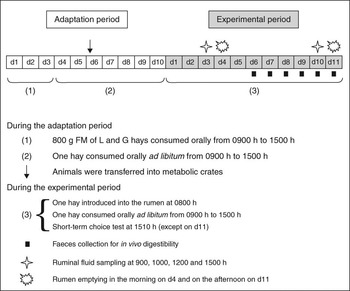
Each experimental period was preceded by an adaptation period lasting 10 days (Figure 1). From day 1 to day 3, all sheep received a limited amount of the two foods (800 g fresh matter (FM) of each) provided separately in two compartments of the trough so that they ate both of them. By this way, we made sure all the animals consumed the same diet and had the same recent experience of both forages before initiating a new experimental period, hence reducing potential carry-over effects between successive treatments. From day 4 to day 10, the sheep were offered ad libitum the single forage that would be orally consumed in the following experimental period. Six days are considered as a minimum to allow the adaptation of digestive processes and intake (Demarquilly et al., Reference Demarquilly, Chenost and Giger1995). In the early morning of day 6 (0800 hours), animals were transferred to metabolic crates to be habituated to the experimental environment.
Over the course of the experiment, sheep (n = 6) were subjected four times to an adaptation period followed by an experimental period so that they were tested on the four treatments according to whether grass (G) or lucerne (L) hay was orally consumed (o) and introduced into the rumen (r).

The experimental periods lasted 11 days, during which the forage previously offered during the last days of the adaptation period was still offered ad libitum to be orally consumed, while the same hay or the other hay was introduced intra-ruminally (Figure 1). Ruminal introductions were made daily at 0800 hours, before the sheep had access to food, in an amount equal to half the total amount received on the previous day (amount orally consumed + amount introduced into the rumen). For the first ruminal introduction of an experimental period, we introduced half the average voluntary food intake of the last 3 days of the adaptation period. When offered at trough the hays were chopped into lengths of 5 to 7 cm. The forage introduced into the rumen was ground through a 1.5 cm sieve so that the average particle sizes obtained (2.6 mm for grass hay and 3.3 mm for lucerne hay) were consistent with the value of about 2.9 mm measured for chewed chopped hay in sheep (Bernard et al., Reference Bernard, Chaise, Baumont and Poncet2000). These ground hays were then mixed with five times their weight of artificial saliva (Church, Reference Church1988) and left overnight before being introduced into the rumen.
Measurements
Feeding behaviour and pattern of intake
The daily pattern of food intake, and time spent eating and ruminating, were monitored individually using an automated system described in Baumont et al. (Reference Baumont, Vimal and Détour1998 and Reference Baumont, Chenost and Demarquilly2004). Briefly, the trough was weighed continuously by sensors fitted with strain gauges. The scales under the troughs were wired up to a data processing system that allowed the changes in trough weight and so the increase in intake over the day to be monitored on 1 min time scale. In addition, jaw movements were recorded by a polyurethane-foam-filled balloon placed in the submandibular space by means of a halter and connected to the microcomputer via a pressure transducer. Data were analysed using Microsoft Excel with macro-commands written in Visual Basic. For each 1-min interval, eating activity was assessed as follows: (i) if the weight of the trough had changed from the previous interval and jaw movements were recorded, then the animal was considered to be eating; (ii) if jaw movements were detected for at least 5 min without the trough showing weight change, the animal was considered to be ruminating; (iii) otherwise, the animal was considered to be neither eating nor ruminating.
Short-term choice tests
On all the days of the experimental periods (except for day 11), we performed a short-term choice test between L and G at 1500 hours just after the 6-h long access to food (Figure 1). We offered 200 g FM of each hay in a two-compartment trough for 5 min. These test conditions were chosen to minimise post-ingestive effects of the hay that was not offered at trough. We changed the side that the hays were presented between days to prevent any lateralisation bias. During these tests, two persons stood in adjacent room, which was darkened and separated from the test room by a glass panel; they watched three sheep each, and every 30 s scanned the behaviour expressed by the animal (eating, ruminating, and idling) and when the animal was eating, whether its head was in the L or G compartment. The choice for the hay not offered at trough during the previous 6 h was expressed as the proportion of total eating scans devoted to it.
In vivo digestibility
Digestibility measurements were performed following the method of Demarquilly et al. (Reference Demarquilly, Chenost and Giger1995) during the last 6 days of each experimental period (Figure 1) through daily collection of faeces every morning before ruminal introductions. Daily aliquots of faeces were weighed, mixed, sampled and dried in a forced air oven at 60°C for 72 h. They were then pooled per sheep and per period.
Ruminal parameters
Estimates of the total weight of the rumen digesta were made by manually removing the liquid and the solid contents of the reticulo-rumen and weighing it. This procedure was made twice during each experimental period: once in the morning of day 4, before the daily intra-ruminal introduction, and once in the afternoon on day 11, after the 6-h long access to food (Figure 1). Just after the removal, the rumen content was mixed and three subsamples of about 250 g FM were taken for dry matter determination. The remainder was then returned to the rumen. The whole process took about 30 min per sheep. These weighings of the minimal and maximal rumen content allowed the mean rumen content weight to be estimated for each sheep in each treatment. The apparent retention time of the diet in the rumen was then calculated by dividing the mean rumen content (in dry matter (DM)) by the daily DM flow (intake + the amount introduced into the rumen; Baumont et al., Reference Baumont, Jailler and Dulphy1997).
Rumen fluid samples were collected for each sheep on day 3 and day 10 of the experimental periods at four different times: at 0800 hours just before the intra-ruminal introduction and food distribution, 1000, 1200 and 1500 hours (Figure 1). For each sample, about 150 ml of rumen fluid was taken and muslin-filtered, and the rumen pH was immediately measured. Sub-samples (4 ml for volatile fatty acids (VFAs) and 0.75 ml for NH3 determinations) were mixed with 5% H3PO4 and stored at −20°C for future analysis.
In situ forage degradability
The in situ DM degradability of the hays was measured after the experiment on three fistulated sheep according to the procedure described by Aufrere et al. (Reference Aufrere, Dudilieu and Poncet2008) using incubation times of 3, 6, 12, 24 and 48 h and two replications per sheep and per incubation time. Rumen DM effective degradability was calculated as proposed by Ørskov and Mc Donald (Reference Ørskov and Mc Donald1979) after fitting the data using a non-linear procedure.
Sample processing and analyses
All the samples of hay and rumen content were oven dried (60°C for 72 h). Samples of forages were then ground through a 0.8 mm sieve and analysed for their contents in crude protein (CP). Fibre contents (neutral detergent fibre (NDF), acid detergent fibre (ADF) and acid detergent lignin (ADL)) were estimated via near-infrared spectroscopy (NIRS) based on Goering and Van Soest (Reference Goering and Van Soest1970) laboratory method. Samples were scanned by NIRS and laboratory determinations were performed on samples selected according to their spectral information (Shenk and Westerhaus, Reference Shenk and Westerhaus1994). These laboratory analyses were then used with the NIR spectra, to expand the prediction equations that were used to estimate the fibre fractions contents of all samples.
The samples of rumen fluid were analysed for total VFAs content by the method of Jouany (Reference Jouany1982), and for ammonia concentrations using a method adapted from Weatherburn (Reference Villalba, Provenza and Stott1967).
Statistical analysis
For all the analyses we used the Mixed procedure of the SAS software package (Statistical Analysis System, 1999). Data were transformed (square root or arcsine as appropriate) when needed so that they satisfy the conditions for parametric analyses. All non-significant interactions were systematically removed from the model.
Data for total voluntary intake and eating time over 6 h were first analysed using the Repeated statement to account for the day effect in each experimental period. As only the first 2 days differed from the others, we considered them as a time of adaptation to forage introduction into the rumen, and so we carried out subsequent analyses on data averaged over days 3 to 11. For consistency, data concerning rumination time, intake rate and choice were also analysed on data averaged over days 3 to 11. We considered treatment, period and their interaction as fixed effects and sheep as a random effect. Average digestibility over the last 6 days of each experimental period, rumen content and diet retention time were similarly analysed. Finally, for choices, we used the Student’s t-test, comparing actual choice with equal preference to determine whether one of the forages was preferred in each treatment.
Data concerning patterns of intake and eating time were analysed in 20 min-long intervals throughout the 6 h of food offer. For each interval, we averaged the data per sheep and per treatment over days 3 to 11 and analysed them using the Repeated statement to account for the interval effect. We considered period, treatment, interval and their interactions as fixed effects, and sheep as a random effect.
Data from ruminal fluid samples were averaged over days 3 and 10 and analysed using the Repeated statement to account for sampling effects. We considered period, treatment, sampling and interactions as fixed effects, and sheep as a random effect.
Results
Forage characteristics
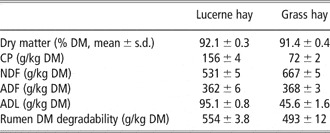
The grass hay had a lower CP content and a higher NDF content than the lucerne hay (Table 1). By contrast, the ADF content was similar in the two hays and the ADL content was higher in the lucerne hay. In line with the differences in NDF content, the in situ effective degradability of DM was higher for the lucerne hay than for the grass hay.
Chemical composition of the experimental hays and their in situ degradability

Feeding behaviour
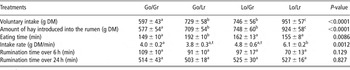
Introducing lucerne instead of grass hay into the rumen led to a significant increase in voluntary intake whichever hay was offered at trough (Table 2). However, this increase in intake resulted from different behaviours according to the nature of the hay offered at trough. When G hay was offered at trough, the increase in voluntary intake was due to an increase in eating time, whereas when it was L, it was due to an increase in intake rate. In treatments with mixed diets (Go/Lr and Lo/Gr), sheep ate for longer but tended to eat more slowly on Go/Lr than on Lo/Gr, which finally led to similar voluntary intakes (Table 2).
Feeding behaviour of sheep during the 6-h access to food, according to whether grass (G) or lucerne (L) hay was orally consumed (o) and introduced into the rumen (r) (mean ± s.e. of data averaged over days 3 to 11 of each experimental period)

DM = dry matter.
Within a row, different superscript letters indicate significant differences at P < 0.05 and values with superscript t tend to differ from each other (0.05 < P < 0.1).
The amount of hay introduced into the rumen of sheep showed the same trend as for voluntary intake (Table 2). This shows that the processing in the experimental method was correct, as the amount of hay introduced into the rumen has to be half the total amount received on the previous day (i.e. amount orally consumed plus amount introduced into the rumen).
Neither the rumination time during the 6 h of food offer nor the daily rumination time was affected by the treatments (P > 0.1; Table 2).
Patterns of intake and eating time
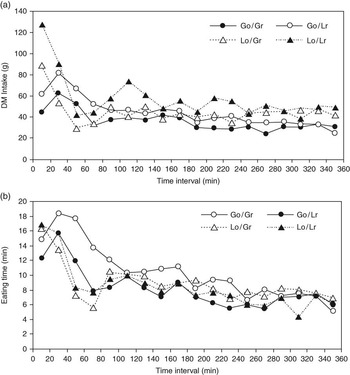
All the tested fixed effects (treatments, intervals and their interaction) except for period were significant (P < 0.05) and all the patterns were influenced by the nature of the hay offered at trough, considering both intake and eating time (Figure 2a and b).
Patterns of intake (a) and eating time (b) over the 6 h of food offer, over 20-min intervals for the four treatments, according to whether grass (G) or lucerne (L) hay was orally consumed (o) and introduced into the rumen (r). Standard errors of the means were calculated on square root transformed data for both DM intake and eating time. In (a), they were equal to 0.266 for Go/Gr, 0.251 for Go/Lr and Lo/Gr, and 0.273 for Lo/Lr. In (b), they were equal to 0.093 for Go/Gr, 0.086 for Go/Lr and Lo/Gr and 0.097 for Lo/Lr.

The shape of the intake pattern was influenced by the nature of the hay offered at trough (Figure 2a). When L was offered at trough, intake was maximal during the first interval (0 to 20), decreased to the third one (40 to 60), slightly increased up to interval 100 to 120 and then levelled off. When G was offered at trough, patterns were different as intake increased between the first two intervals, peaked at the second one (20 to 40) and then decreased until the fifth interval (80 to 100) to a slightly decreasing plateau.
The nature of the hay introduced into the rumen influenced the level of intake but not its distribution over time (Figure 2a). When G hay was eaten, introducing L into the rumen rather than G led to a higher intake at almost all time intervals, but significantly so only for the fourth time interval (P < 0.05 at 60 to 80 min). When L was eaten, a higher intake was measured as L was introduced into the rumen compared with G for the first, the second and the sixth time intervals (P < 0.05).
The patterns of the mixed diets showed that intake of L hay (Lo/Gr) was higher than intake of G hay (Go/Lr) just after food distribution (P < 0.05 at 0 to 20 min) and almost throughout the last hour (P < 0.1 for 300 to 320 and 320 to 340; P < 0.05 for 340 to 360). On the contrary, intake of grass hay was higher than intake of lucerne hay from the second to the fourth time intervals (P < 0.05).
Similarly to the intake patterns, eating time (Figure 2b) decreased from 20 to 80 min and then slightly increased until 120 min, levelling off when L hay was offered at trough without any effect of the nature of the forage introduced into the rumen (P > 0.1 at any interval except at 300 to 320). When G was eaten, eating time first increased until time interval 20 to 40 and then decreased, levelling off from the sixth time interval; it was longer when L was introduced into the rumen compared with G between time intervals 40 to 60 and 80 to 100 and for 140 to 160, 200 to 220 and 220 to 240 (P < 0.05).
Short-term choice tests
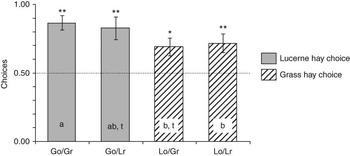
Choices expressed after 6 h of free access to forage favoured the hay that was not orally consumed during this time, whichever the treatment (P < 0.05; Figure 3). The treatment only affected the amplitude of this preference (P = 0.05), with a slightly greater preference for lucerne hay when grass hay was offered at trough than for grass hay when lucerne hay was offered at trough. Thus in treatments with equal post-ingestive consequences (Go/Lr and Lo/Gr) the preference for L in Go/Lr tended to be higher than the preference for G in Lo/Gr (P < 0.1). On the other hand, the nature of the hay introduced into the rumen did not affect short-term preference (P > 0.05; Figure 3).
Choices for the hay that was not previously offered at trough, expressed as the proportion of total feeding scans (mean ± s.e.), according to whether grass (G) or lucerne (L) hay was offered at trough (o) and introduced into the rumen (r). Asterisks indicate significant deviation from the theoretical 0.5 proportion of non-choice. In the columns, different superscript letters indicate significant differences at P < 0.05 and values with superscript t tend to differ from each other (0.05 < P < 0.1).

Diet digestibility and ruminal parameters
The diet digestibility did not differ between treatments (P > 0.05; Table 3). The DM rumen content tended to be higher for the treatments in which L was consumed or introduced into the rumen compared with Go/Gr (P < 0.1; Table 3).
Diet digestibility, weight of rumen content and diet retention time according to whether grass (G) or lucerne (L) hay was orally consumed (o) and introduced into the rumen (r) (mean ± s.e.)

DM = dry matter.
Within a row, different superscript letters indicate significant differences at P < 0.05 and values with a common superscript t1 or t2 tend to differ from each other (0.05 < P < 0.1).
By contrast, diet retention time decreased when L hay was consumed or introduced into the rumen, whichever hay was offered at trough (P < 0.05): the highest diet retention time was measured for Go/Gr and the lowest for Lo/Lr, whereas intermediate and similar values were measured for Go/Lr and Lo/Gr (P > 0.1).
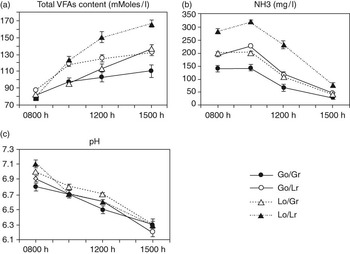
The interaction between sampling and treatment effects influenced the total VFA content (P < 0.01). It was similar across treatments before food offer at 0800 hours (P > 0.1; Figure 4a). Two hours later, the nature of the hay introduced into the rumen influenced VFA content, with higher values for L than for G (P > 0.05). The nature of the hay orally consumed then progressively affected VFA content so that at the end of the feeding period (at 1500 hours), total VFA content was highest for Lo/Lr (P < 0.01), lowest for Go/Gr (P < 0.01) and intermediate with similar values for Lo/Gr and Go/Lr (P > 0.1).
Ruminal determination trial (mean ± s.e. of day 3 and day 10). Evolution of total volatile fatty acid content (a), ammonia concentration (b) and pH (c) of rumen fluid through successive samplings, according to whether grass (G) or lucerne (L) hay was offered at trough (o) and introduced into the rumen (r).

The interaction between sampling and treatment effects influenced ammonia concentration (P < 0.01; Figure 4b): it was highest for Lo/Lr (P < 0.01 at all sampling times), lowest for Go/Gr (P < 0.01 except at 1500 hours, where it was just different from Lo/Lr) and intermediate for treatments with mixed diets with similar values (P > 0.05 at all sampling times).
Finally, the different treatments did not induce any differences in pH (P > 0.1; Figure 4c), which decreased almost regularly throughout the feeding period (P < 0.01).
Discussion
The aim of this work was to study feeding behaviour in sheep fed lucerne hay or grass hay under a controlled post-ingestive environment. The experiment was designed to test the crossing effects of the nature of the forage orally consumed with the nature of the forage introduced into the rumen so that we could investigate (i) to what extent variation in the post-ingestive consequences associated with a given hay could affect feeding behaviour and choice for that hay and (ii) to what extent feeding behaviour and choice for two different hays could differ when these hays were associated with similar post-ingestive consequences.
The experimental procedure
One of the specific features of the experimental procedure (Greenhalgh and Reid, Reference Greenhalgh and Reid1971) was the introduction into the rumen of about 50% of the total amount of received forage. Despite this high proportion, sheep showed good adaptability, as they decreased their voluntary daily intake accordingly and stabilized it within 3 days. Sheep in treatments Lo/Lr and Go/Gr consumed an amount of hay such that they received similar total amounts as sheep orally fed lucerne or grass hay ad libitum with no time restriction (Baumont et al., Reference Baumont, Seguier and Dulphy1990a). Our results are thus consistent with previous studies in which addition of 1 g of feed into the rumen lowered voluntary intake by about 0.9 g (Faverdin et al., Reference Faverdin, Baumont and Ingvartsen1995 for review).
Our experimental procedure also implied that half the total amount of hay received on the previous day was introduced in one go just before food distribution. Consequently, as time elapsed, the major post-ingestive influence of the hay introduced was progressively balanced by that of the forage eaten at trough, as reflected in the evolution of VFA contents. The succession of post-ingestive consequences experienced by the animals throughout the 6 hours of the feeding period were thus different between Go/Lr and Lo/Gr, which explains why we studied the dynamics of feeding behaviour. In both treatments, the rumen content was however similar at the end of the feeding period and throughout the fasting period for 11 days, and so was the ruminal parameters (ammonia and VFA concentrations, fill effect, etc.). We then considered post-ingestive consequences as similar for treatments with mixed diets (Go/Lr and Lo/Gr).
Greenhalgh and Reid (Reference Greenhalgh and Reid1971) were among the first to use this method to investigate the effects of palatability and digestibility of two forages on sheep intake, although they did not look at explicative variables of food intake such as eating time and eating rate, patterns of feeding behaviour or choice between forages. Their results, derived from two distinct experiments involving either dried grass v. oat straw, or dried grass v. meadow hay, proved the method to be useful for showing different effects depending on the pair of foods considered.
Offering the same hay for different post-ingestive consequences
Whether the lucerne or the grass hay was offered at trough, introducing lucerne hay rather than grass hay in the rumen raised voluntary daily intake in the sheep. This can be related to a lower fill effect of the diet when introducing lucerne hay, as shown by the lower diet retention time, which could be attributed to a lower NDF content and a higher rumen degradability of lucerne hay compared with grass hay. The relation between rumen fill and feed intake is well known (Faverdin et al., Reference Faverdin, Baumont and Ingvartsen1995 for review). Several authors have increased the volume or mass of the rumen content with indigestible material such as balloons (Anil et al., Reference Anil, Mbanya, Symonds and Forbes1993) or particles (Weston, Reference Weatherburn1966; Baumont et al., Reference Baumont, Malbert and Ruckebsch1990b), or with digestible materials (Weston, Reference Weatherburn1966; Greenhalgh and Reid, Reference Greenhalgh and Reid1971), and demonstrated an associated decrease in intake. In addition, the higher CP content of the lucerne hay could have improved the efficiency of the ruminal microbial population, as introducing lucerne hay in the rumen rather than grass hay led to increased ammonia concentration and total VFA content in the rumen. The increase in voluntary daily dry matter intake (DMI) measured in our study is consistent with that observed by Greenhalgh and Reid (Reference Greenhalgh and Reid1971), who replaced oat straw or grass hay as introduced forages by a less bulky one, such as dried grass. In their work, variations in voluntary intake were also linked to variations in digestibility between the forages, dried grass being more digestible than grass hay and straw. By contrast, variation of intake observed in our study occurred independently of differences in digestibility, as lucerne and grass hays showed similar values. This highlights the major role of the rate and extent of ruminal degradation in accounting for differences in voluntary intake between forages (Carro et al., Reference Carro, Lopez, Gonzalez and Ovejero1991), especially between grasses and legumes.
Intake modifications can be analysed from animal behavioural adjustments on intake rate and feeding time. For instance, cattle have been shown to increase their feeding time (Campling and Balch, Reference Campling and Balch1961) or their intake rate (Gregorini et al., Reference Gregorini, Gunter, Masino and Beck2007) in response to decreases in the volume or mass of rumen contents. In our study, the modifications of intake in relation to rumen fill resulted in different adaptations in feeding behaviour depending on the nature of the forage orally consumed. The resulting differences in intake were strikingly close to food distribution and then lessened along the 6-h feeding period (Figure 2a). This indicates that sheep instantaneously analysed the post-ingestive consequences of the introduced hay (i.e. their rumen load) and evaluated their satiety level to modulate their motivation to eat the hay offered at trough, even if they adapted their behaviour according to the pre-ingestive characteristics of the hay orally consumed. Sheep ate for longer when grass hay was orally consumed, whereas they ate faster when it was lucerne hay. This could be explained by the physical differences between lucerne and grass hays: lucerne hay is less fibrous than grass hay, favouring easier prehension and mastication by sheep (Jarrige et al., Reference Jarrige, Dulphy, Faverdin, Baumont and Demarquilly1995; Baumont et al., Reference Baumont, Doreau, Ingrand and Veissier2006) and allows more flexibility in intake rate compared with coarse hays that need intense mastication activity.
Offering two different hays for similar post-ingestive consequences
At the end of the 6-h feeding period, treatments with mixed diets (Go/Lr and Lo/Gr) showed similar post-ingestive consequences (digestibility, diet retention time and ruminal parameters) and daily DMI values were similar. We may therefore conclude that pre-ingestive characteristics or palatability per se did not influence voluntary intake between lucerne and grass hays. This would then be consistent with Greenhalgh and Reid (Reference Greenhalgh and Reid1971), who observed, for similar post-ingestive consequences, a significant effect of palatability between oat straw and dried grass, but not between grass hay and dried grass, and concluded that palatability was probably not an important determinant of intake for better-quality forages, whereas it may limit intake of poor-quality forages.
Our results are, however, surprising as sheep generally prefer legumes to grass (Rutter, Reference Rutter2006), so that we expected lucerne hay to be more palatable than grass hay. This finding could be explained either by a decrease in lucerne palatability due to sheeps’ reassessment of lucerne hay, associating it with the consequences of grass hay introduced into the rumen, or by a short-term satiation effect induced by the intra-ruminal introduction of the bulky grass hay. The recorded patterns of intake of Go/Lr and Lo/Gr showed that the pre-ingestive characteristics of lucerne hay still induced a higher palatability in the short term, as intake was higher with Lo/Gr than with Go/Lr just after food distribution. However, intake of grass hay exceeded intake of lucerne hay during the subsequent hour, which may be interpreted as a consequence of higher fill effect due to the ruminal introduction of grass hay (in Lo/Gr) compared with lucerne hay (in Go/Lr). Finally, during the last hour, when it could be assumed that the post-ingestive consequences of the two mixed diets were balanced, intake of lucerne hay was again higher than that of grass hay. We can therefore hypothesise that the palatability of lucerne was not modified, but that sheep adjusted their behaviour finely according to their internal state.
Short-term choices: effect of recent dietary experiences
The literature has widely reported that sheep can develop conditioned food aversions or preferences when either negative (Du Toit et al., Reference Du Toit, Provenza and Nastis1991; Ralphs et al., Reference Ralphs, Provenza, Wiedmeier and Bunderson1995; Kyriazakis et al., Reference Kyriazakis, Papachristou, Duncan and Gordon1997) or positive (Buritt and Provenza, Reference Buritt and Provenza1992; Arsenos and Kyriazakis, Reference Arsenos and Kyriazakis1999; Villalba et al., 2006) post-ingestive consequences are associated with that food. Recently, introduction of straw in the rumen (Baumont et al., Reference Baumont, Jamot and Ginane2007) or distension with a balloon (Villalba et al., Reference Villalba, Provenza, Hall and Peterson2009a and Reference Villalba, Provenza and Manteca2009b) were used to demonstrate that rumen fill is perceived as a negative post-ingestive signal, leading to a decreased preference for the associated forage. We could thus expect the choice of grass hay to be enhanced when it is associated with intraruminal administration of lucerne hay, and conversely the choice of lucerne hay to be decreased when associated with introduction of grass hay, due to differences in fill effect between these two hays. However, the short-term choices of sheep measured after food offer systematically favoured the hay that was not previously orally consumed. Thus, it seems that sheep did not update their knowledge of the hays according to the treatments in the course of the experimental periods or that they did not express this knowledge in the short-time scale of the choice test.
Whatever the case may be, their choices suggest that their motivation for diversity overrode post-ingestive consequences on this short-term scale. This motivation for diversity may be explained by the ‘satiety hypothesis’ (Provenza et al., Reference Provenza, Villalba, Haskell, MacAdam, Griggs and Wiedmeier2007; Villalba et al., Reference Villalba, Provenza, Hall and Peterson2009a and Reference Villalba, Provenza and Manteca2009b), which suggests that animals acquired transient aversions for a food just eaten as a result of sensory input and post-ingestive feedbacks (nutrients and toxins) interacting along concentration gradients. This transient change in food palatability caused animal to search for a different food and then to eat a diverse diet. Preferences for the food opposite to the one that animals ate previously has also been found in ewes grazing monocultures of clover or rye-grass (Newman et al., Reference Newman, Parsons and Harvey1992; Parsons et al., Reference Parsons, Newman, Penning, Harvey and Orr1994) and in heifers fed on hays (Ginane et al., Reference Ginane, Baumont, Lassalas and Petit2002). In these studies, the authors suggested that these preferences could be explained by the desire of animals to balance their diet, or to maintain gut flora diversity by seeking rarity, but also by an attractive effect of novelty, considered as a search for diversity. However, the authors could not draw any firm conclusion as they had not controlled the post-ingestive parameters felt by the animals before and during the choice tests.
We did so and even when the post-ingestive consequences felt before and during the choice tests were similar in nature and intensity with mixed diets (Go/Lr v. Lo/Gr), sheep demonstrated a high motivation for diversity. This indicates that the motivation to eat something new may influence diet choices, at least in the short term, and independently of post-ingestive consequences, because it probably induced pleasure associated with the diversity of the diet. This conclusion was in agreement with the sensory specific satiety which refers to the changing hedonic response to the sensory properties of a food as it is consumed (Rolls, Reference Rolls1986).
In conclusion, post-ingestive consequences are predominant in the control of daily food intake of hays, although pre-ingestive characteristics mostly influenced the behavioural adjustments and patterns of eating activity. Pre-ingestive characteristics also greatly influenced short-term choices in favour of the hay that was not previously consumed, independently of any post-ingestive influence. This suggests that sheep sought a diverse diet more for pleasure than for functional purposes. This finding has relevance for improving animal welfare.
Acknowledgements
This research was supported by grants from Auvergne Region and the INRA-PHASE Division. The authors thank the staff of the INRA-UR1213 experimental farm, particularly Bernard Sepchat, Bernard Mallet and Daniel Thomas, for their technical assistance, laboratory technicians (Aline Le Morvan, Jean-Marie Ballet and Laurent Lanore) for their help in this experiment, and Donato Andueza for his help in NIRS data analysis.