The developmental transition into adulthood is one of personal, contextual, and social role changes, and has therefore been of increasing interest to psychological researchers. Two key markers that are often measured as important outcomes during this period of life are educational attainment and occupational status. By the time individuals reach adulthood in US society they have achieved some level of education and almost all are employed, and these attainments are indicative of both social status and economic well-being. A developmental study of earlier contributions to educational and occupational outcomes is thus important to better understand differences in adult socioeconomic status (SES).
Researchers have been studying the question of what predicts occupational status since the early part of the 20th century. The two variables that have been most emphasized as predictors of occupational attainment are family SES and individual academic competence (Strenze, Reference Strenze2007). A large body of research has supported the roles of these two variables in predicting occupational and educational attainment. More recent research in this field has gone beyond the examination of family SES and academic competence to explore the impact of additional social and psychological variables that may mediate the effects of social origin on adult status attainment. Examples of such variables are parental expectations and values, peer support and encouragement, and involvement in extracurricular activities (Hossler & Stage, Reference Hossler and Stage1992).
One key variable that has been missing from this status attainment literature is mental health. Although research in the field of developmental psychopathology has emphasized the importance of mental health to a number of social and emotional outcomes, this research has not explored the role of mental health as a predictor of socioeconomic attainment. In this paper, we will first briefly outline the existing literature on predictors of adult socioeconomic attainment, and we will then describe how the current study adds to this body of research by including the variables of individual and parental mental health.
Academic Competence and Family SES Predict Educational and Occupational Attainment
A large number of studies over the past several decades have demonstrated that individual ability and family SES are highly associated with occupational attainment in adulthood. The measures of individual ability most commonly examined have been IQ, academic achievement, and educational attainment. Measures of family SES most commonly used have been parental education and parental occupation.
Strenze (Reference Strenze2007) recently conducted a meta-analysis of 83 longitudinal studies examining predictors of academic and occupational success in adulthood. Results confirmed that both intelligence and family SES were important predictors of socioeconomic attainment, with intelligence a slightly stronger predictor than family SES. Researchers in a number of fields have supported this link between IQ and status attainment; they have consistently found that people with higher IQ scores attain more education, hold more prestigious occupations, and earn higher incomes compared to people with lower test scores (Gottfredson, Reference Gottfredson and Nyborg2003; Schmidt & Hunter, Reference Schmidt and Hunter2004). In addition, grades in school, even those obtained as early as elementary school, have been found to strongly predict educational attainment in adulthood (Entwisle, Alexander, & Olson, Reference Entwisle, Alexander and Olson2005). Finally, educational attainment has been found to be directly related to occupational outcomes, even when comparing individuals from identical backgrounds and with identical cognitive skills (Blau & Duncan, Reference Blau and Duncan1967; Jencks et al., Reference Jencks, Smith, Acland, Bane, Cohen and Gintis1972).
For family SES, the achievement literature has consistently shown that parental education is an important factor in predicting children's education and occupation in adulthood (Corwyn & Bradley, Reference Corwyn and Bradley2002). In his work with White males, Jencks et al. (Reference Jencks, Smith, Acland, Bane, Cohen and Gintis1972) reported that the most important determinant of educational attainment was family SES as measured by father's occupation and income, and that educational attainment was in turn the most important determinant of occupational attainment. A more recent study by Entwisle et al. (Reference Entwisle, Alexander and Olson2005) found that family SES as measured by the education and occupational status of both parents in first grade had the largest direct effect on educational attainment at age 22, even compared with individual variables like school achievement and with later measures of SES.
The current study will attempt to replicate these findings using a longitudinal sample of mothers and children. We will examine whether parental SES as measured by parent education and occupation and offspring academic competence as measured by their grades in school, their achievement test scores, and their IQ scores in adolescence will predict offspring educational attainment and occupational status at the age of 30.
Does Mental Health Predict Socioeconomic Attainment?
Although previous research over the past several decades has shown that both academic competence and family SES predict socioeconomic outcomes, much of the variation in occupational attainment remains unexplained. One variable that has not been included in the traditional status attainment literature is mental health. Mental health problems are prevalent in the United States, as an estimated 26.2% of Americans ages 18 years and older suffer from a diagnosable mental disorder in any given year (Kessler, Chiu, Demler, & Walters, Reference Kessler, Chiu, Demler and Walters2005). Mental health problems influence many aspects of adult functioning, and can exert negative effects on an individual's cognitions, motivations, and behaviors across situations and over time.
Mental health is related to SES, but there is a question of the direction of this association captured in the debate between the social causation versus the social drift hypotheses (e.g., Creed, Reference Creed1999; Meich & Chilcoat, Reference Meich and Chilcoat2005). In his analysis of a statewide longitudinal database, Hudson (Reference Hudson2005) reported that SES impacted directly on rates of mental illness, as well as indirectly through the impact of economic hardship on low and middle income groups. Ritsher, Warner, Johnson, and Dohrenwend (Reference Ritsher, Warner, Johnson and Dohrenwend2001) similarly found that parental SES as measured by education was predictive of offspring's later mental health. Moreover, individuals with higher status occupations, particularly those involving control and planning, have been found to report lower rates of depression (Link, Lennon, & Dohrenwend, Reference Link, Lennon and Dohrenwend1993). In contrast, studies have also supported the social drift view, showing that mental health predicts SES. For example, individuals with mental illnesses are more likely to move into lower income communities than are mentally healthy individuals, and severe levels of mental illness have been shown to negatively influence individuals' job performance and stability (Dembling, Rovnyak, Mackey, & Blank, Reference Dembling, Rovnyak, Mackey and Blank2002; Loeffler & Haefner, Reference Loeffler and Haefner1999). However, these questions examining the role of mental health have not been part of the usual literature predicting SES.
One avenue through which mental illness may influence socioeconomic attainment is through its effects on functional impairment. When it comes to predicting how far a person goes in school or what type of job a person obtains, it may not be specific diagnoses or symptoms that are important, but rather the influence of these diagnoses and symptoms on the ways in which an individual is able to function in the world. Researchers and clinicians often use summary measures such as the Global Assessment of Functioning Scale from the Diagnostic and Statistical Manual of Mental Disorders, Fourth Edition, Revised (DSM-IV-R) or the Children's Global Assessment Scale (C-GAS; Schaffer et al., Reference Schaffer, Gould, Brasic, Ambrosini, Fisher and Bird1983) as indicators of both general mental health and level of impaired functioning. These are especially useful in smaller samples where individual diagnoses are not frequent enough for more differentiated analyses. These general mental health scales are highly associated with psychiatric diagnoses and severity of symptoms, and have been found to predict both need for treatment as well as treatment outcome (Moos, Nichols, & Moos, Reference Moos, Nichol and Moos2002). Because functional impairment is believed to be the pathway through which mental illness negatively affects socioeconomic attainment, this more general measure of mental health will be used in the current study.
Does Parental Mental Health Predict Offspring SES?
Because the aim of this study was to examine relations between both parental and child characteristics and child socioeconomic attainment, it was important to consider the possible role of early parental mental health in offspring's later functioning. Research has shown that children who have a parent with a mental illness are at significantly greater risk for multiple psychosocial problems. Studies have noted that offspring of mentally ill parents have higher rates of mental health problems in childhood and adolescence (Beardslee, Versage, & Gladstone, Reference Beardslee, Versage and Gladstone1998) and are more likely to show developmental delays, lower academic competence, and difficulty with social relationships (Oyserman, Mowbray, Meares, & Firminger, Reference Oyserman, Mowbray, Meares and Firminger2000; Sameroff & Seifer, Reference Sameroff and Seifer1983).
Most of the existing research on the effects of parental mental illness on adult offspring has focused exclusively on the intergenerational transmission of psychopathology (Beardslee et al., Reference Beardslee, Versage and Gladstone1998). However, having a parent with mental health problems may not only influence offspring's social and emotional functioning, but may also impact a broader range of competencies related to socioeconomic attainment. In the literature we reviewed, few studies have looked at the effects of individual mental health on educational and occupational attainment, and even fewer studies have looked at the effects of parental mental health on children's attainment. The current study addresses these questions using a sample that is particularly well suited to examine these relations, as it contains a number of mothers presenting mental health problems during their children's first years of life.
Research Questions and Hypotheses
In summary, mental health functioning has been found to influence many areas of life, but to our knowledge studies have yet to investigate whether earlier mental health problems directly predict later educational and occupational outcomes, and how this contribution compares to the more established predictors of family SES and academic competence. The following quote by Jencks et al. (Reference Jencks, Smith, Acland, Bane, Cohen and Gintis1972) sums up the initial, and in many ways continuing, focus of the field when addressing the issue of earlier mental health as a predictor of adult status attainment:
At most, these characteristics (family background, test scores, and educational credentials) explain about half the variation in occupational status. This leaves at least half the variation … to be explained by [additional] factors … Some of this unexplained variation is presumably due to unmeasured character traits, like … mental health … but we doubt if these explain very much. (p. 192)
The current study tests these ideas by examining the relative roles of earlier parent and offspring mental health to offspring's adult socioeconomic attainment while controlling for family SES and offspring academic competence. The following hypotheses were tested using data from a 30-year longitudinal study of mothers and children:
Hypothesis 1: Family SES and offspring academic competence in adolescence will be associated with offspring educational and occupational attainment in adulthood.
Hypothesis 2: Controlling for family SES and academic competence, offspring mental health in adolescence will also be related to their educational and occupational attainment at age 30.
Hypothesis 3: Parental mental health during early childhood will be related to offspring SES in adulthood either directly, or through its associations with adolescent family SES, offspring mental health, and offspring academic competence.
Method
Participants
Our data comes from a 30-year, three-generation longitudinal study of mental health. This study was initiated in 1970, and included families with an overrepresentation of maternal psychopathology. Thus, this sample is particularly well suited to explore the effects of maternal and child mental health. Because the intent of this study was to recruit a community sample of pregnant women with mental health problems, obstetric patients were checked against a countywide psychiatric register that provided information about psychiatric contacts and diagnoses of mental illness. This register had been in existence since 1959 and included approximately 95% of all individuals receiving mental health services in a metropolitan area with a population of about 850,000. A sample of women without mental health problems was obtained by matching these women to other pregnant women scheduled to deliver at the same hospital on the demographic variables of SES, race, age, marital status, and number of children. SES was computed using a modified version of the Hollingshead two-factor index of social position, which is a combination of mother's education, father's education, and head of household's occupation as described in the measures section. Race was self-identified as European American (63%), African American (34%), or Puerto Rican (3%). The final sample had approximately half of the mothers displaying no mental health problems, and approximately half of the mothers having a psychiatric diagnosis before participant children were 3 years old.
This study followed offspring from the time mothers were pregnant until offspring were 30 years old. The current analyses utilize data collected from mothers when children were 30 months old, as well as data collected from mothers and children at 18 and 30 years (Gutman, Sameroff, and Cole, Reference Gutman, Sameroff and Cole2003; Sameroff, Seifer, & Zax, Reference Sameroff, Seifer and Zax1982). At 30 months, 196 families were assessed. Data were collected from 156 participants at age 18 (55% female, 68% European American, 32% African American) and 139 participants at age 30 (51% female, 71% European American, 29% African American).
As is usual in longitudinal studies, families who dropped out between 30 months and age 18 (n = 40) and between 18 and 30 years (n = 17) scored lower on the measures of parent education, parent occupation, parent and child mental health, and child grade point average (GPA) than families who remained in the study. However, a high degree of variability remained in our sample after attrition, as described below in the measures section.
Procedure
When children were 30 months old, mothers came to the laboratory and were assessed for mental health using a structured psychiatric interview. At 18 years, adolescents were brought into the laboratory on two separate occasions and interviewed by two different researchers who then made independent ratings on the adolescents' mental health status. One interviewer made mental health ratings after administering a DSM-based structured psychiatric interview. The other interviewer made mental health ratings after administering a variety of psychometric assessments tapping personality, IQ, and social context variables. Because of the geographic distribution of the participants, at age 30 all data were collected through several phone interviews and a survey packet mailed to participants. One interview included a 2-hr structured diagnostic assessment. A second interview included a 2-hr structured and open-ended interview about family environment, parenting behavior, and personal aspirations and values.
Although a variety of measures were collected on families at each data wave, the current report will focus primarily on several variables in adolescence as possible predictors of educational and occupational outcomes in adulthood. The 18-year variables are parental occupation and education, offspring academic competence, and offspring mental health. In addition, this report will examine the associations between early maternal mental health and each of our 18-year variables and our 30-year outcomes.
Measures
Family SES age 18
Three variables were used as indicators of participants' family SES at age 18: (a) head of household's occupation, (b) mother's educational attainment, and (c) father's educational attainment. Mothers were given questionnaires and asked to indicate the occupation of the head of their household. In this sample, fathers were primarily named as head of household. Occupations were rated on the Hollingshead 9-point scale (Hollingshead, Reference Hollingshead1975), with a score of 1 corresponding to menial occupations and a score of 9 corresponding to highest executives. In this sample 39.1% of parents were unskilled or semiskilled workers, 31.4% of parents were skilled or technical workers, and 29.5% of parents were business owners or professionals.
In addition, mothers and fathers were given questionnaires and asked to indicate their highest education level obtained. More mothers (n = 156) completed the questionnaires than fathers (n = 100). Parental education was coded on the Hollingshead (Reference Hollingshead1975) 7-point scale, with a score of 1 corresponding to less than high school and a score of 7 corresponding to attainment of a graduate or professional degree. In this sample 17.9% of parents had not completed high school, 26.2% had high school diplomas only, 45.5% had completed at least some college, and 10.3% had completed graduate degrees.
Academic competence age 18
Three variables were used as indicators of offspring's academic competence at age 18: (a) GPA, (b) mathematics achievement, and (c) verbal IQ. School records containing GPAs on a 4-point scale for Grades 1 through 12 were obtained, and an average GPA was created as a measure of academic achievement (Gutman et al., Reference Gutman, Sameroff and Cole2003). Participants had an average GPA of 2.26 (SD = 0.74), and GPAs ranged from 0.70 to 3.94.
At age 18 participants completed the Wide Range Achievement Test (WRAT; Jastak & Jastak, Reference Jastak and Jastak1978) Arithmetic Level II portion. The Level II WRAT is a brief achievement test normed for individuals ages 12 through 64 (mean = 100, SD = 15). Split-half reliability for the arithmetic section was 0.94 in the norming sample. Participants in our sample received a mean score of 97 (SD = 17.2) on the WRAT arithmetic portion, and scores ranged from 51 to 136.
Participants also completed the Quick Test (QT) of intelligence (Ammons & Ammons, Reference Ammons and Ammons1962) at age 18. The QT is a brief, 15-min test designed to assess intelligence based on visual–perceptual vocabulary performance. For this test, subjects were shown four drawings and given 50 test words of increasing difficulty, each of which related to one picture. Participants were then asked to point to the picture that corresponded to each word. This word–picture matching test has been found to correlate highly with Wechsler Adult Intelligence Scale IQ and Stanford–Binet scores (Mortimer & Bowen, Reference Mortimer and Bowen1999). Norms include standard scores (mean = 100, SD = 15). Participants in our sample received a mean score of 91 (SD = 12.1) on the QT, and scores ranged from 43 to 120.
Mental health age 18
Mental health of offspring at age 18 was measured by the C-GAS (Schaffer et al., Reference Schaffer, Gould, Brasic, Ambrosini, Fisher and Bird1983), a rating scale for individuals 18 years of age and younger based on the Global Assessment of Functioning Scale from DSM-IV-R. The C-GAS is routinely used as part of DSM assessments for overall ratings of mental health, and the psychometric soundness of the C-GAS has been supported in a number of studies (Bird, Canino, Rubio-Stipec, & Ribera, Reference Bird, Canino and Ribera1987). This score ranges on a scale from 0 to 100 and assesses participants' general psychological functioning in several areas of life (e.g., home, school, and work). Scores of below 70 generally indicate poor psychological functioning. In studies that have used the C-GAS, standard deviations range from 7 to 16 and tend to be higher in clinical samples (Asarnow, Tompson, Woo, & Cantwell, Reference Asarnow, Tompson, Woo and Cantwell2001; Bird et al., Reference Bird, Canino and Ribera1987). In this sample, 36.6% of participants displayed good or superior mental health, 42% displayed some impairment, and 21.4% displayed moderate to severe mental health problems at age 18.
The Diagnostic Interview for Children and Adolescents (DICA; Herjanic & Reich, Reference Herjanic and Reich1982) was also administered at age 18 as a measure of participants' mental health. However, the DICA provided only binary diagnostic categorizations (e.g., a participant did or did not meet the criteria for depression). In contrast, the C-GAS provided a continuous or dimensional measure of overall mental health status and level of functional impairment, and was therefore deemed more appropriate for use in the current study. It is important to note, however, that ratings on the C-GAS were highly correlated with prevalence of psychiatric disorder symptoms as assessed by the DICA (r = −.60, p < .001).
C-GAS ratings were obtained by two independent interviewers, and were then averaged. Given the nature of the data collection, one rater at age 18 had knowledge of participants' school performance when making this mental health rating. In contrast, the other rater had only administered the clinical interview and therefore did not have any additional knowledge of participants' functioning when doing the rating. Regardless of this difference in background knowledge, ratings by these two interviewers were highly correlated (r = .79, p < .001). In addition, the correlations between our measures of academic competence and the C-GAS scores of the two raters were very similar. It was therefore determined that C-GAS ratings were made relatively independently of knowledge of academic competence held by one interviewer.
Occupational attainment age 30
Similar to the 18 year assessment with parents, occupational attainment of offspring at age 30 was obtained from a phone interview and coded based on the Hollingshead 9-point occupation scale. A score of 1 corresponded to menial workers, and a score of 9 corresponded to highest executives. In this sample, the large majority of participants were employed (n = 111). Of these participants, 30.2% were unskilled or semiskilled workers, 41% were skilled or technical workers, and 28.8% were business owners or professionals.
Unemployed participants (n = 28; 17 females, 11 males) were given Hollingshead ratings based on the last job that they had held. Of these unemployed participants, 9 (4 males, 5 females) were actively looking for a job, and the average Hollingshead rating of their last occupation was 2.9. Six female participants classified themselves as full-time homemakers, and they reported an average Hollingshead rating of 3.5 for their last job held. In addition, 2 participants were on maternity leave, 4 were in recovery from physical injuries or surgeries, 1 was unemployed because of unidentified health problems, 1 was in jail, 1 was in school, and 1 was retired.
Educational attainment by age 30
Participants were asked in a phone interview to indicate the highest level of education they had completed by the age of 30. Education level was coded on the Hollingshead 7-point scale, with a score of 1 corresponding to less than high school and a score of 7 corresponding to attainment of a graduate or professional degree. In this sample, 7.9% of participants had not completed high school, 20.1% had high school diplomas only, 59.7% had completed at least some college, and 12.2% had completed graduate degrees.
Maternal mental health during offspring's early childhood
Mothers were administered a DSM-based psychiatric interview based on the Current and Past Psychopathology Scales (Spitzer & Endicott, Reference Spitzer and Endicott1972) when children were 30 months old. The Current and Past Psychopathology Scales is a structured clinical interview that evaluates both current psychiatric functioning and past history. In addition to diagnoses, a score for overall severity of illness after the child's birth was calculated on a 4-point scale (1 = no mental health problems, 4 = severe impairment). Interrater reliability for this measure exceeded 0.80. In order to make this score more analogous to the C-GAS score of offspring mental health, this score was reversed so that higher scores indicated better mental health and lower scores indicated more severe mental health problems. In this sample 50.3% of mothers had good or superior mental health, 15.6% displayed some impairment, and 34.2% had moderate to severe mental health problems during their offspring's early childhood.
Results
Preliminary analyses
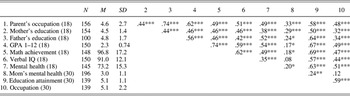
Correlations were first calculated between all of the study variables (see Table 1 for correlations and descriptive statistics). These correlations indicate strong associations between almost all of the study variables. As expected, each of the family SES variables and each of the academic competence variables were significantly correlated with both educational attainment and occupational attainment (p < .001). In addition, offspring adolescent mental health was significantly correlated with both educational and occupational attainment (p < .001), and educational attainment was significantly correlated with occupational attainment (p < .001). Finally, early maternal mental health was correlated with offspring educational attainment (p < .01), but it was not directly related to occupational attainment.
Intercorrelations, means, and standard deviations of the model variables

*p < .05. **p < .01. ***p < .001.
Parental educational and occupational attainment scores were then compared with offspring educational and occupational attainment scores using t tests. When offspring were age 18, mothers in this sample reported a mean education level of 4.5 (SD = 1.4), whereas fathers had a mean education level of 4.8 (SD = 1.7). A score of 4 corresponds to attainment of a high school diploma, and a score of 5 corresponds to some college or specialized school experience. The full range of parent education levels was present in this sample. Offspring at age 30 reported a mean education level of 5.1 (SD = 1.1). Scores ranged from 3 to 7. We compared parent education at age 18 (an average of mothers' education and fathers' education) to offspring education at age 30 and found a significant difference, t (137) = 5.36, p < .001, with offspring attaining more education than their parents.
When offspring were age 18, their parents' average head of household's occupation was a score of 4.6 (SD = 2.7), which corresponds to skilled workers or semiprofessionals. Offspring at age 30 reported a mean occupation score of 5.1 (SD = 2.2), which corresponds to semiprofessionals. The full range of both parent occupations at age 18 and offspring occupations at age 30 were present in this sample. The difference in means between parents' occupation and offspring's occupation was not significant, t (137) = 0.96, p = .339.
Primary analyses
Structural equation modeling (SEM) was used for our primary analyses in this study. Statistical rules of thumb for SEM analyses are that sample sizes exceed 100 cases (Hoyle, Reference Hoyle1995), there should be at least 10 to 20 times as many cases as variables in the model (Mitchell, Reference Mitchell, Schneider and Gurevitch1993), and there should be at least 15 cases per measured variable or indicator (Stevens, Reference Stevens, Grimm and Yarnell1996). Although our sample size for this study was relatively small, it meets these three recommendations and was sufficient for estimating the relatively simple models that we tested.
Missing data were handled using full information maximum likelihood methods. These procedures have been found to yield the least biased estimates when all available data are used for longitudinal analyses (vs. listwise deletion of missing data; Enders, Reference Enders2001; Raykov, Reference Raykov2005). Thus, the full sample of participants whose mothers provided mental health data at 30 months was utilized for these analyses. This full sample provides the best possible variance/covariance estimates and was least likely to be biased by missing data. Alternative longitudinal analyses using just those participants without missing data (i.e., listwise deletion) yielded results that were substantially identical to those reported below.
The gap between the observed and the estimated covariance matrix, which was produced according to the specified models, was used by the program to compute goodness of fit indices that help determine the extent to which the conceptual model provides an acceptable representation of the data. We relied on the widely used goodness of fit indices known as the normed fit index, the Tucker–Lewis index, and the comparative fit index to indicate the extent of fit. A value of 0.90 and higher was regarded as indication of a good fit of the model. In addition, we used the root mean square error of approximation misfit index and its recommended value of 0.06 or lower (Hu & Bentler, Reference Hu and Bentler1999) to indicate acceptable fit.
Model predicting educational and occupational attainment
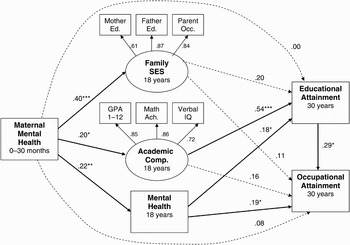
The primary aim of this study was to examine the relative contributions of parental and offspring mental health to offspring educational and occupational attainment in adulthood. Specifically, the goal was to examine whether earlier mental health contributes to later socioeconomic attainment with the more established predictors of academic competence and family SES controlled for. In order to test this research question, a comprehensive model was tested that included the variables of maternal mental health in early childhood, family SES, academic achievement, and offspring mental health in adolescence, and offspring educational and occupational attainment at age 30 (Figure 1).
Structural equation model depicting relations between maternal mental health in early childhood, family socioeconomic status (SES), offspring academic competence, and offspring mental health in adolescence, and offspring educational and occupational attainment in adulthood. The values along the paths are standardized regression coefficients (βs). Covariances between family SES, academic competence, and adolescent mental health are all statistically significant but are not depicted for lack of space, χ2 (24, n = 196) = 46.49, p = .004 (normed fit index = 0.937, Tucker–Lewis index = 0.925, comparative fit index = 0.967, and root mean square error of approximation = 0.053). The dotted lines indicate statistically nonsignificant paths.

Based on an extensive research literature and preliminary correlation analyses, direct pathways were drawn from family SES in adolescence to offspring educational and occupational attainment in adulthood, as well as from offspring academic competence in adolescence to their own educational and occupational attainment in adulthood. Based on the primary hypothesis of this study, direct pathways were also drawn from offspring mental health in adolescence to offspring educational and occupational attainment in adulthood. Because possible associations between maternal mental health in early childhood and offspring educational and occupational attainment at age 30 could be either direct or mediated by the adolescent variables of family SES, offspring academic achievement, and offspring mental health, each of these pathways was tested in the model. Finally, because educational attainment was hypothesized to predict occupational attainment, this pathway was also included and tested.
Results show that the model in Figure 1 fits the data well, χ2 (24, n = 196) = 46.49, p = .004 (normed fit index = 0.937, Tucker–Lewis index = 0.925, comparative fit index = 0.967, and root mean square error of approximation = 0.053). Each hypothesis and its corresponding individual pathways are discussed below.
Hypothesis 1 was that family SES and offspring academic competence in adolescence would be associated with offspring educational and occupational attainment in adulthood. Although the correlations between family SES and academic competence and educational and occupational attainment were all significant (p < .001), Hypothesis 1 was only partially supported by results from the structural equation model. As can be seen in Figure 1, the direct pathways from family SES to educational attainment (β = 0.20, p = .132) and from family SES to occupational attainment (β = 0.11, p = .521) were not significant. The pathway from academic competence to educational attainment was significant (β = 0.54, p < .001), as individuals with higher GPAs and higher IQ scores in adolescence attained more years of education by age 30. The direct pathway from academic competence to occupational attainment was also not significant (β = 0.16, p = .340). However, because the pathway from educational attainment to occupational attainment was significant in this model (β = 0.29, p < .05), together these results suggest that offspring academic competence influences occupational attainment indirectly through its effects on educational attainment.
Hypothesis 2 was that, controlling for family SES and academic competence, offspring mental health in adolescence would also be related to offspring educational and occupational attainment in adulthood. This hypothesis was fully supported. As can be seen in Figure 1, both the pathways from mental health at age 18 to educational attainment at age 30 (β = 0.18, p < .05) and from mental health at age 18 to occupational attainment at age 30 (β = 0.19, p < .05) were significant. In other words, participants with better mental health in adolescence attained more years of education by adulthood, and also had more prestigious occupations at age 30.
Hypothesis 3 was that parental mental health during early childhood would be related to offspring SES in adulthood either directly, or through its associations with adolescent family SES, offspring mental health, and offspring academic competence. Results from this study lend support to indirect associations between early maternal mental health and offspring adult educational and occupational attainment. As can be seen in Figure 1, direct pathways from early maternal mental health to offspring adult educational attainment (β = 0.00, p = .998) and from early maternal mental health to offspring adult occupational attainment (β = 0.08, p = .330) were not significant. However, pathways from early maternal mental health to adolescent academic competence (β = 0.20, p < .05), family SES (β = 0.40, p < .001), and mental health (β = 0.22, p < .01) were all significant. Thus, mothers with better mental health during their children's first years of life are part of higher SES families and have children who achieve better grades and have better mental health in adolescence. The adolescent variables of academic competence and offspring mental health then go on to predict offspring's educational and occupational attainment in adulthood. A formal test of mediation was also conducted using MacKinnon, Lockwood, and Hoffman's (Reference MacKinnon, Lockwood and Hoffman2002) method for SEM, and results were that academic achievement and offspring mental health fully mediated the significant relation found between maternal mental health and offspring educational attainment.
Post hoc analyses
Our first set of post hoc analyses examined possible gender differences in the associations found within our model. An omnibus test of mean gender differences was conducted using a multivariate analysis of variance. The results of this analysis were that there were no gender differences in our study variables (Hotelling trace = 0.178), F (10, 70) = 1.24, p = .279. Multiple group analyses were then conducted in SEM to determine whether our model in Figure 1 fit equally well for males and females in our sample. In these analyses, one model was run in which all parameters were constrained to be equal for males and females, and a second model was run in which these parameters were allowed to be freely estimated (Vandenberg, Reference Vandenberg2002). Results from the model comparison (χ2 = 15.63, df = 12, p = .209) were that imposing the additional restrictions of equal factor loadings across the two sexes of participants did not result in a statistically significant worsening of overall model fit. Thus, we can conclude that our original model tested in our primary analyses fit equally well for males and females in our sample.
Because IQ and school achievement are related but distinct constructs (Greven, Harlaar, Kovas, Charmorro-Premuzie, & Plomin, Reference Greven, Harlaar, Kovas, Chamorro-Premuzie and Plomin2009), our second set of post hoc analyses was designed to examine whether IQ and GPA operate differently in our model. For these analyses, two separate structural equation models were tested. The first was identical to Figure 1 but only included verbal IQ as a measure of academic achievement, whereas the second was identical to Figure 1 but only included GPA. Both models had similar overall fits to the complete model described above. There was only one difference found between the IQ model and the GPA model and between each of these models and the complete model including both IQ and school achievement. In the IQ model, maternal mental health was not related to offspring IQ in adolescence, whereas maternal mental health was related to both school achievement in the GPA model and academic competence in the complete model. All other associations were of the same magnitude and significance. These results, along with results of our correlational analyses, support our use of both IQ and academic achievement as indicators of a single construct in our model.
Discussion
The primary purpose of this study was to investigate potential pathways to socioeconomic attainment in adulthood. A large body of literature focuses on the significant contributions of academic competence and family SES to occupational attainment, yet it is clear that a large portion of the variance in occupational attainment is left unexplained by examining the influence of only these two variables. Mental health is one variable that has received little attention in the status attainment literature to date. Although mental health is inarguably important to adolescent and adult functioning, the questions of whether or not earlier mental health directly predicts later occupational and educational outcomes, as well as how this contribution might compare to the more studied predictors of academic competence and family SES, to our knowledge have not been asked prior to the current study. Furthermore, although parental mental health has been found to impact children in a number of ways, the question of whether early parental mental health has direct or indirect influences on children's adult socioeconomic attainment has not been addressed to date.
The primary analyses of this study tested pathways from earlier maternal mental health, offspring mental health, family SES, and academic competence to offspring educational and occupational attainment in adulthood. In our model, the pathway from academic competence to educational attainment was significant, suggesting that adolescents with better grades and higher IQ scores achieved more years of education by age 30. In addition, the pathway from educational attainment by age 30 to occupational attainment at age 30 was significant. The direct pathway between academic competence and occupational attainment was not significant, which is in keeping with a number of past research studies that have found the path leading from academic competence to occupational attainment to be at least partially mediated by educational attainment (Ceci, Reference Ceci1991; Jencks et al., Reference Jencks, Smith, Acland, Bane, Cohen and Gintis1972). It was somewhat surprising that the pathways from family SES to educational attainment and from family SES to occupational attainment were not significant in this model.
The main finding of this study was that adolescent mental health significantly predicted both adult educational and occupational attainment, even with the predictors of academic competence and family SES in the model. In this model, adolescent mental health emerged as an even stronger predictor of adult SES than family SES in adolescence. Moreover, maternal mental health during children's first few years of life was found to be indirectly related to offspring's socioeconomic attainment in adulthood. In our model, maternal mental health significantly predicted offspring's 18-year family SES, academic competence, and mental health. It is not surprising that maternal mental health in general is related to these variables; however, it is notable that maternal mental health measured during children's first years of life predicts their performance in school and their own mental health 18 years later. Direct pathways between maternal mental health and offspring socioeconomic attainment were not significant. Thus, although early maternal mental health is important to offspring's adult functioning, offspring's individual characteristics in adolescence, particularly their mental health, still play a very important role in predicting their later socioeconomic attainment.
Given the emphasis that has been placed on the importance of family SES to predicting status attainment in adulthood (Corwyn & Bradley, Reference Corwyn and Bradley2002; Duncan, Brooks-Gunn, & Klebanov, Reference Duncan, Brooks-Gunn and Klebanov1994) and that significant correlations were found in our data set between family SES and offspring socioeconomic attainment, we know that parental education and occupation are important to predicting offspring's occupational and educational attainment in adulthood. However, it is possible that mental health of offspring is even more important in predicting their socioeconomic attainment. It is also possible that, in general, family SES exerts more of an influence on individuals early in life, for example, by impacting grades in school. By the age of 18 when individuals finish high school, trajectories influenced by SES may already be set. Therefore, pathways between 18-year SES and adult education and occupation will not be as strong, especially when taking into account more proximal variables such as academic competence and mental health.
There are many avenues through which adolescent mental health might influence adult SES. Overall, adolescents with mental health problems may have trouble negotiating the transition from adolescence to adulthood, and may therefore fall behind their well-functioning peers in preparing for adult roles and responsibilities (Schulenberg & Zarrett, Reference Schulenberg, Zarrett, Arnett and Tanner2006). This could have implications for attaining higher levels of education or securing a job. Our findings suggest that mental health problems may influence an individual's ability to remain in school, as significant links were found between adolescent mental health and educational attainment by adulthood. Another possibility that is not addressed in the current study is that mental health problems in adolescence could lead to high levels of risk taking or delinquent behaviors across emerging adulthood, which could then affect the jobs that these individuals are able to attain at the end of this period.
There are several limitations to this study that must be acknowledged when interpreting these results. First, as discussed earlier, although the sample size in this study was sufficient for running our structural models, the overall sample size was not large. Participants were part of a longitudinal study that they had entered into at birth, and although analyses indicated that a great deal of variability was present in all key variables at each time point in this study, attrition was an issue of concern.
Second and related to this issue, because this was a study of the effects of mental health on socioeconomic attainment, it would have been desirable to analyze the impact of different psychiatric diagnoses or symptoms on educational and occupational attainment. Examining individual diagnoses was not possible in the current study because of the small sample size and the need to include the variables of family SES and academic competence in the structural model. However, because our measure of general mental health functioning was highly correlated with our measures of individual diagnoses and symptoms, and because diagnoses are known to operate through more general levels of functioning, we are confident that mental health was adequately represented in this study.
Third, another limitation is that some studies in the status attainment literature use income as an additional measure of family SES, which we did not have a measure of in the current study. However, because income has been found to be highly correlated with both education and occupation (Ceci & Williams, Reference Ceci and Williams1997; Strenze, Reference Strenze2007) and because many other studies successfully used parent education and parent occupation as sole measures of family SES (e.g., Deary et al., Reference Deary, Taylor, Hart, Wilson, Smith and Blane2005; Luster & McAdoo, Reference Luster and McAdoo1996), we feel confident that family SES was accurately accounted for in this study.
Fourth, as mentioned throughout this paper, the sample used in this study was recruited with an overrepresentation of maternal psychopathology. Although we attempted to control for maternal psychopathology in our final analyses by including it as a variable in our model and the majority of children in this study scored in the average range on our mental health measures in adolescence and adulthood, note that these findings may not be generalizable to other populations. We instead view this study as a first step in a line of research that suggests the importance of including both individual and parental mental health along with the more established predictors of academic competence and family SES when examining adult socioeconomic attainment.
The results from this study can be used to identify several possible intervention strategies. Conclusions drawn from the more traditional status attainment models were often based on the idea that improving academic achievement would put children on a course toward more successful jobs in adulthood. From our own research it appears that another pathway to foster occupational success in adulthood is to improve mental health in late adolescence. Because mental health has been found to be stable from adolescence to adulthood (Schulenberg & Zarrett, Reference Schulenberg, Zarrett, Arnett and Tanner2006), by alleviating mental health problems in adolescents we may be able to not only lower their chances of having mental health problems in adulthood but also improve their chances of educational and occupational success years later. Although possible influences of family SES and academic competence should not be overlooked, this research supports the idea that the end of adolescence may be an especially important period in which to focus on mental health and its consequences for later functioning. In addition, these results highlight the importance of maternal mental health to child functioning and suggest that maternal mental health measured even at the earliest point in a child's life may have consequences for children's outcomes decades later. Interventions focused on alleviating these early maternal mental health problems are thus crucial and may help to impede negative trajectories of functioning that can extend into adolescence and adulthood.
Conclusion
In conclusion, these results suggest that mental health in adolescence is an important predictor of educational and occupational outcomes 12 years later. Mental health, a variable that has received little attention in the status attainment literature, was significantly related to educational and occupational attainment in our model, even with the more established predictors of academic achievement, IQ scores, and family SES included and accounted for. Previous research has emphasized that academic competence and family SES alone do not explain all of the variance in occupational attainment, and our results suggest that adolescent mental health is one additional construct that is important to adult socioeconomic outcomes.
These results thus support the notion that occupational status is multidetermined. Individuals must be regarded as totalities, with cognitive functioning, environmental influences, and emotional health all contributing in some measure to occupational attainment in adulthood. Although emotional health has been largely ignored in the status attainment literature, this is a construct that may be particularly important for predicting success across the developmental transition from adolescence to adulthood.