Introduction
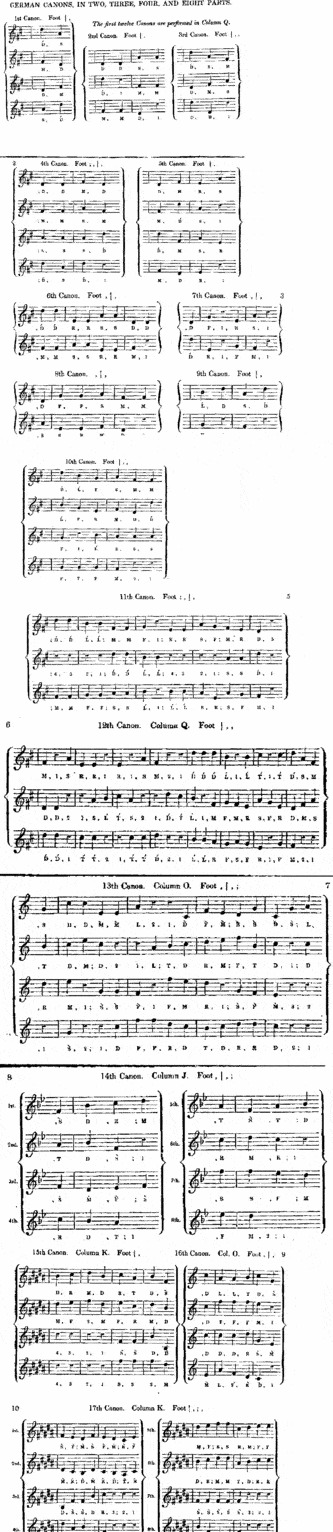
In 1998, Derek Hyde, discussing The German Canons (1834), the first publication of Sarah Anna Glover (1786–1867), asked in a footnote ‘Why German? There is nothing particularly Germanic about them, consisting as they do of canons based on the tonic triad’ (Hyde, Reference HYDE1998: 138) (See Fig. 1). There were two reasons for Glover's title, the first general and the second specific, which will be discussed later. In the first decades of the 19th century, among writers on music education in England there was a widely held belief that school music in Germany and Prussia was far superior to that in the fledgling parish and charitable schools of England. Further, it was seen as imperative that class music instruction in England be improved so that it might aid congregational psalmody and instruction. John Hullah (1812–1884) noted that vocal music was an important element in civilisation and recommended that, in public worship, the congregations in England should unite in singing as did those in the Lutheran churches in Germany and Holland. The great impediment to ‘introducing a more general cultivation of vocal music among the lower orders in Great Britain has been the want of a method of instruction . . . [and] of vocal music in elementary schools’ (Hullah, Reference HULLAH1849: iv).
English calls to improve psalmody
Many early 19th century writers cited the pronouncements of Bishop Beilby Porteus (1731–1808) on contemporary psalmody and confirmed a consensus between members of the clergy that the situation was dire (Cole, Reference COLE1819; Kennedy, Reference KENNEDY1821; Snooke, Reference SNOOKE1827). Cunningham (Reference CUNNINGHAM1824) stated that, ‘It is to be lamented, however, that a part of Divine Worship . . . should be degraded by the manner in which it is commonly performed’ (Preface). Hodgson (Reference HODGSON1811) quoted directly from Porteus: ‘Of all the Services of our Church, none appear to me to have sunk to so low an ebb, or so evidently to need reform, as our parochial psalmody . . . I therefore thought it highly necessary . . . to bring back our psalmody to its antient [sic] purity and simplicity’ (p. 108–109). Even then, this was not a new problem. Gibson (Reference GIBSON1811) cited directions to the clergy, given nearly a century earlier by the then Bishop of London, Edmund, concerning the singing of psalms. Gibson considered that the contemporary performance of psalmody was both shocking and indecent. To counter this he wished that ‘the People of the Parish, and especially the Youth, were trained up and accustomed to one orderly Way of singing some of the Psalm-Tunes’ (Gibson, Reference GIBSON1811: 3). A little later, John Turner (dates unknown) cited Archbishop Secker (1693–1768) who recommended ‘encouraging youth to learn psalmody’ (Turner, Reference TURNER1841: 22). In 1821, Kennedy, despite the pronouncements of Porteus and the others, lamented ‘the still humble condition of sight-singing in our churches’ (p. 25) after more than a century of comments about the issue. Cole (Reference COLE1819) noted that generally so little attention was given to the manner in which psalmody was conducted that ultimately the ‘institution [was] defeated’ (p. 2). These writers are representative of a wide discussion of the perceivedly parlous state of church psalmody and sight singing but, despite much lamenting, few specific solutions were offered.
English music educators used the arguments of members of the clergy to introduce their texts. Turner (1833), the author of the first English language school music textbook, cited Archbishop Secker and mentioned Porteus's suggestion that a few children with the best voices and the best ears for music should be taught to sing well and in parts so that they might lead the rest of the congregation. Porteus did not specify a pedagogical approach but advocated the benefits and delights of class instruction in singing. The bishop acknowledged that such efforts had already been successfully undertaken in several parishes, notably those with Sunday Schools. Apparently, solutions had been found, but these had initially been located abroad.
Continental models
At that time, music education in Germany and Prussia was considered far superior to that in the developing charitable schools of England. In one British journal, Charon (Reference CHARON1821: 283) asserted that: ‘The cultivation of music is astonishing in Germany; even in the smallest charity schools music is publicly taught; no schoolmaster is allowed to exercise his profession unless he is able to teach the elements of this art and some instruments’. In the first decades of the 19th century ‘music became a compulsory subject in German schools’ (Kertz-Welzel, Reference KERTZ-WELZEL2004: 13). Singing was intended to assist in the development of the individual as well as support the aims of state and church. In Prussia, philosopher Wilhelm von Humboldt (1767–1835), the minister of education from 1809 to 1810, noted the influence of music on the development of character.
Several decades later, the German model was still cited as a demonstrable success worthy of emulation. In 1841 Joseph Mainzer (1801–1851) stated that ‘In Germany singing forms an essential part of a good education . . . it is also considered the most efficacious and indispensable means for improving the morals, and developing the taste and understanding of all classes’ (Mainzer, Reference MAINZER1841: xxi). Earlier, in 1833, Turner noted that, ‘In many parts of Germany, in the Tyrol, and in the German cantons of Switzerland, vocal music is almost universally cultivated. Under the sanction of the governments of these states . . . it forms a part of every regular system of education; and in schools more especially designed for general instruction, it ranks next to the Bible in importance’ (Turner, 1833: 30). Turner also specifically mentioned the methods of Pestalozzi and the Reports of the Schools of Industry at Hofwyl. William Hickson (1803–1870), in the preface to The Singing Master (1839), asserted that, ‘In Prussian and the German States, singing is now taught in all the schools. Indeed a knowledge of music is, there, one of the essential qualifications required of every candidate for the profession of a school master’ (Hickson, Reference HICKSON1836, Reference HICKSON1839: 3). When they became available, German music education materials were received with interest in England. In the 1820s, some of Carl Gläser's school music materials reached England.
Carl Gotthelf Gläser (1784–1829)
Gläser was born on 4 May 1784, in Weissenfels, Germany. His first teacher was his father, Carl Ludwig Trangott Gläser (1747–1824), a composer of much church and instrumental music, who was director of music at a seminary in Weissenfels (A Dictionary of Musicians, 1824). Later Gläser studied at the Saint Thomas School, Leipzig, under Johan Adam Hiller and August Eberhard Muller, who taught him the pianoforte, and Campagnoli, who taught him the violin. In 1801 Gläser began the study of law, but this was abandoned in favour of music. In 1817 he moved to Barmen, where he spent the remainder of his years as a choral music director and a teacher of pianoforte, violin and voice. In Barmen Gläser founded a women's choir and opened a music shop, which he maintained until his death on 16 April 1829. Gläser composed many works, including motets (Motetten und Arien auf alle Kirchenfeste [Motets and airs for all church festivals], circa 1824) and instrumental music for guitar, voice and keyboard instruments (Gläser, Reference GLÄSER1826b). A number of his texts were instructional, including Neue Praktische Klavierschule [New practical piano school] (1817); Kurze Anweisung zum Choralspiel [Brief instruction on chorale playing] (1824); Vereinfachter und kurz gefaβter Unterricht in der Theorie der Tonsetzkunst mittels eines musikalischen Kompasses [Simplified and brief instruction in the theory of the art of composition by means of a musical compass] (1828) (Gurlitt, Reference GURLITT1959). Yet other texts were designed for use in schools, such as Liederbuch für Schulen, zum frühesten Unterricht im Singen [Songbook for schools, for the earliest instruction in singing] (circa 1824); Melodienbuch dazu [Melody book for it] (circa 1824); Kurze Anweisung sum Singen für Volksschulen [Short Introduction to Singing for Schools] (circa 1824); 17 Musikalische Bandtafeln, nach Natorps Methode entworfen [17 musical posterboards, . . .] (circa 1824); Musikalische Schulgesangbuch, methodisch geordnet nach Natorps unterweisung im Singen in zwei kursen [Musical School Song Book, methodically organised following Natorp's guidance in Instructions for Teaching Singing in two volumes] (circa 1824) (Weir, Reference TURNER1938; Lightwood, Reference LIGHTWOOD1950).Footnote 1 The last of these texts, a two-volume collection of school songs, was surprisingly influential in England.
Gläser's Musikalisches Schulgesangbuch (1826)
As indicated in the full title, Gläser's Musikalisches Schulgesangbuch methodisch geordnet nach Natorps anleitung zur Unterweisung im Singen in zwei Kursen was based on the Anleitung zur Unterweisung im Singen [Guidance in Instructions for Teaching Singing] by Bernard Christian Ludwig Natorp (1774–1846) that was first published in 1813 (Natorp, Reference NATORP1824). This text was a methodical introduction to musical theory and vocal instruction for the class music teachers that cited Rousseau's Projet concernant de nouveaux signes pour la musique. Lu par l'auteur à l'academie des sciences le 22. Aout 1742’ (Natorp, Reference NATORP1824). These instructions, in two volumes, employed both traditional notation and a comprehensive cipher notation that could represent considerable musical complexity. The intervals were introduced with vocal exercises in the order of the octave, perfect 5th, major 3rd, major 2nd, perfect 4th, major 6th and major 7th. The exercises were, from the outset, realisable in harmony, first in two parts, then three, then four. They were sung to numbers (to reinforce the intervals), to ‘la’, to solfa syllables and to simple religious texts. There were no canons included in either volume (Natorp, Reference NATORP1824). Natorp's text was widely used in the Ruhr (Rainbow, Reference RAINBOW1989).
The only located copy of Gläser's Musikalisches Schulgesangbuch is held by the British Library. This is the second edition (1826) and the name ‘Christiana Glover’ is inscribed on the title page. Christiana was the sister and life-long companion of Sarah Anna Glover (1786–1867). Also on the text is the name Langton Brown, Sarah and Christiana's nephew by marriage who inherited their library. The book was still in the possession of the Glover sisters in 1854 as there is a pencil note on the text: ‘Lent to Mr H Rudd till March 25 1854’. Sarah Glover must have been aware of the book from the 1830s. The two volumes of the Musikalisches Schulgesangbuch are bound together. All music in the text is given in traditional notation. There is no evidence that Glover was familiar with any other texts by Gläser, although the Evangelisches Choral Melodienbuch enthaltend 140 Choralmelodien (1826) is also held by the British Library but this was not intended for class music instruction.
The introduction to the enlarged and improved Musikalisches Schulgesangbuch (1826a) explained that the two volumes of school songs were to be used in conjunction with Gläser's Kurze Anweisung sum Singen. There is no evidence that this text reached England. Gläser suggested that the songs were examples only and should be taught as part of methodical instruction. However, the songs alone proved to be very influential. In Germany at this time learning songs was the main intention of music education. Commonly, theoretical knowledge was only included insofar as it supported the teaching of songs (Kertz-Welzel, Reference KERTZ-WELZEL2004). This was the intention of the text prepared by Michael Traugott Pfeiffer (1746–1827) and Hans Georg Nägeli (1773–1836), Gesangbildungslehre (1810), that applied Pestalozzi's methods to the teaching of singing. Following a very detailed introduction to music theory with illustrative exercises, there was a collection of unison and part songs which progressed from simply singing up and down a major scale to complex three-part songs (SAT). Only the earliest theoretical explanations use a simple numeric notation, and there is neither solmisation nor canons (Pfeiffer & Nägeli, Reference PFEIFFER and NÄGELI1810). This book had a wide circulation and was adopted in many German schools (Rainbow, Reference RAINBOW1989).
Gläser had formulated a set of didactic materials to support music learning. In the introduction to the songs, he recommended the use of large posterboard versions of some of the songs that could be displayed so that the children might be able to see the songs and fix them in their memory. The boards were available for purchase. In the second edition Gläser (1826a) had ‘changed the melodies and harmonies based on my own experience and to the best of my ability’ (p. v).Footnote 2 Gläser had also improved the poetry ‘of our excellent Krummacher’ and added a new four-part composition to the words of ‘Our Father’ by Klopstock which could be performed by a full choir. In the second volume of the Musikalisches Schulgesangbuch Gläser explained that, if the first volume had seemed to concentrate on musical notes, the second focused on expression. He believed that ‘correct singing divorced from terrific performances is simply not enough’ for which reason he beseeched teachers to explain frequently and clearly about the meaning of the words that should be taken very seriously. Gläser pointed out that he had included some songs in minor keys that could be used as teaching examples to explore the differences between major and minor tonalities. He also emphasised the importance of singing the semitones in the chromatic scale and stated that teachers should draw the attention of children to the differences between major and minor thirds. Gläser managed to include teaching advice in the short introductions to the song collections. What was unusual, possibly unique, in the Musikalisches Schulgesangbuch (1826a) was the inclusion of two sets of didactic canons.
The first volume of the Musikalisches Schulgesangbuch (1826a) contained 17 short canons designed to lead students from basic to more complex musical ideas, introducing the degrees of the scale. All the canons were in C major and use two, three and four beats per bar. All use only crotchets or crotchet rests. The first four canons used the tones doh, me and soh. Canons 5 to 7 added re, Canon 8 included fah, Canon 9 incorporated lah, and Canon 12 added te, thus following Natorp's progression. The remainder of the Canons used all the degrees of the diatonic scale. The first 12 remained within the octave C to C1. The remainder gradually extend the tessitura to reach, in Canon 17, from B1 to G1. All the canons had religious texts, for example, the first canon is Kinder, singet Halleluja (Gläser, Reference GLÄSER1826a). Following the canons, the songs range from two to eight parts. There are several rounds. The texts are more varied but remain moralistic, encouraging children to study and behave well. There are no unison songs in the collection. Volume I contains sections of two-, three-, and four-part songs and a number of rounds. The same design is followed in Volume II. The set of 16 canons are rhythmically more complex and intended to be a development of the first set. The first two are sung to the letter names of the notes but the remainder return to religious and moralistic texts. Canon 2 introduces G# and the tonality of A minor. Canons 6 to 11 are in G major, although Glover has added the key signature to Canon 8 as it was omitted by Gläser. This canon also modulates to D major in the middle, with the accidental C# used twice. More keys are introduced – Canon 13 is in E major and the rest are in F major. Following the canons there were six Tagliche Uebungen [Daily exercises] which included long notes with crescendo and diminuendo, and singing up and down the major and chromatic scales. The remainder of the volume contains two, three and four part songs and exercises. Gläser included chorales in three parts, some of which were taken from Natorp (1824). Gläser included songs in minor keys to ensure that children clearly recognised the difference between major and minor tonalities.
The Canons are a carefully sequenced set of teaching exercises that, in the first set, introduced the degrees of the diatonic scale, simple time signatures and, when sung in parts, introduced intervals and harmonies necessary for the songs. The second set added chromatic intervals, additional key signatures and time signatures, and greater rhythmic complexity. Both the canons themselves and the underlying pedagogical practices used by Gläser were influential in England and seem to be the first purpose-written didactic music exercises included in school music materials. Glover had made occasional notes in her two volumes of the Musikalisches Schulgesangbuch. For example, in the first volume, Glover added solmisation initials under notes and commented above a rather chromatic exercise (Gläser 1826: 63) that, ‘This second was solfa [sic] by ear without a mistake’. But it is the subsequent use Glover and then others made of Gläser's materials that demonstrates their influence.
Sarah Anna Glover (1786–1867)
Sarah Anna Glover (1786–1867) was the eldest of four girls, the daughters of Reverend Edward Glover and his wife Christiana. All the girls had been raised to contribute to a desired betterment of society, primarily by the education of the poor and working classes via charity and parish schools. Glover was well-educated and had, from an early age, received instruction in music. She made it her particular quest to improve congregational singing and psalmody and spent many years devising her system, citing Bishop Porteus and stating that the ‘low state of psalmody . . . is I believe, a fact generally acknowledged and frequently lamented’ (Glover, Reference GLOVER1835: 5). In 1812 she began her educational experiments that culminated in two publications: German Canons or Singing Exercises and Psalm Tunes Expressed in the Sol-fa Notation of Music (1834) and Scheme for Rendering Psalmody Congregational (1835). In neither text did Glover mention Gläser or the Musikalisches Schulgesangbuch (Gläser, Reference GLÄSER1826a). Both Glover's texts were published a number of times over the next two decades with slight variations in content and title. The first edition of German Canons (1834) was printed in Glover's original Norwich Sol-fa notation but, in 1838, she also included the canons in the more lavishly printed Guide to Sol-fa-ing; Containing German Canons, also Psalm Tunes according to all measures employed by Brady and Tate (Glover, Reference GLOVER1838) which was solely in staff notation. The specific answer to Hyde's (1998) question about the ‘German’ nature of the material is that the canons were taken directly from Gläser's Musikalisches Schulgesangbuch. In the Scheme for Rendering Psalmody Congregational (1835) Glover referred to the German Canons that were intended as ‘a set of progressive lessons for teaching intervals, if sung merely in unison; but, when performed in parts, exercise the pupils likewise in harmony’ (Glover, Reference GLOVER1835: 9) (See Fig. 1).
The German Canons (Glover, Reference GLOVER1838: 1–10)

Glover's charity school was organised according to the principles of the monitorial system in which older pupils helped teach younger ones. In her very pragmatic Scheme for Rendering Psalmody Congregational (1835) Glover provided detailed instructions for teaching the canons, starting with the first. Initially the teacher taught a small group of the children who would become the leaders of the remainder. She instructed the teacher to point to the notes on the table of tune [a form of modulator using her unique notational system] then dictate half of the canon, asking the children to imitate her. This process was repeated with the second half. Once learnt, the students were to be introduced to the notation in their printed tune-books. Each child should have a copy of the book. Once read, the canon should be sung by the whole class in unison with ‘each child pointing to the note she sings; when the pupils are capable of performing it well alone, the instructress may add a second part softly, with the syllable ah then louder with the Sol-fa syllables, afterwards she may divide the pupils into two companies and after dictating the leading notes to the two companies in succession, sing a third part herself, and so on till all the four parts are distributed amongst four companies; one girl in each company should beat time as soon as it is the turn for her company to begin’ (Glover, Reference GLOVER1835: 46–7). After four or five canons had been learnt, the class of leaders were to return to the school-room and assist the rest of the children. Once learnt by all, the whole school should sing the first Canon in unison. As soon as this was perfect, nine leaders were chosen – one to point to the notation, the others to lead the various sections of the school in their respective parts. Glover (Reference GLOVER1835) continued, stating that the first 12 canons included all the intervals of the doh mode or major scale. Once these had been learnt the pupils should sing up and down the diatonic scale and the teacher might add thirds and sixths above or below the notes.
John Curwen (1816–1880) provided an eyewitness account of Glover's school in Norwich when he visited in 1841:
The plan of procedure was in this wise; – supposing them about to sing the 14th canon, which is in eight parts, the teacher steps into the middle of the circle and announces ‘fourteenth canon.’ Immediately all find the place. “Eight leaders.” Immediately eight children hold up their wands [small baton], dividing the class into equal portions, so that each child may know which leader she is to follow. The chord of the key note is then struck on a glass harmonicon [a glass glockenspiel developed by Glover]. . . and the canon begins. When the first division has sung the first measure, the monitor of the next division, giving a glance at those under her, which means, “follow me,” takes up the strain – beating time upon the book-holder and her arm. The rest of the division marked the time by touching, with their wands, the accent marks in their books. Thus round the class the growing harmony proceeds, until it swells out in the fullest chorus. Turning round we observed that the children on the gallery, by the help of the monitor and the musical ladder, were joining in the melody (Curwen, Reference CURWEN1842c: 216).
Glover did not mention the source of the canons in either German Canons (1834) or Scheme for Rendering Psalmody Congregational (1835). However, from the early 1840s Glover advertised, in the various editions of her texts, a ‘Packet of Duetts, Trios & c. in the Sol-fa Notation of Music’ that were school songs printed individually on single sheets of usually coloured paper that could be purchased in bulk and sold to students at one penny per song. Enough were printed that the children could buy a new song a month for more than a year. One packet containing all 13 songs cost one shilling. All were published by Jarrold and Sons, Norwich. Students could build up a repertoire of songs, not necessarily sacred but all deemed appropriate and moral. The earliest list included ‘Welcome Spring’, ‘Wild Flowers’, ‘The Sun’, ‘The Moon’, ‘Christmas Carol’, ‘Christmas Hymn’, ‘Pastor's Call’, ‘National Anthem’, ‘23rd Psalm’, ‘Christmas Salutation’, ‘Joy’, ‘Nightingale’, ‘Christmas Chant’. Later several more were added: ‘Before the Examination’, ‘After the Examination’ and ‘The Bees’. A number of these were from the same source as the German canons – Gläser's Musikalisches Schulgesangbuch (1826a) and Glover stated this on each song. Available in 1842, ‘Joy’, ‘a German roundelay’, was actually published as a leaflet as it was more extensive and slightly more expensive at two pence. A version in traditional notation was also available for purchase at one shilling and sixpence. Glover's new notation which used only letters and punctuation marks made her songs much more accessible. ‘Joy’ was a transcription of Gläser's ‘Freudenlied’ (Gläser, Reference GLÄSER1826a, I: 11). The rest of the songs were published one or two to a sheet. ‘The Wild Flowers’ was originally ‘Lied im Freien’ [In the open air] (Gläser, Reference GLÄSER1826a, II: 129–137) and Glover's words expressed the same ideas as Gläser's. Glover's ‘Guardian Angel’ was Gläser's ‘Die Sonne’ [The Sun] (Gläser, Reference GLÄSER1826a, I, pp. 108–109). The songs ‘Before the Examination’ and ‘After the Examination’ were also directly from Gläser – ‘Vor der Prufung’ and ‘Nach der Prufung’ respectively (Gläser, Reference GLÄSER1826a, II: 47–48, 65–7). Both songs were published under the title ‘Norwich Sol-fa System Illustrated’ and were prepared for ‘the Diocesan Girls’ Model School, Norwich’. Both were available in staff and sol-fa notation. The texts of these songs were fairly close to the Gläser's originals. It is not known who provided the translations or alternate texts – it may well have been Glover herself as existing documents demonstrate that she read French and Italian, so some ability in German was not unlikely. ‘Psalm 23’ was acknowledged as ‘arranged to a German Air’ that was Gläser's ‘Die Hoffnung’ [Hope] (Gläser, Reference GLÄSER1826a, I: 104–5).
John Turner (dates unknown)
Before Glover's German Canons (1834) appeared, John Turner had, in 1833, published A Manual of instruction in vocal music, chiefly with a view to psalmody, the first English class music text. There were two subsequent editions, in 1835 and 1841, which both had the same minor modification from the first edition. This was an additional discussion in the foreword about the importance of introducing music not only to schools for the poor but also those for the rich, both boys and girls (Turner, Reference TURNER1841). Few details of Turner's life are known. Rainbow (Reference RAINBOW and Rainbow1983) states that he was the music master at the Central School, Westminster, for many years. At the same time, he was responsible for the musical instruction at the Church of England's Teacher Training Centre that was attached to the school. Turner was also choirmaster and organist at St. Stephen's Church, St. John's Wood, London. Turner decried the contemporary degeneration of parochial psalmody and stated that, ‘it is obvious, that efforts of more than a common kind are necessary to raise and establish the art in that degree of excellence, which the service of God requires and demands’ (Turner, Reference TURNER1841: 15). Turner (Reference TURNER1841) pointed out that exhortations from clergy to improve congregational psalmody rarely gave specific suggestions about what should be done. Turner cited Porteus’ idea that a few children be trained to lead church singing. Turner pointed out that this might also be an effective strategy in Sunday and National schools and he strengthened this argument by referring to recent calls by the National Society for the training of teachers in music (Turner, Reference TURNER1841).
Turner (Reference TURNER1841) cited the German model in which ‘it is assumed, that the person who acts as teacher is capable of playing upon some musical instrument; for otherwise he is not qualified for the office he undertakes. The instruments most commonly used for the purpose of leading a class, are the German flute, the hautboy, the clarionet [sic], the violin, the pianoforte, and the organ’ (ibid.: 43). His text introduced, in a sequential manner, music theory and its notation. Catechistic questions concluded every chapter. Turner's class music method did not include purpose written exercises but encouraged the early singing of scales to the letter names of the notes. After this, scales could be sung to lah or ah. Still more advanced pupils might use the sol-fa syllables, but not too soon as ‘too many appellations will confound; it is better that the pupils be completely fixed in the habit of producing a clear tone on the syllable la, before other names are introduced’ (ibid.: 56). When used, sol-fa syllables were to be employed to reinforce the placing of semitones in scales. Turner did not return to this idea in the text although in the concluding ‘Glossorial Index’ Sol-fa-ing, Solfeggio and Solmisation were all defined as ‘an exercise for the voice in singing the scales and intervals. These several names took their rise from the use of the monosyllables, do, re, mi, fa, sol, &c.’ (Turner, Reference TURNER1841: 194). Exercises included at the conclusion illustrated each of these concepts and could be sung. Following the exercises 11 pieces were included – a Gloria, five hymns, four psalms and the National Anthem.Footnote 3 All the pieces were in three parts (SSA) in traditional notation (Turner, 1833).
As discussed, Glover first published German Canons in 1834 and Scheme for Rendering Psalmody Congregational the following year. Turner mentioned her efforts in the preface to The Class Singing-Book for Schools and Families, with Canons, Tunes and Exercises, for Practice (Turner, Reference TURNER1838). This book was for singing class pupils whereas the earlier Manual was for the teacher. Turner asserted that the Manual, having ‘been some time before the public, and, having undergone the test of experience has been found fully to answer the purpose for which it was completed. But a smaller and cheaper tract, to be placed in the hands of the scholars themselves, was still wanting; and to supply this deficiency is the object of the present work’ (Turner, Reference TURNER1838: iii). Turner repeated ideas he had first presented in the Manual concerning the ‘importance and probable effects of a more extended cultivation of vocal music’ (Turner, Reference TURNER1838: iii). Turner asserted that music was a means of promoting human happiness and that his Manual had recently been approved by the Society for Promoting Christian Knowledge and the National Society. Then Turner stated that, ‘it would be unjust to withhold the meed of praise from others who are zealously labouring in the same cause; and the Author therefore refers with great pleasure to the exertions of Miss Glover, a benevolent and talented young lady of Norwich; and to those of Mr Hickson, whose lectures, lately delivered in the metropolis, have attracted such favourable notice’ (Turner, Reference TURNER1838: iv). This flattering acknowledgement must have been well received. The ‘talented young lady’ was then 52 years old.
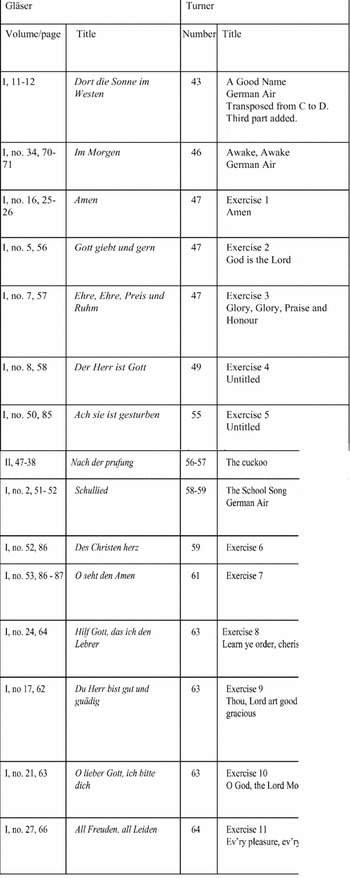
Turner chose to use short moral songs as exercises rather than the Psalms and Hymns he had used in the Manual. Turner, like Glover, argued that it was inappropriate to use sacred words for exercises as that might degrade their meaning in the minds of the young singers (Turner, Reference TURNER1838). Turner selected eight of the Canons for inclusion in The Class Singing Book. He used Canons 1 to 5 and 15 to 17. All of these were in the doh or major mode. He acknowledged that Canon 17, in eight parts, should not be taught until the class had ‘attained considerable proficiency, and until efficient leaders have been trained’ (Turner, Reference TURNER1838: viii). Turner recognised both the work of Gläser and Glover, stating that, ‘these Canons, a few of the Tunes, and all the Exercises, are selected from a German work, entitled “Musikalisches Schulgesangbuch.” In the original they are set to words; but the plan adopted by Miss Glover, of using them with the sol-fa syllables, is preferred, because it gives the pupils a better idea of the intervals’ (Turner, Reference TURNER1838: viii). Clearly, Turner had seen the texts of both Glover and Gläser. Further, Turner included exercises from Gläser's book that Glover never used. A comparison of the contents of Musikalisches Schulgesangbuch (Gläser, Reference GLÄSER1826a) and The Class Singing Book (Turner, Reference TURNER1838) reveals Turner's indebtedness (Fig. 2).
A comparison of the contents of Musikalisches Schulgesangbuch (Gläser, Reference GLÄSER1826a) and The Class Singing Book (Turner, Reference TURNER1838)

Turner (1833) pointed out that it was important for children to acquire a complete and clear understanding of the words they sing. He believed, as did all the reformers of school music at this time, that instruction in music would form an antidote to a life of idleness and vicious indulgence. He made comparison between ‘the industrious classes of our own country, where music does not prevail, [and] other countries where it does, and it will be found that the balance in point of morality is much in favour of the latter’ (ibid.: 30).
A contemporary review of Turner's The Class Singing-Book described it as a very useful little work that would provide answers to the too frequently heard ‘shocking dissonance . . . of loud bawling children, out or time, and out of tune’ (Review The Class Singing-Book, 1841: 52). Turner's works were recognised as a simple and comprehensive plan for instructing classes of children in a thorough knowledge of the scale and intervals which led from singing in unison to singing in parts employing ‘solfeggio’ and solmisation syllables ultimately enabling accurate sight singing (ibid.: 53). It was understandable that Turner, like Glover before him, would employ Gläser's canons, exercises and some of the songs as they did just what he desired.
William Edward Hickson (1803–1870)
In retrospect, Curwen identified that other music educators had influenced him besides Glover. Curwen (1875: 6) stated that, ‘I had Miss Glover's example . . . She taught from the beginning by real tunes, rather than by dry exercises. Mr Hickson did the same’. Hickson was a boot and shoe manufacturer who, upon retirement from business in 1840, gave himself to philanthropic pursuits. He was a composer and had a deep interest in musical education. In 1836 he published The Singing Master, containing Instructions for Teaching in Schools and Families. This was followed by the text of a lecture to the Sunday School Union on The Use of Singing as a Part of the Moral Discipline of Schools (1838) and subsequently Part-Singing or Vocal Harmony for Choral Societies and Home Circles (1842). Hickson also looked to Germany for a model of effective music education. He visited the Low Countries and North Germany in 1839 and published the results in the Westminster Review, a literary journal that he bought and edited, and in a book, Dutch and German Schools (Reference HICKSON1840). Hickson publicly expressed gratitude to other music educators including Glover, Hullah and Mainzer, recognising both their successes and their pedagogical differences (Scholes, Reference SCHOLES1947).
Hickson (Reference HICKSON1840: 62) asserted that, in Germany, ‘in every gymnasium, however, or high grammar school . . . we found that a singing master was considered quite as indispensable as a master for Latin and Greek’. He did criticise the pedantry he observed in some singing teachers in Germany, as he believed that music should have a ‘cheerfulizing influence’ (ibid.: 63) that could invigorate the buoyant spirits of youth and carry useful moral, rather than sacred, texts. Hickson (Reference HICKSON1839) believed that the time was coming when vocal music would be universally introduced to English schools. ‘Already in Prussia, and indeed in all the German States, a knowledge of music is a sine qua non among the qualifications required of every candidate for the profession of a schoolmaster. In the humblest village-school in Germany, and indeed very generally on the Continent, singing is taught; and in the superior schools, the master is further required to teach his pupils to play upon some musical instrument, and to instruct them in the science of Harmony or Thorough Base’ (preface).
In 1836 Hickson listed the advantages of teaching singing universally to children. Singing could vary the routine of schooling and make children happier and wiser – songs selected should ‘impress their minds with kindly feelings, and kindle or strengthen just and generous emotions more effectually than can be done by any mode of persuasion or reproof’ (Hickson, Reference HICKSON1836: 3) Teaching children to sing provided lifelong, innocent enjoyment which could wean the mind from ‘vicious and debasing pursuits’ (ibid.). To support this goal, Hickson wanted a collection of songs adapted to the comprehension and tastes of children that could be morally uplifting. He did not recommend the singing of hymns in schools as the subjects were too serious and the repetition of sacred words as teaching exercises robbed the text of its significance. In this he was in accord with Glover and Turner. Hickson (Reference HICKSON1836) did not adopt Glover's practice of singing to sol-fa syllables as he considered their advantage over note letter names ‘very trifling’ (ibid.: 7). Hickson (Reference HICKSON1836) arranged his songs sequentially with the most difficult songs at the end. All the airs were ‘well-known popular favourites, and none of them new, with the exception of one, which we have named “Welcome.” This is taken from a large collection of German trios and quartets, entitled “Orpheus”’ (ibid.: 4). All the melodies were harmonised in three parts in the same manner as Glover and Turner. Singing in harmony was much preferred to unison singing, as ‘In teaching music very little is effected if the pupil is only enabled to sing the air, or melody.’ (ibid.: 4). All the songs had been tried in schools. The Singing Master (Hickson, Reference HICKSON1836) contained 64 songs that were prefaced by an introduction to teaching singing. Glover had in her possession the third edition of The Singing Master (Hickson, Reference HICKSON1839) that was substantially modified from the first. The extended preface contained a longer argument for the inclusion of singing in education. Part of this was an even stronger statement about the potential of music education to curb drunkenness, decadence and social disruption amongst the working classes. Again Hickson returned to the German example where ‘the effect of music in diminishing the temptation to intemperance has been strongly exemplified . . . Forty years ago they were one of the most drunken nations on the face of the earth; but since music has been taught scientifically in the humblest school, they have become, comparatively, remarkable for their sobriety’ (Hickson, Reference HICKSON1839: iii).
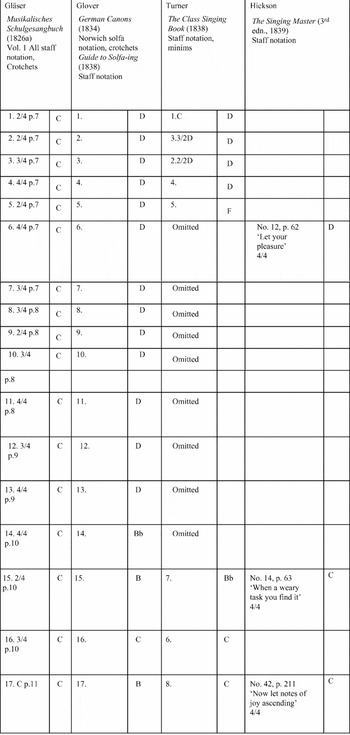
Glover's copy of the revised third edition included the five volumes in one that comprised Hickson's The Singing Master (1839).Footnote 4 In Part 1 ‘First Lessons in Singing and the Notation of Music’ there was a set of 16 didactic vocal exercises. Three of these were ascribed to the Musikalisches Schulgesangbuch (Gläser, Reference GLÄSER1826a). Glover, in her copy, had identified the source of two exercises in marginal notes. Canon 6 was given the text ‘Let your pleasure wait your leisure, But your work do not delay’. And Canon 15 now was sung to ‘When a weary task you find it, Persevere and never mind it’. Hickson also added words to Canon 17 ‘Now let notes of Joy Ascending’ which was included in the Second Class Tune Book. Hickson did not identify Gläser by name and so may well have taken the materials from Glover who also did not name Gläser but did identify the source of songs as the Musikalisches Schulgesangbuch. Hickson was not quoting from Turner who did not include Canon 6 in his works. A comparison of the works of Gläser, Glover, Turner and Hickson demonstrates how much material was borrowed from Gläser's original (Fig 3).
A comparison of the works of Gläser, Glover, Turner and Hickson

One additional music educator was aware of Gläser's materials.
John Curwen (1816–1880)
In 1841, Congregational minister, Rev. John Curwen, was commissioned by a Sunday School Conference to find an easy way to teach children to sing with a view to improving psalmody. He came across Glover's Scheme for Rendering Psalmody Congregational (1835) and, after visiting her in Norwich, was inspired to publish the system in 1843, with a few alterations, in the first of his many texts, Singing for Schools and Congregations. That same year Curwen published a series of lessons on singing in The Independent Magazine in which he used much of Glover's material, including, in one lesson, the Canons. He published them in his adaptation of Glover's notation and noted that they were from ‘Miss Glover's Solfa Tune Book’ and that they might be taught ‘first as simple exercises’ and then used as canons (Curwen, Reference CURWEN1842b). Curwen (n.d.) recognised that although there were only a few canons, they contained ‘all the intervals of the scale, and are learnt with very great accuracy and precision’ (ibid.: xxx). In Singing for Schools and Congregations (1843) Curwen only included Canon 15 as Exercise 61 now sung to ‘Oh! Give thanks to the God of Heaven, For his mercy endureth forever, Halleluiah, Halleluiah’. There was no acknowledgement of its source, unlike other works carefully ascribed to composers such as Mozart and Handel. This round was included in subsequent editions of the text (Curwen, n.d.). Curwen frequently acknowledged the work of Glover and there was between them an occasionally uneasy relationship. Curwen offered to reprint Glover's materials in their original form but all that was finally reproduced, with Glover's permission, were the individual song sheets that were included in one of Curwen's sets of Songs for Young People No. 5 (1856). Thus ‘The Sun’, ‘The Moon’, ‘Guardian Angels’, ‘The Bees’, ‘Chant for Christmas Day’, ‘The Pence Table’, ‘Christmas Day Hymn’, ‘The Christmas Salutation’, ‘The National Anthem’, ‘After the Examination or Morning Song’ and ‘Before the Examination’ were included. As noted the last two were from Gläser's Musikalisches Schulgesangbuch (1826a). Although Curwen repeatedly acknowledged his debt to Glover and cited the works of many other music educators, he made no mention of Gläser (Curwen, Reference CURWEN1843, Reference CURWEN1875, Reference CURWEN1892). Considering Curwen's meticulous attention to detail, it can be assumed that he was unfamiliar with Gläser's texts.
Conclusion
The 1830s were a very busy, innovative and productive decade for English music pedagogy. Turner, Glover, Hickson and Curwen were amongst the major music educators who published seminal works at this time. These pedagogists influenced and borrowed from each other quite freely, only sometimes acknowledging the source of ideas and materials. A major impetus and source of principles and practices was Germany, and, more specifically, Gläser, who, in turn, had been influenced by Natorp. Glover, having recognised the mooted necessity to improve English music pedagogy and the excellence of German practices at that time, was the first to adopt Gläser's materials. It is little wonder that Glover just used Gläser's canons – they are concise, effective and quickly reach quite complex musical ideas. Since that time, the idea of the didactic interval song has permeated music education approaches and materials designed for use in schoolrooms.
Glover influenced other English music educators. Turner included some of the German canons in his materials for schools. In turn, Hullah wrote ‘interval songs’; Hickson included three of the canons. Curwen initially used the canons but later rejected them. He adopted Glover's model of a sequenced set of teaching songs and exercises that introduced and reinforced the concepts under discussion, although not as efficiently as Gläser. Many of Curwen's principles and practices were adapted by Kodály who also understood the importance of purpose-written didactic teaching songs and exercises. Gläser's version of the purpose-written didactic vocal exercise or song for class music instruction was a new development. It was not the same as earlier texts that might include the singing of scales and intervals as part of vocal instruction. It was not the same as a collection of extant and/or composed songs that were deemed suitable for children but were not presented in a sequential manner that introduced the intervals and developed aural and theoretical understanding. This idea was demonstrably influential and has become pervasive.
As early as 1842, Curwen, in the series of ‘Lessons on Singing’ in The Independent Magazine referred to a song, ‘The Lark’, composed by Hullah (Reference HULLAH1849) as an ‘Interval Song’ (Curwen, 1842a: 63). ‘The Lark’ is carefully constructed. Each individual part moves only in stepwise motion but together they introduce aurally thirds, fourths, fifths, and sixths. The intervals are not introduced in the order used by Gläser, Glover and Curwen, but the song is specifically devised for the teaching of intervals. Hullah followed this first song with a series that continued until all the diatonic intervals were employed.
Undoubtedly the notion of the didactic intervallic song would have occurred to many music educators, however the first English music educator to whom this occurred was Glover. The songs that she used were those of Gläser who had created a model set of canons. So the German canons were just that and they provided a model that music educators have emulated for nearly 200 years.