Antimicrobial resistance is a serious threat to global public health.Reference Watkins and Bonomo 1 Surveillance of colonization and infections is an essential component of any comprehensive program to control antimicrobial resistant organisms (AROs). The Public Health Agency of Canada recently established the Canadian Antimicrobial Resistance Surveillance System (CARSS) as part of their action plan on antimicrobial resistance and use in Canada. 2 Although the number of participating hospitals in this program has increased, there are still some important limitations: hospitals are predominantly large tertiary-care facilities, and most of the data describe incidence of infections with no information regarding ARO colonization. To address these surveillance gaps, we conducted the first national prevalence survey of AROs in a large sample of Canadian hospitals in 2010 with a follow-up survey 2 years later. Targeted AROs included methicillin-resistant Staphylococcus aureus (MRSA), vancomycin-resistant Enterococcus (VRE), extended-spectrum β-lactamase (ESBL)–producing organisms, carbapenem-resistant Enterobacteriaceae (CREs), and Clostridium difficile infection (CDI). While MRSA and CDI prevalences were stable, the prevalence of VRE colonization increased between 2010 and 2012.Reference Williams, Simor and Kiss 3 To assess more recent potential changes in the epidemiology of AROs in Canada, we conducted a point-prevalence survey in 2016 targeting the same AROs. We also collected information on selected infection prevention and control policies used in Canada hospitals to control AROs to detect identify changes that might potentially impact the epidemiology of these organisms or our capacity to detect them.
Methods
The methods and definitions used in this point-prevalence survey were similar to those described for the surveys conducted in 2010 and 2012.Reference Williams, Simor and Kiss 3 , Reference Simor, Williams and McGeer 4 An invitation to participate was sent by email to all Canadian hospitals with at least 50 adult inpatients beds. Facilities providing only rehabilitation, psychiatric, pediatric, and long-term care were excluded. Participating hospitals were asked to select 1 weekday between February 8 and February 19, 2016, to conduct the survey. On the day of the survey, all adult (≥18 years) inpatients in acute-care units were identified using the hospital census. Patients colonized or infected with MRSA, VRE, ESBL, or CRE, or who had CDI were flagged using infection prevention and control and laboratory databases were included (Appendix). A standardized questionnaire was completed for each patient using the medical records to determine whether the patient met criteria for infection. Recorded information also included age, sex, date of admission, and anatomic site where the ARO was recovered. In addition, each participating site completed a standardized questionnaire describing hospital characteristics, infection prevention and control policies regarding AROs, and laboratory tests used to detect AROs. Infection control professionals at the participating hospitals attended standardized teleconference training for data collection. The Ethics Review Board at Sunnybrook Health Sciences Centre in Toronto, Ontario, approved the study.
Patients with MRSA, VRE, ESBL, or CRE were defined as those who had a culture or molecular test confirming the presence of 1 of the AROs on the day of the survey or any time previously and who were on additional precautions (ie, contact precautions) for the organism. For this study, an ESBL producing organism was defined as an Enterobacteriacae resistant to at least 1 of the third-generation cephalosporins. A CRE was defined as an Enterobacteriacae resistant to at least 1 carbapenem antibiotic. Infection status was defined using the National Healthcare Safety Network criteria. 5 CDI was defined by the presence of diarrhea (3 or more watery stools within 24 hours) with a positive C. difficile test (toxin assay or NAAT) and receipt of targeted treatment for this infection, or if pseudomembranous colitis had been documented by endoscopy within the previous 14 days.Reference Williams, Simor and Kiss 3 , Reference Simor, Williams and McGeer 4
Data analysis and statistical methods
The primary outcomes were the prevalence of MRSA, VRE, CDI, ESBL and CRE, calculated as the number of cases per 100 adult inpatients with 95% confidence interval (95% CI) in each of the participating hospitals on the date of the point-prevalence survey. For each ARO, median prevalences in 2012 and 2016 were compared by the Mann-Whitney U test. A χ2 test was used to compare selected ARO infection prevention and control hospital policies across the 3 years. Univariate and multivariate logistic regressions were conducted to identify hospital characteristics associated with prevalence of each ARO. Covariates significantly associated with the prevalence in univariate comparisons were assessed for multicollinearity using tolerance statistics, and those with tolerance ≥0.4 were retained in the model. Poisson modeling for binomial distribution was conducted as sensitivity analyses and did not show major differences with the logistic regression. All analyses were performed using SAS version 9.4 software (SAS Institute, Cary, North Carolina).
Results
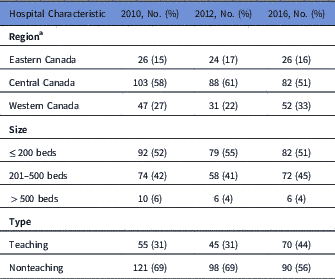
In total, 160 hospitals participated in the survey, representing 36,524 adult acute-care beds in 9 of 10 provinces with a 96% occupancy rate (n=35,018) on the day of the survey. Characteristics of participating hospitals are shown in Table 1.
Characteristics of Participating Hospitals in 2010, 2012, and 2016

a Eastern Canada: Newfoundland and Labrador, Prince Edward Island, Nova Scotia, and New Brunswick. Central Canada: Quebec and Ontario. Western Canada: Manitoba, Saskatchewan, Alberta, British Columbia, and the Northwest Territories.
Colonized or infected MRSA patients were reported from 152 (95%) of participating hospitals; patients with VRE were reported from 101 hospitals (63%); patients with ESBL were reported from 85 hospitals (53%); patients with CRE were reported from 24 hospitals (15%); and patients with CDI were reported from 123 hospitals (77%). Hospitals reported a total of 3,117 patients colonized or infected with at least 1 ARO, representing a prevalence of 8.9 per 100 inpatients (95% CI, 7.9–9.9). Overall, 1,705 patients were colonized or infected with MRSA (4.9 per 100 inpatients; 95% CI, 4.3–5.4); 238 patients were infected with MRSA (0.7 per 100 inpatients; 95% CI, 0.5–0.8); 902 patients were colonized or infected with VRE (2.6 per 100 inpatients; 95% CI, 1.8–3.4); 24 patients were infected with VRE (0.07 per 100 inpatients; 95% CI, 0.04–0.10); 428 patients were colonized or infected with an ESBL-producing Enterobacteriaceae (1.2 per 100 inpatients; 95% CI, 1.0–1.6); 30 patients were colonized or infected with a CRE (0.09 per 100 inpatients; 95% CI, 0.05–0.12); and 436 patients had a confirmed CDI (1.2 per 100 inpatients; 95% CI, 1.1–1.4).
Klebesiella spp were the most frequent genus with carbapenem resistance, with 11 reported cases (34%) followed by Escherichia coli (28%) and Enterobacter spp (22%). Of the 31 reported CREs, 21 were characterized by a molecular test. NDM-1 was the most frequent carbapenemase enzyme in 8 cases (38%), followed by OXA-48 in 5 cases (24%) and by KPC in 4 cases (19%). Carriage sites are shown in Appendix Table 1.
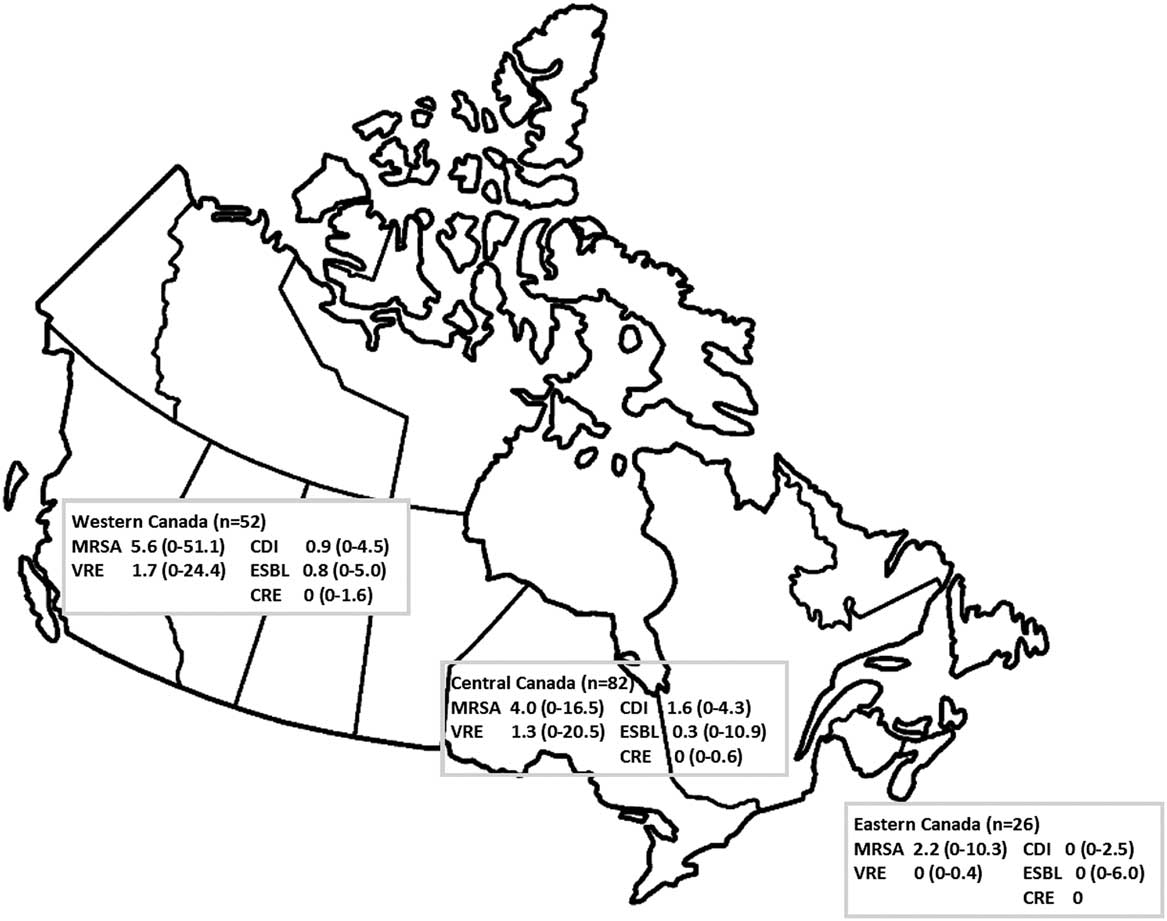
Significant differences in the geographical distribution of AROs were observed (Fig. 1). The median prevalence of MRSA was higher in western Canada than in the rest of the country (P=.003). Western Canada also had the highest median prevalence for VRE (P=.001). However, central Canada had a higher median prevalence of CDI (P=.001).
Median (range) prevalence (per 100 inpatients) of methicillin-resistant Staphylococcus aureus (MRSA, colonized or infected cases), vancomycin-resistant Enterococcus (VRE), Clostridium difficile infection, extended-spectrum β-lactamase-producing Enterobacteriaceae (ESBL) and carbapenem-resistant Enterobacteriaceae (CRE). Legend: Eastern Canada: Newfoundland and Labrador, Nova Scotia, New Brunswick. Central Canada: Quebec, Ontario. Western Canada: Manitoba, Saskatchewan, Alberta, British Columbia.

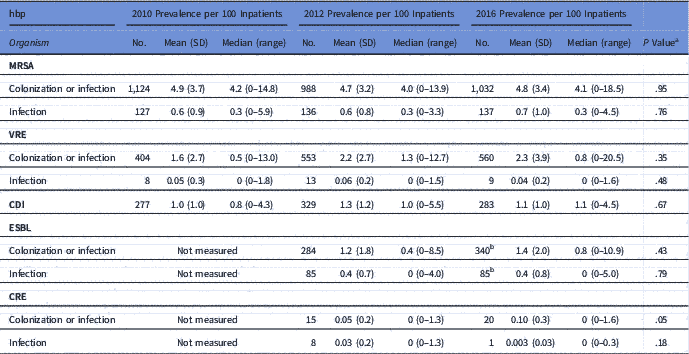
Overall, 106 hospitals participated in all 3 point-prevalence surveys (2010, 2012, and 2016). Mean and median prevalences of MRSA, VRE, and CDI in these hospitals are summarized in Table 2. No significant changes were detected from 2012 to 2016 in the prevalence of any of the AROs.
Mean and Median Prevalence of Antibiotic-Resistant Organisms in Adult Inpatients of Canadian Acute-Care Hospitals That Participated in All 3 Surveys (n=106)

Note. CDI, Clostridium difficile infection; CRE, carbapenem-resistant Enterobacteriaceae, ESBL, extended-spectrum β-lactamase-producing Enterobacteriaceae; MRSA, methicillin-resistant Staphylococcus aureus; VRE, vancomycin-resistant Enterococcus.
Overall in 2016 survey, 28 patients were infected by both MRSA and CDI, 175 patients were infected by MRSA and VRE, 42 patients were infected by VRE and CDI, and 5 patients were infected by all 3 AROs.
a Comparing median prevalence in 2012 with that in 2016.
b ESBL cases were reported by only 99 hospitals. Data include all cases as defined by each setting.
All participating hospitals reported conducting either universal or targeted screening for MRSA, most often (93%) using chromogenic agar media. VRE infection prevention and control practices changed since 2010 (Table 3). In 2010, all but 1 hospital performed universal or targeted screening compared to 90% in 2012 and 78% in 2016 (P < .001). Also, 7% of hospitals reported not placing VRE patients under additional precautions (ie, contact precautions) if VRE was identified in a clinical specimen. Nucleic acid amplification testing had been used in 76% of participating hospitals as part of the diagnosis algorithm for C. difficile detection compared to 49% in 2012 and 9% in 2010. Only 27% of hospitals screened for ESBLs and 29% of participants did not place ESBL patients in additional (contact) precautions if the ARO was identified in a clinical specimen. High-risk patients were screened for rectal carriage of CREs on admission in 61% of hospitals. The total number of patients that were under additional precautions for any reason on the day of their survey was provided by 114 hospitals: 61% of these patients (n=1,983 of 3,225) were isolated for at least 1 ARO.
Selected VRE Infection and Control Policies

Note. VRE, vancomycin-resistant Enterococcus.
a P<.001.
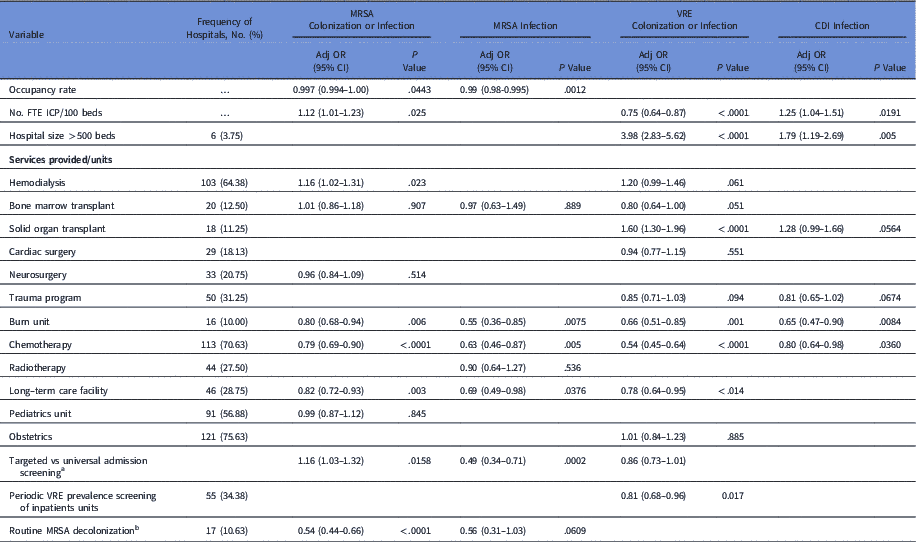
Crude and adjusted models of hospitals characteristics associated with ARO prevalence are shown in Table 4 and in the Appendix. Overall prevalence of MRSA (colonization or infection) was not associated with the number of beds nor with occupancy rate on the day of the survey (Table 4). MRSA prevalence was higher in settings offering hemodialysis but lower in settings offering care for burns, chemotherapy, and long-term care. Targeted screening (Appendix-Table 2) was associated with higher MRSA prevalence in the adjusted model than universal screening but was associated with lower MRSA infection prevalence (Table 4). Routine MRSA decolonization was expectedly associated with a lower MRSA prevalence. CDI prevalence was associated with few hospital criteria. The CDI was higher in larger settings (≥200 beds) but decreased in settings with burn and chemotherapy units. Increasing attributed time of infection prevention and control personnel did not seem to have a positive effect in reducing the prevalence of MRSA nor of CDI, but it was associated with a decrease in VRE prevalence.
Covariates Associated With Infection Prevalence in Multivariate Models in the 2016 Survey (n=160 hospitals)

Note. CDI, Clostridium difficile infection; CI, confidence interval; FTE, full-time equivalent; ICP, infection control professional; MRSA, methicillin-resistant Staphylococcus aureus; OR, odds ratio; VRE, vancomycin-resistant Enterococcus.
All covariates were tested for univariate comparisons and for tolerance level as measure of collinearity; results are presented for the final retained models.
a Targeted screening for MRSA or VRE at admission to hospital on the basis of risk factor assessment.
b MRSA decolonization with intranasal mupirocin with or without use of a topical or systemic agent.
Discussion
Canada and the United States recently released national action plans for reducing antimicrobial resistance. 6 , Reference House 7 Both plans emphasize the importance of surveillance to identify new threats or changing patterns in antimicrobial resistance. Despite growing efforts to improve surveillance, most of the data on ARO in Canadian hospitals are incidence data provided to CARSS by a relatively small number of large tertiary-care hospitals. 2 In this study, we aimed to draw a national picture of AROs in Canadian hospitals using a point-prevalence survey in 160 hospitals (representing ~70% of eligible facilities) in 9 of 10 Canadian provinces.
Clostridium difficile remains the single most frequent ARO in Canadian hospitals, as it is in many countries.Reference Magill, Edwards and Bamberg 8 , Reference Martin, Monaghan and Wilcox 9 Despite a decrease in healthcare-associated CDI incidence since 2011, 2 our survey did not show any difference in the prevalence of CDI among adult inpatients compared to 2010 and 2012. However, more Canadian hospitals are now using commercial nucleic acid amplification tests as part of their algorithm to diagnose CDI. Whether increased use of NAAT increases sensitivity or leads to overdiagnosisReference Polage, Gyorke and Kennedy 10 is not known, but it may mask a decrease in the prevalence of CDI.
The prevalence of MRSA did not significantly change from 2010 to 2016. A relatively small proportion of patients (14%) with MRSA were infected, representing a mean MRSA infection prevalence of 0.7 per 100 inpatients, identical to that observed in the 2012 survey. In comparison, a declining trend in the incidence of MRSA infection has been reported by the Canadian Antimicrobial Resistance Surveillance System, with a decrease of ~25% in MRSA infection rates among hospitalized patients from 2008 to 2014. 2 This declining trend in incidence of MRSA healthcare-associated infection has also been reported in the United States. 11 Although we used of a broader definition to identify healthcare-associated MRSA infection, the prevalence in Canadian hospitals was lower than that identified in a 2011 multistate point-prevalence survey in US facilities (0.4 per 100 inpatients vs 0.5 per 100 inpatients).Reference Magill, Edwards and Bamberg 8
We did not detect any change in the prevalence of VRE from 2012 to 2016. However, since our previous survey in 2012, a significant number of participating hospitals stopped performing VRE screening on admission, probably due to the burden of VRE management with limited resource for infection control. The true prevalence of VRE colonization in Canadian hospitals is therefore likely to be higher than that observed in this survey. VRE infection prevalence is less subject to detection bias. Fortunately, VRE infection in Canada remains uncommon with only 23 patients identified with VRE infection (0.07 per 100 inpatients). Data from CARSS showed a steady increase of the infection rate of VRE between 2008 and 2012. 2 From 2012 to 2014, the rate decreased but did not return to the previous lower rate of 2008. However, this rate remains much lower in the Canadian hospitals than in the United States facilities. In the United States, Enterococcus spp remain the second most common cause of healthcare-associated infections. According to the NHSN data from 2014, 29.8% of enterococci healthcare-associated infections were resistant to vancomycin.Reference Weiner, Webb and Limbago 12 The percentage of invasive Enterococcus faecium with resistance to vancomycin varies greatly among European countries such as Norway, Sweden, and Iceland, which reported no resistance, whereas Ireland reported resistance as high as 46%. 13 A significant increase in the proportion of vancomycin-resistant E. faecium occurred in 12 of the 26 EARS-Net participating countries between 2012 and 2015.
CREs represent a growing concern because many of these organisms are resistant to other classes of antibiotics as well. Very few treatment options exist for patients infected with these isolates, and outcomes might be poorer than infection with non-CRE organisms.Reference Tamma, Goodman and Harris 14 The threat of the emergence and dissemination of mcr-1 encoding colistin resistance further increases the danger of CREs.Reference Jeannot, Bolard and Plesiat 15 Our survey showed that CREs remain infrequently identified in Canadian hospitals. However, they were reported from more hospitals in 2016 (15%) compared to 2012 (7%). Also, the mean prevalence reported from hospitals that submitted CRE data for the 2012 and 2016 survey was slightly higher (0.10 per 100 inpatients) than in 2012 (0.05 per 100 inpatients). Importantly, more hospitals were performing active surveillance for CREs in 2016 compared to 2012. Fortunately, infections remain very rare, with only 3 infections reported from all 160 participating hospitals. Unsurprisingly, as it is observed worldwide, Klebsiella spp most frequently exhibit carbapenem resistance. Although the number of organisms was very small, the overrepresentation of the NDM carbapenemase enzyme identified is surprising because the KPC enzyme is usually the most frequent enzyme identified in carbapenem resistance in Canada. 2 Prospective surveillance in Canada is currently performed by the Canadian Nosocomial Infection Surveillance Program (CNISP) in 58 hospitals, and CNISP data have shown that the CRE rate did not change significantly from 2010 to 2014 (0.19 and 0.22 per 10,000 patient days respectively). 2 In Europe, CRE incidence varies widely from country to country, but a global an increase occurred in the proportion of K. pneumoniae that were resistant to carbapenem from 2010 to 2014. 13 The CDC in the United States changed in 2015 the CRE surveillance definition to increase sensitivity by including all Enterobacteriaceae with resistance to at least 1 of the carbapenem antibiotics or documentation that the isolate possessed a carbapenemase enzyme. 16 According to 2013 CDC data, 11% of K. pneumoniae and 2% of E. coli healthcare-associated infections were resistant to carbapenem antibiotic. 17
True prevalence of ESBLs is very hard to assess because the definition for what defines a potentially transmittable ESBL varies from one center to another across Canada. Also, a minority of hospitals perform active screening for these organisms. The ESBL infection prevalence rate is more reliable than the total ESBL prevalence because it is less affected by detection bias. Our data show that the mean prevalence for ESBL infection remained the same (0.4 per 100 inpatients) in 2012 and in 2016.
A secondary objective of this study was to identify institutional characteristics associated with prevalence of AROs. Although we did find some significant associations, such as hospital size >500 beds and higher prevalence of VRE and CDI, these do not necessarily imply a causal relationship. The 2016 point-prevalence survey was conducted during the peak of the influenza season in most of Canada. Nevertheless, the 5 studied AROs still accounted for >60% of additional precautions used in Canadian hospitals. Because putting additional measures in place requires significant resources and physical space, a further increase in the prevalence of these AROs could have adverse effects such as bed blocking and overcrowding.
We believe that the results of this survey are representative of Canadian acute-care hospitals with at least 50 inpatient beds. Overall, 106 hospitals participated in all 3 surveys, allowing for an accurate analysis of the trends of AROs prevalence over time. The results are not applicable to pediatric, psychiatric, rehabilitation, or long-term care facilities. We have identified some differences between our AROs prevalence results and the incidence data as reported by the Canadian surveillance programs; overall, we did not find significant changes in the prevalence, while the incidences for CDI, MRSA and VRE infection decreased. These findings could, in part, be related to the limited ability to detect changes in the prevalence of organisms that are likely to colonize an individual for prolonged periods of time. Thus, prevalence data compliment those provided by determining incidence to obtain a more robust understanding of the burden of disease attributable to AROs in hospital settings. Varied screening practices can cause detection bias, and sampling variations and may have affected the identification of patients colonized with these organisms.
In conclusion, these data provide national prevalence rates for MRSA, VRE, ESBLs, CREs and CDI among adult inpatients in Canadian hospitals. The rates have remained similar for MRSA and CDI from 2010 to 2016. VRE prevalence significantly increased from 2010 to 2012 but remained similar when comparing 2016 to 2012. However, fewer hospitals are now screening for VRE colonization, which will limit our capacity to monitor real change over time. The number of VRE infections in Canadian hospitals remains low, but the impact of recent changes in VRE screening on infection rates has yet to be determined. CREs were identified in more hospitals in 2016 than in 2012, perhaps because of increased awareness and screening, but they remain infrequently identified in Canadian hospitals. Ongoing national surveillance for AROs is important to evaluate potential changes in the epidemiology of diseases caused by these bacteria.
Acknowledgments
We thank the infection control and prevention professionals at participating sites who collected and submitted data for the survey.
Financial support
No financial support was provided relevant to this article.
Conflicts of interest
All authors report no conflicts of interest relevant to this article.
Supplementary material
To view supplementary material for this article, please visit https://doi.org/10.1017/ice.2018.279