Introduction
Ruminant production systems have considerably intensified in the past decades in response to increased demand for animal products and cost constraints. The environmental impact associated with animal waste, particularly nitrogen (N) from concentrated animal agriculture, is an area of concern for intensive production systems (Kohn et al., Reference Kohn, Dou, Ferguson and Boston1997). N is released into the environment through the urine and faeces of livestock as undigested N fractions and as end-products of protein metabolism. Feeding N above the dietary requirements increases the potential for losses of reactive N to air and water. Although virtually no N is volatilised directly from animals, the N in animal manure can be converted to ammonium (NH4+) by hydrolysis of urea that is the major end-product of N metabolism in ruminants. Excess N in surface water from run-off, acid rain or resurfacing leached N causes algae populations to grow rapidly. The growth and decomposition of algae consume dissolved oxygen in the water and this event affects the survival and productivity of fish and other aquatic animals. Finally, N contamination of ground water and wells can cause a condition known as methaemoglobinaemia, where nitrite replaces oxygen in haemoglobin. As methaemoglobin increases, blood oxygen levels decrease, resulting in cyanosis or oxygen starvation.
Dairy cows excrete three times more N in animal waste than in milk (Misselbrook et al., Reference Misselbrook, Powell, Broderick and Grabber2005). An average cow producing 8200 kg of milk annually excretes 21 000 kg of manure containing about 110 kg of N, with approximately equal proportions excreted in faeces and urine (Van Horn et al., Reference Van Horn, Newton and Kunkle1996). With the current growth trend, by the year 2016 the USA dairy herd will have 8.4 million cows (Cooley, Reference Cooley2007), which will result in the release of about 935 000 t of N to the environment annually. The majority of urinary N is in the form of urea, which is hydrolysed by faecal urease to NH3. About 25% of dairy manure N is lost as NH3 under current US practices (Pinder et al., Reference Pinder, Strader, Davidson and Adams2004), contributing to the total annual NH3 re-deposition rates of 23 to 40 kg of N per ha (Burkart and James, Reference Burkart and James1999). Studies that compared crop and livestock production indicated that the efficiency of N use for cereal production was 54%, whereas in the dairy system the efficiency of N use was only 28% (Domburg et al., Reference Domburg, Edwards, Sinclair and Chalmers2000). Accordingly, the potential to increase the efficiency of N utilisation in the dairy industry is considerable. Minimising N excretion is the most obvious way to curb ammonia emissions. By reducing the excretion of urinary N, less ammonia will be formed and volatilised.
Alfalfa is high in N content, and approximately 80% of its protein is degraded in the rumen (Broderick and Buxton, Reference Broderick and Buxton1991). The high degradability of alfalfa protein potentially leads to poor N use efficiency by the rumen micro-organisms and the eventual loss of excess ammonia via absorption through the rumen wall. In the blood, ammonia-N (NH4-N) is converted to urea via an energy-dependent process and eventually excreted in urine as urea-N. There is interest in developing novel ways to reduce the rate and possibly the extent of alfalfa protein degradation in the rumen. The rationale for reducing rumen degradability of dietary proteins are: (1) protein requirements of high-producing animals cannot solely be met from rumen microbial sources; (2) protein is the most expensive component of ruminant animal diets; and (3) excessive degradation of proteins leads to greater amounts of nitrogenous compounds excreted in the urine and faeces, which is a major environmental concern. Phenolic compounds such as tannins bind to proteins and could thus potentially reduce ruminal degradation of feed proteins.
Tannins are a complex group of naturally occurring polyphenolic plant metabolites with molecular masses ranging from 300 to 3000 Da (Mingshu et al., Reference Mingshu, Kai, Qiang and Dongying2006). They can precipitate gelatin and other proteins from solution (Mehansho et al., Reference Mehansho, Butler and Carlson1987), with both beneficial and adverse effects. Beneficial effects include suppression of bloat (Jones et al., Reference Jones, Anderson and Ross1973) and protection of dietary protein in the rumen (Waghorn et al., Reference Waghorn, Shelton, McNabb and McCutcheon1994). Adverse effects of tannins are associated with their ability to bind with dietary protein, carbohydrate and minerals (McSweeney et al., Reference McSweeney, Palmer, McNeill and Krause2001). The effect of tannins on the nutritive value of tannin-containing browse was studied with the use of tannin-binding agents including polyethylene glycol (PEG) (Makkar et al., Reference Makkar, Blümmel and Becker1995; Getachew et al., Reference Getachew, Makkar and Becker2001a and Reference Getachew, Makkar and Becker2002). PEG binds tannins and inhibits the biological effects of tannins on proteins. Comparison was made between the biological properties of tannin-containing browses with and without PEG when consumed by ruminants (Makkar, Reference Makkar2003; Ben Salem et al., Reference Ben Salem, Ben Salem and Ben Said2005a).
Due to its availability, cost and relative purity, tannic acid has been used widely to study the effect of tannins on rumen fermentation (Driedger et al., Reference Driedger, Hatfield and Garrigus1969; Nishimuta et al., Reference Nishimuta, Ely and Boling1974; Murdiati et al., Reference Murdiati, McSweeney and Lowry1992; Zhu and Filippich, Reference Zhu and Filippich1992; Plumlee et al., Reference Plumlee, Johnson and Galey1998; Hervas et al., Reference Hervas, Frutos, Serrano, Mantecon and Giraldez2000; Santos et al., Reference Santos, Oliveira, Petit, Cecato, Zeoula, Rigolon, Damasceno, Branco and Bett2000; Frutos et al., Reference Frutos, Hervas, Giraldez and Mantecon2004; Martinez et al., Reference Martinez, Moyano, Diaz, Barroso and Alarcon2005 and Reference Martinez, McAllister, Wang and Reuter2006). The objective of this study was to assess the influence of spraying tannic acid (TA) on chopped alfalfa hay on in vitro rumen fermentation of dry matter (DM) and N retention by sheep fed alfalfa hay.
Materials and methods
Feed
Alfalfa hay was made from one field lot of alfalfa harvested at the bud stage. The hay was chopped through a 2.5-cm screen. Tannic acid (MP biomedicals, Inc, Solon, Ohio, Cat # 190275) was dissolved in lukewarm water and sprayed on the chopped alfalfa hay to produce alfalfa with 0, 30, 60 or 90 g TA per kg DM alfalfa. The sprayed alfalfa was subsequently air dried outdoors under shade.
In vitro gas production, DM and fibre digestibility
Samples of TA alfalfa with 0, 30, 60 and 90 g TA per kg DM were ground and incubated in buffered cattle rumen fluid using a gas production procedure (Menke and Steingass, Reference Menke and Steingass1988). Four samples from each treatment were ground in a Wiley mill to pass through a 1-mm screen sieve (Arthur A. Thomas, Philadelphia, PA, USA). Approximately 200 mg ground sample was placed in calibrated glass syringes with four syringes per sample. In two of the syringes, approximately 200 mg PEG (MW 6000, Hampton Research, Aliso Viejo, CA, USA) was added while the remaining two syringes contained only alfalfa (no PEG added). Buffered mineral solution (Menke and Steingass, Reference Menke and Steingass1988) was placed in a water bath at 39°C with continuous flushing with CO2. Rumen fluid was collected after the morning feeding from two ruminally fistulated, non-lactating and non-pregnant Holstein cows fed oat hay twice daily at approximately 0700 and 1800 h. Rumen fluid was pumped with a manually operated vacuum pump into two pre-warmed thermos flasks and transported to the laboratory, where the rumen fluid was combined, filtered through four layers of cheesecloth and flushed with CO2. Rumen fluid was added to the buffered mineral solution, which was maintained in a water bath at 39°C, and combined. An incubation run consisted of 68 syringes (4 TA level × 4 samples × 2 PEG level × 2 replicates; plus 2 blanks and 2 standards). All handling was under continuous flushing with CO2. Buffered rumen fluid, 30 ml, was dispensed into each syringe. After closing the clip on the silicon tube at the syringe tip, each syringe was gently shaken and the tubes were opened to remove gas by pushing the piston upwards to achieve complete removal of gas. The clip was closed, this initial volume was recorded and the syringe was placed in a water bath at 39°C. After each gas reading, each syringe was gently shaken. Gas production was recorded at 0, 2, 4, 6, 8, 10, 24, 26, 28, 30, 32, 34, 48, 50, 52, 54, 56 and 72 h from the start of incubation. Gas production was corrected for blank incubations (i.e. no substrate). After 72 h of incubation, about 10 ml of the syringe contents was centrifuged at 15 000 × g for 20 min. Supernatant (5 ml) was pipetted into a 15 ml plastic tube containing 1 ml of 25% metaphosphoric acid and centrifuged at 15 000 × g for subsequent determination of short-chain fatty acid (SCFA).
In vitro DM and fibre degradation
In vitro true degradability of DM (IVTD) and neutral-detergent fibre degradability (dNDF) were determined according to Holden (Reference Holden1999) for each alfalfa hay using an ANKOM DAISY incubator (ANKOM Technology Corporation, Fairport, NY, USA) and a fibre analyser (ANKOM Technology Corporation). For IVTD determination, three sets of 0.5-g samples from 16 feed samples (four subsamples from each tannin level) were weighed in duplicate into ANKOM F57 filter bags. Bags were placed in each of the four digestion vessels, 1.6 l buffer solution and 400 ml of the rumen inoculum were added to each vessel, and the vessels were flushed with CO2 and incubated in the DAISYII at 39°C for 8, 24 and 48 h. After each incubation period, the bottles were removed and the bags were washed with deionised water until there was no colour in the rinse water. An ANKOM200 fibre analyser with neutral-detergent solution as described previously (Robinson et al., Reference Robinson, Mathews and Fadel1999) was used to determine the remaining fibre in each bag.
Protein precipitation capacity
The biological activity of extractable tannins was determined by the radial diffusion method with bovine serum albumin-containing gels as described by Hagerman (Reference Hagerman1987) and modified by Giner-Chavez et al. (Reference Giner-Chavez, Van Soest, Robertson, Lascano and Pell1997).
Feeding experiment
Animals and feeding
Four wether sheep (average body weight of 40.5 ± 3.1 kg) were used in a 4 × 4 Latin-square design (four concentrations of TA and four feeding periods). Each period consisted of 14 days with 9 days for adaptation and 5 days for total collection of faeces and urine. Animals were fed twice daily at a maintenance level of energy (2.2% of body weight) in approximately equal amounts at each feeding at about 0700 and 1700 h. Feeding at the maintenance level was chosen in order to facilitate a complete consumption of feed offered. Animals were housed in individual metal metabolism crates (1 m × 2 m) with free access to drinking water. The total collection of faeces and urine began on day 10. The Animal Use and Care Administration Committee of the University of California at Davis approved care of the sheep.
Faecal collection
Each sheep was fitted with a faecal collection harness on the morning of day 9 of each period to allow 1-day adjustment and fitting of the harness. Beginning on day 10, a canvas collection bag with a plastic inner bag was connected to the harness. Faeces were collected before feeding at 0630 and 1630 h. The faecal output at each collection was weighed and then transferred to a composite bag for each sheep within period and the composite bag was stored in a freezer until the end of study. At the end of faecal collection, the composite bag was weighed as a check of the sum of the 10 individual samples. Faecal samples were dried to a constant weight at 60 °C. Dried and ground faecal samples were incubated for 72 h using an in vitro gas system in duplicate with and without PEG following a similar procedure as used for feed and incubations in order to assess whether the tannin–protein complexes formed in the rumen were fully dissociated in the lower gut or excreted in a bound form.
Urine collection
Each metabolism crate was fitted with a urine collection tray similar to a funnel below the expanded metal flooring. Urine was collected into an individual 4-l plastic container with 150 ml H2SO4. Urine pH was not determined prior to acidification. Total urine volume was measured at 0700 and 1700 h daily, and urine was transferred into a pre-tared plastic bottle for each animal and then weighed. Specific gravity of the urine was measured using a hydrometer. About 10 ml of urine was pipetted into a 15-ml plastic tube and frozen until needed for analysis. The remaining urine was stored in a 20-l plastic container for each sheep during the entire collection period.
Blood samples
Blood samples were collected from a jugular vein of each sheep on day 13 of each experimental period before the morning feeding (0 h) and at 2, 4, 6, 8 and 10 h after the morning feeding. The blood samples were centrifuged at 12 000 g for 20 min, and plasma and serum samples were stored at −80°C until analysis.
Chemical analysis
Feed and faecal DM were determined by heating the samples at 105° C for 3 h (Reuter et al., Reference Reuter, Robinson, Peverill and Price1986). Total N in feed and faecal samples was determined using a N gas analyser using furnace and thermal conductivity (LECO FP-528) (AOAC, 2005). Acid-detergent fibre (ADF) and lignin were determined as described by Association of Official Analtical Chemists (2005). Neutral-detergent fibre (NDF) was determined according to Van Soest et al. (Reference Van Soest, Robertson and Lewis1991). Ash was determined as the gravimetric loss of organic matter (OM) by heating to 550°C for 8 h. N in urine was measured using a Kjeldahl method (Carlson, Reference Carlson1978). Ammonium-N in the supernatant after 72 h of in vitro incubation of feed and faecal samples was measured using an auto analyser (Getachew et al., Reference Getachew, Pittroff, Putnam, Dandekar, Goyal and DePeters2008). Total and individual SCFA were determined as described by Getachew et al. (Reference Getachew, DePeters, Robinson and Taylor2001b).
Blood metabolites
Blood metabolites were used to assess potential liver toxicity associated with feeding TA to sheep. Albumin, alkaline phosphatase (ALP), aspartate aminotransferase (AST), total bilirubin (TBILI), blood urea-N (BUN), calcium (Ca), creatinine, creatine kinase (CK), γ-glutamyltransferase (GGT), glucose, inorganic phosphorous, total protein, Na+, K+ and Cl− were analysed using a Roche blood analytical kit (Roche Diagnostics, Indianapolis, IN, USA). Sorbitol dehydrogenase (SDH) determination was based on the reaction of fructose and NADH to form sorbitol and NAD (Roche Diagnostics).
Calculations and statistical analysis
In vitro study
Data from in vitro assays of the feed samples were analysed in two steps. First, a non-linear model was fitted to the time series of gas production readings from time 0 h to 72 h. The model chosen was the Brody function, as it fits many in vitro gas production profiles well (France et al., Reference France, Dijkstra, Dhanoa, Lopez and Bannink2000; Getachew et al., Reference Getachew, Pittroff, Putnam, Dandekar, Goyal and DePeters2008). The Brody function has three parameters: GAST (cumulative gas production), beta (a location parameter) and gamma (intrinsic rate of gas production). Parameter estimates were consolidated into a data set and subjected to multivariate analysis of variance (manova) analysis under the expectation of significant difference among parameter correlations. Tannin level and PEG addition were modelled as fixed factors. After determination of a global F-test significance, parameters were then subjected to univariate analysis of variance (anova) with the same fixed factors. Chemical assays for in vitro analysis included determination of SCFA, acetate–propionate ratio and ammonia. The same model as used for analysis of incubation kinetics parameters was used for these chemical assays. In both analyses, the full model, including the interaction between TA and PEG, was reduced for any term not significant at P ⩽ 0.05. Where interaction existed, sliced effect multiple comparisons were conducted under a conservative Tukey–Kramer adjustment for experimental error. These comparisons separated different TA levels for PEG or non-PEG incubations. DM and fibre digestibility measured at three different incubation time points were analysed by linear anova with incubation time and TA as fixed factors. Levels of TA concentrations were compared at each time point with a sliced effect approach as described above.
In vivo study
The animal feeding experiment was a 4 × 4 Latin square. For all data collected on animals that comprised repeated observations on the same animal within the same period, linear effects of treatment and time point post feeding at which measurements were taken were analysed with a mixed-model maximum likelihood approach. Several co-variance structures were tested to accommodate correlated observations on the same experimental unit; however, the model generally converged only under the assumption of a first order auto-regressive error structure. For the analysis of N metabolism, the following response variables were considered: total N content in urine, total urea-N in urine, faecal N output, total N output, N balance, retained N and N digestibility.
For serum BUN analysis, several measurements taken at intervals post feeding were available. Since the interaction between time post feeding and TA concentration was significant, levels of TA concentrations were compared at each measurement time point. For these simultaneous comparisons, the Tukey–Kramer adjustment for experiment-wise error rate was chosen.
Results
In vitro gas production, SCFA, DM and fibre degradability and NH4-N concentration
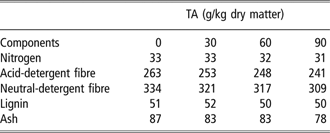
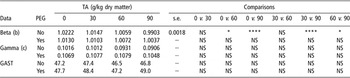
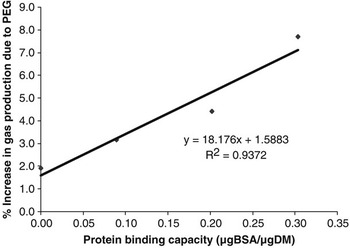
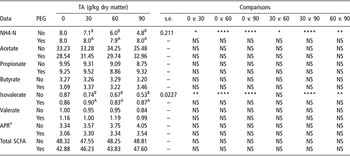
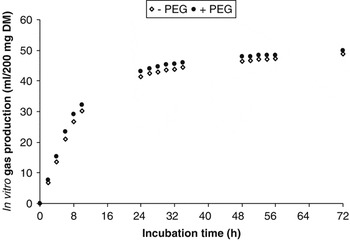
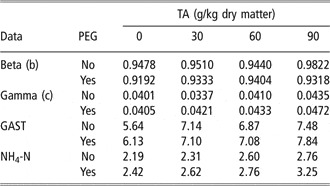
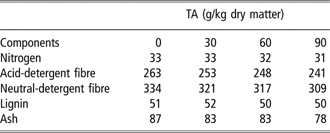
The chemical composition of the TA-sprayed alfalfa used for the in vitro study and the sheep N balance study is presented in Table 1. In vitro gas production characteristics of TA-sprayed alfalfa in the presence and absence of PEG are presented in Table 2. The extent of gas production when no PEG was added was not affected by TA (P > 0.05). Addition of PEG numerically increased the extent of gas production (Table 2, Figure 2). Addition of TA reduced NH4-N concentration by 14%, 31% and 67% at the TA levels of 30, 60 and 90 g/kg DM, respectively. Addition of PEG significantly increased (P < 0.05) NH4-N concentration at all levels of added TA compared with the control. There was a strong relationship (R 2 = 0.94) between percentage increase in gas production due to PEG and the protein-binding assay (Figure 1). The net individual and total SCFA production and NH4-N concentration from incubations with varying concentrations of TA are presented in Table 3. Addition of TA significantly reduced isovalerate production at all levels of TA compared with the control, and the addition of PEG increased isovalerate production (Figure 2).
Chemical composition of tannic acid (TA)-sprayed alfalfa used in vitro and feeding study
Gas production characteristics of tannic acid (TA)-sprayed alfalfa in the presence and absence of polyethylene glycol (PEG)

*P < 0.05; **P < 0.01; ***P < 0.001; ****P < 0.0001; NS = not significant.
Beta = location parameter; gamma = intrinsic rate of gas production (ml/h); GAST = extent (asymptotic gas production, ml).
Relationship between percentage increase in gas production due to polyethylene glycol (PEG) and protein binding capacity (bovine serum albumin-precipitable protein) of alfalfa hay sprayed with different levels of tannic acid (TA).

Net individual and total short-chain fatty acid (SCFA; mmol/l) production and ammonia-nitrogen concentration (NH4-N, mmol/l) on incubation of tannic acid (TA)-sprayed alfalfa in the presence and absence of polyethylene glycol (PEG)

*P < 0.05; **P < 0.01; ***P < 0.001; ****P < 0.0001; NS = not significant; A,BDifferent superscripts in columns indicate significant difference at P < 0.05.
†APR = acetate-to-propionate ratio.
In vitro gas production pattern on incubation of tannic acid-sprayed alfalfa in the presence (●) and absence of polyethylene glycol (PEG) (◊).

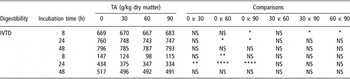
In vitro true digestibility of DM and NDF of treated alfalfa at 8, 24, and 48 h incubation are presented in Table 4. The effect of TA on in vitro degradability was more dramatic on NDF than DM. At 8 h incubation, addition of TA resulted in the reduction of NDF digestibility by 33% at 60 g TA per kg DM compared with the control. At 24 h incubation, TA reduced IVTD (P < 0.05) at the 60 and 90 g levels but not at 30 g/kg DM compared with the control. Digestibility of NDF was reduced by all levels of TA compared with the control. The magnitude of the reduction in fibre digestibility due to TA was less at 48 h compared with 8 and 24 h of incubation.
In vitro true degradability of dry matter (IVTD) and neutral-detergent fibre degradability (dNDF) (g/kg dry matter) of alfalfa hay sprayed with different levels of tannic acid (TA) after different incubation times

*P < 0.05; **P < 0.01; ***P < 0.001; ****P < 0.0001; NS = not significant.
Nutrient digestibility and nitrogen utilisation
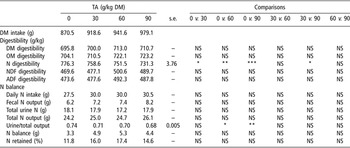
Nitrogen digestibility was decreased significantly by TA at all three levels of inclusion compared with control (Table 5). Faecal N output and urine-N remained unaffected by TA levels. The proportion of urine-N to the total N output decreased at two higher TA levels of 60 (P < 0.05) and 90 (P < 0.01).
Dry matter (DM), nutrient digestibility and nitrogen (N) balance in sheep fed tannic acid (TA)-sprayed alfalfa

*P < 0.05; **P < 0.01; ***P < 0.001; ****P < 0.0001; NS = not significant.
Gas production characteristics and net NH4-N production of faecal samples from sheep fed TA-sprayed alfalfa incubated in the presence and absence of PEG were not significantly affected by TA (Table 6). In the absence of PEG, the asymptotic gas production increased by 26%, 21% and 33% for 30, 60 and 90 g TA per kg DM, respectively. The Net NH4-N increased by 5, 19 and 26% at 30, 60 and 90 g TA per kg DM, respectively. In the presence of PEG, the asymptotic gas production increased by 16%, 15% and 28% at 30, 60 and 90 g TA per kg DM, while the net NH4-N increased by 8%, 14% and 34% at 30, 60 and 90 g TA per kg DM, respectively.
Gas production characteristics and net ammonia nitrogen (NH4-N) production of faecal samples from sheep fed tannic acid (TA)-sprayed alfalfa incubated in the presence and absence of polyethylene glycol (PEG)

Beta, location parameter; gamma, intrinsic rate of gas production (ml/h); GAST, extent (asymptotic gas production, ml).
Note: None of the comparisons was significantly different (P > 0.05).
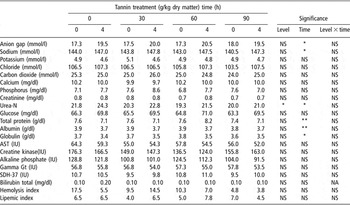
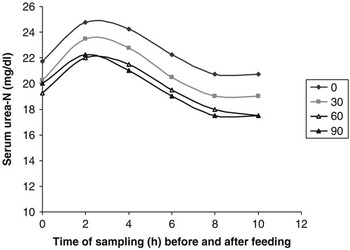
Blood anion gap and electrolytes (Na, K, Cl, Ca and P), metabolites (glucose, creatinine, albumin and total serum protein, total bilirubin) and enzymes (creatine kinase, AST, GGT and SDH) were unaffected by the TA treatment (Table 7). There was a sampling time effect for anion gap, Na, urea-N, total protein, albumin and globulin. Blood urea-N decreased as the TA level in the diet increased (P < 0.05). The pattern of serum urea-N level before and after feeding of TA-sprayed alfalfa is presented in Figure 3. Serum urea-N level peaked at about 2 h after feeding and then started to decline to the post-feeding level. The effect of TA concentration in alfalfa is reflected in the pattern with the control higher followed in order of TA concentration.
Effect of tannic acid (TA)-sprayed alfalfa feeding on serum metabolite and electrolyte concentration in sheep before and 4 h after feeding

AST = aspartate aminotransferase; SDH = sorbitol dehydrogenase.
*P < 0.05; **P < 0.01; NS = not significant; NA = not available.
Pattern of serum urea-N on feeding of alfalfa hay sprayed with tannic acid (0, 30, 60 and 90 g/kg dry matter).

Discussion
In vitro gas production and DM degradability
Spraying of alfalfa hay with TA had no effect on in vitro gas and SCFA production, but reduced NH4-N concentration. The decrease in NH4-N in the presence of TA was consistent with the findings of others (Singh et al., Reference Singh, Bhat and Sharma2001; Getachew et al., Reference Getachew, Pittroff, Putnam, Dandekar, Goyal and DePeters2008). The increased gas production, SCFA and NH4-N in the presence of PEG was an indirect measure of the biological activity of tannins. Previous studies showed a significant increase in gas and SCFA production from tannin-containing feeds in the presence of PEG (Getachew et al., Reference Getachew, Makkar and Becker2000 and Reference Getachew, Makkar and Becker2002; Frutos et al., Reference Frutos, Hervas, Giraldez and Mantecon2004). The increase in gas and SCFA production in the presence of PEG depends not only on the amount of tannins but also on the biological activity of tannins. The close relationship between the tannin-binding assay and the biological assay using PEG (Figure 1) indicates that both methods can be used to quantify the bioreactivity of tannins. The significant effect of TA at early hours (8 and 24 h) incubation on DM and fibre degradability compared to later hours (48 h) could be due to the adaptation of rumen microbes to tannins as suggested by Makkar (Reference Makkar2003). Murdiati et al. (Reference Murdiati, McSweeney and Lowry1992) reported the presence of gallic acid, ellagic acid and tannic acid in the rumen fluid of sheep dosed with TA. The presence TA metabolites in the rumen suggest that TA is degraded by rumen microbes.
TA is also used to reduce protein breakdown during the ensiling process. Spraying TA on alfalfa before ensiling affected neither N concentration nor effective degradability of crude protein (CP) but reduced the percentage of CP solubilised at initiation of incubation (Santos et al., Reference Santos, Oliveira, Petit, Cecato, Zeoula, Rigolon, Damasceno, Branco and Bett2000). However, soya bean treatment with TA reduced ruminal degradation and intestinal digestibility of proteins (Hervas et al., Reference Hervas, Frutos, Serrano, Mantecon and Giraldez2000).
The ability of tannins to precipitate different proteins varies considerably (Bennick, Reference Bennick2002). A competitive assay indicated that the relative affinity of proteins for condensed tannin varied more than 100-fold (Hagerman and Buttler, Reference Hagerman and Buttler1981). The highest affinities were for proteins, polypeptides and polymers with a high proline content, whereas small globular proteins such as lysozyme had the lowest affinity. Proteins that are large, with high proline, and with no secondary or tertiary structure, are readily precipitated by tannins (Bennick, Reference Bennick2002). Molecular characterisation of alfalfa protein would be an important step to predict the potential binding ability of alfalfa protein to tannins.
Nutrient digestibility and N balance
Although the study was aimed at improving the efficiency of N utilisation in the dairy system, the large quantity of feed required and the difficulty in total collection of faeces and urine from cattle appear to be the limiting factors in terms of cost and ease of operation. Woods et al. (Reference Woods, Moloney, Mulligan, Kenny and O’Mara1999) stated that sheep were often used as a model for digestion in cattle although there is a paucity of data to support this assumption. Sheep were fed at maintenance because feed intake affects the apparent digestibility of feeds. In general, as DM intake increased, apparent digestibility decreased in dairy cattle (National Research Council, 1989) and a similar trend was reported with sheep (Mulligan et al., Reference Mulligan, Caffrey, Rath, Callan and O’Mara2001). In fact, Mulligan et al. (Reference Mulligan, Caffrey, Rath, Callan and O’Mara2001) reported that the decrease in diet digestibility with increased feed intake could be attributed to higher rumen turnover rates observed in both sheep and cattle. Woods et al. (Reference Woods, Moloney, Mulligan, Kenny and O’Mara1999) reported that digestibility of concentrate ingredients obtained from sheep fed at maintenance were ‘applicable to maintenance fed cattle’. O’Mara et al. (Reference O’Mara, Coyle, Drennan, Young and Caffrey1999) fed sheep and cattle slightly about maintenance (1.15 to 1.35 times maintenance) diets of concentrate ingredients as well as a hay and soya bean diet. Apparent digestibility of OM, CP and NDF was not different between sheep and cattle. Thus, these data support the use of sheep as a model animal for estimating diet digestibility in cattle in response to increasing levels of tannic acid. Future work will involve cattle to relate diet digestibility with animal performance and nutrient excretion.
Alfalfa hay sprayed with TA was readily consumed regardless of the level of TA. This may be due to the presence of proline-rich protein (PRP) in saliva, which tends to bind to tannins and plays a protective role against the binding of tannins to mucosal proteins (Robbins et al., Reference Robbins, Mole, Hagerman and Hanley1987; Bacon and Rhodes, Reference Bacon and Rhodes2000). The brown colour of urine from sheep at the highest level of TA was consistent with previous reports (Plumlee et al., Reference Plumlee, Johnson and Galey1998). The presence of tannins in plants reduced the ruminal degradation of feed protein and also reduced N retention (Ben Salem et al., Reference Ben Salem, Nefzaoui, Makkar, Hochlef, Ben Salem and Ben Salem2005b). Thus, protein protection by tannins may not always increase N retention in animals. Reduction in fibre digestibility was observed when a tannin-containing plant was fed in the absence of PEG (Ben Salem et al., Reference Ben Salem, Nefzaoui, Ben Salem and Tisserand2000). Negative N balance was reported when tannin-containing browse was fed to sheep, despite a lack of effect on faecal and urinary N. The negative N balance was reversed by the inclusion of PEG in the diet (Ben Salem et al., Reference Ben Salem, Nefzaoui, Ben Salem and Tisserand2000). The higher faecal N as the TA level increased suggests that tannin–protein complexes that are formed in the rumen may not completely dissociate post ruminally. The reversibility of the tannin–protein complex formation may depend on the binding affinity of tannins to proteins and other macromolecules (Makkar, Reference Makkar2003).
Blood metabolites
In the current study, we have not measured the TA metabolites in blood, but other studies (Zhu and Filippich, Reference Zhu and Filippich1995) reported the presence of TA metabolites such as gallic acid, pyrogallo and 4-O-methyl gallic acid (4OMGA) in ruminal fluid, abomasal fluid, plasma and urine after an oral dose of TA (4 g/kg body weight), which is evidence of the degradation of TA by rumen microbes. Degradation of TA could be evidence of the presence of anaerobic bacteria capable of degrading aromatic compounds (Cheng et al., Reference Cheng, Jones, Simpson and Bryant1969; Simpson et al., Reference Simpson, Jones and Wolin1969; Krumholz and Bryant, Reference Krumholz and Bryant1986). Gallotannin can also be degraded to non-phenolic compounds such as methane and SCFA by anaerobic microbes (Field and Lettinga, Reference Field and Lettinga1987). One study reported the absence of pyrogallol after dosing calves with TA (Plumlee et al., Reference Plumlee, Johnson and Galey1998). Serum biochemistry was within the range that was reported by other authors (Zhu and Filippich, Reference Zhu and Filippich1992; Plumlee et al., Reference Plumlee, Johnson and Galey1998). Only blood urea-N was affected by both the level of tannin and sampling time after feeding, although other metabolites were affected by sampling time. The blood urea-N was elevated at 2 h after feeding and started to decline to the pre-feeding level. AAT and albumin concentrations were within the normal range. SDH is a member of the alcohol dehydrogenase family and is a homotetrameric Zn-enzyme that has been studied as a biomarker of toxic exposure (Dixon et al., Reference Dixon, Hodson and Kaiser1987).
When tannins are produced by the plant itself, their effect on the animal may be more severe than when TA is added externally. In a study that compared TA and oak leaves with comparable amounts of tannins, feeding oak leaves caused severe damage to the animal compared with TA (Plumlee et al., Reference Plumlee, Johnson and Galey1998). Oral administration of TA did not produce liver damage as evidenced in either blood parameters, which is consistent with other findings (Zhu and Filippich, Reference Zhu and Filippich1992 and Reference Zhu and Filippich1995; Plumlee et al., Reference Plumlee, Johnson and Galey1998) and confirmed by histological studies (Plumlee et al., Reference Plumlee, Johnson and Galey1998). The reason for the absence of liver damage in sheep following high levels of TA feeding is not entirely clear, although several factors may be involved. Following ingestion by ruminants, TA may bind to peptides and proteins or PRP in the saliva, mucous, ruminal contents and surface epithelial cells (Zhu and Filippich, Reference Zhu and Filippich1992), which may prevent the absorption of TA and eliminate any systematic effect of TA and its metabolite. Phenolic metabolites, such as pyrogallol, oxidise oxyhaemoglobin to methaemoglobin and cause methaemoglobinaemia (Plumlee et al., Reference Plumlee, Johnson and Galey1998). Rumen microbes are capable of degrading hydrolysable tannins. The toxic effects of tannin-containing feeds could therefore be due to both absorption of degraded products of hydrolysable tannins, and higher concentration of phenols in the blood stream exceeding liver detoxification capacity (Makkar, Reference Makkar2003).
Conclusion
Addition of TA had more pronounced effects on protein degradation than carbohydrate digestion as confirmed by both in vitro and in vivo studies. Absence of toxicity as evidenced by serum metabolites and electrolyte panel data in sheep consuming high levels of TA intake suggests that TA may be degraded by rumen microbes. However, this should be examined by blood analysis for TA metabolites. Although TA did not affect N retention, there was a reduction in urine-N as a proportion of the total N output, which might lead to a reduction in N emissions from urinary urea-N to the atmosphere. Faecal N increased as TA level increased, which suggests that the tannin–protein complexes formed in the rumen may not be fully dissociated post ruminally in sheep. The mechanism for tannin binding and dissociation in the digestive tract must be elucidated before further studies with dairy cattle are performed. Therefore, the factors that influence dissociation of tannin–protein complexes post ruminally warrant further study in sheep to better optimise the beneficial effects of tannin in improving N utilisation efficiency.
Acknowledgements
The authors thank Scott Taylor for his assistance with SCFA analysis, Nelmy Narvaez for protein precipitation assay and Martin Dally for help in animal management and blood sampling. The work was supported by the University of California Discovery grant and Forage Genetics International.