Infants with tetralogy of Fallot have immediate post-operative mortality of 1–2% with survival of approximately 90% during the first two decades of life.Reference Ooi, Moorjani and Baliulis1, Reference Lee, Lee and Kim2 Strong evidence exists demonstrating that patients with severe pulmonary regurgitation in repaired tetralogy of Fallot are at risk for death and can have severe right ventricular dilatation and dysfunction, tachyarrhythmias, and/or heart failure symptoms.Reference Murphy, Gersh and Mair3–Reference Ammash, Dearani and Burkhart11 Pulmonary valve replacement reduces end-diastolic and end-systolic volumes by 30–50% at 1-year post-procedure, yet indications and timing of pulmonary valve replacement remain controversial.Reference Meijboom, Roos-Hesselink and McGhie8–Reference Geva12 Cardiac MRI is well suited to complement clinical assessment of signs and symptoms of need for pulmonary valve replacement due to its ability to measure pulmonary regurgitation, right ventricular volume, and right ventricular function. Standard of care assessment of patients with tetralogy of Fallot for pulmonary valve replacement typically involves cardiac MRI, and there is ongoing investigation into how early after tetralogy of Fallot repairs pulmonary valve replacement should occur given the severity of sequelae in the third decade of life.Reference Meijboom, Roos-Hesselink and McGhie8–Reference Geva12
Food and Drug Administration approved assays for biomarkers of cardiac failure/function N-terminal pro-brain natriuretic peptide (NT-proBNP), soluble suppressor of tumorigenicity 2, and galectin-3 are used in children and adults with CHD.Reference Mueller and Djeplinger13–Reference Santaguida, Don-Wauchope and Oremus15 However, the relation of NT-proBNP, soluble suppressor of tumorigenicity 2, and galectin-3 to actual cardiac haemodynamics in patients with tetralogy of Fallot undergoing pulmonary valve replacement has not been described, diminishing their potential clinical value in this scenario.Reference Eindhoven, van den Bosch and Boersma16
NT-proBNP is the biologically inactive cleavage product of its prohormone. The active hormone brain natriuretic peptide is developmentally regulated with values peaking in infancy and decreasing to adult levels by age 6.Reference Koch and Singer17, Reference Albers, Mir and Haddad18 Brain natriuretic peptide is induced with atrial and ventricular stretch and has shown clinical diagnostic utility in children with heart failure, surgical repair of CHD, and pulmonary hypertension.Reference Eindhoven, van den Bosch and Boersma16, Reference Abman, Hansmann and Archer19
Soluble suppressor of tumorigenicity 2 is a cardiac stretch-induced member of the interleukin-1 receptor family, and is a circulating scavenger receptor for interleukin 33 that competes for ligand with the surface bound receptor (ST2L). Lack of interleukin 33/ST2L signalling has been associated with cardiac cellular death, cardiac fibrosis, and reduced cardiac function.Reference McCarthy and Januzzi20, Reference Lupu and Agoston-Coldea21
Galectin-3 is a carbohydrate-binding protein released by activated cardiac macrophages that becomes upregulated in decompensated heart failure. Galectin-3 has been implicated in the accumulation of myocardial collagen and alteration of the myocardial extracellular matrix, and is thought to play an active role in the pathogenesis of heart failure.Reference Paul and Harshaw-Ellis22–Reference Mohammed, Gafar and Hussien25
These biomarkers of heart failure/function could be particularly helpful in determining optimal timing of pulmonary valve replacement. To date, no study has compared NT-proBNP, soluble suppressor of tumorigenicity 2, and galectin-3 in CHD.Reference Paul and Harshaw-Ellis22–Reference Pérez-Piaya, Abarca and Soler29 Therefore, we aimed to determine if circulating and clinically available cardiac markers NT-proBNP, soluble suppressor of tumorigenicity 2, and/or galectin-3 are associated with cardiac haemodynamics at the time of pulmonary valve replacement. We hypothesised that NT-proBNP, soluble suppressor of tumorigenicity 2, and galectin-3 would have significant associations with right heart volume/pressure overload from pulmonary valve insufficiency and/or stenosis.
Materials and methods
This was an IRB approved study conducted with a waiver of consent at the Johns Hopkins Children’s Center between the dates 19 July, 2011 and 13 January, 2015. The study complied with appropriate institutional and national guidelines for ethical matters. Prospective patients undergoing interventional cardiac catheterisation for pulmonary valve replacement were studied (n = 16). Indications for pulmonary valve replacement at our institution follow generally accepted guidelines,Reference Geva30 asymptomatic patients would be considered if they had moderate or severe pulmonary regurgitation greater than or equal to 25% with two or more of the following criteria: right ventricular end-diastolic volume index >150 ml/m2 or z score >4, right ventricular end-systolic volume index >80 ml/m2, right ventricular ejection fraction less than 47% via MRI, QRS duration >160 ms, sustained tachyarrhythmia related to right-sided heart volume overload, right ventricular outflow tract obstruction with right ventricular systolic pressure approaching 70% systemic pressure, severe branch pulmonary artery stenosis not amenable to catheter therapy (for patients where catheter-based intervention was expected to be preferable to surgical intervention), and/or greater than or equal to moderate tricuspid regurgitation. Patients greater than or equal to 3 years of age at the time of repair for tetralogy of Fallot, along with women with severe pulmonary regurgitation and right ventricular dilatation at risk for pregnancy-related complications, would also be considered if they met one or more of the aforementioned criteria. Symptomatic patients would be considered if they met one or more of the aforementioned criteria. Symptoms have been defined as exercise intolerance, signs and symptoms of heart failure, and/or syncope attributable to arrhythmia. Serum samples for biomarker measurement were obtained from a pre-intervention blood sample obtained after femoral venous sheath placement in the catheterisation laboratory and before haemodynamic or angiographic determinations were made. Calculation of cardiac output in all cases used the Fick method (as opposed to measuring oxygen consumption). All cases were intubated with general anaesthesia. No positive end-expiratory pressure settings were used and all low pressure measurements such as right atrial pressures were measured at the end of expiration.
A custom-made robotically spotted multiplex chemoelectrolumiscent enzyme-linked immunosorbent assay for NT-proBNP, soluble suppressor of tumorigenicity 2, and galectin-3 (Meso Scale Discovery, Gaithersburg, MD, USA) was developed using commercial capture and detection antibodies and standards (R&D systems). The most recent cardiac MRI data prior to pulmonary valve replacement (indexed right ventricular and left ventricular volumes, and ejection fraction) were also compared to biomarker levels and invasive haemodynamics. Spearman correlation was used to identify significant correlations (p < 0.05) of biomarkers with baseline cardiac haemodynamics or cardiac MRI- derived volumes. Correlations are reported as Spearman correlation coefficient (r-value) and p-value.
Results
Heart failure biomarkers and cardiac haemodynamics
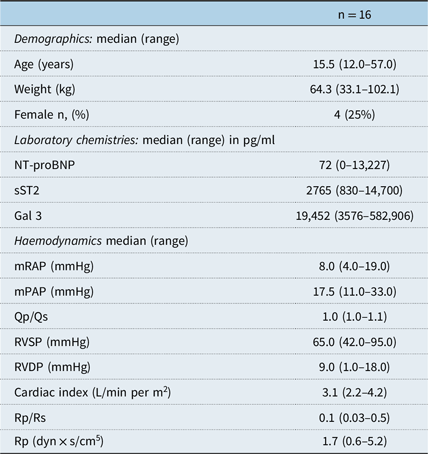
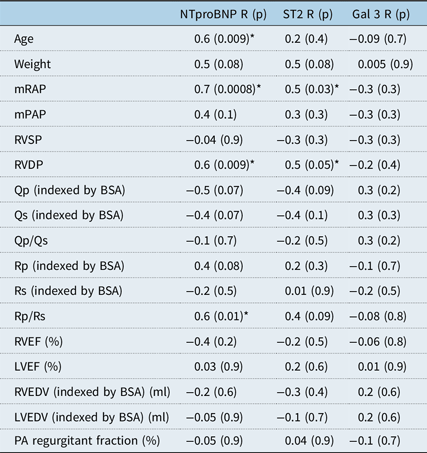
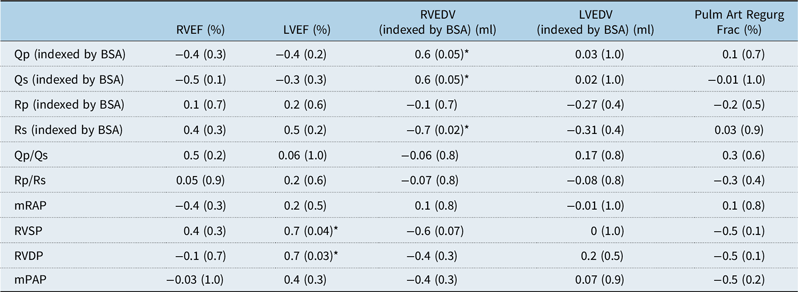
As shown in Table 1, 16 patients had transcatheter pulmonary valve replacement. Median age was 15.5 years and 25% were female (n = 4). Indications for pulmonary valve replacement were severe valve stenosis (n = 13), severe pulmonary regurgitation (n = 1), and a combination of stenosis and pulmonary regurgitation with right ventricular dysfunction (n = 2). More specifically, three patients had 66% systemic right ventricular pressures, the patient with severe pulmonary regurgitation had right ventricular volume greater than 200 ml/m2, and the two patients with moderate stenosis and pulmonary regurgitation with right ventricular dysfunction had right ventricular end-diastolic fractions of less than 40%. No patients had restrictive right ventricular physiology, right ventricular outflow tract aneurysm, decreased left ventricular ejection fraction, severe aortic regurgitation, or residual ratio of pulmonary to systemic flow > 1.5. Steady-state right heart pressures were mean right atrial pressure (median 8.0 mmHg), right ventricular end-diastolic pressure (median 9.0 mmHg), and right ventricular systolic pressure (median 65.0 mmHg). NT-proBNP and soluble suppressor of tumorigenicity 2 were significantly correlated with mean right atrial pressure (0.7, p = 0.0008 and 0.5, p = 0.03, respectively) and right ventricular end-diastolic pressure (0.6, p = 0.009 and 0.5, p = 0.05, respectively) (see Table 2). NT-proBNP alone was significantly correlated with age (0.6, p = 0.008) and the ratio of pulmonary to systemic vascular resistance (0.6, p = 0.01). Galectin-3 had no significant correlations. There were no significant correlations between biomarker levels and cardiac MRI-derived right heart function and ventricular volume measurements. There were no significant relationships between haemodynamic data and cardiac MRI obtained right ventricular ejection fraction, right ventricular end-diastolic volume, or pulmonary regurgitation fraction. Specifically, mean right atrial pressure and right ventricular end-diastolic pressure did not correlate with cardiac MRI-derived right ventricular end-diastolic volume, right ventricular ejection fraction, or pulmonary regurgitation (Table 3).
Clinical characteristics for cohorts.

NT-proBNP = N-terminal pro-brain natriuretic peptide; sST2 = soluble suppressor of tumorigenicity 2; Gal 3 = galectin-3; mRAP = mean right atrial pressure; mPAP = mean pulmonary artery pressure; Qp/Qs = ratio of pulmonary to systemic flow; RVSP = right ventricular systolic pressure; RVDP = right ventricular diastolic pressure; Rp/Rs = ratio of pulmonary to systemic vascular resistance; Rp = Pulmonary vascular resistance.
Data expressed as mean, median, number (n), percentage (%), or range as indicated.
Biomarker correlation to cardiac MRI and transcatheter obtained haemodynamic measurements.

NT-proBNP = N-terminal pro-brain natriuretic peptide; sST2 = soluble suppressor of tumorigenicity 2; Gal 3 = Galectin-3; mRAP = mean right atrial pressure; mPAP = mean pulmonary artery pressure; RVSP = right ventricular systolic pressure; RVDP = right ventricular diastolic pressure; Qp = pulmonary flow; Qs = systemic flow; Qp/Qs = ratio of pulmonary to systemic flow; Rp = Pulmonary vascular resistance; Rs = systemic vascular resistance; Rp/Rs = ratio of pulmonary to systemic vascular resistance; RVEF = right ventricular ejection fraction; LVEF = left ventricular ejection fraction; RVEDV = right ventricular end diastolic volume; LVEDV = left ventricular end diastolic volume; Pulm Art Regurg Frac = pulmonary artery regurgitant fraction; BSA = body surface area; PA = pulmonary artery.
Data expressed as r-value (p-value).
* p < 0.05.
Cardiac MRI correlation to transcatheter obtained haemodynamic measurements.

RVEF = right ventricular ejection fraction; LVEF = left ventricular ejection fraction; RVEDV = right ventricular end diastolic volume; LVEDV = left ventricular end diastolic volume; Pulm Art Regurg Frac = pulmonary artery regurgitant fraction; Qp = pulmonary flow; Qs = systemic flow; Rp = pulmonary vascular resistance; Rs = systemic vascular resistance; Qp/Qs = ratio of pulmonary to systemic flow; Rp/Rs = ratio of pulmonary to systemic vascular resistance; mRAP = mean right atrial pressure; RVSP = right ventricular systolic pressure; RVDP = right ventricular diastolic pressure; mPAP = mean pulmonary artery pressure; BSA = body surface area.
Data expressed as r-value (p-value).
* p < 0.05
Discussion
The repertoire of clinically available heart failure biomarkers has expanded past brain natriuretic peptide proteins to new markers such as soluble suppressor of tumorigenicity 2 and galectin-3, which reflect not only cardiac stretch but also cardiac pathobiology. Although NT-proBNP has been used clinically for patients with structural CHD, its comparison and potential efficacy to reflect invasive haemodynamics in patients with CHD lacks sufficient evidence to support predictable, regular use.
We demonstrate the ability of the cardiac heart failure biomarker proteins NT-proBNP and soluble suppressor of tumorigenicity 2 to reflect invasive haemodynamic derangements in right heart volume/pressure overload patients with tetralogy of Fallot and intention to treat with transcatheter pulmonary valve replacement. Galectin-3 did not demonstrate significant relationships to haemodynamics in this cohort.
This cohort of post-operative tetralogy of Fallot patients with intention to treat with a transcatheter pulmonary valve replacement, as expected, had elevated mean right atrial pressure, mean pulmonary artery pressure, right ventricular systolic pressure, and right ventricular end-diastolic pressure. These data are consistent with current knowledge of haemodynamics in clinical right ventricular and atrial volume overload with chronic pulmonary valve insufficiency with a transannular patch repair and residual pulmonary stenosis.Reference Meijboom, Roos-Hesselink and McGhie8–Reference Ammash, Dearani and Burkhart11, Reference Paul and Harshaw-Ellis22 Mean right atrial pressure and right ventricular end-diastolic pressure were increased and significantly positively correlated with NT-proBNP and soluble suppressor of tumorigenicity 2. The ratio of pulmonary to systemic vascular resistance median value was 0.1 (range 0.03–0.5) and was significantly positively correlated with NT-proBNP. Due to the broad age range of patients in our study and the range from mild to moderately elevated the ratio of pulmonary to systemic vascular resistance, it is difficult to assess the significance of this finding.
Interestingly, NT-proBNP and soluble suppressor of tumorigenicity 2 significantly correlated with mean right atrial pressure and right ventricular end-diastolic pressure but not with cardiac MRI- derived right ventricular volumes or ejection fraction. Cardiac MRI measures also did not correlate with mean right atrial pressure or right ventricular end-diastolic pressure. In a prior study, NT-proBNP levels have been found to correlate with cardiac MRI-derived right atrial area as a surrogate for increased right atrial pressure.Reference Kunii, Kamada and Ohtsuki26 However, right atrial area was not measured in our study. The disconnect between cardiac MRI volumes and invasive pressure measurements likely results from the complex pressure–volume relationships between mean right atrial pressure and right ventricular end-diastolic pressure, outflow tract surgical scar, and severe pulmonary insufficiency. It can be expected that the relationship between cardiac MRI-derived volume and invasive haemodynamic pressure measurement would be non-linear and highly dependent upon multiple factors such as age, pulmonary vascular resistance, and degree of residual pulmonary artery stenosis.
As NT-proBNP and soluble suppressor of tumorigenicity 2 correlated strongly with mean right atrial pressure and right ventricular end-diastolic pressure, they could be used as serial non-invasive correlates of cardiac haemodynamics to optimise timing of valve implantation or timing of cardiac MRI. NT-proBNP might reflect derangements in the ratio of pulmonary to systemic vascular resistance. In repaired tetralogy of Fallot patients, the timing of surgical or transcatheter pulmonary valve replacement is controversial.Reference Geva30 NT-proBNP and soluble suppressor of tumorigenicity 2 merit further investigation as estimates of right ventricular dysfunction and as measures of clinical improvement post-pulmonary valve replacement. Unlike soluble suppressor of tumorigenicity 2, NT-proBNP significantly positively correlated with age (0.6, p = 0.009). This finding potentially limits NT-proBNP as a predictor of right heart haemodynamics in adult CHD.
In conclusion, the cardiac stretch biomarkers NT-proBNP and soluble suppressor of tumorigenicity 2 were strongly correlated with elevated right heart pressures in patients selected for pulmonary valve replacement. NT-proBNP and soluble suppressor of tumorigenicity 2 had significant correlation to elevated right ventricular haemodynamics associated with elevated right ventricular volume and pressure. As clinical criteria for timing of pulmonary valve replacement are not well defined, the significant correlation of NT-proBNP and soluble suppressor of tumorigenicity 2 with right atrial and ventricular pressures may aid in a more rational assessment and optimal timing to preserve right ventricular function. As soluble suppressor of tumorigenicity 2 is not confounded by age, it may be a superior measure of right heart dysfunction in children.
Study limitations
A limitation of this study was its small sample size. In addition, our study had a broad age range that could have limited the detection of biomarker correlations. The biomarkers studied have been better characterised in adults than in children. The possibility of age as a confounder remains uncertain until more studies have examined these biomarkers in children. We also lacked serial sampling to better define the relevance in change of biomarker levels with right ventricular volume, regurgitant fraction, and function over time. This study analysed correlations, which was the appropriate method to probe for a relationship between haemodynamics and biomarker levels. Further research should address whether altered haemodynamics in these patient populations causes the release of biomarkers associated with cardiac stretch. The Fick method was used to measure cardiac haemodynamics, as opposed to direct measurement of oxygen consumption. As both methods have their own known flaws, this limitation of the study was known and not avoidable.
Acknowledgements
None.
Financial support
This research was funded by NHLBI R01 HL119664 (J.R.B.), and grant funded to Allen D. Everett.
Conflicts of interest
None.
Ethical standards
The authors assert that all procedures contributing to this work comply with the ethical standards of the relevant national guidelines on human experimentation and with the Helsinki Declaration of 1975, as revised in 2008, and have been approved by the institutional committee at the Johns Hopkins Hospital located at Baltimore, MD.