Introduction
Warming climates have the potential to modify the interactions among species with uncertain outcomes on populations and communities (Donnelly et al., Reference Donnelly, Caffarra and O'Neill2011). In particular, the synchrony between the emergence of spring-active defoliators and the budburst of their host plants could be affected by increasing temperatures (Parmesan, Reference Parmesan2007; Both et al., Reference Both, van Asch, Bijlsma, van den Burg and Visser2009; Singer & Parmesan, Reference Singer and Parmesan2010; Donnelly et al., Reference Donnelly, Caffarra and O'Neill2011). Synchrony between these two events is thought to enable these insects to feed on newly flushed young leaves that are generally nutritionally superior to older foliage (Feeny, Reference Feeny1970; Larsson & Ohmart, Reference Larsson and Ohmart1988; Hunter & Elkinton, Reference Hunter and Elkinton2000; van Asch & Visser, Reference van Asch and Visser2007). Typically, as leaves mature, leaf toughness increases, water content decreases, foliar sugar/protein ratio shifts from protein-dominated to sugar-dominated compounds (Ayres & MacLean, Reference Ayres and MacLean1987; Haukioja et al., Reference Haukioja, Ossipov and Lempa2002) and tannins tend to increase in older foliage (Feeny, Reference Feeny1970). For these reasons, larval growth, development and survival of folivorous insects most commonly declines as leaves mature (Ayres & Maclean, Reference Ayres and MacLean1987; Larsson & Ohmart, Reference Larsson and Ohmart1988; Haukioja et al., Reference Haukioja, Ossipov and Lempa2002). Shifts in synchrony can therefore affect food quality for insect herbivores with consequences for their survival, fitness and population viability (Raupp et al., Reference Raupp, Werren and Sadof1988; Quiring, Reference Quiring1992; van Asch & Visser, Reference van Asch and Visser2007).
The thermal environment (temperature and light together) of insects and their host plants can be crucial to the fitness of the insect herbivores. Temperature can influence insect herbivores by directly affecting the rates of growth and development (e.g. Knapp & Casey, Reference Knapp and Casey1986; Stamp & Bowers, Reference Stamp and Bowers1994; Yang & Stamp, Reference Yang and Stamp1996) and/or indirectly through effects on host plant phenology and quality (e.g. Stamp & Bowers, Reference Stamp and Bowers1994; Aizen & Patterson, Reference Aizen and Patterson1995; Dury et al., Reference Dury, Good, Perrins, Buse and Kaye1998; Levesque et al., Reference Levesque, Fortin and Mauffette2002). The light environment can also affect insect herbivores through effects on plant quality. The effects of temperature and light on insect herbivores via leaf quality can be correlated (Niesenbaum & Kluger, Reference Niesenbaum and Kluger2006). For example, leaf tannin and carbon-based secondary compounds, including phenolics, increase in response to high temperature and light levels (Nichols-Orians, Reference Nichols-Orians1991; Dudt & Shure, Reference Dudt and Shure1994; Close & McArthur, Reference Close and McArthur2002), and this can reduce leaf suitability for herbivores (Feeny, 1970; Roberts & Paul, Reference Roberts and Paul2006). Shade and cooler temperatures can increase leaf water content (Henriksson et al., Reference Henriksson, Haukioja, Ossipov, Ossipova, Sillanpää, Kapari and Pihlaja2003; Moran & Showler, Reference Moran and Showler2005), total nitrogen and/or amino acid concentrations in some systems (Crone & Jones, Reference Crone and Jones1999; Moon et al., Reference Moon, Rossi and Stiling2000; Henriksson et al., Reference Henriksson, Haukioja, Ossipov, Ossipova, Sillanpää, Kapari and Pihlaja2003; Moran & Showler, Reference Moran and Showler2005; Roberts & Paul, Reference Roberts and Paul2006, but see Louda & Rodman, Reference Louda and Rodman1996; Koricheva et al., Reference Koricheva, Larsson, Haukioja and Keinanen1998; Rowe & Potter, Reference Rowe and Potter2000), and can reduce leaf sugars and toughness (Henriksson et al., Reference Henriksson, Haukioja, Ossipov, Ossipova, Sillanpää, Kapari and Pihlaja2003), which may have a strong influence on herbivore fitness traits (Slansky, Reference Slansky, Stamp and Casey1993; Henriksson et al., Reference Henriksson, Haukioja, Ossipov, Ossipova, Sillanpää, Kapari and Pihlaja2003; Roberts & Paul, Reference Roberts and Paul2006). Generally, the insect performance is improved in warm, sunlit habitats (e.g. Lincoln & Mooney, Reference Lincoln and Mooney1984; Nichols-Orians, Reference Nichols-Orians1991; Fortin & Mauffette, Reference Fortin and Mauffette2001; Levesque et al., Reference Levesque, Fortin and Mauffette2002; Niesenbaum & Kluger, Reference Niesenbaum and Kluger2006, but see Lindroth et al., Reference Lindroth, Reich, Tjoelker, Volin and Oleksyn1993; Crone & Jones, Reference Crone and Jones1999; Henriksson et al., Reference Henriksson, Haukioja, Ossipov, Ossipova, Sillanpää, Kapari and Pihlaja2003; Muth et al., Reference Muth, Kluger, Levy, Edwards and Niesenbaum2008), but how different thermal environments influence phenological interactions between insect herbivores and their host plants is an open question.
While some long-term studies have monitored annual variation in the synchrony of budburst and egg hatch (van Asch & Visser, Reference van Asch and Visser2007 and references therein), experimental manipulation of thermal environments can be used to explore phenological interactions between insect herbivores and their host plants in a shorter period of time. These have been relatively underutilized. Here, we used variation in ambient temperatures and light levels between sun-exposed and shaded trees to determine whether the synchrony between egg hatch of western tent caterpillars Malacosoma californicum pluviale Dyar (Lepidoptera: Lasiocampidae), a spring-active generalist polyphagous insect – and budburst of one of its host plants – the red alder, Alnus rubra Bongard (Betulaceae) – changes with different thermal environments. We deployed egg masses on north (shaded) and south (sun-exposed) branches of red alder trees to experimentally manipulate the timing of budburst and egg hatch and evaluate the influence of this timing on larval growth and development. We predicted that budburst and egg hatch would be better synchronized in warmer, sunlit environments.
To explore the potential outcome of a disruption in phenological synchrony, we carried out laboratory assays to determine the effect of variation in the quality of young, youthful and mature leaves on larval growth and development for both sun-exposed and shaded leaves. While most first instar larvae hatch more or less in synchrony with budburst, some emerge as late as 3–5 weeks after budburst when mostly mature leaves are available (Sarfraz, Myers and Kharouba, personal observation). A previous attempt to disrupt the synchrony between the timing of egg hatch and leaf development in this species found that a forced delay in egg hatching had little influence on the time to reach the fifth instar (Myers, Reference Myers1992). Therefore, we predicted that late emerging insects would catch up to early emerging insects.
Study system
We selected the western tent caterpillar–red alder system, as there is normally a strong synchrony between different phenological events of the insect herbivore and its host plant. Further, tent caterpillars offer an excellent system to detect the potential impact of increasing temperatures on synchrony as being early spring-active herbivores they have only a narrow window of time for their larval activities. Larvae hatch in early spring at roughly the same time as budburst (late March/early April) and have five instars. They mature in 6–8 weeks under optimal conditions and pupate in June/July. Adults emerge after two weeks, and without feeding, they mate and each female lays a single egg mass on a twig of the host tree. Shortly after the egg mass is deposited, embryogenesis begins and pharate larvae develop and remain within the eggs until the following spring. Western tent caterpillars are univoltine. They are gregarious as larvae and make a communal tent, which gradually expands as the larvae grow (Brunner, Reference Brunner1993; Fitzgerald, Reference Fitzgerald1995). Caterpillars can elevate their body temperatures as much as 21 °C above ambient temperature by basking in the sun (Frid & Myers, Reference Frid and Myers2002).
Red alder is a deciduous broadleaf tree, native to western North America and is most often observed as a lowland species along the northern Pacific coast (Harrington et al., Reference Harrington, Zasada, Allen, Hibbs and Tarrant1994). It begins budburst in spring, and budburst and leaf development are expected to occur earlier on south-facing trees than on north ones (Moore et al., Reference Moore, Myers and Eng1988). Leaves of red alder continue to mature and undergo physical and chemical changes as the season progresses. For example, leaf phenolic compounds including condensed tannins decrease from spring through fall. Leaf fiber content (e.g. neutral detergent fiber, acid detergent fiber and lignin) of green leaves increases from spring through summer to fall, but crude protein content remains high, perhaps because red alder is a nitrogen fixer (González-Hernández et al., Reference González-Hernández, Starkey and Karchesy2000).
Materials and methods
Field study
This study was designed to evaluate the timing of egg hatch and budburst, and larval growth and development on south, sun-exposed, and north, shaded trees under field conditions. The experiment was carried out at Totem Field at the University of British Columbia (UBC), Canada on a grove of red alders that were planted about 15 years ago. One row of trees faces south and one faces north (over 50 trees in total). Of these, 30 trees were chosen (15 south facing and 15 north facing).
Overwintered egg masses of western tent caterpillars were collected from apple trees on Saturna Island, British Columbia in February 2010 and brought to UBC where they were kept outdoors until they were attached to the distal ends of individual branches of each tree starting on March 10 (one egg mass/branch). Branches were selected based on their relative height from ground, the presence of live buds in close proximity to each other, sufficient diameter to attach egg masses and distance from the main trunk in order to avoid complete shading. Small temperature loggers (iButtons®, Maxim Integrated Products Inc., USA) were attached to branches of both south and north sides of trees, and recorded the temperature every 15 min for the duration of the experiment.
Branches were checked daily to semi-daily for evidence of budburst, number of leaves, length of the longest leaf, egg hatch and larval instar. Once individuals reached the third instars, 10 larvae were arbitrarily selected from each family every 4 days and were weighed in the laboratory. Growth rate to the third instar was calculated as the larval mass divided by the number of days between egg hatch and day of weighing. After the third instar, most families on the north side disappeared, likely in search of more direct sun. Therefore, the field study was terminated soon after the larvae reached third instar. ‘Spring’ was defined as the first day of budburst (March 10) until egg hatch across all groups (April 30). Maximum and mean daily maximum temperatures for this period were calculated. Daily temperatures were taken from 6:00 h to 18:00 h.
To test for differences in budburst, egg hatch, degree of synchrony (number of days between budburst and egg hatch), growth rate and daily temperature between sun and shade habitats, we used a generalized least squares model fit using maximum likelihood where variance was allowed to vary based on aspect using the varIdent variance function in R. To meet normality assumptions, we took the inverse of budburst, egg hatch, synchrony; maximum daily temperature; and log-transformed growth rate and mean daily maximum temperature. To determine whether growth rate of leaves differed between treatments, we used a repeated measures approach with length as our response variable and time (day of year) and habitat as fixed effects. Tree, branch and day (to account for multiple leaves measured) were random effects. To improve homoscedasticity, variance was allowed to vary exponentially with time. To evaluate model fit, full models were compared with a reduced model using a likelihood ratio test. These analyses were done using R 2.14.1 (R Development Core Team, 2012). For presentation mean values followed by standard errors are used throughout.
Laboratory assays: larval survival, growth and development
The laboratory assays were used to study the variation in larval performance related to three leaf maturation stages and aspect (sun versus shade). Egg masses from the same group collected for the field study were kept outdoors for one month, and then transferred to individual paper cups at room temperature (ca. 22 °C) and allowed to hatch. Larvae were fed red alder leaves collected from the south-facing (sun-exposed) and north-facing (shaded) rows of red alder trees from Totem Field (see the ‘Field Study’ section for details). We used three-leaf age classes based on their position on branches as described by Lowman & Box (Reference Lowman and Box1983), i.e. young (age class-I, 1.0–2.5 cm), ‘youthful’ (age class-II, 3.0–5.0 cm) and mature (age class-III, >5.0 cm). The entire laboratory assay was repeated twice, 5 days apart; the first assay consisted of 10 trees from each side (N=10 egg masses) and the second assay consisted of nine trees from each side (N=9 egg masses). In both assays, trees were considered as random effects and three types of leaf sizes were collected from each south and north side tree.
First-instar larvae from the families (egg masses) were mixed and distributed across treatments. Larvae were introduced into plastic cups (N=10 larvae per cup) and three cups for each tree were prepared (one cup for each leaf size). Each group was fed fresh leaves from the same tree consistently throughout the experiment. These assays were carried out in a growth chamber at 20±1 °C with 18 h light and 15±1 °C with 6 h dark cycle. Larval survival was recorded daily throughout this experiment. When larvae moulted to the third instars, they were separated and reared individually (one larva per cup) until the experiment was terminated. Third-instar larvae were weighed when they were 1 day and 5 days old. As the insects consumed more young leaf tissue than was available at this stage, newly moulted fourth instar larvae were randomly subsampled from each cohort for continued feeding. Fourth instar larvae were weighed when they were 1 day and 5 days old. Larval growth rates for third and fourth instars were calculated following Kerslake & Hartley (Reference Kerslake and Hartley1997): growth rate (g day−1)=larval weight gain/number of days feeding. Newly moulted (<1 day) fourth-instar larvae were observed daily until they moulted into fifth instars (<1 day) and the development time for each larva was calculated based on the number of days between two consecutive moults. The experiment was terminated when larvae either died or moulted to the fifth instar.
The results of the two full assays were similar and therefore data for both assays were pooled for analysis (survival of first, second, third and fourth instars: χ21=0.90, P=0.34; χ21=0.28, P=0.60; χ21=0.18, P=0.67; and χ21=0.33, P=0.57, respectively; growth rate of third instars: χ21=1.42, P=0.56; growth rate of fourth instars: χ21=0.03, P=0.86; and development time: χ21=2.01, P=0.39). Larval survival was analyzed using generalized linear models in JMP 8.02 (SAS Institute Inc., 2010). Leaf age, thermal environment (south versus north) and their interaction were first added to the model and then the non-significant terms were removed sequentially. Data for larval growth rate and development time were log transformed to meet normality assumptions and analyzed with mixed effects models using the restricted maximum likelihood estimation method. Leaf age and thermal environment were treated as fixed effects with log10 initial larval weight as a continuous covariate and tree as a random effect. All factors and their interactions were first added to the models and then the non-significant terms were removed sequentially. A Tukey–Kramer HSD test (α=0.05) was used for multiple comparisons (JMP 8.02; SAS Institute Inc., 2010).
Results
Field study
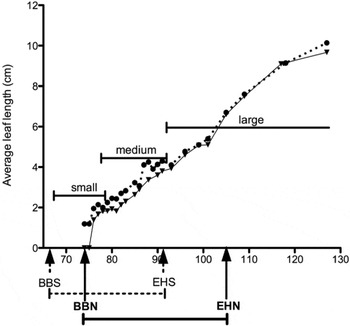
The increased sun exposure of the south-facing trees was associated with warmer temperatures with the maximum and mean daily maximum temperatures being significantly higher on the south side compared with the north side (mean=3.06±0.90 °C, LRT=15.52, df=1,26, P<0.001; mean=2.78±0.39 °C, LRT=53.09, df=1,26, P<0.001, respectively). Warmer temperatures modified the phenology of both buds and larvae. Budburst and egg hatch were significantly earlier on the south side by 4.83±0.69 and 3.91±1.68 days on average, respectively (LRT=29.35, df=2,4, P<0.001; LRT=17.34, df=2,4, P<0.001). However, the degree of synchrony (number of days between budburst and egg hatch) was not significantly different between aspects (LRT=3.00, df=2,4, P=0.22). Larval growth rate was also significantly faster on the south side by a mean rate of 0.272 g d−1 ±0.11SE (LRT=6.09, df=2,4, P=0.048). While the leaves were slightly longer on the south side over the first 17 d (fig. 1; LRT=1.84, df=7, 8, P=0.18), neither leaf growth rate nor leaf length across the entire experiment differed significantly between habitats (LRT=1.49, df=8, 9, P=0.22; LRT=1.74, df=7, 8, P=0.19).
Change in average leaf length (cm) for 15 south-facing (circles and dotted line) and 15 north-facing trees (triangles and solid line) over Julian days (day 1=January 1). Measurements started on 15 March 2010. Young (small), youthful (medium) and mature (large) indicate the days over which the average sizes of leaves were in the range used in the food quality bioassays. Differences in synchrony for south (S)- and north (N)-facing trees represented by the number of days between earliest budburst (BB) and earliest egg hatch (EH) across each row.

Laboratory assays: larval survival, growth and development
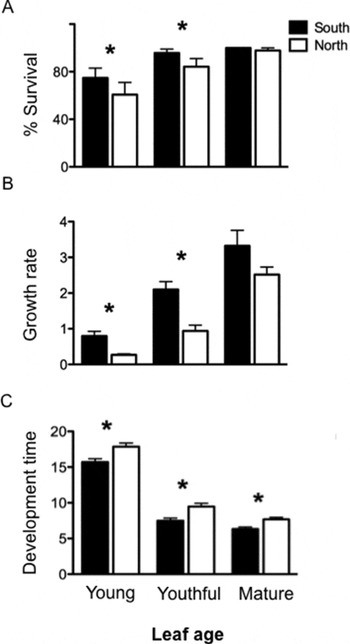
Survival of larvae for the first three instars was 100, 97 and 99%, respectively, and was not influenced by leaf age (χ22=2.23, P=0.99, N=1140; χ22=3.33, P=0.19, N=1139; χ22=3.91, P=0.14, N=1104, respectively) or thermal environment (χ21=5.98, P=0.99, N=1140; χ21=0.14, P=0.70, N=1139; χ21=0.90, P=0.34, N=1104, respectively). For fourth instars, both leaf age and thermal environment significantly affected larval survival (χ22=87.28, P<0.001, N=566; χ21=7.71, P=0.006, N=566, respectively), but the interaction between leaf age and thermal environment was not significant (χ22=2.91, P=0.23). Survival of fourth instars was significantly lower on young (23%) and youthful (14%) leaves from the north side than on corresponding leaves from the south side trees, but this was not the case for larvae fed mature leaves (fig. 2a).
(a) Survival (% and binomial confidence limit) of fourth instars when larvae were fed young, youthful and mature leaves from either south-facing (filled bars) or north-facing (open bars) red alder trees (χ21=11.50, P<0.001, N=186; χ21=12.40, P<0.001, N=190; and χ21=2.06, P=0.15, N=190, respectively); (b) larval growth rate (g d−1×100, mean and SE) of fourth instars when larvae were fed young, youthful and mature leaves from either south-facing (filled bars) or north-facing (open bars) trees (F=5.12, df=1, 121, P=0.03; F=6.25, df=1, 166, P=0.02; and F=0.05, df=1, 183, P=0.82, respectively); (c) development time (days, mean and SE) of fourth instars when larvae were fed young, youthful and mature leaves from either south-facing (filled bars) or north-facing (open bars) trees (F=35.14, df=1, 121, P<0.001; F=34.17, df=1, 166, P<0.001; and F=60.01, df=1, 183, P<0.001, respectively). *indicates significant difference.

The growth rate of the third-instar larvae was significantly influenced by leaf age (F=30.42, df=2, 1084, P<0.001) but not by thermal environment (F=3.37, df=1, 1084, P=0.07), and the interaction between leaf age and thermal environment was not significant (F=2.78, df=2, 1084, P=0.07). Growth rate of the third instar larvae was significantly higher on mature leaves compared with youthful and young leaves (1.05±0.12, 0.64±0.06 and 0.50±0.06, respectively; Tukey–Kramer HSD test). Growth rate of the fourth instar larvae was significantly influenced by both leaf age (F=10.37, df=2, 476, P<0.001) and thermal environment (F=4.76, df=1, 476, P=0.03), but the interaction between leaf age and shading was not significant (F=0.92, df=2, 476, P=0.40). Growth rate of the fourth instars was significantly higher on mature leaves overall but larvae grew better on young (53% higher) and youthful (85% higher) leaves from south compared with north side trees. Larval growth rate was similar and better on mature leaves from south-facing and north-facing trees (fig. 2b).
Development of the fourth-instar larvae was significantly affected by both leaf age (F=37.59, df=2, 476, P<0.001) and thermal environment (F=24.71, df=1, 476, P<0.001), but the interaction between leaf age and thermal environment was not significant (F=2.87, df=2, 476, P=0.07). Larval development was fastest on mature leaves and slowest on young leaves. Moreover, larvae developed faster on young (14%), youthful (27%) and mature (22%) leaves from the south than the north side trees (fig. 2c).
Discussion
The thermal environment of insects and their host trees can be crucial to the fitness of the insect herbivores. We used the temperature and light differences between north-facing (shade) and south-facing (sun) trees to experimentally manipulate the timing of budburst and egg hatch. While the 3 °C average higher temperature of southern trees advanced the timing of budburst and egg hatch, synchrony was not disrupted. Therefore, larvae would have fed on leaves in the same developmental stage under both thermal conditions. Moreover, our results suggest that the overall degree of synchrony between tent caterpillars and red alders can be robust to differences in thermal environments, although more work is needed to determine the relative importance of temperature and lack of direct sunlight in influencing phenological synchrony.
Leaf quality had no significant influence on growth or survival in the laboratory for early instars reared as family groups, suggesting that early instar western tent caterpillars may not be as influenced by synchrony with leaf phenology as late instar larvae. This could be interpreted as an adaptation to phenological variability in budburst across years and among sites (Parry et al., Reference Parry, Spence and Volney1998; van Asch & Visser, Reference van Asch and Visser2007). For gregarious western tent caterpillars the strategy of young larvae is to manage absent or poor quality foliage by ‘persisting’, perhaps on remaining yolk stores, rather than ‘escaping’ through ballooning as used in some other Lepidoptera for which larvae are solitary (Zalucki et al., Reference Zalucki, Clarke and Malcolm2002 and references therein). Examples of early spring Lepidoptera with ballooning behavior are winter moth, Operophtera brumata (Briggs, Reference Briggs1957; Edland, Reference Edland1971), Bruce spanworm, O. bruceata (Brown, Reference Brown1962), and gypsy moth, Lymantria dispar (Taylor & Reling, Reference Taylor and Reling1986).
Later instar larvae performed better on mature leaves from south-facing trees than on younger leaves from the same aspect. The improved growth and survival of fourth instar larvae on mature leaves is the opposite of what might be predicted given that leaf age is often linked with decreasing nutritional suitability (Feeny, Reference Feeny1970; Ayres & MacLean, Reference Ayres and MacLean1987; Haukioja et al., Reference Haukioja, Ossipov and Lempa2002). Previous studies that have found reduced herbivore fitness on mature leaves could be due to differences in the study system or classification of leaf age (e.g. Coley, Reference Coley1980; Ayres & Maclean, Reference Ayres and MacLean1987; Larsson & Ohmart, Reference Larsson and Ohmart1988; Haukioja et al., Reference Haukioja, Ossipov and Lempa2002). For example, red alder trees, as nitrogen fixers, show different patterns of chemical changes in foliage and protein levels remain high and phenolics decline as leaves mature during the summer (González-Hernández et al., Reference González-Hernández, Starkey and Karchesy2000). In addition, most studies only used later larval instars (e.g. Haukioja et al., Reference Haukioja, Ossipov and Lempa2002), potentially eliminating the detection of effects of instar-specific adaptations to a particular leaf age.
Based on differences in larval performance on different leaf age groups, our results suggest that late emerging insects may not only catch up with early emerging insects, but also that they may perform better than their early emerging counterparts in terms of higher survival, better growth, and faster development. Some studies show that a reduction in synchrony between egg hatch and budburst can have consequences for insect fitness (Wint, Reference Wint1983; Raupp et al., Reference Raupp, Werren and Sadof1988; Quiring, Reference Quiring1992; van Asch & Visser, Reference van Asch and Visser2007). For example, gypsy moth (Miller et al., Reference Miller, Hanson and Kimberling1991), winter moth (van Dongen et al., Reference van Dongen, Backeljau, Matthysen and Dhondt1997), autumnal moth (Epirrita autumnata) (Haukioja et al., Reference Haukioja, Ossipov and Lempa2002), and forest tent caterpillars (Malacosoma disstria) (Parry et al., Reference Parry, Spence and Volney1998) feeding on older leaves have low survival, grow at slower rate, and are much lighter at pupation. Other studies have found that close synchrony is not important for larval performance (Watt & McFarlane, Reference Watt and McFarlane1991; Myers, Reference Myers1992; Kerslake & Hartley, Reference Kerslake and Hartley1997; but see Jones & Despland, Reference Jones and Despland2006). Flexibility in emergence dates for spring-active folivores could be a strategy to decrease sensitivity to inter-annual weather fluctuations (Reynolds et al., Reference Reynolds, Ayres, Siccama and Holmes2007). Certainly, more work is needed to determine the context under which phenological synchrony is important for survival, growth and development.
We found that overall developmental performance of the tent caterpillars was higher on south, sun-exposed leaves than on north, shade-exposed leaves. Larval development time in the field was substantially prolonged on north side trees (ca. 30 days more than on south ones) and most larvae on north-facing trees did not complete development. These results are not consistent with the resource allocation hypothesis which posits that since leaves growing in direct light have higher carbon/nutrient ratio, contain relatively more carbon-based secondary compounds, fewer mineral nutrients and proteins compared with plants growing in shade or under suboptimal light conditions (Coley et al., Reference Coley, Bryant and Chapin1985; Herms & Mattson, Reference Herms and Mattson1992; Henriksson et al., Reference Henriksson, Haukioja, Ossipov, Ossipova, Sillanpää, Kapari and Pihlaja2003; Muth et al., Reference Muth, Kluger, Levy, Edwards and Niesenbaum2008; Endara & Coley, Reference Endara and Coley2011), sun-exposed leaves should be less nutritious for insect herbivores than those that are shaded. Our results support work by Moore et al. (Reference Moore, Myers and Eng1988) who reported that more egg masses and tents occurred on the south-facing than on north-facing trees and that pupae were significantly heavier when reared as larvae on leaves from the sun-exposed trees. Similarly, larval growth rates of forest tent caterpillars were higher on sun-exposed than shaded leaves (Levesque et al., Reference Levesque, Fortin and Mauffette2002). Louda & Rodman (Reference Louda and Rodman1996) and Sipura & Tahvanainen (Reference Sipura and Tahvanainen2000) also demonstrated that herbivorous insects preferred host plants growing in open habitats and their developmental performance was higher in open than shady areas.
Abiotic factors, particularly temperature, likely played a key role in the differences in developmental performance of larvae between sun-exposed and shaded trees through direct and indirect effects. Daily temperatures were significantly cooler on the shaded side and temperature is known to play a key role in insect development and growth (Frid & Myers, Reference Frid and Myers2002; Levesque et al., Reference Levesque, Fortin and Mauffette2002; Niesenbaum & Kluger, Reference Niesenbaum and Kluger2006). Moreover, without direct sun, it would be more difficult for north-facing larvae to elevate their body temperatures by basking, a behavior thought to be important for the persistence of this species (Myers, Reference Myers2000). Our results also suggest that leaf quality was higher on the sun-exposed branches, thus improving developmental performance of the insect herbivores (Stamp & Bowers, Reference Stamp and Bowers1994; Dury et al., Reference Dury, Good, Perrins, Buse and Kaye1998).
Given that seasonal timing of many biological events are shifting at differing rates in response to climatic changes across taxonomic levels, phenological synchronizations between closely interacting species are likely to change in the future (Edwards & Richardson, Reference Edwards and Richardson2004; Winder & Schindler, Reference Winder and Schindler2004; Parmesan, Reference Parmesan2007; Both et al., Reference Both, van Asch, Bijlsma, van den Burg and Visser2009; Donnelly et al., Reference Donnelly, Caffarra and O'Neill2011). The relationship between the timing of larval and leaf development appears to be robust in western tent caterpillars with early instars of this gregarious species showing little influence of premature or delayed egg hatch, although the field data presented were for one site-year and the phenological window considered here was narrow. However, shifts in the timing of emergence or temperature-associated changes in development time could alter the degree of exposure to predation (Parry et al., Reference Parry, Spence and Volney1998, but see Singer & Parmesan, Reference Singer and Parmesan2010), parasitism (Hicks et al., Reference Hicks, Aegerter, Leather and Watt2007), and potentially mediate sensitivity to disease infections (Sarfraz RM, unpublished data) and degree of insect-pathogen synchrony with possible consequences for the dynamics of their interactions. Warming climates may not have a strong negative impact on insect herbivore success through shifts in phenological synchrony but might influence other aspects of leaf quality, larval condition, pupal development, and timing of mating and oviposition. Further research under experimental warming conditions would allow these predictions to be investigated (Kharouba et al., unpublished data).
Acknowledgements
We thank Aimee Gibson, Ian Bishop, Kelsie Hardman, and Krysta Banack for technical assistance. This research was supported by a postdoctoral fellowship from the Natural Sciences and Engineering Research Council of Canada to Sarfraz, an NSERC CGS-D award to Kharouba, and an NSERC Discovery Grant to Myers.