

Introduction
Horses, in comparison with almost every other land mammal, have a greater maximal aerobic capacity relative to body mass. According to PooleReference Poole1, the Thoroughbreds, in particular, ‘can deliver and consume more O2 in toto per unit body mass than any other mammal of their respective size’Reference Poole1. The maximal rate of oxygen consumption (VO2max) of an individual is an indicator of aerobic athletic abilityReference Poole1–Reference Marlin and Nankervis3, and is the product of central factors affecting oxygen delivery and peripheral factors influencing the ability to utilize oxygen at the tissue levelReference Poole1–Reference Marlin and Nankervis3. As expressed in the Fick equation: VO2 = Q × (a − v)O2, where Q is the cardiac output in l min− 1 and (a − v)O2 is the arterial venous oxygen content differenceReference Poole1–Reference Marlin and Nankervis3. In general terms, there are multiple central factors that limit VO2, all of which are associated with the lungs and heart and their interrelated ability to deliver oxygenated blood to the peripheryReference Poole1–Reference Marlin and Nankervis3. These include factors such as alterations in lung function, alveolar permeability, blood volume, heart rate and all the determinants of stroke volume that have the potential to affect cardiac outputReference Poole1–Reference McKeever and Hinchcliff4. Utilization in the tissues can further be affected by a host of factors affecting membrane permeability, capillarization, fibre type distribution, mitochondrial density and the pathways, enzymes, and cofactors affecting aerobic metabolism in the cellReference Poole1–Reference McKeever and Hinchcliff4.
Published studies of humans, horses and other species have reported that the documented decline in aerobic capacity is the result of ageing-induced decreases in many of the above-mentioned central as well as peripheral mechanisms affecting the ability to transport and utilize oxygenReference McKeever and Malinowski5–Reference Pollock, Foster, Knapp, Rod and Schmidt14. A decline in maximal cardiac output appears to be one of the major central factors associated with the age-related decrease in VO2max in humansReference Lakatta and Masoro10, Reference Raven, Mitchell and Westfeldt15, Reference Seals, Hagberg, Hurley, Ehsani and Holloszy16. The age-related decline in maximal cardiac output results from both a decline in factors affecting stroke volume and a decrease in maximal heart rate (HRmax)Reference Lakatta and Masoro10, Reference Raven, Mitchell and Westfeldt15–Reference Londeree and Moeschberger19. The reduction in maximal aerobic capacity is also due to ageing-induced changes in peripheral factors including alterations in fibre type distribution in the muscles, alterations in factors affecting the ability to transport oxygen from the blood into muscle cells and, ultimately, cellular changes in myocytes affecting aerobic metabolismReference Lakatta and Masoro10, Reference Raven, Mitchell and Westfeldt15–Reference Londeree and Moeschberger19. Interestingly, while the decline in HRmax in humans appears to be permanent and not affected by subsequent training, the decline in stroke volume appears to be somewhat reversible with exercise trainingReference Lakatta and Masoro10, Reference Raven, Mitchell and Westfeldt15–Reference Londeree and Moeschberger19.
Recently, an age-related decline in VO2max has been documented in Standardbred mares grouped by ageReference McKeever and Malinowski5, Reference Betros, McKeever, Kearns and Malinowksi6. The design of those studies was ‘vertical’ in that they compared VO2max in old versus young horses or in groupings of old, middle-aged and young horsesReference McKeever and Malinowski5, Reference Betros, McKeever, Kearns and Malinowksi6. The information gained was important as it documented that older mares do, in fact, exhibit a lower aerobic capacity than younger maresReference McKeever and Malinowski5, Reference Betros, McKeever, Kearns and Malinowksi6. However, there have been no horizontal studies tracking VO2max across time. Partly because of this, prior experiments have not established when the decline in cardiopulmonary function beginsReference McKeever and Malinowski5, Reference Betros, McKeever, Kearns and Malinowksi6. Therefore, the objective of the present study was to utilize longitudinal data to test the nature of the association between age and VO2max, and secondarily, to determine whether there is a ‘breakpoint’ in the age-related decline in aerobic capacity.
Materials and methods
Experimental design
The methods and procedures used were carried out with the approval of the Rutgers University Institutional Review Board for the Use and Care of Animals. This experiment was a retrospective study, in which multiple factors determining VO2max that had been measured over a wide range of ages were compared and analysed. The retrospective analysis included horizontal data acquired on the same horse, while the other datasets were derived from incremental exercise tests conducted for various other experiments. The VO2max values were determined by conducting graded exercise testing, and measuring oxygen uptake in unfit Standardbred maresReference McKeever and Malinowski5, Reference Betros, McKeever, Kearns and Malinowksi6. Such values were generated from the exercise protocol as detailed below.
Animals
The data were collected from a total of 50 unfit Standardbred mares. All the horses were maintained at Rutgers under similar conditions, and had not received exercise training for at least 3 years. The horses were housed as a group on pasture. Their diet consisted of the typical feeding regimen at Rutgers including 6 kg day− 1 alfalfa and grass hay, and 3 kg day− 1 of grain twice per day. Their weights ranged between 445 and 525 kg, and ages ranged from 4 to 29 years.
Exercise protocol
Prior to the studies, the horses were taught how to run on a treadmill while wearing a calorimeter apparatusReference McKeever and Malinowski5, Reference Betros, McKeever, Kearns and Malinowksi6. Each horse performed exercise while the changes in oxygen uptake were measured in response to incremental exercise to find VO2max. The treadmill was fixed on a 6% grade. The horses wore an indirect open-flow calorimeter apparatus. The test began at a speed of 4 m s− 1 for 60 s, and increased by incremental 1 m s− 1 increases every 60 s until the horses became fatiguedReference McKeever and Malinowski5, Reference Betros, McKeever, Kearns and Malinowksi6. Fatigue was defined as the point where the horses could not keep up with the treadmill. Oxygen uptake was measured continuously through the exercise period, and was recorded in 10-s intervals. The maximal oxygen uptake was defined by a plateau in oxygen uptake despite the increase in the speed of the treadmillReference McKeever and Malinowski5, Reference Betros, McKeever, Kearns and Malinowksi6.
Statistical analysis
Hierarchical regression analyses were performed using the polynomial trends of age as the predictor variable to assess the relationship between age and VO2maxReference Johnson20. The linear function of age was entered as a predictor at step 1, followed by the quadratic function of age at step 2 and the cubic function of age at step 3. Due to the use of repeated measures in the regression analyses, within-subjects clustering effects were assessed, and adjusted significance tests were used where appropriate as outlined by Donner and CunninghamReference Donner and Cunningham21 and Scott and HoltReference Scott and Holt22.
Simple contrasts to the youngest age were used as follow-ups to determine a potential age-related break point or decline in aerobic capacityReference Johnson20. The Bonferroni corrections were used because of the number of comparisonsReference Johnson20. Because of small cell sizes for some ages as well as theoretical considerations, years were grouped in two different ways for analyses: as 2-year intervals and as 3-year intervals. Results for each are presented separately. Significance was established at P < 0.05.
Results
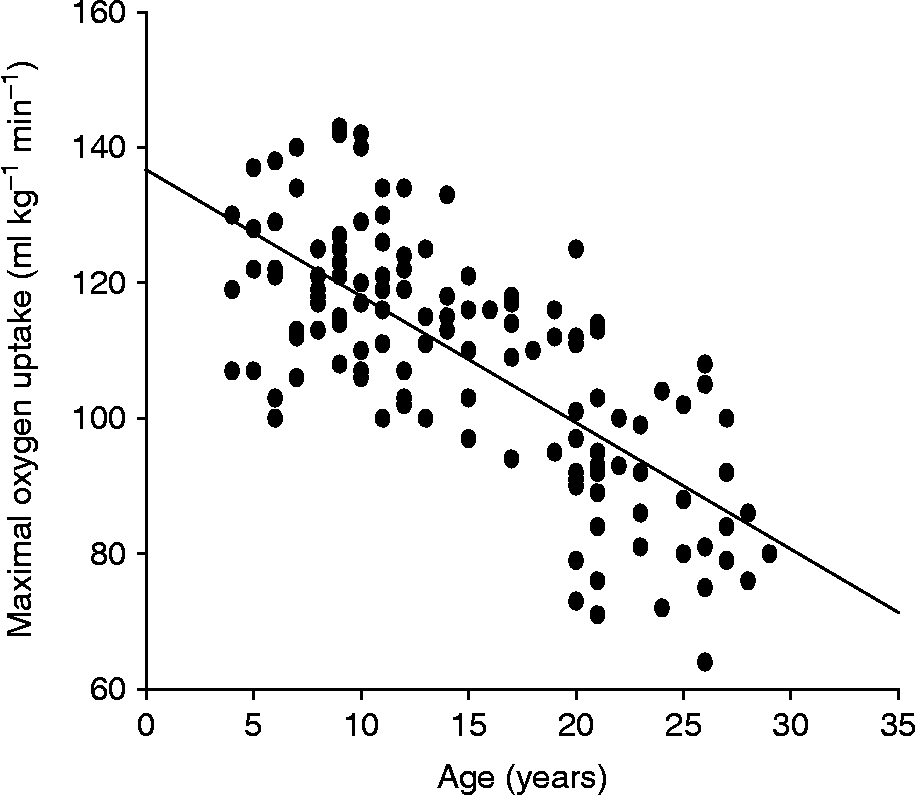
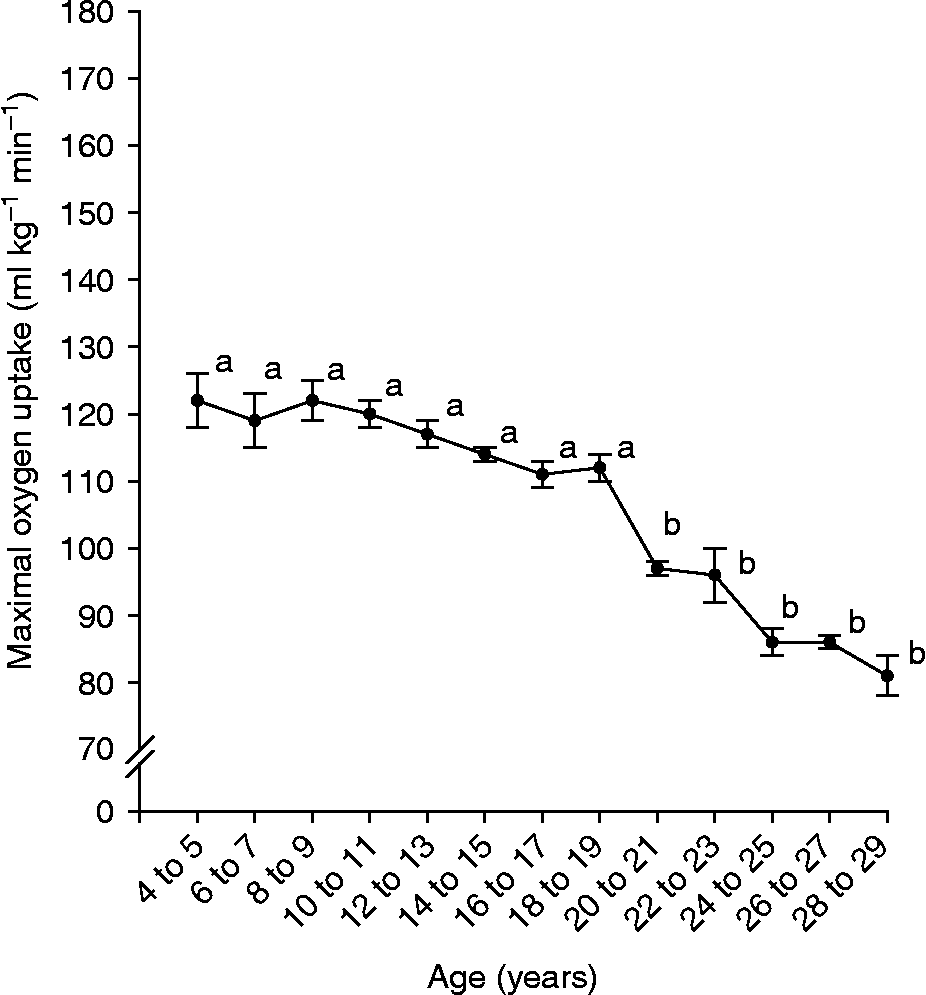
The linear trend for age accounted for 53.8% of the variance in VO2max (P < 0.001) due to a progressive decline in aerobic fitness from the ages of 4–29 years (Fig. 1). While the increment in percentage variance accounted for by the quadratic trend was small ( = 0.023), this was a significant increase (P = 0.01). In total, the quadratic function for age accounted for 55.4% of the variance in VO2max. Simple contrasts using a 2-year age span for grouping revealed that compared with 4–5-year-old horses, there was a significant decline in VO2max starting at ages of 20–21 years (P < 0.001). The decline in VO2max approached significance at the ages of 18–19 years (P = 0.059). When categorized into 3-year age groupings, a significant decrease in aerobic capacity occurred at 19–21 years when compared with 4–6-year-old horses (P < 0.001). This downturn approached significance at the ages of 16–18 years (P = 0.077). Figure 2 shows a gradual decline in VO2max as the horses aged, ranging approximately from 120–125 to 110–115 ml kg− 1 min− 1 from the ages of 4–18 years. Between the ages of 18 and 20 years, there is a drop from 115 to 97 ml kg− 1 min− 1. After this point, the slope of the decline in VO2max drops from 97 to 81 ml kg− 1 min− 1 from the ages of 20–29 years.
Linear regression depicting VO2max versus age using data collected from 50 Standardbred mares obtained from graded exercise tests

Mean ( ± SE) VO2max presented in 2-year intervals. Data are obtained from 50 unfit Standardbred mares. Points marked with different letters are statistically different

Discussion
The major finding of the present study was the clear downturn in cardiopulmonary function between the ages of 18 and 20 years. This finding compares with previous studies that have analysed the VO2max decline in humans with ageReference McKeever and Malinowski5, Reference Betros, McKeever, Kearns and Malinowksi6, and with horses grouped by age and/or fitness levelReference McKeever and Malinowski5, Reference Betros, McKeever, Kearns and Malinowksi6. However, the data acquired from this study add to the literature a more detailed timeline pinpointing when the decline in cardiopulmonary function begins. The results obtained here mirror the response observed in humans. That is, horses and humans share a decline in aerobic capacity with age due to a decrease in both stroke volume and HRmaxReference McKeever and Malinowski5, Reference Betros, McKeever, Kearns and Malinowksi6. In addition, they share similar changes in muscle fibres and body compositionReference McKeever7, Reference Lehnhard, McKeever, Kearns and Beekley23, and in hormonal changes that affect cardiovascular controlReference McKeever7, Reference McKeever and Malinowski8. There are also a number of disorders seen in both aged humans and horses including hyperinsulinaemia, hyperglycaemia, pituitary and thyroid adenomas and Cushing's diseaseReference McKeever7. The similarities observed between the species in aerobic capacity, cardiovascular function, muscle fibre and hormonal changes underscore the remarkable comparative physiology of these two species, particularly with regard to the effects of exercise.
In addition to the noted central mechanisms, peripheral mechanisms such as muscle fibre type and body composition are also affected by ageing, and can further contribute to the cardiopulmonary function decline. It has been observed that older mares have a smaller amount of type I and type IIA myosin heavy chain (MHC) and a larger amount of type IIX MHC than younger maresReference Lehnhard, McKeever, Kearns and Beekley23. As type IIX MHC fibres utilize anaerobic metabolism, they are responsible for short-term bioenergetics. Therefore, the shift in fibre type would not promote endurance capacityReference Lehnhard, McKeever, Kearns and Beekley23. In addition, older horses experience changes in body composition with age, involving an increase in fat mass and a decrease in total fat-free massReference Lehnhard, McKeever, Kearns and Beekley23. Such changes may contribute to limiting the exercise capacity seen in older horsesReference McKeever7, Reference Lehnhard, McKeever, Kearns and Beekley23, though this remains to be determined.
It has been established that endocrine responses to exercise also differ between older and younger horsesReference McKeever and Malinowski8. Younger horses have greater amounts of atrial natriuretic peptide, which is a vasodilator contributing to blood flow during exerciseReference McKeever and Malinowski8. Younger horses would then have a greater ability to increase blood flow to the exercising muscles. On the other hand, older horses exhibit greater plasma rennin activity, which causes vasoconstriction and regulates blood pressureReference McKeever and Malinowski8. Older horses also have lower vasopressin concentrations than younger horses, which further regulate blood volume and pressure during workReference McKeever and Malinowski8. While this is speculative, such changes in hormone release and function may also influence the age-related decline in exercise capacity.
Humans and horses share common mechanisms contributing to the age-related deterioration in VO2maxReference McKeever7, Reference Holloszy, Kohrt and Masoro9, Reference Dempsey, Seals, Lamb, Gisolfi and Nadel12, Reference Raven, Mitchell and Westfeldt15. The decline is particularly pronounced in horses around the ages of 18–20 years, while in humans, the decline in aerobic capacity first begins between the ages of 40 and 50 yearsReference Holloszy, Kohrt and Masoro9, Reference Dempsey, Seals, Lamb, Gisolfi and Nadel12, Reference Raven, Mitchell and Westfeldt15. These changes, however, can be attenuated with exercise training in both humans and horsesReference McKeever and Malinowski5, Reference McKeever7, Reference Holloszy, Kohrt and Masoro9, Reference Dempsey, Seals, Lamb, Gisolfi and Nadel12, Reference Raven, Mitchell and Westfeldt15.
Exercise training is capable of delaying the age-related decline in VO2max, but the decrease in aerobic capacity still eventually occurs in humans as they reach their 50s and 60s. It has been reported that horses in their 20s are similar in many respects to humans who are 60 and overReference McKeever and Malinowski5–Reference McKeever and Malinowski8. It appears that preservation of cardiac output is the main mechanism by which training attenuates the decrease in aerobic powerReference McKeever and Malinowski5. More specifically, exercise primarily helps to maintain stroke volumeReference McKeever and Malinowski5, given that the age-induced decline in HRmax is not altered with training and appears to remain permanent. Though ageing changes the factors contributing to stroke volume, including preload, contractility and heart chamber size, exercise training can cause improvements in function through positive modifications of the same factorsReference McKeever and Malinowski5.
Training can also have a significant effect on peripheral mechanisms impacting oxygen utilizationReference McKeever and Malinowski5. Ageing causes decreases in muscle fibre size, capillarization and muscle massReference McKeever and Malinowski5, each of which is a factor that can limit blood flow to the exercising muscles. Much like humans, older horses also experience changes in body composition and fibre type that can contribute to the decline in exercise capacityReference McKeever7. However, training can aid in reversing such a decline by allowing for a reduction in fat mass and an enhancement of muscle massReference McKeever7. This allows muscles to be more metabolically activeReference McKeever and Malinowski5 and more capable of conducting sufficient blood flow for oxygen transport and utilizationReference Poole1.
One may speculate that diet and previous exercise history may also have an effect on the decline in VO2max and any reversal with training. However, there are no supporting data suggesting that diet influences the age-related decline in VO2max. For the present study, the effect of diet was not assessed as all horses were administered a standardized feeding regimen. When considering previous exercise, it must be noted that all the mares were in an untrained condition for at least 3 years prior to the measurements, and that there exist no records of their prior training status. In addition, the VO2max values exhibited are typical of unfit Standardbred mares, and therefore appear to accurately represent horses in the unfit condition. While it is intuitively appealing to classify the observed downturn in VO2max as a definitive ‘breakpoint’, we recognize that this might be a premature classification due to the different cell sizes inherent in this data analysis. The analysis of the data from the current study does demonstrate a best fit with a curvilinear relationship. However, this observation does differ from the linear relationship between age and HRmax reported in a retrospective analysis performed on data from a wide range of equine records from multiple institutionsReference Vincent, Newton, Deaton, Franklin, Biddick and McKeever24. Future longitudinal studies could help clarify this physiological occurrence and elucidate the magnitude and meaningfulness of this ‘break’ in cardiorespiratory fitness.
The results obtained here can be applied to aid horse owners in the development of exercise training programmes to maximize performance and increase performance longevity in their horses throughout the ageing process. Given that a marked downturn in cardiopulmonary function begins between the ages of 18 and 20 years, it is important to enforce optimal training prior to that decline as this may attenuate the rate of cardiopulmonary degradation. It has been calculated that more than 15% of the horses in the United States are over the age of 20 yearsReference Hintz25. Such horses continue to participate in athletic activitiesReference McKeever7, Reference Hintz25, and thus it is also important to devise an exercise programme appropriate for an active older horse. As aerobic capacity and cardiac output begin to decline, so does the ability to tolerate intensive exercise. Older horses are then fatigued more readily than younger horsesReference McKeever7. The exercise protocols that trainers use for younger horses often continue to be applied to older horses. However, this may present a health concern as overtraining can occur with an inaccurate exercise regimenReference McKeever7. With a more accurate picture of what appears to be an ‘age-related break point’, trainers should be able to adjust training programmes to incorporate changes in absolute and relative intensity tolerance. Also, given the established similarities in cardiopulmonary responses to ageing between horses and humans, trainers should also consider the increased recovery needs that are speculated to exist in ageing humansReference Fell and Williams26. This approach would potentially maximize improvements in cardiac output and aerobic capacity before the decline beginsReference McKeever and Malinowski5, and promote the health and fitness of active older horsesReference McKeever7.
Acknowledgements
The authors thank the undergraduate animal science research students Joanne Powell, Anthony Sacchetti, William Kovach and Thomas Lehman of Cook College Animal Care for their hard work in collecting and recording data. The research support was provided by the New Jersey State Initiative on Equine, the New Jersey Agricultural Experiment Station, Rutgers University and the George H. Cook Scholars Program.