Capital is the force that raises the productivity of labor and creates the wealth of nations. It is the lifeblood of the capitalist system, the foundation of progress, and the one thing the poor countries of the world cannot seem to produce for themselves . . .
Hernando de Soto (Reference de Soto2000: 5)
1. Introduction
In the quest to explain why some countries become rich while others remain poor, development economists offer many plausible explanations. Although there is no general consensus, there are some factors that have been widely recognized as being positively correlated with economic development. More recently, economists have begun emphasizing the role of institutions in the development process. The most important of these institutional structures is the presence of secure and well-defined property rights, something that economists have long claimed must be present for markets to function effectively (Montesquieu, 1748; Smith, 1776; Hayek, Reference Hayek1960).
Hernando de Soto (Reference de Soto1989, Reference de Soto2000), in his books The Other Path and The Mystery of Capital: Why Capitalism Triumphs in the West and Fails Everywhere Else, explains the channels through which insecure and poorly defined property rights stifle economic development. Insecure property rights weaken the incentive for owners to make long-term capital investments, and hinder the ability of owners to use their property as collateral to secure loans to finance capital investment. We view de Soto's work as a specific hypothesis defining possible channels through which property rights impact development. These channels are (1) the ability to secure a loan by utilizing property as collateral, (2) the incentives to invest in capital formation, and (3) the precise nature of these investments, specifically long-term versus short-term investments.
This paper empirically tests de Soto's hypothesis in order to verify the specific mechanisms through which secure property rights influence development. Acemoglu et al. (Reference Acemoglu, Johnson and Robinson2001, Reference Acemoglu, Johnson and Robinson2002) empirically identify the general positive relationship that exists between property rights and economic development. Their papers show that history plays a large part in determining current property rights institutions, and these institutions explain a large portion of the variance in cross-country development. Thus, they are able to determine that secure and well-defined property rights impact the level of economic development. The question that follows is: Exactly how do property rights influence a country's economic performance? De Soto provides a testable hypothesis that we empirically examine to provide an answer to this ‘how’ question.
We build upon the framework established in Acemoglu et al. (Reference Acemoglu, Johnson and Robinson2001, Reference Acemoglu, Johnson and Robinson2002) to extend the analysis in order to discover the underlying mechanisms through which property rights operate. We first confirm the positive relationship between well-defined property rights and the level of economic development, as previously established in the existing literature. Next, is our own original contribution in which we examine the channels through which property rights affect economic growth by examining their impact on domestic credit, gross capital formation, and gross fixed capital formation. By testing the relationship of property rights to domestic credit, we are able to capture the collateral effect. The two capital formation variables indicate the impact property rights have on investment. These two variables allow us to also examine whether property rights influence the allocation of investment between mobile short-term capital and long-term fixed capital.
Our paper is the first to specifically identify and empirically test the means by which property rights institutions influence development, namely their effect on the ability to use an asset as collateral, on the incentives for capital formation, and on alterations in the nature of investment. In order to perform these tests, we construct a cross-sectional dataset that relies on annual and averaged data and spans from 1970 to 1999, depending on which variable is used. We also find it necessary to utilize several different regression specifications to maximize the number of observations and to provide robustness.Footnote 1 Our specific empirical methodology is presented and discussed in more detail in a later section.
Our results uniformly confirm de Soto's hypothesis that secure property rights lead to increases in credit, through the collateral effect, and increases in both short-term and long-term capital formation. These effects in turn lead to economic growth. Therefore, we identify channels through which property rights are operating. Also, as de Soto's theory would predict, we find a stronger effect of property rights institutions on gross fixed capital formation than on gross capital formation, which includes short-term assets. This suggests that insecure property rights alter the nature of investment and create incentives for individuals to accumulate short-term mobile inventories rather than invest in long-term fixed capital. Our results are robust across two different international measures of property rights (ICRG's average protection against risk of expropriation measure and the Heritage Foundation's Index of Private Property) and to different model specifications.
Due to the possibility of reverse causation, we employ instrumental variable estimation to isolate the effect of property rights institutions and to determine a causal relationship. It is possible that changes in domestic credit, capital formation, or economic development impact property rights institutions, rather than vice versa. For example, the presence of immobile capital, such as a factory, may help secure property rights. What we want to show is that investment in this capital will not be undertaken in the absence of secure and well-defined property rights. Therefore, it is necessary to instrument for our measures of property rights. In order to do so, we turn to Acemoglu et al. (Reference Acemoglu, Johnson and Robinson2001, Reference Acemoglu, Johnson and Robinson2002) who identify valid instruments for property rights measures. For our analysis we employ settler mortality as our instrument. Our results continue to support de Soto's hypothesis and demonstrate the channels through which property rights influence development.
The remainder of the paper is organized as follows. Section 2 provides a brief overview of the current literature examining property rights and development. Section 3 discusses de Soto's ‘mystery’, the idea that secure property rights underlie economic development, and further elaborates the empirical predictions of his hypothesis. Section 4 outlines the data used in our empirical analysis and discusses our results. Section 5 provides robustness by controlling for potential reverse causality. Section 6 concludes.
2. Property rights, capital, and development
In addition to the work of de Soto, which we will discuss in detail in the next section, other authors have also postulated that institutions, including property rights institutions, have substantial impacts on economic development.Footnote 2 Douglass North (Reference North1990) argues that the costliness of exchange and production is a result of institutions. Insecure property rights increase transactions costs, which in turn reduces capital formation.Footnote 3 Peter Bauer (Reference Bauer2000) also argues that capital formation is an outcome of institutions, essential for an economy to progress from subsistence production to market production. Property rights institutions provide incentives, facilitate production and exchange, and lead to increased capital accumulation, investment, technological innovation, and entrepreneurship. Hence, property rights ultimately promote economic growth (Scully, Reference Scully1988; Boettke, Reference Boettke1994; Leblang, Reference Leblang1996; Acemoglu et al., Reference Acemoglu, Johnson and Robinson2001, Reference Acemoglu, Johnson and Robinson2002). Thus, the works of these other authors also provide theoretical linkages between secure and well-defined property rights and economic development consistent with de Soto.
The empirical literature examining the impact of property rights finds that more secure property rights are positively correlated with a country's level of investment and economic growth (Besley, Reference Besley1995; Knack and Keefer, Reference Knack and Keefer1995; Mauro, Reference Mauro1995). In an examination of the variation in output per worker across countries, Hall and Jones (Reference Hall and Jones1999) emphasize the importance of social infrastructure, defined as government policies and institutions, and conclude that a good social infrastructure positively affects economic performance. Using settler mortality rates as an instrument for current institutions, Acemoglu et al. (Reference Acemoglu, Johnson and Robinson2001) find large effects of institutions on per capita income in former colonies. They also attribute the reversal in relative incomes from 1500 to today across countries to variations in institutions (Acemoglu et al., Reference Acemoglu, Johnson and Robinson2002).Footnote 4 Rodrik et al. (Reference Rodrik, Subramanian and Trebbi2004) examine the impact of institutions on income levels and find a positive and significant effect of institutions on per capita income. Property rights also affect investment and economic development by encouraging entrepreneurship (Murphy et al., Reference Murphy, Shleifer and Vishny1991; Johnson et al., Reference Johnson, McMillan and Woodruff2002; Boettke and Coyne, Reference Boettke and Coyne2003).
This paper builds on these previous studies by examining the direct effects of property rights institutions on capital formation, collateral, and the nature of investment. To do this, we analyze the importance of property rights for collateralizing assets. We also examine the quantity and distinction between both short-run and long-run capital formation. These tests identify the channels through which property rights affect economic growth. To motivate our empirical model, we begin with a more detailed discussion of de Soto's main hypotheses in the next section.
3. de Soto's ‘Mystery’
De Soto defines property rights as those rights ‘which confer on their holders inalienable and exclusive entitlement to them’ (1989: 159). He highlights many beneficial aspects of secure property rights, including their ability to fix the economic potential of assets, integrate dispersed information into one system, make individuals accountable and assets fungible, network individuals, and protect transactions (de Soto, Reference de Soto2000). We break down de Soto's property theory into three main avenues: (1) the ability to secure a loan by utilizing property as collateral, (2) the incentive to invest in capital formation, and (3) the precise nature of these investments, specifically long-term versus short-term investments.
3.1 Assets as collateral
In The Other Path (1989) and The Mystery of Capital (2000), de Soto argues that secure and well-defined property rights transform assets from ‘dead capital’ into resources that can be used to generate additional capital and obtain credit. In this manner, property rights stimulate production. He illustrates the inability of property to be used as collateral in many developing countries with insecure property rights:
a lender must make the same costly investments as a purchaser in order to make sure that the property is under the borrower's control and that, in the event of a default, the property can be obtained with the same rights as those enjoyed by the present owner. This increases the interest rate charged by lenders for loans guaranteed by an expectative property right or its equivalent; worse still, it may simply prevent such transactions from taking place. (1989: 162)Footnote 5
As an example of how important property rights are for the use of collateral, de Soto illustrates that in the United States approximately 70% of new business credit comes from using titles to other assets as collateral (2000: 84). Insecure property rights in much of the developing world discourage the use of assets as collateral, hampering capital formation, the division of labor, and specialization.
3.2 Capital accumulation
De Soto emphasizes the important role played by property rights for development by focusing on their impact on capital accumulation. De Soto illustrates that insecure property rights reduce capital formation by prohibiting the use of assets as collateral and increasing uncertainty, thus altering the nature of investment. According to de Soto (Reference de Soto2000), in 1997 the savings of poor individuals in developing countries was equal to forty times the value of all foreign aid received since 1945. Despite this rather large amount of accumulated savings, de Soto estimates that 80% of the world is undercapitalized as a result of insecure property rights that impede the process by which individuals generate capital from these accumulated assets.
In many developing countries people have de facto rights to their residential property (e.g., as squatters) but hold no formal legally enforceable title.Footnote 6 In 1997, de Soto estimates the total value of all real estate held by individuals in the Third World and former communist countries that was not formally legally owned at $9.3 trillion. De Soto refers to these assets as ‘dead capital’, resources whose insecurity does not allow surplus value to be extracted through multiple transactions, nor used as collateral to obtain loans.
3.3 Uncertainty, the durability of capital, and the nature of investment
Property rights institutions also affect economic development through uncertainty and its effects on long-term fixed investment versus short-term capital accumulation, such as inventories. This occurs because property right uncertainty alters individuals’ time preference in capital investment. Secure property rights provide incentives to make longer-term investments in land, factories, and innovations. Without secure property rights, individuals are not likely to invest in fixed long-term uses.
De Soto (Reference de Soto1989) outlines the means by which insecure property rights reduce long-term fixed investment. In the absence of secure property rights, businesses are more likely to use labor-intensive technology and operate at an inefficient level, decreasing capital investment. Also, financiers will require high rates of return from investors, resulting in low levels of long-term investment in production. As businesses attempt to avoid detection, mobility of assets is an important factor when property rights are insecure. As an illustration, de Soto discusses the relationship between property rights and inventory accumulation. He explains that in the absence of property rights, individuals prefer to hold short-term inventories rather than savings and investment in long-term fixed capital. This is a result of the perverse incentives created by uncertainty arising from insecure property. When property rights are insecure, individuals and businesses avoid long-term investment in fixed capital, accumulate mobile inventories, and are more likely to sell ‘from barrows rather than from stalls made with proper building materials’ (de Soto, Reference de Soto1989: 67).
In summary, de Soto's main testable hypotheses are that without secure property rights, individuals do not have the correct incentives to produce efficiently and invest in long-term fixed capital and cannot use their assets as collateral to stimulate production. Instead, individuals hold short-term inventories, invest in mobile assets, and fail to build permanent structures. The result is a decrease in aggregate investment and capital accumulation, and thus lower economic growth. We now turn to our empirical examination of whether differences in the institutional structure of property rights across countries explains their different levels of domestic credit, investment in inventories, and investment in long-term fixed capital.
4. Data and empirical results
In order to maximize observations due to data limitations, we implement cross-sectional regressions relying on both annual and averaged data, depending on the variable. We discuss this in more detail below and provide a summary of the definitions and sources for all of our variables in Appendix 1. For our analysis, we employ two alternative measures of the degree to which property rights are secure and well-defined across countries. The first is the average protection against risk of government expropriation, or ‘expropriation risk’, compiled by Political Risk Services. This index is measured on a scale of 0 to 10, with a higher score indicating less risk and more protection against government expropriation. Due to data limitation, we have a limited time span and average this variable from 1985 to 1995. Our second measure, the Heritage Index of Private Property, is measured on a scale of 1 to 5, with a higher score indicating more protection of private property.Footnote 7 We use 1997 values for this index following conventional property rights literature discussed in Section 2.
Our main dependent variables are domestic credit to the private sector (collected in 1998), gross capital formation, and gross fixed capital formation (collected and averaged from 1990 to 1999). All three measures are taken as a percentage of Gross Domestic Product. We view domestic credit to the private sector as an appropriate measure to capture the collateral affect because it represents the ability to secure a loan. Domestic credit to the private sector refers to financial resources provided to the private sector, such as through loans that establish a claim for repayment. Securing a loan requires some form of credit or collateral to signal repayment abilities. When property rights are weak and insecure it is much more difficult to use assets as collateral and thus more difficult to secure a loan. This variable captures how improvements in property rights institutions allow individuals to utilize resources to obtain credit.
Because gross fixed capital formation excludes short-term assets (inventories), while gross capital formation includes them, we can examine the difference in the magnitude of the coefficient on property rights security across these two dependent variables to see whether short-run capital formation is distorted relative to long-run capital formation, as de Soto's hypothesis predicts. We expect the coefficient on our measures of property rights to be positive and significant for all three of our main dependent variables.
In addition, our summary statistics are provided as Appendix 2. Our sample includes all countries for which the variables are available, which differs slightly depending on which measure of property rights is used. A list of countries is provided in Appendix 3.
To see whether these measures indeed capture the salient features of property rights that contribute to economic development, in addition to our examination of measures of capital formation, we also see whether they positively correlate with GDP per capita levels, a consistent finding in existing literature. Thus, all regressions are performed using the log of real GDP per capita (measured by the purchasing power parity method) as a dependent variable as well as with the measures of capital formation and collateral. We confirm the positive relationship previously found in the existing literature to provide validity to our specific model and results. GDP per capita is measured in 1995 to remain consistent with the current literature (Acemgolu et al., Reference Acemoglu, Johnson and Robinson2001, Reference Acemoglu, Johnson and Robinson2002).
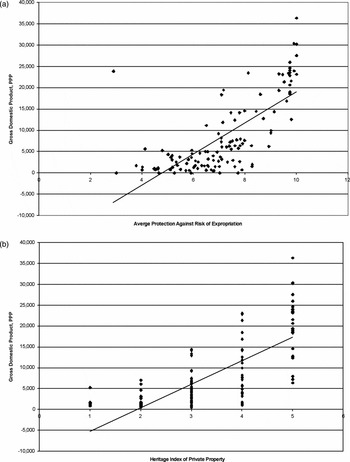
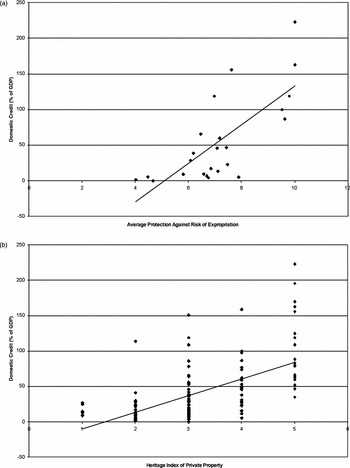
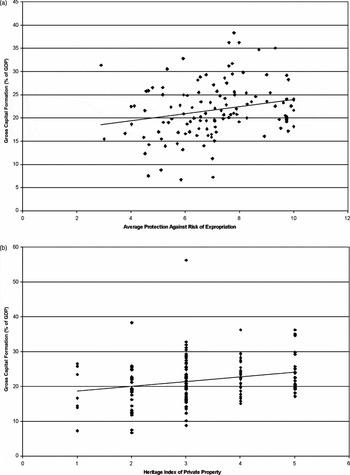
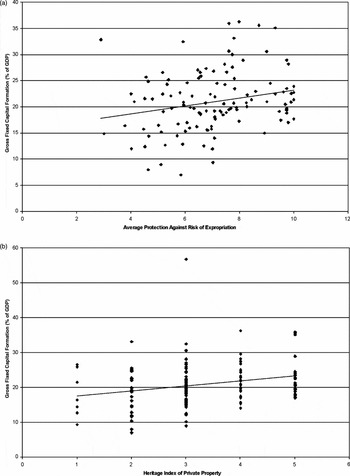
Even in the raw data, correlations are very clear between our measures of property rights security and our variables of interest. Figures 1(a) and 1(b) show the raw correlations between our two measures of property rights and GDP per capita. Both seem to show a strong positive correlation. Figures 2(a) and 2(b) show the correlations with domestic credit (a measure of collateralization), which again appear to be strongly positive. Figures 3(a) and 3(b) and 4(a) and 4(b) show the correlations with gross capital formation and gross fixed capital formation respectively. Again, the relationships appear positive, although not as strongly as the relationships in Figures 1 and 2. These raw relationships can also be expressed as a univariate model. These results are provided as Appendix 4 (including several specifications using OLS and our 2SLS estimation that we discuss in a later section of the paper).
(a) Average protection against risk of expropriation and GDP per capita. (b) Heritage Index of Private Property and GDP per capita

(a) Average protection against risk of expropriation and domestic credit (as a percentage of GDP). (b) Heritage Index of Private Property and domestic credit (as a percentage of GDP)

(a) Average protection against risk of expropriation and gross capital formation (as a percentage of GDP). (b) Heritage Index of Private Property and gross capital formation (as a percentage of GDP)

(a) Average protection against risk of expropriation and gross fixed capital formation (as a percentage of GDP). (b) Heritage Index of Private Property and gross fixed capital formation (as a percentage of GDP)

While the raw relationships appear supportive of de Soto's hypothesis, they do not control for other factors that may matter. We follow the existing literature that examines the impact of property rights protection on economic development, as summarized in Section 2, in selecting control variables for our more complete specification as identified by Acemoglu et al., Reference Acemoglu, Johnson and Robinson2001, Reference Acemoglu, Johnson and Robinson2002; Sachs, Reference Sachs2003; and Rodrik et al. (Reference Rodrik, Subramanian and Trebbi2004).
Our more complete specification can be expressed as

where Z′ is a vector of control variables, including inflation, government consumption, geography, religion, legal origin, and ethnolinguistic fractionalization. We use the log of inflation, as measured by the consumer price index, and government consumption as a percentage of GDP to capture the impact of macroeconomic variables. These variables are lagged averages from 1970 to 1998. Macroeconomic variables are generally thought to impact both investment and financial development. For example, countries that suffer from high inflation usually have less developed financial systems. Therefore, we find it necessary to control for this potential negative effect.
Geography, measured as distance from the equator is included as a control variable because of its possible effects on development (Engerman and Sokoloff, Reference Engerman, Sokoloff and Harber1997; Hall and Jones, Reference Hall and Jones1999; La Porta et al., Reference La Porta, Lopez-de-Silanes, Shleifer and Vishny1999; Gallup et al., Reference Gallup, Sachs and Mellinger1999; Sachs, Reference Sachs2001, Reference Sachs2003). It is argued that geography may impact development because of the exposure to greater disease climates. The literature finds mixed results on the possible effect of geography without an emerging consensus. Thus, we find it important to include it as part of our control variables.
It is suggested that different religions may have diverse effects on economic development (Grier, Reference Grier1997; La Porta et al., Reference La Porta, Lopez-de-Silanes, Shleifer and Vishny1999). For example, it is suggested that Protestantism promotes hard work and individualism that leads to higher levels of economic development. Due to the possibility that religion may impact development, we find it necessary to control for the possible effects on our dependent variables. Religion is accounted for in our regression as a proportion of the population in 1980 classified as Roman Catholic, Protestant, Muslim, and other.
Legal origin is controlled to capture the effects of common versus civil law (Rubin, Reference Rubin1977; La Porta et al., Reference La Porta, Lopez-de-Silanes, Shleifer and Vishny1999; Glaeser and Shleifer, Reference Glaeser and Shleifer2002; Djankov et al., Reference Djankov, Porta, Lopez-de-Silanes and Shleifer2003; La Porta et al., Reference La Porta, Lopez-de-Silanes, Pop-Eleches and Shleifer2004). The idea that many countries have a distinct legal origin is identified by La Porta et al. (Reference La Porta, Lopez-de-Silanes, Shleifer and Vishny1999) and Glaeser and Shleifer (Reference Glaeser and Shleifer2002). Legal origin is shown to shape financial, legal, and economic institutions and outcomes (Djankov et al., Reference Djankov, Porta, Lopez-de-Silanes and Shleifer2003). Different legal traditions, imposed during colonization, affect current legal systems. These legal traditions are classified as common law and civil law systems. Common law, imposed during British colonization, is referred to as English legal origin. The French, Scandanavian, and German colonizers imposed civil law systems. Current legal systems may impact both capital investments and financial development and are therefore included in our analysis. We control for the effect of legal systems by including legal origin as dummy variables representing English, French, German, Scandinavian, and Socialist origin.
Lastly, we include ethnolinguistic fractionalization as a control variable to account for the possible effects of ethnic and linguistic diversity on development. A population comprised of a large amount of diversity may find it difficult to overcome differences and engage in widespread trading and exchange. Different ethnic groups may also pursue different public policies which could lead to political instability (Easterly and Levine, Reference William and Levine1997; La Porta et al., Reference La Porta, Lopez-de-Silanes, Shleifer and Vishny1999; Easterly, Reference Easterly2001; Leeson, Reference Leeson2005).Footnote 8 We control for ethnolinguistic fractionalization due to these potential harmful effects. We measure this variable as an average of five different indices that capture ethnic and linguistic diversity in a country.
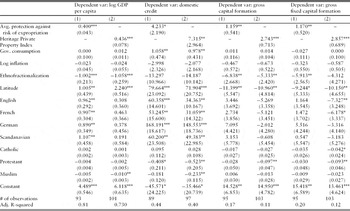
Table 1 shows the results of our regressions including these control variables. Both measures of property rights have positive and significant coefficients in the regressions for the log of per capita GDP. A one unit increase in either of these indices results in approximately a 0.4% increase in GDP per capita. Alternatively, a 1% increase in GDP per capita could be achieved through an approximately 2.5 unit increase in property rights security as measured by the index. For reference, a 2.5 unit difference is approximately the difference between the United States and Mexico. While the relationship is positive and statistically significant, the economic magnitude of the result is somewhat less than we would have expected. The results for our three measures of capital formation and collateral, however, are much larger. A one unit change in the index is estimated to produce a sizable increase in domestic credit (our measure of collateral) of between 4 to 7 percentage points (as a share of GDP). The impact of the 2.5 difference between the United States and Mexico would thus be much larger for domestic credit, roughly increasing it by 10 to 17.5 percentage points (as a share of GDP).
OLS cross-sectional regressions with controls: World sample

Notes: Standard errors are in parentheses. Significance level: *** at 1%, ** at 5%, * at 10%. Catholic, Protestant, and Muslim captures Religion and English, French, German, and Scandanavian captures Legal Origin Control Variables. Columns (1) are regressions using average protection against risk of expropriation. Columns (2) are regressions using Heritage Index of Private Property.
The results for gross capital formation and gross fixed capital formation are also positive and significant, and again larger than the GDP estimates (although lower than the estimates for domestic credit). The 2.5 unit difference between the United States and Mexico would be associated with an increase in capital formation as a share of GDP of between 2.9 and 5 percentage points (found again as 2.5 times the coefficient estimates). Thus, more secure property rights result in a higher level of capital formation in an economy.
The coefficients for gross fixed capital formation and gross capital formation, while similar, are consistently different in the manner predicted by de Soto's hypothesis. Because gross capital formation includes both short-term (inventory) and long-term capital formation, while gross fixed capital formation excludes inventories, de Soto's hypothesis would suggest that property rights security should have a larger impact on gross fixed capital formation (as it shifts capital formation away from inventories and other short-run assets). Across the board, the coefficient estimates for gross fixed capital are indeed larger than the estimates for total gross capital formation.
Thus, the results in Table 1 uniformly support de Soto's conjectures that the presence of secure and well-defined property rights increase capital formation and the extension of domestic credit through the collateral effect. There is also evidence that weaker property rights cause a substitution into more mobile, short-term capital such as inventories.
5. Robustness checks
In this section we examine whether our results are robust to possible problems of reverse causality and endogeneity. It is possible that economic development due to access to credit and long-term capital formation subsequently results in institutional improvements in the security of property rights, rather than vice versa. To explore this, we adopt the approach of Acemoglu et al. (Reference Acemoglu, Johnson and Robinson2001) where we use a historical variable of settler mortality to instrument for our measures of property rights. In doing so, we isolate the effect of property rights on the channels of development.
Acemoglu et al. (Reference Acemoglu, Johnson and Robinson2001) identify settler mortality faced by colonizers as an appropriate instrumental variable for property rights institutions. Their argument is that disease affected the settlement patterns of colonizers between 1500 and 1900. Colonizers were more likely to settle in areas with low expected mortality rates and hence establish ‘good’ institutions that included secure property rights. Areas with higher expected mortality rates were not conducive to settlement, resulting in extractive institutions or worse property rights. Following the logic of institutional path dependence, these past institutions reflect current institutions, which in turn influence current economic performance.Footnote 9 To summarize, the higher mortality rates faced by colonizers in 1500 represent insecure property rights institutions in countries today and vice versa.
This approach circumvents the problem of reverse causation because settler mortality determines current property rights institutions, but not current capital formation or domestic credit. Also, current capital formation and domestic credit cannot determine settler mortality in 1500, making it a valid instrument. In other words, settler mortality is driving the security of property rights, but it is not directly impacting our dependent variables. By implementing settler mortality as our instrument we can determine the causal relationship between property rights and channels of development.
We follow this approach for our IV estimation model specification


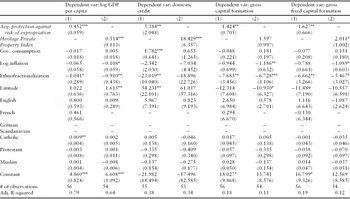
where equation (1) is our first stage regression and Xi is our measure of property rights and Mi represents our instrument, the log of settler mortality. Equation (2) is the second stage regression where vi is our instrumented measure of property rights and Z represents our control variables. In our IV estimation model, we use a sample of countries restricted to the ex-colonies due to the nature of our instrument. To ensure that differences between our original OLS results and the results from our IV estimation are not simply the result of using a different subsample, we also re-estimate our original OLS models on this subsample of countries for comparison with the IV results. This would also ensure that the IV results could be generalized back to our full sample of countries. The results from the re-estimation of our original OLS models using this subsample of countries is presented in Table 2.Footnote 10
OLS Cross-sectional regressions with controls: ex-colonies sample

Notes: Standard errors are in parentheses. Significance level: *** at 1%, ** at 5%, * at 10%. Catholic, Protestant, and Muslim captures Religion and English, French, German, and Scandanavian captures Legal Origin Control Variables. Columns (1) are regressions using average protection against risk of expropriation. Columns (2) are regressions using Heritage Index of Private Property.
Almost universally, the results for this subsample confirm our earlier estimates, and in some cases the results are actually stronger. The only notable change is for domestic credit, but only in the specification that uses the Heritage Index of Private Property, where the coefficient rises from 7.3 to 18.4. This would suggest that our subsample is fairly representative of the entire set of countries included in our previous regressions. The results from our 2SLS estimations are presented in Table 3.
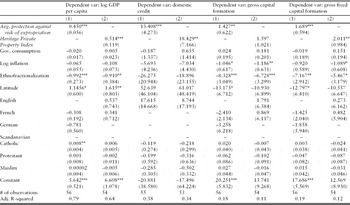
2SLS Cross-sectional regressions: IV estimation

Notes: Standard errors are in parentheses. Significance level: *** at 1%, ** at 5%, * at 10%. Catholic, Protestant, and Muslim captures Religion and English, French, German, and Scandanavian captures Legal Origin Control Variables. Columns (1) are regressions using average protection against risk of expropriation. Columns (2) are regressions using Heritage Index of Private Property.
The results from our IV estimations suggest that our original results did not suffer from significant problems of reverse causality or endogeneity. The coefficient estimates in Table 3 are virtually identical to those in Table 2, and to those in Table 1. The only notable change is again for domestic credit, but this time for the other property rights measure, risk of expropriation. Rather than the coefficient shrinking, as it would if endogeneity were present, this coefficient actually increases. Thus, taken as a whole, the results presented in this section suggest that our results presented in Table 1 are robust and accurate.Footnote 11
6. Conclusion
In The Other Path and The Mystery of Capital, Hernando de Soto discusses the implications of property rights institutions for economic development, identifying the channels through which property rights operate. His hypothesis is that secure property rights increase long-term capital accumulation and access to credit, leading to economic growth. Secure property rights provide incentives to invest in capital. When property rights are secure, assets can be used as collateral and to obtain credit for loans, thereby attracting additional capital. Property rights also affect the quantity and nature of capital investment. Secure property rights lead individuals to invest in long-term fixed capital rather than accumulate short-term mobile assets, such as inventories.
This paper empirically investigates this hypothesis that institutions of secure and well-defined property rights create incentives that encourage economic growth and development. Using different measures of property rights, we find positive and significant effects of property rights institutions on wealth, collateral, and capital formation. We also find evidence supporting our expectation that secure property rights have a greater effect on long-term fixed capital. These results are robust to different model specifications, including IV estimation. Our analysis identifies specific avenues property rights take to promote development and these avenues of operation suggest answers to the question of exactly how property rights impact economic performance.
Appendix 1: Data Description and Sources

Appendix 2: Summary Statistics

Appendix 3: Country list

Appendix 4: Univariate Regressions OLS and IV Estimation

Note: Standard errors are in parentheses. Significance level: *** at 1%, ** at 5%, * at 10%. Each coeffient represents a separate univariate regression.