As East Central Europe is fast approaching the end of its second decade after the fall of the Berlin Wall, new studies of postcommunist politics and society can increasingly benefit from a longer historical perspective.Footnote 1 We can now replace the “history of the present” lens that was typical of much research in the highly volatile 1990s with accounts that more extensively compare the most fundamental trends emerging from the decades before and after 1989–1990. In this spirit, both books under review make substantive and historically well-informed contributions to our understanding of the politics of work and workers in Central and Eastern Europe. In The Defeat of Solidarity, David Ost develops a gripping account of the progressive and interlinked defeats of labor interests and liberal democratic politics in Poland from the 1980s up to the present day. In Constructing Unemployment, Phineas Baxandall offers a theory of the political meaning of unemployment, applied mainly to the case of Hungary from the late 1940s until the end of the 1990s.
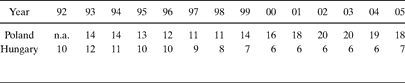
These books are essentially in-depth case studies of one country over a prolonged period of time, backed up by a thorough mastery of the press and research output in Poland and Hungary and by extensive experience gained in prolonged research visits. Commendably, the evidence invoked is also brought to bear on larger questions of the politics of job loss, union decline, and worker anger well beyond the postcommunist region. Yet their focus on the politics of job loss specifically in the postcommunist context is timely. During communist rule, unemployment was officially nonexistent. But as Table 1 shows, unemployment levels quickly shot up to high levels in both Poland and Hungary in the 1990s. This unique communist/postcommunist constellation is likely to have produced rather different political dynamics of labor and job loss than those we know from more advanced democracies.Footnote 2
Yearly Aggregate Unemployment in Poland and Hungary (Percentage of the Labor Force), 1992–2005
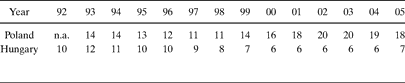
Source: ILO data, at http://laborsta.ilo.org/
In addition to focusing a rich political and historical lens on the still insufficiently explored terrain of East Central Europe, both books also make yet another useful contribution to current literatures on unemployment and labor politics in capitalist democracies. They do so by developing constructivist and ideational, rather than currently paradigmatic historical-institutional or rational-choice based, theories. Baxandall admits from the outset to be little interested in “shifts in the strength of political agents with pre-assigned preferences, or … in the institutionalized rules on which political preferences compete” (5). Instead, the focus is on “the political production of ideas about what is socially beneficial and what counts as success regarding unemployment. Interpretations and discourse are treated as constitutive rather than merely indicative of social change” (5). In the same vein, Ost's self-proclaimed ideational account of Polish labor weakness “stresses the role of ideas,” since it was predominantly “the strong pro-market ideas held by union leaders and the rank and file and their low self-esteem … that left labor unable to defend its interests or pursue its agenda in the postcommunist era. … [T]he causes of the weakness (including the inability to think in class terms, which is an expression of that weakness) follows from ideas”(193).
Such idea-based approaches seem to be particularly suited to the postcommunist context. Ideational changes tend to be spurred by the dissatisfaction with the inadequacy of existing belief structures and behavioral patterns either through a process of gradual disillusionment or through an exogenous shock. In addition, for new ideas to become influential, they need to be accompanied by the opening up of a political space because of changing material conditions.Footnote 3 Since both these conditions were eminently present in postcommunist Europe after 1989, ideational theories hold the promise of shedding new light on the regional politics of job loss and union weakness. In light of the above, this article is organized as follows. The first two sections review the arguments proposed by Baxandall and Ost. I discuss these arguments in the context of a number of wider literatures and theories regarding, notably, the political dynamics of transitional costs, and the ramifications of job loss for the liberal quality of emerging models of market democracy in East Central Europe. The third section points to remaining puzzles regarding the role of agency and ideology among union elites. The last section concludes.
Did Polish Elites Sacrifice Political Liberalism to Salvage Economic Liberalism?
The Defeat of Solidarity offers a compellingly written and rigorously researched political history of organized labor and worker anger in Poland, which poses highly pertinent questions about labor and anger in liberal democracy more generally.Footnote 4 The book narrates how Solidarity's powerful elites, under two predominant postcommunist configurations, chose to either brush aside the social costs of transition (what I shall henceforth dub the technocratic-liberal stream) or to shift the blame for these costs through illiberal attacks on communists, foreigners, and nonbelievers (the right-wing-conservative stream). The book's starting assumption is that anger forms an essential part of economic capitalism, as it is inherent to the structural role of workers as economic subordinates. Referring to the historical role of labor in building democracy in interwar EuropeFootnote 5 and postauthoritarian Latin America,Footnote 6 Ost suggests that the cleavages along which political elites incorporate workers' grievances crucially determine the nature of democratic capitalism. If capitalism is to go hand in hand with a thriving liberal model of democracy, labor needs to be included as labor—that is, by seeking economic concessions along class lines. If labor interests are excluded or comprehensively hurt, labor anger will eventually find politically illiberal outlets. Ost's main thesis is that postcommunist elites deliberately, and ultimately successfully, attempted to install economic liberalism, but only by engaging in tactics that eventually led to the defeat of political liberalism in Poland.
To gain plausibility, ideational theories of politics generally need to be as specific as possible on actor agency and on actor designation. Reviewing the benefits and drawbacks of such theories, Sheri Berman notes that since “agency—the ability of individuals and groups to reshape their environment—plays a crucial role, the careful attention … to the actions, resources, and inclinations of particular political actors is very welcome.”Footnote 7 Moreover, ideational variables do not affect outcomes on their own: They become causally important only by influencing their human hosts. Hence, it is particularly important for scholars of ideational politics to delineate as clearly as possible the connection between ideas and the concrete political actors embodying them.Footnote 8 Ost certainly meets both requirements, as he painstakingly traces the postcommunist trajectories of key liberal elites who had been Solidarity opposition leaders under communism.
One stream of former Solidarity elites, a group identified as technocratic-liberals, was the first to conquer power after 1989. It consisted of politicians such as Tadeusz Mazowiecki, the first postcommunist Prime Minister, former Solidarity figureheads such as Bronislaw Geremek and Jacek Kuron, the opinion-makers around Adam Michnik's Gazeta Wyborcza, and the Freedom Union Party around three-time Finance Minister Leszek Balcerowicz. Once in government, they oversaw policy reforms that hurt, first and foremost, their own supposed backers: blue-collar and low-skilled white-collar labor. Convinced almost religiously of the urgency to install “unqualified” market capitalism, these technocratic-liberals decided to push through with economic reforms, cost what may. In the process, they simply ignored and suppressed labor anger or dismissed it as irrational. After jumpstarting market reforms with the notorious Balcerowicz shock therapy program on January 1, 1990, the technocratic-liberals consciously ignored the protests of workers who were threatened or hit by job loss and hurt by wage declines. From September 1989 onward, Lech Walesa repeatedly declared that “We will not catch up to Europe if we build a strong trade union.” From late 1988, these former Solidarity union elites positively decided to keep labor down, as they
… systematically—and very consciously—squandered its opportunities, going on to create political parties that proudly boasted a middle-class, pro-business orientation and that enjoyed telling workers honestly … that labor should expect to find no succor under its wings. [Solidarity] squandered its assets by repeatedly refusing to act—even to pretend to act—as a defender of labor interests. … Far from trying to fight the new market economy, the union embraced it, channeling the anger it caused onto political or religious others, thus leaving a profoundly illiberal legacy in its wake (35, original emphasis).
In the early days between 1988 and late 1992, these powerful technocratic-liberals either tried to stifle strikes or to belatedly jump on the bandwagon of strikes that had been organized without their permission. When worker anger could no longer be repressed altogether, Solidarity union leaders finally started to “lead” and “mobilize” workers, but only in order to contain them. Ost documents how many strikes reported in the Polish press throughout the 1990s were really cases of local Solidarity unionists nominally “waving the flag” in an unconvinced display of ritual solidarity with their national leadership. Both the repression of genuine strikes and the organization of ritual strikes indicate why it can be erroneous to automatically equate protest participation with issue salience.
Ost provides numerous examples showing how, long after the Solidarity movement had lost government power and had organized into a political party, its leaders kept disregarding labor's economic demands. Once the short early honeymoon period had given way to a particularly chaotic template of postcommunist politics in 1990s Poland, political liberalism suffered bruising blows at the hands of three distinct sets of political forces. Two of these had direct links to the former Solidarity opposition movement. As we have seen, this process was set in motion by the hardnosed technocratic-liberals epitomized by the emblematic figure of Balcerowicz. However, the coup de grâce to Polish liberalism was administered by two politically more astute movements. The most important of these was a second, right-wingconservative stream of former Solidarity leaders. Early on, Lech Walesa broke with the technocratic-liberals to run for president in 1991, soundly defeating Mazowiecki in a self-proclaimed “war at the top.” Lech and Jaroslaw Kaczynski were among Walesa's primary supporters, while Jan Olszewski and Marta Suchocka became his successive Prime Ministers. After the shocking defeat of the Solidarity government in 1993, the most important figure among the right-wing-conservatives was Marian Krzaklewski, who founded Solidarity Electoral Action (SEA) in 1995, steering the party to power in 1997 and into the present century. Observing the fast-dwindling popularity of Freedom Union's die-hard brand of technocratic-liberalism, these conservatives increasingly understood that angry workers needed to be offered some outlet for their anger. Communicating through media such as the Solidarity Weekly journal and, especially, the immensely popular nation-wide Catholic radio station, Radio Maryja, they became the first movement to channel worker anger. But, crucially, they did so not along class lines, but along identity lines. Toward the second part of the 1990s, these Polish conservatives thus became both the harbingers and the exponents of a second stage in the political economy of postcommunist market reform costs. This stage marked a shift toward illiberal politics—in Poland and beyond.
Quiescence and Illiberalism: Two Stages in the Political Dynamics of Neoliberal Reform Costs
Ost provides an insightful account of the political activation of illiberal cleavages and tensions by the Polish right-wing conservatives. Their methods ranged from strong nationalist and Christian-Catholic appeals against abortion and atheists to omnipresent lustration campaigns and witch hunts against communists. Crypto-communists and technocratic-liberal elites in various positions of power were systematically blamed for worker suffering and for introducing “un-Polish,” “immoral,” non-Catholic, and pro-Western forms of crony capitalism. Ost's thesis has been further corroborated by recent political developments in Poland.Footnote 9 The right-wing-conservative Law and Justice Party led by Lech and Jaroslaw Kaczyński (who had earlier fallen out with Walesa and the entire Solidarity Movement) took illiberal conservatism to new extremes and won the 2005 elections on precisely the kind of pro-Catholic, antiabortion, anticommunist, homophobic, and Eurosceptic platform so well described by Ost. This has led the Kaczyński twins to become, respectively, Poland's President (since October 2005) and Prime Minister (July 2006–October 2007). Once in power, the Kaczyńskis have set up commissions such as “Truth and Justice” and “Tracking Crimes against the Polish Nation” to probe alleged past scandals, and they have signed draconian new lustration laws requiring hundreds of thousands of civil servants to publicize their political past.Footnote 10
The political rhetoric initiated by Solidarity Electoral Action and emulated by Law and Justice was further amplified by a third stream of yet more extremist parties. Many reform losers who were left in the cold by Solidarity's technocratic-liberals were nevertheless wary to vote for the former Communist Party, on ideological grounds and because it had overseen rising unemployment while in power (see Table 1). These reform losers provided hundreds of thousands of up-for-grabs votes for Zygmunt Wrzodak's conservative Catholic League of Polish Families (LPR) and Andrzej Lepper's leftwing-populist Self-Defense (Samoobrona). Banking in on worker anger with antielite, xenophobic, or outright vengeful platforms, these parties shared twenty percent of the vote in the 2001 elections and had further successes in 2005.Footnote 11 Neither Law and Justice nor its more extremist rivals seem as keen on economic liberalism as Solidarity's first generation of postcommunist elites in government. But their political strategies are strongly consistent with Ost's narrative of the demise of Polish liberalism.
Importantly, this narrative also has a wider geographical scope. In much of postcommunist Europe, the political forces of illiberalism have disproportionately drawn on the support and participation of the transitional losers disillusioned by liberal reforms that have hurt rather than helped them. Worker anger has equally been incorporated along right-wing ethnic or nationalist lines in the 1990s' Slovakia under Vladimir Meciar and again after 2005, as well as in Romania, Croatia, Serbia, and the Baltic states, with similar consequences for the liberal quality of democracy.Footnote 12 Consider Baxandall's case study, Hungary. This postcommunist success story, with a liberal coalition party in government for most of the postcommunist period, has equally strongly verged towards illiberalism in recent years. Having narrowly lost power in the 2002 general elections, Hungary's leading right-wing-centrist party, FIDESZ, called on the nation to resist the lawfully elected new social-democratic-liberal coalition. Instead, FIDESZ's ousted Prime Minister, Viktor Orban, launched a self-proclaimed grassroots resistance movement and refused to cooperate with the government in the subsequent four years. Recognizing that disaffected transitional losers were Hungary's real swing voters, FIDESZ instead catered for both extreme left and extreme right sentiment with highly divisive rhetoric. In a populist strategy increasingly mirroring that of Poland's Law and Justice, Orban developed a nationalist and Eurosceptic platform based on “Hungarian-ness,” “family values,” and repeated condemnations of “non-nationals”—liberals and former communists.Footnote 13 In 2006, FIDESZ again narrowly lost the elections, marking the first time in Hungary's postcommunist history that an incumbent coalition was restored to power. Orban and his party then turned to overtly supporting and covertly organizing the single most violent spell of political protests since 1989. Ostensibly reacting to a leaked speech in which Prime Minister Ferenc Gyurcsany admitted to having lied during the election campaign, groups of right-wing nationalist-radicals occupied central parts of Budapest in violent protests during the commemorations of the 1956 Revolution in October 2006. They built barricades, vandalized cars, fought with riot police and attacked Budapest's main synagogue.Footnote 14
In light of the above, Constructing Unemployment proposes a somewhat counterintuitive thesis on the first stage of reform costs. Baxandall inquires how political framing shaped and changed the subjective meaning and, consequently, the political salience of unemployment in Hungary. For Baxandall, unemployment is “a socially-constructed benchmark” (4). In this view, unemployment is of primordial political importance because it is used by citizens for evaluating governments' economic competence, yet it can be manipulated by governments through changes in discourse and in policies. The book's aim is to show “how governments reshape the meaning of unemployment through policies and public declarations and how it is often in their interest to do so” (3). Baxandall's “institutional-constructivist” theory holds that the social “meaning” of employment is politically constructed and manipulated by governments, through official discourse, policies, and definitions. Unemployment, Baxandall suggests, will generally be most salient politically when there are clear institutional boundaries between the employed and the unemployed and when the unemployed are prototypical “core” workers, such as male industrial breadwinners.
In an insightful historical review, Baxandall shows how the Hungarian Communist Party aimed at eliminating unemployment before the Second World War but accepted unemployment once in power after the war. Building on work by economic historians (such as Ivan Berend) and economic sociologists (such as Akos Rona-Tas) and on a mass of documentary evidence, he argues that the longstanding taboo against unemployment in the Hungarian workers' state was a political invention caused by de-Stalinization policies and the implicit social compact struck between Party and citizens after the crushed revolution of 1956. Following this compact, the Party provided full employment and economic progress in return for political quiescence. Towards the 1980s, however, the Party allowed and even stimulated new forms of private entrepreneurship.Footnote 15 Late communism in Hungary was characterized by an extensive and wide-ranging sphere of private market activity, including craftsmanship, house building, and farming. Baxandall argues that these popular new forms of employment diluted the old prototype of core employment, and in so doing dissolved the communist taboo against unemployment. Contrary to widely held expectations, unemployment therefore had surprisingly little political impact once it started rising dramatically after the fall of communism (see Table 1).
As we have seen, unemployment plays a crucial role in Ost's account of Poland. Solidarity elites “submerged anger about rising unemployment (identified by two-thirds of the population as the country's leading problem) or the continuing drop in real wages into demands that ‘communists and criminals’ be thrown into jail” (73–74). In stark contrast, Baxandall suggests that unemployment in Hungary was curiously swept under the carpet as a politically important phenomenon: “[P]olicy commitments and debates came to presume that most Hungarians held a diverse portfolio of income sources and a lack of a primary job could therefore be acceptable so long as alternative income sources were made available. Against the backdrop of political expectations for prosperous self-employment, unemployment became less politically salient” (135, original emphasis). Stronger still, unemployment “virtually disappeared as a political issue at the same time that unemployment rates skyrocketed” (122). Given that Hungarian unemployment levels had reached ten percent by 1992 and twelve percent by 1993, this would be a remarkable observation, if true. The argument is that in the early postcommunist years, the distinction between employment and unemployment was increasingly “blurred,” both as a result of communist informal work legacies and because of the new emphasis on entrepreneurship as the new “benchmark” and “frame” of social and economic success. Unemployment consequently lost political salience because citizens “became less reliant on their main job to be the sole source of livelihood and these main jobs were no longer the measure of government success. … The meaning of unemployment was eroded by sharp declines in postcommunist wages in real terms” (125). These same factors are also used to explain why unemployment was more salient in Poland than in Hungary. However, far from having more exclusive jobs, Polish households typically juggled with three or four different sorts of economic activities with varying degrees of legality.Footnote 16 And Polish real wage drops were higher, not lower, than those in Hungary and the Czech Republic in every year between 1989 and 1995.Footnote 17 So this should have made unemployment less salient in Poland.
Baxandall interchangeably uses a loose array of variables to tap the political salience of unemployment, including rhetoric by politicians, coverage in the written press and on TV, voting behavior, and participation by the unemployed in protests or the mentioning of their plight during protests. Much is made of the observation that there were few protests in which the unemployed were involved or in which unemployment and layoffs were mentioned as a grievance. For instance, “of seven hundred protest events mentioned in major newspapers between 1989 and 1994, there were only eight events in which the unemployed are identifiably involved and very few in which unemployment was mentioned as grievances” (123).
One problem with such observational measures of salience is that they take political events at face value, without recognizing potential elements of strategy. As I indicated above, Ost's book provides many reasons for being skeptical about taking observed protests as a measure of grassroots salience. The same applies at the top as well. As I have indicated elsewhere, Hungarian and Polish postcommunist elites have widely used damage-control policies aimed at preempting protests by aggrieved workers, before they mobilized.Footnote 18 Although his main emphasis remains on framing throughout, Baxandall intermittently alludes to strategic issues. Thus he mentions that unemployment benefit recipients were allowed to continue earning income and that early and disability retirement was encouraged. But the main effect of such policies was nevertheless that they intensified a growing trend of Hungarian social policies “to blur rather than reinforce the line between the employed, the unemployed, and those who have left the labor force” (130).
Baxandall rightly identifies political quiescence as one of the defining characteristics of the first stage of the politics of postcommunist reforms. But regarding the causes of this quiescence, the argument that the strategic reconfiguration of material incentives rather than the social construction of meanings played a key role in pacifying angry workers is more compatible with the existing evidence. The unemployed in postcommunism recorded higher psychological distress levels than the employed even though they had more frequent financial worries and fewer external sources of financial, economic, or psychological aid.Footnote 19 Political attitudes showed similar patterns. Unemployment was negatively correlated with the share of votes received by incumbent parties in many general elections.Footnote 20 Across seven countries, citizens in the poorest two income quintiles recorded by far the highest support for unemployment protection.Footnote 21 Although Polish unemployment reached a peak level of twenty percent in 1991–2004, between thirty-nine to fifty-seven percent of Poles felt they could lose their job.Footnote 22 In Hungary, where unemployment was supposedly least salient politically, sixty percent of low-income earners, half of middle-income earners, and a third of high-income earners reported to be concerned about becoming unemployed in 1992, when unemployment stood at ten percent. The fear of unemployment was generally greater than the fear of inflation, especially among those with low incomes. This “fear gap” uniformly widened as time went by, again most strongly in the case of the poor.Footnote 23
In sum, the social costs of transition have had a high salience, and they most strongly shaped the attitudes of those who were most at risk. Self-employment may have been perceived as the new frame of success, but workers' real wages did drop dramatically. Those who lost their jobs were faced with yet harsher deprivation. Baxandall acknowledges that the unemployed themselves rarely started their own businesses and that they had relatively less access to second economy income (136). He maintains, however, that the general perception of employment, as based on multiple income sources, nonetheless reduced the political salience of unemployment. It strikes one as implausible to believe that transitional losers could be “framed” by the new entrepreneurship and multiple earnings benchmarks to such an extent that it made unemployment lose most of its salience.
Remaining Puzzles: Ideology, Agency, and the Case of Union Elites
One core remaining puzzle in the politics of postcommunist job loss regards the role of ideology and agency in the case of union elites. Current theories tend to argue that low legitimacy and reduced agency prevented postcommunist union leaders from winning material benefits for their members—or even from trying to recruit new members in the face of massive exit.Footnote 24 Similar presumptions also form the core of Baxandall's explanation of the comprehensive decline of the power and militancy of trade unions. Constructing Unemployment argues that communist legacies of private entrepreneurship made Hungarian unions “too much” preoccupied with their loss of control to militate strongly against the early rise of unemployment (140). Unions “unwisely” focused on post hoc unemployment compensation in the form of severance payments, and they were “encouraged” in this approach by the emphasis on entrepreneurship as the solution to employment problems (140). As a result,
By the time one-party rule ended in 1990, it was already well established that unions would not militantly resist layoffs the way they had in Poland. But unions would have been more militant against unemployment if they saw themselves as protecting old-style bread winner jobs rather than securing entrepreneurship and subcontracting ventures (140).
But exactly why did unions decide to “see themselves” as securing entrepreneurship? Why did they not change tactics once the transitional costs soared high, hurting their rank and file? While framing effects and social constructivism are seen to be immensely powerful, unions in this account are endowed with a stunning lack of agency and political astuteness. Who did the framing in communist and postcommunist Hungary? Beyond general categories, Baxandall rarely identifies the particular actors involved or the interplay of their ideas and their material interests. Yet, as we have seen, the plausibility of any ideational theory of politics crucially depends upon a careful analysis of agency and a solution to this actor designation problem.
More generally, a weakness of current explanations of labor weakness lies in their argument that in the face of substantial upward mobility in the social, political, economic, and cultural realms, only union elites could not muster a degree of agency. To be sure, postcommunist unions have suffered from their perception as past agents for the Communist Party and from the fact that enterprise restructuring, market liberalization, and private-sector job creation were all stacked against them. However, the inevitable early loss of organizational clout does not imply that postcommunist unions could not be turned into assertive actors with reinvigorated political clout. Transition provided unseen new opportunities for upward mobility. New entrepreneurial actors quickly rose up to become political, economic, and cultural elites.Footnote 25 Ambitious unionists had similar chances to rebrand themselves by fighting combatively for workers. Such entrepreneurs have often been at the heart of worker mobilization, by focusing labor anger into concrete economic demands.Footnote 26 After all, it is precisely the “opening up” of multiple dimensions of politics and society which made the 1990s particularly conducive to actor agency. As Ira Katznelson has argued, such periods offer an uncommon range of choices as “the space for human agency opens wide and the play of preferences can come to possess an unusual capacity to determine outcomes.”Footnote 27 These periods provoke “possibilities for particularly consequential purposive action. Then personal preferences, choices, and transformative visions can profoundly reshape structures that control human social possibilities.”Footnote 28
Ost's ideational theory of labor weakness, while stronger on the agency side, does leave a number of remaining puzzles regarding the power of ideology among union elites. The Defeat of Solidarity portrays Solidarity's technocratic-liberal elites as doggedly single-minded in a holier-than-thou modernization mission. Positively priding itself in being unpopular for hurting labor, this stream is said to have refused to change tack on course to its own political collapse in 2001, when it failed to even enter parliament. Ost argues that these elites believed that workers needed to be hurt: “In targeting labor, liberals saw themselves following their much vaunted ethic of ‘living in truth,’” for they earnestly believed that the consolidation of a capitalist economy required the marginalization of labor” (102, original emphasis). Solidarity Electoral Action, part of the movement's second, right-wing-conservative stream, is portrayed as successfully enforcing political quiescence upon their suffering but ideologically confused rank and file in a bid to save economic liberalism by sacrificing political liberalism. And yet, as a direct result of its illiberal shadowboxing tactics, this movement, too, lost government power (in mid-1993), the presidency (in late 1995), millions of union members, and eventually most political relevance, first as a trade union and then as a party.
So, in the end, all sides lost out in this account of Solidarity's (and liberalism's) defeat. Ost is conscious of the ironies implied by his thesis: “Liberals acted as if the population were not worthy of its leaders. It was as if they wished to do what Bertold Brecht had ironically advised the East German Communist party forty years earlier: dissolve the people and elect another” (109). Nevertheless, he attributes the dramatic collapse of Solidarity to genuine false beliefs, on both sides of the labor movement:
Many of the union's intellectual leaders sincerely believed that creating a new dominant class, in which they themselves might be key players, was in the long-term interests of workers. (They tried not to think of the obvious analogy: that just like the communists before them, they alone knew what was in labor's interests, and so were justified in deceiving workers because “in reality” they were only helping them. Still, they genuinely believed this to be so.) Finally, the bulk of the country's trade union activists were complicit in this market turn. Workers accepted and believed in their leadership, as demonstrated by their remarkable quiescence in the face of these painful reforms.Footnote 29
Corroborating important earlier insights by MeardiFootnote 30 and others, Ost devotes an intriguing chapter to the presentation of surveys and evidence gathered from extensive field research and multiple interviews at labor sites wide across Poland. This indicates how little union members saw themselves in class terms, and how much they really seemed to believe that it was their task to support the new capitalists—firm owners—unopposed. Workers, even unionists, saw themselves as Poles, Christians, and men, but not, first and foremost, as workers: “[T]hey weren't ‘workers’ but ‘anti-communist Polish Catholic workers,’ with emphasis on the adjectives” (134). Nor, strikingly, did workers believe they had the right to oppose employers: “[F]irms have rights, not workers.” Confused ideas about their own role in the new capitalist order clearly determined the behavior of Polish workers.
Yet Ost is much less clear about the sources of the beliefs of the elites who drive his story. Why were Solidarity's leading intellectuals, presumably carrying only books by Milton Friedman and Friedrich Hayek under the arm, so religiously convinced of the need for a neoliberal model of market capitalism? Why were they convinced that there was no alternative to eroding worker power? Ost actually wants to remain agnostic about these questions: “[W]hether or not there ‘really was’ an alternative [is] … the wrong way topose the question … because it turns a political issue into a technocratic one” (110).
So, puzzlingly, having described the many dire consequences of the neo-(il)liberal route that has been taken in Poland, Ost does not consider the question of alternative routes worth asking. In the face of globalization and liberal reforms, he argues, the main issue was for liberals to talk to their members about their anger, almost irrespectively of the material benefits they could really offer: “[T]he point is not necessarily to have answers to economic anxiety but to constantly speak to that anxiety … to engage with the problem head-on, to offer even minor palliatives.”Footnote 31 But is this not proposing smokescreens for the good (liberal) cause as an alternative to smokescreens for a bad (illiberal) cause? The scale and depth of industrial and agricultural restructuring may have been greater in Poland than in most other Central European countries. But this was also a time when organized labor in many advanced democracies had successfully established new, mutually beneficial, forms of cooperation with employers.Footnote 32 At least in the coordinated market economies of Western Europe, organized labor has by and large held the bastion against neoliberal forces ever since the 1970s.Footnote 33 Yet Ost's eminent Polish intellectuals are portrayed as never seriously studying “really existing” alternative varieties of capitalism that might have helped rather than hurt workers. Why did they not? Blueprints were available, notably continental European- and Scandinavian-style wage coordination, or, indeed, Slovenian-style corporatism and Czech-style active labor market policies. Even granting the power of ideas, the question thus remains why Poland's liberals, many of whom were former labor leaders, chose to kneel exclusively at the altar of (il)liberalism.
Conclusions: The Illiberal Turn among East Central European Success Stories
As the new democracies in Central Europe approach their second decade after communism, they have also entered a second stage in the political dynamics of economic reforms. Unemployment and labor anger more generally have clearly not disappeared from the political scene in this stage. But paradoxically, at a time when liberal forces were on the rise among erstwhile postcommunist “transition laggards” such as Georgia, Ukraine, Croatia, and Serbia-Montenegro, many first-stage “transition leaders” have experienced a turn in distinctly illiberal directions. Moreover, these transition leaders have seen a variation on the Nixon-goes-to-China theme, whereby union elites have been central in hurting the interests of their rank and file. The theme itself appears to have played out across a wider set of emerging democracies. Reflecting on labor fortunes in developing nations since the mid-1980s, Gay Seidman remarked that “in Africa, Latin America, the Philippines, South Korea and elsewhere, new leaders backed by worker and community-based movements for democracy have challenged authoritarian regimes—and then, once in power, adopted policies that seem designed to weaken the very movements that brought democratic governments to power.”Footnote 34
In East Central Europe, the first stage in the political dynamics of reform costs in the 1990s has led to damage control strategies, by which government elites used welfare programs and other material benefits to prevent large-scale reform protests and marginalize organized labor.Footnote 35 Complementing Ost's emphasis on nonmaterial and identity-based tactics, it is worth pointing out that Poland has actually been a postcommunist forerunner in terms of social spending as well.Footnote 36 Combining both approaches, postcommunism's liberal elites have achieved remarkable successes—peaceful democratic consolidation, fast market reforms, and ultimately the long-coveted European Union membership. But they have paid a high price, in the form of lost voters (as politicians) and lost members (as union leaders). As these countries entered the second stage of reform politics toward the end of the last decade and into this century, the silencing of organized labor and angry workers has accelerated the instauration of neoliberal varieties of market capitalism and has contributed to fast-growing socioeconomic inequalities in this region. At the same time, the uninterrupted functioning of procedural democracy, with peaceful alternations of rival parties in government, increasingly coevolved with a decreasing quality of liberal democracy among many of these “transition leaders.” As we have seen, one indicator has been the growing electoral influence of extremist parties and the increasingly illiberal platforms of originally centrist parties. More successfully than any other book to date, The Defeat of Solidarity captures how these illiberal forces thrived by offering substitute identity-based satisfactions for economic woes (190). The problem, thus, is not just that civil society has remained comparatively weak in this region. Where and when it has flowered, postcommunist civil society has often been of a “bad”Footnote 37 variety to boot.
A second set of indicators of reform losers' anger has been low electoral turnouts combined with widespread protest voting. Between 1991 and 2004, national elections in the eight most successful postcommunist democracies—those that entered the EU in the first accession round of 2004—have led to major electoral dismissals in twenty-three out of thirty-one cases.Footnote 38 This may simultaneously reflect strong levels of formal democracy and high levels of democratic discontent. The political consequences of postcommunist job loss thus point to the need to go beyond complacent procedural definitions of democracy. And they underscore the core message of Ost's remarkable book: It is not capitalism as such, but the way in which capitalism is challenged, that underpins the foundations of a liberal model of democracy. Among many postcommunist transition leaders meanwhile, the interplay between a neoliberal economy and illiberal political forces is currently in full swing.