Introduction
The presence of mild cognitive impairment (MCI) is associated with an increased risk of Alzheimer-type dementia (AD) (Petersen et al. Reference Petersen, Smith, Waring, Ivnik, Tangalos and Kokmen1999; Morris et al. Reference Morris, Storandt, Miller, McKeel, Price, Rubin and Berg2001). It is still unclear whether a diagnosis of MCI can accurately identify subjects' future AD in a clinical setting. First, previous clinical studies have mainly investigated the positive predictive value or conversion rate of MCI to AD (Petersen et al. Reference Petersen, Smith, Waring, Ivnik, Tangalos and Kokmen1999; Luis et al. Reference Luis, Barker, Loewenstein, Crum, Rogaeva, Kawarai, St George-Hyslop and Duara2004). In clinical practice and for the planning of clinical research, however, it is also important to know the risk of AD in subjects without MCI so that the sensitivity, specificity and negative predictive value can be calculated. Second, little is known about the effect of age on the ability of MCI criteria to detect subjects with future AD, although there is some evidence for such an effect (Solfrizzi et al. Reference Solfrizzi, Panza, Colacicco, D'Introno, Capurso, Torres, Grigoletto, Maggi, Del Parigi, Reiman, Caselli, Scafato, Farchi and Capurso2004; Visser et al. Reference Visser, Scheltens and Verhey2005). Third, it remains unclear which definition of MCI can best identify subjects with future AD in clinical practice. One clinical study with a short follow-up noted large differences in sensitivity, specificity and positive and negative predictive values between five MCI definitions (Rasquin et al. Reference Rasquin, Lodder, Visser, Lousberg and Verhey2005). Differences in predictive accuracy of MCI definitions were also reported in population-based studies (Ritchie et al. Reference Ritchie, Artero and Touchon2001; Busse et al. Reference Busse, Bischkopf, Riedel-Heller and Angermeyer2003c; Fisk & Rockwood, Reference Fisk and Rockwood2005). These studies suggested that the criteria of ageing-associated cognitive decline (AACD) had the best overall predictive accuracy as measured with the area under the curve (AUC) of a receiver operating characteristic (ROC) curve, with an AUC between 0.67 and 0.74 (Ritchie et al. Reference Ritchie, Artero and Touchon2001; Busse et al. Reference Busse, Bischkopf, Riedel-Heller and Angermeyer2003c). However, the findings from these population-based studies may not apply to a clinical setting because of referral bias and because the spectrum or severity of the disease in the general population may be different from that seen in clinical settings. Moreover, the population-based studies were conducted in subjects older than 60, while subjects with MCI seen in clinical settings can be younger as well.
The aim of the present study was to investigate the predictive accuracy of four common MCI definitions for AD over a 5-year period in a large clinical sample aged from 40 to 85 and to investigate the effect of age on the predictive accuracy. The MCI definitions used were those of amnestic MCI (Petersen et al. Reference Petersen, Smith, Waring, Ivnik, Tangalos and Kokmen1999), mild functional impairment (MFI; Reisberg et al. Reference Reisberg, Ferris, De Leon and Crook1982), AACD (Levy, Reference Levy1994), and age-associated memory impairment (AAMI; Crook et al. Reference Crook, Bartus, Ferris, Whitehouse, Cohen and Gershon1986). Although the definitions of AACD and AAMI were originally not designed for the detection of subjects at risk for AD, they were included in the present study because previous studies have shown that these definitions could accurately identify subjects with future AD or dementia (Goldman & Morris, Reference Goldman and Morris2001; Busse et al. Reference Busse, Bischkopf, Riedel-Heller and Angermeyer2003b). Analyses were conducted in the entire sample and in subgroups of subjects aged 40–54, 55–69 and 70–85. The AUC of the ROC was taken as a measure of overall predictive accuracy. Other measures of predictive accuracy investigated were the sensitivity, specificity, positive predictive value, negative predictive value, positive likelihood ratio, and negative likelihood ratio.
Method
Subjects
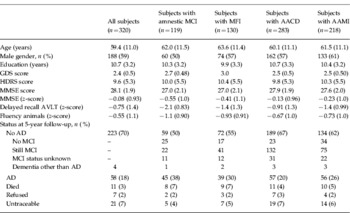
Subjects were selected from an ongoing longitudinal study of non-demented subjects referred to the Maastricht memory clinic. The memory clinic is an out-patient clinic located at the psychiatry and neurology department of a university hospital. Consecutive patients were included at the time of the first visit to the memory clinic if they were older than 39 years, were not demented, and had no apparent cause for their cognitive impairment, such as cerebrovascular disorders, brain trauma, endocrine disorders or psychiatric disorders other than mild affective disorders (Visser et al. Reference Visser, Verhey, Ponds, Kester and Jolles2000). All these subjects had at least a score of 2 on the Global Deterioration Scale (GDS; Reisberg et al. Reference Reisberg, Ferris, De Leon and Crook1982). Subjects included in this study were referred to the memory clinic by general practitioners (68%), neurologists (8%), psychiatrists (16%) or others (7%). Subjects were reinvestigated about 2, 5 and 10 years after the baseline visit. For the present study, we selected all subjects older than 39 who were eligible for the 5-year follow-up assessment and who had a score of 2 or 3 on the GDS (n=343). We excluded subjects who scored higher than 20 on the 17-item Hamilton Depression Rating Scale (HDRS; Hamilton, Reference Hamilton1960) (n=22) because we showed in a previous study that these subjects were at high risk of depression-related cognitive impairment and did not progress to AD at follow-up (Visser et al. Reference Visser, Verhey, Ponds, Kester and Jolles2000). In addition, we excluded one subject with no neuropsychological examination. The baseline characteristics of the final sample (n=320) are shown in Table 1. All subjects gave their informed consent. The study was approved by the medical ethics committee of Maastricht University Hospital, The Netherlands.
Baseline characteristics and status at 5-year follow-up
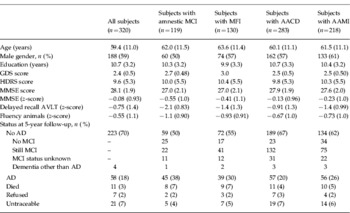
MCI, Mild cognitive impairment; MFI, mild functional impairment; AACD, ageing-associated cognitive decline; AAMI, age-associated memory impairment; GDS, Global Deterioration Scale; HDRS, Hamilton Depression Rating Scale; MMSE, Mini-Mental State Examination; AVLT, Auditory Verbal Learning Task; AD, Alzheimer-type dementia.
z-score indicates the number of standard deviations from the average of a healthy control population (Visser et al. Reference Visser, Verhey, Ponds, Kester and Jolles2000). A negative z-score indicates a score below the average.
Clinical assessment and clinical diagnosis at baseline and follow-up
At baseline all subjects underwent a standardized assessment, which included a history provided by the patient and a significant other, a psychiatric, neurological and physical examination, the Mini-Mental State Examination (MMSE; Folstein et al. Reference Folstein, Folstein and McHugh1975), assessment using clinical rating scales [i.e. the GDS (Reisberg et al. Reference Reisberg, Ferris, De Leon and Crook1982), HDRS (Hamilton, Reference Hamilton1960), Blessed Dementia Rating Scale (BDRS; Blessed et al. Reference Blessed, Tomlinson and Roth1968) and Hachinski Ischaemic Scale (Hachinski et al. Reference Hachinski, Iliff, Zilhka, Du Boulay, McAllister, Marshall, Russell and Symon1975)], appropriate laboratory tests (i.e. tests for haematology, glucose, biochemical analyses, vitamin B12, and thyroid stimulating hormone), a neuropsychological assessment, and computed tomography (CT) or magnetic resonance imaging (MRI) as described elsewhere (Verhey et al. Reference Verhey, Jolles, Ponds, Rozendaal, Plugge, de Vet, Vreeling and van de Lugt1993). The diagnosis of dementia and AD was made according to the DSM-IV and NINCDS-ADRDA criteria (McKhann et al. Reference McKhann, Drachman, Folstein, Katzman, Price and Stadlan1984; APA, 1994). The diagnosis of frontotemporal lobe dementia and primary progressive aphasia were made according to the Neary criteria (Neary et al. Reference Neary, Snowden, Gustafson, Passant, Stuss, Black, Freedman, Kertesz, Robert, Albert, Boone, Miller, Cummings and Benson1998). Vascular cognitive impairment was diagnosed in subjects who met NINDS-AIREN criteria of vascular dementia (Roman et al. Reference Roman, Tatemichi, Erkinjuntti, Cummings, Masdeu, Garcia, Amaducci, Orgogozo, Brun, Hofman, Moody, O'Brien, Yamaguchi, Grafman, Drayer, Bennett, Fisher, Ogata, Kokmen, Bermejo, Wolf, Gorelick, Bick, Pajeau, Bell, Decarli, Culebras, Korczyn, Bogousslavsky, Hartmann and Scheinberg1993) or in subjects who had suffered from a stroke and had cognitive impairments without fulfilling criteria of dementia. The follow-up assessment consisted of a standardized questionnaire about medical history and cognitive complaints, the MMSE, GDS, HDRS and BDRS, and an extensive neuropsychological test protocol (Visser et al. Reference Visser, Verhey, Ponds, Kester and Jolles2000). Additional investigations were undertaken on indication only. Fourteen subjects (4.4%) who refused to come for the follow-up assessment were assessed by a telephone interview, which included a standardized questionnaire about medical history and cognitive complaints, and the Telephone Interview for Cognitive Status (Brandt et al. Reference Brandt, Spencer and Folstein1988). The diagnosis of dementia and AD at follow-up was made by a neuropsychiatrist and a neuropsychologist, both of whom were unaware of the baseline assessment and who made their diagnosis independently of each other. If there was disagreement about the clinical diagnosis, a consensus meeting was held and if no agreement was reached, the subject was considered not demented.
Definitions of mild cognitive impairment (MCI)
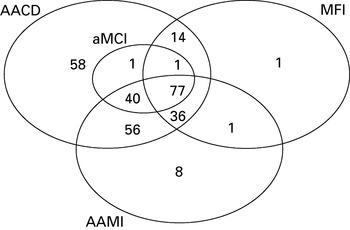
The definitions of MCI were applied to the 320 subjects who met the inclusion and exclusion criteria. The MCI definitions were not mutually exclusive and subjects could meet criteria of more than one MCI definition. MCI was diagnosed in the same way at baseline and at follow-up. The overlap between the criteria in selecting subjects with MCI at baseline is shown in Fig. 1.
Overlap in the selection of subjects according to different diagnostic criteria of mild cognitive impairment (MCI). The numbers indicate the number of subjects meeting the criteria of a specific MCI definition. For example, 40 subjects meet the criteria of both ageing-associated cognitive decline (AACD), amnestic MCI (aMCI) and age-associated memory impairment (AAMI). MFI, mild functional impairment.

Amnestic MCI
Amnestic MCI (Petersen et al. Reference Petersen, Smith, Waring, Ivnik, Tangalos and Kokmen1999) was defined as a score 1.5 standard deviations (s.d.) below the mean of a reference population after correction for age, gender and education on the learning measure (defined as the sum of words reproduced in five learning trials) or the delayed recall measure of the Rey Auditory Verbal Learning Test (RAVLT) (n=311) or a 10-word list (n=9) (Brand & Jolles, Reference Brand and Jolles1987; Lezak, Reference Lezak1995). The test procedure for the RAVLT and the 10-word list is the same except that the word list that has to be remembered consists of 15 words in the RAVLT and 10 words in the other test. The reference population comprised 1400 cognitively normal subjects older than 40 selected randomly within age strata from a registry of general practitioners (van Boxtel et al. Reference van Boxtel, Buntinx, Houx, Metsemakers, Knottnerus and Jolles1998; Visser et al. Reference Visser, Verhey, Ponds, Kester and Jolles2000). The amnestic MCI criteria also require intact activities of daily living. This was operationalized as the absence of dementia and a score below 4 on the GDS, which was part of the inclusion criteria of the study, in agreement with previous studies (Geslani et al. Reference Geslani, Tierney, Herrmann and Szalai2005). Ninety-eight of the 119 subjects with amnestic MCI (82%) also had impairments in other cognitive domains and met criteria of multiple domain amnestic MCI (Winblad et al. Reference Winblad, Palmer, Kivipelto, Jelic, Fratiglioni, Wahlund, Nordberg, Backman, Albert, Almkvist, Arai, Basun, Blennow, de Leon, DeCarli, Erkinjuntti, Giacobini, Graff, Hardy, Jack, Jorm, Ritchie, van Duijn, Visser and Petersen2004). Because of the small number of subjects with single domain amnestic MCI (n=21), subjects with single and multiple domain amnestic MCI were taken together in the analyses.
Mild functional impairment (MFI)
MFI (Reisberg et al. Reference Reisberg, Ferris, De Leon and Crook1982) was defined as a score of 3 on the GDS.
Aging-Associated Cognitive Decline (AACD)
AACD (Levy, Reference Levy1994) was defined as a score 1 s.d. below the mean of a reference population on at least one test of memory, language, attention, executive functioning or abstract reasoning. Memory function was assessed with the learning measure and delayed recall measure of the RAVLT or the 10-word list. Language function was measured with a 1-min verbal fluency test for animals and for professions or trades. Attention was measured with card 1 of the Stroop Colour Word Test (SCWT; Stroop, Reference Stroop1935) and part A of the Trail Making Test (TMT; Reitan, Reference Reitan1958). Executive functioning was assessed with card 3 of the SCWT and part B of the TMT. Abstract reasoning was measured with the Dutch version of the Wechsler Adult Intelligence Scale (WAIS) (n=13) (Stinissen et al. Reference Stinissen, Willems, Coetsier and Hulsman1970), the Groningen Intelligence Test (n=216) (Luteyn et al. Reference Luteyn and van der Ploeg1983) or the Coloured Progressive Matrices (n=7) (Raven, Reference Raven1965). In addition, subjects were classified as suffering from AACD if visuoconstruction was impaired, which is defined as a severe impairment in the completion of the honeycomb figure (Lezak, Reference Lezak1995) or inability to copy the pentagons of the MMSE. Subjects with missing data were classified according to the tests that were available. The majority of these subjects met the criteria for AACD based on impairments on one of the other tests. Only eight subjects with missing data had no impairments on the other tests.
Age-Associated Memory Impairment (AAMI)
AAMI (Crook et al. Reference Crook, Bartus, Ferris, Whitehouse, Cohen and Gershon1986) was defined as a score on the delayed recall measure of the RAVLT or the 10-word list 1 s.d. below the average of 77 healthy subjects aged 24 to 32 from the Maastricht Ageing Study, after adjusting for the level of education (van Boxtel et al. Reference van Boxtel, Buntinx, Houx, Metsemakers, Knottnerus and Jolles1998; Visser et al. Reference Visser, Verhey, Ponds, Kester and Jolles2000).
Statistical analysis
We defined four groups for each MCI definition: subjects with AD at follow-up who met the MCI criteria at baseline (group a), subjects with AD at follow-up who did not meet the MCI criteria at baseline (group b), subjects without AD at follow-up who met the MCI criteria at baseline (group c), and subjects without AD at follow-up who did not meet the MCI criteria at baseline (group d). The main outcome measure was the AUC of an ROC curve. For dichotomous outcome measures as used here, the AUC is the average of the sensitivity and specificity. The AUC, its 95% confidence interval and the asymptotic significance were calculated with SPSS 11 for Macintosh (SPSS Inc., Chicago, IL, USA). Secondary outcome measures were the sensitivity [a/(a+b)], specificity [d/(c+d)], positive predictive value [a/(a+c)], negative predictive value [d/(b+d)], positive likelihood ratio [sensitivity/(1−specificity)] and negative likelihood ratio [(1−sensitivity)/specificity] (Habbema et al. Reference Habbema, Eijkemans, Krijnen, Knottnerus and Knottnerus2002). The analyses were conducted on data for the entire sample and for a subgroup of subjects aged 40–54, 55–69 and 70–85.
Results
The baseline characteristics of the subjects who met the criteria of amnestic MCI, MFI, AACD and AAMI are shown in Table 1. Information on outcome with respect to cognitive functioning at the 5-year follow-up was available for 281 subjects (88%). Of these, 58 subjects (21%) had AD at follow-up. Four of these subjects (7%) were 40–54 years old at baseline, 29 (50%) were 55–69 years old, and 25 (43%) were 70–85 years old. The group of subjects without AD (n=223) included one subject with frontotemporal dementia, one subject with primary progressive aphasia, one subject with dementia due to other causes, three subjects with vascular cognitive impairment, and one subject with Parkinson's disease at follow-up. Information on cognitive outcome was not available for 39 subjects because they had died (n=11), were untraceable (n=21) or refused (n=7). Subjects for whom there was no information on cognitive outcome were significantly older (64.9 v. 58.7 years, p=0.001) compared with subjects for whom such information was available, while gender, years of education, GDS score, MMSE score, the score on the HDRS and the delayed recall score did not differ between subjects with or without information on cognitive outcome (p>0.10). The MCI diagnosis at follow-up in subjects without AD was not always available as in some subjects neuropsychological testing was missing or incomplete at the 5-year follow-up. Of the eight subjects without AACD who had missing tests at baseline, none progressed to AD. The outcome at the 5-year follow-up of the subjects who met the criteria of amnestic MCI, MFI, AACD and AAMI is shown in Table 1.
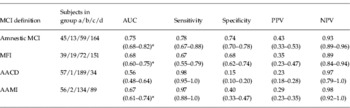
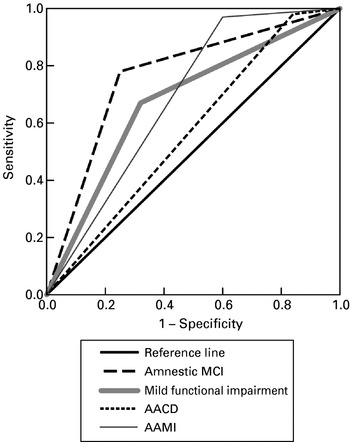
The AUC, sensitivity, specificity, positive predictive value and negative predictive value for AD of each MCI definition in the entire sample are shown in Table 2. A diagnosis of amnestic MCI (AUC=0.75), MFI (AUC=0.68) and AAMI (AUC=0.67) could predict AD at follow-up but a diagnosis of AACD (AUC=0.56) was not predictive of AD (Fig. 2). The difference in AUC between the amnestic MCI and AACD criteria was statistically significant. The definitions of amnestic MCI and MFI combined a moderately high sensitivity (0.67–0.78) with a moderately high specificity (0.68–0.74), while the definitions of AACD and AAMI combined a very high sensitivity (0.97–0.98) with a low specificity (0.15–0.40). The positive predictive value was low (range 0.23–0.43) and the negative predictive value high (range 0.89–0.98) for all MCI definitions. The positive likelihood ratio varied between 1.2 for a diagnosis of AACD criteria and 2.9 for a diagnosis of amnestic MCI and the negative likelihood ratio varied between 0.09 for a diagnosis of AAMI and 0.48 for a diagnosis of MFI (data not shown). Analyses after exclusion of subjects for whom the diagnosis was based on a telephone interview yielded similar results (data not shown).
Predictive accuracy of MCI definitions for AD at follow-up

AD, Alzheimer-type dementia; AUC, area under the curve; PPV, positive predictive value; NPV, negative predictive value; MCI, mild cognitive impairment; MFI, mild functional impairment; AACD, ageing-associated cognitive decline; AAMI, age-associated memory impairment.
Group a, subjects with AD at follow-up who met the MCI criteria at baseline; group b, subjects with AD at follow-up who did not meet the MCI criteria at baseline; group c, subjects without AD at follow-up who met the MCI criteria at baseline; group d, subjects without AD at follow-up who did not meet the MCI criteria at baseline.
95% Confidence intervals are given in parentheses. * p<0.001.
Receiver operating characteristic (ROC) curves showing the ability of four criteria of mild cognitive impairment (MCI) to predict Alzheimer-type dementia (AD). AACD, ageing-associated cognitive decline; AAMI, age-associated memory impairment.

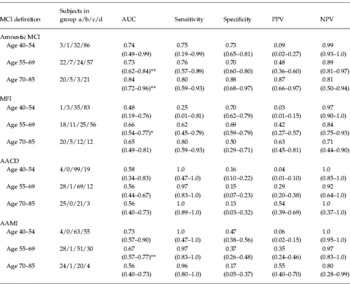
Age had a strong effect on the predictive accuracy as measured with the AUC (Table 3). In subjects aged 40–54, none of the MCI definitions was predictive of AD. In subjects aged 55–69, AD could be predicted by the criteria of amnestic MCI (AUC=0.73), MFI (AUC=0.66) and AAMI (AUC=0.67). In subjects aged 70–85, only the criteria of amnestic MCI (AUC=0.84) were predictive of AD. The difference in AUC of the amnestic MCI and AACD criteria was statistically significant in subjects older than 55 and the difference in AUC between the amnestic MCI and AAMI criteria was statistically significant in subjects older than 70. Age also influenced the sensitivity, specificity, and positive and negative predictive values (Table 3). The sensitivity increased with age for the definition of MFI. The specificity increased with age for the definition of amnestic MCI and decreased with age for the definitions of MFI and AAMI. The positive predictive value strongly increased with age for all definitions and the negative predictive accuracy decreased with age for all definitions except for the definition of AACD. In addition, the positive and negative likelihood ratios changed with age (data not shown). The positive likelihood ratio increased with age for the definitions of amnestic MCI and MFI and decreased for the definition of AAMI. The highest positive likelihood ratio was 6.4 for a diagnosis of amnestic MCI in subjects 70–85 years old. The negative likelihood ratio decreased with age for all definitions except for the definition of AACD. Again, analyses after exclusion of subjects for whom the diagnosis was based on a telephone interview yielded similar results (data not shown).
Effect of age on predictive accuracy of MCI definitions for AD at follow-up

AD, Alzheimer-type dementia; AUC, area under the curve; PPV, positive predictive value; NPV, negative predictive value; MCI, mild cognitive impairment; MFI, mild functional impairment; AACD, Ageing-Associated Cognitive Decline; AAMI, Age-Associated Memory Impairment.
Group a, subjects with AD at follow-up who met the MCI criteria at baseline; group b, subjects with AD at follow-up who did not meet the MCI criteria at baseline; group c, subjects without AD at follow-up who met the MCI criteria at baseline; group d, subjects without AD at follow-up who did not meet the MCI criteria at baseline.
95% Confidence intervals are given in parentheses. * p<0.05; ** p<0.01.
Discussion
The predictive accuracy of MCI for AD is dependent on age and the definition of MCI used. A good predictive accuracy with an AUC, sensitivity, specificity and positive predictive value above 0.80 was only observed in subjects 70–85 years old with the definition of amnestic MCI. The low to moderately high predictive accuracy in subjects aged 40–70 limits the clinical utility of MCI definitions for predicting AD considerably because 57% of the subjects with prodromal AD in our study were in this age range.
The effect of age on the AUC, sensitivity, specificity, and positive and negative likelihood ratios suggests that the clinical presentation of prodromal AD or the disorder from which prodromal AD has to be distinguished varies with age. For example, the increase in sensitivity of the diagnosis of MFI with age indicates that elderly subjects with prodromal AD present with more severe functional impairments than young subjects with prodromal AD. The decrease in specificity of the diagnosis of AAMI with age implies that elderly subjects without prodromal AD more easily meet the AAMI criteria than young subjects without prodromal AD. This can be explained by the fact that the AAMI criteria do not apply age-corrected cut-off scores such that elderly subjects are more likely to meet the AAMI criteria than young subjects because of age-related cognitive decline. The increase in positive predictive value and the decrease in negative predictive value with increasing age probably reflect the increase in incidence of AD with age in the general population. It is important to note that this age effect was also present in a memory clinic setting even though the subjects had been selected through a referral process. The effect of age on the positive predictive value of MCI criteria has been observed in other studies as well (Solfrizzi et al. Reference Solfrizzi, Panza, Colacicco, D'Introno, Capurso, Torres, Grigoletto, Maggi, Del Parigi, Reiman, Caselli, Scafato, Farchi and Capurso2004; Visser et al. Reference Visser, Scheltens and Verhey2005, Reference Visser, Kester, Jolles and Verhey2006).
There were marked differences on the measures of predictive accuracy between the MCI definitions. The criteria of amnestic MCI and MFI combined a moderately high sensitivity with a moderately high specificity. The criteria of AACD and AAMI, on the contrary, combined a very high sensitivity with a low specificity. The high sensitivity and low specificity of these criteria probably resulted from the fact that they were designed to detect age-related cognitive decline rather than prodromal AD. The highest AUC was found for the criteria of amnestic MCI, indicating that this definition has the best trade-off between sensitivity and specificity, although most of the differences in AUC between the MCI definitions were not statistically significant. Measures of predictive accuracy of different MCI definitions have been compared in population-based studies but these studies used dementia as the outcome and not AD (Ritchie et al. Reference Ritchie, Artero and Touchon2001; Busse et al. Reference Busse, Bischkopf, Riedel-Heller and Angermeyer2003a). Contrary to our findings, these studies found that AACD (AUC between 0.66 and 0.74) had a better overall predictive accuracy than amnestic MCI (AUC between 0.50 and 0.51). This difference may be explained by the difference in outcome measure but also by differences in the operationalization of the MCI criteria. For example, we defined amnestic MCI as single or multiple domain amnestic MCI, whereas it was defined as single domain amnestic MCI in the population-based studies. Another explanation for the difference may be referral or selection bias. For example, the prevalence of AACD in our sample (88%) was much higher than that in the population-based studies (8.8–21%).
Previous clinical studies on measures of predictive accuracy of MCI for AD have mainly investigated the positive predictive value or conversion rate from MCI to AD. Although the findings from these studies cannot be compared directly with our study because of differences in the operationalization of the MCI criteria, the average age of the subjects, or the length of follow-up, the positive predictive value in our study is comparable to these studies (Kluger et al. Reference Kluger, Ferris, Golomb, Mittelman and Reisberg1999; Jelic et al. Reference Jelic, Johansson, Almkvist, Shigeta, Julin, Nordberg, Winblad and Wahlund2000; Bozoki et al. Reference Bozoki, Giordani, Heidebrink, Berent and Foster2001; Drzezga et al. Reference Drzezga, Grimmer, Riemenschneider, Lautenschlager, Siebner, Alexopoulus, Minoshima, Schwaiger and Kurz2005).
Even though memory impairment is a key feature of AD, 20–25% of the subjects with AD at follow-up did not meet the criteria of amnestic MCI at baseline in our study, which is consistent with other studies (Geslani et al. Reference Geslani, Tierney, Herrmann and Szalai2005; Storandt et al. Reference Storandt, Grant, Miller and Morris2006). Therapeutic and diagnostic studies on prodromal AD that include only subjects with amnestic MCI may therefore miss a substantial number of subjects with prodromal AD.
The sample had some specific characteristics. The average age of the sample was low compared to that in most other clinical studies on MCI. The low age may have resulted from the fact that we included subjects from age 40 onwards and from the setting of the memory clinic, which was located at a psychiatry and neurology department rather than a geriatric department. In addition, the prevalence of non-Alzheimer-type dementias at follow-up was low, probably because subjects at high risk for other types of dementia were excluded at baseline or because these subjects were less likely to be referred to a memory clinic. Other clinical studies have also shown that AD was the main cause of dementia in MCI subjects who developed dementia (Geslani et al. Reference Geslani, Tierney, Herrmann and Szalai2005).
A strength of our study was its clinical setting, which makes the results relevant for clinical practice. Other strengths include the large sample size and the compliance rate of 88%. A limitation is the 5-year follow-up period. Although this follow-up period was much longer than in most other clinical studies, MCI may convert into AD over a longer time (Stokholm et al. Reference Stokholm, Jakobsen, Czarna, Mortensen and Waldemar2005; Hodges et al. Reference Hodges, Erzinclioglu and Patterson2006; Visser et al. Reference Visser, Kester, Jolles and Verhey2006). Therefore, we may have made a false-negative diagnosis of AD in a number of subjects, and may have underestimated the positive predictive value and overestimated the negative predictive value. Another limitation is that the number of subjects in some subgroups was small, which limited statistical power and resulted in broad 95% confidence intervals. Finally, the findings from this study may not apply to clinical settings with different patient characteristics or settings in which other tests or cut-offs are used to define MCI (Busse et al. Reference Busse, Bischkopf, Riedel-Heller and Angermeyer2003c; Alladi et al. Reference Alladi, Arnold, Mitchell, Nestor and Hodges2006).
Our study suggests that MCI should be considered as a description of cognitive functioning in which the underlying disorder can vary rather than as a nosological entity representing the prodromal stage of AD (Morris et al. Reference Morris, Storandt, Miller, McKeel, Price, Rubin and Berg2001). The ability of MCI definitions to detect subjects with future AD is likely to increase if they are used in combination with other markers or risk factors of AD such as age, the apolipoprotein E genotype, atrophy of the medial temporal lobe, or beta amyloid and tau levels in cerebrospinal fluid (Visser et al. Reference Visser, Verhey, Scheltens, Cruts, Ponds, Hofman, Van Broeckhoven and Jolles2002; Grundman et al. Reference Grundman, Petersen, Bennett, Feldman, Salloway, Visser, Thal, Schenk, Khachaturian and Thies2006; Hansson et al. Reference Hansson, Zetterberg, Buchhave, Londos, Blennow and Minthon2006). The choice for a specific MCI definition in clinical studies may depend on the purpose of the study. For example, studies that need a high specificity for AD, such as drug trials, may use the criteria of amnestic MCI, while studies that need a high sensitivity for AD, such as studies on new predictors for AD, may use the criteria of AAMI or AACD. In clinical practice, it seems advisable to keep subjects with amnestic MCI who are older than 55 under clinical supervision. However, it should be realized that not all subjects with amnestic MCI will develop AD and that the absence of amnestic MCI does not exclude AD.
Declaration of Interest
None.