Introduction
The performance of middle-ear surgery under local anaesthesia has a long history, and many advantages over general anaesthesia: reduced intra-operative bleeding; greater overall patient safety; elimination of the slight but definite risk of laryngotracheal trauma from intubation; reduced post-operative nausea and vomiting, earlier mobilisation (generally); and reduced cost.Reference Lancer and Fisch1 Despite these advantages, this technique is only performed by a small number of otolaryngologists, because some surgeons feel that patients may not tolerate such otological intervention under local anaesthesia.Reference Sarmento and Tomita2 However, one study found that, although the intense sensations of noise and anxiety were the greatest sources of discomfort, the majority of patients preferred local anaesthesia to general anaesthesia.Reference Yung3
In the past, when we have performed middle-ear surgery under local anaesthesia, some patients have complained of anxiety, dizziness, nausea, vomiting and earache. In order to minimise such problems associated with middle-ear surgery under local anaesthesia, we investigated the results of operative sedation with midazolam alone versus midazolam plus remifentanil.
Patients and methods
Prior to study commencement, we received approval from our institutional ethics committee and obtained written, informed consent from all participants.
In order to establish a control group, we observed 19 patients undergoing elective middle-ear surgery under local anaesthesia. Twenty-four hours post-operatively, these patients were given a questionnaire assessing the level of pain at the time of local anaesthetic injection and also during the operation. The questionnaire also assessed anxiety and post-operative dizziness, nausea and vomiting.
We then prospectively assessed a further 40 patients undergoing middle-ear surgery under local anaesthesia.
Exclusion criteria were: an age of less than 20 years or more than 60 years; chest or heart problems; pregnancy; a history of chronic sedative use; a history of alcohol or drug abuse; and known or suspected psychiatric disturbance. We also excluded patients requiring surgery lasting more than 3 hours (due to severe middle-ear and/or mastoid pathology).
The 40 patients were allocated randomly (by opening a sealed, numbered envelope containing the study group designation) to receive one of two forms of sedation, either: (1) midazolam (0.04 mg/kg loading dose then 0.04 mg/kg/hour continuous dose), or (2) midazolam plus remifentanil (midazolam as 0.04 mg/kg loading dose then 0.04 mg/kg/hour continuous dose, plus remifentanil as 0.5 µg/kg loading dose then 0.05 µg/kg/minute continuous dose). Patients in the midazolam group also received intravenous saline, in the same volume as the remifentanil in the midazolam–remifentanil group.
No other premedication was given.
Twenty-four hours post-operatively, the 40 study group patients were given the same questionnaire as the control patients, but with additional questions assessing their overall satisfaction with operative sedation.
Surgical procedure
Prior to surgery, 2 per cent lidocaine with 1:100 000 adrenaline was injected into the external auditory canal, at 6 and 12 o'clock positions, and also into the retroauricular skin crease region.
All surgical procedures were performed by the same otolaryngologist using the same technique.
Tympanomastoidectomy was performed, consisting of simple mastoidectomy and type one tympanoplasty. If the middle-ear or mastoid cavity pathology was severe, surgery was performed under general anaesthesia because of the longer operating time involved. Myringoplasty was performed via a transcanal approach. Connective tissue harvested from the retroauricular area was grafted onto the tympanic membrane using an underlay technique.
Sedation outcome measures
Pain during local anaesthetic injection and during the operation itself were assessed in the recovery room, using a visual analogue scale (VAS), where 0 = no pain and 10 = severe pain. Anxiety was also assessed using a VAS, where: 0 = no anxiety and 10 = most anxiety.
Twenty-four hours after surgery, patients were again assessed, by a different anaesthetist to the one involved in their operation.
Patients' peri-operative sedation levels were assessed simultaneously, 24 hours post-operatively, both by the patients themselves and by the investigators. Patients graded their intra-operative sedation level (patients' memory) using a VAS, where 0 = asleep and 5 = alert. The investigators graded the patients' intra-operative sedation status using the observer's assessment of alertness and sedation scale, where 1 = fully alert and 5 = deep sleep. Patients' satisfaction with sedation was assessed using the following scale: 5 = extremely satisfied, 4 = satisfied, 3 = undecided, 2 = dissatisfied and 1 = extremely dissatisfied. The safety of sedation was assessed by monitoring respiratory and haemodynamic parameters and adverse anaesthetic events, including hypotension (i.e. systolic blood pressure <90 mmHg), bradycardia (heart rate <60 beats/minute), oxygen desaturation (<94 per cent) and respiratory depression (breathing rate <10 breaths/minute).
Statistical analysis
We used Fisher's exact test to analyse post-operative nausea, vomiting and dizziness, and also to analyse some demographic data. We used the Kruskal–Wallis test for comparisons between the three groups regarding the remaining demographic data, pain at the local anaesthetic injection site, pain during the operation, and anxiety. The Mann–Whitney test was used to analyse differences between the midazolam group and the midazolam–remifentanil group with regard to patients' memory of their operation, depth of sedation and satisfaction with sedation. A probability of p < 0.05 was taken to indicate statistical significance.
Results
Patient demographics
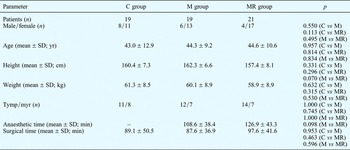
The control group comprised eight men and 11 women, with a mean age ± standard deviation (SD) of 43.0 ± 12.9 years. The midazolam group comprised six men and 13 women, with an average age ± SD of 44.3 ± 9.2 years. The midazolam–remifentanil group comprised four men and 17 women, with an average age ± SD of 44.6 ± 10.6 years.
The surgical procedures performed were: control group, 11 tympanomastoidectomies and eight myringoplasties; midazolam group, 12 tympanomastoidectomies and seven myringoplasties; and midazolam–remifentanil group, 14 tympanomastoidectomies and seven myringoplasties.
Demographic and baseline physiological characteristics did not differ significantly between the three groups (Table I).
Patient demographics and clinical profiles

C = control; M = midazolam; MR = midazolam–remifentanil; SD = standard deviation; yr = years; tymp = tympanomastoidectomy; myr = myringoplasty
Pain on local anaesthetic injection
Patient VAS scores for local anaesthetic injection pain were assessed.
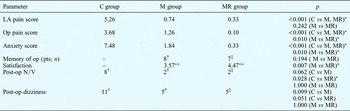
The control group had a mean pain score of 5.26/10.
In the midazolam group, four patients remembered their local anaesthetic injection; these patients' individual pain scores were 0, 2, 5 and 7, and their mean pain score was 3.5/10. The overall mean pain score for the midazolam group was 0.74/10.
In the midazolam–remifentanil group, four patients remembered their local anaesthetic injection; these patients' individual pain scores were 0, 0, 0 and 7, and their mean pain score was 1.75/10. The overall mean pain score for the midazolam–remifentanil group was 0.33/10.
The mean injection pain scores of the midazolam and midazolam–remifentanil groups did not differ significantly (p = 0.242), but both were significantly lower than that of the control group (p < 0.001) (Table II).
Results

Data represent means unless otherwise specified. *Significant difference. †Of 19 patients; ‡of 21 patients; **of 5 patients. C = control; M = midazolam; MR = midazolam–remifentanil; LA = local anaesthesic injection; op = operation; pts = patients; post-op = post-operative; N/V = nausea and vomiting
Intra-operative pain
In the control group, the mean intra-operative pain score was 3.68/10.
In the midazolam group, six patients complained of intra-operative pain; their mean pain score was 4/10. The overall mean pain score for the midazolam group was 1.26/10.
In the midazolam–remifentanil group, only one patient reported intra-operative pain, with a pain score of 2/10. The overall mean pain score for the midazolam–remifentanil group was 0.1/10.
The mean intra-operative pain scores of the midazolam and midazolam–remifentanil groups were both significantly lower than that of the control group (p < 0.001). Patients in the midazolam–remifentanil group reported significantly less intra-operative pain compared with the midazolam group (p = 0.010) (Table II).
Anxiety
The mean anxiety score for the control group was 7.48/10, equating to a very high level of anxiety.
In the midazolam–remifentanil group, the sole patient who complained of intra-operative pain was also the only patient in this group to report anxiety, with a score of 7/10. The overall mean anxiety score for the midazolam–remifentanil group was 0.33/10.
However, in the midazolam group eight patients complained of anxiety; these patients had a mean anxiety score of 4.38/10. The overall mean anxiety score for the midazolam group was 1.84/10.
The mean anxiety scores of the midazolam and midazolam–remifentanil groups were both significantly lower than that of the control group (p < 0.001). Midazolam–remifentanil group patients had significantly lower anxiety scores compared with the midazolam group (p = 0.009) (Table II).
Memory of surgery
Eight patients in the midazolam group and seven in the midazolam–remifentanil group reported remembering their operation (Table II). The individual, self-rated sedation scores for the eight midazolam group patients were 5, 5, 4, 3, 3, 2, 1 and 1; those for the seven midazolam–remifentanil group patients were 3, 2, 2, 1, 1, 1 and 1. Patients in midazolam–remifentanil group had vaguer memories than those in midazolam group .
Objective sedation level
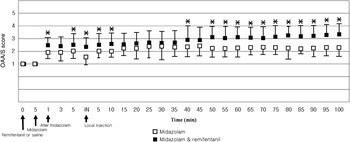
The investigators' objective scores for patients' intra-operative alertness and sedation generally ranged between 2 and 4, for both study groups. However, a statistically significant difference was still observed between the mean alertness and sedation scores of the midazolam and midazolam–remifentanil groups (Figure 1).
Effect of midazolam and midazolam plus remifentanil on objective alertness and sedation, using the observer's assessment of alertness/sedation scale (OAA/S). Data represent means ± standard deviations. *Significant difference.

Satisfaction with sedation
The mean sedation satisfaction score was 4.47/5 for the midazolam–remifentanil group and 3.57/5 for the midazolam group; this difference was statistically significant (p = 0.007) (Table II).
Adverse events
Post-operative nausea and vomiting developed in eight control patients, two midazolam–remifentanil group patients and two midazolam group patients. Thus, post-operative nausea and vomiting was more prevalent in the control group than in either the midazolam group (p = 0.062) or the midazolam–remifentanil group (p = 0.028). The difference in this respect between the control and midazolam groups was not statistically significant because of the small sample size. No difference was observed in this respect between the midazolam and midazolam–remifentanil groups (p = 0.916) (Table II).
Post-operative dizziness developed in 11 control group patients, five midazolam group patients and five midazolam–remifentanil group patients. Dizziness was more prevalent in the control group than in either the midazolam group (p = 0.099) or the midazolam–remifentanil group (p = 0.051), but neither of these differences was statistically significant. No statistically significant differences in dizziness prevalence were observed between the midazolam and midazolam–remifentanil groups (p = 0.855) (Table II).
Respiratory and haemodynamic stability
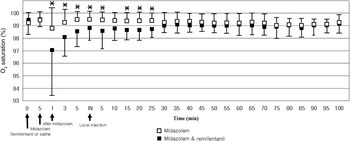
Oxygen desaturation developed in two midazolam–remifentanil group patients and one midazolam group patient. Desaturated patients recovered to normal oxygen saturation levels after physical stimulation, such as gentle shaking. In the group, the mean oxygen saturation was significantly reduced during the period from 1 minute after midazolam injection to 25 minutes after local anaesthetic injection, compared with midazolam group; however, the mean oxygen saturation in the midazolam–remifentanil group was greater than 97 per cent during all monitored periods (Figure 2).
Effect of midazolam and midazolam plus remifentanil on oxygen saturation. Data represent means ± standard deviations. *Significant difference.

In both study groups, systolic and diastolic blood pressures decreased 1 minute after midazolam infusion commencement and increased slightly after local anaesthetic injection at the operation site. However, there were no statistically significant differences in blood pressure stability between the two study groups.
Soon after the local anaesthetic injection, the mean heart rate increased in both study groups, and gradually became higher in the midazolam–remifentanil group than in the midazolam group; however, this difference was not statistically significant.
Discussion
Sedation is often used in patients who are anxious about undergoing surgery under local anaesthesia. However, sedation is rarely used for middle-ear surgery conducted under local anaesthesia. Many otolaryngologists recommend general anaesthesia for middle-ear surgery, because the procedures involved (including drilling and suction) can cause negative experiences and bad memories for the patient. In addition, sudden patient movements may cause inner ear trauma during manipulation of the ossicular chain. Moreover, the patient's head must remain tilted during the operation. Therefore, using local anaesthesia alone has limitations for both patient and surgeon.
Nevertheless, some patients refuse general anaesthesia because of previous experiences of post-operative discomfort due to intubation or the effects of the anaesthetic itself. Many patients fear anaesthetic complications, and as a result some request middle-ear surgery without general anaesthesia.
A survey of patients who had undergone middle-ear surgery found that the commonest types of discomfort experienced were overwhelming anxiety and an intense intra-operative sensation of noise, followed by dizziness, backache, claustrophobia and earache.Reference Yung3
These complaints are consistent with the results of the present study. Our 19 control group patients had mean VAS pain scores of 5.26 during local anaesthetic injection and 3.68 during surgery, and a mean VAS anxiety score of 7.48 (indicating a state of high anxiety). In the control group, eight patients reported nausea and vomiting and 11 complained of post-operative dizziness.
Two patients who did not receive sedation refused surgery in the operating theatre because of claustrophobia and anxiety; these patients were excluded from the study.
In our midazolam and midazolam–remifentanil groups, scores for anxiety and local anaesthetic injection pain were markedly lower, compared with the control group. Presumably as a result, these patients reported a high degree of satisfaction with the procedure.
The present study investigated the use of midazolam and remifentanil as sedatives.
Midazolam is a benzodiazepine which acts on the central nervous system and can relieve anxiety and induce sleep, sedation and memory loss. It has a fast onset time and short duration of action, and causes only minimal pain when injected intravenously because of its hydrophilic characteristics.Reference Khanderia and Pandit4 Due to these advantages, its use as a sedative has been investigated in many studies. However, our study differed from previous ones in that we maintained a continuous infusion of sedative after the initial bolus dose, enabling continuous sedation. Continuous midazolam infusion has previously been used to ensure a constant and appropriate depth of anaesthesia.Reference Melvin, Johnson, Quasha and Eger5 The half-life of midazolam is 2–4 hours, and complete clearance is not achieved until at least 12 hours after infusion. Therefore, we did not administer patient questionnaires until 24 hours post-operatively.
Remifentanil has been suggested to provide acceptable sedation and analgesia when administered by continuous infusion in combination with intravenous midazolam.Reference Avramov, Smith and White6, Reference Gold, Watkins, Sung, Yarmush, Chung and Uy7 Remifentanil is a recently approved opioid analgesic which undergoes rapid metabolism, via nonspecific blood and tissue esterases, into a carboxylic acid metabolite.Reference Egan, Lemmens, Fiset, Hermann, Muir and Stanski8, Reference Glass, Hardman, Kamiyama, Quill, Marton and Donn9 The rapid onset and elimination of remifentanil make it ideally suited to administration by continuous infusion, and should permit more precise control of its analgesic effect.Reference Rosow10 In the present study, the patients receiving remifentanil and midazolam had less residual memory of surgery and a more favourable sedation depth and anxiety level, compared with those receiving midazolam alone. This suggests that continuous infusion of remifentanil enhances the amnestic, sedative and anxiolytic effects of midazolam.
Previous studies of middle-ear surgery have found a high correlation with post-operative nausea and vomiting. Liu et al. reported a post-operative nausea and vomiting incidence of 65 per cent in a control group with no antiemetic management.Reference Liu, Li, Wang, Ho, Chang and Ho11 Misra et al. reported a post-operative nausea and vomiting incidence of 55 per cent.Reference Misra, Pullani and Mohamed12 The incidence in the present study was 42 per cent. Several studies have indicated that midazolam significantly reduces post-operative nausea and vomiting. Sanjay and Tauro reported that continuous infusion of midazolam at a maintenance dosage of 0.02 mg/kg/hour resulted in an antiemetic effect similar to that of ondansetrone.Reference Sanjay and Tauro13 In the current study, only 10 per cent of midazolam–remifentanil group patients and 11 per cent of midazolam group patients reported post-operative nausea and vomiting. Both groups showed a significant decrease in this respect compared with the control group, supporting the suggestion that continuous intra-operative midazolam infusion decreases the occurrence of post-operative nausea and vomiting.
• Fifty-nine patients receiving middle-ear surgery under local anaesthesia were divided into three groups: local anaesthesia only, local anaesthesia and midazolam, and local anaesthesia and midazolam plus remifentanil
• Sedation with midazolam satisfactorily controlled pain, anxiety, nausea, vomiting and post-operative dizziness in most cases
• Results were better still when midazolam was accompanied by remifentanil
In the current study, all patients maintained oxygen saturation levels of over 98 per cent 25 minutes after initial midazolam administration, and had stable haemodynamic conditions during surgery. So the 25-minute point is the most critical in attending to patients after midazolam injection. Thus, the anaesthetist should not keep the patient after stabilisation.
Conclusion
Patients undergoing middle-ear surgery under local anaesthesia alone risk experiencing intra-operative pain and anxiety, and post-operative nausea, vomiting and dizziness. However, in the present study the majority of patients receiving additional pre- and intra-operative sedation with midazolam satisfactorily overcame pain, anxiety, and post-operative nausea, vomiting and dizziness. Results were better still when midazolam was accompanied by remifentanil.