Introduction
Circadian rhythms, the approximately 24-hour cycles that govern various physiological processes, are fundamental to maintaining homeostasis in living organisms. These rhythms are driven by a complex interplay of core clock genes, including Brain and Muscle ARNT-Like 1 (Bmal1), Cryptochrome (Cry) and Period (Per), which generate endogenous oscillations that synchronize biological functions with environmental cycles, primarily the light–dark cycle (Boden & Kennaway, Reference Boden and Kennaway2006). Discovered in the early 20th century, circadian rhythms have been extensively studied across different species, revealing their critical role in various bodily functions, from sleep-wake cycles to metabolic regulation (Hastings et al., Reference Hastings, Reddy and Maywood2003; Reppert & Weaver, Reference Reppert and Weaver2002).
In reproductive health, circadian rhythms influence numerous aspects, including the timing of the estrous cycle, ovulation, sperm production and pregnancy maintenance (Kennaway, Reference Kennaway2005). The hypothalamus, particularly the suprachiasmatic nucleus (SCN), acts as the central pacemaker, coordinating hormonal signals with environmental light cues to regulate these reproductive processes (Moore & Eichler, Reference Moore and Eichler1972; Silver et al., Reference Silver, LeSauter, Tresco and Lehman1996). Disruptions to circadian rhythms, caused by factors such as shift work, jet lag, or genetic mutations, can lead to significant reproductive challenges (Labyak et al., Reference Labyak, Lava, Turek and Zee2002; Kovanen et al., Reference Kovanen, Saarikoski, Aromaa, Lönnqvist and Partonen2010).
Historical perspectives on circadian rhythms provide a rich context for understanding their evolution and significance. The concept of biological clocks was first proposed by French scientist Jean-Jacques d’Ortous de Mairan in the 18th century, who observed leaf movements in plants even in constant darkness. This observation hinted at an internal biological mechanism governing these rhythms (De Mairan, Reference De Mairan1729). Further research in the 20th century, particularly by scientists such as Franz Halberg and Colin Pittendrigh, laid the groundwork for modern chronobiology, elucidating the genetic and molecular bases of circadian rhythms (Halberg, Reference Halberg1960; Pittendrigh, Reference Pittendrigh1960).
This review examines the molecular mechanisms underpinning circadian rhythms and their impact on reproductive health, incorporating findings from both animal models and human studies. We delve into the intricate interplay between circadian genes, hormonal regulation and environmental factors, underscoring the critical importance of circadian integrity for optimal reproductive outcomes (Boden & Kennaway, Reference Boden and Kennaway2006; Alvarez et al., Reference Alvarez, Hansen, Ord, Bebas, Chappell and Giebultowicz2008; Kennaway, Reference Kennaway2005). The potential therapeutic implications of maintaining circadian rhythms are also discussed, highlighting novel avenues for enhancing reproductive health (Boden & Kennaway, Reference Boden and Kennaway2006; Alvarez et al., Reference Alvarez, Hansen, Ord, Bebas, Chappell and Giebultowicz2008; Kennaway, Reference Kennaway2005).
The CLOCK-Bmal1heterodimer initiates transcription of PER and CRY genes, which feedback to repress their own transcription, maintaining ∼24-hour oscillations. Disruption in these genes (e.g. BMAL1 knockout models) results in irregular ovulation, impaired spermatogenesis and decreased fertility (Liu et al., Reference Liu, Li, Liu, Xie, Wu and Zhou2017).
To summarize the circadian genetic framework, Bmal1 and CLOCK form the core transcriptional activators, regulating PER and CRY genes in a self-regulating feedback loop. These core genes also control downstream targets like REV-ERBα and RORα, which mediate steroidogenesis and gonadotropin release. Mutations in BMAL1 or CLOCK lead to infertility, disrupted estrous cycles and impaired hormone synthesis. PER and CRY genes contribute to the repression phase of the cycle and are equally crucial for reproductive rhythm stability (Chappell et al., Reference Chappell, White and Mellon2003; Liu et al., Reference Liu, Li, Liu, Xie, Wu and Zhou2017). Disruptions in any of these components can impair gonadal function and fertility, underlining the necessity of circadian integrity for reproductive success.
Circadian regulation of female reproductive functions
The topic of female reproduction encompasses critical factors such as ovarian function, the endometrium, vaginal health and hormonal status. These elements play a pivotal role in maintaining a healthy and functional female reproductive system.
Hypothalamus/pituitary axis
The hypothalamus and pituitary gland play a crucial role in regulating the reproductive cycle through the secretion of gonadotropin-releasing hormone (GnRH) and the subsequent release of luteinizing hormone (LH) and follicle-stimulating hormone (FSH) (Boden & Kennaway, Reference Boden and Kennaway2006). The circadian control of the LH surge is essential for timely ovulation, with studies in rodents demonstrating that disruptions in circadian timing can delay or inhibit ovulation (Kennaway et al., Reference Kennaway, Boden and Voultsios2004). The SCN of the hypothalamus acts as the central pacemaker, coordinating these hormonal signals with environmental light cues (Moore & Eichler, Reference Moore and Eichler1972).
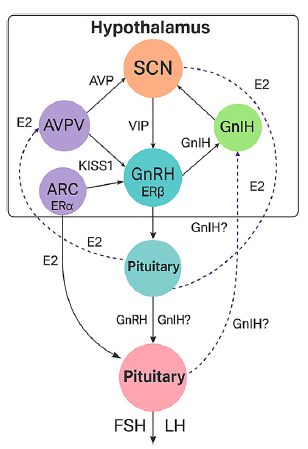
Studies have shown that the LH surge, crucial for ovulation, follows a circadian pattern tightly regulated by the SCN. The SCN receives light signals through the retina and processes them to maintain the circadian timing of the LH surge (Alvarez et al., Reference Alvarez, Hansen, Ord, Bebas, Chappell and Giebultowicz2008). Disruptions in light exposure, such as those caused by shift work or long flights across time zones, can lead to alterations in the timing of the LH surge, ultimately affecting ovulation and fertility (Boden & Kennaway, Reference Boden and Kennaway2006; Labyak et al., Reference Labyak, Lava, Turek and Zee2002). For instance, female shift workers often experience menstrual irregularities and reduced fertility, highlighting the sensitivity of the reproductive axis to circadian disruptions (Labyak et al., Reference Labyak, Lava, Turek and Zee2002) (Figure 1 illustrates the neuroendocrine pathways involved in this regulation).
Neuroendocrine regulation of the human reproductive axis by the circadian clock. SCN signals modulate GnRH, Kisspeptin and GnIH pathways, influencing pituitary LH and FSH secretion.

Circadian disruption in shift workers interferes with hypothalamic-pituitary-gonadal axis signalling, particularly by altering the rhythmic release of GnRH and subsequent LH/FSH secretion. These hormonal imbalances have been shown to impair follicular development and ovulatory timing in females, leading to subfertility (Mahoney, Reference Mahoney2010).
In addition to light exposure, genetic mutations in clock genes can also disrupt the circadian regulation of the hypothalamus-pituitary axis. For instance, studies on rodents with mutations in the Bmal1 gene have shown disrupted LH surges and subsequent ovulatory failure (Alvarez et al., Reference Alvarez, Hansen, Ord, Bebas, Chappell and Giebultowicz2008). These findings suggest that maintaining the integrity of circadian rhythms is essential for the proper functioning of the reproductive axis and fertility (Boden & Kennaway, Reference Boden and Kennaway2006) (See Figure 1 for an overview of the SCN’s influence on GnRH and pituitary signalling).
Ovarian function
The ovary exhibits circadian rhythmicity, with core clock genes such as Bmal1 and Per2 showing oscillatory expression patterns (Fahrenkrug et al., Reference Fahrenkrug, Georg, Hannibal, Hindersson and Gras2006). These rhythms are crucial for the regulation of follicular development, oocyte maturation and ovulation. Disruptions in the expression of these genes can lead to irregular estrous cycles and impaired fertility (Boden et al., Reference Boden, Varcoe, Voultsios and Kennaway2010). For instance, Bmal1 knockout mice exhibit disrupted ovarian rhythms and fail to maintain regular estrous cycles (Boden et al., Reference Boden, Varcoe, Voultsios and Kennaway2010).
Clock genes in the ovary regulate the expression of various genes involved in follicular development and oocyte maturation (Fahrenkrug et al., Reference Fahrenkrug, Georg, Hannibal, Hindersson and Gras2006). The rhythmic expression of these clock genes ensures that the processes of folliculogenesis and oocyte maturation occur in a timely manner. Disruptions in the circadian expression of these genes can lead to delayed or abnormal follicular development, resulting in reduced fertility (Boden et al., Reference Boden, Varcoe, Voultsios and Kennaway2010).
Environmental factors such as light exposure and shift work can also disrupt the circadian regulation of ovarian function. Studies on female shift workers have shown that irregular work hours can lead to menstrual irregularities and reduced fertility (Labyak et al., Reference Labyak, Lava, Turek and Zee2002). Similarly, exposure to artificial light at night (ALAN) can disrupt the circadian rhythms of clock genes in the ovary, leading to impaired reproductive function (Kavanen et al., Reference Kovanen, Saarikoski, Aromaa, Lönnqvist and Partonen2010). Furthermore, the role of melatonin, a hormone produced in response to darkness, in regulating ovarian function and its potential therapeutic applications should be explored (Reiter et al., Reference Reiter, Tan, Korkmaz, Rosales-Corral and Manchester2014).
Vaginal health
The circadian clock also exerts regulatory control over the vaginal epithelium, which undergoes cyclical changes influenced by estrogen levels and local immune responses. Core clock genes such as BMAL1 and CLOCK have been shown to modulate epithelial barrier function and mucosal immunity in reproductive tissues, including the vagina. Disruptions in circadian rhythms – such as those caused by shift work or irregular sleep – can alter vaginal microbiota composition and reduce resistance to infections, thereby compromising vaginal health and fertility (Schiavi et al., Reference Schiavi, Faiano and D’Oria2022). These findings underscore the importance of circadian stability not only for endocrine regulation but also for maintaining optimal local reproductive tract conditions.
Circadian control of early embryogenesis and implantation
The influence of circadian rhythms extends beyond gametogenesis into early embryonic and uterine development. Preimplantation embryos express core clock genes – including BMAL1, CLOCK, PER1 and Cry1 – that are essential for coordinating cleavage divisions, transcriptional activation and metabolic homeostasis. Maternal deletion of BMAL1 disrupts this orchestration, resulting in delayed cleavage, downregulation of pluripotency genes such as OCT4 and SOX2, impaired blastocyst expansion and ultimately reduced implantation success (Stanton et al., Reference Stanton, Chang and Barakat2023) (Figure 2 highlights the role of core clock genes in endocrine signalling relevant to these outcomes).The circadian machinery also contributes to epigenetic remodelling during the zygote-to-blastocyst transition, with evidence suggesting that circadian disruption can lead to long-lasting alterations in embryo gene expression profiles.
Circadian control of melatonin and cortisol via core clock genes. Light entrains SCN activity, affecting endocrine rhythms through the pineal and adrenal glands.

Post implantation success is similarly dependent on circadian integrity within maternal tissues. The endometrium possesses its own circadian clock, which regulates expression of genes involved in decidualization, angiogenesis and immune tolerance. In animal models, exposure to irregular light–dark cycles during early pregnancy alters endometrial expression of Bmal1 and REV-ERBα, reduces progesterone receptor signalling and disrupts uterine receptivity, leading to increased rates of embryo resorption and early pregnancy loss (Vollmers et al., Reference Vollmers, Gill and DiTacchio2022). These findings emphasize that synchrony between embryonic and maternal circadian systems is critical not only for implantation, but for sustaining early gestational development.
Circadian influence on male reproductive functions
The study of male reproduction primarily addresses the performance of the testes, the health of the epididymis, the state of the seminal vesicles and the overall hormonal equilibrium. These factors are vital for maintaining effective and optimal male reproductive health.
Testicular function
Similar to the ovary, the testis expresses clock genes that regulate spermatogenesis. The rhythmic expression of genes such as Per1 and Bmal1 in the testis is essential for maintaining sperm production and testosterone synthesis (Alvarez et al., Reference Alvarez, Hansen, Ord, Bebas, Chappell and Giebultowicz2008). Disruptions in these rhythms, as seen in Bmal1 knockout mice, result in reduced sperm count, motility and impaired testosterone production (Alvarez et al., Reference Alvarez, Hansen, Ord, Bebas, Chappell and Giebultowicz2008).
Studies have shown that the circadian regulation of spermatogenesis is crucial for maintaining optimal sperm quality and fertility (Alvarez et al., Reference Alvarez, Hansen, Ord, Bebas, Chappell and Giebultowicz2008). Clock genes in the testis regulate the expression of various genes involved in spermatogenesis, ensuring that the process occurs in a timely manner. Disruptions in the circadian expression of these genes can lead to reduced sperm count, motility and impaired fertility (Boden & Kennaway, Reference Boden and Kennaway2006).
Environmental factors such as light exposure and shift work can also disrupt the circadian regulation of testicular function. Studies on male shift workers have shown that irregular work hours can lead to altered sperm quality and decreased testosterone levels (Labyak et al., Reference Labyak, Lava, Turek and Zee2002). Similarly, exposure to ALAN can disrupt the circadian rhythms of clock genes in the testis, leading to impaired reproductive function (Kavanen et al., Reference Kovanen, Saarikoski, Aromaa, Lönnqvist and Partonen2010). Additionally, lifestyle factors such as diet and exercise play a significant role in maintaining circadian health and, consequently, reproductive health (Waters & Devaney, Reference Waters and Devaney2013).
Additional factors
Lifestyle interventions such as circadian-aligned nutrition and physical activity have emerged as promising non-pharmacological strategies to mitigate fertility decline associated with circadian disruption. Time-aligned dietary patterns, including time-restricted feeding (TRF) and early meal timing, have been shown to restore testosterone levels, improve sperm motility and resynchronize reproductive hormone secretion disrupted by shift work or nocturnal light exposure (Challet et al., Reference Challet, van der Spek and Garaulet2022). Similarly, engaging in morning or early-day aerobic exercise enhances Bmal1and Per2 expression in gonadal tissues and supports ovulatory function in females with irregular cycles due to circadian misalignment (Guo et al., Reference Guo, Li and Zhang2023). These findings underscore the therapeutic value of lifestyle restructuring, not only to restore reproductive endocrine balance but also to reinforce systemic circadian synchrony.
Environmental endocrine disruptors and chronodisruption
Environmental endocrine-disrupting chemicals (EDCs), such as bisphenol A (BPA), phthalates and polychlorinated biphenyls (PCBs), have emerged as significant threats to both hormonal balance and circadian regulation. These compounds mimic or block natural hormones by binding to nuclear receptors, including estrogen and androgen receptors, thereby impairing reproductive function. Recent evidence indicates that EDCs also disrupt the transcriptional oscillations of core circadian genes such as CLOCK, Bmal1 and Per2 in ovarian granulosa cells and testicular Sertoli cells, resulting in asynchrony of gonadal hormone secretion and gametogenic timing (Xu et al., Reference Xu, Hu, Liu, Chen and Sun2023).
Moreover, several EDCs alter the expression of melatonin receptor genes and downregulate AANAT (aralkylamine N-acetyltransferase), a key enzyme in melatonin biosynthesis. This dual disruption – of endocrine and circadian systems – can lead to menstrual cycle irregularities, reduced sperm motility, altered implantation windows and increased miscarriage risk (Mukherjee et al., Reference Mukherjee, Patel and Jain2022).
Given the crosstalk between circadian rhythms and endocrine regulation at the level of both transcriptional control and systemic hormone signalling, EDC exposure represents a convergent threat to reproductive homeostasis. Therefore, reproductive chronotoxicology – an emerging field investigating time-dependent vulnerability to environmental toxins – should be integrated into future fertility research and public health policy.
Circadian regulation of spermatogenesis
The circadian clock plays a central role in regulating gametogenesis at both hormonal and cellular levels. In the testis, core clock components such as Bmal1 and CLOCK are rhythmically expressed in Sertoli and Leydig cells, coordinating androgen production and timing of the seminiferous epithelial cycle. Disruption of these genes, particularly Bmal1, leads to defective spermiogenesis, characterized by impaired chromatin condensation due to downregulation of protamine 1 and 2 (PRM1/2), malformed acrosomes, reduced motility and increased DNA fragmentation – all of which compromise fertilization potential (Yang et al., Reference Yang, Lee and Jeong2021). Importantly, these defects are most pronounced during the elongation and maturation phases of spermatid development, suggesting stage-specific circadian vulnerability.
Similarly, in the ovary, granulosa and theca cells exhibit oscillatory expression of Per2, CLOCK and Bmal1 which govern key processes such as follicular recruitment, estradiol synthesis and LH receptor signalling. Circadian misalignment – whether due to genetic deletion or environmental cues like light at night – has been shown to delay or abolish the preovulatory LH surge, disrupt steroidogenesis and reduce follicle viability (Xie et al., Reference Xie, Ma and Zhou2022). These disruptions impair oocyte maturation and ovulation, contributing to subfertility and poor assisted reproduction outcomes. Collectively, the circadian clock is an essential regulator of reproductive competence through its tightly controlled, stage-specific influence on both spermatogenesis and oogenesis.
Impact of circadian disruption on reproductive health
Environmental and lifestyle factors
Modern lifestyles, characterized by irregular work hours, exposure to artificial light and frequent travel, can disrupt circadian rhythms and consequently impact reproductive health. Shift work, in particular, has been associated with menstrual irregularities and reduced fertility in women (Labyak et al., Reference Labyak, Lava, Turek and Zee2002). Similarly, male shift workers exhibit altered sperm quality and decreased testosterone levels, highlighting the sensitivity of reproductive functions to circadian disruptions (Alvarez et al., Reference Alvarez, Hansen, Ord, Bebas, Chappell and Giebultowicz2008).
The impact of shift work on reproductive health has been extensively studied. Women working night shifts or rotating shifts often experience irregular menstrual cycles, reduced fertility and an increased risk of miscarriage (Labyak et al., Reference Labyak, Lava, Turek and Zee2002). Men working irregular hours also face reproductive challenges, including reduced sperm quality and lower testosterone levels (Alvarez et al., Reference Alvarez, Hansen, Ord, Bebas, Chappell and Giebultowicz2008).
Exposure to ALAN, a common feature of modern lifestyles, can also disrupt circadian rhythms and negatively impact reproductive health. Studies have shown that artificial light exposure can alter the expression of clock genes in reproductive tissues, leading to impaired fertility (Kavanen et al., Reference Kovanen, Saarikoski, Aromaa, Lönnqvist and Partonen2010). Furthermore, frequent travel across time zones can lead to jet lag, which disrupts circadian rhythms and can affect reproductive function (Boden & Kennaway, Reference Boden and Kennaway2006).
Genetic factors
Mutations in core clock genes can have profound effects on reproductive health. Clock mutant mice, for example, exhibit irregular estrous cycles and impaired fertility (Kennaway et al., Reference Kennaway, Boden and Voultsios2004). Similarly, polymorphisms in human clock genes have been linked to variations in reproductive outcomes, including altered menstrual cycles and pregnancy rates (Kavanen et al., Reference Kovanen, Saarikoski, Aromaa, Lönnqvist and Partonen2010).
Studies on animal models with mutations in core clock genes have provided valuable insights into the role of circadian rhythms in reproductive health. For instance, Bmal1 knockout mice exhibit disrupted circadian rhythms and impaired fertility (Alvarez et al., Reference Alvarez, Hansen, Ord, Bebas, Chappell and Giebultowicz2008). These findings highlight the importance of maintaining the integrity of circadian rhythms for optimal reproductive function.
In humans, genetic polymorphisms in clock genes have been associated with variations in reproductive outcomes. For example, polymorphisms in the Bmal1 and NPAS2 genes have been linked to altered menstrual cycles and reduced fertility (Kavanen et al., Reference Kovanen, Saarikoski, Aromaa, Lönnqvist and Partonen2010). These findings suggest that genetic variations in clock genes can influence reproductive health and highlight the need for further research in this area.
Therapeutic implications
Chronotherapy
Understanding the role of circadian rhythms in reproductive health opens up potential therapeutic avenues. Chronotherapy, which involves timing the administration of treatments to coincide with specific phases of the circadian cycle, could enhance the effectiveness of fertility treatments. Additionally, lifestyle interventions aimed at synchronizing circadian rhythms, such as regulated light exposure and consistent sleep schedules, may improve reproductive outcomes (Kennaway, Reference Kennaway2005).
Chronotherapy has shown promise in enhancing the effectiveness of fertility treatments. For instance, timing the administration of gonadotropins to coincide with the natural circadian rhythms of LH and FSH can improve ovulation induction and increase the chances of successful pregnancy (Kennaway, Reference Kennaway2005). Similarly, timing the administration of testosterone replacement therapy to coincide with the natural circadian rhythms of testosterone can improve the effectiveness of treatment in men with hypogonadism (Alvarez et al., Reference Alvarez, Hansen, Ord, Bebas, Chappell and Giebultowicz2008).
Lifestyle interventions
Lifestyle interventions aimed at synchronizing circadian rhythms can also improve reproductive outcomes. Regulating light exposure, maintaining consistent sleep schedules and avoiding shift work can help maintain circadian integrity and improve fertility (Boden & Kennaway, Reference Boden and Kennaway2006). Additionally, interventions such as light therapy and melatonin supplementation have shown promise in regulating circadian rhythms and improving reproductive health (Kavanen et al., Reference Kovanen, Saarikoski, Aromaa, Lönnqvist and Partonen2010).
Future directions
Further research is needed to explore the therapeutic potential of chronotherapy and lifestyle interventions in reproductive health. Investigating the mechanisms through which circadian rhythms influence reproductive functions and identifying optimal timing for interventions can lead to more effective treatments and improved reproductive outcomes. Additionally, personalized medicine approaches that take into account individual circadian profiles may offer tailored therapeutic strategies for enhancing reproductive health (Kennaway, Reference Kennaway2005; Boden & Kennaway, Reference Boden and Kennaway2006; Alvarez et al., Reference Alvarez, Hansen, Ord, Bebas, Chappell and Giebultowicz2008).
Circadian Regulation of Gametes and Early Embryo Development
The circadian clock plays a central role in regulating gametogenesis at both hormonal and cellular levels. In the testis, core clock components such as Bmal1 and CLOCK are rhythmically expressed in Sertoli and Leydig cells, coordinating androgen production and timing of the seminiferous epithelial cycle. Disruption of these genes, particularly Bmal1, leads to defective spermiogenesis, characterized by impaired chromatin condensation due to downregulation of protamine 1 and 2 (Prm1/2), malformed acrosomes, reduced motility and increased DNA fragmentation – all of which compromise fertilization potential (Yang et al., Reference Yang, Lee and Jeong2021). Importantly, these defects are most pronounced during the elongation and maturation phases of spermatid development, suggesting stage-specific circadian vulnerability
Similarly, in the ovary, granulosa and theca cells exhibit oscillatory expression of Per2, CLOCK and Bmal1, which govern key processes such as follicular recruitment, estradiol synthesis and LH receptor signalling. Circadian misalignment – whether due to genetic deletion or environmental cues like light at night – has been shown to delay or abolish the preovulatory LH surge, disrupt steroidogenesis and reduce follicle viability (Xie et al., Reference Xie, Ma and Zhou2022). These disruptions impair oocyte maturation and ovulation, contributing to subfertility and poor assisted reproduction outcomes. Collectively, the circadian Cry is an essential regulator of reproductive competence through its tightly controlled, stage-specific influence on both spermatogenesis and oogenesis.
Environmental influences on circadian rhythms
Light exposure
Light is the primary environmental cue that synchronizes circadian rhythms with the external environment. The retina detects light and transmits signals to the SCN, which adjusts the body’s internal clock accordingly (Panda et al., Reference Panda, Hogenesch and Kay2002). Artificial light exposure at night can disrupt this synchronization, leading to altered circadian and reproductive functions (Figure 2 shows how light entrains SCN activity and modulates hormone release.). Studies have shown that light pollution can affect the timing of the LH surge and ovulation, highlighting the sensitivity of reproductive processes to light cues (Reiter et al., Reference Reiter, Tan, Korkmaz, Rosales-Corral and Manchester2014).
Shift work and jet lag
Shift work and jet lag are common disruptors of circadian rhythms. The irregular schedules and frequent time zone changes associated with these lifestyles can lead to misalignment between the internal clock and the external environment (Wright et al., Reference Wright, McHill, Birks, Griffin, Rusterholz and Chinoy2013). This misalignment can cause menstrual irregularities, reduced fertility and increased risk of miscarriage in women, as well as reduced sperm quality and testosterone levels in men (Labyak et al., Reference Labyak, Lava, Turek and Zee2002; Alvarez et al., Reference Alvarez, Hansen, Ord, Bebas, Chappell and Giebultowicz2008).
Advanced therapeutic strategies
Pharmacological interventions
Pharmacological interventions targeting circadian rhythms hold promise for improving reproductive health. Melatonin, a hormone produced in response to darkness, is a key regulator of circadian rhythms and has been shown to enhance fertility by improving oocyte quality and endometrial receptivity (Reiter et al., Reference Reiter, Tan, Korkmaz, Rosales-Corral and Manchester2014). Additionally, drugs that modulate the activity of core clock genes could be developed to treat circadian-related reproductive disorders (Hirota et al., Reference Hirota, Lee, St John, Sawa, Iwaisako, Noguchi, Pongsawakul, Sonntag, Welsh, Brenner, Doyle and Kay2012).
Personalized medicine
Personalized medicine approaches that consider individual circadian profiles could revolutionize the treatment of reproductive disorders. By tailoring interventions to align with a person’s specific circadian rhythms, it may be possible to enhance the efficacy of fertility treatments and improve reproductive outcomes (Roenneberg and Merrow, Reference Roenneberg and Merrow2016). This approach requires detailed knowledge of an individual’s circadian profile, which can be obtained through various diagnostic tools such as actigraphy and chronobiological assessments.
Gene editing
Advances in gene editing technologies, such as CRISPR-Cas9, offer the potential to correct genetic mutations in clock genes that contribute to reproductive dysfunctions. By precisely targeting and modifying specific genetic sequences, it may be possible to restore normal circadian function and improve fertility (Doudna and Charpentier, Reference Doudna and Charpentier2014). However, the ethical and safety considerations of gene editing must be carefully addressed before these approaches can be widely adopted.
Discussion
The role of circadian rhythms in reproduction has expanded beyond behavioural regulation to include critical control over gametogenesis, fertilization, implantation and pregnancy maintenance. Disruption of the core transcription-translation feedback loop involving CLOCK, Bmal1, Per and Cry has been linked to irregular gonadotropin secretion, poor sperm parameters, altered follicular development and implantation failure. While murine studies have established causality, evidence from human models remains correlative and variable due to lifestyle and genetic heterogeneity (Anderson et al., Reference Anderson, Morgan and Brown2023).
Recent advances highlight that personalized interventions such as TRF, light therapy and exercise-timed to circadian cues can partially restore reproductive rhythms in shift workers and night-exposed populations (Nakamura et al., Reference Nakamura, Sellix and Menaker2022). However, current research lacks longitudinal data tracking how such behavioural re-entrainment translates to successful pregnancy outcomes in humans. Moreover, the impact of circadian misalignment on epigenetic imprinting in gametes and early embryos is an emerging area that remains underexplored (Brito et al., Reference Brito, Tello and Wang2023).
Environmental factors such as ALAN, irregular work hours and EDCs act synergistically to exacerbate reproductive dysfunctions via circadian desynchronization. While animal studies demonstrate altered expression of GnRH, Kiss1 and melatonin receptors under disrupted cycles, human studies often rely on self-reported chronotype or work history. Future research should employ chronobiological profiling tools – including dim light melatonin onset (DLMO) and actigraphy – alongside reproductive diagnostics to map precise timing-dependent vulnerabilities.
Integrating chronobiology with reproductive medicine has immense potential for therapeutic innovation. Beyond melatonin supplementation, timed administration of fertility drugs (chronotherapy) and personalized lifestyle interventions could offer new hope for individuals with infertility due to occupational or environmental circadian disruption. This calls for interdisciplinary research that unites endocrinology, neurobiology, molecular genetics and environmental health.
Future research directions
Mechanistic studies
Future research should focus on elucidating the precise mechanisms through which circadian rhythms regulate reproductive functions. This includes investigating the molecular interactions between clock genes and their downstream targets, as well as the role of circadian rhythms in modulating hormonal signalling pathways. Advanced techniques such as single-cell RNA sequencing and proteomics could provide valuable insights into these complex regulatory networks (Liu et al., Reference Liu, Li, Liu, Xie, Wu and Zhou2017).
Longitudinal studies
Longitudinal studies are needed to assess the long-term impact of circadian disruptions on reproductive health. These studies should track individuals over extended periods to determine how factors such as shift work, light exposure and genetic variations influence reproductive outcomes. By identifying the critical periods and cumulative effects of circadian disruptions, it may be possible to develop more effective prevention and intervention strategies (Vetter et al., Reference Vetter, Devore, Wegrzyn, Massa, Speizer, Kawachi and Schernhammer2018).
Interdisciplinary approaches
Interdisciplinary approaches that integrate chronobiology, reproductive biology and environmental health are essential for addressing the complex interactions between circadian rhythms and reproductive functions. Collaboration between researchers, clinicians and policymakers can facilitate the translation of basic research findings into clinical applications and public health initiatives. This holistic approach is crucial for developing comprehensive strategies to enhance reproductive health in the context of modern lifestyles and environmental challenges (Foster and Kreitzman, Reference Foster and Kreitzman2014).
Conclusion
Circadian rhythms play a critical role in regulating reproductive functions. Disruptions to these rhythms, whether through environmental factors, lifestyle choices, or genetic mutations, can lead to significant reproductive challenges. Maintaining circadian integrity is essential for optimal reproductive health, and further research is needed to explore therapeutic interventions that can mitigate the effects of circadian disruptions (Kennaway, Reference Kennaway2005; Boden & Kennaway, Reference Boden and Kennaway2006). This comprehensive review highlights the importance of understanding the interplay between circadian rhythms and reproductive health, providing a foundation for future research and potential therapeutic applications.
Data availability
The datasets generated and analysed during the current study are available from the corresponding author on reasonable request.
Acknowledgements
The authors would like to thank the individuals and institutions that contributed to this research.
Author contributions
-
• S.K.: Conceptualization, Investigation, Writing-original draft, Writing-review & editing.
-
• L.O.: Conceptualization, Investigation, Writing-original draft, Writing-review & editing.
All authors reviewed and approved the final manuscript.
Competing interests
The authors declare that they have no conflicts of interest.
Funding
Not applicable.
Ethical standards
Not applicable.
Consent to Participate
Not applicable.
Consent to Publication
Not applicable.