Introduction
The importance of volunteering to society, voluntary organisations and individuals has been acknowledged in recent decades (Salamon et al., Reference Salamon, Anheier, List, Toepler and Sokolowski1999, Reference Salamon and Sokolowski2004; Wilson and Musick, Reference Wilson and Musick2000). Volunteering is usually perceived as a social and communal activity that enhances social capital, strengthens the community and helps in delivering services that otherwise would have been more expensive or underprovided (Putnam, Reference Putnam2000). Volunteers are an important resource in human service organisations, and they legitimate the organisation and signal its trustworthiness, so further resources can be acquired. Volunteers are an important link between the organisation and the community, as they can represent both. Not having to deal with administration and bureaucracy, volunteers, more than paid workers, can focus on direct services and free the professional staff to achieve other objectives and goals. Volunteering reduces social exclusion and alienation, and can empower clients to give, and not only to receive (Ellis, Reference Ellis1996). Additionally, it was found that clients, especially from socially excluded groups, such as in-distress youth, trust volunteers more than paid workers, prefer to receive services from volunteers and see them as altruists (Ronel et al., Reference Ronel, Haski-Leventhal, Ben-David and York2008). Volunteering can have a positive impact on the individual volunteer as well; it can increase physical and psychological wellbeing, create a wider social network, reduce loneliness, help youth volunteers overcome adolescence-related problems and more (see review by Wilson and Musick, Reference Wilson and Musick2000).
However, volunteering may also have some negative social aspects, which ought to be taken into account and addressed. Volunteering may express social gaps, as volunteers are typically people with higher income, higher education and social resources, providing support for those in need (see Wilson, Reference Wilson2000). In a neo-liberal economy, volunteerism may encourage governments to privatise services and withdraw from their basic responsibilities to citizens, as NGOs and human services organisations provide services to populations in need through volunteers (for more see Salamon et al., Reference Salamon, Hems and Chinnock2000). Finally, although volunteer agencies are putting effort into recruiting volunteers from socially excluded populations (such as minorities) and people with disabilities, they are not always successful. As a consequence, volunteering may even lead to further social exclusion.
Notwithstanding the possible negative aspects of volunteering, the overall possible positive impact of volunteering is generally acknowledged. Particularly since the United Nations announced 2001 as the International Year of Volunteers, in many parts of the Western world national governments have increased attempts to encourage volunteering (Davis Smith, Reference Davis Smith2003). In addition to government policies concerning volunteering, one can also observe the growing involvement of the business world (corporate volunteering) and from educational institutes (community service and service learning).
The interest of government, educational institutes and corporate entities adds another layer of complexity to volunteering. Traditionally, the world of volunteering has consisted of three major actors: the volunteers who give their time freely to help others with no monetary remuneration (see more about definition of volunteers in Cnaan et al., Reference Cnaan, Handy and Wadsworth1996; and on perceptions of who is a volunteer in Handy et al., Reference Handy, Cnaan, Brudney, Ascoli, Meijs and Ranade2000); the volunteer organisations that provide the mechanism for formal volunteering; and the clients (or recipients/members) who are the target population of the services provided by the organisations and the volunteers. Some overlapping areas can exist between the three circles, as recipients take part in, or even establish such organisations, or in the case of a client volunteering for other clients: that is, people who volunteer for their own social group (see the example of youth volunteering for youth; Haski-Leventhal et al., Reference Haski-Leventhal, Ronel, York and Ben-David2008c).
In this article, we focus on the involvement of other actors – here called ‘third parties’ – to enhance volunteering. Although there is a growing awareness of the increasing involvement of governments, businesses and educational institutes in achieving this goal, as yet there have been no systematic attempts to analyse or conceptualise these third-party interventions as a new and substantial force that seems to transform and extend the world of volunteering. In this article, we therefore advance a new theoretical framework, ‘the third-party model’, which observes the ways in which political leaderships, corporations and educational institutes (seek to) enhance volunteering. To do so, we present two important and relevant concepts. These are, firstly, volunteerability, as presented by Meijs and colleagues (Meijs et al., Reference Meijs, Ten Hoorn, Tschirhart and Brudney2006a, Reference Meijs, Ten Hoorn and Brudney2006b) and, secondly, recruitability, which was developed for this article. We present each of the three parties, and give examples of strategies to enhance volunteerability and recruitability in the Western world. We examine the main motivations for and benefits from volunteering, and their impact on the different components of volunteerability and recruitability. The framework accounts for both positive and negative aspects of volunteering. We end by presenting ethical and practical dilemmas, suggesting other third parties that may get involved, and pointing to the importance of the model to research on social policy and to policy making, regarding the enhancement of volunteering.
Volunteerability and recruitability
In order to attain greater numbers of volunteers, as well as to address the possible negative impacts of volunteer involvement, two terms should be considered: volunteerability and recruitability.
Volunteerability covers the willingness, capability and availability of individuals to volunteer. The concept is derived from employability, a term used to express an individual's employment status and ability to be employed. Volunteerability addresses the question: what makes a person more or less willing or able to volunteer? According to Meijs et al. (Reference Meijs, Ten Hoorn, Tschirhart and Brudney2006a, Reference Meijs, Ten Hoorn and Brudney2006b), volunteerability is about overcoming a whole array of barriers that prevent people from volunteering, and understanding that people volunteer more as their willingness, capability and availability increase.
• Willingness: the will to volunteer is influenced by social norms, individual attitudes and values, psychological motives and by perceiving volunteering as rewarding and as feasible (in net-cost terms; see Handy et al., Reference Handy, Cnaan, Brudney, Ascoli, Meijs and Ranade2000). It can be enhanced by different incentives, mainly by improving volunteers’ reputation in society, providing intrinsic benefits and reducing free riders.
• Capability: a person may be capable of volunteering if she or he has the skills and knowledge required for volunteering in a specific role or organisation. Everyone is capable of volunteering in some role or another, in some organisation or another. However, training and guidance can be a key element in improving capability to volunteer.
• Availability: the greatest obstacle to volunteering is lack of time (Sundeen et al., Reference Sundeen, Raskoff and Garcia2007). In modern life, juggling between ‘greedy institutions’ (Coser, Reference Coser1974), such as jobs, family, education, friends and leisure, leaves people with limited time to give. Therefore, increasing volunteerability may be done by combining volunteering with one of these activities. Additionally, people need to be emotionally available and able to commit themselves in order to volunteer.
The second factor in fostering better volunteerism and addressing the possible negative impacts of volunteering is recruitability, which refers to the ability of volunteer organisations to recruit volunteers and maintain them. In order to have an effective process of enhancing volunteering, we need to focus not only on the supply side of the volunteers, but also on the demand side: the volunteer organisations and their ability to provide professional management of volunteers (for more on demand and supply of volunteers and the balance between them, see Handy and Brudney, Reference Handy and Brudney2007). Organisations’ recruitability also has three main components:
• Accessibility: the degree to which the organisation is accessible to potential volunteers: can people know that the organisation needs volunteers and what kind? Can people reach the organisation – physically, technically and even geographically? Is the organisation open to diversity and accessible to people with disabilities? Is the organisation accessible for its own clients to volunteer? Accessibility may be improved by marketing, by opening branches, by improving physical access and by creating virtual volunteering opportunities (Murray and Harrison, Reference Murray, Harrison and Brudney2005) and so on. Organisations that work with volunteers are sometimes hard to reach. Calling all nursing homes in the Rotterdam area showed that only 18 per cent of the volunteer administrators could be reached in one telephone call (Meijs, Reference Meijs2007). Likewise, research shows only 67 per cent of volunteer centres responded to e-mail requests for information about a specific volunteering opportunity (Meijs, Reference Meijs2008).
• Resources: to increase the number and diversity of volunteers in an organisation, some resources are needed. As always, financial resources are important, but human resources are too. The organisation can improve its level of professional volunteer management by having the right volunteer work force, training its staff and encouraging its volunteers to become the human resources that further develop volunteerism in the organisation.
• Networks and cooperation: by creating networks with other organisations, a non-profit may increase its accessibility as well as its resources. Cooperation with other organisations (volunteer, business and government) can help increase the number of volunteers, by pooling resources and by sharing knowledge and expertise. Inter-sectoral collaboration, however, may be discouraged because of the (perceived) disadvantages of such partnerships in terms of a lack of organisational capacity to manage such partnerships, doubts about the quality of such relationships, concern about a potential loss of independence and inter-sectoral competition with regard to specific kinds of resources, such as private donations and volunteers (Gazley and Brudney, Reference Gazley and Brudney2007).
The third-party model
Against the background of a generally accepted idea that volunteering must be encouraged, and the emergence of new forms of volunteering, such as corporate volunteering or service learning, it becomes clear that not only are the volunteer organisations and individuals responsible for such encouragement, but third parties can also play an important role. Governments, corporations and educational institutes may all enhance the volunteerability of individuals and the recruitability of volunteer organisations. Each one of the three suggested third parties may and will have their own important interests in volunteering. The volunteer organisations should also be interested in partnering with such third parties; being more of an outsider may provide new perspectives, solutions, resources and new populations from which to recruit volunteers.
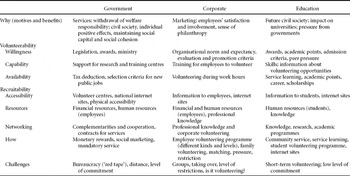
Table 1 summarises the three parties’ involvement in enhancing volunteering, their different motivations to do so, their benefits and their challenges. It also summarises each party's impact on the different components of volunteerability and recruitability. In order to develop and explain our framework, we will show some examples of the many ways in which they do so in the Western world (in the US, Canada, Europe, Israel and Australia), and suggest new ideas for encouraging volunteerism by third parties. The examples given in this article were collected based upon a systematic analysis of secondary resources, academic sources, policy documents and internet sites.
Third party model.

Governments and political leadership
Governments and local municipalities are involved in volunteering, both directly and indirectly. The 2001 International Year of Volunteers has been a driving force for creating policies that governments can employ to stimulate volunteering (see also Davis Smith, Reference Davis Smith2003, Reference Davis Smith, Davis Smith and Locke2007). Based on the experience of 2001, van Hal et al. (Reference van Hal, Meijs and Steenbergen2004: 22) differentiated between volunteering policies that are a deliberate strategy adapted by a government (or other external body) to influence and stimulate volunteering and volunteerism, and the ‘traditional’ volunteer policy which is used to define the relations between an organisation and its volunteers. It must be noted that the volunteering policy of a government aims at enhancing volunteering as such, not a specific kind of service that is provided by a certain non-profit organisation using volunteers.
There seem to be four major motivations for governments to be involved in enhancing volunteering (see Meijs, Reference Meijs2004). First, volunteering can be seen as a way to improve the quality of life (Thoits and Hewitt, Reference Thoits and Hewitt2001) and (career) possibilities of individual volunteers (Wilson and Musick, Reference Wilson and Musick2000). Second, volunteering is a way to keep services affordable or to improve the quality of these services (Brudney, Reference Brudney1990). This would mean, for example, a reduction in costs for society, clients and/or participators (members) and a higher quality of public services (see, for example, Brudney and Duncombe, Reference Brudney and Duncombe1992). Third, volunteering is a way to develop or at least maintain social capital and social cohesion, and to include socially disadvantaged groups (Gay, Reference Gay1998). Lastly, volunteering is connected with democratic processes and to the participation of citizens in local governance (Berger et al., Reference Berger, Foster and Meinhard2005; Lowndes and Wilson, Reference Lowndes and Wilson2001; Taylor, Reference Taylor2006). Volunteering can also strengthen local community and neighbourliness (Haski-Leventhal et al., Reference Haski-Leventhal, Ben-Arieh and Melton2008a).
Governments can improve the citizens’ volunteerability and promote volunteerism in general, and within socially excluded populations in particular. Governments and parliaments have the unique power to promote volunteering through legislation enhancing citizens’ willingness to volunteer. According to Brudney (Reference Brudney2004), the US federal government can create a climate that encourages volunteering by the different appeals from US presidents on citizens to volunteers,Footnote 1 by passing laws such as the National and Community Service Trust Act (passed by the Clinton administration in 1993), or by signing an agreement between the government and voluntary organisations, as was done by UK Prime Minister, Tony Blair, in 1998 with the Compact and his speech to the National Council for Voluntary Organisations in 1999 (Howlett and Locke, Reference Howlett and Locke1999). Plowden described the UK Compact as a general agreement and a set of codes that ‘should guide working relationships between government and the voluntary and community sector’ (Reference Plowden2003: 426). The National and Community Service Trust Act led to the start of the Corporation of National and Community service (www.NationalService.gov) running several programmes, such as Senior Corps, AmeriCorps, AmeriCorps*VISTA, AmeriCorps NCCC and Learn and Serve America.
Willingness to volunteer can also be promoted by giving awards to volunteers and thus acknowledging their unique contribution to society (such as the President's volunteer service award in the USA or the Queen's Award for Voluntary Service in the UK). By commemorating the international volunteer day (5 December), political leadership may also show its appreciation to volunteers. In some places, such as in the state of South Australia, governments signal the importance of volunteering by assigning a minister of volunteering (www.ministers.sa.gov.au). Willingness to volunteer can also be improved by protecting the volunteer (Brudney, Reference Brudney2004). This, for example, can be created by instruments such as the Volunteer Protection Act that gives legal or liability protection to volunteers (passed in 1997 by the US national Congress, Department of Transportation, 1997). Governments can also address the possible negative aspects of volunteerism by beginning a discourse with volunteer organisations. Such a discourse is now taking place in Israel through ‘round-tables’ initiated by the Israeli government and NGOs, in February 2008.
Governments can also improve the professionalisation of volunteers’ managers, and thus improve people's capability to volunteer. Governments can provide a culture of knowledge about volunteering (Brudney, Reference Brudney2004) by supporting research on volunteerism, making knowledge more accessible and developing centres which train volunteer managers and even volunteers themselves. Although the US government may not be involved in research funding, the European Union and several European national governments are (see, for example, the 2008 Study on volunteering tender from the European Union [EACEA/2008/07]). Moreover, governments may ensure that people with disabilities or from excluded groups in society can also volunteer (some guidelines can be found in the UN recommendations on ways governments and the United Nations system can support volunteers, A/56/L.27; United Nations, 2001). By assigning committees to suggest ways to encourage volunteering in the country (such as the Russell Commission in the UK [2005], Commissie Vrijwilligersbeleid, the Netherlands [2001–2005], and the Enquete Kommission Zukunft des Bürgerschaftlichen Engagement, Germany [1999–2002]), governments may gain ideas and solutions that were previously overlooked. In a disaster relief situation, governments can enhance people's capability to help by providing training, resources and support. When the 2004 Tsunami occurred, the Australian government offered travel costs, accommodation and medical insurance to Australians who wanted to volunteer and help in the disaster areas.
Government power to increase people's availability to volunteer is not as direct as the other third-party sectors (corporations and educational institutes), but it can be helpful. By giving tax deductions to people who volunteer, governments can allow people to work less and have more time to volunteer. Additionally, by giving priority to people who volunteer in a public job, governments assure that volunteering is part of people's career plans, and not just leisure time activity.
Governments can certainly enhance recruitability among volunteer organisations. First, they can improve the accessibility of volunteer organisations to potential volunteers, especially for socially excluded ones. They can develop volunteer centres where people may come and learn about volunteer opportunities. In some countries, volunteer centres are strong and recognised organisations whose job is to encourage volunteering and promote the professionalisation of volunteer managers (van den Bos et al., Reference van den Bos, Brudney, Meijs and Hoorn2005). Although it may be less common in the US context, other national governments have extensive programmes to fund the creation of (local) volunteer centres and national peak bodies (van den Bos, Reference van den Bos2006). Through the intermediating bodies of volunteer centres, local governments can provide in-kind support, technical assistance − including training, assistance in ‘matching’ (volunteer job banks) − and incentives for volunteer work, for citizens in general or for specific groups such as young people or minorities (van der Pennen, Reference van der Pennen2003). In Canada, for example, there are over 200 such volunteer centres, and in Israel there is one in every major municipality. Accessibility can also be promoted by airing national internet sites on volunteering and volunteer opportunities (such as www.vrijwilligerswerk.nl in The Netherlands). In some countries (for example The Netherlands), local governments invest in local community involvement brokers that have the task of creating links between the volunteer involving organisations and business (Meijs and van der Voort, Reference Meijs and Voort2004b). Finally, physical accessibility can also be improved, by laws which require volunteer organisations to be accessible to all, and by financing organisations to do so.
The power to divert financial resources to volunteer organisations and for the promotion of volunteering can also be helpful. Not only is the money needed, but also by funding voluntary action, governments signal its importance. The British government allocated £100,000,000 for the implementation of the Russell Commission recommendations (England Volunteering Development Council, 2005). It also gave millions of pounds to programmes in the UK such as ‘Goldstar’ and ‘Volunteering for All’, aiming to promote volunteering among socially excluded populations. Also, government institutes and organisations can encourage their own workers to volunteer for certain organisations, hereby providing human resources. This resembles the corporate volunteering perspective that will be described in the next paragraph.
We thus observe new and intensifying networks between governments and non-profit organisations aimed at enhancing volunteering. Based on the above-mentioned measures and examples, these relations may be defined as ‘complementary’ and ‘cooperative’ (Najam, Reference Najam2000). Complementarity exists when government and non-government organisations share the same goal, but use different strategies. This applies in particular to government efforts to improve the volunteerability component. A cooperative relationship is characterised by a convergence of preferred ends as well as means. This may apply to an important extent to third-party government efforts to improve the recruitability of organisations. The aforementioned volunteer programmes for socially excluded groups that were set up by the UK government are a good example of new partnerships with non-profit and community organisations. Such partnerships differ from more common contracting relationships in the provision of public services, in which non-profit organisations work as a supplement to government (Gazley and Brudney, Reference Gazley and Brudney2007; Young, Reference Young2000). It nevertheless may be noted that the more traditional involvement of non-profit organisations in the welfare mix also generates a substantial demand for volunteers. Governments can ask organisations to provide services for the government or on its behalf, and in this way assure the sustainability of the organisation.
Corporations
In the last two decades, corporate social responsibility (CSR) has become an important part of the policies of for-profit organisations. Although the perception of what exactly is socially responsible corporate behaviour is not always agreed upon (Campbell, Reference Campbell2007), there seems to be a global movement toward companies’ consideration of their impact on society. One of the instruments that companies are increasingly using is corporate volunteering. Meijs and van der Voort (Reference Meijs and Voort2004a) explained that corporate volunteering occurs when the company shows commitment to their employees volunteering. In corporate volunteering, the companies encourage their employees to give time and expertise as volunteers, and volunteer activities can be undertaken within or outside the employee's official workload and time. Tuffrey defined corporate volunteering as ‘the voluntary activity of employees, encouraged and supported by their employers, in their local communities’ (Reference Tuffrey1998a: 3).
Corporate volunteering may offer benefits for the company, employees and the community (Tschirhart, Reference Tschirhart and Brudney2005). Among the numerous benefits of corporate volunteering documented in the literature, some argue that it can create a sense of community (Austin, Reference Austin1997; Pancer et al., Reference Pancer, Baetz and Rog2002) and positively influence attitudes of employees towards the organisation and the employees themselves (Gilder et al., Reference Gilder, Schuyt and Breedijk2005). Also possible are competency and skills development for employees, which benefits both them and their employers through the building of human capital (see Benjamin, Reference Benjamin2001; Lee, Reference Lee2001; Tschirhart, Reference Tschirhart and Brudney2005; Tuffrey, Reference Tuffrey1998b). Other advantages for companies may be an enhanced reputation and branding of the company name (Tschirhart, Reference Tschirhart and Brudney2005).
Corporate volunteering can influence employees’ volunteerability in several ways. Meijs and associates (2009) linked the following effects to corporate volunteering: legitimisation, resource needs, expectations, socialisation, incentives, substitution and resentment. Corporate volunteering may address the willingness to volunteer – by encouraging employees to do so; by making volunteering an organisational norm and expectancy; by creating peer encouragement or pressure; or, in a more extreme scenario, forcing employees to volunteer or making it part of their evaluation and promotion criteria. Haski-Leventhal and Cnaan (in press) discussed the power of the group, including peer employees, to encourage people to volunteer and retain them.
By including volunteering as part of the workload, and allowing employees to volunteer during work hours, corporations may improve people's availability to volunteer. Further, corporations may use their ‘fun days’ at work for volunteering, and even combine family days with volunteering. That these measures could substantially enhance people's availability was suggested by a recent British survey, where 50 per cent of all respondents who were current employees, and whose organisation did have a corporate volunteer programme, stated that it would greatly encourage them if they could have paid time off to take part in such programmes (Low et al., Reference Low, Butt, Ellis Pain and Davis Smith2007).
Finally, corporations may address the capability of employees to volunteer, by supporting and training them, or by working closely with non-profit organisations and ensuring that their employees will undergo sufficient training before they start volunteering, or during their volunteer work. In the above-mentioned British survey, for example, an important motivation to participate in employer-supported volunteering was if respondents would be able to improve skills through volunteering (Low et al., Reference Low, Butt, Ellis Pain and Davis Smith2007).
Corporate social responsibility may also improve volunteer organisations’ recruitability. First, they improve the accessibility of the non-profits; since they allow a large number of people (employees and their social circles) to know about volunteering opportunities in these organisations. Furthermore, in some cases corporations develop new channels to recruit volunteers, such as airing internet sites. For example, some corporations support ‘volunteer match’, an internet site that helps match people who want to volunteer with suitable organisations (to see their list: http://www.volunteermatch.org/about/supporters/index.jsp).
Secondly, corporations can improve volunteer organisations’ level of resources. By asking their employees to volunteer for a certain organisation or cause, they may increase the human resources of that organisation. They may also financially support some organisations. Moreover, many corporations have important professional knowledge that can be shared with volunteer organisations and with volunteer managers. For example, a human resource manager can mentor a volunteer manager, and thus translate knowledge, improve skills and professionalise for the best interest of volunteers and clients.
Networking with companies is also an interesting perspective to enhance volunteering in general and for the single organisation. Austin (Reference Austin2000) presented three succeeding stages of partnering within cross-sectoral relationships: philanthropic, transactional and integrative. Seen from the perspective of delivering services, the integrative perspective is in many cases the most promising because there is an in-depth connection between the non-profit organisation and the company. Seen from the perspective of enhancing volunteering, the philanthropic and transactional stages might offer more benefits, because they seem to leave more freedom for employees to choose their own cause.
Educational institutes
Student volunteering (whether in high schools, colleges or universities) can benefit the community, the students and the academic institutes. Students are not only an important pool of volunteers at present, but also for civil society of tomorrow (Haski-Leventhal et al., Reference Haski-Leventhal, Cnaan and Handy2008b). In high schools and universities, students volunteer either as a result of their socialisation, out of their free will or as part of their learning duties. It has been shown that having family, friends or teachers who volunteer, being encouraged to volunteer, prior participation in school and church-based service and personal initiative lead young people to participate in extra-curricular volunteering (Hustinx et al., Reference Hustinx, Vanhove, Declercq, Hermans and Lammertyn2005; Sundeen and Raskoff, Reference Sundeen and Raskoff2000).
Volunteering during high-school years was found to have a positive impact on adolescents’ success in school, and it helped reduce several behavioural problems, such as drug abuse, violence and early pregnancy (Schondel et al., Reference Schondel, Boehm, Rose and Marlowe1995; Uggen and Janikula, Reference Uggen and Janikula1999). Youth volunteering was found to be related to better grades in school, an ambition for higher education, increased self confidence, inner motivation to accomplish tasks as well as to have fewer behavioural problems and unwanted pregnancies (Johnson et al., Reference Johnson, Beebe, Mortimer and Snyder1998; Moore and Allen, Reference Moore and Allen1996).
In American high schools, 38 per cent of students (10.6 million adolescents) participated in school-based services in 2005 (Independent Sector, 2005). In Israel, 32–40 per cent of adolescents volunteered for their community in the years 2005–2006. Of those who volunteered, 40 per cent did so through school community services. However, in a recent study, it was found that compulsory ‘personal commitment’ led to less volunteering a decade later, and those who were forced to volunteer in high school volunteered even less than those who had no such programme (Haski-Leventhal et al., in press). Further, in a study of mandatory service in universities, Stukas et al. (Reference Stukas, Snyder and Clary1999) demonstrated that stronger perceptions of external control eliminated an otherwise positive relationship between prior volunteer experience and future intentions to volunteer.
As for university students, Astin and Sax (Reference Astin and Sax1998) found that participation in voluntary work during undergraduate years enhances students’ academic development, life skills development and sense of civic responsibility. In addition, volunteering can enhance students’ job experience, help them choose the right vocation and improve students’ résumés and opportunities as they leave university and seek jobs. Student volunteering is also in the interest of academic institutes. Haski-Leventhal and colleagues (Reference Haski-Leventhal, Cnaan and Handy2008b) explained that when students engage in a variety of voluntary activities, the social and cultural life on campus and in the community is enhanced, and the university gains prestige. This is the last phase in people's development in which society can recruit them and socialise them to become pro-social members (see also Parker-Gwin, Reference Parker-Gwin1996). In a recent study, Handy et al. (under review) found that university students attach significantly more importance to instrumental reasons for volunteering, in particular the use of volunteering for résumé-building purposes, in countries where institutes of higher education and employers signal such utilitarian value of volunteering – thereby threatening to undermine the civic ethos of these young people.
Educational institutes can enhance their students’ volunteerability. By developing programmes in which students volunteer for the community, as well as by providing courses that enhance service learning, the institute may improve students’ willingness to volunteer (Puckett et al., Reference Puckett, Harkavy and Benson2007). A survey conducted by Berry and Chisholm (Reference Berry and Chisholm1999) found that universities in 23 nations provided service learning courses. If students realise that volunteering is an opportunity to examine career possibilities, gaining experience and accessibility to organisations, they will be more willing to do so. However, it should also be noted that such courses or service have better long-term impact if they are optional rather than compulsory.
Acknowledging student volunteering, by giving appraisal, awards and even important benefits (for example, academic points), educational institutes can encourage high-school and university students to volunteer. Finally, by asking applicants about their volunteering experience, educational institutes signal the underlying importance of voluntary activity, and thus promote it. Educational institutes can express their commitment to volunteering by joining other high-schools and universities that are also committed to the issue (for example, Campus Compact, 2007).
Institutes of higher education can also enhance their students’ availability to volunteer. Since most students are busy studying, maintaining or improving their grades and promoting their future careers, educational institutes can make volunteering more achievable if they allow students to combine the above tasks with volunteer work. Service learning courses are one option to do so; awarding academic points for volunteering is another. Some students are obliged to work while in college. By giving scholarships to students who volunteer (volunteer stipends), this obstacle could also be removed. It may be especially important to support students with economic difficulties, disabilities or other challenges to volunteer. Educational institutes may also enhance students’ capability to volunteer if they help develop skills, for example through service learning courses, and by giving students information about volunteering opportunities.
Educational institutes can also play an important role in enhancing voluntary organisations and their recruitability. By networking with such organisations, they may share knowledge, promote research and develop academic programmes to teach management of volunteers. Thus, they develop knowledge and skills resources. As explained above, educational institutes can enhance accessibility of students to the organisations, if they let them know where they can volunteer, or open an internet site on volunteer opportunities (for example: Student Volunteering England: http://www.studentvol.org.uk).
Discussion
In the Western world today, having more volunteers to provide more services is a goal that many governments and volunteer organisations strive to achieve. In this article, we showed how macro-level actors (the third parties) can enhance volunteering through the meso-level (organisations’ recruitability) and the micro-level (individual volunteerability), with awareness of inclusion of all social groups, particularly organisational clients.
Governments and political leaderships have the power and the resources, as well as the interest, to promote volunteering at a national level. Corporations and other organisations have massive human resources and professional knowledge they can share, in order to promote their own social responsibility, effectiveness and marketing agendas. Educational institutes have students to volunteer and academic knowledge to share. Working together with volunteer organisations, the third parties can boost volunteering, volunteers and volunteer-involving organisations.
The concepts of volunteerability and recruitability refer to both sides of the volunteer market: supply (volunteer labour force) and demand (organisations and services; Handy and Brudney, Reference Handy and Brudney2007). Only by improving all aspects of volunteerability (willingness, availability and capability) as well as all aspects of recruitability (accessibility, resources and partnership) can volunteering be effectively enhanced. If a big corporation decides to encourage its employees’ volunteerability, but does not address the volunteer organisation's recruitability, then there will be too much supply and insufficient demand.
Ethical, moral and practical dilemmas
When discussing the involvement of government in volunteering, several issues arise. First, is it really volunteering if governments encourage people to get involved, and, moreover, if they coerce people to do so? As explained above, free will is usually perceived as an essential component to the definition of volunteering (Cnaan and Amrofell, Reference Cnaan and Amrofell1994; Cnaan et al., Reference Cnaan, Handy and Wadsworth1996; Handy et al., Reference Handy, Cnaan, Brudney, Ascoli, Meijs and Ranade2000). Second, can we really speak of civil society if it is not only the citizens who initiate and take responsibility over their lives? Finally, one may argue that by encouraging volunteering, the political leadership reduces its own duty to provide services, and that, in the long term, such a withdrawal may end with cuts in the social welfare systems, to the extent that not even the volunteer organisations will be able to cope.
A number of issues arise regarding CSR in general and corporate volunteering in particular. Is it really volunteering if people get paid to do it (for example, if they do it during their working hours), or if they have no or little free choice but to volunteer? Second, ethical dilemmas may arise on the NGOs side: should they agree to work with any corporation that offers their help? For example, should an environmental organisation accept volunteers from a corporation that harms the environment? Third, how do non-profits find the balance of partnering with a big corporation and not losing their own agenda, culture and way of doing things? Corporate volunteering may mean that a large number of people enter an organisation at one time. It is often the case that NGOs do not have enough tasks for all volunteers or feel threatened as their managerial skills are being challenged. Voluntary organisations may find they lose ‘their own voice’ by partnering with such corporations.
Regarding the involvement of educational institutes, once more there is debate whether stipend volunteering or service learning may apply to the narrow definition of volunteering. However, there is also a practical dilemma to working with students, since most of them are only available to volunteer during the academic year, and when it is over they cease to volunteer. Often, their young age and lack of experience challenge voluntary organisations. Furthermore, adolescent volunteers tend to emphasise the role of the group, create sub-groups in the organisation and even conflict with peers and staff (Haski-Leventhal et al., Reference Haski-Leventhal, Ronel, York and Ben-David2008c).
Other third parties that can get involved
In this article, we focused on three major parties that have the power, knowledge and resources to enhance volunteering. Obviously, there are other actors that could have an important role in that task.
The mass media can play a vital role in encouraging people to volunteer. By reporting volunteer opportunities they can raise a person's capability to volunteer and moreover raise the organisation's recruitability. If a person, sitting at home and watching television, can learn of organisations, places and targets that are easier to reach, it may impact that individual's sense of ability to volunteer. More importantly, the media can show the positive side of volunteering to the volunteer, demonstrate recognition and appreciation of what volunteers do, and help in turning volunteering into a positive social norm.
Another interesting angle to enhancing volunteerism is the role of philanthropy. Funds and foundations, private corporations and private philanthropists, all financially support volunteer organisations. The importance of volunteering should be emphasised more, even become a criteria for receiving funds. In particular, volunteering by the clients of the organisation, socially excluded people or people with disabilities, should be emphasised. Thus, philanthropists may also have a role in enhancing volunteering and social inclusion. However, this should be done in a sensitive manner, which does not harm the clients.
Contribution to existing knowledge
This article has examined the many ways in which governments, corporations and educational institutes foster volunteerism, as well as identified other possible means to do so under a unified third-party model. Although there may be some ethical and practical dilemmas in the involvement of third parties, their ability to enhance volunteering and its many positive aspects, and even do that while addressing its possible negative ones, is so essential that more systematic attention should be drawn to the subject.
The article contributes to the body of knowledge on volunteering by presenting the two sides of the demand and supply equation: the volunteerability of the individual on the one hand, and recruitability of the volunteer organisation on the other. It challenges the existing literature on volunteerism, in particular by bringing a wider definition of volunteerism, and it presents a perspective different from the traditional literature on encouraging volunteering. The third-party model is a new theoretical framework that adds new concepts and actors to the existing theory on volunteerism. On the practical aspect of the management of volunteers, it may help managers to think ‘out of the box’ and understand that by working together with other parties they may enhance volunteering in their organisation and volunteering in general. The examples that were drawn here from the Western world can demonstrate new ways in doing so.
More specifically, the article contributes to the body of knowledge on social policy by thoroughly describing a new direction in volunteering policy, in terms of a deliberate strategy to enhance participation in volunteering, not only by governments and political leaderships, but also by other important actors. It is the first article that ties together in a systematic and comprehensive way well-known concepts, such as social capital, civil society and volunteerism, as well as new ones, such as volunteerability and recruitability, to provide a new theoretical model on social policy regarding volunteerism. It provides a comprehensive and multidimensional inventory of why and how third parties intervene, as well as taking into consideration the possible negative consequences that should be watched for while doing so.
On the practical aspect, it may give information and provide examples to social policy makers, in the Western world and elsewhere, on why and how to work together with volunteer organisations, corporations and educational institutes, to enhance a cause which is perceived as important, without always fully knowing why, and what to do to encourage volunteerism which is socially inclusive.
The third-party model can be further studied and developed. Parallel models can be developed for other places in the world, where sometimes volunteering is less popular. We invite a further discussion on the model and further examples on encouraging volunteerism by third parties, not only from the Western world.