Introduction
Health care workers (HCWs) represent a population with highly frequent exposure to infectious diseases. During the Ebola virus outbreak in West Africa, more than 800 HCWs were infected and the infection rate was nearly 30 times as high in HCWs as in nonmedical personnel. 1 Application of medical protection techniques and barriers is pivotal for controlling the source of infectious diseases, blocking transmission routes, and protecting susceptible populations during the management of emerging infectious diseases. The use of personal protective equipment (PPE), such as medical protective coveralls, gloves, respirators, goggles or other equipment, is an important strategy for infectious disease prevention and control. Reference Fischer, Weber and Wohl2 However, there exist some problems concerning PPE application. First, it is hard to choose a proper guidance on PPE application to follow as there are various types available. Second, the rate of appropriate PPE use by HCWs worldwide is unsatisfactory due to the complicated requirements and procedure of PPE donning and doffing. Previous simulated studies found that 10 to 100% of workers were self-contaminated, despite wearing PPE. In response to emerging infectious diseases, HCWs have little time for PPE use training and may not master its application well due to the complicated guidelines and lack of training and experience in daily work, and they may also be anxious about the infection and doubt the quality and effectiveness of PPE, which may lead to errors in the donning and doffing process, increasing the potential risks for contamination in clinical practice. Reference Selvaraj, Lee and Harrell3–Reference Kang, Kim and Choi5 Therefore, training on PPE application needs to be enhanced to help HCWs master the correct procedures for PPE donning and doffing, which is one of the key measures to preserve the safety of HCWs during clinical practice.
PPE started to receive widespread attention in China following the outbreak of the severe acute respiratory syndrome (SARS) epidemic in 2003. In the early stages of the SARS epidemic, the infection rate of HCWs was high. There were 2 reasons for this: On the 1 hand, they lacked appropriate PPE and were only wearing 12-layer gauze masks and cloth-made coveralls; on the other hand, they had been neglecting the studying and training of PPE protocols in daily work. After reviewing international protection standards and implementing strict PPE protocols, the infection rate was significantly reduced. Reference Hua, Li and Kun6 However, although the awareness of HCWs toward occupational exposure has significantly increased since then, their adherence to PPE protocols remains low because it is rarely used in daily clinical practice. A survey about the use of PPE by HCWs during the 2009 influenza H1N1 pandemic found that only 18% of respondents were able to correctly identify all components of PPE, and only half of them adhered strictly to the rules of donning PPE, exposing both HCWs and inpatients to a high risk of infection. Reference Hu, Zhang and Li7
There was very limited research on PPE donning and doffing before the outbreak of the COVID-19 pandemic in China, and little was known about how HCWs actually use PPE. Many HCWs have little experience dealing with emerging infectious diseases and are therefore not well-trained in PPE application. In response to public health emergencies, especially a pandemic disease, it is necessary for HCWs to know how to use PPE correctly within a short period of time. The purpose of this study was to identify the key error-prone operational steps and sites of self-contamination during donning and doffing of PPE, in order to facilitate the training on correct application of PPE by HCWs and better preserve their safety.
Methods
This study was conducted in a general hospital from April to July 2019 in Chongqing, China. Fifty-six participants (37 nurses and 19 physicians) were recruited. They were instructed to don and doff PPE under observation so as to find erroneous operational steps and sites of self-contamination. The Ethics Committee of Southwest Hospital (Chongqing, China) reviewed and approved the study.
Training and Practice
After establishing the protocols of the PPE, we sent out messages to different departments to recruit volunteers. The exclusion criterion was pregnant or mobility-impaired personnel. All volunteers were given detailed information about the purpose and intent of the research and they signed informed consent.
The training was conducted by 2 head nurses who had been engaged in the treatment of infectious diseases for 27 years and 16 years, respectively. They also participated in the Chinese medical team in the fight against Ebola in West Africa and were proficient in the use of PPE. Through 30 minutes of theoretical teaching and 60 minutes of practice, the participants understood and mastered the basic procedures and requirements for wearing PPE issued by the Chinese Center for Disease Control and Prevention (China CDC).
PPE Donning and Doffing Procedures
The latest guidelines on PPE application, “Procedures for Personal Protection Against Ebola Hemorrhagic Fever,” issued by China CDC, 8 were selected, which are also used as the basic guidance for the coronavirus disease (COVID-19) pandemic. The procedures of donning and doffing are as follows (more details are shown in Table 1, and they were made according to the Technical Standard for Isolation in Hospital formulated by the National Health Commission of the People’s Republic of China):
Stepwise detailed explanations of donning and doffing procedures

Donning Procedure
Perform hand hygiene → Put on personal scrubs → Put on work cap → Put on medical N95 respirator → Put on protective goggles → Put on inner gloves → Put on medical coverall → Put on waterproof boots or disposable work shoe covers → Put on outer gloves.
Doffing Procedure
Perform hand hygiene → Remove the boots or work shoe covers → Remove the medical coverall → Remove the outer gloves → Remove the protective goggles → Remove the medical protective N95 respirator → Remove the work cap → Remove the inner gloves → Perform hand hygiene and Back to clean area.
Monitoring of Operational Steps and Identifying Sites of Self-Contamination
Simulation of PPE Contamination
Ultraviolet (UV)-fluorescent labeling is an example of immersive simulation that uses UV-fluorescent tracers to indicate contamination of the environment and PPE, with visualization of cross-contamination providing strong and instant feedback to users. Reference Poller, Hall and Bailey9 After donning the PPE, the participants were instructed to apply 2.5*2.5 cm of fluorescein (OnSolution Pty Ltd, Australia), approximately the size of a 1 RMB coin to each of the 6 sites (2 hands, chest, abdomen, and 2 knee joints), and then randomly smear it over the coverall to simulate the contamination. Then, they doffed the PPE according to the procedure. When this was completed, the indoor light was turned off and the exposed skin of the participants and the surface of their scrubs were inspected with a UV flashlight, and the sites of fluorescent contamination were photographed once detected, as shown in Figure 1.
Contamination the skin and clothes A on the elbow, B on the right hand and wrist.

Videotape Analyses
The process of the participants donning and doffing PPE was recorded by 2 high-definition cameras. The videotapes were then analyzed by 4 professional evaluators. They developed a procedural checklist of PPE donning and doffing and analyzed the videotapes in accordance with protocols. Two of the evaluators reviewed all the videos and documented protocol deviations in detail, according to the checklist. Then, the other 2 reviewers checked the documents together.
Results
Demographics of the Participants
A total of 56 clinical medical staff from different departments volunteered to participate in this experimental study, including 11 (19.6%) males and 45 (80.4%) females, with an average age of 29.86±4.96 years and an average work history of 6.95±4.75 years. Other information includes: all of them were right-handed; 37 (66.1%) nursing staff and 19 (33.9%) physicians; 16 (28.6%) with associate degrees, 32 (57.1%) with bachelor’s degrees, 6 (10.7%) with master’s degrees, and 2 (3.6%) with PhD degrees; 16 (39.0%) junior staff, 16 (39.0%) intermediate staff, and 9 (22.0%) senior staff; 12 (21.4%) from the Department of Infectious Diseases; and 44 (78.6%) from other departments. The participants had no prior PPE training experience, except for wearing gloves and shoe covers, and were unfamiliar with the procedure and requirements of PPE use in their daily practice. However, wearing PPE is one of the key methods to preserve the safety of HCWs when they are taking care of patients with high-consequence infectious diseases, such as the COVID-19 pandemic.
Error-Prone Operational Steps
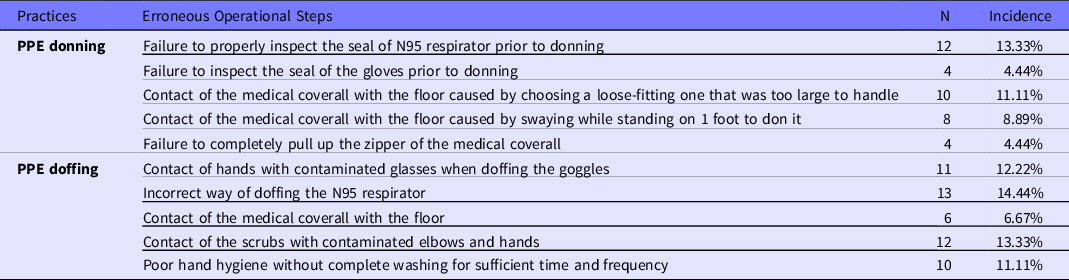
Error-prone operational steps during PPE donning included: (1) failure to properly inspect the seal of N95 respirator (12 times/13.33%); (2) failure to inspect the seal of the gloves (4 times/4.44%); (3) contact of the medical coverall with the floor caused by choosing a loose-fitting one that was too large to handle (10 times/11.11%); (4) contact of the medical coverall with the floor caused by swaying while standing on 1 foot to don it (8 times/8.89%); and (5) failure to completely pull up the zipper of the medical coverall (4 times/4.44%). Error-prone steps during the PPE doffing included: (1) contact of hands with contaminated glasses when doffing the goggles (11 times/12.22%); (2) incorrect way of doffing the N95 respirator (13 times/14.44%); (3) contact of the medical coverall with the floor (6 times/6.67%); (4) contact of the scrubs with contaminated elbows and hands (12 times/13.33%); and (5) poor hand hygiene without complete washing for sufficient time and frequency (10 times/11.11%). The detailed information is listed in Table 2.
The incidence of erroneous steps in donning PPE by HCWs

Key Sites of Self-Contamination
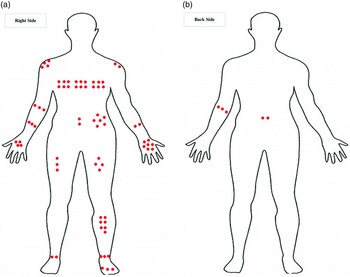
The sites of self-contamination detected after PPE removal included: left hand and wrist (n = 7), left lower leg (n = 7), center chest (n = 6), left chest (n = 6), right chest (n = 6), left abdomen (n = 5), right hand and wrist (n = 4), right shoulder (n = 4), left thigh (n = 4), right thigh (n = 3), right elbow joint (n = 3), right forearm (n = 3), left ankle (n = 3), left shoe upper (n = 3), left forearm (n = 2), left shoulder (n = 2), middle of the abdomen (n = 2), and right ankle (n = 2). These are illustrated in Figure 2.
Sites prone to contamination during PPE removal, A on the right side; B on the back side.

Discussion
PPE application is complicated. Ill-fitting PPE is widely considered as one of the main difficulties in PPE use. Reference Kang, Kim and Choi5 Loose-fitting medical coveralls may limit the flexibility of medical staff to don and doff properly, whereas tight-fitting ones may interfere with clinical practice. However, PPE design is not always properly fitting for each HCW. In regard to ill-fitting PPE, a study of women’s PPE experiences in the UK found that coveralls are among the worst-fitting PPE components. 10 In our study, 80% of the participants were women, and they did not master the donning skills well. They could not hold the entire coverall in their hands because it was too large or stand stably on 1 foot to wear the coverall, causing part of it to be dragged (stepped) on the floor and contaminated. PPE fit (or lack of it) typically was related to the doffing barriers and facilitators. Reference Baloh, Reisinger and Dukes11 Therefore, PPE should be designed in different sizes, and HCWs need to choose properly fitting ones. Furthermore, as the place where PPE is donned is clean, a chair or bench may be placed for HCWs to sit on and wear PPE comfortably and correctly.
This study also found that, when donning the N95 respirator, many HCWs did not pay enough attention to the shape and seal of the mask. This not only increased the risk of exposure to and infection by aerosol pollutants and breathing difficulty, but also reduced comfort. A previous study reported that gaps around the mask can be a route for the Middle East respiratory syndrome coronavirus (MERS-CoV) and other infection if masks are not firmly attached to the face. Reference Nam, Yeon and Park12 Therefore, HCWs should choose properly sized masks, inspect the seal, and properly fix the straps to prevent slippage.
Some HCWs may forget to pull up the zipper of the coverall completely due to neglect. Zipper, Velcro, or other types of fasteners can make sure that PPE stays in the right place when caring for patients, or potential pathogens may contact the exposed skin and cause severe infections as a result of an insufficient seal. In future training, the operators should be reminded to routinely press the zipper firmly to the top to prevent it from sliding down.
One important step that can easily be overlooked is the inspection of the seal of gloves. Since the hands are most frequently exposed to contaminants, broken gloves or gloves of poor quality are among the greatest risk factors for infection and exposure for HCWs. Therefore, HCWs should develop a habit of inspecting whether the gloves are airtight before donning and completely covering the wrist of the medical coverall with the gloves.
During the PPE doffing process, it is important to remember that the external surfaces are contaminated. To safely remove PPE, medical personnel must touch only the clean inner surfaces. However, during the process of doffing in this study, HCWs had great difficulty in rolling the medical coverall outward and pulling it down the back and often touched the outer surface of it with their hands, causing severe secondary touch contamination. This means stronger training is needed to improve their ability to rolling the medical coverall outward down the back in a controlled way until completely pulling it off their body. Moreover, the design of coveralls needs to be optimized to allow more convenient donning and doffing, such as using different colors for the inner and outer surfaces so that HCWs can clearly differentiate between clean and contaminated surfaces, or building a buddy system to allow them to observe and help each other to avoid secondary contamination. Reference Reidy, Fletcher and Shieber13
This study found that, when doffing the N95 respirator or goggles, a considerable number of HCWs did not follow the correct procedure. Instead, they often held the goggles or masks by hand to remove them fast, increasing the risk of contaminating their eyes or face. This may be related to the discomfort caused by wearing the masks or goggles for a long time, as well as the bad habits formed in the past.
When doffing head and face protective equipment, such as goggles, the arms were more likely to touch the head and face, whereas when rolling the medical coverall outward, the elbows were more likely to touch the contaminated surface and spread the pollutants to other parts of the body. These behaviors were related to poor mastery of doffing skills. When doffing the goggles, head/face protection equipment, and medical coverall as required, the arms should be fully abducted at a right angle with the longitudinal axis of the body.
Hands are one of the most commonly contaminated sites due to poor hand hygiene during the doffing process. In our study, some steps in hand hygiene were skipped. Insufficient time and frequency of handwashing resulted in poor hand hygiene. In addition, some HCWs subconsciously believed that, after doffing the gloves, their hands were clean and thus ignored the specific requirement for hand hygiene. Although gloves can effectively protect HCWs’ hands, they may also spread contamination to clean PPE items. Thus, we should highly emphasize the importance of performing good hand hygiene to minimize risk of contamination.
Key Sites of Self-Contamination in the Doffing Process
During the PPE doffing process, the unprotected skin and scrubs may be contaminated by pathogenic microorganisms and are therefore sites that are most prone to infection. Reference Hall, Poller and Bailey14 Fluorescent tracers can simulate the contaminated situation, in which HCWs are infected with a pathogen through direct contact with contaminated surfaces or portable equipment and are useful for illustrating pathogen transmission and developing effective strategies for infection control. Reference Alhmidi, Koganti and Tomas15 Correct use of PPE can reduce the risk of contamination for HCWs exposed to infections. However, the results of the simulated fluorescence detection study by JaHyun Kang et al. indicated that approximately 66% of HCWs might be at risk of contamination while using PPE. Reference Kang, O’Donnell and Colaianne16
In this study, the hands and wrists were found to be the sites with the highest frequency of contamination. The hands are the primary body part that contact patients with infectious diseases and various pathogenic microorganisms, and also the body parts that most frequently contact contaminants during doffing process. Studies have shown that, even with medical coveralls and gloves, 2–5% of HCWs were still infected by multidrug-resistant bacteria, and 24% of HCWs had residue Clostridium difficile on their hands after doffing their gloves. Reference Morgan, Liang and Smith17,Reference Morgan, Rogawski and Thom18 Therefore, hand hygiene is critical for HCWs caring for patients with infectious diseases, and they should consistently implement standard precautions to effectively prevent the spread of viruses.
In addition, our study showed that the chest and abdomen were also key sites of contamination. This was mainly due to the unskilled removal of the medical coveralls, that was, when rolling the medical coverall outward, the contaminated external surface was not completely wrapped, causing secondary contamination. Moreover, the left side of the body of HCWs had a higher frequency of contamination than the right side, which might be related to the preference for right-hand operation and greater flexibility of the right limbs. HCWs should be specifically reminded of these tendencies during the training process.
This study has several limitations. The fluorescent reagent used in this experiment is in an emulsion state, which mainly simulates transmission through contact, but not transmission through air or droplets, which needs to be further studied. Second, the presence of cameras exerts a certain stress on the participants, which may influence their performance and result in more mistakes. Different recording methods should be used to avoid these factors in the follow-up study.
Conclusion
The major reasons for errors in the process of PPE donning and doffing may be the complicated procedures and lack of training. Identifying the steps that are prone to errors during donning and doffing can facilitate the targeted explanations and exercises in the training. Our findings suggest that, in future training, it is necessary to pay more attention to steps prone to errors and body parts more frequently contaminated. Additionally, the design of PPE needs to be improved, for example, producing better-fitting medical coveralls, N95 respirators and goggles, and zippers that can be fixed, and so forth. Meanwhile, the results can also be used for revising the detailed PPE usage protocols to reduce contamination and provide better protection for medical workers and patients.
Author contributions
Zhang HL and Yang S are co-first authors.
Funding statement
This work was supported by Technological Innovation in the Major Field of Military Medicine of the Southwest Hospital, Army Medical University [number SWH2017ZDCX2005]; Innovation Project of Military Medicine [18CXZ038].
Conflict(s) of interest
The authors declared no potential conflicts of interest with respect to the research, authorship, and/or publication of this paper.