I. INTRODUCTION
SiCp/Al composites as a promising structural material have received significant attention in recent years extensively used in the aerospace and other high-tech fields due to their excellent mechanical properties developed during the age-hardening process, such as high specific strength, high thermal conductivity, good dimensional stability, and other appropriate properties. Reference Ryu, Chung, Cha and Hong1–Reference Pan, Yang and Yin13 Aging treatment can significantly increase properties of Al matrix composites, especially 2xxx, 6xxx, and 7xxx series alloys. Reference Surappa, Dutta and Surappa14–Reference Mousavi Abarghouie and Seyed Reihani23
In investigation of age-hardening kinetics of SiCp/Al composites, it has been shown that the addition of ceramic particles to age-hardenable Al alloys does not affect the aging sequence. Reference Badini and Marino24 The SiC reinforcement does not affect the precipitation path, and the activation energy for θ″ precipitation (calculated by Ozawa's method) is not appreciably different for unreinforced alloy and composite. Reference Badini and Marino24 However, the addition of ceramic particles has different effects on precipitation kinetics of composite compared with unreinforced alloy. Reference Bekheet, Gadelrab, Salah and Abdel-Azim17,Reference Christman and Suresh20,Reference Badini and Marino24–Reference Lu, Lai, Su, Teo and Feng29 It has been reported that all the transformations involved in the aging sequence are shifted towards lower temperatures during the differential scanning calorimetry (DSC) scans of the composite material. Reference Badini and Marino24 The age-hardenable SiC/Al composites demonstrate accelerated kinetics of aging, when compared to that of the unreinforced alloy due to the much greater dislocation density in the former. Reference Chen and Chao26 Meanwhile, the dislocations punched out at the reinforcement and matrix interfaces can relax the stress generated owing to the mismatch in coefficients of thermal expansion of Al and SiC. Reference Chen and Chao26 Dutta and Bourell Reference Dutta and Bourell30 and Appendino et al. Reference Appendino, Badini, Marino and Tomasi31 studied SiC/6061Al composites and found that due to the increasing of solute diffusivity and dislocation density, the aging kinetics of the composite was accelerated, although the precipitation sequence of the composite was similar with that of the unreinforced 6061 alloy. On the other hand, there were some explanations that it decreased or posed very little alteration in the aging kinetics. Reference Mousavi Abarghouie and Seyed Reihani23 Pal et al. showed that the age-hardening kinetics of Al–Cu–Mg alloy composites reinforced with different percentages of SiC particles decelerated, due to the lower concentration of vacancies, inadequate dislocation density, and extensive interfacial segregation of alloying elements. Reference Pal, Mitra and Bhanuprasad32 Furthermore, Skibo et al. reported that the age-hardening kinetics between the 6061 Al alloy and its composites reinforced with 10 and 20 wt% SiC aged at 175 °C exhibited no obvious difference. Reference Skibo, Morris, Lloyd, Fisherman and Dhingra33
One of the problems arising in the heating treatment of the composites during the solution and quenching treatment is the quench sensitivity, which brings on the inhomogeneity and reduction in properties in the center of the composites. Reference Badini and Marino24,Reference Li and Xiong34–Reference Oguocha, Radjabi and Yannacopoulos39 While many studies have been devoted to the relationship between microstructure and property during aging of metal matrix composites (MMCs), few studies have been made of this relationship during quenching. Reference Thomas and King35,Reference Liu, Li, Jiang, Zhang, Zhou and Wu38 Both aluminum alloy and aluminum matrix composites exhibit quench sensitivity i.e., a change in as-quenched properties and precipitation behavior with the cooling rate, although the sensitivity differs between alloy systems. Papazian Reference Papazian37 showed, using DSC analysis, that the quench sensitivity of discontinuously reinforced MMCs was increased over that of unreinforced alloys, for a range of matrix alloys. The least sensitivity alloys were affected most when the reinforcements were added. This could have important consequences regarding the heat treatment of MMCs, in that the quench parameters may have to be more tightly controlled than for unreinforced alloys to ensure consistent as-quenched properties.
The Jominy end quench test, well known as a method of measuring hardenability in steels and aluminum alloys, offers a method for studying many quenching conditions with a minimum amount of sample. Reference Yazdi40 The aim of the present work concerned on the relationship between the cooling rate and the microstructure of SiCp/2024Al composites by using the Jominy end quench test. The potential for developing a new understanding of the complex response of high volume fraction MMCs under processing conditions, especially quenching, was presented.
II. EXPERIMENTAL DETAILS
A. Material and treatment
The 2024 Al alloy was used in this research that supplied by Northeast Light Alloy Limited Liability Company. The composition of the main alloying elements of 2024 alloy is listed in Table I. Commercial α-SiC particles with average particle size of 5 μm were used as the reinforcements. In this research, the 2024 Al containing 45 vol% SiC particulates composites were manufactured by squeezed casting method.
Main elemental composition of studied alloy (mass fraction, %).

Bal. = Balance.
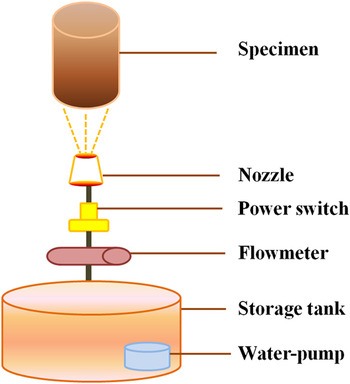
As Jominy test is one of the most commonly used experimental procedure for evaluating the quench sensitivity of steels and Al alloys, it can be used in numerical simulation programs to further evaluate the quench sensitivity of Al matrix composites. A bar with a size of 40 mm in diameter and 125 mm in length was used in this study. Small holes were drilled at 5, 10, 15, 30, and 60 mm, respectively, from the quenched end to introduce a group of 1.5 mm-diameter K-type thermocouples inserted with their tips at the mid-point of the bar. Figure 1 showed the homemade experiment equipment for Jominy end quench test of SiC/Al composites, which included storage tank, water pump, flow-meter, power switch, and nozzle. Table II showed the test parameters of Jominy end quench test. Turn on the switch and adjust the spout height and injection flow rate. In our experiment, the spout height was 90 mm and injection flow rate was 400 L/h during the whole quenching process. The bar was soaked in a salt bath furnace at 495 °C for 1 h. After the solution treatment, the bar was transferred to a set of Jominy end quench test equipment within 5 s to prevent nature aging. The distance of quench end of the bar and the nozzle was kept 10 mm. Turn on the switch and water was sprayed to the quenched end from a pipe immediately. A computer-driven MX100 data logging system (Shenzhen Keruijie Technology Co. Ltd., Shenzhen, China) was used to record the cooling curves at different positions at which the thermocouples were located. Turn off the switch until the temperature of the bar was below 50 °C. The quenched bar was then aged in 160 °C/10 h.
The experiment equipment for Jominy end quench test.

The test parameters of Jominy end quench test.

B. Microstructural analysis
The microstructures and particle–matrix interfaces of the as-casted specimens were studied using back-scattered electron (BSE) imaging modes on a scanning electron microscope (SEM). Differential scanning calorimetry (DSC) was carried on different samploes using a DSC141 production equipment (SATARAM Instrumentation, Lyon, France). The specimens smaller than 30 mg were submitted to DSC under a nitrogen atmosphere with scanning rates of 20 °C/min.
C. Hardness tests
Hardness measurements were performed using a 220HBS-3000 hardness tester (Laizhou Huayin Testing Instrument Co. Ltd., Laizhou, China) with the load of 294 N. At least 5 hardness measurements were done on each sample and then averaged.
III. RESULTS AND DISCUSSION
A. Microstructural characterization
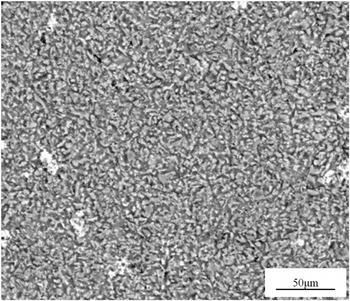
SEM (BSE) micrograph of 2024Al–45 vol% SiC composite in the as-casted condition showed the uniform distribution of SiC particulates arranged at the matrix structure and a very homogeneous microstructures free of porosity, as shown in Fig. 2. The brightness in the micrograph was due to higher atomic number of Cu in comparison with aluminum, silicon, and carbon.
SEM (BSE) image of SiCp/Al composite in as-casted condition.

B. Cooling curves
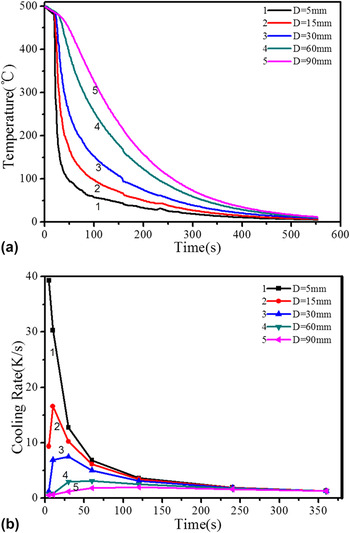
The Jominy end quench test was designed to simulate the one dimension cooling process of the composites. The distances corresponding to the positions were measured from the quenched end, at which the thermocouples were located. The thermal evolution of the bar during quenching process and the cooling rates as a function of quenched time was shown in Fig. 3. The temperature of the quenched end was at a lower range in a short time, while it took longer time for the composites away from the quenched end below 100 °C [Fig. 3(a)]. Hence, a large temperature gradient was formed, which decreased as the distance from the quenched end reduced.
Cooling curves (a) and the cooling rates as function of quenched time (b).

In Fig. 3(b), the cooling rate exhibited an evident decrease with the extension of quenched time at 5 mm from the quenched end. However, the cooling rates reduced after a rise at 15, 30, and 60 mm from the quenched end, respectively. The cooling rate remained almost unchanged at 90 mm. Due to the heat transfer, the cooling rates at different positions exhibited differences. The larger the temperature gradient, the more the heat flows and the higher the cooling rate. Therefore, it can be found that the cooling rates decreased with the increase of the distance from the quenched end. At D = 90 mm, the cooling rates in the quench sensitive temperature range (450–200 °C) was only 1.9 °C/s.
C. Hardness test
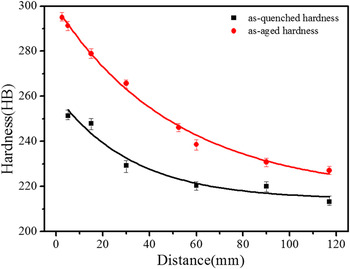
Pieces were sliced at different distances from the quenched end and the as-quenched and as-aged hardness of the bar were shown in Fig. 4. On the whole, the hardness along the direction of the distance far from the quench end exhibited a great decrease. At D = 117 mm, the drop percentages in the as-quenched and as-aged hardness were 18.2% and 23%, respectively. Likewise, the cooling rates reduced with distance away from the quenched end. Hence, the 45 vol% SiC/Al composites exhibited quench sensitivity due to the significant drop in the hardness with distance away from the quenched end. Generally, the quench sensitivity could be simply described by the depth of age hardening layer which is evaluated by the distance at where a certain hardness retention value is selected. Reference Deng, Wan, Zhang and Zhang41 The depths corresponding to 90% of maximum as-aged hardness measured by the Jominy end quench test were 30 mm.
Hardness as function of distance from quenched end of as-quenched bar.

D. Calorimetric study
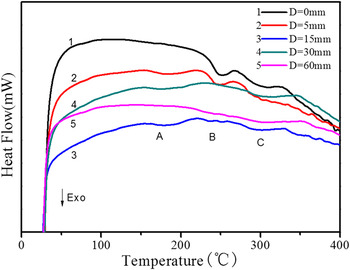
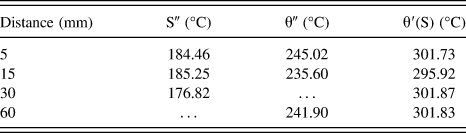
Calorimetric techniques have long been applied to microstructural characterization of A1 alloys and Al matrix composites. Reference García-Cordovilla and Louis42 The DSC curves for the quenched composites were shown in Fig. 5. Three well-distinguished peaks A, B, and C can be observed in the temperature range from 160 to 300 °C. The first peak A at about 180 °C would be associated with the formation of S″ precipitates which was not usually seen in the quenched or peak-aged (T6) SiCp/2024Al composites. Actually, the differences in peak temperatures observed by various authors for the same phenomenon can be due to different methods of material preparation. The second peak B at about 240 °C would be associated with the formation of metastable θ″ precipitates. The third peak C at about 300 °C would be associated with the formation of θ′(S′) precipitates. Previous observations showed θ′ phases and S′ phases formed at the same time. Reference Wang and Wu43–Reference Garmong47 The peak temperatures, related to the size and stability of the precipitate and the reaction kinetics, were compared for samples at different distances from quenched end of bar (Table III). The peak temperatures of precipitation were not affected by cooling rate, while they were only slightly affected by the scanning rate of DSC.
DSC traces of the solutionized 2024-SiC composite.

Peak temperatures for the precipitation.

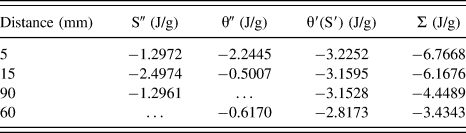
The reaction enthalpy can be given by the net area of the reaction peak, which directly reflected the volume fraction of the forming or dissolving phase during aging process. The overall enthalpy involved in the precipitation of all metastable phases (S″ + θ″ + θ′ + S′) decreased as the distance increased (Table IV). Compared with 5 mm, the overall enthalpy involved in the precipitation of all metastable phases decreased by 10, 35, and 50% at 15, 30, and 60 mm from quenched end, respectively, and the corresponding as-aged hardness reduced by 5.5, 10, and 19.1%. This showed that the smaller amount of precipitate phase that formed during the DSC ran after the slower quenching. This indicated that the precipitate was present in the sample before the DSC ran, and thus, it probably formed during quenching.
ΔH involved in the precipitation.

As discussed earlier, the as-aged hardness along the direction of the distance far from the quench end exhibited a great decrease. The relation between as-aged hardness and cooling rate through mathematical fitting method was as follows:
 $$Y = 289.09 - 86.49\,\exp \left( {{{ - X} \mathord{\left/ {\vphantom {{ - X} {4.743}}} \right. \kern-\nulldelimiterspace} {4.743}}} \right),$$
Y represented the as-aged hardness while X represented the average cooling rate between 200 and 450 °C.
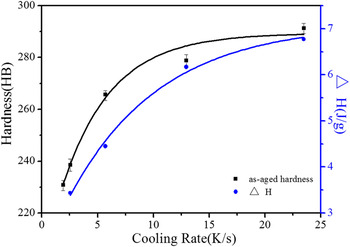
According to Fig. 6, SiC/Al composites exhibited two different quench sensitivity regimes. At slow cooling rates, the composites were more quench sensitive. The as-aged hardness increased rapidly with the cooling rate increase. At high cooling rates, the composites were mildly quench sensitive. The as-aged hardness showed a slow rise tendency with the cooling rate increase. When the quenching rate was more than 23.5 °C/s, the as-aged hardness of the composites reached the maximum property. The depths corresponding to 90% of maximum artificial aging hardness are 30 mm. It can be seen that the greater the cooling rate, the higher the hardness. During the quenching process, at intermediate temperatures (200 to 450 °C), where the cooling rate had a significant impact on the mechanical properties of the composites, the cooling rate should be high enough (more than 23 °C/s) to ensure a supersaturated solid solution was retained, while at higher or lower temperatures, a decrease of cooling rate could be helpful to relieve residual stress.
Hardness and ΔH as function of average cooling rate between 200 and 450 °C.

Likewise, the variation of the overall enthalpy showed similar trend as hardness (Fig. 6). It can be seen that the overall enthalpy involved in the precipitation of all metastable phases (S″ + θ″ + θ′ + S′) increased with the cooling rate increase. In other words, the formation of intermediate precipitates during cooling was the main reason for the decrease of as-aged hardness. The cooling rate reduced as the distance increased, which decomposed the supersaturated solid solution and reduced aging process available solute atom concentration. The overall enthalpy which reflected the volume fraction of all metastable phases reduced as the cooling rate decreased and therefore the as-aged hardness decreased. The formation of intermediate precipitates during cooling will be more dominant since the MMCs had a greater number of potential nucleation sites than unreinforced alloy. A faster cooling rate resulted in more precipitation on finer scale, which improved mechanical properties.
The quench sensitivity of Al alloys and Al matrix composites have been attributed to several mechanisms, such as intermediate phases precipitate, dislocation strengthening and vacancy/Guinier–Preston (GP) zone. Previous research revealed that the 20% SiCp/2124Al composites showed only one sensitivity regime i.e., a single gradient of the MMC hardness versus cooling rate, due to the increased effect of dislocation strengthening and intermediate precipitation during quenching and the reduced effect of vacancy/GPB zone content. Reference Thomas and King35 However, high volume fraction SiCp/Al composites exhibited two different quench sensitivity regimes. At high cooling rates, the MMCs were mildly quench sensitive. At slow cooling rates the composites was more quench sensitive. Previous microstructural observations showed intermediate precipitate formation to be significant at low cooling rate. Therefore, the quench sensitivity of composites at low cooling rate resulted from the formation of intermediate precipitates during cooling.
IV. CONCLUSIONS
As Jominy test is one of the most commonly used experimental procedure for evaluating the hardenability, it can be used in the quench sensitivity of Al matrix composites. The quench sensitivity of the 45 vol% SiCp/2024Al composites manufactured by squeezed casting method has been studied based on Jominy end quench test. Based on the hardness measurements and calorimetric investigations, the conclusions derived from this study can be given as follows:
-
(1) The Jominy end quench test was designed to simulate the one dimension cooling process of the composites. The cooling rates decreased with increasing distance from the quenched end of the bar.
-
(2) The depths corresponding to 90% of maximum artificial aging hardness measured by the Jominy end quench test were found to be 30 mm and when the quench cooling rate was 23.5 °C/s the as-aged hardness reached the maximum. The relation of precipitation and cooling rate was obtained and its variation with cooling rate was identical with the as-aged hardness.
-
(3) The SiCp/2024Al composites exhibited two different quench sensitivity regimes. At high cooling rates, the MMCs were mildly quench sensitive. At slow cooling rates the composites were more quench sensitive. The formation of intermediate precipitates during cooling was found to be dominant at low cooling rate.