Introduction
Service user involvement in research has its roots in the movement for the empowerment of users of social and health/medical services with respect to having a say in how those services and treatments are allocated and offered to them (see Cowden and Singh, Reference Cowden and Singh2007). Over the last two decades there has been a steady move towards such involvement in the mechanisms and procedures of both the provision and the assessment of service delivery and also in the research that underpins such services – both social and health/medical. What had long been recognized is the inequity of power that has existed between the providers of services and their users; and between the medical and social establishments and the individuals they ‘serve’. Such an unequal power distribution has also been seen to exist in the relationship between researchers and their ‘subjects’. Within the process of research, views and perceptions of service users have been collected and collated as ‘data’ and interpreted by researchers (see Beresford, Reference Beresford2007), thus to some extent bypassing the direct understandings and meanings of service users. Hence, it is not surprising that the issue of empowerment of service users has entered the arena of research. Many users feel that they can and should be involved in a process which directly or indirectly reports on and influences their lives. This view has been echoed by many in the medical and social care professions, including academic researchers (see Beresford, Reference Beresford, Lowes and Hulat2005).
Principles of user involvement have now been enshrined in policy, for example, the Department of Health requires NHS organisations to show evidence of user involvement in the research they conduct (Department of Health, 2000, 2001) and many research funding bodies, including the Economic and Social Research Council, the Joseph Rowntree Foundation and others view evidence of service user involvement as a prerequisite for funding and as a proxy indicator of a high-quality proposal or application. There is a general understanding that service user involvement in the research process is a ‘good thing’ and will enhance the ‘quality’ of studies in some ways.
Service user involvement can take a number of different forms. Within service provision it has been described as being either democratic or consumerist (see Beresford, Reference Beresford2002), whilst in the field of research Beresford (Reference Beresford2007) lists the approaches to service user contribution as involvement in conventional research, collaborative research and user research. In practice, this exists as a ‘continuum’ of involvement (Beresford, Reference Beresford, Lowes and Hulat2005) ranging from a very light or even tokenistic contribution, to a position where an entire research project is carried out and controlled by service users themselves. However, such different models of involvement lead to a wide variety of different interpretations of what is meant by service user involvement and may lead to differing views of the value and desirability of such involvement. The emancipatory paradigm for conducting disability research, for example, comprises of a number of key principles, one of which is ‘the devolution of control over research production to ensure full accountability to disabled people and their organisations’ (Priestley, Reference Priestley1999: 16).This and the other principles of the emancipatory research paradigm could define the pure position of the ‘Advocates’ of user involvement (as described later in this paper) in relation to disability research. Berseford (Reference Beresford, Lowes and Hulat2005) makes a useful distinction between ‘emancipatory and user controlled research’ (which reflect a commitment to redistribute power in research and to serve a democratising purpose) and ‘user involvement’ in research (which reflects ‘the broader interest in participatory initiatives to include the knowledge and view points’ of service users) (Beresford, Reference Beresford, Lowes and Hulat2005: 14). He continues: ‘While it can be useful to see these two approaches to participation in research as different, it can also be helpful to see them as different ends of a continuum of involvement for service users, from non to complete control’ (ibid.).
Set alongside this is a ‘hierarchy’ of research methods and approaches in health/medical research, which ranges from systematic reviews of randomised controlled trials (RCTs) at the ‘top’ (Type I) to expert opinion (Type IV) at the ‘bottom’ (see, for example, Kroke et al., Reference Kroke, Boeing, Rossnagel and Willich2003). Personal experience, i.e. that of the service user or carer, is included in some versions and may be placed below (see, for example, Davies and Crombie, Reference Davies and Crombie2001) or alongside expert opinion, as in the National Service Framework for Mental Health (Department of Health, 1999: 6) but still at the bottom (see Glasby and Beresford, Reference Glasby and Beresford2006). While such a hierarchy is generally used by medical researchers to grade the evidence supporting the effectiveness of clinical interventions, for example, for systematic reviews, it is seen as disempowering because it places service users’ views at the bottom of the hierarchy. Hence, issues of empowerment have also become inextricably linked with those of methodology. This has led to a focus of the debate on service user involvement in research to be on its empowering role for users (see Hanley, Reference Hanley2005; Beresford, Reference Beresford2007) alongside its effect on the broader quality of knowledge and evidence. The emancipatory research paradigm (see Stone and Priestley, Reference Stone and Priestley1996; Priestley, Reference Priestley1999) advocates the need to adopt a plurality of methods for data collection and analysis rather than to focus on any single method. There has been little work, however, on the effect of service user involvement on the quality of research, research outputs and outcomes, even though the involvement of service users in research is widely advocated. Indeed, Beresford acknowledges that ‘we have little systematic knowledge about what the gains and achievements of participation may actually be’ (Beresford, Reference Beresford, Lowes and Hulat2005: 6).
In this article, we present the findings of a study of social policy researchers’ views and attitudes towards service user involvement in research. The data we present show the diversity of stances towards service user involvement by this ‘community’. The variety of positions taken poses significant challenges to the assumption that service user involvement is always a ‘good thing’, that it is widely valued and desired and that it is widely understood. The views of our sample represent the continuum of approaches to user involvement from ‘none’ to ‘complete control’. They also illustrate the misunderstandings and suspicions about what user involvement entails and in some cases a failure to engage with and comprehend the case for user involvement in social research. If such involvement is to become more genuinely accepted by a greater number of researchers, then Advocates and Adversaries will need to engage in dialogue, in particular, to understand the principles and practice of user involvement along the full research continuum and how such involvement affects the quality of the research process, its outputs and outcomes.
Methods
This study is based on an internet survey of 251 social policy researchers, followed by a series of discussion groups (with 26 participants) and in-depth telephone interviews with a further 28 respondents. Potential respondents were identified by their membership of the Social Policy Association or Social Policy Discussion List. Details of the survey were emailed to 800–900 individuals who were considered to be involved in the field of social policy research. Over 80 per cent of our internet respondents (83.1 per cent) had been involved in social policy research for five years or longer and most were based in universities or academic institutions (79.6 per cent). The gender distribution was approximately equal, with 47 per cent male and 53 per cent female respondents.
Telephone interviews of approximately 30 minutes were carried out with the participants who had indicated in our internet survey that they were willing to be interviewed. A purposive sampling method was used to select these interviewees so that as wide a range as possible of different attitudes to research and quality were represented in the sample. A one-day discussion seminar was also organised, to which 26 experienced social policy researchers, including members of the social work and social policy Research Assessment Exercise (RAE) sub-panel, were invited to attend. The RAE is a periodic assessment of academic research conducted across all disciplines in all universities in the UK. Discussion participants were identified from their publication record or senior role within their organisations. Participants of the discussion group did not take part in the telephone interviews.
Results
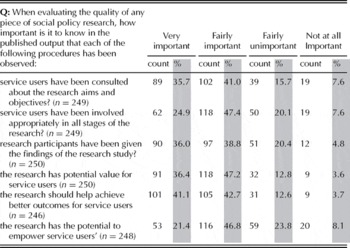
The e-survey contained a number of questions relating to respondents’ perceptions of user involvement in research as an indicator of quality. The responses are summarised in Table 1.
Respondents’ perceptions of the importance of service user involvement in research (as demonstrated in the published output)

Around three quarters of the respondents considered it ‘Very important’ or ‘Fairly important’ that users had been consulted about the research aims and objectives, that they had had appropriate involvement at all stages of the research process and that they had been given findings of the research study. However, the remaining quarter felt such issues to be of little importance.
Similarly, when asked about outcomes for service users, a small but sizeable minority of respondents considered such issues not to be of great importance (see Table 1). These findings suggest, therefore, that far from there being a consensus on the value of service user involvement in the research process, there was a spread of stances ranging from advocacy to apparent indifference.
The Advocates of user involvement
One stance, which we define as that of the Advocates, is characterised by an unconditional or strong support for service user involvement in social policy research:
I think the whole user movement has transformed a lot of social policy research and transformed it almost wholly for the good. So I view that very positively.
I think it's the single most important thing that's happened in research in my lifetime quite honestly. I think the power balance has begun to shift, but nowhere near enough yet.
Research was seen, by some, as a partnership between users who had experience of services and understood that particular environment and the researcher who was versed in the ways of the research community:
user research I think is a partnership between the people who actually know what that world is like and the people who know what the world of research is like. And that kind of research I think is extraordinarily powerful and would have to be judged by the rigour of what that research is trying to do, which might be very different from other, other tests of rigour that one would apply to other sorts of research.
Some Advocates thought that service users should be involved in all stages of the research process, from conceiving the research ideas through to the dissemination of findings:
I would want to see users involved at every stage in the research process right from the research design, through, right the way through to dissemination . . . all the projects that I do research for are guided by a steering group which has a variety of stakeholders on it and they want to talk about every aspect of it, including the design of questionnaires and you know whatever methodology I'm actually using.
Some also emphasised that this involvement needed to be genuine and meaningful. The Advocates’ comments suggest that there are seven main advantages for social policy research when service users are involved.
(1) Service user involvement helps social policy research to be grounded in the everyday experiences of users. Here the focus of comments is primarily on what service users bring to research in terms of their experiences of being on the receiving end of social interventions and of the policies that generate and promote such interventions; hence, grounding the research and the researcher in the ‘real world’ of the service user and not in an imagined or assumed version of it:
I think what they obviously bring you is insight and experience of being the recipients of services, which in policy terms I think is quite an important perspective and one that can be neglected.
I think they bring a real perspective in terms of connecting the researchers to the real world in which users are living and that's always good to be reminded of. And they can provide the researchers with some very good ideas and novel approaches to what they might do or how they might go about something.
(2) Service user involvement helps to ensure social policy research is relevant. Here the focus of comments is meant to imply that social policy research should remain grounded in issues that are relevant to users, and that user involvement can be instrumental in promoting this:
I think it's just an acknowledgement that your average social policy academic has just become so far removed from being the users of welfare services that they now need this kind of direct contact and they should have been having it before. But I think for me it's a signal that they've just become so far more removed from the experience they need to kind of find ways to reconnect with it.
(3) Service user involvement helps in the formulation and design of the research and provides scrutiny of ethics and process. Respondents’ comments emphasised the contribution that service user perspectives can make in informing an appropriate conceptualisation and design for the research and to ensure that the research is conducted to high ethical and procedural standards:
They bring expert experiential knowledge about the subject being researched, which can both help ensure that issues are defined more appropriately, and maybe help ensure that the design of the research is appropriate and therefore will engage with the people it needs to engage with. They bring alternative perspectives which may not be well documented, and therefore may alert researchers to things that they haven't actually thought about before.
(4) Service user involvement can help the researcher to gain access to research participants. Some respondents referred to the help that service users can give the researcher in terms of finding a sample or gaining access to ‘difficult to find’ populations:
they may actually make it possible to do research that requires access to people who will be very resistant to, you know, to being researched, so they may actually help access.
Or indeed you may get access to organisations or groups that you otherwise might have struggled to get. So they can have a positive impact.
(5) Service user involvement can help the dissemination and implementation of findings. Here the involvement of service users could help in the dissemination of research findings through access to diverse networks:
I think they bring good insight into the actual realties of the problem, the consequences of the problem. I think they're also incredibly valuable in trying to disseminate findings as well.
users need to be involved in helping to systematically shape an effective and efficient intervention.
(6) Service user involvement helps to make the research accessible and understandable. Some respondents’ comments suggested that a specific beneficial outcome of service user involvement concerns the published output itself, which is more likely to be accessible when users have been involved. It may be interesting to note here that accessibility of published outputs was ranked as the most important indicator of quality by participants in the e-survey (see Becker et al., Reference Becker, Bryman and Sempik2006; Sempik et al., Reference Sempik, Becker and Bryman2007). The following quotations illustrate this point:
Involvement of subjects should help make concepts and vocabulary of researchers more widely understood.
I think if you've got users actually reading your writings or attending meetings at which they're discussed you simply cannot write about them in the kind of way that people used to write about users. So I see that as very, very positive.
(7) Service user involvement can improve the quality of social policy research. A few respondents thought that user involvement would automatically improve the quality of social policy research. They saw it as a de facto indicator of quality:
Well it has a very important impact on the quality because without it I don't think you can actually get any kind of answers to your questions.
I think it can have a very, quite a big impact, it can certainly lead you to question your assumptions about what's important, what's interesting and it can also lead you to question how you do the work.
Cautious Advocates
Although some respondents supported service user involvement in principle, they argued that the level and nature of involvement would vary in practice according to the type of research (for example, whether it was applied or theoretical), the ‘topic’ being studied, the research questions being asked or for whom the research was being conducted. Thus, there was a view that service user involvement could be more appropriate and necessary where the research was policy and practice-oriented or where it was being conducted for policy purposes, than when it was theoretical (or ‘scholarly’):
I think it should be assumed that you would involve people who are recipients, beneficiaries unless there is a strong argument against. But I think how you do it depends on the particular research question. But I think it's certainly a question that ought to be on any researcher's agenda as something to be considered as part of the research design and the research process.
I think for an applied piece of work it's really important that you involve service users in setting the agenda of research, so it's a question of defining the topic and how that topic is defined and priority for that topic where service users have an extremely important voice . . . for any applied piece of work that is . . . that should be part of good quality. But you can still do really good quality research and not involve people in that . . . it's about the choice of topic.
The Agnostics and Adversaries
Some respondents were more critical about the value of service user involvement in principle and in practice. Some expressed strong (sometimes hostile) views, seeing user involvement as ‘trendy’ or as a ‘bandwagon’ with no proven worth, while others were less sure of the advantages that it brought and consequently expressed ambivalent or unconvinced views.
Hostile or ambivalent views towards service user involvement, again, can be categorised under seven main concerns.
(1) Service user involvement is a fad, driven by ideology rather than proven in value. Here the respondents expressed a concern that service user involvement is being driven by fashion rather than by evidence of value:
God forbid we get into a situation where we've all got to use, have, user involvement. There is a move towards that . . . I think that it needs more critical appraisal.
I would question the assumption that it necessarily improves the quality of the work. It can do perhaps, but I think there's a real danger that you presume it does and therefore think because . . . users are involved it is better research. Do they necessarily know about research methods, what's appropriate and so on? . . . there's a danger that it's a bit of a kind of bandwagon, a bit of a sort of trendy way of doing things but not necessarily improving. . .
(2) Service user involvement can be tokenistic in practice, rather than a genuine exercise in involving other stakeholders. Some respondents expressed concern that in practice service user involvement can be a public relations exercise, a tokenistic attempt to ‘tick off’ the box that it has been done, rather than a genuine commitment to the principle and practice of service user involvement:
With ESRC type research, the user involvement is just a PR exercise. I don't believe in it and then one is going through a fantastic number of hoops to find these users to involve in the research.
And I mean there is always this very strong danger of tokenism . . . I mean sometimes we can formally state we're involving people but that doesn't necessarily mean that we've kind of got a meaningful, and I mean again that's partly again a research design question.
In one case, a respondent suggested that service user involvement could move beyond tokenism to be exploitative:
There are many examples of exploitation of the people themselves in order to meet the brownie points. You reel in your person with learning disability and put them in a setting which is completely inappropriate and all feel very virtuous, but actually I think it's a misuse of people.
(3) Service users do not have the skills or knowledge to be involved. Some respondents expressed concern about the abilities of service users to engage with or conduct (or control) research:
i.e. Not all users are in a position to give informed contributions, or sustained contributions and that has to be recognised, particularly vulnerable groups like people . . . with significant communication problems, significant learning disabilities, or who might be . . . very mobile or . . . difficult to track . . . that needn't exclude them but it makes it difficult and so on and so forth. So you've got to get the right people.
(4) Service users bring their own agendas to the research. While some respondents supported the principle and practice of service user involvement, they were also concerned that users would have their own agendas and perspectives and that these could affect the research process and outputs. The concern here is that service users bring their own agendas to the research process and will want to influence the research in particular ways for particular purposes:
I don't think it always improves the quality of the work because sometimes users may have strong views . . .
and I think there's a danger if you just say users should always be involved that, they, those agendas drive the research, you know it becomes a kind of partial thing.
(5) Service user involvement requires a ‘representative’ sample. One concern expressed by a number of respondents is the possibility that a biased sample of service users might be involved who would promote a particular viewpoint:
there's drawbacks . . . I think in terms of having users involved at the beginning of a project and having been at advisory group meetings in which users are there, perhaps they're given a bit too much credence in setting the methods and the approach to some extent because they're kind of used as a representative of the population when they're not, they're really individuals, if you see what I mean.
(6) Service user involvement is costly and time consuming. ‘Real’ user involvement can be expensive and some funding bodies, despite a rhetoric of user involvement, do not adequately fund this activity:
And I have to say the [research funder] is a very good example of this where they want the world for tuppence. Erm. . . and they specify the criteria of transparent user engagement, i.e. beneficiary engagement but actually fund research I think relatively modestly compared with erm. . . certainly some other major resources of funding. They actually make it very difficult to do that.
(7) The value of service user involvement is not proven. It will not necessarily improve the quality of social policy research. The majority of Agnostic and Adversarial respondents thought that service user involvement would not necessarily improve the quality of research (and thus, that user involvement should not be seen as a proxy indicator of quality). The belief here was that quality is determined by a number of criteria other than the extent or nature of service user involvement per se:
I don't think user involvement is always appropriate or necessary, in terms of determining the quality of research projects. There are plenty of topics and plenty of types of research where it would not necessarily improve the quality. . .
it doesn't necessarily make it quality, you could do a really bad piece of research that has heavy user involvement, you could do a really good piece of research that doesn't have much for all sorts of reasons.
So involving users is not necessarily a guarantee of the quality of the work, in fact sometimes it may have the reverse effect.
Discussion
Whilst the majority of our participants favoured involving service users, many different comments were received regarding how and at what stage they could (and should) be involved in research. Such a wide range of stances may arise from the different models of service user involvement (see Minogue et al., Reference Minogue, Boness, Brown and Girdlestone2005; Beresford, Reference Beresford2007) and misunderstandings and suspicion from some of our sample.
The concept of service user involvement in research is becoming more developed and it is extending into different topics and aspects of research, for example, into that on social work, social policy, health policy, medical and social interventions and others. It is a concept that is heavily promoted by service user movements, policy makers and funders; and one that many researchers are therefore familiar with and have begun to accept and adopt. However, as this study shows, some are still Agnostic and remain to be convinced.
Whilst the Advocates in our sample did not express overt support for the emancipatory/user controlled paradigm, they did perceive user involvement as essential to the research process bringing many advantages, including ‘grounding’ the research in the everyday experience of users, making the research relevant, accessible and useful. In some cases it was seen as a de facto indicator of high quality.
On the other hand, Agnostics and Adversaries questioned the presumption that service user involvement is desirable per se. They pointed to the lack of supporting evidence and suggested the existence of a ‘bandwagon’ driven by some researchers’ ideological stance and the agendas of the service user movement and some research funders. One criticism of service user involvement was that it could be seen as a proxy indicator of high quality, and other issues of methodology and design might be overlooked. They also feared that service user involvement could lead to tokenism – involving users only to satisfy the requirements of funders or policy makers. Such involvement can be exploitative. If their input is sought only to justify procedural requirements, then their involvement may have little bearing on the direction or outcome of the research. Of course, these concerns have been discussed in the literature by proponents of user involvement (see, for example, Royle et al., Reference Royle, Steel, Hanley and Bradburn2001; Hanley, Reference Hanley2005; Beresford, Reference Beresford2007).
Issues of power and control are also central to Agnostics’ and Adversaries’ arguments that research requires specific skills which researchers have but which may be lacking among service users. They argue that it would be unfair and unrealistic to expect users to make an equal or meaningful contribution to research when they were not trained in research methods, designs or analysis. Whilst the training of users in research methods has been seen as important by some authors (Lockey et al., Reference Lockey, Sitzia, Gillingham, Millyard, Miller, Ahmed, Beales, Bennett, Parfoot, Sigrist and Sigrist2004) and some researchers have actively pursued this course (see, for example, Simpson et al., Reference Simpson, Bryant, Ruddy and Atkin2006), others, perhaps, view their lack of expertise as a legitimate reason for excluding them or minimising their involvement. To a large extent, this perspective does not take account of the principles of user involvement as advanced by its proponents. These include ensuring access and support for a wide range of service users to enable them to participate effectively and meaningfully in the research process (Beresford, Reference Beresford, Lowes and Hulat2005: 3).
In this study, we have identified those who are opposed to user involvement in research and those who are still undecided of its value, as well as those who support it. The views of the Adversaries and Agnostics are hardly represented in the current literature. Such dissenting views will be important in the development of a model of service user involvement in research that is robust, sophisticated and open to challenge and debate. Advocates of service user involvement in research will need to engage with and respond to the criticisms of user involvement as expressed by some social policy academics and researchers as outlined in this paper. The Agnostics and Adversaries will require answers and evidence of the benefits of user involvement and its association with quality in social policy research if they are to become convinced of its utility and value, and if they are to engage with service users in future research studies. These are challenges that will need to be addressed directly by those on all ‘sides’.