


Introduction
International organizations (IOs) monitor rule compliance and promote co-operation, in part by publicly criticizing states that violate international norms. Yet public criticism requires timely, verifiable evidence and exposes IOs to reputational and political backlash, making it difficult to do so under conditions of imperfect information.
IOs therefore face a recurrent problem that goes beyond information scarcity: deciding which information they can credibly act upon. In practice, IOs receive abundant and often conflicting signals from governments, media, and civil society. Only some of this information, however, becomes actionable. We argue that the difference lies not in the content of the information alone, but in the social relationships through which it is conveyed.
Existing scholarship has long recognized that non-governmental organizations (NGOs) supply information to international organizations. What remains poorly understood is how some NGOs come to function as trusted informational conduits. We advance a relational account in which repeated interaction between IO bureaucrats and specific NGOs generates familiarity, informal communication channels, and trust. These relationships condition whether information is treated as reliable and, ultimately, whether it is used to justify public criticism.
This relational process is especially consequential for discretionary IO outputs such as press releases. Unlike resolutions, reports, or judicial decisions, press releases typically do not require approval by member states and are weakly institutionalized within formal rules. As the United Nations Dag Hammarskjöld Library notes, ‘press releases serve information purposes only and are not considered official documents’.Footnote 1 Their informality grants IO bureaucracies considerable discretion over timing and content but also heightens the reputational risks of error or bias. As a result, IOs rely heavily on trusted social conduits when deciding whether and how to speak publicly.
We test this argument in the context of the Inter-American Commission on Human Rights (IACHR). Human rights monitoring entails acute information asymmetries and high political sensitivity, raising both the value of credible local information and the costs of public criticism. The IACHR, therefore, offers a particularly informative setting for examining when IOs issue critical press releases.
Empirically, we combine an original dataset of IACHR press releases and NGO participation in public hearings (1996–2020) with an instrumental variable strategy, quantitative text analysis, and qualitative evidence from interviews and documentary materials. Across approaches, we show that the Commission is more likely to criticize a country on a given topic when it has established ties with local NGOs focused on that country and issue area, and that stronger ties correspond to more negative language in its public statements.
This study makes three contributions to research on international organizations and NGOs. First, it advances a relational account of IO public action by showing how discretionary outputs such as press releases depend on trust-based ties between IO staff and specific non-state actors. Second, it explains when and why IOs engage in public criticism by showing that IO–NGO relationships are not merely functional exchanges of information, but social relationships that condition whether external evidence is treated as credible and actionable. Third, it introduces a novel dataset of IO press releases combined with original interview evidence, offering systematic insight into how relational trust shapes IO public communication.
The argument is timely given contemporary challenges facing both IOs and NGOs. IOs face mounting contestation as the liberal international order is increasingly challenged by both rising powers and nationalist-populist movements within established democracies (Börzel and Zürn Reference Börzel and Zürn2021). At the same time, democratic backsliding (Hyde Reference Hyde2020) and the spread of restrictive laws targeting civil society have reduced the civic space in which NGOs operate (Chaudhry Reference Chaudhry2022; Lian and Murdie Reference Lian and Murdie2023). These developments raise questions about the durability of information channels between IOs and civil society, and about the resilience of international accountability mechanisms when local sources face repression or exclusion.
The paper proceeds as follows. The next section reviews existing explanations for IOs’ decisions to criticize states. The section Theory: Local NGOs as Reliable Information Suppliers presents the theoretical argument. The sections Case Selection and Empirical Strategy, Quantitative Evidence, and Qualitative Evidence on the Causal Mechanism develop the empirical strategy. The Conclusion section summarizes the findings, outlines avenues for future research, and discusses policy implications.
Criticism by International Organizations and the Role of NGOs
International organizations’ practice of publicly criticizing states for their domestic behavior is often understood as a ‘process of persuasion’, aimed at highlighting inconsistencies between state conduct and the identity of the ‘civilized community of states’ (Risse and Sikkink Reference Risse, Sikkink, Risse, Ropp and Sikkink1999, 15). Much of the existing literature emphasizes the politicized nature of such practices, focusing on states’ strategic use of criticism in international fora (Carraro Reference Carraro2017; Kim Reference Kim2023; Lebovic and Voeten Reference Lebovic and Voeten2006; Terman and Voeten Reference Terman and Voeten2018).Footnote 2
Despite this extensive literature, IOs’ own agency in deciding when to publicly criticize states remains puzzling, particularly given their dependence on member states’ support for institutional survival (Gray Reference Gray2018). This raises a central question: under what conditions do IOs choose to criticize states?
Existing explanations offer partial answers. One line of argument emphasizes mandates, suggesting that IOs criticize member states when violations clearly fall within their jurisdiction (Hurd Reference Hurd2014; Keohane Reference Keohane1984). A contrasting perspective focuses on power, contending that IO behavior largely reflects the preferences of dominant states and predicting selective criticism aligned with major powers’ interests (Clark and Dolan Reference Clark and Dolan2021; Mearsheimer Reference Mearsheimer1994). Principal–agent approaches occupy a middle ground, arguing that IO autonomy is conditional: delegation can create opportunities for bureaucratic independence, particularly when member states’ preferences diverge (Hawkins et al. Reference Hawkins, Lake, Nielson and Tierney2006; Nielson and Tierney Reference Nielson and Tierney2003). Finally, bureaucratic theories shift attention inward, highlighting how organizational identities, professional norms, and commitments to institutional missions can motivate autonomous action in defense of legitimacy (Barnett and Finnemore Reference Barnett and Finnemore1999, Reference Barnett and Finnemore2004; Bauer Reference Bauer2006; Johnson Reference Johnson2014).
Taken together, these perspectives primarily explain why IOs may have incentives to criticize states or face constraints on doing so. They devote far less attention to whether IOs possess the capacity to act autonomously, even when such incentives exist. In practice, IOs’ decisions to publicly criticize states are fundamentally shaped by the availability and quality of information (Carson and Thompson Reference Carson, Thompson, Wivel and Paul2019). Given the scope and complexity of international affairs, IOs often operate under conditions of imperfect information, either lacking knowledge of violations warranting censure or confronting abundant but contradictory evidence. This limitation underscores the central role of information collection and verification in shaping IO decision making. Organizational research similarly shows that variation in the amount and reliability of information can significantly affect institutional behavior (Bariff and Galbraith Reference Bariff and Galbraith1978; Pettigrew Reference Pettigrew1972).
These informational constraints direct attention to NGOs. A substantial literature shows that NGOs can influence IO behavior through information provision (Betsill and Corell Reference Betsill and Corell2001; Corell and Betsill Reference Corell and Betsill2001; Dörfler and Heinzel Reference Dörfler and Heinzel2023; Gulbrandsen and Andresen Reference Gulbrandsen and Andresen2004; Keck and Sikkink Reference Keck and Sikkink1998; Tallberg et al. Reference Tallberg, Dellmuth, Agné and Duit2018). Such influence depends critically on credibility: IO decision makers are more likely to rely on NGO-supplied information when they perceive both the source and the information itself as reliable (Bloodgood and Schmitz, Reference Bloodgood and Schmitz2024). Consistent with this logic, Nie (Reference Nie2023) demonstrates that information presented in a reputable and neutral manner is more likely to be incorporated into IO outputs, underscoring that formal access alone is insufficient.
At the same time, information politics are uneven. Well-resourced NGOs tend to receive disproportionate attention, while underrepresented contexts are more likely to be neglected (Ron et al. Reference Ron, Ramos and Rodgers2005). Moreover, despite extensive research on NGOs’ formal access to IOs, we know far less about how actors translate access into influence over specific policy outputs.
The literature shows that information flows through multiple layers of civil society. Local and international NGOs exchange information, with local organizations providing context-specific knowledge and international NGOs translating that information for IO officials and serving as recurring points of reference (Dörfler and Heinzel Reference Dörfler and Heinzel2023; Keck and Sikkink Reference Keck and Sikkink1998). Much of this research, however, assumes that local NGOs engage IOs primarily through international intermediaries rather than through direct interaction (Fleishman et al. Reference Fleishman, Campbell and Braithwaite2025).
This article builds on these insights by examining when local NGOs with direct access shape IOs’ ability to publicly criticize states. While existing research emphasizes the importance of credible information suppliers, it often conceptualizes this relationship in functional terms: IOs require information, NGOs have it, and exchange follows. We know far less about how local NGOs become trusted interlocutors and how trust is built over time. By focusing on social ties between NGO representatives and IO officials, and on how repeated interactions transform unfamiliar actors into trusted informants, this study advances a relational account of IO criticism.
Theory: Local NGOs as Reliable Information Suppliers
Our theoretical starting point is that information about situations on the ground – and how those situations are interpreted – mediates the relationship between state actions and IOs’ decisions to publicly criticize them through press releases. Unlike resolutions or judicial decisions, press releases are generally not governed by IO statutes or formal rules of procedure, leaving IO bureaucracies with considerable discretion over their timing, content, and frequency. Building on scholarship on informal governance in international organizations (Stone Reference Stone2013), we treat press releases as discretionary outputs that operate alongside formal instruments but are not subject to the same procedural constraints or evidentiary thresholds. Precisely because they fall outside codified decision-making processes, press releases provide a useful window into how IO staff assess information, manage uncertainty, and decide when public criticism is warranted.
We argue that IOs are more likely to issue critical press releases when they have access to information that satisfies two conditions, and that access to such information depends on social ties between IO staff and external actors. First, information must be mandate-aligned: public criticism requires evaluative judgments against institutional norms, leading IOs to privilege information that is contextualized and assessed in light of the standards they are tasked with upholding. Second, information must be perceived as reliable, because the legitimacy of IOs’ public statements depends on their credibility (Barnett and Finnemore Reference Barnett and Finnemore2004; Tallberg and Zürn Reference Tallberg and Zürn2019).
Acquiring such information poses substantial challenges. Direct information-gathering methods, such as country visits or site inspections, allow IOs to observe events first-hand, interview witnesses, and inspect sites (Dai Reference Dai2002; Kelley Reference Kelley2009). These approaches are especially common in areas such as election monitoring and arms control. However, their resource-intensive nature makes systematic and comprehensive coverage across member states impractical, even for well-resourced organizations.
To address these constraints, IOs often rely on external sources. In doing so, they must assess both whether information is mandate-aligned and whether it is sufficiently reliable to support public criticism. Reliability is particularly important, as acting on inaccurate or biased information can generate diplomatic tensions and reputational harm (Johnson Reference Johnson2011). Trusted information suppliers therefore hold a strategic advantage: the greater the confidence IO bureaucracies place in a source, the more likely they are to act on the information it provides.
Potential sources of information include governments, media outlets, and NGOs. Although self-reporting plays a role in international co-operation (Creamer and Simmons Reference Creamer and Simmons2020; Karlas Reference Karlas2022), it is generally insufficient for critical public pronouncements. IOs are typically skeptical of state-provided information due to strategic incentives to conceal wrongdoing and the political sensitivities surrounding self-reporting (Worsnop Reference Worsnop2019).
Media outlets represent another important source of information. IO bureaucracies may monitor news reports to identify potential violations or emerging situations of concern. However, media coverage often lacks the contextual and normative analysis required for public criticism. While useful for identifying discrete events, media reports rarely provide systematic assessments of patterns over time, links to prior incidents, or evaluations of states’ legal responsibility. Moreover, reporting biases and market-driven definitions of newsworthiness shape which events receive coverage (Baum and Potter Reference Baum and Potter2008; Hafner-Burton and Ron Reference Hafner-Burton and Ron2013; Ramos et al. Reference Ramos, Ron and Thomas2007; Weidmann Reference Weidmann2016), while editorial orientations influence how events are framed (Cushion et al. Reference Cushion, Kilby, Thomas, Morani and Sambrook2018). As a result, IOs rarely rely on media accounts alone when issuing critical press releases.
In contrast, NGOs often provide detailed evidence and domain-specific expertise, making them particularly valuable information suppliers. NGOs – especially those operating locally – maintain close engagement with affected communities and regularly monitor government behavior in issue areas such as human rights, environmental protection, and humanitarian assistance (Haas Reference Haas1992; Keck and Sikkink Reference Keck and Sikkink1998). These activities enable local NGOs to generate information that is closely aligned with IO mandates and relevant normative frameworks (Broome and Seabrooke Reference Broome and Seabrooke2017).
Local NGOs also have strong incentives to share information with IOs. By supplying evidence, they seek to hold states accountable, amplify their claims, gain access to policy-making processes, and leverage international norms in support of their causes (Brysk Reference Brysk1993; Carayannis and Weiss Reference Carayannis and Weiss2021; Dür Reference Dür2008; Keck and Sikkink Reference Keck and Sikkink1998; Simmons Reference Simmons2009). However, not all local NGOs are equally reliable information suppliers. Political motivations and advocacy goals can introduce bias, requiring IOs to exercise caution when relying on NGO-provided evidence. To manage these risks, IOs rely on informational shortcuts, evaluating reliability through familiarity with and trust in the individuals and organizations providing the information.
Our argument builds on the view of IOs as bureaucracies composed of individuals rather than unitary actors (Lang et al. Reference Lang, Wellner and Kentikelenis2025), but it departs from bureaucratic approaches that emphasize insulation from external influence. Trust, in our account, is not established between organizations in the abstract but between specific individuals: IO bureaucrats responsible for particular countries or issue areas and the NGO representatives with whom they interact repeatedly in formal and informal settings. When personnel change, these relationships must be rebuilt.
While it is well-established that IOs rely on NGOs as information suppliers (Eilstrup-Sangiovanni and Sharman Reference Eilstrup-Sangiovanni and Sharman2021), we refine this insight by showing that repeated interaction enables local NGOs to become trusted informants. Much of the existing literature treats this relationship as primarily functional (Tallberg et al. Reference Tallberg, Sommerer, Squatrito and Jönsson2014; Tallberg et al. Reference Tallberg, Dellmuth, Agné and Duit2018). We argue instead that information exchange is fundamentally social rather than automatic. Trust and familiarity – sometimes reinforced through ‘revolving door’ dynamics between NGOs and the international public sector – enable information to flow and be acted upon (Belli and Bursens, Reference Belli and Bursens2023; Reiners Reference Reiners2021, Reference Reiners2024; Seabrooke and Tsingou Reference Seabrooke and Tsingou2021). As a result, local NGOs with established reputations and close ties to IO bureaucracies are more likely to be treated as reliable information sources (Nie Reference Nie2023).
This emphasis on social relations should not be interpreted as a constructivist socialization argument. We do not claim that bureaucrats’ interests in enforcing norms or criticizing violations are constituted through interaction with NGOs. Instead, we treat these interests as given and focus on how social relations facilitate the flow and use of information.Footnote 3
Our causal mechanism operates through the following steps. First, local NGOs participate in formal IO activities, such as public hearings, creating opportunities for direct interaction with IO staff. Second, repeated interactions foster personal relationships, enabling the exchange of contact information and the development of informal communication channels. Third, through these interactions, IO bureaucrats assess NGOs’ expertise and reliability, gradually developing trust in specific organizations. Fourth, when events warranting criticism occur, trusted NGOs either proactively alert IO staff or are contacted by bureaucrats seeking additional information (McCubbins and Schwartz Reference McCubbins and Schwartz1984). Finally, information from trusted sources reduces uncertainty about the situation on the ground and mitigates reputational risk, making public criticism more likely.
This argument generates several observable implications. In the case of the IACHR, we expect to observe: (1) a greater focus on countries where local NGOs with which the IACHR has had repeated interactions are based; (2) criticism concentrated in issue areas in which these NGOs specialize; (3) more critical language when information is supplied by more trusted sources; and (4) reliance on NGO-provided information in moments of crisis, when timely information is especially valuable.
The scope of our argument is limited to environments in which NGOs are able to collect information and link with IOs. A minimal degree of civic space is therefore a necessary condition for the mechanisms we theorize to operate. Where civic space is severely restricted (Lian and Murdie Reference Lian and Murdie2023), opportunities for repeated interaction and trust formation are limited, and IOs face acute information scarcity rather than an absence of incentives to act. This constraint is well-documented in the human rights literature and reflects broader challenges in norm monitoring and enforcement in closed or highly repressive regimes (Hafner-Burton et al. Reference Hafner-Burton, Mansfield and Pevehouse2013; Keck and Sikkink Reference Keck and Sikkink1998; Risse and Ropp Reference Risse, Ropp, Risse, Ropp and Sikkink2013).
Importantly, we do not argue that IOs are irrelevant in such contexts. Rather, in the absence of reliable local sources, IOs are more likely to rely on alternative information channels, such as foreign journalists, states, international bureaucracies, or activists in exile. Our theory does not seek to explain IO behavior in all political contexts; instead, it specifies the conditions under which local NGOs are most likely to operate as influential information suppliers.
Case Selection and Empirical Strategy
Our theoretical framework posits that IOs are more likely to publicly criticize states when they can draw on a larger stock of mandate-aligned information from sources they perceive as reliable. We test this framework by examining the Inter-American Commission on Human Rights (IACHR) and the role of NGO-provided information in its decisions to publicly condemn human rights violations through press releases.
The IACHR is an autonomous organ of the Organization of American States (OAS). The OAS has historically had 35 member states, covering all countries in the Americas,Footnote 4 the majority of which are democratic. In comparative perspective, the Inter-American human rights regime therefore sits between the European and African regimes in terms of the democratic composition of its membership.
We do not claim that the IACHR is representative of all IOs. Rather, it provides an analytically informative setting for studying the mechanisms at the core of our argument. Human rights violations are often decentralized and difficult to observe, creating pronounced information asymmetries and strong incentives for IOs to rely on external sources. At the same time, the IACHR offers institutionalized channels for sustained engagement with civil society, including public hearings and the individual petitions system. These features create repeated opportunities for interaction between IO staff and local NGOs, allowing us to assess when and how trust-based relationships shape public criticism.
The Commission is composed of seven independent experts elected by the OAS General Assembly. Commissioners serve a four-year mandate and may be re-elected for one additional term. Their work is supported by a more stable bureaucracy – the IACHR staff – who provide monitoring, legal support, and other day-to-day functions. Commissioners oversee both thematic and country-specific rapporteurships, except for two special rapporteurships led by appointed external individuals. The Commission’s promotional activities include country visits, thematic and country reports, and press releases through which it assesses and, at times, criticizes states’ human rights records.Footnote 5
Press releases are not explicitly regulated in the Commission’s statute, leaving considerable discretion over their timing, frequency, and content. They are drafted by IACHR staff; typically by the monitoring group that tracks human rights conditions across member states. The instruction to draft a press release may come from a Commissioner or may originate within the staff, sometimes at the request of civil society (interviewees #6, #9, #10, and #11). As one staff member put it, press releases draw on ‘the information we [the IACHR staff] collect from the states, the media, and civil society’ (interviewee #9). Press releases are published only after the Commissioners vote on their appropriateness and approve their content (interviewees #6 and #9). This process grants staff substantial agenda-setting discretion while still exposing the organization to reputational and political risks, making the decision to issue a critical press release a theoretically meaningful outcome.
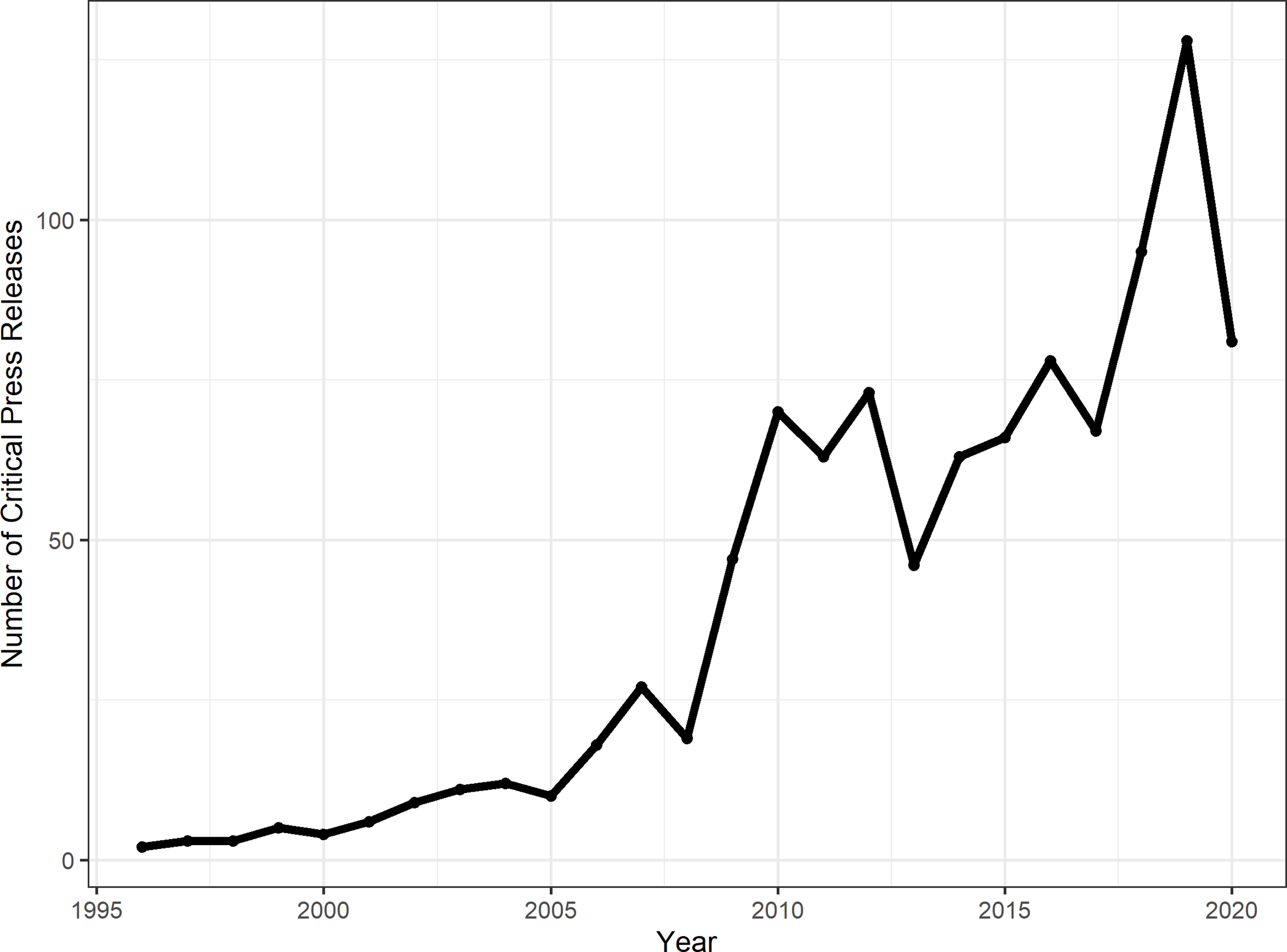
Figure 1 illustrates the evolution of critical press releases from 1996, the start year of our empirical analysis.Footnote 6 Between 1996 and 2020, the Commission issued 1,006 critical press releases, with considerable variation in the countries targeted (see Figure A.1 in the appendix).Footnote 7
Total number of critical press releases (1996–2020).

In the sections that follow, we evaluate the theory using original data on press releases and local NGOs’ interactions with the Commission. Our argument implies that the IACHR should be more likely to issue critical press releases when it has more established ties to local NGOs that can provide timely, mandate-aligned information. We focus on local NGOs because, although international NGOs are well-positioned to sustain a presence near international fora, they often lack the direct, on-the-ground access that is especially valuable for identifying and contextualizing time-sensitive developments.
We therefore test two hypotheses. The first captures the core implication that greater engagement with local NGOs increases the likelihood of criticism:
Hypothesis 1 The Inter-American Commission on Human Rights is more likely to issue press releases criticizing a country when it has established ties with a greater number of NGOs from that country.
The second hypothesis captures issue specificity. Because NGOs’ ability to supply mandate-aligned information depends in part on their domain expertise, we expect that ties matter most for the topics on which NGOs specialize:
Hypothesis 2 The Inter-American Commission on Human Rights is more likely to issue press releases criticizing a country on a particular topic when it has established ties with a greater number of NGOs from that country that have expertise on that topic.
These expectations are conditional on the presence of sufficient civic space for local NGOs to collect information and engage the Commission. To evaluate the argument, we employ a multi-method design in which each empirical component targets a distinct element of the theory. First, the quantitative observational analysis tests the central implication: whether the IACHR is more likely to issue a critical press release about a country (and a country-topic pair) when it has more ties to local NGOs. These models establish the basic association and assess its robustness across specifications, controls, and alternative operationalizations.
Second, an instrumental variable strategy addresses potential endogeneity in local NGO ties to the Commission. By leveraging geographic features of transnational advocacy in the region as a source of plausibly exogenous variation, these models assess whether the observed association is consistent with a causal effect of NGO information provision rather than reverse causality or omitted variables. Third, the text analysis evaluates press release content, assessing whether ties to local NGOs are associated not only with the likelihood of criticism but also with its intensity.
Finally, qualitative evidence illustrates the mechanism through which local NGOs become perceived as reliable information suppliers and how their information enters the press release-making process. We draw on semi-structured interviewsFootnote 8 and publicly available documents to connect the statistical patterns to institutional processes and social interactions. Taken together, the four components jointly test the theory: observational models establish the relationship, the IV strategy provides leverage on causality, the text analysis examines intensity, and qualitative evidence illustrates how trust-based relationships between local NGOs and Commission staff are built and later activated as information channels when the Commission considers issuing critical press releases.
Quantitative Evidence
Data and Variables
We test our theory using an original dataset of press releases issued by the IACHR concerning the thirty-five member states of the OAS between 1996 and 2020.Footnote 9 All press releases were manually coded to identify (a) whether the document was critical, (b) the country targeted, and (c) the human rights topic addressed. To capture issue specificity, we coded up to three human rights issues per press release and then aggregated them into eight broad topic categories. The appendix provides detailed information on the coding process and topic aggregation (see sections A.2 and A.3.1).
Consistent with our hypotheses, we construct two dependent variables. The first is the number of press releases criticizing a given country in a given year (country–year). The second is the number of press releases criticizing a given country on a specific human rights topic in a given year (country–year–topic).
Measuring ties between NGOs and the Commission
Our key explanatory variables capture ties between the Commission and local NGOs. The first measures the number of local NGOs from a given country with which the IACHR has established ties (Hypothesis 1). The second captures ties between the IACHR and local NGOs from a given country that specialize in a particular human rights topic (Hypothesis 2). For example, these variables measure the number of ties between the IACHR bureaucracy and human rights NGOs based in Brazil, as well as the number of ties with Brazilian NGOs with an interest in gender and reproductive rights.
We operationalize NGO–Commission ties using NGOs’ participation in public hearings during the Commission’s regular sessions. Hearings are formal meetings among the IACHR, state representatives, and civil society actors in which participants present and contest information on human rights situations in specific countries or across the region.Footnote 10 Hearings are typically held in person at the Commission’s headquarters in Washington, D.C., or in member states (with exceptions during the pandemic). NGOs and state delegations make formal statements, and information on hearing topics and participants is publicly released by the Commission.
Public hearings provide a suitable measure of NGO–Commission ties for three reasons. First, they are institutionalized interactions that allow NGOs to present detailed, context-specific information directly to Commission staff and Commissioners, thereby demonstrating expertise and mandate alignment. Second, hearings facilitate personal interaction and the exchange of contact information, enabling the development of informal communication channels. Interview evidence confirms that interactions before and after hearings are often as important as the formal session itself for relationship-building.Footnote 11 Third, repeated participation in hearings creates opportunities for trust to develop over time, which is central to our theoretical argument.
To construct our first independent variable, Local NGOs, we coded the headquarters country and country of focus for the 2,656 distinct NGOs that participated in hearings between 1996 and 2020. Of these NGOs, 86 per cent are headquartered in OAS member states. We define local NGOs as organizations that are both based in and focused on a single OAS member state. In total, 55 per cent of all unique NGO participations in hearings (11,324 in total) involve local NGOs. However, only 39.5 per cent of these participations correspond to local NGOs that appeared at least twice in hearings during the two years preceding a given country–year observation, reflecting repeated interaction.
Our measure focuses on the number of local NGOs from each country that participated in at least two hearings related to that country in the two years prior. The requirement of at least two participations captures repeated interaction rather than one-off engagement, while the two-year window reflects both the recency and frequency of contact with Commission staff. To be counted, a local NGO must therefore have participated in hearings sufficiently often and recently to plausibly be familiar to the bureaucrats involved in drafting press releases at the time of publication.
The second independent variable, Local NGOs by topic, extends this logic to issue areas. It records the number of local NGOs that participated in at least two hearings on a given country–topic combination in the two preceding years. This measure captures whether the Commission has established ties with NGOs that possess relevant domain expertise for a particular human rights area.
Alternative explanations and control variables
A potential concern is that the severity of the human rights situation on the ground drives both NGOs’ participation in hearings and the Commission’s decision to issue press releases, rather than NGOs serving as information conduits between events and criticism. Several features of the institutional process make this alternative explanation unlikely. Hearings occur only twice a year and require NGOs to request participation well in advance, whereas press releases allow the Commission to respond rapidly to unfolding events throughout the year.Footnote 12
In contrast, press releases frequently address events that occurred hours or days before publication, such as ‘IACHR condemns murder of gay teenager in Brazil’ (Inter-American Commission on Human Rights 2012) or ‘IACHR condemns acts of violence in Peruvian prisons’ (Inter-American Commission on Human Rights 2020). This temporal mismatch suggests that hearings do not simply respond to the same immediate events as press releases. Instead, our argument is that information and relationships developed through hearings enable NGOs to subsequently alert the Commission to urgent developments through informal channels. Interview evidence supports this interpretation, indicating that Commission staff primarily use hearings to assess broader patterns and structural human rights concerns, rather than to respond to discrete events.Footnote 13
We nevertheless account for this alternative explanation by including a latent measure of repression. The variable Human rights captures the incidence of government repression in each country–year (Fariss et al. Reference Fariss, Kenwick and Reuning2020).Footnote 14 We also conduct additional tests in Appendix Section A.5, which show that variation in human rights conditions is not significantly correlated with the number of topic-specific press releases issued by the IACHR.
Secondly, we control for the strength of civil society using the civil society participation index (CSO part.) (Coppedge et al. Reference Coppedge, Gerring, Knutsen, Lindberg, Teorell, Altman, Bernhard, Fish, Glynn, Hicken, Lührmann, Marquardt, McMann, Paxton, Pemstein, Seim, Sigman, Skaaning, Staton, Wilson, Cornell, Gastaldi, Gjerløw, Ilchenko, Krusell, Maxwell, Mechkova, Medzihorsky, Pernes, von Römer, Stepanova, Sundström, Tzelgov, Wang, Wig and Ziblatt2019). The expected relationship between this variable and critical press releases is theoretically ambiguous. On the one hand, a robust civil society may be associated with better human rights practices, in which case higher values of this index should correspond to fewer critical press releases. On the other hand, greater civil society participation may increase the visibility of violations by producing and disseminating more information, potentially making the Commission more reactive to those situations. Importantly, this variable also allows us to test another alternative explanation: that the mere presence of civil society is sufficient to trigger criticism. By controlling for overall civil society participation, we isolate the effect of NGO *ties* to the Commission, rather than the volume of information produced in a country more generally.
Thirdly, we account for the possibility that the Commission relies on media reporting when deciding whether to issue press releases. To control for media-driven attention, we include a measure of Media coverage, constructed by scraping articles published by the New York Times that mention a given country and the term ‘human rights violations’ in a given year. If media reporting shapes Commission behavior, greater coverage should be associated with a higher likelihood of critical press releases.
We further include controls capturing institutional and geopolitical dynamics that may bias the Commission’s decisions. The variable Commissioner accounts for whether a country has a national serving as a Commissioner, addressing the possibility that Commissioners may be less inclined to criticize their home countries (Posner and De Figueiredo Reference Posner and De Figueiredo2005). We also account for variation in decision-makers’ priorities within the IACHR. Commissioners oversee both country and thematic rapporteurships, which may shape the organization’s focus across issues and countries. To capture this, we include IACHR interest, measured as the number of meetings held by rapporteurs with government actors in a given country–year. This variable proxies the attention and priorities of the Commission’s leadership, drawing on rapporteurs’ discretionary activities as reported in the Commission’s annual reports.Footnote 15
Finally, we consider the potential influence of powerful principals, focusing on the United States as a major financial contributor to the Commission.Footnote 16 This dependence raises the possibility that the Commission may strategically target states less aligned with US interests (Terman Reference Terman2023). To address this concern, we include Geopolitics, a measure of each OAS country’s alignment with the United States based on inverted UN ideal point distances (Bailey et al. Reference Bailey, Strezhnev and Voeten2014), with the United States assigned the maximum affinity score.
We also control for country characteristics commonly associated with repression and international scrutiny (Poe and Tate Reference Poe and Neal Tate1994), including political regime type (Democracy), GDP per capita (GDP pc),Footnote 17 population size,Footnote 18 and the number of Inter-American human rights treaties ratified by each country. All models include country and year fixed effects, and we report robust standard errors clustered by country.
OLS Results
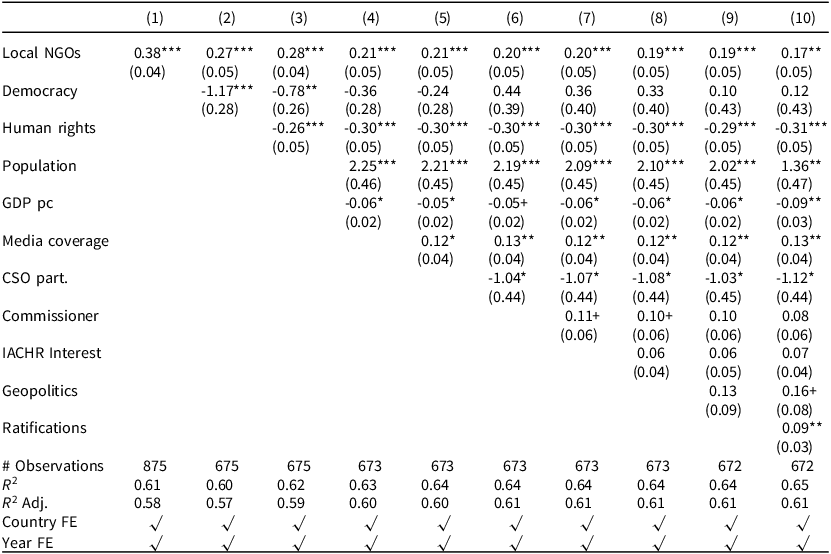
Table 1 presents the results of ordinary least squares (OLS) regression models predicting the number of condemnatory press releases issued by the IACHR. Both the dependent variable and Local NGOs are logged to account for skewed distributions and potential non-linear relationships. Model 1 includes only Local NGOs along with country and year fixed effects. Model 2 adds Democracy, and Model 3 further includes Human rights. Model 4 incorporates Population and GDP pc, Model 5 adds Media coverage, and Model 6 controls for CSO part. Models 7, 8, and 9 sequentially introduce indicators for the presence of a national Commissioner, the Commission’s interest in the country, and political affinity with the United States. Model 10 adds the total number of regional human rights treaties ratified by a country in a given year.
OLS regressions to predict the adoption of critical press releases about a given country

Table 1. Long description
A table with 10 columns and 18 rows presenting regression results. The columns are labeled (1) to (10), representing different models. The rows include Local NGOs, Int. NGOs, Local NGOs (1), Democracy, Human rights, Population, GDP pc, Media coverage, CSO part., Commissioner, IACHR interest, Geopolitics, Ratifications, # Observations, R^2, R^2 Adj., Country FE, and Year FE. Each cell contains regression coefficients with standard errors in parentheses. Notable trends include significant coefficients for Local NGOs, Human rights, Population, and Media coverage across various models.
+p < 0.1, *p < 0.05, **p < 0.01, ***p < 0.001.
Robust standard errors are clustered by country.
Across all specifications, the number of local NGOs that participated in hearings about a country in the previous two years is positively and statistically significantly associated with the number of critical press releases issued about that country. The coefficient on Local NGOs remains stable in sign and significance as additional controls are introduced, providing strong support for Hypothesis 1. Substantively, countries whose local NGOs are more connected to the Commission are more likely to be publicly criticized.
Turning to the control variables, Democracy takes the expected negative sign in several specifications, but its effect is statistically significant in only two models, suggesting no robust relationship between regime type and the likelihood of criticism. By contrast, Human rights is consistently and significantly associated with critical press releases: worse human rights practices are linked to more frequent public condemnation by the Commission. Countries with lower GDP per capita and larger populations also tend to receive more critical press releases.
Media coverage is positively and significantly correlated with criticism across specifications, indicating that the Commission is more likely to issue press releases concerning countries that receive greater international media attention. Lower levels of civil society participation (CSO part.) are likewise associated with more critical press releases, consistent with the interpretation that the Commission is more active in contexts characterized by weaker domestic civic space.
The presence of a national Commissioner (Commissioner) is positively associated with criticism, suggesting greater scrutiny of countries represented within the Commission, although this effect does not reach conventional levels of statistical significance. The Commission’s interest in a country (IACHR interest) is not significantly related to the outcome. Political alignment with the United States (Geopolitics) is positively correlated with the dependent variable, although at low levels of statistical significance. Finally, the number of regional human rights treaties ratified by a country (Ratifications) is positively and significantly associated with critical press releases, indicating that states further embedded in the regional legal framework are more frequently subject to public scrutiny.
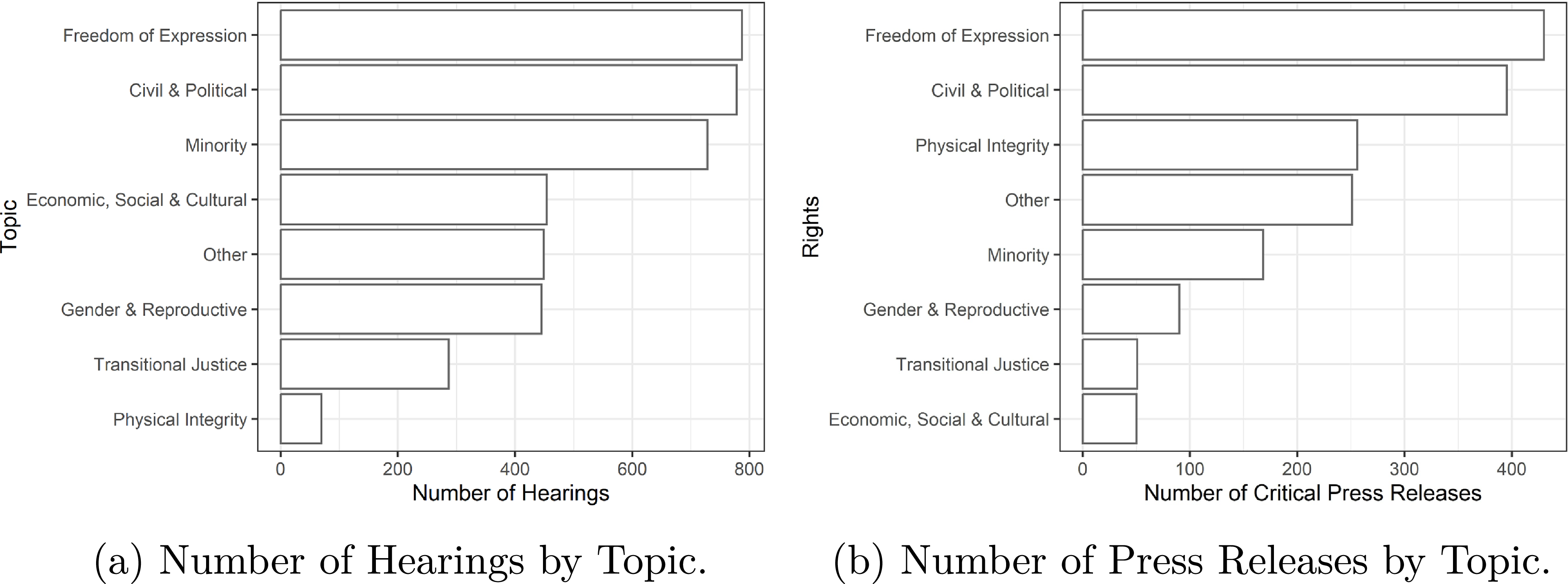
Hypothesis 2 poses a more demanding test of our theory. If correct, the Commission should be more likely to criticize a country on specific human rights topics when more local NGOs from that country that are active in those issue areas, have established ties with the Commission. To test this expectation, we classified all hearings and press releases issued by the IACHR into eight broad human rights topics. Figure 2(a) and (b) display the distribution of hearings and critical press releases across these categories. Section A.3.1 in the appendix details the coding decisions and the issues included in each topic.
Distribution of variables by topic (1996–2020).

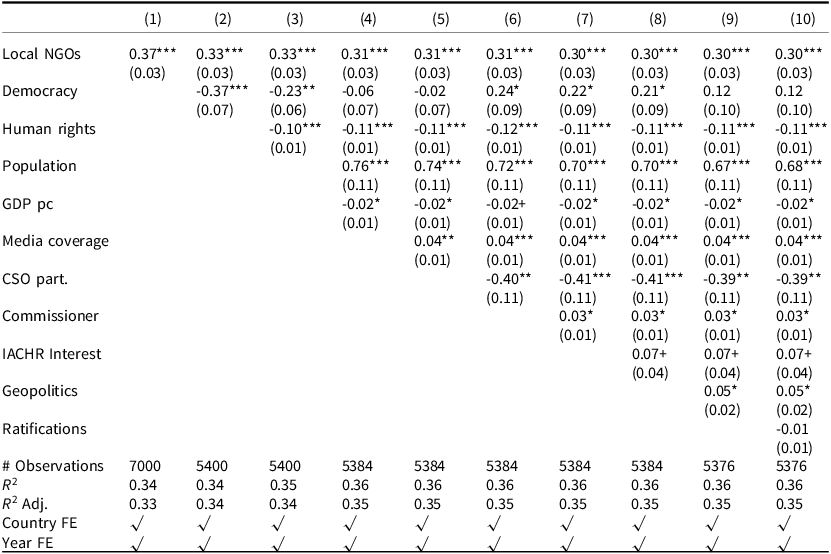
We then estimated a set of linear models predicting the number of press releases criticizing a country on a given topic as a function of the number of local NGOs that participated in at least two hearings on the same country–topic combination in the previous two years. All models include the full set of control variables used in the baseline analysis, as well as country, year, and topic fixed effects. Robust standard errors are clustered by country. The results are reported in Table 2.
Linear models to predict the number of negative press releases about a country on a given topic

Table 2. Long description
A table with 10 columns and 18 rows, showing the results of linear models predicting the number of negative press releases about a country on a given topic. The columns are labeled with numbers from 1 to 10. The rows include variables such as Local NGOs, Int. NGOs, Local NGOs (1), Democracy, Human rights, Population, GDP pc, Media coverage, CSO part., Commissioner, IACHR interest, Geopolitics, and Ratifications. Each row contains values with standard errors in parentheses. The table also includes the number of observations, R-squared values, and fixed effects for country, year, and topic. Row 1: Local NGOs, 0.37 (0.03), 0.30 (0.03), 0.30 (0.03), 0.28 (0.03), 0.28 (0.03), 0.28 (0.03), 0.27 (0.03), 0.27 (0.03), 0.27 (0.03). Row 2: Int. NGOs, 0.08 (0.10), 0.09 (0.10), 0.08 (0.10), 0.08 (0.10), 0.09 (0.10), 0.09 (0.10), 0.08 (0.10), 0.09 (0.10), 0.09 (0.10). Row 3: Local NGOs (1), 0.05 (0.02), 0.05 (0.02), 0.05 (0.02), 0.05 (0.02), 0.04 (0.02), 0.04 (0.02), 0.04 (0.02), 0.04 (0.02), 0.04 (0.02). Row 4: Democracy, -0.37 (0.07), -0.23 (0.07), -0.06 (0.07), -0.02 (0.07), 0.24 (0.09), 0.21 (0.09), 0.21 (0.09), 0.12 (0.10), 0.12 (0.10). Row 5: Human rights, -0.10 (0.01), -0.11 (0.01), -0.11 (0.01), -0.11 (0.01), -0.11 (0.01), -0.11 (0.01), -0.11 (0.01), -0.11 (0.01), -0.11 (0.01). Row 6: Population, 0.75 (0.11), 0.74 (0.11), 0.72 (0.11), 0.69 (0.11), 0.69 (0.11), 0.69 (0.11), 0.66 (0.11), 0.66 (0.11), 0.66 (0.11). Row 7: GDP pc, -0.02 (0.01), -0.02 (0.01), -0.02 (0.01), -0.02 (0.01), -0.02 (0.01), -0.02 (0.01), -0.02 (0.01), -0.02 (0.01), -0.02 (0.01). Row 8: Media coverage, 0.03 (0.01), 0.04 (0.01), 0.04 (0.01), 0.04 (0.01), 0.04 (0.01), 0.04 (0.01), 0.04 (0.01), 0.04 (0.01), 0.04 (0.01). Row 9: CSO part., -0.39 (0.11), -0.40 (0.11), -0.40 (0.11), -0.38 (0.11), -0.38 (0.11). Row 10: Commissioner, 0.03 (0.01), 0.03 (0.01), 0.03 (0.01), 0.03 (0.01), 0.03 (0.01). Row 11: IACHR interest, 0.07 (0.04), 0.07 (0.04), 0.07 (0.04). Row 12: Geopolitics, 0.05 (0.02), 0.05 (0.02). Row 13: Ratifications, -0.01 (0.01). The table also includes the number of observations (ranging from 5376 to 7000), R-squared values (ranging from 0.34 to 0.36), and fixed effects for country, year, and topic (all 2713).
+p < 0.1, *p < 0.05, **p < 0.01, ***p < 0.001.
Robust standard errors are clustered by country.
Consistent with our theoretical expectations, the results indicate that the Commission is more likely to issue critical press releases on topics around which local NGOs have built relationships with the Commission through repeated participation in hearings. These findings reinforce the interpretation that hearings serve as venues for relationship-building, which local NGOs later activate when relevant events occur on the ground. The control variables behave similarly to those in the country-level models.
We assess the robustness of these findings in several ways. First, we re-estimate the models using hierarchical specifications. Second, we adopt a more stringent threshold for our main explanatory variable, counting only local NGOs that participated in at least three hearings in the previous two years. The results remain consistent with our argument and are reported in Table A.5 and Appendix Section A.10.
To further probe the scope of our argument, we examine whether repeated participation in hearings by international NGOs, such as Human Rights Watch or Amnesty International, similarly increases the likelihood of criticism. This test allows us to distinguish between familiarity with the Commission and access to local, context-specific knowledge. While international NGOs may develop considerable familiarity with Commission staff through repeated interaction, they typically lack the on-the-ground presence of local NGOs. Consistent with our expectations, repeated participation by international NGOs is not positively or statistically significantly associated with critical press releases. This finding suggests that repeated interaction alone is insufficient; influence depends on the combination of familiarity and local expertise. Full results are presented in Appendix Section A.12.
Instrumental Variable Approach
The results so far indicate a strong association between local NGOs’ participation in hearings and criticism by the IACHR. However, this relationship may be confounded by unobserved factors that jointly affect NGOs’ engagement with the Commission and the Commission’s propensity to issue critical press releases. To address this concern, we employ an instrumental variable (IV) approach. Specifically, we instrument Local NGOs using the number of local NGOs from neighboring countries (that is, countries that share a border) that participated in IACHR hearings on a given topic.
The relevance of this instrument rests on three considerations. First, NGOs operate within regional advocacy networks that organize around specific issue areas. These networks facilitate cross-border co-ordination and often encourage NGOs in neighboring countries with similar expertise to participate in IACHR hearings on the same topic.
Second, issue specialization reinforces these dynamics: when NGOs in one country engage the Commission on a particular topic, they often mobilize counterpart organizations in neighboring countries to contribute to a co-ordinated regional intervention.
Third, participation in international hearings involves logistical, informational, and financial barriers. NGOs from neighboring countries can lower these barriers by sharing procedural knowledge, offering strategic advice, and facilitating contacts with the Commission, thereby increasing the likelihood of local NGO participation.
Operationally, we calculate – for each country, year, and topic – the number of local NGOs based in neighboring OAS member states that participated in at least two hearings concerning their own countries on that topic in the previous two years. For example, in 2015–16, nineteen local NGOs participated at least twice in hearings related to gender and reproductive rights: three from Argentina, nine from Mexico, and seven from Brazil. For Uruguay in 2017, this yields an instrument value of ten (three Argentine and seven Brazilian NGOs), while for Chile in the same year and topic the value is three.
This measure captures regional patterns of NGO engagement that are plausibly related to local NGOs’ participation in hearings but unlikely to directly influence criticism of a specific country. We argue that NGOs based in neighboring countries are not reliable information suppliers about events in another country, as they typically lack sustained on-the-ground access, contextual knowledge, and the organizational capacity to follow up with the Commission when urgent developments arise.
A potential violation of the exclusion restriction is that the instrument may proxy for the overall salience of a topic at the regional level, which could independently affect the likelihood of criticism. To address this concern, we conduct placebo tests examining whether NGO participation in region-wide, topic-only hearings predicts either (a) local NGO participation in country-specific hearings on the same topic or (b) the total number of critical press releases issued on that topic. As reported in Appendix Section A.9, we find no evidence that regional topic salience, measured in this way, predicts country-level criticism. This supports the validity of the instrument.
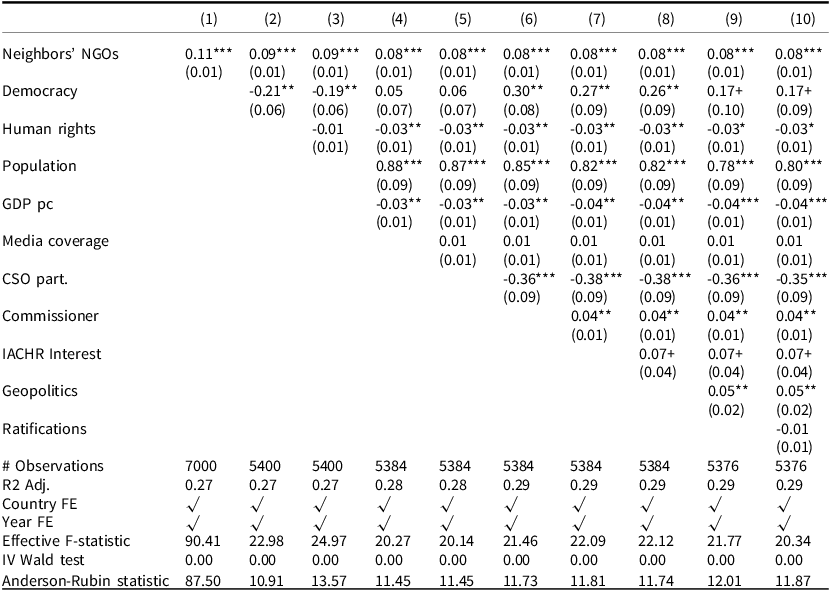
We include the full set of control variables, along with country, year, and topic fixed effects. Results from the first stage of the instrumental variable design are presented in Table 3. The instrument is statistically significant at the α = 0.001 level and performs as expected. The positive coefficient on Neighbors’ NGOs indicates that greater participation by NGOs from neighboring countries is associated with increased participation by NGOs from the focal country in IACHR hearings.
First-stage regression to predict the number of NGOs participating in hearings

Table 3. Long description
The table presents regression results for predicting the number of NGOs participating in hearings. It includes ten columns labeled (1) to (10) and several rows with different variables. Each column shows coefficients and standard errors for various factors affecting NGO participation. Key variables include Regional hearings, Democracy, Human rights, Population, GDP per capita, Media coverage, CSO participation, Commissioner, IACHR interest, Geopolitics, and Ratifications. The table also lists the number of observations, country fixed effects, and year fixed effects. Notable trends include significant positive coefficients for Population and significant negative coefficients for CSO participation and GDP per capita.
+p < 0.1, *p < 0.05, **p < 0.01, ***p < 0.001.
Robust standard errors are clustered by country.
Following Andrews et al. (Reference Andrews, Stock and Sun2019), we assess the strength of the instrument using multiple diagnostics. We report the effective F-statistic, the Wald test, and the Anderson–Rubin test. Across all specifications, these tests indicate a strong instrument: the lowest effective F-statistic is 20, the Wald test rejects weak identification at conventional levels, and the lowest Anderson–Rubin statistic is 11.87. Together, these results suggest that the instrument explains substantial variation in the endogenous explanatory variable.
All covariates that may plausibly influence the Commission’s decision to criticize a country are included in the first-stage regression. Participation by local NGOs is higher when NGOs from neighboring countries are also active in IACHR hearings, a relationship that is robust across specifications. Local NGO participation is also higher in countries with worse human rights conditions, weaker civil society, the presence of a Commissioner from the home country, and closer geopolitical alignment with the United States. As expected, countries with larger populations also exhibit greater NGO participation in hearings. All remaining controls do not reach conventional levels of statistical significance.
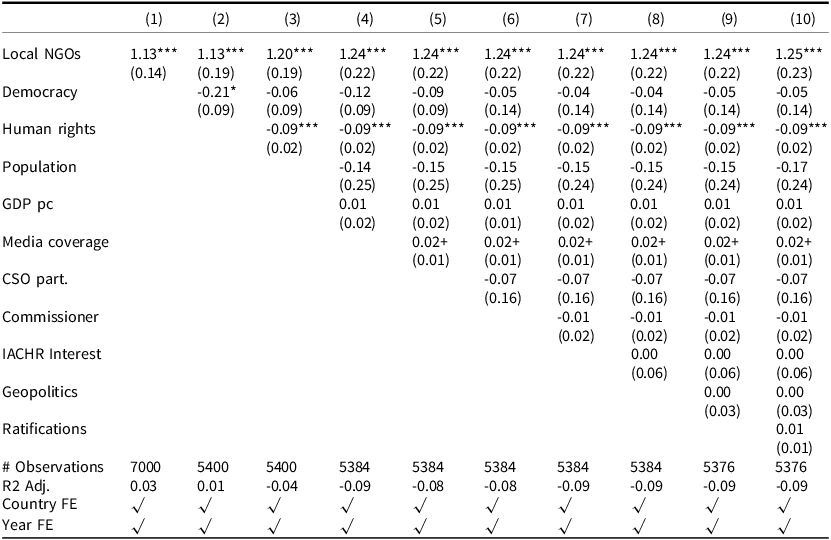
We now turn to the second stage of the instrumental variable analysis, which estimates the effect of local NGOs’ interactions with the Commission on the likelihood of public criticism. Results are presented in Table 4. The instrumented measure of local NGO participation is consistently and positively associated with the number of critical press releases issued by the Commission. This relationship is statistically significant at the α = 0.001 level across all model specifications and remains robust to the inclusion of the full set of controls. Substantively, these results indicate that the more ties the IACHR has with local NGOs operating in a given country and issue area, the more likely it is to issue critical public statements concerning that country and topic.
Second-stage regression to predict the number of negative press releases against a country on a specific topic

Table 4. Long description
The table presents second-stage regression results to predict the number of negative press releases against a country on a specific topic. It includes nine columns labeled (1) to (9) and multiple rows with different variables. Key variables include Local NGOs, Int. NGOs, Local NGOs (1), Democracy, Human rights, Population, GDP pc, Media coverage, CSO part., Commissioner, IACHR interest, Geopolitics, and Ratifications. Each row provides regression coefficients and standard errors for these variables. Notable trends include significant positive associations for Local NGOs and significant negative associations for Human rights across all columns. The table also includes the number of observations and fixed effects for countries, years, and country-year combinations.
+p < 0.1, *p < 0.05, **p < 0.01, ***p < 0.001.
Robust standard errors are clustered by country.
Among the control variables, the general human rights situation is the only factor that consistently predicts criticism: worse conditions are associated with a higher likelihood of condemnatory press releases. Media coverage is positively correlated with criticism at the α = 0.1 level. All other controls yield statistically insignificant coefficients.
Finally, we conduct a series of robustness checks to assess the sensitivity of our results to unobserved confounding. These include alternative model specifications and alternative operationalizations of the key independent variable. In addition, we perform a formal sensitivity analysis following Hazlett and Parente (Reference Hazlett and Parente2023). As reported in Appendix Section A.8, even unobserved confounders with strength comparable to benchmark covariates would be insufficient to overturn our core findings. This provides further evidence that the estimated relationship between local NGO ties and IO criticism is robust to hidden bias.
Text Analysis
The analyses above focus on whether ties between local NGOs and the IACHR are associated with a greater propensity of the Commission to issue critical press releases. Our theory also has implications for how the Commission criticizes states. Beyond expanding access to specific, actionable, and verifiable information, ties to local NGOs should enable the Commission to articulate criticism in a more precise, targeted, and substantively grounded manner. When information is detailed and credible, the Commission is better positioned to substantiate its claims and express criticism more forcefully. From this perspective, variation in the language of press releases provides an additional observable implication of the theory. If local NGOs supply credible evidence that informs the Commission’s assessment of country conditions, this information should shape not only the decision to criticize but also the intensity of that criticism.
This generates the expectation that criticism informed by local sources will be more negative in tone. While our theory does not require shifts in rhetorical intensity for criticism to occur, variation in tone provides a useful indicator of whether the Commission is drawing on detailed and credible information when crafting its statements. In this sense, sentiment analysis offers an additional behavioral measure of the underlying informational mechanism, consistent with existing work on variation in IO shaming practices (Squatrito et al. Reference Squatrito, Lundgren and Sommerer2019).
To evaluate these expectations, we conduct a sentiment analysis of all IACHR press releases using an adapted version of the AFINN lexicon (Nielsen Reference Nielsen2011).Footnote 19 Details on the lexicon, illustrative examples, and descriptive statistics are provided in Appendix Section A.11.2. For each press release, we generate a continuous measure of negative language by summing the lexicon scores of all words in the text. We then aggregate sentiment scores at the country–year level and at the country–topic–year level. Country–years in which no press release was issued are coded as zero, indicating neutral language.
To assess whether rhetorical intensity varies with the Commission’s informational environment, we relate sentiment scores to differences in the strength of ties between the Commission and local NGOs. Tables A.12 and A.13 in the appendix replicate the main regression specifications, replacing the dependent variable with our measure of negative sentiment. The results show that press releases issued following higher levels of interaction with local NGOs are systematically more negative in tone. Substantively, press releases issued after two years of repeated interactions with local NGOs score, on average, 30–35 points more negative on the polarity scale (Models 1–4), corresponding to a 15–17 per cent increase in negative sentiment (Models 5–8). This evidence reinforces the interpretation of our main findings, suggesting that ties to local NGOs shape not only whether the Commission criticizes states, but also how sharply it does so.
Qualitative Evidence on the Causal Mechanism
This section provides qualitative evidence illustrating the mechanisms through which NGOs become reliable information suppliers to IOs and how this, in turn, shapes the Commission’s decisions to criticize states through press releases. Rather than testing causal effects, the qualitative material traces the processes underlying our statistical results. We organize the evidence around the steps of the causal mechanism outlined above: (1) formal interactions create opportunities for contact; (2) repeated interactions foster personal relationships and informal communication channels; (3) IO bureaucrats assess NGOs’ expertise and reliability, developing trust; (4) trusted NGOs supply information when critical events occur; and (5) this information enables public criticism.
From Formal Interaction to Informal Channels
We begin with evidence on the first two steps of the mechanism: how formal interactions generate opportunities for contact and how repeated interactions foster personal relationships and informal channels of communication. Reliability, in this account, develops through sustained personal interaction between IACHR staff and NGO representatives.
Longstanding relationships often emerge through the Commission’s system of individual petitions. NGOs representing victims file many cases before the IACHR, supply evidence of violations, and periodically monitor states’ compliance with reparations (Montal and Pauselli Reference Montal and Pauselli2023). Because petition proceedings unfold over several years, NGO representatives and Commission staff interact repeatedly, gradually developing interpersonal familiarity.
Promotional activities – especially public hearings – also play a central role. Hearings provide structured opportunities for NGOs to present information, but they also generate informal encounters that extend beyond the formal agenda. As one Commission staffer explained:
During a hearing, you collect the emails of the people who are there, talk to them, and let them know that they can contact you about anything. That’s how you start to establish a connection. We did that several times; you message the person who was at the hearing, you keep following up, and that’s how you stay in touch.Footnote 20
NGO representatives emphasize that much of the relationship-building occurs outside the hearing room. As one put it, ‘It’s not just about the hearing; it’s also about what you discuss in the hallway before, the coffee you have afterward, the side meetings’.Footnote 21
Both NGO representatives and Commission staff stressed that trust must be continually renewed, particularly when personnel change. Commissioners serve limited terms, and staff turnover requires relationships to be rebuilt:
Every time there’s a change in Commissioners, it’s essential to sit down at the table and get to know each other … That takes time. These individuals are there for four years, maybe eight. It became complicated during the pandemic with the virtual format. That’s why we needed to attend the March [2023] session in Los Angeles, where we had an important hearing, but it was crucial because we were going to talk to people, have those hallway conversations, have a drink with someone we met at the bar.Footnote 22
Information Reliability and the Limits of State and Media Sources
A necessary condition for the mechanism to operate is that IO bureaucrats care about the reliability of the information they act on. The IACHR gathers information through multiple channels, including country visits, which offer mandate-aligned and highly reliable evidence. However, visits require state consentFootnote 23 and substantial resources, limiting their frequency. Between 2010 and 2020, the Commission conducted thirty-two visits across seventeen countries.Footnote 24
As a result, the Commission relies heavily on external sources. Interviews reveal acute awareness of the risks associated with acting on unreliable information. One staffer explained:
If you are an independent body, there is no way to trust 100 per cent other than through direct observation … what we can establish is a threshold [of reliability].Footnote 25
Press releases are particularly sensitive. States often contest them publicly, prompting the Commission to adopt informal verification procedures.Footnote 26 According to a government official, states may be given a brief opportunity to provide corrective information before publication.Footnote 27 Commissioners, in turn, frequently demand additional corroboration before approving critical statements.Footnote 28
Information from states is viewed with caution. As one staffer put it, ‘the information that the state provides voluntarily is about the good things it is doing’.Footnote 29 Media sources play a role in monitoring but are rarely sufficient on their own.Footnote 30
Media coverage can alert the Commission to potentially concerning situations, but it rarely provides information in a form that is directly actionable for public criticism. As one Commission staffer responsible for monitoring explained, ‘you can’t just rely on what is in the media’. Describing a press release condemning the deaths of children during police raids in Brazil, the same staffer noted that they ‘initially gathered information from the media. However, we then turned to an organization that collects data with a methodology to identify these cases … we rely on these data because we have more confidence in them due to their source’.Footnote 31
Trusted NGOs as Information Providers
Against this background, NGOs with established ties to the Commission emerge as critical information suppliers. Interviews consistently indicate that press releases are most likely when civil society actively engages the Commission with specific, well-documented concerns.Footnote 32 In the absence of such ties, issuing a press release becomes considerably more difficult:
We [at the Commission] knew there were issues in Trinidad and Tobago with Venezuelan migrants, but we didn’t have civil society sending us that information. Making a statement with confidence was challenging.Footnote 33
NGOs often go beyond reporting facts, explaining why a press release would be timely or consequential in a given context. As one NGO representative noted, ‘The Commission needs to understand the impact a press release can have; why doing it now matters’.Footnote 34
These exchanges are highly personalized. NGOs described initial conversations followed by detailed documentary submissions, emphasizing that ‘trust is key to having that first political conversation’.Footnote 35 Several interviewees mentioned sharing urgent information via WhatsApp, a communication channel that requires access to someone’s personal phone number.Footnote 36 Commission staff acknowledged that familiarity shapes responsiveness:
It can happen that one reacts more to those they trust more … there were organizations with whom we had closer relationships, and for that reason things moved faster.Footnote 37
We illustrate the full causal mechanism by looking at the publication of a press release on 20 June 2023 condemning the excessive use of force against demonstrators in Jujuy, Argentina.Footnote 38 The press release followed widespread protests triggered by the decision of Jujuy’s governor, Gerardo Morales, to revise the provincial constitution, a move that prompted sustained mobilization by diverse groups, including indigenous communities.
As protests unfolded between 17 and 19 June, Argentine media outlets reported extensively on demonstrations and police repression. A review of articles containing the keywords ‘Jujuy’ and ‘Morales’ published by the five largest national news outlets during this period identified thirty-eight articles covering the protests and the use of force.Footnote 39 This corpus captures the universe of available public information before the Commission issued its statement and provides a baseline for evaluating whether media reporting alone can account for the content of the press release.
While media accounts documented clashes and repression, they offered uneven and incomplete detail. Several elements emphasized in the Commission’s press release – such as the detention of journalists and the severity of specific injuries – received little or inconsistent coverage. Notably, the arrest of two journalists mentioned by the Commission appeared in only one media report and was primarily publicized by a civil society organization, the Foro de Periodismo Argentino (FOPEA). Similarly, information about a teenager who lost an eye, which the Commission highlighted, appeared in only two articles, one of which relied on testimony from a lawyer connected to Jujuy-based NGOs and two national NGOs with a sustained advocacy presence before the IACHR: the Centro de Estudios Legales y Sociales and the Asociación Civil por la Igualdad y la Justicia.
At the same time, some allegations that circulated in the media – such as claims regarding the disappearance of protesters – did not appear in the Commission’s press release. These claims originated with local lawyers who lacked organizational ties to the Commission, suggesting selective uptake rather than wholesale reliance on media narratives.
Interviews with Argentine NGOs confirm that organizations that regularly participate in hearings and have established ties to the Commission actively transmitted information during the Jujuy protests. One interviewee described how their organization shared documentation with the Commission: ‘we sent [to the IACHR] a lot of materials regarding local complaints, cases, testimonies, and we achieved a statement from the Commission that was very good. […] The key was that [we] compiled clear, well-sourced, objective, and organized information. We didn’t exaggerate anything but presented the patterns reliably’.Footnote 40 Another interviewee explained that they contacted the Commission to assist with fact assessment, noting that ‘these are informal channels of the Commission and we are not the only ones to do this’.Footnote 41
Taken together, the sequence suggests a pattern consistent with our mechanism. Media reporting signaled a developing crisis, but trusted NGOs – drawing on prior relationships with the Commission – supplied curated, methodologically grounded, and mandate-relevant information through informal channels. This information appears to have shaped both the specificity and selectivity of the Commission’s public criticism. While this evidence is necessarily circumstantial, it illustrates how established relationships with local NGOs can transform diffuse public signals into actionable information, enabling the Commission to issue timely and substantively grounded press releases.
Conclusion
This article explains when and why international organizations (IOs) publicly criticize states. Existing accounts emphasize incentives and constraints such as mandates, power, delegation, and bureaucratic mission, but pay less attention to whether IOs have the informational capacity to act, even when they have reasons to do so. We argue that public criticism depends on access to mandate-aligned and reliable information, and that IOs obtain such information through social ties with local non-governmental organizations (NGOs). Repeated interaction transforms unfamiliar NGOs into trusted interlocutors. Those relationships then function as conduits for timely, verifiable information when events unfold, reducing uncertainty and reputational risk and making critical press releases more likely.
We test this theory using the IACHR and its practice of issuing critical press releases. Our empirical strategy combined statistical analyses of original data on IACHR press releases and NGO participation in public hearings, an instrumental variable design to address endogeneity concerns, and text analysis to assess whether ties correspond to sharper rhetorical intensity. We complemented these analyses with qualitative evidence from interviews and documentary materials that illustrate the causal mechanism. Across approaches, the evidence supports the theory: the more local NGOs with established ties to the Commission in a given country and topic, the more criticism the IACHR directs at that country on that topic, and the more negative the language of its public statements.
The analysis makes three contributions. First, we developed a relational theory of IO public action centered on social ties, specifying how trust and familiarity condition the translation of external information into discretionary organizational outputs. Second, we explained variation in IO public criticism by linking credibility to information sources: IOs do not simply act when they have incentives to do so, but when they can do so credibly, and credibility depends on trusted informational relationships rather than access alone. Third, we provided new empirical evidence for these claims using a novel dataset of IO press releases combined with interviews that illuminate how trust is built and activated under conditions of imperfect information.
These findings contribute to several literatures. First, they refine theories of IO autonomy by showing that the capacity to engage in public criticism depends not only on mandates, delegation, or insulation, but also on the availability of trusted informational relationships that make such action viable. The latter varies within IOs, over time and across monitored countries, while the former set of factors usually do not. Second, the article advances IO–NGO research by moving beyond access-based and purely functional accounts of information provision, demonstrating that influence depends on relational credibility built through repeated interaction with bureaucrats. Third, the findings speak to naming and shaming scholarship by highlighting the social organization of information flows that make public criticism possible.
The article also suggests different avenues for future research. One question concerns distributional consequences: if IOs rely on trusted local interlocutors, which countries and communities remain informationally peripheral, and how do resource constraints and network position shape whose claims become legible to IO bureaucracies? Future work could also examine whether similar relational mechanisms operate for more formal IO outputs (reports, precautionary measures, or judgments) and in other policy domains characterized by hard-to-observe violations, including corruption, environmental enforcement, or border governance.
Normatively, the argument highlights a tension between legitimacy and informational dependence. Reliance on trusted local sources can improve accuracy and enable timely responses to abuses, but it also implies that public criticism may track relational access rather than underlying need. As a result, the states most likely to engage in serious violations may also be the least likely to face IO criticism when repression, civic space restrictions, or isolation sever the information pipelines that enable accountability. This tension suggests concrete policy implications for IOs seeking to strengthen monitoring while maintaining procedural fairness. Institutional reforms that broaden and diversify civil society engagement – such as systematic outreach to underrepresented contexts, more transparent criteria for incorporating external evidence, and mechanisms to mitigate the effects of staff turnover on informational pipelines – could reduce informational blind spots without lowering reliability thresholds. For NGOs and donors, the findings imply that sustained engagement strategies emphasizing long-term relationship-building and credible documentation may matter as much as episodic advocacy in shaping IO responses.
More broadly, the article highlights that public criticism is not simply an expression of IO will; it is an organizational output conditioned by the social infrastructure of information. Understanding when IOs speak requires attention not only to what they want to say, but also to who they can credibly listen to.
Supplementary material
The supplementary material for this article can be found at https://doi.org/10.1017/S0007123426101719.
Data availability statement
Replication data for this paper can be found at Harvard Dataverse: https://doi.org/10.7910/DVN/ENHRWY.
Acknowledgements
We are grateful to Gary Bass, Erica Chenoweth, Elisha Cohen, Xinyuan Dai, Lucrecia García Iommi, Helen Milner, Francesca Parente, Aníbal Pérez Liñán, Rachel Schoner, James Vreeland, Matt Winters, Deborah Yashar, and participants of the 2022 International Studies Association’s Convention, the 2022 Latin American Studies Association’s Congress, the 2023 American Political Science Association’s Annual Meeting, and Princeton University’s IR Graduate Research Seminar, Latin American Politics Workshop, and Niehaus Fellows’ Workshop for their feedback. We would also like to thank the undergraduate students who worked with us at the Inter-American Human Rights System Lab of Universidad Torcuato di Tella for their most valuable research assistance. All errors remain our own.
Financial support
This research received no specific grant from any funding agency, commercial or not-for-profit sectors.
Competing interests
None.


 Open access

