Congenital heart defects are the most common structural birth defects affecting nearly 8–10 in 1000 live births worldwide, and are associated with significant morbidity and mortality. Among a wide range of aetiologically heterogeneous conditions, conotruncal anomalies account for approximately one-third of all congenital heart defects.Reference Agopian, Mitchell and Glessner 1 A group of severe heart malformations involving the cardiac outflow tract, aortic arch, ductus arteriosus, and proximal pulmonary arteries is seen. Transposition of the great arteries, tetralogy of Fallot, double-outlet right ventricle, persistent truncus arteriosus, and aortic arch anomalies are included in conotruncal heart defects. Both genetic, epigenetic, and environmental factors such as maternal nutrition and lifestyle factors are involved in the complex aetiology of conotruncal heart diseases. Defective folic acid pathway and common variants of folate-metabolising enzymes have been described as potential risk factors for conotruncal heart disease and other congenital anomalies such as neural tube defects. Peri-conceptional folic acid consumption has been shown to reduce the incidence of conotruncal heart disease.Reference Shaw, O’Malley, Wasserman, Tolarova and Lammer 2 Although the protective mechanism of folic acid during cardiac morphogenesis is unclear, it has been thought that the teratogenic effect of folate insufficiency might be related to hyperhomocysteinaemia. Polymorphisms of genes encoding folate-related enzymes such as methylenetetrahydrofolate reductase (MTHFR) and nicotinamide N-methyltransferase (NNMT) have been found to cause hyperhomocysteinaemia, which is associated with conotruncal heart disease.Reference Souto, Blanco-Vaca and Soria 3
The MTHFR gene, located on 1p36.3, encodes one of the main enzymes involved in folic acid metabolism. Its product is a 77 kDa protein, catalysing the conversion of 5,10-methylenetetrahydrofolate into 5- methyltetrahydrofolate, the major circulating form of folate, which is an important precursor in methylation reactions. Changes in MTHFR activity and folate concentration have many effects on different metabolic pathways, including nucleotide balance, DNA and RNA synthesis, DNA repair, and epigenetic changes in DNA. In addition, two coding polymorphisms have been extensively studied and are associated with reduced enzyme activity. The first is C677T (rs1801133) at exon 4, at the folate-binding site, and results in an alanine-to-valine substitution. The other is A1298C (rs1801131) at exon 7 within the plausible S-adenosyl-methinonine regulatory domain and results in a glutamate-to-alanine change.Reference Robien and Ulrich 4 Generally, 677TT genotype is associated with high homocysteine and low folate levels, whereas the A1298C genotype has an unclear effect on them.Reference Storti, Vittorini and Iascone 5 C677T substitution leads to a thermolabile form of MTHFR, reducing its enzyme activity by ~50%.Reference Frosst, Blom and Milos 6 A1298C polymorphism is known to lead to reduced enzyme activity, especially when inherited in trans with the 677T variant.Reference Weisberg, Tran, Christensen, Sibani and Rozen 7
Recently Souto et al determined that a gene mapped at 11q23 has a significant role in homocysteine regulation. This gene encodes the nicotinamide N-methyl transferase (NNMT) enzyme, which is a SAM-dependent methyltransferase, and catalyses the N-methylation of nicotinamide and other pyridines to form pyridimium ions.Reference Lu, Zhu and Wen 8 It was shown that rs694539 polymorphism of the NNMT gene, although it resides in the first intron, is associated with reduced homocysteine concentration, suggesting a regulatory role for transcription.Reference Souto, Blanco-Vaca and Soria 3 , Reference Zhang, Miyaki, Araki, Nakayama and Muramatsu 9
In this study, we aimed to determine whether MTHFR gene C677T and A1298C and NNMT gene rs694539 polymorphisms are associated with the development of conotruncal heart defects.
Materials and methods
A total of 79 patients with echocardiographically proven conotruncal heart defect, 44 males and 35 females (mean age: 3.7±7.6), and 99 echocardiographically proven control subjects, 52 males and 47 females (mean age: 8.7±5.9) were included in the study. We did not screen single gene defects and 22q11.2 deletions as a routine procedure in our subjects. Only infants with suspected single gene disorders were screened and excluded from the study. For each case, anatomical features were confirmed by reviewing echocardiography and cardiac catheterisation. Families of all the participants were informed about the study and they provided their informed consent. DNA samples were isolated from 1 to 2 ml venous blood samples according to the manufacturer’s instructions (Invisorb® Spin DNA Extraction Kit, Stratec Biomedical AG, Birkenfeld, Germany). Polymerase chain reaction restriction fragment length polymorphism reaction for MTHFR gene C677T polymorphism was carried out as described previously.Reference Shrubsole, Gao and Cai 10 Genotyping for MTHFR gene A1298C and NNMT gene rs694539 polymorphisms were carried out using real-time polymerase chain reaction mutation detection/allelic discrimination kit (PrimerDesign® Ltd, Southampton, United Kingdom) as per the manufacturer's instructions.
Statistics
Allele frequencies for each genotype were calculated by the gene counting method. The differences in allele frequencies between groups and deviation from the Hardy–Weinberg equilibrium were determined by the chi-square test. Odds ratios and 95% confidence intervals for both heterozygous and homozygous mutants as well as wild-type genotypes were calculated as a measure of the association between the genotypes and the presence of conotruncal heart disease. Distribution of genotypes among groups and odds ratios were also analysed according to the dominant genetic model, suggesting that MTHFR gene 677T and 1298C and NNMT gene rs694539 A alleles are risk factors for conotruncal heart disease; CT and TT, AC and CC, GA and AA genotypes are pooled. The statistical analyses were carried out using the Statistical Package of Social Science for Windows version 15.00 (SPSS Inc., Chicago, Illinois, United States of America). The values of p<0.05 were considered to be statistically significant.
Results
Patient characteristics
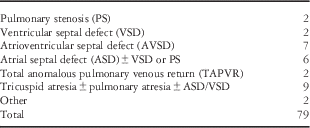
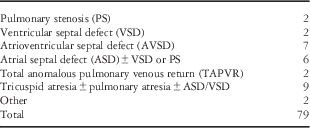
We included 79 patients with conotruncal heart defect, 44 males and 35 females (mean age 3.7±7.6 years), and 99 control individuals without conotruncal heart defect, 52 males and 47 females (mean age 8.7±5.9 years). Clinical characteristics of the patients are given in Table 1.
Clinical characteristics of the patients.
Allele frequencies
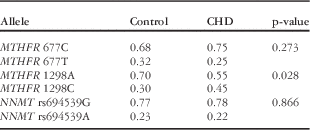
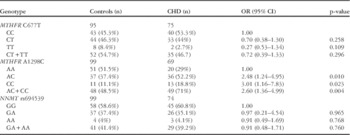
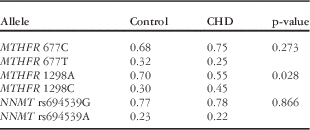
The case group consisted of 79 patients, and the control group consisted of 99 individuals. We were not able to determine MTHFR C677T genotype for four individuals in each group, MTHFR A1298C genotype for 10 individuals, and NNMT rs694539 GA genotype for five individuals in the case group. The allele frequencies for three polymorphisms among the case and control samples are given in Table 2, and the genotype distribution is given in Table 3. All three genotype distributions were in the Hardy–Weinberg equilibrium in each group.
Allele frequencies of the control and coronary heart disease groups and p-values according to the χ2 test.
CHD=congenital heart disease
MTHFR C677T and A1298C and NNMT rs694539 genotype frequencies among controls and coronary heart disease patients.

CHD=congenital heart disease; CI=confidence interval; OR=odds ratio
Allele frequencies were not different between the two groups, except for MTHFR A1298C polymorphism in which the C allele frequency was statistically higher in the case group (0.45 versus 0.30) (p=0.028).
Genotype distribution of the MTHFR A1298C polymorphism showed a statistically significant difference between the two groups. In the case group, AC and CC genotypes were higher than the control group (p<0.05). We have found that MTHFR A1298C polymorphism is associated with conotruncal heart disease; C allele (p=0.028), AC (OR[95%CI]=2.48[1.24–4.95], p=0.010), CC (OR[95% CI]=3.01[1.16–7.83], p=0.023), and AC+CC (OR[95% CI]=2.60[1.36–4.99], p=0.004) genotypes are more frequent in the patient group. Genotype distributions of the MTHFR C677T and NNMT rs694539 polymorphisms were similar in the two groups when evaluated separately and also according to the dominant genetic model (p>0.05).
Discussion
Congenital heart disorders are a heterogeneous group of malformations with a prevalence of 1/100, and conotruncal anomalies account for approximately one-third of all congenital heart defects. They are the most prevalent congenital anomalies and play a significant role in childhood morbidity and mortality. The aetiology of conotruncal heart disease is unclear. Approximately 5–8% of conotruncal heart diseases are attributable to chromosomal abnormalities and 3% to classical gene defects. For the rest, both genetic, epigenetic, and environmental factors such as maternal nutrition and lifestyle factors are plausible causes, implying a complex aetiology.
Hyperhomocysteinaemia is known as a causal factor for conotruncal heart diseases as well as neural tube defects, cleft lip-palate, venous thrombosis, and Alzheimer disease.Reference Souto, Blanco-Vaca and Soria 3 , Reference Verkleij-Hagoort, Bliek, Sayed-Tabatabaei, Ursem, Steegers and Steegers-Theunissen 11 Many genetic factors influence plasma homocysteine levels. Of these, MTHFR gene C677T polymorphism is the most studied, and it accounts for <10% of the variance in plasma homocysteine levels.Reference Kluijtmans, Young and Boreham 12 Recently, the NNMT enzyme was also identified in a genome-wide linkage analysis as a candidate regulator of homocysteine metabolism.Reference Souto, Blanco-Vaca and Soria 3
Conotruncal heart disease primarily result from incomplete embryonic development of the heart during the first 6 weeks of gestation, and it is well known that methylenetetrahydrofolate reductase and folate metabolism are significantly involved in its formation. In this context, we have evaluated the possible association between the MTHFR C677T, A1298C and NNMT rs694539 GA polymorphisms, which are implied in folate metabolism, and the development of conotruncal heart disease through the analysis of 79 conotruncal heart disease patients and 99 control individuals. We have found that MTHFR A1298C polymorphism is associated with conotruncal heart disease; C allele, AC, CC, and AC+CC genotypes are more frequent in the patient group. We can assume that children with C allele have an ~2.5–3-fold increased risk for conotruncal heart disease development; however, allele and genotype frequencies of the MTHFR C677T and NNMT rs694539 GA polymorphisms were not statistically different among patient and control groups (p>0.05) (Tables 2 and 3).
There are many studies analysing the association of MTHFR gene C677T and A1298C polymorphisms with conotruncal heart disease. Although some of them have found an association, their results are contradictory.Reference Gong, Gu and Zhang 13 – Reference Zidan, Rezk and Mohammed 15 When considering the MTHFR gene A1298C polymorphism, several studies have found no association with conotruncal heart disease,Reference Storti, Vittorini and Iascone 5 , Reference Sahiner, Alanay, Alehan, Tuncbilek and Alikasifoglu 16 some studies have found that 1298C allele is protective for conotruncal heart disease.Reference Hobbs, James and Parsian 17 – Reference van Driel, Smedts and Helbing 19 Hobbs et al have suggested three explanations for its protective effect. One is that there may be another undetected functional polymorphism in linkage disequilibrium with A1298C. The second is that the lower activity of the MTHFR enzyme leads to error-free DNA synthesis with abundant purines and pyrimidines, and the third explanation is the selective survival of the 1298A allele.Reference Hobbs, James and Parsian 17 Our results are in accordance with the findings of some studies indicating an association of the MTHFR 1298C allele and CC genotype with conotruncal heart disease.Reference Zidan, Rezk and Mohammed 15 , Reference Lupo, Goldmuntz and Mitchell 20 , Reference Kotby, Anwar, El-Masry, Awady, El-Nashar and Meguid 21 Lupo et al genotyped case (conotruncal heart disease)–parent triads (n=727) for 10 functional variants of nine folate metabolic genes and reported an association between MTHFR A1298C and conotruncal heart disease (p=0.02).Reference Lupo, Goldmuntz and Mitchell 20 Chao et al conducted a study in a cohort of 17 patients with isolated patent ductus arteriosus and 34 control individuals, and found that the greater proportion of the PDA patients had the MTHFR 1298CC and 1298AA genotypes.Reference Chao, Wei, Huang and Yang 22 An increased risk of congenital cardiac disease for isolated ostium secundum atrial septal defect patients with 1298CC genotype was also reported.Reference Xu, Xu and Xue 23 Recently, in a meta-analysis, an increased risk of myocardial infarction for patients with MTHFR 1298CC genotype has been reported (CC versus CA+AA; OR[95%CI]=1.37[1.03–1.84], p=0.033).Reference Chen, Liu, Hong, Hu and Cheng 24 As hyperhomocysteinaemia is a risk factor for myocardial infarction development, this study also supports our results.
The MTHFR C677T polymorphism has been extensively analysed in both functional and association studies. Although the greater part of association studies with conotruncal heart disease have found no association,Reference Storti, Vittorini and Iascone 5 , Reference Sahiner, Alanay, Alehan, Tuncbilek and Alikasifoglu 16 , Reference Hobbs, James and Parsian 17 , Reference Christensen, Zada and Rohlicek 25 – Reference Wintner, Hafner, Stonek, Stuempflen, Metzenbauer and Philipp 27 a minor part indicates a 2.2–3.46-fold increased risk for conotruncal heart disease development for 677TT children.Reference Gong, Gu and Zhang 13 , Reference Zidan, Rezk and Mohammed 15 The functional effect of C677T polymorphism on MTHFR enzyme activity is well-documented, but the role of A1298C polymorphism at exon 7 within the plausible regulatory domain is still unclear; it has been shown that it reduces enzyme activity, especially when inherited in trans with the C677T variant.Reference Weisberg, Tran, Christensen, Sibani and Rozen 7 The combined association of MTHFR C677T and A1298C polymorphisms with conotruncal heart disease has also been analysed in the field. The study of Garcia Fragoso et al has reported that in a small sample of conotruncal heart disease patients, compound heterozygosity was found to be a risk factor (OR[95%CI]=3.7[1.6–8.6], p=0.0016).Reference García-Fragoso, García-García, Leavitt, Renta, Ayala and Cadilla 28 These results may suggest a functional role of the A1298C polymorphism on MTHFR enzyme activity, or the presence of an undetected functional polymorphism in linkage disequilibrium with A1298C, as suggested by Hobbs et al.Reference Hobbs, James and Parsian 17 We have found no association of combined genotypes with conotruncal heart disease (data not shown).
We analysed the association of conotruncal heart diseases with MTHFR C677T and A1298C polymorphisms. Although both polymorphisms diminish MTHFR enzyme activity, they act in different ways. The 677T variant causes a thermolabile form of MTHFR and is associated with elevated homocysteine levels. On the other hand, the 1298C variant affects the S-adenosyl-methionine-binding regulatory domain, and reduced enzyme activity can be attributed to the conformational changes of the enzyme that occur after S-adenosyl-methionine binding.Reference Robien and Ulrich 4 Our results indicate that only A1298C polymorphism is associated with conotruncal heart diseases. We can assume that discordance of the two polymorphisms can be the result of different metabolic activities of the MTHFR enzyme. Heart development is a multifactorial complex process in which many different factors and pathways are included. As A1298C polymorphism reduces MTHFR activity dependending on S-adenosyl-methionine binding, we can hypothesise that MTHFR influences heart development through methylation-dependent rather than homocysteine-dependent pathways, although they are closely related. Alternatively, we can suggest that 1298C variant affects cardiovascular development via affecting the activities of S-adenosyl-methionine-bound proteins that influence cardiovascular development.
There are a limited number of studies searching the association of NNMT gene rs694539 polymorphism with conotruncal heart disease. The study of van Driel et al investigated 292 conotruncal heart disease cases and 316 control families for NNMT rs694539 polymorphism, maternal peri-conception medicine use, and dietary intake of nicotinamide. They found that the last two factors are independently associated with conotruncal heart disease, but there is no significant association for the NNMT rs694539 AG/AA genotype in mothers, fathers, or children; however, the combination of NNMT rs694539 polymorphism, maternal peri-conception medicine use, and dietary intake of nicotinamide showed a risk of 2.7 (OR[95% CI]=2.7[1.02–8.1]) for mothers and 8.8 (OR[95% CI]=8.8[2.4–32.5]) for children.Reference van Driel, Smedts and Helbing 19 Recently, the study of Gong et al also showed no association between congenital conotruncal heart disease and NNMT rs694539 AG/AA polymorphism in a cohort of 244 conotruncal heart disease patients and 136 controls.Reference Gong, Gu and Zhang 13 To the best of our knowledge, this is the third study investigating the association of NNMT rs694539 AG/AA polymorphism and conotruncal heart disease risk, and all of them are in agreement, suggesting that rs694539 is not an independent risk factor for conotruncal heart disease development.
In conclusion, we found an association between MTHFR 1298C allele and conotruncal heart disease; however, there were no associations between MTHFR C677T, NNMT rs694539 AG/AA polymorphisms and conotruncal heart disease. Further studies with larger sample sizes should be carried out to confirm our findings.
Study limitations
One of the limitations of our study is our inability to measure the plasma homocysteine levels, which is a major risk factor for conotruncal heart disease development, and it reflects the effects of studied genotypes. The other one is the small sample group; however, we think that our study will be helpful in clarifying the effects of polymorphisms within folic acid-related genes on the complex aetiology of conotruncal heart disease development.
Acknowledgement
None
Financial Support
This study was supported through a grant (2009/26) by the Kirikkale University Scientific Research Projects Co-ordination Unit.
Conflicts of Interest
None.
Ethical standard
The study was approved by the local ethics committee.