Introduction
Caring is one of the fundamental tenets of healthcare. Positive aspects of providing care are altruistic, often described as a sense of identity, the ability to meet challenges, self-gratification, satisfaction and mastery.Reference Nijboer, Tempelaar, Sanderman, Triemstra, Spruijt and van den Bos 1 Negative aspects include caregiver burden, the strain and responsibility for the physical and emotional needs of caring, and the concurrence of psychological response syndromes among healthcare providers and patient/family dyads. Caring too much can be a major emotional risk resulting in compassion fatigue. Researchers found that it was the intense use of empathy and the emotionally intense contact with patients and their families that led to compassion fatigue syndrome (CFS).Reference Figley 2 – Reference Potter, Deshields and Divanbeigi 5
Discerning the nuances of the costs of caring
This section will describe the constructs of compassion fatigue, secondary traumatic stress (STS) and burnout. CFS was first identified by JoinsonReference Joinson 6 in a study of burnout in nurses who worked in an emergency department. Compassion fatigue occurs when empathetic, caring individuals absorb the traumatic stress of those they help resulting in a form of burnout affecting caregiving professions. FigleyReference Figley 2 defined compassion fatigue as ‘the cost a caregiver experiences as a result of caring for others’. Oncology nurses acquire compassion fatigue through repeated exposure to patients suffering the effects of trauma, such as side effects of aggressive treatment and the end stages of cancer.Reference Potter, Deshields and Divanbeigi 5 Najjar et al.Reference Najjar, Davis, Coon-Beck and Carney Doebbeling 7 conjectured that cancer care providers’ empathy with their patients’ losses may feel a personal sense of failure or futility. Compassion fatigue takes a toll not only on cancer-care providers but also the workplace causing decreased productivity, more sick days and higher staffing turnover.Reference Najjar, Davis, Coon-Beck and Carney Doebbeling 7
Compassion satisfaction is defined as the pleasure derived from being able to do your work well. Healthcare professionals often find satisfaction in assisting people who experience extremely stressful events,Reference Stamm, Varra, Pearlman and Giller 8 yet the stress associated with these efforts can have a negative impact.Reference Figley 2 , Reference Jenkins and Maslach 9 , Reference Figley 10 One negative consequence of secondary exposure has been identified as STS.Reference Stamm, Varra, Pearlman and Giller 8
FigleyReference Figley 10 defines STS as ‘the natural consequent behaviors and emotions resulting from knowing about a traumatizing event experienced by a significant other; the stress resulting from helping or wanting to help a traumatized or suffering person’. Secondary exposure to stress can cause changes in how the individual experiences him/herself and others; changes in schemas about oneself and the world.Reference Pearlman and Saakvitne 11 STS symptoms of persistent provocation can include: (1) difficulty falling/staying asleep; (2) irritability or outbursts of anger; (3) difficulty concentrating; (4) hypervigilance for the traumatised person; (5) exaggerated startle response; and (6) physiologic reactivity to cues.Reference Figley 10
Burnout is a prolonged response to chronic emotional and interpersonal stressors on the job, and is defined by the three dimensions of exhaustion, cynicism, and inefficacy (i.e., lack of personal accomplishment).Reference Maslach, Schaufeli and Leiter 12 Researchers have identified burnout as a consequence for the helping professions.Reference Maslach and Goldberg 13 , Reference Dierendonck, Schaufeli and Buunk 14 Jones and FletcherReference Dollard, Winefield, Le Blanc, Schaufeli and Winefield 15 define job demands as ‘… the degree to which the environment contains stimuli that peremptorily requires attention and response’. Work demands can be classified as quantitative (e.g., workload, high work pace), or qualitative (e.g., emotional demands of patients and families; physical demands such as noise, heat and crowding; and mental demands such as attention, vigilance and concentration).Reference Dollard, Winefield, Le Blanc, Schaufeli and Winefield 15 Job resources which are necessary to deal with job demands ‘may be located at the level of the task’ (e.g., feedback, identity, autonomy); the organisation of work (e.g., role clarity, participation in decision-making); interpersonal and social relations (e.g., supervisor and co-worker support); and the organisation at large (e.g., supervisor coaching, supportive organisational climate, valued social position).Reference Dollard, Winefield, Le Blanc, Schaufeli and Winefield 15 Together with job resources, job demands can potentially turn into stressors, ultimately resulting in burnout. As a result, professionals may become less empathetic towards their patients and may demonstrate negative behaviour towards co-workers. Burnout and STS have come to be viewed as differing primarily in the affective domains of self-inefficacy (burnout) and fear (STS).Reference Stamm, Varra, Pearlman and Giller 8
Compassion fatigue is often linked to burnout, a related concept that results in slowly developing frustration, a loss of control, and generally low morale. The definition of compassion fatigue is difficult to define and there is blurring between compassion fatigue and burnout; both can be caused by closely identifying with patients and can negatively affect the services provided by the healthcare professional.Reference Najjar, Davis, Coon-Beck and Carney Doebbeling 7 Compassion fatigue shares symptoms and some causes with burnout. Compassion fatigue originates from the cost of deeply caring for one's patients whereas burnout is more accurately related to an organisational problem. Burnout occurs when a person perceives his or her demands as outweighing the resources available. Burnout is a progressive loss of energy, idealism and purpose which can be experienced by people in the helping professions due to the conditions that they work in, or is defined as a syndrome of responses due to increased feelings of exhaustion, negative attitudes towards the recipients of one's service—depersonalisation and tendency to feel dissatisfied with accomplishments at work.Reference Maslach 16 Compassion fatigue evolves specifically from the relationship between the healthcare professional and the patient, whereas burnout results from stresses that arise from the healthcare professional's interaction with the work environment.Reference Kearney, Weininger, Vachon, Harrison and Mount 17
FigleyReference Figley 2 suggests that STS has a conceptual relationship to burnout, as a latent variable contributing to compassion fatigue, yet this is hard to discern because compassion fatigue and STS have sometimes been used interchangeably.
Common characteristics that each of these constructs share are that they can be experienced by anyone working in a helping and caring profession. These experiences can result in long-term negative effects on a healthcare professional's ability to perform proficiently and maintain effective therapeutic relationships with patients as the result of exposure to the suffering of others.
Study purpose
Cancer is a traumatic stressor affecting the patient, their family and the healthcare professionals who provide treatment. Approximately 50% of all incident cases of cancer require radiation treatment at some point during the management of the disease. 18 In Canada 2012, there were 186,400 new cases of cancer diagnosed. Based on these estimates, ∼93,200 people were treated with radiation therapy. 19 The duration of a treatment course ranges from a single treatment fraction upwards to 50 treatment sessions.
Patients and their families often develop dependent, intimate, close relationships with radiation therapists (RTTs). The intensity of these relationships can place a heavy emotional burden on the healthcare professionals.Reference Dollard, Winefield, Le Blanc, Schaufeli and Winefield 15 It has been suggested that the strain and responsibility for the physical and emotional needs of caring in cancer care emanates from the imbalance between the coping ability of the healthcare professional and the demands of the work place,Reference Isikhan, Comez and Daniz 20 which can lead to compassion fatigue and or burnout.
The current study investigated the presence of compassion fatigue, burnout and compassion satisfaction in Canadian RTTs. The present study addresses the importance of the emotional burden that RTTs can experience while caring for their cancer patients.
Study methods
Instrumentation
In 2012, Canadian RTTs were invited to participate in an anonymous electronic questionnaire to measure compassion fatigue, burnout and compassion satisfaction.Reference Hudnall-Stamm 21 , Reference Dahlem, Zimet and Walker 22 Institutional ethics review was obtained before starting the study. Potential participants were invited by e-mail with a link to the online questionnaire (FluidSurveys, Ottawa, Canada). The respondents had consented to participate in the study using an electronic declaration. Reminders were sent at weeks 2, 4 and 8. The questionnaire was open for a period of 12 weeks.
Questionnaire
The study questionnaire consisted of the following instruments:
-
(1) A survey developed for this study to obtain personal/demographic information and occupational variables;
-
(2) The 29-item Professional Quality of Life Compassion Satisfaction and Fatigue Questionnaire (ProQOL–Revision V, 2009–2011) was used to assess the potential for compassion satisfaction and vulnerability for burnout and STS.Reference Hudnall-Stamm 21 This validated tool has been used in a variety of settings including social work and nursing to assess compassion fatigue with reports of psychometric validation.Reference Adams, Boscarino and Figley 4 , Reference Potter, Deshields and Divanbeigi 5 , Reference Najjar, Davis, Coon-Beck and Carney Doebbeling 7 , Reference Abendroth 23 Completion of the ProQOL-V involved selecting response choices on a 0 (never) to 5 (very often) Likert scale. A number of items required reverse coding where high numbers delineated high compassion satisfaction, compassion fatigue and burnout. Scores of the ProQOL-V to measure compassion satisfaction and burnout and trauma were indexed to a scale of 0 (low) to 1 (high). Indices were calculated using the following equations (1) and (2):
 $$no{ {\rm{Compassion}}\;{\rm{Satisfaction}}\;{\rm{Index}} \,{\rm{ = }}\,{\rm{Respondent}} \cr \quad{\rm{score/Total}}\;{\rm{achievable}}\;{\rm{score}}\;{\rm{(50)}}$$
 $$no{{\rm{Burnout}}\;{\rm{and}}\;{\rm{Trauma}}\;{\rm{Index}} \,{\rm{ = }}\,{\rm{Respondent}} \cr\quad {\rm{score/Total}}\;{\rm{achievable}}\;{\rm{score}}\;{\rm{(50)}}$$
-
(3) The Multidimensional Scale of Perceived Social Support (MSPSS, 1991) was used to assess perceived social support.Reference Dahlem, Zimet and Walker 22 It is comprised of 12 statements that divides perceived social support into three distinct constructs; that derived from family members, friends and from significant others. Completion of the MSPSS involved selecting response choices on a 1 (very strongly disagree) to 7 (very strongly agree) Likert scale. Scoring is based on the premise that high levels of perceived social support are associated with low levels of depression and anxiety symptomology. The MSPSS and like instruments have been used as compassion assessment documents in the works of Adams et al. and Kash et al.Reference Adams, Boscarino and Figley 4 , Reference Kash, Holland and Breitbart 24 to identify and assess personal coping strategies within the healthcare professions.
Statistical analysis
Descriptive statistics were used to summarise demographic and biographic attributes. Categorical data was compiled using survey metrics to discern factors that were hypothesised to be linked to compassion fatigue, burnout and STS. Therefore, respondents were classified under: (1) personal factors (gender, age); (2) employment factors (education level, years of employment, contact time with patients (3) social factors (marital status). A linear regression analysis using these independent variables was performed to examine correlations (r 2) with STS and burnout (GraphPad InStat, V3, La Jolla, USA). In addition, linear regression analysis also tested correlations with all respondents (n = 477) to burnout and STS. A two-way ANOVA was performed to test the statistical significance between varying groups within the study population. Differences in demographic and biographic variables was tested for significance using two-tailed t-tests; p-values <0·05 were considered statistically significant. Although StammReference Hudnall-Stamm 21 recommended using summed scores for the ProQOL-V across each of the three subscales, individual response statements were assessed for potential risk catalysts for compassion satisfaction, burnout and STS.
Results
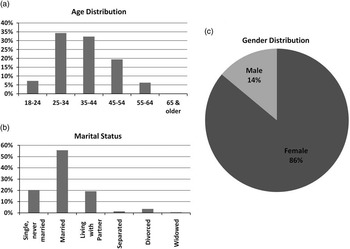
A total of 477 survey responses were received representing a 36% response rate given the known number of RTTs (n = 1,343) who had membership in the Canadian Association of Medical Radiation Technologists in 2012. 25 Eighty-six per cent of respondents (n = 407) were women. The gender distribution of respondents in this study is representative of the national population of RTTs. The Canadian RTT workforce is typically between the ages of 18 years to 65 years old. Approximately 67% of respondents were between 25 and 44 years of age, with 75% of respondents being married or equivalent (Figure 1).
Socio-demographic cross section of respondents. (a) Age distribution. (b) Marital Status and (c) Gender Distribution of respondents (n = 477).

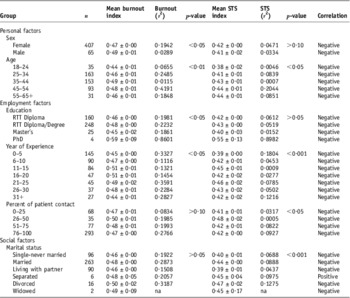
Results of the linear regression analyses indicated that there were negative correlations between the ProQOL-V subscales (STS and burnout) and the independent study variables associated with personal, work and social categories (Table 1). There were variances in the coefficient of determination (r 2) between these categorical groups (described below).
Burnout and STS index according to personal factors, employment factors and social factors

Note: For mean burnout and STS values, index range: [0 (low)–1 (high)].
Abbreviations: STS, secondary traumatic stress; RTT, radiation therapist.
Personal factors
Personal factors examined gender and age as independent variables. Both men and women showed a negative correlation to burnout and STS (i.e., both categories did not demonstrate burnout and STS). Comparisons between genders showed differences in correlations to burnout (females r 2 = 0·194, males r 2 = 0·028, p < 0·05). Correlations between gender and STS were insignificant (p > 0·10). Age was categorically classified according to questionnaire groupings. RTTs of all age groups did not demonstrate signs of STS. Only RTTs between the ages of 45 and 54 demonstrated a stronger inverse relationship to burnout (r 2 = 0·419, p < 0·01) and STS (r 2 = 0·204, p < 0·05).
Employment factors
Employment factors were divided into education, years of experience and percentage of patient contact. All categories demonstrated an inverse correlation to burnout (p < 0·05) and STS (p > 0·05, insignificant). In general, education levels did not greatly affect the correlation coefficients of determination for burnout. The greatest negative correlation was found in doctoral level RTTs (burnout r 2 = 0·860, p < 0·05, STS r 2 = 0·898, p > 0·05), although it is important to note that this group only had a sample size of four respondents. Negative correlations relating years of experience and burnout and STS were weak (burnout r 2 range: 0·111–0·359, STS r 2 range: 0·045–0·180). Likewise, the amount of patient contact did not show a strong correlative effect to burnout and STS (Table 1).
Support networks and social factors
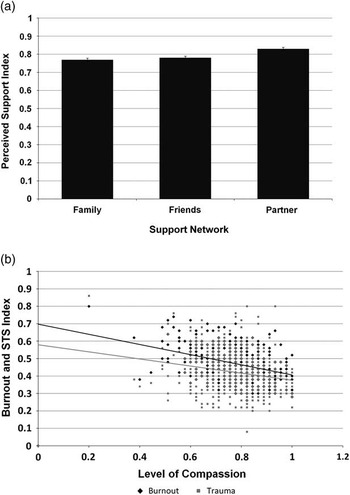
The use of the MSPSS for assessing perceived social support demonstrated that there were substantial social support networks and compassion satisfaction levels in RTTs (Figure 2a). Family perceived support index was found to be 0·769 [standard error (SEM) = 0·009]; Friends perceived support index was 0·781 (SEM = 0·008), and significant others perceived support index was 0·829 (SEM = 0·009). Marital status did not have a significant impact on burnout (p > 0·05), but did show a weak negative correlation to STS (r 2 range = 0·068–0·127) (Table 1).
(a, b) Perceived level of support, compassion satisfaction, burnout and trauma. (a) Perceived level of support shows a high index, demonstrating that participants felt well supported within their social network (bars = standard errors). (b). There was a weak negative correlation between the level of compassion satisfaction and burnout and STS (r 2 = 0·143 burnout, r 2 = 0·042 trauma) n = 477, index range: [0 (low)–1 (high)].

Levels of compassion satisfaction, burnout and STS
Relationships between compassion satisfaction (i.e., level of compassion) to burnout and STS were examined. Linear regression analysis for all respondents (n = 477) demonstrated a negative correlation between compassion satisfaction and burnout (r 2 = 0·143, p < 0·05) and STS (r 2 = 0·042, p < 0·05). The results of the study indicate that Canadian RTTs demonstrate no significant correlations to burnout and STS (Figure 2).
Discussion
Many variables are shown to influence the level of compassion fatigue in research studies. Female caregivers have been correlated with increased stress response symptomology in several studies.Reference Covinsky, Newcomer and Fox 26 , Reference Haley, LaMonde, Han, Burton and Schonwetter 27 Ramirez et al.,Reference Emanuel, Ferris, von Gunten and Von Roenn 28 found that for oncologists of either sex, being unmarried was an independent risk factor for burnout. Several studies assert that caregivers of a younger age correlate with more depression symptoms.Reference Given, Wyatt and Given 29 – Reference Rivera 32 Emanuel et al.Reference Emanuel, Ferris, von Gunten and Von Roenn 28 suggest that age is confounded with work experience, so burnout may be a greater risk earlier in one's career. Similarly, Isikhan et al.Reference Isikhan, Comez and Daniz 20 found that younger healthcare professionals have greater difficulty in dealing with patients, experienced more workday stress, and criticised their jobs more intensively. Abendroth and FlanneryReference Abendroth and Flannery 3 found that care providers with higher levels of education to be more vulnerable to the risk of developing compassion fatigue.
Our study found no causal relationships between age ranges, gender, marital status, or years of employment with an increased risk of compassion fatigue, burnout or STS. Negative correlations were found between the study variables and the ProQOL-V subscales, with one exception. A positive correlation was found for those respondents who identified their marital status as ‘separated’. However, due to the low number of respondents, this may contribute to an insignificant correlation value. Similarly, ‘widowed’ responses were not applicable as there were too few values for analysis. The correlation between compassion satisfaction, burnout and STS was found to be less prominent in females than in male respondents. The 25–34 and 45–54 age groups coped best regarding risk of burnout (r 2 = 0·249 and 0·419 respectively); the 45–54 age group coped best regarding risk of STS (r 2 = 0·204).
When subjected to persistent stressors, there is an adaptation response which refers to the negative impact on the body and mind as a result from either too much stress or inefficient management of stress.Reference Akroyd, Caison and Adams 33 Each individual will have unique warning signs as indicators of early onset of compassion fatigue and burnout. Prodromal signs and symptoms leading to these psychological syndromes include: exhaustion, anger and irritability, increased use of alcohol and drugs, heightened anxiety or irrational fears, hypersensitivity or insensitivity to emotional material, absenteeism, and impaired ability to make decisions and care for patients. Furthermore, the ability to adjust to repeated stress is also determined by the way one perceives a situation, for example cardiovascular stress response, and elevated blood pressure responses during periods of perceived stress.
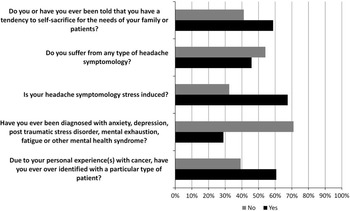
Interestingly, study participants did identify some health-related variables that measure physiologic responses to stress: 46% of respondents indicated that they suffered from headache symptomology; of those, 67·5% stated that their headaches were stress induced; 29% of respondents reported that they have been diagnosed with anxiety, depression, post-traumatic stress disorder, mental exhaustion, fatigue or other mental health disorders (Figure 3).
Respondent experiences with stress, anxiety and symptomologies related to compassion fatigue.

Maslach (1982)Reference Maslach 34 in SaboReference Sabo 35 states that ‘helping relationships by their very nature are emotionally charged and can carry a heavy psychological burden’. Our study explored whether the length of engagement of RTTs’ therapeutic relationship with cancer patients directly affects their ability to cope with psychological burdens as caregiver burden has been directly correlated with depression.Reference Bedard, Molloy, Squire, Dubois, Lever and O'Donnell 36 , Reference Butler and Chapman 37 A review of the literature on the health of nurses found that working in specialty practice areas such as oncology were particularly vulnerable to work-related stress.Reference Sabo 35 In our study, 62% of respondents spend 75–100% of their time in direct patient contact with cancer patients, followed by 16% who spend 50–75% of their work time in direct patient contact. No significant relationships were found associated with the ProQOL-V subscales compared with the employment variables for level of education, years of clinical experience and per cent of patient contact. Due to personal experiences with cancer, 61% of respondents stated that they have over identified with a particular type of patient, and 59% have been told that they have a tendency to self-sacrifice for the needs of patients and family. PhD responses were not applicable as there were too few values for analysis.
For individual response statement scores that assessed potential risk catalysts for STS, 74% of respondents indicated they are ‘preoccupied with more than one person they help’ [ratings 3 (somewhat often)–5 (very often)]; 55% ‘jump or are startled by unexpected sounds’; 43% find it ‘difficult to separate their personal life from their life as a RTT’; 39% have ‘felt “on edge” about various things’; and 28% felt ‘depressed because of being witness to the traumatic experiences of their patients’.
For individual response statement scores that assessed the potential risk catalysts for burnout, almost 95% of respondents felt they were ‘preoccupied with more than one person they help’ [ratings 2 (a few times)–5 (very often)]; 89% indicated they were ‘worn-out because of their work as an RTT [ratings 2 (a few times)–5 (very often)]; 85% felt ‘overwhelmed because of their case (work) load seeming endless [ratings 2 (a few times)–5 (very often)]; and almost 83% indicated ‘they felt “bogged down” by the system’ [ratings 2 (a few times)–5 (very often)].
Isikhan et al.Reference Isikhan, Comez and Daniz 20 found that ineffectual managerial support and job demands caused a statistically significant increase in the job stress scores of health care professionals. When study participants were asked whether ‘My work organization helps RTTs cope with stressful events associated with their work’, 58% of respondents disagreed with this statement.
Anecdotal reports from some RTTs indicate that they pay an emotional price for demonstrating empathy towards their patients and that sometimes they have difficulty coping with these emotions. As one respondent stated, ‘I feel that the system prevents me from doing more to help and thus I am frustrated and exhausted. The system does not make it easy to help others the way I want to. Too many constraints, not enough time, equipment, supplies etc. are lacking. At the end of the day I feel good about what I have been able to do and what I do, but at a price. My social life and after work events suffer because I don't have any more energy or caring available. Hence other stresses of life are now beginning to be overwhelming’.
Study limitations
There are several limitations in our study that make the results provisional. The survey completion rate was below 50% which might introduce a potential bias response. Second, completion of the ProQOL-V instrument does not encompass the continuum of persistent responses to accurately gauge long-term prevalence and potential for developing compassion fatigue and burnout in Canadian RTTs as the responses received reflected the frequency of current work experiences the RTT came into contact with over a course of 30 days when completing the questionnaire. Third, there was missing data from respondents. The calculations were adjusted to reflect the number of responses received.
Conclusion
The ProQOL-V Self-Test is considered one of the most effective validated tools to date that assess the participants’ potential for compassion satisfaction and vulnerability for CFS and burnout. While our study did not find any occurrences of RTTs overtly displaying compassion fatigue, STS or burnout, we did find potential risk catalysts that suggest some individuals may be at risk of developing compassion fatigue, STS or burnout.
There is more need for organised support to the concepts of compassion fatigue, burnout and STS starting with undergraduate education, employee orientation and continuing education on awareness and coping skills, and the availability of confidential, employee assisted programmes and resources available by specialised individuals to deal with ‘like’ professions. RTTs who perceive themselves as vulnerable should not be made to feel that there is a stigma attached to such an acknowledgement.
Despite many psychological stressors, Canadian RTTs display amazing resiliency. They have a very positive and substantial social support network that allows them to demonstrate high levels of compassion satisfaction in their daily practice.
Acknowledgement
C.G. wrote and revised the paper. C.G., W.T.T., F.G., B.B., I.M., K.O. collected data and carried out data analysis. W.T.T. supervised research. The authors thank Ms Sheila Robson and Dr Gregory J. Czarnota for unprecedented support.